

S03 E05
Preventing DEI Missteps and Building Belonging
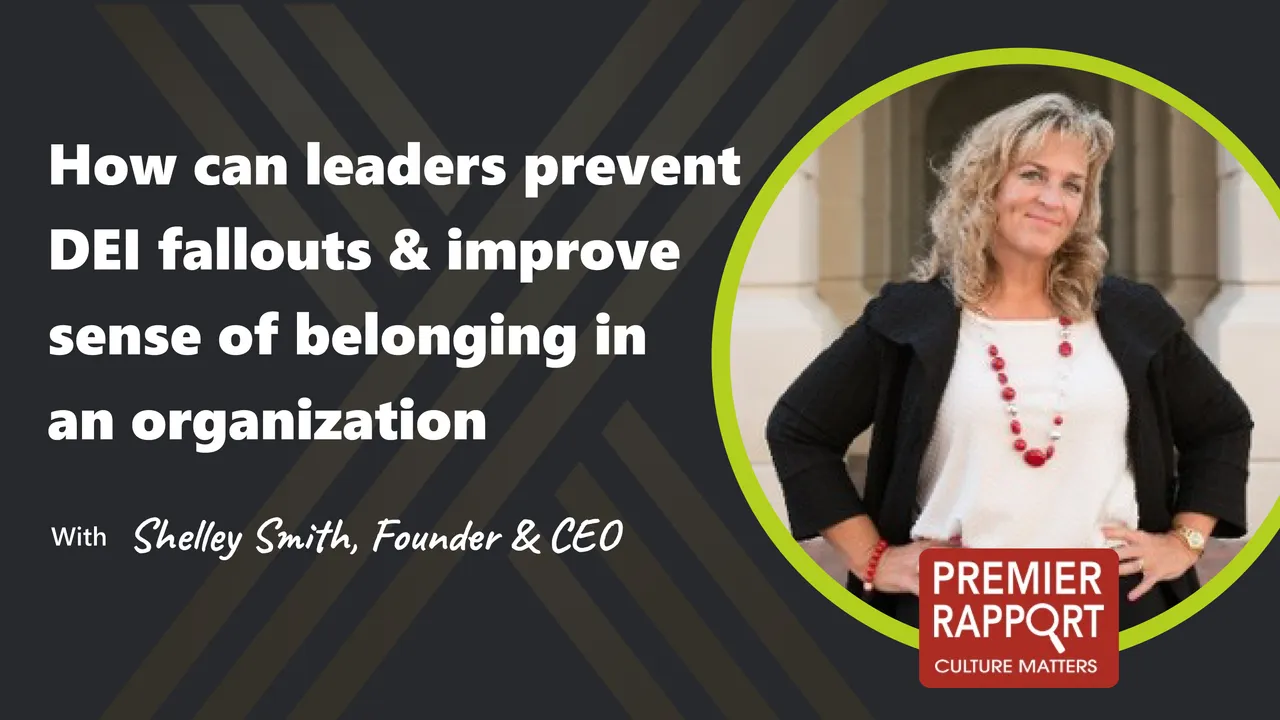
Shelley Smith explores how leaders can avoid DEI missteps by building unique cultures, empowering all managers as custodians of engagement, and ensuring employee feedback drives consistent, visible change.
TL;DR
What you need to know from this episode
- Alignment comes before any DEI program. Before adding initiatives, leaders need shared mission, vision, values, and even a culture statement. Without that unity, boards and employees cannot agree on what the culture even is.
- Culture is built every day, not in a day. Diversity, equity, and inclusion cannot be switched on overnight. They show up in daily choices and only stick when leaders work them intentionally rather than by accident.
- Copying another brand's playbook backfires. Duplicating what an admired company does rarely works. Organizations have to understand who they are and build a culture that is unique to them.
- Every people manager is a custodian, not just HR. HR carries the institutional knowledge, but ownership of engagement and DEI belongs at all levels. When everyone owns it, holding each other accountable becomes the norm.
- Listening only counts when you act on it. Surveys, one-on-ones, stay interviews, and daily rapport keep a real pulse, but the data has to drive visible conversations and recognition to matter.
Shelley Smith has spent more than thirty five years arguing that culture was never about the building, it was always about the people. As the Founder and CEO of Premier Rapport, a consulting firm she has run for just over 13 years, she has helped mid-size businesses, enterprises, and multinational corporations build workplace cultures that stay healthy and still protect the bottom line.
In this episode of CultureClub X, host Nicole Patrick sits down with her to unpack diversity, equity, inclusion, and belonging, from policy framing all the way to daily implementation. Smith came to this work from the hotel industry, where she realized the brick and the mortar mattered far less than the human beings inside it. That lens shapes every answer she gives. DEI cannot be bolted on, copying another brand's playbook almost always fails, and a culture is only ever as strong as the alignment sitting underneath it.
The core question of the conversation is a practical one. How do leaders keep DEI from becoming an empty stamp, and how do they build a genuine sense of belonging that everyone in the organization actually owns? Smith's answer begins long before any initiative launches, with the plain words a company uses to describe itself.
Why alignment has to come before any DEI initiative
Smith's first move is to slow leaders down. Too many, she says, reach for the stamp: Disney does this, so let us do that. The real work is less glamorous and starts with clarifying the company's purpose, its mission and vision, and the values that assimilate with them. Without unity there, boards cannot even quote their own value statement, and their employees have no idea what the culture is.
Her diagnostic is simple. Hand everyone in the room an index card and ask them to write three to five values that describe the workplace culture. The descriptions almost never match. When she then asks someone to read the culture statement, the room often admits there is none at all.
That gap between people's answers is exactly where DEI efforts quietly come apart. Alignment between mission, vision, values, and a genuine culture statement is the word Smith keeps returning to, because without it every downstream initiative rests on sand.
Culture is not built in a day, it is built every day
Belonging, in Smith's framing, is not something a company can wake up and declare. You cannot announce a diversified, equitable, and inclusive workforce and expect it to be true overnight. Those are three separate pieces of work, and they have to be pulled into the culture effectively and daily.
Workplace culture is not built in a day, it's built every day.
The point is intention over accident. Much of what shows up in a culture, she notes, happens by accident: it was designed one way, but the design does not match the lived reality. It never will unless leaders do it on purpose. Closing that gap means treating culture as a daily measure rather than an annual campaign, because it shows up every day just like the people do.
Why copying another company's playbook backfires
Leaders love a shortcut, and admired brands make tempting templates. Smith is blunt that duplicating what you saw somewhere else simply does not work. An organization has to understand who it is first, then make its values roll trippingly off everyone's tongue.
Plugging DEI in somewhere because everyone is talking about it produces the opposite of belonging. The honest starting point is to back up, work out who you actually are, and decide how your values circle around DEI if that is genuinely where you intend to focus. There is no framework that copies and pastes cleanly from one company to the next.
How a deliberate change process keeps DEI on track
When the conversation turns to scaling good practice, Smith reaches for change management. She favors Prosci and the ADKAR model, paired with her own ACC system: analyze where you are, curate the path, then move into creation. Skip that structure and leaders end up tugging at whatever idea crossed their desk that morning.
The discipline is knowing where you are now, where you want to go, and the incremental stops in between. Without a plan, she says, everyone climbs into the car and drives in separate directions, insisting they will get there eventually. A deliberate process also builds in how teammates get rewarded and recognized for doing the work the right way, so leaders can report back on real progress rather than guesswork.
Why focusing on one thing makes culture stick
To prevent DEI fallout, Smith tells leaders to own where they are and resist taking on too much. Culture becomes sticky when an organization frames one priority, keeps everyone focused on it, and rewards progress around it consistently. That is when a value turns into a pillar that cannot be moved.
Her metaphor is the new car. Buy one and suddenly you see that model everywhere, because you are focused on it. Point a whole team at a single diversity goal over the next 30, 45, 60, or 90 days and the same focus makes it part of how things are done, and how they are not.
Newcomers quickly learn the guard rails from teammates who tell them plainly that is not how we do things here. That shared accountability is where psychological safety grows, because people feel able to speak up when something does not look right instead of assuming they are the only one who notices.
Who actually owns employee engagement and DEI
Smith knows her next answer will please some listeners and disappoint others. She does not believe HR should be the sole custodian of engagement and culture. HR brings institutional knowledge, expertise, and the data to bubble issues up, but it should not be the only owner, and neither should the CEO.
So I prefer to say that all people managers need to be the custodians of this versus not one or the other.
When ownership sits with every people manager, accountability becomes shared. People stop saying that is just an HR thing and start holding each other to what right looks like. That is the kind of managerial effectiveness that keeps a change effort from springing what Smith calls leaks, especially when a whole organization is trying to shift its DEI perspective at once.
How continuous listening keeps a finger on the pulse
Asked how busy leaders keep listening, Smith refuses to name a single tool. She describes a three-legged stool of trust: managers trusting employees, employees trusting managers, and employees trusting each other. On top of that sit the right surveys, one-on-ones, stay interviews, and recognition for aligned behavior.
Having the right assessment that gives you the total perspective and not only satisfaction, but total engagement through those different lenses, I think is key.
A survey run twice a year is a pulse check, but the between-moments matter just as much: the Zoom call where you check in on people first, or noticing something is off and following up in person. Those layers are where a two-way employee feedback loop forms.
Smith is emphatic that leaders must then act on what they hear. A system provides incredible information, but the value only lands when someone leaves their office and turns that data into real conversations. Doing that hand in hand with the human check-ins is what keeps a culture, and its commitment to belonging, honest as the organization grows.

About the guest
Shelley Smith
Founder & CEO, Premier Rapport
Shelley Smith is a best-selling author, consultant, and Founder & CEO of Premier Rapport consulting firm. Her experience over the past 35+ years has earned her a reputation as the Creator of the Culture Inquiry in businesses globally. Shelley has worked with mid-size businesses, enterprises, and national and multinational corporations that seek to create an intentional workplace culture that creates a healthy work environment and yields savings to the bottom line.
Her clientele includes well recognised organizations like, Marriott international, Ferguson, Mitsubishi chemical, Virginia premier, PB Mares to name a few. She is also a notable alumni of Cornell university.
Full episode transcript
Season 03, Episode 05 · Shelley Smith with Nicole Patrick · 24 min
Hello everyone and welcome to the latest episode of CultureClub X powered by CultureMonkey. I'm your host, Nicole Patrick. CultureMonkey is a complete employee engagement platform that helps you as a leader to measure and improve your workplace culture, thereby enabling you to listen to your employees better.
In this episode of this season of CultureClub X, we have with us Shelley Smith, Founder and CEO of Premier Rapport consulting firm. Shelley Smith is a bestselling author and consultant. Her experience over the past 35 years has earned her a reputation as the Creator of the Culture Inquiry in businesses globally. Shelley has worked with mid-sized businesses, enterprises, and national and multinational corporations that seek to create an intentional workplace culture that creates a healthy work environment and yields savings to the bottom line. Her clientele include recognized organizations like Marriott International, Ferguson, Mitsubishi Chemical, Virginia Premier, and PB Mares, to name a few. She is also a notable alumna of Cornell University.
Shelley, welcome again to CultureClub X's videocast on diversity, equity, inclusion, and belonging in the workplace, from policy framing to effective implementation. Before we begin, please tell us a little bit more about yourself and your organization.
I'm very happy to be here today. I appreciate being one of your many guests that are on. So thank you so much. Gosh, I don't know what else to add to that.
Let's see, Premier Rapport, I've been in business for just over 13 years. I came from the hotel industry and morphed and realized it was not about the brick and the mortar, but it was always about the people. And so being able to every day get to work with different environments and different sizes, just to help companies, individuals, and leaders to level up that workplace culture, is a good thing. It's a good thing.
Great, well, very nice to have you. Let's get into it.
Board members often overlook what's essential while formulating policies around culture. It could be because of hurdles or because this is just low on their list of priorities. What, according to you, are the key focus areas for senior leadership to build a better culture for their organization? And how can they ensure that this is embedded in their company culture in a meaningful way?
Well, unfortunately, people look for the stamp. The easy way is like, oh, Disney's doing this, let's do that. And it's not that easy, although we do over-complicate it. The core is, and the secret is, clarifying what the company's purpose is. What is their drive? What is that mission and vision? And then the values that assimilate with that. If we don't have unity around that, then often the board and the leaders get confused and they can't even quote something like a mission and a vision and a value statement in order to even figure out what it is that they do and to attract the right people, and then their employees have no idea what it is.
One of the simple ways that you can find out if you're aligned or not is ask everybody in the room, I do this quite often, to write down on an index card three to five values or value statements that really describe what the workplace culture is. And what I find is, unfortunately, there's not alignment. The descriptions are different. And then I say, okay, somebody read the vision statement. Okay, somebody read the mission statement. Okay, somebody read the culture statement. We don't have a culture statement. Okay, somebody tell me what the values are and how are they made actionable. And then we have all these varying degrees of what right looks like.
And so the easy answer is don't try to duplicate something that you've seen elsewhere, because that just doesn't work. You've got to understand who you are and then to be able to have that trippingly roll off of everybody's tongue. So I know that was broad, but essential is alignment, is the key word I'm looking at. We have to have alignment between the mission, the vision, the values, and yes, we need to have a culture statement too.
That makes complete sense to me. I've spoken to a lot of people about the same, you know, DEIB, and it's interesting to see the alignment side of it, and that really you do want to have one thing flow to the next and trickle to the other. So it's an interesting take on it that makes complete sense.
Absolutely, and you can't just be a company that, oh, everybody's talking about DEI, let's plug that in someplace. Yeah, no, it doesn't work that way. You have to live it, breathe it, understand that those are three separate pieces and how are you going to pull that into your culture effectively and daily. Workplace culture is not built in a day, it's built every day. We cannot automatically wake up and say we have a diversified workforce and that we provide equity and we absolutely provide inclusion. It's just not that simple in order to do that. So we have to start with backing up, finding out who are we, and if we intentionally are going to be focused on DEI, then how and what are our values circled around that.
With that being said, there is no company culture framework that can be replicated as a copy paste mechanism. Once formulated, how can people leaders ensure organizational wide scalability and permeability of good culture practices? What role can managers play in the process of change management?
Well, first of all, is to understand what change management process you're going to utilize. And you've got to lean into that. One of my favorites is actually Prosci, the ADKAR model, which allows you to stop process deliberately, the accountability piece, the communication piece. So if your focus is on diversity, equity, and inclusion, what elements, where are you now? The first thing you have to do from a framework is understand where you are now, to understand what benchmark are you going to go to. I call it the ACC system. So analyze it, then you're able to curate it and get into the final creation mode. And if not, then you're lost along the way and you literally are pulling and tugging on thoughts of the moment.
Something that you read in the process of the day, maybe around DEI, it's like, oh, we can go do that. Or, oh yes, we do that. Or, okay, let's ask that during the interview process. Or it's like, no, stop, pause, where are we? Where do we want to go ideally? How do we get there? And what are the incremental stops along the way? And what do we have to change? So to your question, that change management process needs to be deliberate. And then that gets at how do we reward and recognize our teammates for doing it the right way. So again, I know that's a bit of a broad perspective, but we've got to be able to report back properly only if we understand where we're at and where we're going. If not, we're just all getting in the car and driving our own separate directions and saying, oh, we're going to get there eventually. So we don't have a plan. And we don't know if we're there yet for the goal.
It's just like setting up a business. You wouldn't just blindly say, oh, well, I know I want to do this, but I have no plan. You have a business plan that you follow, that every single day you take little steps to get where you want to be in a year or two. And so it seems like it's no different with that than with this, that every day you do a little bit, you follow that road to get to where you want for your whole company and culture to be.
Exactly, intentionally, not accidentally. But much of what happens around whether we think that we are where we want to be from a DEI standpoint or not, and the overall workplace culture, is it's happening by accident. It was a design, but the design doesn't match the living. And it never will if we don't do it intentionally. So to your point, it has to be a daily measure, which is why I say it's built every day. Workplace culture shows up every day, just like we do. What are we doing about it? And what role are we playing?
Yep, exactly.
Recently, many big companies known to have a good company culture have reported a lack of proper DEI initiatives. How do you think that leaders can prevent such fallout and draft framework to convey the right message of DEI being an essential component of company culture?
First of all, we have to own where we are. So again, going back, I hate to be repetitive, but if we don't know where we're beginning, and why do we want to make a change? If we don't believe that there is a gain, I mean, we're in business, but we don't think that there's any value in focusing in on any of the elements of DEI, we don't think there's any value in having conversations, deliberate conversations around culture, the reality is it doesn't matter what you put around it, it's not going to happen. So we've got to be able to benchmark and have an understanding of where, again, where we're trying to go. So step one is as an owner, as a board member, as a leader, own where we are. What are we doing right around the different elements of DEI and our overall culture piece? And where do we want to do better? And again, why?
It's going to benefit our team if we focused here, and if we gain this, when we do what? This is going to provide the branding that we're looking for internally, externally. This is going to give the services that we're providing in a better way when we do XYZ around DEI. If not, again, it doesn't become sticky when we try to take on too many things and we can't put a frame around too many things. We need to focus on one thing, a step at a time, have everyone in the organization focused in on that and rewarding them around that. That's when it truly does come to life and it becomes a pillar that cannot be moved when we do that consistently.
You know, I use an example of, if we're going to do something specifically around diversity and everybody's going to focus on that one thing over the next 30, 45, 60, 90 days, the reason why it works if it's one thing and it's focused for a long haul, it's just like when you buy a new car, all of a sudden you see that car everywhere in the same color that you just bought. Why? Because you're focused in on it. So imagine the power if you have everybody on your team focused in on that one thing, that's how it becomes sticky and just comes a part of the day-to-day. This is how we do things and this is how we don't do things. Again, anything that is related to the culture piece, the value piece, and certainly diversity, equity, and inclusion.
That makes total sense. And I'm sure, like you just said, with how you don't do things, things that aren't working will start to stick out like a sore thumb and you'll really be able to find yourself your own culture of what's meant to be.
And the accountability that the rest of the team members have, they become a part of it. Anytime anybody is new, it's brought into the team. They're going to very quickly go, oh yeah, no, no, no, no, no, we don't do that. This is how we do it. So it's the guard rails that we put up of what's right and what right does not look like as well, which is equally as important because that's where all the gray happens, is when people don't speak up at that point.
And I'm sure they're more comfortable then to speak up because everyone is in the same boat and everyone's really trying to focus on it at the same time, instead of one person feeling a little off and not wanting to bring it up because no one else is. In their mind, no one else feels this way, and it's only then when, in reality, most people probably are feeling the same way if it's not working, but they're just too afraid to speak up about it.
Exactly, because they think that that wrong way is just natural. Oh, I've heard so many times, and I'm sure you have too, that's just how we do it around here. That's just how it is around here. Oh, it's always been that way around here. So instead of saying the opposite of, yeah, no, we used to do it that way but we do it this way now, or wow, that's never been my experience. I've noticed that when I do say something, XYZ is heard, or it is changed. So yes, it takes the brave souls in order to stand up and to say something. But it's easier when everybody is focused on the masses at the same time.
Do you agree that HR are the custodians of employee engagement and the subsequent culture practices, not just the owners? If so, what are your thoughts on this?
I might make a few people happy and a few people sad. I do not believe that HR should be the custodians. I know that the reality is that is where it typically starts and lands, and that's where the ownership is. They are certainly a piece of the pie, but the effective, the highly functioning team, the custodianship is at all levels. Everybody needs to own that practice. Now that doesn't mean that they can't bring the institutional knowledge and they can't bring that expertise to it, and it doesn't mean that they can't be the ones to bubble it up and to show the value and to be the voice of reasoning, especially when it comes with the DEI and the statistics that we're looking at.
But they should not be the sole proprietor owner, and nor should it just be the owner. Again, it needs to be the multitude of lenses. Anyone who is a people manager needs to be all on the same page and needs to feel like they have that ownership of all of those elements, because if we don't, that becomes a weak link and it's easy for the inconsistencies around what right looks like. I call them leaks, begin to happen when we don't have this. So we say that that's just you or that's just me. So I prefer to say that all people managers need to be the custodians of this versus not one or the other. And again, it's easier to do things by the masses, especially when you talk about change management, when everybody is flowing from different angles, all going into unison as well.
I've asked variations of that question to a few people and it always comes down to that you have to empower more than just one group. If you just empower the HR heads to be in charge of all of this, it's not really going to work the same as if you empower all the different managers, and that they can manage their employees and their team to all feel responsible. And that's how everyone then feels responsible and works toward the common goal. So I think your answer was.
Well, and this is how we create the almighty grail of inclusion. If we feel like we're all a part of that thing, that process, that focus, that purpose, then we're all holding each other accountable again. And when something all of a sudden doesn't look right, everybody is speaking up because they cannot not speak up. They feel compelled in order to do so because they have that accountability ownership on them versus, oh, that's just an HR thing. That's just sales. Oh no, that's just us that does that. So the more we can move away from that and have more of an agile mindset, the more likelihood the success ratio is, especially if you're in a change management process where you're really trying to shift the DEI perspective inside of the workplace culture. So food for thought, food for thought.
How can people leaders pay attention to their organization's pulse and constantly listen to their employees' feedback despite their workloads? What methods can they use to empower managers to use the right tech to gain actionable insights?
I don't think it's one thing. I think it's a multitude of things. Absolutely using the right assessment, using the right survey piece in order to understand the team dynamic, the culture dynamic, the company dynamic, the management dynamic. All of that is predicated on the trust perspective, and it's a three-legged stool. So the manager has to trust their employees. The employees have to trust the manager, but the employees have to trust each other as well. So having the right assessment that gives you the total perspective and not only satisfaction, but total engagement through those different lenses, I think is key. One-on-one conversations with your employees is also a huge part of that. Dedicated check-in time, stay interviews, and properly rewarding and recognizing for aligned behaviors. All of those elements are a must.
Will one thing help you? Sure, one thing can kind of help you and guide you, but it may not give you all of the information that you need. So if you do a survey a couple of times a year, you're doing that to pulse check. All the things that you get in the in-between is what's working and you're able to pull in and to reinforce. Having the one-on-one conversations and the check-ins and the stay interviews allow you to create a two-way conversation, and then rewarding those right behaviors. So I think it's all of those layers of the elements. So then you're not just having a cake, you're having a multiple layer cake with multiple icing that everybody loves and sprinkles and ice cream on top. That's what gets the final culmination of really understanding if your methods are right through those different pulse checks.
So I think the key word that you said is keeping that pulse on it. We cannot just check in once a year or once every five years, or all of a sudden because you're trying to be rated as the top workplace and so now we're going to do that survey. No, you need to do it constantly as a check-in. It's how you get on a Zoom call in the morning with your team and you check in on them first. It's how you notice that there's something off with a team member and you call them afterwards, or you stop into the office, or maybe you're a factory and you go out on the floor. It's those moments building rapport daily that truly keep the pulse of what's happening. And again, cannot stress enough rewarding and recognizing when things are done right publicly with a team member. So then again, it's easy for me as a new team member to go, oh, this is how we do things around here.
Exactly, and I think that it really is so important to constantly be checking in, especially as organizations are trying to scale or pivot and making sure that what was working for an employee when they first came on is still working for them five years later or two years down the line as they're growing with the business that's also growing. And that is where tech solutions like CultureMonkey really do come in, where you can constantly check in with them, constantly see how things are going, and do that hand-in-hand with face-to-face meets or Zoom meets and make sure that you really are able, even when you have a large workload, to keep that constant pulse check. I totally agree with everything you're saying.
Absolutely, and using that information. Your system provides incredible information. So when you have that information, do something with it. Leaders that have multiple layers, you've got to get out of your office and get out of your space to go have real conversations with the data that you've inquired. And you'd say, hey, I saw this recently on one of our check-ins. Hey, I saw that there was a response. Because some of the information is specific. You know exactly who said it. And then some of it is generic. So use that language, so they must go hand-in-hand. Absolutely.
Exactly. That is such a beautiful take on a topic that is being talked upon by many organizations today, Shelley. I was going through one of your recent blogs in the Virginian-Pilot where you had said the importance of keeping your ear to the ground and being a leader who has true insight on what's happening with their team on the ground on a frequent basis. It was very interesting and relatable to what we at CultureMonkey are solving for people leaders around the world. Thank you so much for your time, Shelley. This has been such an enriching experience for all of us. I'm sure our viewers will gain insight immensely from your thoughts. And won't you please let our viewers know how they can connect with you if they want to have a quick chat or give you some comments.
Great. Thank you so much again for having me on today. It's definitely a valuable topic that everybody is talking about and absolutely should be talking about, and taking pause to say, hmm, how are we? How are we showing up? So if you've got more questions for me directly, you can go on, I'm on every social media platform. It's just at Premier Rapport. You can also email me at Shelley at PremierRapport.com. And I'll be more than happy to give you some additional resources or to answer any questions. So thank you so much for having me on today.
Yeah, thank you, Shelley, for helping us understand the needs of a dynamically changing topic. I also think it's important for people leaders to constantly listen to their people and cater to their DEI and B needs as well. And honestly, that's where an employee management platform like CultureMonkey can save the day for our leaders. If you are a people leader who wants to listen to your employees better using the super swift tool and improve your company culture, log into www.CultureMonkey.io today. With that being said, it was an absolute pleasure to have spoken with you and get to know you better. That's all we have in this week's episode of CultureClub X powered by CultureMonkey. Until next time, this is your host, Nicole, signing off.
Frequently asked questions
How can leaders prevent a DEI initiative from failing?
Shelley Smith advises leaders to own where they are today, understand why a change is worth making, and then benchmark against where they want to go. Rather than taking on too many things at once, she recommends framing one priority, getting the whole organization focused on it, and rewarding progress consistently.
Done that way, a value becomes a pillar that cannot easily be moved. Trying to bolt DEI on because everyone else is talking about it, she warns, produces the opposite of belonging.
Should HR own employee engagement and company culture?
Smith does not believe HR should be the sole custodian. HR brings institutional knowledge, expertise, and the data to raise issues, but it should not be the only owner, and neither should the CEO.
Instead, she argues that every people manager needs to be a custodian, so accountability is shared across all levels and no one can dismiss culture as just an HR thing.
What change management model does Shelley Smith recommend?
One of her favorites is Prosci and the ADKAR model, which forces deliberate attention to accountability and communication. She pairs it with her own ACC system: analyze where you are, curate the path forward, then move into the creation stage.
The common thread is knowing your current benchmark, your destination, and the incremental stops in between, so a team is not just driving in separate directions hoping to arrive.
How often should companies survey and listen to employees?
Smith says a survey run a couple of times a year is a genuine pulse check, but it is not enough on its own. The moments in between matter just as much, including one-on-ones, stay interviews, dedicated check-in time, and simply noticing when a team member seems off.
She frames listening as building rapport daily rather than checking in once a year to chase a top-workplace rating.
Why does copying another company's culture not work?
According to Smith, there is no culture framework that can be replicated as a copy paste mechanism. Duplicating what a larger brand does ignores the fact that every organization is different, and it usually fails.
Her alternative is to understand who you are first, align mission, vision, and values around that identity, and only then decide how DEI fits your specific culture.
Read the cross-episode roundups
More from CultureClub X
 S06 E19change leadershipFrom Cost Center to Catalyst: How CPOs Turn People Strategy Into Business Advantage, with L. David Kingsley
 L. David Kingsley
 S06 E17ai in hrBuilding Trust and Belonging in the Age of AI, with Jessica Smith
 Jessica Smith
 S06 E14manager effectivenessTurning Engagement Data Into Culture Change
 Dr. Adam Hickman
Never miss an episode
Every new episode, plus the takeaways that matter, posted on the CultureMonkey LinkedIn page as soon as they drop.
Free on LinkedIn. Unfollow anytime.