

S03 E06
Flexibility, Autonomy, and the Fight Against Attrition
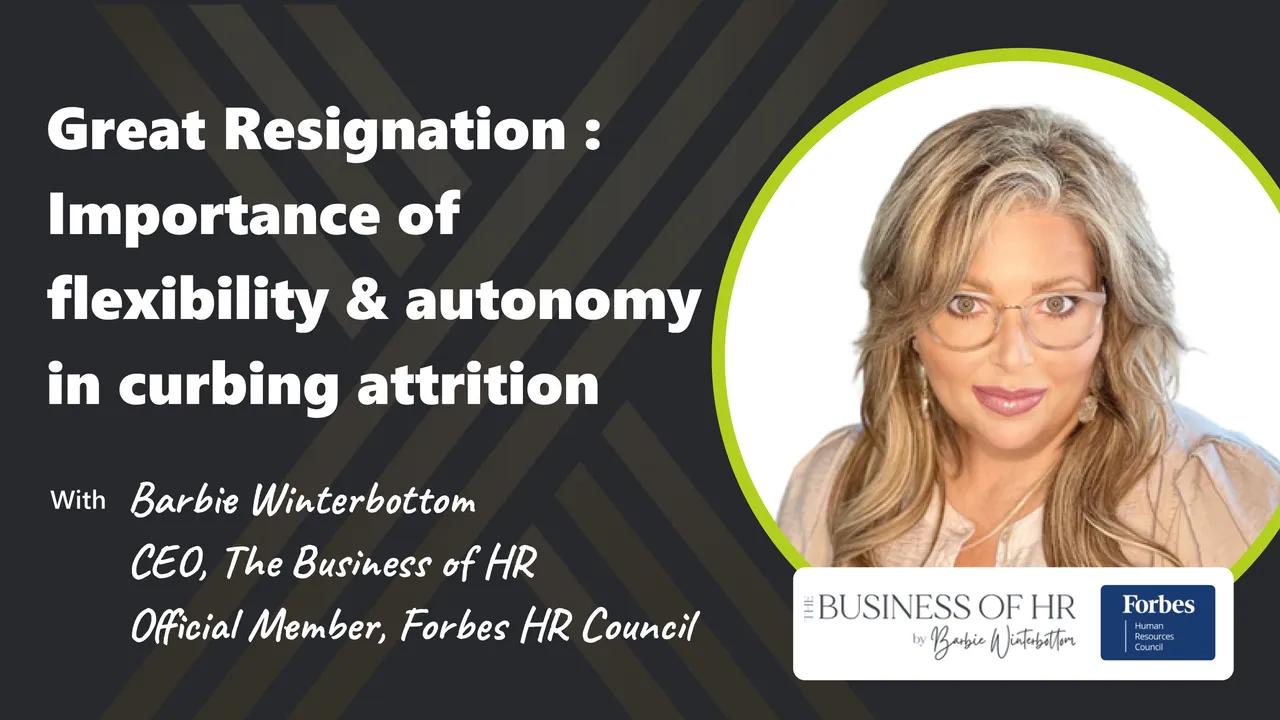
In this episode, Barbie Winterbottom shares how leaders can combat attrition by building safe feedback spaces, valuing transparency, and empowering managers, showing why flexibility and autonomy matter more than rigid policies.
TL;DR
What you need to know from this episode
- The great resignation exposed employers who were not paying attention. Barbie Winterbottom argues the signs of shifting expectations were visible well before the pandemic, and companies that assumed laid off workers would come begging to return misjudged the moment badly.
- Stop infantilizing employees and give them a consumer grade experience. People run their entire lives from a phone, then fill out paper forms at work. Winterbottom wants HR to design intuitive, end to end experiences that treat staff as capable adults.
- Culture fails the moment it becomes an HR policy. When rigid rules let managers dodge hard conversations by blaming HR, leaders stop owning their teams. HR's real job is to build infrastructure and coach leaders, not police them.
- Listen more often than once a year, and act on what you hear. Annual surveys are stale by the time they are analyzed. Frequent pulse checks, attention to behavior, and visible follow through on feedback are what actually move retention.
- Diverse hiring without belonging is ice cream left out to melt. Attracting diverse talent means little if people arrive into environments where they are the only one. Psychological safety is a company wide initiative, not an HR task.
Barbie Winterbottom has spent more than 25 years in the people space, and along the way she earned a nickname that stuck: the culture whisperer. As CEO and founder of the Business of HR, she now coaches HR teams to stop seeing themselves as compliance managers and start operating as business leaders who happen to work with people. On this episode of CultureClub X, hosted by Nicole Patrick, she took on the great resignation and what it really exposed about the gap between employers and the people who do the work.
Her core argument is simple and a little uncomfortable. Employees spent the pandemic learning they could survive without the jobs that once held them, and they came back with new expectations. The organizations that were caught off guard, she says, were mostly the ones that were not paying attention, because the signs had been building for years.
Across the conversation, Winterbottom keeps returning to one idea: culture is not a policy you publish, it is the sum of every interaction an employee has. If leaders want to keep talent, they have to listen differently, act on what they hear, and treat adults like adults.
Why so many employers were caught off guard by the great resignation
Winterbottom does not let inattentive employers off the hook. She believes there were plenty of signals that the relationship between employer and employee was shifting, and that people were no longer willing to stay somewhere they did not feel seen, heard, valued, and understood. Those four elements, she argues, are how belonging gets built.
Part of the miscalculation was tactical. When companies furloughed and laid off staff at mass levels early in the pandemic, many assumed the newly unemployed would come hounding to return. The opposite happened. During the months at home, people worked out exactly what they would and would not tolerate going forward.
How the consumer experience reset what employees expect at work
One of Winterbottom's sharpest points is that Amazon and the smartphone quietly rewired expectations. People bank, shop, and manage their whole lives from a device within arm's reach, then arrive at work and are handed literal paperwork for someone else to key in. She wants HR to design a consumer grade experience from end to end.
We have to stop infantilizing employees and creating that consumer intuitive experience from end to end.
Her prescription is to build the processes, tools, and infrastructure that let people thrive rather than policing them. Treat employees like capable adults, she argues, and they invest in the work. Treat them like children, and they disengage.
What happens when HR stops being the policy police
Winterbottom is blunt about HR's reputation as the bad guys, the function you visit only when you are in trouble or being fired. That framing, she says, has to go, because HR is not there to impose punitive judgment and discipline.
We've got to step away from being the HR policy police and from creating rigid construct.
Rigid policy also gives managers an easy out. If every rule belongs to HR, a leader can dodge a hard conversation by pointing down the hall. Winterbottom's fix is to coach leaders to own the relationship and only escalate when they genuinely need help having the conversation.
Why flexibility and autonomy now beat rigid control
Asked whether the great resignation would push companies toward a more employee centric model, Winterbottom was candid: only for the ones paying attention. She still meets organizations that refuse to accept that inequity or privilege exists, and she is not convinced the pendulum will swing all the way back to where it was.
What changed permanently, she argues, is that people proved to themselves they could survive. Many picked up gig work, delivered groceries, and found a way to pay their bills. She lived it herself when her position was eliminated and she launched her consulting firm years ahead of plan. People now want ownership and flexibility, and they will not trade it back for a rigid situation with no say.
What listening beyond the annual survey actually looks like
For Winterbottom, retention starts with a different kind of listening. Annual surveys, she warns, are often outdated by the time the data is aggregated, audited, and actioned. She advocates frequent pulse checks, even a daily read on how people are feeling, paired with close attention to behavior: who people go to with questions, how work flows, and how colleagues treat one another.
She also insists that listening is worthless without follow through. Bringing in third parties can create a layer of safety so feedback is honest, but the organization then has to action it and prove that transparency is welcome. Closing that employee feedback loop is what turns responses into trust.
It's OK to tell us the good, the bad and the ugly, because that's how we know what we need to fix.
Sometimes the fix is tiny. She describes moving a time clock next to the break room so employees stopped losing a good eight minutes of a 30 minute lunch just walking to and from it. Small changes like that signal that someone is paying attention and cares about protected downtime.
How subcultures and exit data reveal where retention really breaks
In large organizations, Winterbottom argues, gathering real time feedback from every single person every day is impossible, so leaders should look at subcultures instead. IT has a different culture than marketing or sales, and people experience work largely through their direct leader. That relationship is where retention is won or lost.
She also wants HR to connect exit data to attraction strategy. Companies often keep telling recruits a story about the experience that is five years out of date. Asking why people are attracted, why they stay, and why they leave gives leaders the data points to build an honest employer brand and a durable retention plan.
The ice cream analogy that reframes DEI and belonging
Winterbottom's most memorable moment is an analogy she credits to someone she can no longer name. Imagine rewarding a team with an ice cream party, sourcing 12 premium flavors, then having the vendor deliver at 11 for a party at 2. By the time everyone comes down, the ice cream has melted. Do you blame the ice cream, or admit you never gave it a container in which to thrive?
The point lands hard for DEI. Companies pour energy into diverse attraction, then hire people into environments where they are the only one and never build a safe space for them to stay. Creating psychological safety at work, she stresses, is a company initiative, not an HR chore. She and her friend Natasha Bowman once listed everything that made them unique and concluded that no single dimension defines a person, which is why employees need to feel they can bring their whole selves to work.
How continuous listening turns culture talk into action
The thread running through Winterbottom's advice is that culture is experienced, not announced, and the only way to know how people are experiencing it is to keep asking and keep acting. That is exactly the discipline an employee listening platform is built to support: frequent pulse checks, honest and anonymous feedback, and analytics that surface the subcultures leaders would otherwise miss.
Her closing warning is that as long as culture is treated as an HR policy, it will fail. The organizations that win the war for talent will be the ones that listen in real time, respond to the good, the bad, and the ugly, and give their people genuine ownership over how they work.

About the guest
Barbie Winterbottom
CEO, Business of HR
Barbie Winterbottom is also an author, Culture coach, Keynote speaker and an up and coming HR influencer. Her experience over the past 25+ years has earned her the reputation as the Culture Whisperer’, in the business circles.
Barbie is also a DEI and company culture champion who has worked with well recognized global brands like Amazon, Starbucks Coffee, Wipro, Microsoft and Glassdoor to name a few. She is also an alumni of Florida state university and also an official member of Forbes HR council.
Full episode transcript
Season 03, Episode 06 · Barbie Winterbottom with Nicole Patrick · 43 min
Hello everyone, and welcome to the latest episode of Culture Club, powered by CultureMonkey. I'm your host, Nicole Patrick. CultureMonkey is a complete employee engagement platform that helps people leaders measure and improve workplace culture.
This season of Culture Club, we have with us Barbie Winterbottom, CEO of the Business of HR. She's an author, culture coach, keynote speaker, and an up and coming HR influencer. Her experience over the past 25 years has earned her the reputation as the culture whisperer in business circles. Barbie is also a DEI and company culture champion who has worked with well recognized global brands like Amazon, Starbucks Coffee, Wipro, Microsoft, and Glassdoor to name a few. She's an alumni of Florida State University and is also an official member of the Forbes HR Council.
Barbie, welcome again to Culture Club's videocast on the great resignation and the retention challenge, its impact and the way forward. Before we begin today, please tell us a little bit more about yourself and your organization.
Thank you. What an amazing introduction. I'm like, who's she talking about? Oh, that would be me. Thank you for that, I love it. As you mentioned, I'm the CEO and founder of the Business of HR. I have a long career, which makes me feel really old, in the people space.
Throughout my career there were a few recurring themes. One of which was that the folks within the HR community were constantly clamoring for a seat at the table and constantly trying to have our voices heard. I started to recognize the gaps that existed then and exist now between the HR community and the business community.
It occurred to me when I had taken over an underperforming team, and I started asking them questions about, what were the EBITDA goals of the organization? What were your shareholder values? Who are your top five customers? Who are your top five competitors? Just business based questions, and no one on the HR team could answer any of those questions. When I launched my business, I thought back about that particular experience, and it just instantaneously clicked to me to name my business the Business of HR.
Because I have a passion for helping transform those who work in human resources to become business leaders who work in the people space. We have to understand the language of our businesses, speak that language, and connect the dots between our business goals and desired outcomes and the people who actually do the work that creates those outcomes. It's fundamentally a huge part of our role, and baked in there is the output of culture.
Culture, in my opinion, is the manifestation of every connection, every conversation, every email, every meeting we have. Every time we talk or connect with another human within that work community, we are a reflection of that culture. Because the culture is what helps us understand our boundaries, our values, and our expectations of how we treat one another and how we execute the work we do. That's a high level, but a broader overview of my approach and my organization.
I love that. That's so cool, and we're so excited to have you here today. I can already tell we're going to really gain a lot from your insight.
Awesome.
So let's get into it.
Some people leaders feel that organizations were caught off guard by the great resignation. Were signs of this drive ignored before the pandemic struck? What could be the factors that drove this paradigm shift in employee expectations?
I do think that some organizations were caught off guard, mainly because perhaps they weren't paying attention. I believe there were lots of signs. We've seen a groundswell of change happening between the employer and employee relationship, and employees are more and more self empowered to define what work looks like for them, and to not remain within an organization where they don't feel seen, heard, valued, and understood. I think those are four primary elements of how we create belonging.
When you're in an organization and you don't feel like you belong there, you don't feel like your contributions are valued, there are inequities and there's no growth path, why would you stay? Pre pandemic, unfortunately, in many cases employers had the upper hand. We'll use that phrase loosely. Employers felt like people should be honored to work here, and if they're not willing to fill out a 20 page application and spend 30 minutes applying for the job, then I don't want them. There are all these misperceptions around this relationship and the way in which we treat each other.
I think Amazon, while I worked there, taught me so much, but also as a consumer Amazon has taught me so much. One of the things I think Amazon has done for the world is it's really helped us understand what a seamless consumer experience looks like, and employees want and deserve and now expect a consumer like experience. When we boil that down, what does that look like? Because we can use all these terms and phrases, but if we don't really help to operationalize it, then it's just talk, it becomes echo chambers, and that's not helpful for anyone.
When I'm coaching an HR team about how we look at this, think about the phone that everybody has, probably within arm's reach at any given time. What do we do on that phone? We bank, we shop, we order groceries, we talk to family, we talk to friends, we check our everything. Everything we do is managed through that phone, and yet when we onboard employees, we have them fill out literal paperwork to turn over to someone else who then sits and does data entry. Why are we doing that? Why are we not allowing employees to enter their own data into systems? Because we feel as though, what if they get it wrong? What if they make a mistake? Well, what if they do? What if they make a mistake and they don't pay their mortgage? Does the mortgage company come to their house and help them write the check? No.
We have to stop infantilizing employees and creating that consumer intuitive experience from end to end. That's how I think we establish ourselves as a leader from an employment perspective, and that's what's been missing in the employee experience. Employers who were caught off guard didn't have this on their radar before. I think they do now.
If we remember early in the pandemic when organizations were furloughing and laying off and terminating employees at mass levels, that also in many ways fueled the fire of employers not paying attention. Because they thought all these people have lost their jobs, they're going to be hounding to come back to work. We're going to be in an even better position to get the great talent we want because so many people have lost their jobs. But the exact opposite happened. In those 10 to 12 months when we were all at home and figuring our lives out, we recognized what we will and will not tolerate going forward.
That's a long answer for that question, but I do believe yes, some people were caught off guard. If they're not now paying attention, there's never going to be a bigger sign for them than what we've just experienced over the past year and a half to two years. It's on them at this point if they're not paying attention.
That makes total sense to me. I hadn't thought about it in that way, that employers did think they were going to be able to get better employees, and that just isn't what happened. Employees wanted to be empowered. Just like you said, they want to be able to do things on their own, to onboard themselves, to have that power for themselves.
That's the only way you're going to have a great company culture, with everyone feeling like they're a part of things. If you feel like a child when you're working at a company, you're not going to have the same investment as you will if you're empowered and you think we're all in this together, my employers are listening to me. It makes such a big difference.
The way I look at the role of people who work in human resources or on the people team is that it's our job to create the processes, the tools, and the infrastructure that allow our people to have that consumer like experience and to thrive in their roles. We've got to step away from being the HR policy police and from creating rigid construct.
What's happened over the past hundreds of years, but really in the past 20 or 30 that I've been in the working world, is we've seen a shift, but unfortunately a lot of folks are really slow to change in this space. HR has always been looked at as compliance, regulatory managers, this and that. What that's created from an employee perspective is that we're the bad guys. You go to HR when you're in trouble, you go to HR when you're being fired, HR is the bad guy. We have to remove ourselves from that space, because we are not here to impose punitive judgment and discipline.
Our job is to create that thriving infrastructure and to empower our people leaders to lead, and to do that we have to stop with this rigid policy. Because if all we're doing is creating a checklist for a manager to say, well, HR told me, did you do this, okay, if you do this then this, all that's doing is creating the perfect scenario for that leader to say, oh, it's not my decision, that's HR's policy, if you don't like it, go to HR.
We have to empower that leader to say, let's talk about what you're looking for, let's talk about X, Y, and Z, and manage it through that relationship. If all else fails, or they don't know how to have that conversation, then we're there to coach that leader. But let's not be the scapegoat of rigid policy, which basically takes all ownership of leading away from that people leader. That's another big change I think we're seeing.
Totally.
Do you think the great resignation is the linchpin that will lead companies to adopt a more employee centric model? What tips would you give to HR leaders to attain this goal?
I think for organizations that are paying attention, yes. I'm sad to say there are organizations out there that still refuse to accept the reality. In my consulting role today, I work with lots of different organizations, and I still work with organizations that don't believe that inequity or privilege exists. When you think about whether this will influence those organizations that haven't adopted a new framework, I'm not sure what will happen there, because we're seeing talent leaving en masse.
If organizations aren't aware of their employee cycles, that's another big indicator. We always know that right after bonuses are paid, we see an uptick in resignations. People wait until that bonus cycle is paid out, then they move on. But we're seeing it 40, 50, 60 percent higher than we've seen in the past. They're waiting for that financial element to be in their account, but they've been planning their exit for a while. It didn't just happen overnight.
For the organizations that are not paying attention, they're seeing this happen and they're having that internal struggle of, do we embrace this new way of going forward, or do we dig in? I think the belief is that eventually the pendulum will swing back, as it often does, to the other side, and they'll be in their sweet spot again where they have control. I'm not so sure that's going to happen this time. I do believe the pendulum will swing back and we'll find a new steady state. But will it go back to what it was pre pandemic? No, because people won't have it.
What we've learned as individuals is that we can survive. That's the key that employers need to pay attention to. All these people who were furloughed or terminated or laid off during the pandemic, they had to survive. What did they do? They picked up gig work, delivering groceries, delivering food, delivering whatever they needed to do. They found a way to pay their bills. Yes, they certainly had assistance and benefits from the government, but even outside of that, they found ways to make it work.
I lost my job at the beginning of the pandemic. My position was eliminated. The organization I worked for was hit really hard and had to make tough decisions. I didn't have a plan B at that time. What did I do? I opened my consulting firm, which was something on my radar to do three to five years from now, but that got fast forwarded to two years ago. We have to recognize that employees figured out a way to survive, and now they're empowered to know they don't have to tolerate the things they tolerated pre pandemic, and they're not going to.
People would rather have flexibility, have ownership, be able to work either from home or hybrid or what have you, than go into a situation where it's rigid and they have no ownership or flexibility. We're adults. We want to feel like we have ownership over our lives, and employers have to embrace that.
Exactly, I totally agree with that. A lot of it goes back to giving employees the feeling that they wanted to be there, that they have power, and that we are important parts of this larger company. Company culture is a huge part of that.
What role do you think lack of employee wellness initiatives, flexibility, and autonomy play in employee attrition? How can managers combat the great resignation by addressing these?
We have to pay attention to mental health more so than ever before. It's always been there. People have always had their struggles and challenges. It was never okay to talk about it, and it is more than okay to talk about it now. So one thing organizations need to do is make sure their people leaders have some training on how to have those conversations. If an employee approaches you and says, I'm just not feeling healthy, or I'm feeling overwhelmed, or I feel sad, I don't know what's going on with me, they need to have language to address those conversations.
I'm not saying they need to be a therapist. They are not that, unless they actually are, but that's a small subset of total employees. We have to help our people leaders, because we're afraid of those conversations, because we don't want to say the wrong thing. Pre pandemic, a lot of those conversations were considered taboo, and it was, don't engage, send them to HR. We don't need to send them to HR. Be a human, reach out, have that conversation. But also pay attention to the people who aren't speaking up, because that's just as, if not more, important. The folks who are speaking up at least have the awareness that they need help, but it's the folks who don't that I worry about the most.
So first and foremost is to make sure people leaders have training around some of these more sensitive issues and everything we've gone through over the past two years, and what burnout really looks like. There's a great book by sisters Emily and Amelia Nagoski called Burnout. Every people leader should have this book, because it really helps us understand the emotional and physiological responses our bodies have to stress and burnout, what that looks like in the workplace, and then what we can do to address it.
The other thing, just as important and critical from a culture perspective, is for leaders to embody the values that our corporation says we believe. If part of our company values is that we act with integrity, or that we are kind in our communication, or that we are creative and innovative and always learning, and yet when we go to a people leader and try to engage in a conversation they shut us down or don't support us learning something new, that's going to erode that employee experience and your culture more than anything else, because now we're out of integrity. And as a company, if we don't address that, the employee is left to believe that that's okay, and if they don't have to do it, I guess I'm not expected to do it either.
So to me it's multiple things. There's not a one size fits all. I do believe the future is going to be about individualization and critical thinking, looking at what that person needs and how we can accommodate it to the best of our ability. It doesn't mean it's going to be a free for all, because we can't make everything happen for every person. An organization isn't your therapist, they're not your banker, they're not your child care provider. There are boundaries there. But we can do our best to create the best individual experience possible.
I've been thinking about this a lot lately, because as I'm growing my organization and focusing my marketing messages, I'm working with a group that asks, well, what do you want your company to be, what do you want to call it, and so much of it is all about that people experience. It's what all of this boils down to. We use the word culture, which is fine, but it's really about how we experience that culture that matters. Everyone is going to experience that culture through their lens, through their eyes, and what happens to them throughout the day. So we have to layer in that individualization element in as many ways as we can to bring those two things together.
That makes total sense, and it's a really cool way to look at it. It's kind of like everything in our lives nowadays is geared just towards us. When you go on your phone, it's geared just towards you. The data is aggregated to be specifically for you. So it makes sense that now this would need to travel into companies and the business world to keep up with the rest of our lives and not feel outdated, like the workplace is the one piece of your life that's not really fitting into the rest of the puzzle.
Good. Yay. If it didn't, I'd have bigger problems.
The great resignation has forced organizations to take a hard look at their employee relationships and culture practices. What can organizations do to truly improve the employee experience and retain top talent?
I think we have to listen, in ways that perhaps we didn't listen before. First we have to ask questions. If you've ever done listening sessions or culture walks throughout an organization, those are incredibly valuable and you get great information there. But we also have to listen to the things that people aren't necessarily saying. What I mean by that is paying attention to their actions, paying attention to who's working with whom. What does that organizational flow look like? What are the handoffs within our company? How do we treat one another? Those are the biggest indicators of what is and isn't working, and how we can move things forward.
I believe surveys have their place, but if you're doing an annual survey, you're likely not going to get much lift from it, because by the time you pull the data together, aggregate it, audit it, and put plans in place, it's outdated. It's no longer relevant. So I'm a huge advocate for doing much more frequent pulse checks, whether it's a daily response. It can be, how are you feeling today? Are you excited to walk through the doors? Did you wake up with dread? Help give people language so they know how to respond. But then also pay attention to what they're doing while they're there at work.
We don't do enough of that, because we're running a business and ultimately it boils down to financial elements. That's the one black and white measure we can always count on to say, are we winning or losing? So I understand we have to do that. But just as important is paying that same amount of attention to our people and what's actually happening. One of my favorite things I used to be able to do with one organization was sit in one of the leaders' offices that had a glass wall, and I could look out over the entire production floor. I used to love to sit there for my lunch breaks, or just go and sit while I needed to think about something. You can watch people's walk paths, how they interact, who's talking with whom. That gives you such insight. In the past 30 minutes, five people have gone over to that employee for questions. We need to find out what that person does. What do they know? Why are people gravitating over there? They clearly are doing something right and have created a safe space for people to come and ask them questions. And yet the supervisor is sitting over there at their desk and nobody is going over there. What's going on?
So paying attention in ways that we didn't before, I think, is crucial. Asking direct questions and creating safe spaces for people to respond is also crucial, which can be sticky, I get that. That's where organizations are bringing in folks like me and third parties, because it creates that layer of safety where people feel as though they can be more open and genuine with their feedback. But that's not enough. The organization has to then action it and allow people to understand that it's okay to be transparent. It's OK to tell us the good, the bad and the ugly, because that's how we know what we need to fix.
Sometimes it's little things. I used this example the other day with a team, but something as simple as moving a time clock to a more convenient space can be huge. In this situation, employees had 30 minutes for their lunch break, and the time clock was installed in some back corner. So they had to leave their workstation, walk over there, clock out, and then walk all the way over to the break room. A good eight minutes of their break was eaten up just walking to and from the time clock. That's not an employee friendly experience. All we had to do was move the time clock right outside the break room. That's a huge lift that lets people know you're paying attention, you're listening, and you care enough that they have that 30 minutes of protected downtime. Sometimes we make it out to be so much more than it has to be, when it can be little changes like that.
That's where tools like CultureMonkey come in, because you're able to easily, even if you're very busy, keep the pulse of your employees and see, okay, this week a lot of people have been speaking about this, or in the past two months I see this and it comes up every single day. Maybe a manager wouldn't normally have the time to interview every single employee working under them, but this makes it a lot easier for them to constantly check the pulse and ultimately have a happier work experience and be able to scale the company better, because people will want to stay on. You won't constantly be dealing with employee retention problems. It's an exciting time that we can use these technologies. You didn't really have this 10 or 15 years ago, so it's the right time to take advantage of it.
It is. And where you can really get granular with a tool like that, and I love it, is say you have a town hall meeting today. Check the pulse of your people tomorrow morning. Were they lifted up by that town hall meeting, or were they pushed down? So you're able to really hone in on very specific responses based on something that happened. I'm a huge fan of daily pulse checks myself, because it really does give you the ability to repeatedly ask the same type of question over and over again and see how your responses are trending, but also see how people are feeling real time in the moment. And that is absolutely crucial.
Exactly.
To combat attrition, leaders need to constantly listen to their employees and take action on feedback. In large organizations, however, it becomes extremely difficult to keep track of your employees' pulse. How can people leaders leverage technology to help them with the retention process, and how do you think it can help in scaling your organization?
Large organizations can have challenges with gathering information. But if we break it down, history tells us, data tells us, that people are tied to their leader. Within an organization, you can have subcultures that exist throughout different departments. IT is going to have a subculture very different than marketing, versus human resources, versus what happens with sales. So if we start looking at these micro groups and these subcultures, that's where we're really going to get the meat of the data we need. When you have hundreds of thousands of employees dispersed across the globe, it is impossible to gather real time feedback from every single person every single day. People take time off, they're on vacation, they're out sick. You're never going to get 100 percent of every employee each and every day.
But that leader can stay in touch with their people much more succinctly and genuinely if they work on building that relationship, because that person's view of their work experience is based on that particular leader. We see it over and over again when someone moves internally from one team to the next and they're like, what just happened? They went from a team they knew well, and now the dynamics are different, the expectations are different, the leader is different. Maybe they were used to having weekly or biweekly one on ones with their leader, and this new leader doesn't meet with their team except once a quarter. That's a big shift.
So fundamentally it's that particular people leader staying in touch with their teams. And any technology, like I said, surveys are hugely important in that. But also, how do we use the data, being able to have really good analytics on that data and dive into it, and not just look at the superficial pieces, because we tend to do that. We look at the very first thing that jumps out at us. But when you start to drill down and see those subcultures and those different areas, that's where we really have the ability to start tweaking the employee experience based on what is happening in their lives. Not our assumptions of what's happening, but what they're telling us is happening. So that's where technology can really help inform the way in which we create our strategy for growth.
Why are people attracted to our organization? That's one. Why are they staying? That's two. Why are they leaving? That's three. All of those data points are incredibly important when we're looking at scale and strategy and long term retention. I think a lot of organizations miss the connection between exit and attraction. I always want to look at, show me your exit and your termination data. What's your attrition story telling us? Because we have to understand that if we're going to build the right attraction strategy. We might be attracting people based on all the wrong things and telling them a story that no longer exists here. We often get stuck on tapes from five years ago. When you started, this was your experience, and so that's the story you continue to lean into when attracting new talent, but that may not be the reality of what it is today. So we have to make sure we're always staying in touch with that exit and that stay interview data so we can build that attraction strategy. When you look at growth, all of those data points matter, and if we're not using data to inform those decisions, we're really missing out.
Does lack of DEI and B efforts in an organization lead to employee attrition? As a culture specialist, what do you think HR leaders can do to retain their top talent by focusing on improving their DEI and B efforts?
This is a big one, and I spend a lot of my time talking about this. We often focus DEI from a culture perspective on attraction, and we want to make sure we're attracting diverse pipelines, that we're touching HBCUs from a recruiting perspective. All of those things are absolutely phenomenal, and we need to keep doing them. But what we don't think about is what happens after we hire that person, and what is their experience.
So I use this analogy, and I didn't make it up, I heard it from someone years ago and I wish I remembered where, because I would give them credit. If you're listening or watching and you came up with this, please let me know. Imagine you're going to have an employee celebration. You had a business goal, you met the goal, and the reward is an ice cream party for your team. We want to make sure we have all the best ice cream and the most diverse flavors out there, so we find the best ice cream provider. They guarantee a choice of 12 different flavors, made with the best ingredients, top of the line, individual servings, everything you can imagine. We spend time organizing the space, making sure we market it, so all the employees know to come down at two o'clock for the ice cream social in the break room. To be proactive, we have the vendor deliver the ice cream at 11 so we can get everything set up by two o'clock. Everybody comes down at two o'clock, they go to get their ice cream, and it's melted. Do we blame the ice cream, or do we stop and think, wow, we didn't have a container for that ice cream so that it could thrive, it could be in its best form, it could do what it's meant to do?
So we have to associate that with employees. We're out there creating these amazing attraction strategies, partnering with universities, partnering with GED programs if we're looking to bring people in who may not have gone down the college route, and yet we hire them but we haven't created a safe space for them within our organization. They're the only Black person, the only person of Asian descent, the only person who has a neurodiverse learning style, the only this, the only that. So they don't feel safe, and they don't stay, because they were brought in based on one perspective, but the reality was very different.
When we think about how we create safety, our people teams have to understand that creating that psychological safety and those safe spaces, and sometimes it is even physical safety, is not HR's job. It is a company initiative. Everyone in the organization needs to understand that. One of my dearest friends is also an HR consultant, Natasha Bowman. Natasha and I have talked about this so often. Natasha has shared with the world that she has been diagnosed with bipolar disorder and had attempted to take her life. Thankfully she was not successful. We were talking one day and said, just between the two of us, look at all the things that make us unique. We're both women. She's Black, I'm white. I'm overweight, she's not, she says she is, but she's not. She has bipolar disorder, I have ADD, I'm gay, she's straight. We could list all of these things that are unique to us, but not any one of them defines us. They're all dimensions of who we are.
We need to recognize that every employee and every person we meet has the same thing. Not any one thing defines one person. We all have multiple dimensions and multiple aspects that make us who we are, and we need to be able to bring that into our workplaces and feel comfortable being fully who we are. It doesn't mean we lead with that. Natasha doesn't walk into a room and say, hi, my name is Natasha and I have bipolar disorder and I'm Black. I don't walk into a room and say, hi, I'm Barbie, I'm over 40, I'm overweight, and I'm gay. Nobody does that, but I need to feel as though I can talk about who I am, and have it be a safe, welcoming environment for that. That's where we've got to tie these things together for our people in much more assertive ways than we have in the past.
Totally. I love that ice cream analogy, it's great. I wish I knew who came up with it. If you're out there, let us know. But yeah, everyone is different, and everyone wants to feel included in their diversity. We all have special characteristics and we don't want to have to hide them in the workplace. We don't want to shout it out to everyone, but if you feel accepted, you're going to work better, you're going to work harder, and you're going to have a better time doing it.
I think the bottom line about everything we've discussed today is that these are all initiatives, all things that can be put in place not only for employees to feel better or be happier, but for a business to run smoother and to eventually and hopefully have more growth.
Well, thank you.
This has been such an insightful take on the topic. I was looking through one of your mentions on a blog where you had said that employers need to be prepared for a robust war for great talent, and that what top talent seeks is flexibility from an employer. I found that really interesting, and I think it's relatable to the ongoing drive of the great resignation. Retention is a problem that is omnipresent amongst the minds of people leaders across the globe, and with the rapid rate of technology adoption, people leaders can benefit immensely if they adopt tech for enhancing their company culture.
That's where a tool like CultureMonkey steps in and saves the day. CultureMonkey's employee engagement platform seamlessly enables HR leaders and line managers to listen to their employees' needs, analyze their feedback, and most importantly, act on them. So log on to CultureMonkey.io today and see how we can help you improve your company's culture. With that being said, thank you so much for your time, Barbie. This has been such an enriching experience for all of us, and I'm sure our viewers will agree. Before we end, please let our viewers know how they can connect or reach out to you in case they want to share their thoughts or have a quick chat.
Sure, I would love that. You can go to my website, which is businessofhr.com. You can also find me on LinkedIn, I'm pretty active there. I do have a presence on Instagram, although I'm not super active there, but I also have a YouTube channel, and I encourage everybody to check out the Business of HR YouTube channel. I have a weekly show myself where I interview people from all over the world who are leaders, whether they're within the HR space or people leaders or business leaders. On the YouTube channel are all those episodes, and people can reach me that way as well. So there are multiple mediums out there for sure.
Great, I'm sure our viewers will definitely go and check that out. I'm going to check it out myself. And that's all we have for you in this episode of Culture Club, powered by CultureMonkey. Until next time, I'm your host, Nicole, signing off.
Frequently asked questions
Why were companies caught off guard by the great resignation?
According to Barbie Winterbottom, many employers simply were not paying attention to signals that had been building for years. Employees had grown more self empowered to define what work looked like for them and were no longer willing to stay where they did not feel seen, heard, valued, and understood.
She also points to a tactical misread: when organizations furloughed and laid off staff early in the pandemic, many assumed those workers would rush back. Instead, people found ways to survive and returned with clearer standards for what they would tolerate.
How often should organizations survey employees for engagement?
Winterbottom is a strong advocate for frequent pulse checks over annual surveys, which she says are often outdated by the time the data is aggregated, audited, and actioned. She even supports a daily read on how people are feeling, such as whether they were excited to walk through the doors.
Just as important, she argues, is paying attention to behavior and taking visible action on what the data reveals, otherwise the listening is wasted.
How can managers support employee mental health without being therapists?
Winterbottom says people leaders do not need to be therapists, but they do need language to handle sensitive conversations when an employee says they feel overwhelmed or unwell. She recommends training managers so they are not afraid of saying the wrong thing.
She also urges leaders to watch the people who are not speaking up, since those employees may need help the most, and to embody the company's stated values so the culture does not erode.
Why does diverse hiring fail without belonging?
Using her ice cream analogy, Winterbottom explains that sourcing diverse talent is like buying premium ice cream and then leaving it out to melt because no one provided a container in which it could thrive. People hired into environments where they are the only one, and where no safe space exists, tend not to stay.
She frames creating psychological safety as a company wide initiative rather than something HR owns alone.
How can leaders use exit data to improve retention?
Winterbottom recommends connecting exit and termination data to attraction strategy. Organizations often keep telling recruits a story about the experience that may be five years out of date.
By asking why people are attracted, why they stay, and why they leave, leaders get the data points needed to build an honest employer brand and a stronger long term retention plan.
Read the cross-episode roundups
More from CultureClub X
 S07 E02change leadershipHR as Chief Disruption Officer: Why Supporting the Business Is a Ceiling, with Jennifer McClure
 Jennifer McClure
 S07 E01employee engagementWhy is employee wellbeing spending not paying off? | Gethin Nadin, Benifex
 Gethin Nadin
 S06 E18ai in hrShould HR use AI to cut jobs or make people more valuable? | Steve Cadigan, LinkedIn's first CHRO
 Steve Cadigan
Never miss an episode
Every new episode, plus the takeaways that matter, posted on the CultureMonkey LinkedIn page as soon as they drop.
Free on LinkedIn. Unfollow anytime.