CultureMonkey Research|Anonymous Feedback|Guide|2026

Anonymous employee feedback: Best methods and tools.

Anonymous employee feedback is a structured process where employees share opinions, concerns, and suggestions without their identity being recorded or traceable. This guide covers the methods that make it work and the tools that do it best.

Santhosh, Sr. Content Strategist at CultureMonkey
SanthoshAuthor

Sr. Content Strategist covering employee engagement, anonymous feedback, and pulse surveys. 4 years in HR tech.

People Science TeamVerifier

Research team analyzing engagement across 15+ industries globally. 10M+ anonymized data points verified for accuracy.

12 min read5 tools reviewedUpdated Nov 7, 2024Fact-checked
No vendor pays for placement CultureMonkey reviewed by the same criteria as all others G2 ratings verified 2024 Guide fact-checked by People Science team
TL;DR

Culture Amp is the best anonymous feedback tool for data-driven HR teams that need industry benchmarking and science-backed templates. 15Five is best for mid-market companies where managers drive the feedback cycle. CultureMonkey is best for enterprises needing HRIS integration, 100+ languages, and AI-powered analytics. All five tools are ranked below by anonymity architecture, G2 score, and post-survey action capabilities.

01
Why anonymity works
The evidence behind anonymous feedback and why it captures what named surveys miss.
02
5 tools compared
Culture Amp, 15Five, CultureMonkey, WorkTango, Incogneato ranked by anonymity architecture and G2 score.
03
8 methods
Structural and operational methods for collecting and acting on anonymous feedback effectively.

Is anonymous feedback a good idea?

Absolutely. Anonymous feedback can be a game-changer when it comes to creating an open and honest communication culture within your organization. By providing a safe and confidential space for employees to express their thoughts, concerns, and suggestions, anonymous feedback surveys empower individuals who might otherwise hesitate to speak up. Choosing the right platform from top survey vendors is an important first step.

ResearchForbes

Organizations with anonymous feedback programs see higher trust, more candid input, and faster identification of systemic issues that named surveys miss.

Read the full analysis →

Anonymous feedback surveys can also help identify systemic issues or challenges within the workplace that employees might be hesitant to address openly. By collecting honest feedback without fear of repercussions, organizations can gain a deeper understanding of employee sentiment, pinpoint areas for improvement, and foster a more positive and productive work environment. Using benchmarks helps organizations compare their feedback data against industry standards.

The Evidence

Why are anonymous employee surveys the best way to get feedback?

When employees know their identities will be protected, they share genuine thoughts without fear of repercussions or judgment.

01
Unfiltered honesty

Without the fear of being identified, employees express themselves openly, providing feedback that may have otherwise remained unsaid. This raw data is more valuable than polished, safe responses.

02
Inclusive participation

Anonymous surveys empower introverted team members and those at all organizational levels to share feedback without being influenced by power dynamics or fear of consequences.

03
Diverse perspectives

By giving everyone a voice regardless of rank or personality, organizations tap into a wider range of ideas and viewpoints, creating a more democratic workplace culture.

04
Systemic issue detection

Anonymous feedback surfaces patterns that individual conversations miss. When multiple employees independently raise the same concern, it validates the issue and prioritizes action.

74%

of employees say they would share more honest feedback if their anonymity was guaranteed.

Gallup, State of the Global WorkplaceSee the data →
"
Employees should not feel like they are being tracked and monitored versus being genuinely heard. The goal is to build avenues where people can surface what they are struggling with in ways that feel safe and responsive.
Shari Chernack, Chief People Officer at Isaacson Miller
Shari Chernack
Chief People Officer, Isaacson Miller
CultureClub X / S06 E01Watch episode →
Challenges of obtaining genuine feedback
3 pitfalls
01
Vague or ambiguous responses

Without identifying information, it can be difficult to gain clarity on specific feedback, leaving leaders unsure of the full context behind a concern.

Use follow-up pulse surveys to drill into themes without breaking anonymity.
02
Unconstructive venting

Anonymity can sometimes embolden individuals to vent frustrations without offering actionable suggestions, creating noise that buries real signal.

Tools with AI-powered sentiment analysis categorize and prioritize feedback automatically.
03
Trust deficit

Employees need reassurance that anonymity is truly upheld and that sharing their thoughts will not lead to unintended consequences.

Use dedicated anonymous feedback tools with structural safeguards like response thresholds and metadata stripping.
Ready to listen?

Get honest feedback your employees are already thinking but not saying.

100+ anonymous survey templates. AI-powered analysis. Action planning built in.

15-25%
higher participation in anonymous surveys vs. named surveys (SHRM, 2023)
Benchmark Data

Anonymous feedback participation by industry

How response rates and engagement scores vary across sectors when anonymity is guaranteed.

TechnologyHigh adoption
87%
Engagement score: 4.12/5.0
HealthcareGrowing
79%
Engagement score: 3.94/5.0
Financial ServicesStrong
82%
Engagement score: 4.01/5.0
ManufacturingEmerging
71%
Engagement score: 3.82/5.0
Retail / HospitalityMultichannel needed
68%
Engagement score: 3.76/5.0
EducationImproving
74%
Engagement score: 3.88/5.0
Source: CultureMonkey platform data, 10M+ responses, 1,247 organizations, Jan 2024 - Mar 2026.View full dataset →
"
If there is one thing that creates a safe environment, it is the possibility to give feedback, to express your point of view without judgment and in an unbiased way. When people feel considered and valued, they are able to drive their teams and set the trajectory for change.
Maria Rosaria Bonifacio, VP and People Head at Nokia
Maria Rosaria Bonifacio
VP and People Head, Nokia
CultureClub X / S06 E08Watch episode →
Methods

8 methods for collecting and acting on anonymous employee feedback

These are not generic best practices. They are the structural and operational methods that separate organizations with 80%+ participation from those watching their survey programs quietly die.

01
Architecture

Strip metadata at the infrastructure level

Most tools claim anonymity but log IP addresses, browser fingerprints, and submission timestamps that can be reverse-engineered. True anonymity requires stripping all identifying metadata before responses hit the database. Look for tools that proxy submissions through anonymization layers, not just hide the name field in the UI.

If your tool only hides the respondent name, you have confidentiality, not anonymity.
02
Thresholds

Enforce minimum response thresholds per reporting group

In a team of four, even anonymous responses can be attributed through elimination. Set a minimum of 5 responses (8-10 for sensitive topics like DEI or leadership) before results are visible to any manager. Suppress results entirely for groups that fall below the threshold rather than aggregating them upward, which can still expose small-team data.

Aggregating small teams into larger groups is not a substitute for suppression.
03
Timing

Randomize submission windows and batch delivery

When a manager sees that the only response came in at 2:47 PM and only one person works the late shift, anonymity is broken by timing alone. Batch-deliver results after the collection window closes rather than streaming them in real-time. Some organizations add random delays of 1-4 hours before individual responses appear in the aggregate.

Real-time dashboards during open surveys are an anonymity risk most teams overlook.
04
Communication

Show the anonymity architecture, not just the promise

Telling employees their feedback is anonymous does not build trust. Showing them how it works does. Publish a one-page document explaining what data is collected, what is stripped, who can see what, and what the minimum thresholds are. Organizations that explain the mechanism see 20-30% higher participation than those that just say trust us.

Trust is built by transparency about the system, not assurances about intent.
05
Follow-up

Use anonymous follow-up threads instead of one-off surveys

A single anonymous survey captures a snapshot. Anonymous follow-up threads let you drill into themes without breaking anonymity. When a pattern emerges (e.g., 40% of engineering flags burnout), launch a targeted anonymous thread asking for specifics. This gives you the context that single surveys lack without requiring anyone to identify themselves.

The richest anonymous data comes from follow-up, not from the first survey.
06
Action loops

Close the loop publicly within 30 days or stop surveying

The fastest way to kill anonymous feedback participation is to collect it and do nothing visible. Within 30 days of results, publish what you heard (themes, not quotes), what you are doing about it, and what you are not doing and why. Organizations that close the loop within 30 days see sustained participation above 80%. Those that do not see a 15-25% drop per cycle.

Survey fatigue is not caused by too many surveys. It is caused by too little follow-through.
07
Access control

Restrict raw data access by role with audit trails

Anonymity guarantees are only as strong as the access controls behind them. Limit who can view open-text responses, segment data below the threshold, or export raw files. Log every access event. If an HR leader can export all responses sorted by department and timestamp, the anonymity guarantee you made to employees is performative.

If anyone can export raw responses, your anonymity guarantee is a policy, not a system.
08
Design

Design surveys that produce actionable data, not just sentiment scores

Most anonymous surveys ask how employees feel. Better ones ask what specific behavior, process, or decision caused that feeling. Replace agree/disagree Likert scales with targeted questions: What is one thing your manager could change? What process slows your team down most? Specific questions produce specific actions. Vague questions produce dashboards nobody uses.

A survey that produces a 7.2 engagement score and no clear next step is a waste of everyone's time.
The Toolkit

Best anonymous feedback tools (2026)

Five anonymous feedback tools ranked by anonymity architecture, G2 score, and what happens after employees submit.

#ToolBest ForKey FeaturesPricingG2
01Culture AmpPeople analytics
Science-backed templatesBenchmarkingAction planning
Custom4.5
0215FiveManager-led feedback
Anonymous check-insPulse surveysVisibility settings
From $4/user/mo4.6
03CultureMonkeyEnterprise + HRIS
100+ languagesAI sentimentResponse thresholdsMetadata stripping
Custom4.7
04WorkTangoMultichannel delivery
SMSKioskEmailSlackAI themes
Custom4.5
05IncogneatoTwo-way conversations
Anonymous messagingCustom surveysLightweight setup
Free plan available4.4
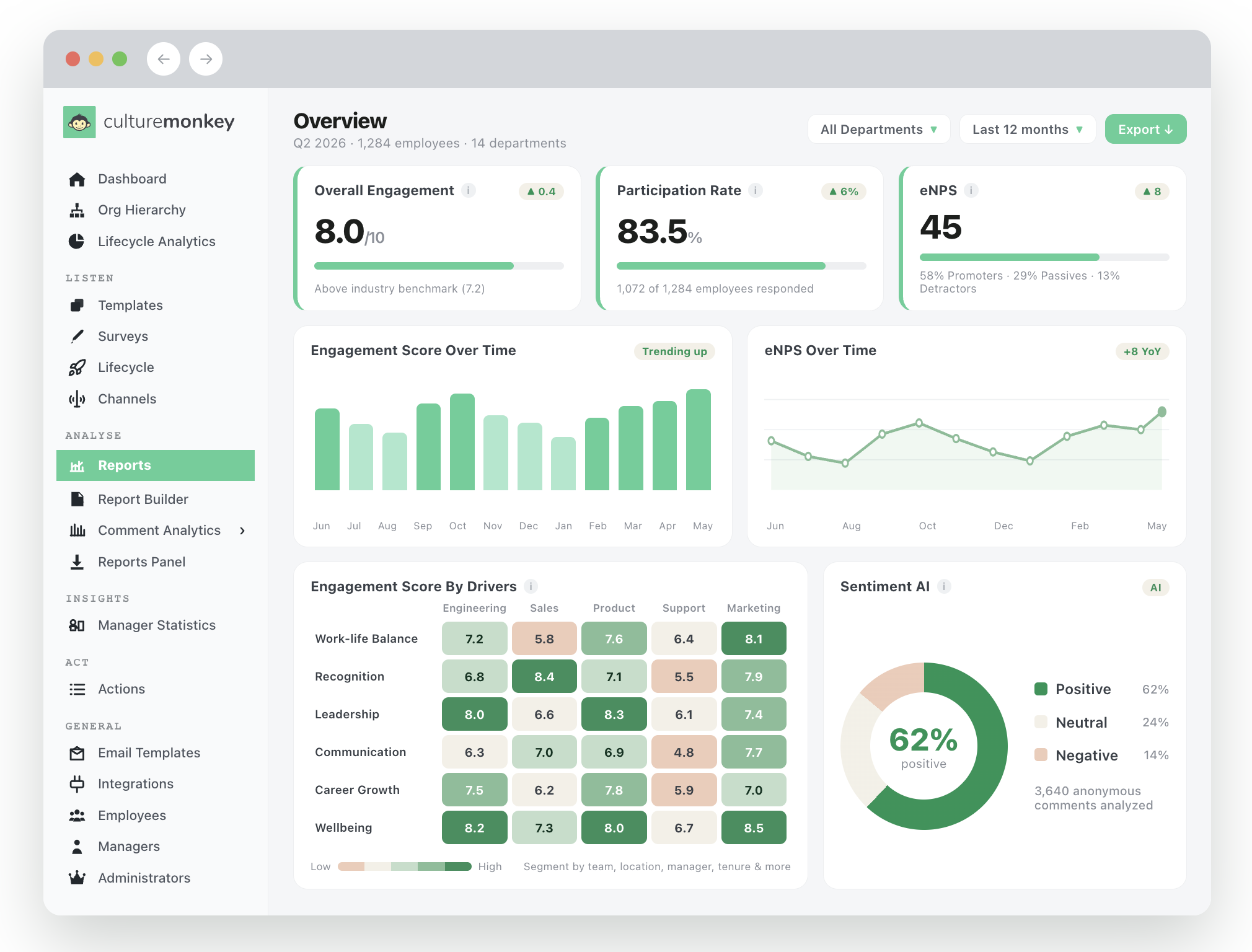
Culture Amp platform screenshot
#1Culture Amp
4.5 G2

Culture Amp enables organizations to design and administer anonymous surveys, access real-time analytics, translate feedback into action plans, and assess manager effectiveness through anonymous feedback.

Best for
Data-driven HR teams that need industry benchmarking, science-backed question templates, and detailed people analytics.
Key features
Science-backed survey templates
Industry benchmarking
Action planning workflows
Manager effectiveness analytics
Visit website
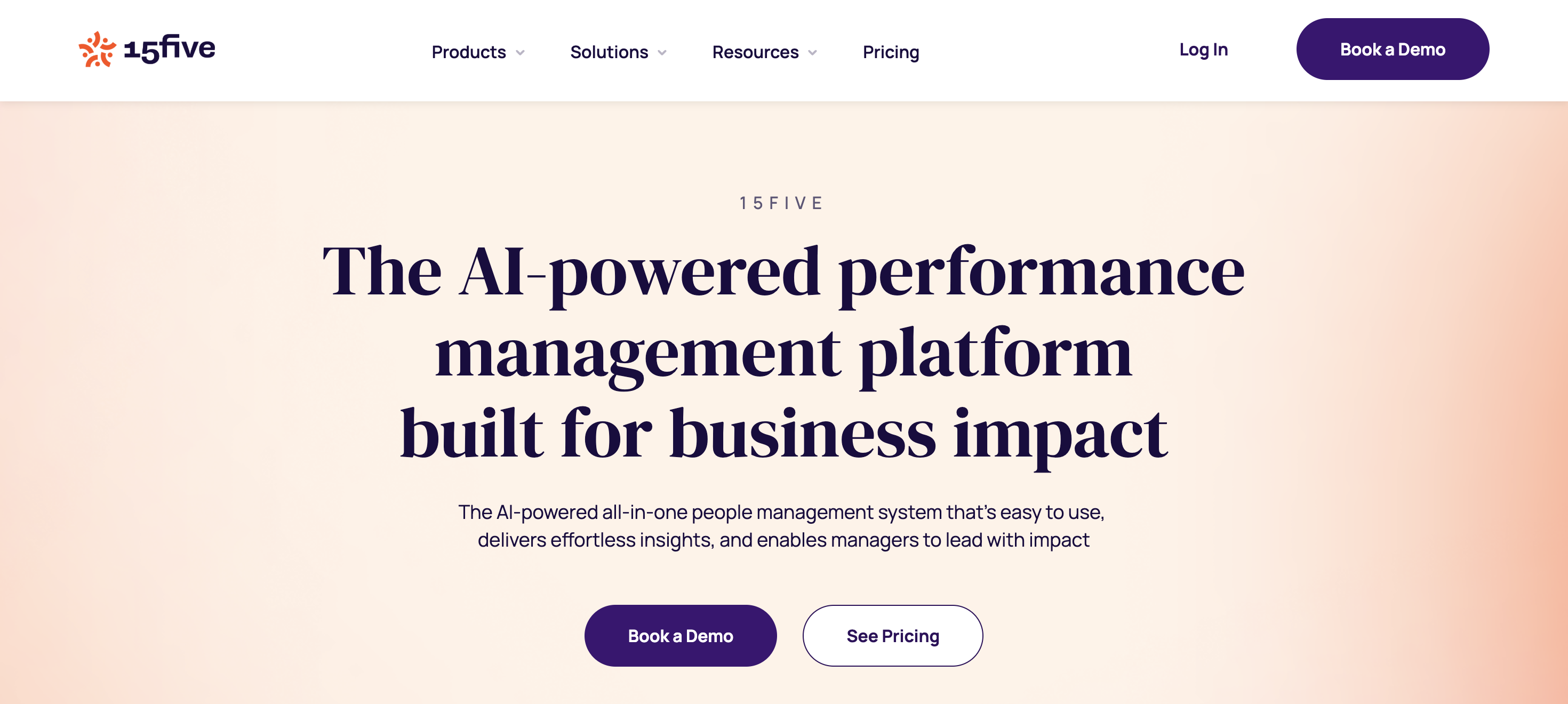
15Five platform screenshot
#215Five
4.6 G2

15Five empowers organizations to foster open communication through anonymous check-ins, customizable surveys, regular pulse surveys that capture sentiment in real-time, and feedback visibility settings that maintain anonymity.

Best for
Mid-market companies where managers drive the feedback cycle directly and need lightweight weekly check-ins alongside structured surveys.
Key features
Anonymous weekly check-ins
Customizable pulse surveys
Feedback visibility controls
Real-time sentiment tracking
Visit website
CultureMonkey platform screenshot
#3CultureMonkey
4.7 G2

CultureMonkey offers 100+ tailored anonymous survey templates, customizable surveys aligned to your brand, workplace sentiment analysis, real-time feedback analysis powered by AI, and tools to measure manager effectiveness.

Best for
Enterprise organizations needing HRIS integration, multilingual support (100+ languages), and AI-powered analytics that connect anonymous feedback to action plans.
Key features
100+ languages with HRIS integration
AI-powered sentiment analysis
Response thresholds and metadata stripping
Manager effectiveness dashboards
Visit website
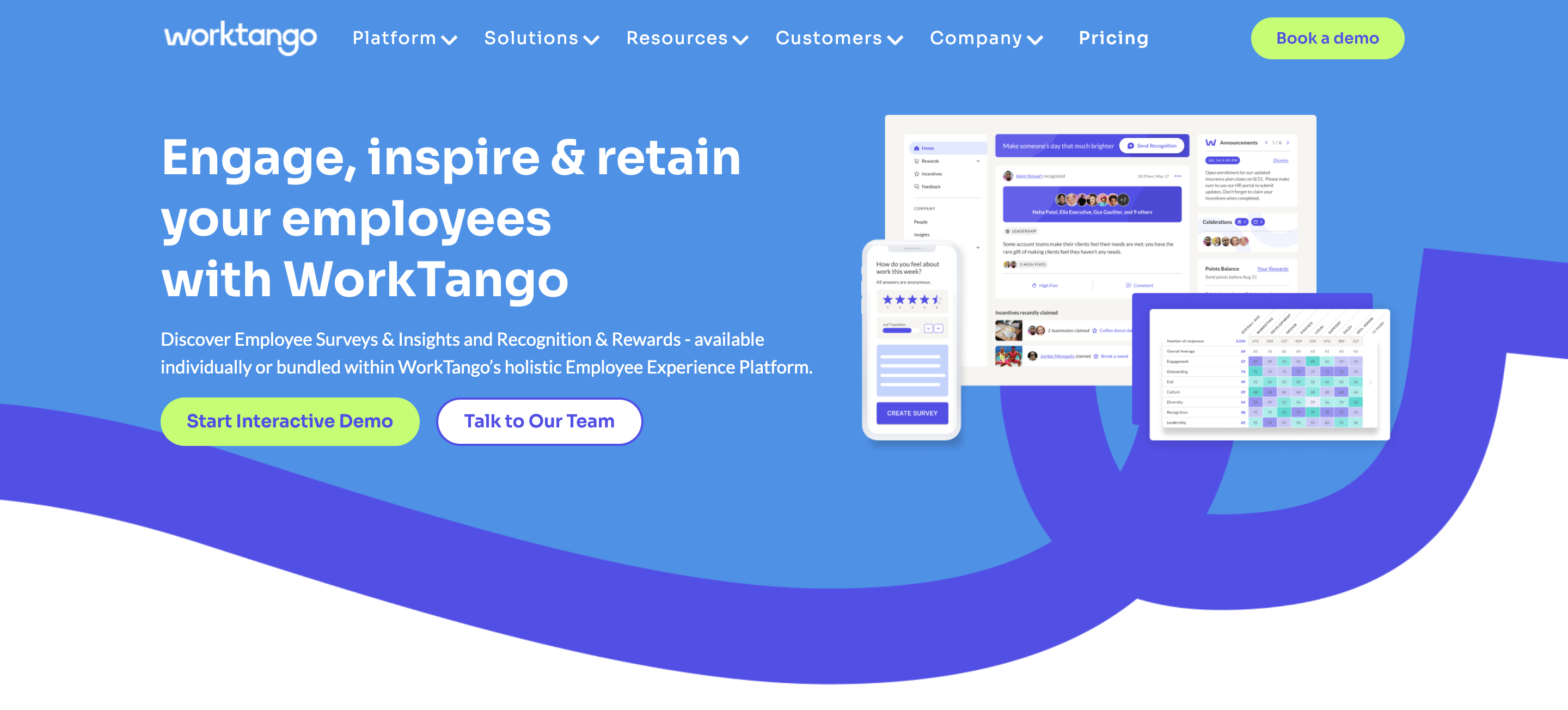
WorkTango platform screenshot
#4WorkTango
4.5 G2

WorkTango lets organizations conduct anonymous surveys, gain deep insights with AI-powered analytics that identify themes and sentiment, explore feedback through interactive dashboards, and translate feedback into action.

Best for
Organizations with frontline workers who lack regular email access. SMS, kiosk, and multichannel delivery reach every employee.
Key features
SMS, kiosk, and email delivery
AI-powered theme detection
Interactive analytics dashboards
Action planning and follow-up tools
Visit website
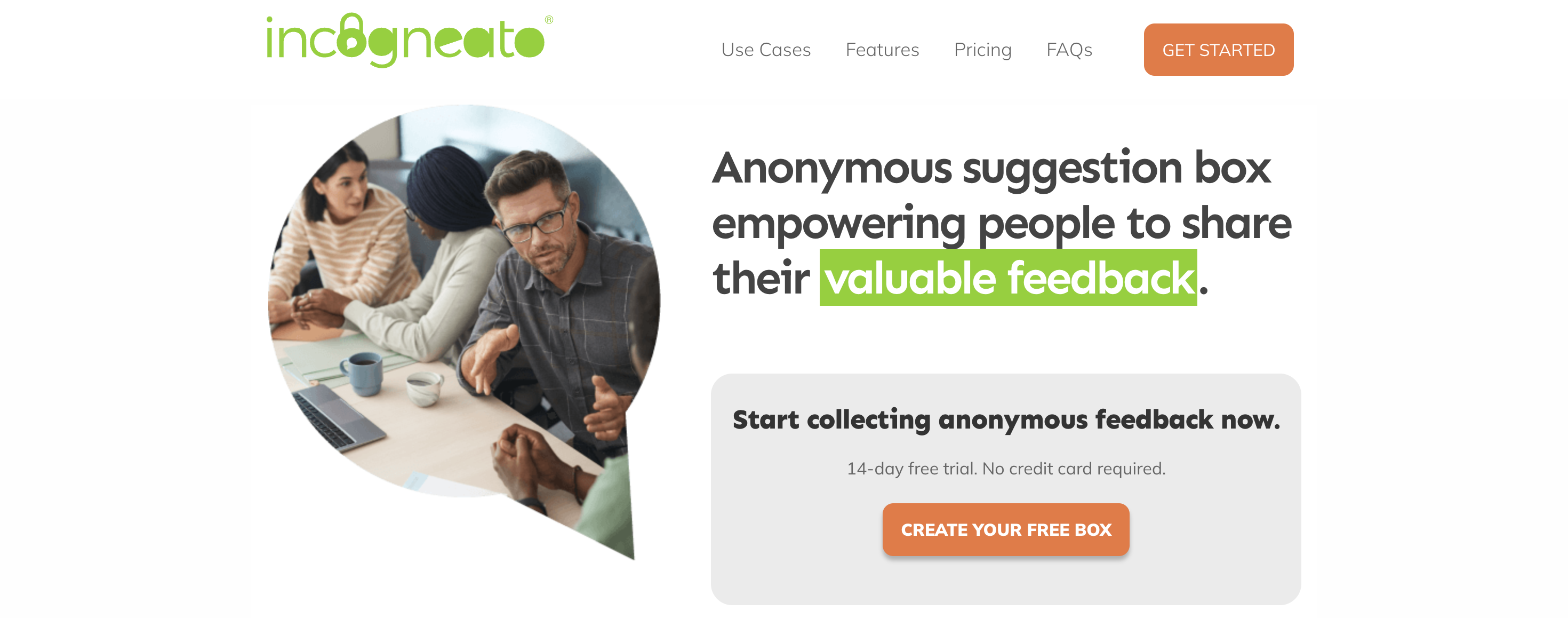
Incogneato platform screenshot
#5Incogneato
4.4 G2

Incogneato provides a secure, anonymous channel for employees to share thoughts and concerns, supports two-way anonymous conversations with management, and delivers insights to spot trends and patterns.

Best for
Small teams and startups that need simple, fast anonymous feedback with two-way anonymous messaging and no enterprise overhead.
Key features
Two-way anonymous conversations
Custom survey builder
Lightweight zero-config setup
Trend and pattern analytics
Visit website
Real Results
Case StudyRobertshaw
Manufacturing4,500+ employees14 locations
4x
eNPS growth
9.21 to 38.11
71%
Reduction in
actively disengaged
8.7
Engagement score
up from 7.5
84%+
Managers rated
8+ by their teams
Evaluation Framework

How to evaluate anonymous feedback tools

Five criteria that separate effective platforms from survey tools with anonymity bolted on.

01. Anonymity architecture
Does the tool structurally prevent identification?

Metadata stripping, response thresholds, and role-based access. Policy-based anonymity is weaker than architecture-based anonymity.

02. Analysis depth
Can it surface insights from open-ended responses at scale?

Themes, sentiment, and actionable patterns from thousands of text responses. Manual review does not work beyond 200 responses.

03. Action planning
Does feedback connect to owners, deadlines, and follow-up?

The platform should close the loop between what employees say and what leadership does. Feedback without a closed loop erodes trust.

04. Delivery channels
Can it reach every employee through their preferred channel?

Email-only delivery misses frontline workers, remote teams, and deskless employees. SMS, kiosk, Slack, and WhatsApp matter.

05. Integration ecosystem
Does it connect to your HRIS and existing workflows?

Standalone tools create data silos that limit the impact of feedback. Native HRIS integration eliminates manual roster management.

Case Study
StudyIn
Education / 800+ employees / 40+ countries
93.9%
Participation
7.9
Engagement
70.6%
Highly engaged
16.65
eNPS baseline

Conclusion

By providing a safe and confidential space for employees to share their thoughts and concerns, organizations can gain valuable insights, address challenges, and take proactive action. CultureMonkey, with its tailored survey templates, customizable surveys, real-time analytics, and people science-powered features, stands out as a leading platform that helps organizations unlock the full potential of anonymous employee feedback.

With CultureMonkey's anonymous employee feedback tool, organizations can create a feedback loop that nurtures open communication, drives positive change, and cultivates a happier, more engaged workforce. Embrace the power of anonymous employee feedback and watch your organization thrive.

FAQ

Frequently asked questions

What is anonymous employee feedback?
Anonymous employee feedback is a structured process where employees share opinions, concerns, and suggestions without their identity being recorded or traceable. Unlike confidential feedback where identity is known but access-restricted, anonymous feedback structurally eliminates identification, producing more candid and actionable responses on sensitive workplace topics. Understanding employee engagement is key to designing effective feedback programs.
Is anonymous employee feedback a good idea?
Yes. Anonymous feedback removes the social desirability bias that causes employees to filter their responses. Organizations using employee feedback tools consistently surface issues that named surveys miss, including management blind spots, culture gaps, and early attrition signals. The key is pairing anonymity with visible follow-through so employees see that honest input leads to real change.
Why are anonymous employee surveys the best way to get feedback?
Anonymous surveys produce higher participation rates (15 to 25% higher than named surveys) and more honest responses. When employees know their identity is protected, they share genuine thoughts without fear of repercussions. This is especially critical for sensitive topics like leadership quality, compensation fairness, and workplace harassment where named responses produce artificially positive data.
How do I make my employee feedback anonymous?
Use a dedicated employee feedback software that strips identifying metadata, disables IP tracking, enforces minimum response thresholds before displaying results, and restricts data access by role. Communicate these safeguards clearly to employees before launching surveys. The platform should make anonymity structurally guaranteed, not just policy-dependent.
What are the best anonymous feedback tools in 2026?
The top anonymous feedback tools in 2026 are Culture Amp (G2: 4.5, best for people analytics), 15Five (G2: 4.6, best for manager-led feedback), CultureMonkey (G2: 4.7, best for enterprise and HRIS integration), WorkTango (G2: 4.5, best for multichannel delivery), and Incogneato (G2: 4.4, best for two-way anonymous conversations). You can also compare engagement survey software across a wider set of vendors.
How should organizations handle anonymous feedback?
Organizations should build structural safeguards first: strip identifying metadata at the infrastructure level, enforce minimum response thresholds per group, randomize submission windows, and restrict raw data access by role. Then focus on execution: communicate the anonymity architecture transparently, use anonymous follow-up threads for context, design surveys that produce actionable data using proven survey questions, and close the feedback loop publicly within 30 days.
What is the difference between anonymous feedback and confidential feedback?
Anonymous feedback never collects or stores identifying information. Confidential feedback tracks respondent identity but restricts who can access it. Anonymous feedback produces more candid responses because the risk of identification is structurally eliminated, not just limited by access policies that could change.
How often should organizations collect anonymous feedback?
Most organizations run a comprehensive annual engagement survey and supplement it with shorter pulse surveys quarterly. The right cadence depends on your capacity to act on results between cycles. Surveying without follow-through erodes trust faster than not surveying at all.
Can anonymous feedback tools integrate with HRIS systems?
Yes. Leading tools like Culture Amp and CultureMonkey integrate with major HRIS platforms including Workday, BambooHR, SAP SuccessFactors, and others. These integrations automate employee roster syncing, department mapping, and survey distribution while maintaining anonymity at the response level. A well-integrated employee experience platform eliminates manual roster management.
Do anonymous feedback tools support multilingual surveys?
Yes. Enterprise-grade tools support 50 or more languages with professional translations, not just machine translation. CultureMonkey supports 100+ languages. Multilingual and omni-channel surveys are essential for organizations with global or diverse workforces to ensure every employee can respond in their preferred language.
How do anonymous feedback tools use AI for analysis?
Modern anonymous feedback tools use AI to analyze open-ended responses at scale, identifying sentiment patterns, recurring themes, and emerging concerns across departments. AI-powered analytics surface actionable insights from thousands of text responses that would take weeks to review manually.
What delivery channels do anonymous feedback tools support?
Leading tools support multiple delivery channels including email, Slack, Microsoft Teams, SMS, WhatsApp, and in-app notifications. Multichannel delivery ensures surveys reach every employee regardless of their work setup, whether they are desk-based, remote, or frontline workers without regular email access.
How can organizations measure the ROI of anonymous feedback programs?
Track four metrics: participation rate improvement over survey cycles, time-to-action on identified issues, engagement score trends correlated with feedback-driven changes, and attrition reduction in teams where feedback led to interventions. Organizations that close the feedback loop within 30 days see the strongest ROI indicators.
What is the minimum response threshold for anonymous surveys?
The industry standard minimum response threshold is 5 responses per group before results are displayed. This prevents identification of individual respondents in small teams. Some organizations set higher thresholds of 8 to 10 for particularly sensitive survey topics like DEI or leadership feedback.
Can managers see individual anonymous responses?
No. In properly configured anonymous feedback tools, managers see only aggregated results for their team, never individual responses. Results are suppressed entirely if the team falls below the minimum response threshold. Role-based access controls ensure that data visibility matches the anonymity guarantee communicated to employees. The methodology behind these safeguards is well-established across leading platforms.
You might also like