

S04 E08
Culture at the Core: What Managers Actually Drive
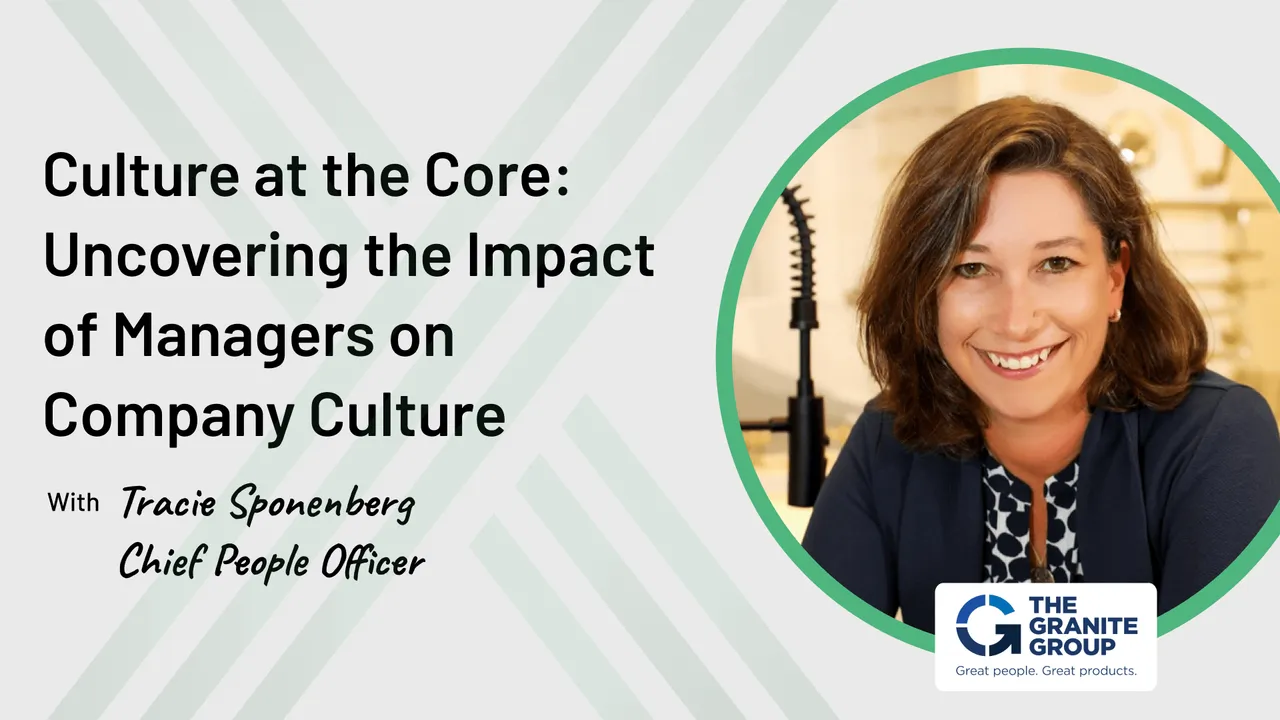
Tracie Sponenberg, Chief People Officer at The Granite Group, joins S04 E08 of CultureClub X to unpack what managers actually drive in company culture, why trust should be given freely, and how people teams can build an individual employee experience while technology deepens rather than replaces human connection.
TL;DR
What you need to know from this episode
- Give trust freely instead of waiting for people to earn it. Tracie learned this from her CEO: extend trust from the start and treat violations as the exception. Her shorthand is the eight C's of trust, from clarity and compassion through consistency.
- Behavior change is the biggest mental health red flag. A dressed-up person arriving disheveled, a punctual person running late, a social person going quiet. The check-in can be as simple as, I noticed X, is everything okay?
- Careers are journeys, not ladders. Sideways, backwards, part-time, or a break from the company can all be the right move. The Granite Group builds learning paths for each role and teaches emerging leaders to lead, not just manage.
- Microcultures drive the overall culture. The Granite Group has one company culture and over 60 team cultures, because every manager sets the tone. HR is not the holder of the culture, and neither is the CEO. It is everybody.
- Automate the routine so humans can connect. Frequent pulse checks beat long point-in-time surveys, and team-led implementations beat resistance to new tools. Technology does not replace human connection; used well, it creates more room for it.
What do managers actually drive when it comes to company culture? In this episode of CultureClub X, powered by CultureMonkey, host Diana Blass sits down with Tracie Sponenberg, Chief People Officer at The Granite Group, to unpack that question from every angle: trust, mental health, burnout, psychological safety, career development, and the technology that holds it all together.
Tracie leads all people functions at The Granite Group, a wholesale distributor of plumbing, heating, cooling, water, and energy supplies with more than 730 people across roughly 56 locations in New England. Her career spans HR leadership at a Pulitzer Prize winning newspaper, a multi-state professional services firm, and a national wellness distribution and technology company.
What makes the conversation stand out is Tracie's own arc. She started out super compliance focused and, in recent years, transitioned into a people first leader. That shift colors every answer she gives, from why trust should be given freely to why you cannot wrap a career development policy around everyone.
Why does trust come before everything else in workplace culture?
Diana opens with the bedrock question: what steps can managers take to make employees feel more valued and improve trust within their teams? Tracie's answer starts from a simple premise: "if you don't have trust, you don't have a relationship." That holds in the workplace just as it does in any other relationship.
Her go-to framework comes from a blog she still cites more than 10 years later, The Eight Pillars of Trust by David Horsiger. She calls them the eight C's of trust: clarity, compassion, character, competency, commitment, connection, contribution and consistency. Hit all eight, she says, and you are building trust with your team.
I used to expect trust to be earned by me. I used to expect people to gain my trust. But I learned from my CEO, Bill Condren, that he gives it freely. If you violate it, that's a problem. But he gives trust freely.
Notably, she does not lean on formal trust exercises. Her leadership team does them occasionally, but what works best with her own team is being authentic, being a straight shooter, and "saying what you mean and meaning what you say."
How can managers become first responders for mental health?
Tracie is careful to say she is not a mental health expert, but she believes everybody can do really simple things to know if there is an issue. The biggest trigger is any kind of behavior change. Someone who normally comes in dressed up suddenly is not. Someone who was always on time starts running late. Someone who was happy turns sad, angry, or anxious, or stops joining conversations.
The response can be as simple as "I noticed X, is everything okay?" That question only lands if trust is already there, which is why she keeps coming back to frontline managers. They are the person an employee will most likely go to, so they need to know where to turn for help even if they cannot know everything.
She recommends Melissa Doman's book on mental health at work and suggests looking into mental health first aid certification, which someone on her own team holds. And while reading people is harder in virtual settings, she insists it is not impossible: you can still notice body language and patterns like someone repeatedly coming late to a meeting.
The pandemic, she says, was terrible for our collective mental health as a society. The Granite Group responded by assigning each member of the people team a set of states to check in on managers and employees, and by building communities for different segments of the population, like women and managers, to share ideas and support one another.
Manager burnout is real, but everybody is overloaded
Asked whether managers are overburdened with expectations beyond their scope of work, Tracie widens the lens. Managers are overburdened, yes, but as a society everybody is. She points to a statistic from an article Jack Kelly wrote, that 98% of HR professionals are burned out, which is how she recognized her own: "I read that and went, wow, that's what it is."
There is no magic wand that makes things better. Her prescription is to lean on technology to automate some things and even to check in on people, but to remember that tools never remove the human obligation. Recognize people as people, not numbers or line items on a spreadsheet.
Employees are not asking for flexibility anymore, they are demanding it
Diana raises the lists circulating on LinkedIn: no dress codes for people who are not client facing, no answering after hours, micromanagement is out. People have found their voice. So how does a people leader honor what employees demand while maintaining the company's own culture and standards?
Tracie's first move is to understand what your culture is. The Granite Group runs in-person businesses that have to operate certain hours, but the company got much better at flexibility within those constraints: part-timers, 4/10 schedules, opening up possibilities beyond what it always did.
People are not asking, they're demanding these types of things for their workplaces, and I love it.
The test she applies to any rule: do I have that policy in place just because it has always been there, or is it something that can really be changed? People perform better if you meet them where they are at, and she believes meeting the needs of the workforce while still meeting the needs of the business is very possible.
How does psychological safety turn trust into belonging?
You cannot have trust without psychological safety at work, which Tracie defines as people being comfortable speaking out without fear of repercussions. But she pushes one step further: the real destination is a sense of belonging, something she thinks workplaces should have been talking about all along.
Her advice for managers is strikingly personal: think before you react. Take a step back, look at yourself in the mirror, and consider what you are going to say and what its impact could be on the individual, the team, and the company. Be tolerant of mistakes and use them as learning tools instead of berating somebody for failure.
Timing matters too. Tough conversations, comfortable or uncomfortable, should happen as in the moment as possible. Addressing an issue a month later does not do anyone any good.
Why promoting your best salesperson is not a leadership strategy
Like a lot of organizations, The Granite Group used to hand its best inside sales person the branch manager job when it opened up, and wish them good luck. Tracie has spent years fixing that through a partnership with a leadership consultant and a series of training that started with the executive team, moved through directors and branch managers, and now includes a program for emerging leaders.
The goal is for people to learn how to lead, not just manage. Where the company once barely factored in people skills when promoting, it certainly does now.
One of her team's biggest projects is career journeys, learning paths for each role, built on the recognition that a career may not be an upward ladder. It may be sideways, backwards, or down. Some people need to leave the organization for a period of time or step back into a part-time role, and the more flexible the company is about that, the better it does.
It all comes back to individual conversations. Her people team's purpose is building an incredible individual people experience, hyper-focused on each person, precisely because a single career development policy cannot fit everyone.
Do microcultures drive company culture or the other way around?
Asked whether manager driven microcultures guide the larger culture or vice versa, Tracie is unequivocal: the microcultures are really what drives the overall culture. The Granite Group has its company culture, but it also has over 60 individual cultures across teams, departments, and locations, because each manager sets the tone for their team.
That reframes who owns culture. HR is not the holder of the culture, and neither is the CEO. It is everybody.
On measurement, she favors frequency over length. Really long surveys measure a point in time, while a pulse survey tool that checks in on the same question over a period of time gives a much better measurement. Without data you are relying on your own instinct, which is helpful in some cases but is not everything.
Cohesion across 56 locations still takes deliberate rituals. Once a year the company brings everybody together for a voluntary annual meeting that draws about 75% of its people, plus monthly town halls in different places and quarterly meetings at every single location with a member of the executive team.
What does this mean for employee listening?
Tracie's team automates everything it can so the humans can focus on the things that really matter: strategic initiatives, coaching, guiding people, and getting physically out to locations to talk to them. The company is even looking at how AI can sit over the whole tech stack and parts of the people experience.
Her adoption playbook is ownership. When The Granite Group replaced a 51 page paper new hire packet, she had her tiny team run the implementations themselves, so each person could say, I did that. Nearly everyone on the team has since led an implementation, which she credits with melting resistance. And when a system fails to stick, the team admits the mistake and moves on.
I think technology is a wonderful tool, it doesn't replace human connection. It actually helps us, though, be more connected to other people if we're using technology in the right way.
That is ultimately where employee listening lands in this conversation. Pulse checks, check-in tools, and data-informed decisions give managers the signal, but it is the human follow-up, the noticing and the individual conversation, that turns listening into trust. Technology earns its place by making managers more connected to their people, not less.

About the guest
Tracie Sponenberg
Chief People Officer-The granite group
Tracie Sponenberg is the Chief People Officer at The Granite Group, a New England wholesale distributor of plumbing, heating, cooling, water, and energy supplies, where she leads all people functions across the company. Over a career of more than 20 years, she has led HR at an award-winning multi-state professional services firm, a Pulitzer Prize winning newspaper and publishing company, and a national wellness distribution and technology company. She co-founded projects like HR Rebooted and DisruptHR, is a keynote speaker on HR, technology, and business issues, and is a past president of her local SHRM chapter.
Her writing has been featured on NPR and in publications including USA Today, US News and World Report, Employee Benefits News, and The Wall Street Journal. She is SPHR and SHRM SCP certified, a graduate of Framingham State University, and sits on the boards of the Harvard Pilgrim Foundation, Red River Theaters, and Families in Transition.
Full episode transcript
Season 04, Episode 08 · Tracie Sponenberg with Diana Blass · 42 min
Frequently asked questions
What are the eight C's of trust for managers?
Tracie Sponenberg draws on The Eight Pillars of Trust, a blog by David Horsiger, and calls them the eight C's: clarity, compassion, character, competency, commitment, connection, contribution and consistency. If a manager is hitting on all eight, they are building trust with their team.
She adds that trust does not always need formal exercises. Authenticity, directness, and having tough conversations go a long way, as does giving trust freely rather than expecting people to earn it.
How can managers spot mental health struggles on their team?
Watch for any kind of behavior change: someone who normally dresses up and suddenly does not, someone always on time who is now late, someone happy who becomes sad, angry, or anxious, or someone who stops joining team conversations. Any change like that is a trigger for a conversation, which can be as simple as, I noticed X, is everything okay? Is there anything I can do to help?
Tracie also suggests mental health first aid certification and equipping frontline managers to know where to turn for help, since they are the person an employee is most likely to approach when trust exists.
What can organizations do to reduce manager burnout?
Tracie's starting point is honesty about scale: everybody is overloaded, not just managers, and she cites an article by Jack Kelly reporting that 98% of HR professionals are burned out. Burnout is tricky to recognize and difficult to get over, so there is no magic wand.
What helps is leaning on technology to automate routine work and to check in on people, while still being there as a human. Organizations should recognize people as people, not numbers or line items on a spreadsheet.
Are frequent pulse surveys better than long annual surveys?
In Tracie's view, really long surveys measure a point in time, while frequent pulse checks, particularly ones that revisit the same question over a period of time, give a much better measurement. That data informs decisions at both company and team level; without it, you are relying on instinct alone.
How do you overcome resistance to new HR technology?
Tracie's approach at The Granite Group was to have her team members own the implementations themselves, with her there to help. When everything went live, each person could say, I did that, and nearly everyone on her team has now led some type of implementation. Involving people outside the team also helps.
She also recommends recognizing failure: if a system is failing to stick, step back, admit the mistake, and move on rather than forcing it.
Read the cross-episode roundups
More from CultureClub X
 S06 E19change leadershipFrom Cost Center to Catalyst: How CPOs Turn People Strategy Into Business Advantage, with L. David Kingsley
 L. David Kingsley
 S06 E17ai in hrBuilding Trust and Belonging in the Age of AI, with Jessica Smith
 Jessica Smith
 S06 E14manager effectivenessTurning Engagement Data Into Culture Change
 Dr. Adam Hickman
Never miss an episode
Every new episode, plus the takeaways that matter, posted on the CultureMonkey LinkedIn page as soon as they drop.
Free on LinkedIn. Unfollow anytime.