

S06 E12
Trust as a KPI: The Pulse Survey Playbook
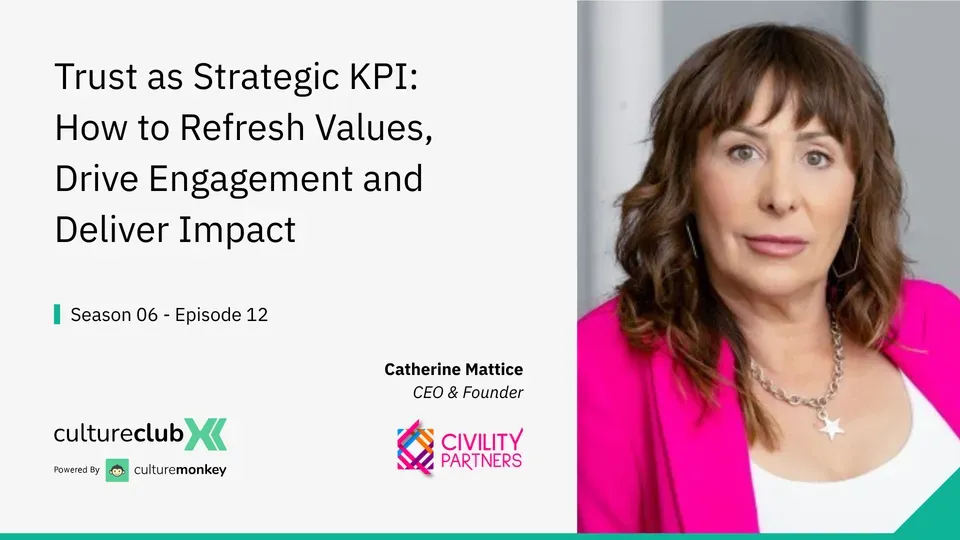
Civility Partners CEO Catherine Mattice on treating trust as a strategic KPI. Why trust breaks down through unaddressed behaviors, why engagement is an outcome of culture, how to measure trust through surprise exits and early HR conversations, and how pulse surveys turn culture into performance.
TL;DR
What you need to know from this episode
- Trust rarely breaks in one dramatic moment. It erodes through subtle behaviors. Microaggressions, gossip, and sarcasm are the “death by a thousand cuts” that go unaddressed because they are not against policy. When managers let those small moments slide, trust quietly disappears and disengagement follows.
- Engagement is an outcome of culture, not culture itself. A strong engagement score signals a healthy culture, but it is not the whole picture. Measure relationships, psychological safety, and efficiency too, or run listening sessions, before assuming the score tells you everything.
- Culture is defined by daily interactions, not the top. When people describe their workplace, they talk about their team and their manager, not the CEO. That means every employee can shape culture, and peer accountability becomes the engine, once organizations give people the tools and the permission to use it.
- Trust can be measured as a KPI through behavior, not just survey scores. Track surprise exits, because fewer of them means managers sense concerns early. Track informal coaching conversations with HR, because more of them means people trust HR as a partner rather than the principal’s office.
- Pulse surveys turn culture into a performance engine only when results are acted on and published. People want to feel heard. Sharing the good and the bad, then showing what you are doing about it, creates buy-in and proves that feedback leads to real change.
Catherine Mattice is the founder and CEO of Civility Partners, an organizational development firm that helps companies build respectful workplace cultures and turn around toxic ones.
In this episode of CultureClub X, she makes the case for treating trust as a strategic KPI: something you define, measure, and manage like any other business goal. You will learn how trust actually breaks down inside high-performing teams, why your engagement score is not the same as your culture, how to measure trust through behavior, and how pulse surveys turn culture into a genuine performance engine.
The business case is hard to argue with. Gallup’s State of the Global Workplace: 2026 report found that only 20% of employees worldwide were engaged in 2025, and that low engagement costs the world economy roughly $10 trillion in lost productivity.
The flip side is equally clear: in Paul Zak’s research for Harvard Business Review (2017), people at high-trust companies reported 50% higher productivity, 76% more engagement, 74% less stress, and 40% less burnout than people at low-trust companies. Trust is not a soft topic.
It is a performance variable.
How trust actually breaks down in high-performing teams
The most common way trust erodes is not a scandal or a single betrayal. It is the accumulation of small, subtle behaviors that no policy covers. Catherine points to microaggressions, gossip, incivility, and sarcasm: the kind of conduct that feels minor in isolation but compounds into what she calls death by a thousand cuts.
These behaviors slip past because they are not unlawful and not against the rules, so managers let them go rather than micromanage adult colleagues. Over time they grow more frequent and more aggressive, and the trust between people quietly drains away.
Understanding how microaggressions at work operate is the first step to addressing them before they harden into a toxic work environment.
The key is that when that behavior isn’t addressed early on, because those little moments do break trust, then they start to go on and on, and then trust just disappears over time.
Catherine knows this pattern from the inside. Early in her career she worked in HR for a company with one deeply toxic person, and she watched the complaints and turnover pile up. When her own concerns went unheard, her loyalty faded and her performance dropped. She made a conscious choice to disengage, a behavior we would now call quiet quitting, long before that phrase existed.
That is exactly how the spiral works: when people feel their employer does not care, they stop caring back, and their manager senses the withdrawal, which erodes trust further in both directions.
The same dynamic shows up today in quiet quitting examples and in the broader rise of disengaged employees.
The lesson is that small, tolerated behaviors are early warning signs, not background noise.
Why your engagement score is not the same as your culture
Most organizations already run an engagement survey, and Catherine is clear that this is a good thing. But she draws a distinction that reframes the entire measurement conversation: engagement is an outcome of culture, not culture itself. A strong score is an indicator that your culture is probably healthy, yet it does not tell you what is actually happening underneath.
Treating the engagement number as the final word is how leaders miss the relationships, the psychological safety, and the day-to-day friction that the score quietly averages out.
Engagement is an outcome of culture, though. It’s not necessarily telling you about your culture.
Her recommendation is to widen the lens. Keep measuring engagement, but also measure relationships, psychological safety at work, and efficiency, asking blunt questions like whether people get what they need in a timely way.
Pair the numbers with a listening tour: walk around, ask people what the culture is really like in their own words, and notice where reality diverges from the dashboard. The goal is to understand the culture that produces the score, not to mistake the score for the culture.
That distinction is what turns a survey into a real read on employee sentiment.
Culture comes from daily interactions, not the top
There is a comfortable myth that culture flows down from the executive team. Catherine pushes back hard. Leadership matters and can influence culture, but ask anyone what it is like to work somewhere and they will not describe the CEO. They will describe their team and their manager. Culture, in her framing, is defined by daily interactions, which means every single person carries the ability to shape it.
That is a more demanding idea than top-down culture, because it puts responsibility on managers and peers, not just on a values statement on the website.
Our understanding of culture comes from our daily interactions, and that means that every single person has the ability to influence culture.
This is also why values need to be refreshed, and refreshed in the right direction. Too many companies post core values on a website and run a nomination program, then wonder why behavior never changes.
Catherine argues that values should be treated as fluid and built from the bottom up: ask employees what the team already lives by, highlight those values, and let them guide behavior, rather than dictating a list from the top. Managers are the lever here, coaching people in the moment about how their behavior lands.
The catch is that organizations rarely give managers the skills, the permission, or the empowerment to do that coaching, so it never becomes part of the job. Reframing core values at work as lived behavior, not posted slogans, is what makes them real.
Measuring Trust as a KPI: Four Behavioral Signals to Track
Catherine Mattice’s approach to making trust measurable, by tracking the behaviors that reveal it rather than relying on a single survey score. Think outside the box about what trust looks like in action, then find the numbers behind it.
Ask About Trust Directly
Include a trust score inside your culture survey. It is the simplest signal, and it sets a baseline you can move quarter over quarter, the same way you would track any other KPI.
Watch Your Surprise Exits
Count the resignations that catch managers off guard. Fewer surprise exits means managers sense concerns early and can have the conversation before someone leaves. A high surprise rate means people did not trust the employer enough to speak up.
Track Early HR Conversations
Measure how often people come to HR for informal coaching before a problem becomes a formal complaint. When HR is seen as a partner rather than the principal’s office, those subtle conversations rise, and that is a trust signal.
Define the Behaviors That Show Trust
Decide what trust looks like in action inside your organization, name the behaviors you want to see and not see, then find where you can measure them. Trust becomes a KPI the moment you attach behavior and numbers to it.
What is really stopping trust from becoming a KPI
If the link between trust and performance is obvious, why is trust so rarely measured? Catherine’s answer is candid. The logic that cared-for people care back should not need an ROI case, yet in practice many CEOs still do not buy it, so HR is left building the business case before anyone will act. The fix she keeps returning to is structural: rebrand HR.
For too long HR has carried the reputation of the principal’s office, the place you avoid until something explodes. If HR instead becomes known as a coach, a helper, and a partner, people will bring the small conflicts early, which both resolves problems sooner and generates a measurable trust signal.
The same instinct that makes someone hide a problem is the instinct that, once removed, lets you measure trust through how freely people reach out.
This is also why an employee trust survey works best when paired with behavioral signals like exit interviews rather than standing alone.
Making peer accountability real
Catherine’s change work leans heavily on peer accountability, which follows directly from the idea that culture lives in daily interactions. Her teams train people to be upstanders, because if everyone can hold each other accountable, then everyone is accountable for the culture. That is how communities function.
What blocks it inside companies is the familiar brush-off: someone raises a concern about a colleague and hears “that is just how they are” or “let it go.” Without explicit permission to get involved, people stay silent, and accountability never becomes shared.
Building real accountability in the workplace means equipping people to raise issues directly and backing them when they do.
If we can all hold each other accountable, then we’re all accountable for the culture. But organizations need to give people the tools and the permission to hold each other accountable.
When Civility Partners enters an organization, much of the work is bringing the elephants out of the room: facilitating the difficult one-on-one conversations between people and departments that have stopped talking to each other. The advice Catherine gives most often is also the simplest. Get people to talk about the conflict, because it has to come out.
It is not in our nature to dive in front of a bus, so a neutral outsider often has to create the safe space first, but the answer is almost always the same: surface the issue, talk it through, and it can only get better from there. The end state is an organization that owns that work itself, not one that needs a consultant forever.
Turn trust signals into action before they show up as attrition
See how CultureMonkey’s pulse survey tools and real-time sentiment analysis help people teams hear what employees actually feel, catch concerns early, and turn culture into decisions managers act on.
Rebuilding human connection in the age of AI
On AI, Catherine’s answer is reassuringly consistent with everything else: people still have to be human, and you still have to have the conversations. AI can help at the margins, for example by letting you run a scenario through a tool that understands a colleague’s personality profile before a difficult conversation, so you choose the right approach.
And while some jobs will be replaced, new ones appear, because someone has to manage the AI that does the work. The risk is not the technology itself but what we let it do to our attention and our relationships.
We can’t just lose the humanity just because we’re using AI.
She draws a sharp analogy to social media. Posting a photo and collecting likes gives a false sense of importance, and she suspects AI will have its own hard-to-predict effects on our personalities and mental health. The discipline, then, is self-awareness: keep the human conversations going, do not let the tool take over, and remember that simply talking about the uncertainty openly already helps.
Most organizations, she notes, are figuring AI out at the same pace as everyone else, so leaders do not need to pretend they are further ahead than they are.
Turning pulse surveys into a performance engine
Catherine’s closing argument ties the whole conversation together: culture belongs on the strategic plan, right next to market share, customer scores, and revenue. The mechanism is the same one used for every other strategic goal. Set a benchmark, build a plan, implement it, then check the data to see if it is working.
Pulse surveys give you that loop for culture. You can point to a specific question, run the survey again, and watch whether the score on that question improved, which is how you know change is actually happening.
But the survey only works if people feel heard, and feeling heard depends on action. Catherine is emphatic that humans are not cogs in a wheel, and that giving and receiving feedback is a basic need. So her practical tip is to publish the results, including the bad and the ugly, alongside what you plan to do about them.
Publishing does something subtle and powerful: it shows the employee who had a bad experience that they are not alone, which builds community and buy-in. She has seen the same effect with live anonymous polls in training, where people who feel fine suddenly see that half the room does not feel psychologically safe, and that data creates the buy-in to act. Without that visible follow-up, a survey changes nothing.
With it, you close the employee feedback loop and connect culture directly to engagement and performance.
We are not cogs in a wheel, and we absolutely, as a basic human need, require feedback and the ability to give feedback and to feel heard.
People do not perform when they feel their company is not loyal to them, and they will not stay loyal if their ideas are never heard. Tie those behaviors to the goals leaders already care about, and trust stops being a soft sentiment and starts being a culture of performance.
That is the playbook: make trust a KPI, measure it through behavior, refresh values from the ground up, share accountability, and use pulse surveys to keep the loop alive.

About the guest
Catherine Mattice
Founder and CEO, Civility Partners
Catherine Mattice, MA, SPHR, SHRM-SCP, is the founder and CEO of Civility Partners, an organizational development firm focused on helping organizations create respectful workplace cultures and specializing in turning around toxic cultures. Civility Partners’ clients range from Fortune 500s to small businesses across many industries. Catherine is a TEDx speaker and an HR thought leader who has appeared in venues such as USA Today, Bloomberg, CNN, NPR, and many other national news outlets as an expert.
She is an award-winning speaker, author, and blogger, and has developed more than 60 courses reaching global audiences on LinkedIn Learning. Her fourth book, Navigating Toxic Work Environments For Dummies (Wiley), is available in all major bookstores and wherever audiobooks are sold.
Full episode transcript
Season 06, Episode 12 · Catherine Mattice with Darcy Mehta · 37 min
Welcome to season six of CultureClub X, powered by CultureMonkey. I’m your host, Darcy Mehta. CultureMonkey is an AI-powered employee engagement platform that helps organizations listen to their employees and build stronger workplace cultures.
CultureClub X is our global thought leadership forum where CHROs and people leaders share insights, explore trends, and exchange practical strategies for building future-ready organizations.
Today we’re honored to host Catherine Mattice, CEO and founder of Civility Partners, an executive coach and workplace culture consultant. Catherine is a recognized TEDx speaker, an award-winning author, and one of the most sought-after voices in organizational culture today. Catherine, welcome. It’s such an honor to have you here with us today.
Thank you for having me.
To give a little background: Catherine is the founder and CEO of Civility Partners, an organizational development firm focused on helping organizations build respectful workplace cultures, with a particular specialization in turning around toxic ones. Civility Partners works with a wide range of clients, from Fortune 500 companies to small businesses across industries.
Catherine is a TEDx speaker and a well-known HR thought leader, featured in USA Today, Bloomberg, CNN, NPR, and numerous national news outlets as a subject matter expert. She is an award-winning speaker, author, and blogger, and has developed more than 60 courses on LinkedIn Learning that reach global audiences. Her fourth book, Navigating Toxic Work Environments For Dummies, published by Wiley, is available at all major bookstores and wherever audiobooks are sold.
Catherine, your work at the intersection of culture, trust, and organizational transformation makes you exactly the right person to lead this conversation. Today we’re diving into a topic that is both timely and critical for every people leader: trust as a strategic KPI, and how to refresh values, drive engagement, and deliver impact. Before we dive in, could you share a little more about your own leadership journey and what led you to focus so deeply on trust and workplace culture?
Sure. I was internal HR, working for a company that was pretty great, except for one person who was very toxic. As HR, I was getting a lot of the complaints, dealing with the turnover, and really getting a front-row seat to the damage that type of behavior causes.
I started getting my master’s degree while I was working there, and ended up doing all of my graduate research on the opposite of trust, which is workplace bullying and toxic environments. Honestly, I found it kind of therapeutic to learn about the situation I was in through the academic research, and to realize it’s a problem around the world. After grad school I had the knowledge and the tools to address it, so I decided to start a business and see where it goes.
That was 17 years ago. Back then it was very much about harassment or nothing; there was no employee experience, no in-between. It took a while to get people to care about this, but now it’s a hot topic. There are lots of culture consultants out there, but I do feel like I’m one of the original culture consultants talking about what employees need from a human level.
That’s amazing. How great to turn a toxic workplace into your own business and something like this, and now you’re helping others. So many of us have experienced that, so it’s always interesting to learn and realize you’re not alone. Thank you for sharing. Let’s dive into our first question.
What is the most common way trust breaks down in high-performing cultures?
I’d say it’s the very subtle little things that people do, like microaggressions. We’ve all heard that term by now, this sort of death by a thousand cuts. There are a lot of other similar behaviors: gossip, incivility, sarcasm that can push the line. Sarcasm is a dangerous line to walk.
These are the more under-the-radar behaviors that we allow to go on, because we’re not all here to micromanage each other. We’re all humans. They’re not against the law and they’re not against policy, and they evolve over time, getting worse and more frequent. Those are the kinds of behaviors that are real trust breakers. There’s also never having a solution and always being the complainer, or making a mistake, or getting caught sharing information you were asked to keep confidential. There are so many versions.
The key is that when that behavior isn’t addressed early on, because those little moments do break trust, they start to go on and on, and then trust just disappears over time.
Absolutely. It erodes. Every little cut, every barb, it just starts to break down. What you said about microaggressions is so interesting, because you take one in itself and that’s not harassment. That used to be the only thing we named. Well, that’s not harassment, but you add them all together, happening every day, and it really is something. It’s great that now it’s much more talked about.
I’ll share an example. Just last night, someone told me she worked in a place where she felt bullied, went to her boss and said, I feel like this other person is bullying me. The answer was, don’t take it personally, she does that to everyone. That’s a very common response. That’s just how they are. I know they’re a little overly sarcastic, but don’t let it bother you. That’s the stuff organizations do that really breaks down trust.
Back when I was dealing with it, it was the lack of loyalty. Over time I stopped performing as well, because I started to feel like if you don’t care about me or all these other people I keep talking to you about, boss, then I don’t care either, so I’m not going to work as hard. Why would I? It was a conscious choice to disengage, which now we might call quiet quitting. Back then there wasn’t that phrase. And then my boss didn’t trust me either, because he could probably notice it. So it’s this insidious spiral that we go down.
It’s close to my heart, because I’ve been in this and experienced it, and you’re absolutely right. I did the same thing, that silent quitting. You perform well when you have positive reinforcement, but if you’re in a toxic place and you’re not being heard and it gets worse, you stop caring too. It’s so clear, especially from the outside.
How do you refresh values to stay relevant without losing authenticity?
There are a lot of ways to answer that. One is from the organizational standpoint. With core values, a lot of times companies create them, and then they don’t really do anything with them. They’re on the website, and maybe there’s an employee nomination process where you nominate Darcy because she lived the value of collaboration. But that doesn’t actually change the way people behave.
Organizations would do well to refresh values fairly often. They’re meant to be fluid. Organizations should be talking to their employees about what their values are, and work with what employees have to say, so that it’s not here are our values, you must act this way. It’s, what are the values we’re already living, let’s highlight those and put them on the website. It’s the opposite direction.
Then there are managers. Managers have a great ability to influence the culture in their own team. A lot of times we say culture comes from the top. I think that’s not correct. The top can certainly influence culture and they matter, but as a manager you can talk to your team about your team’s values and your own values, and say things like, yesterday I witnessed you interrupting somebody a lot in our meeting, and that could hurt that person, it might keep them from talking more. Just something to think about. You get in there, coach people, and help them be better humans. But organizations often fail to give managers the skills, the permission, and the empowerment to do that. A lot of managers don’t even realize that should be part of their job, because it’s not clarified by the organization.
That’s such a good point. It’s easy to say it comes from the top down, but it’s that day-to-day manager. That’s who you’re seeing every day and interacting with. And if they’re not doing it, maybe they don’t know that they should be and can be. This leads into our next question.
What’s stopping most organizations from prioritizing trust as a strategic KPI, and how can you measure trust as a KPI?
Great question. As we talked about earlier, it’s so obvious. If people feel you’re loyal to them and you care about their wellbeing, they’re going to care about the organization and its wellbeing. Period. We shouldn’t need ROI and all this stuff, but unfortunately we still do. Gallup does tons of research on how disengaged employees cost you a certain amount versus engaged employees. The real challenge is that CEOs still don’t buy into it, despite the common sense that happy people perform better.
That’s something I’m up against a lot. Often when people come to us for help, it’s HR, and part of our role in selling is helping them make the business case to CEOs, which hurts my soul a little bit. I’m a business owner too, but inside I’m just thinking, care about your people. If they’re telling you they’re exiting because their manager is toxic, let’s fix that.
In terms of KPIs around trust, one is a straight survey score asking about trust. But there are a lot of other ways to look at it. We had a client whose KPI was that she was getting a lot of exits that surprised her. For her it was, if we can minimize the number of surprise exits, that would tell me we’re rebuilding trust, because if there was trust, the manager would already sense an employee was thinking of leaving and could have a conversation before they just up and leave. People upping and leaving means they didn’t trust the employer.
Another way to measure trust is the complaints and things people share with HR. Unfortunately, HR has this reputation of being the principal’s office. You keep things to yourself until it explodes or until it’s harassment. If HR could rebrand, and every HR person has to work on this in their own organization, walking around and making themselves known as a coach, a helper, a partner, then I could call HR and say, Darcy and I aren’t getting along well, I need some help. It’s not unlawful, we’re just having conflict, what can I do? HR gives me advice, and I go talk to Darcy. That’s another KPI. The more of those subtle conversations HR has, the more it indicates people trust the employer. You have to think outside the box about what represents trust, what behaviors indicate it, and where you can measure those.
Exactly. I like that example of rebranding HR. It’s very true. There’s always that principal’s office feeling you had growing up, and the fear of retribution. Maybe you need help with someone, but you don’t want them to get fired, you don’t want to feel responsible. If we look at it more as, we’re here for a conversation, we’re here to help make this a better workplace, not just here for consequences, that would make a massive difference.
It’s still something I think HR struggles with. When I say that at HR conferences, they get it, but it’s easy to understand sitting in a chair at a conference. Then you get sucked into all the fires, and your CEO wants you to focus on payroll and benefits. HR has to get permission from the CEO to be more involved with the humans, which is also mind-boggling, but that’s where we’re at. It takes a strong and proud professional to help their CEO understand what they’re really capable of if they’re allowed to roam free.
Absolutely. Human is in the title, right?
Moving from HR, what role does peer accountability play in your change leadership framework?
We do a lot of training around being an upstander. That saying, culture comes from the top, again, it’s wrong. Culture is defined by your daily interactions. When people say, what’s it like to work at your place, nobody says, well, the CEO is this. It’s, I love my team, it’s super great, I feel really supported. Or it’s, my team is difficult, my manager does this, it’s inefficient. Our understanding of culture comes from our daily interactions, and that means every single person has the ability to influence culture.
So we help empower employees to speak up. Maybe instead of going to HR to talk about a little conflict, I come to you and say, this is what’s going on. There has to be an expectation that if I come to you to talk about a conflict, you’re open to it, and that we both come into that conversation knowing we’re supported by the organization to problem solve. What happens a lot is people tell their manager they’re having a hard time with someone, and the manager says, they’re just like that with everyone, or just let it go. They’re not given explicit permission to get involved with the accountability.
But that’s how communities work. If we can all hold each other accountable, then we’re all accountable for the culture. Organizations need to give people the tools and the permission to hold each other accountable.
Absolutely. I like that culture is your day to day, and that’s what we’re all responsible for. It’s all those small interactions, your team, the people you’re seeing, your peers. The way it comes from the top down is feeling you have the permission to do that, which makes it a company-wide culture where everyone feels they can play their part. That is community: everyone interacting, building each other, supporting each other.
I’ll add to that. One of the things we really do with our clients is help bring the elephants out of the room, having one-on-one conversations to help people get back together, or departments that aren’t talking to each other. It’s facilitating these difficult conversations where everybody’s been keeping things to themselves, and then helping the organization take that over. We don’t want to be their consultant forever. As nice as that would be for my bank account, that’s not the goal.
I hear that too. Someone asked me the other day, I have this conflict, two people, and I’m in the middle of it, what do I do? Get them to talk about it, it has to come out. That’s the answer. As humans, it’s not in our nature to dive in front of a bus, which is what it can feel like, but that’s how you solve things, by talking them through and getting them out in the open.
It does require the outsider to create that safe space, and we’re happy to be that person.
Absolutely. Sometimes it’s easier to tell an outsider your problems, because they don’t know you. That third-person perspective can be so helpful.
What’s your immediate call to action for chief people officers to turn culture into a measurable performance advantage?
Step number one is do a culture survey. A lot of people are doing engagement surveys, which I know is something CultureMonkey offers. But engagement is an outcome of culture. It’s not necessarily telling you about your culture. If you have good engagement scores, that’s an indicator you have a good culture, but it’s not the end all be all.
I’d suggest doing engagement and also looking at relationships, psychological safety, and things like efficiency: do I get what I need in a timely manner? I don’t see a lot of surveys that look at that. Look at it from a bigger picture, or do a listening tour, going around and just talking to people. What’s it like here? What’s the culture in your mind? If you can build strong rapport and partnership, it’s easier as a chief people officer to get that real information. Or hire a consultant to do listening sessions so people feel real confidentiality, and the consultant gives you a report of themes rather than here’s what everybody said individually.
Going beyond the engagement survey is my main tip. Then, just like with engagement scores, you can say, question 25 was this, and the next time we ran it, question 25 improved. That’s how you know it’s changing. And look at those other KPIs we talked about. If you don’t already have KPIs around trust, that’s a great first step. What are the behaviors we see and don’t see that would indicate trust, and what do we need to improve?
I love that distinction. Not just finding out engagement, but engagement comes from culture. So focus on the culture first, then talk about engagement scores. That’s a great first step and call to action.
Switching gears to AI. HBR highlights restoring humanity amid AI change. As AI takes over tasks and shifts power in teams, what cultural interventions have you used to rebuild human connection without losing momentum?
That’s a great question. My answer is probably not that different from what we talked about earlier. People still have to be human. You still have to have conversations. The beauty of AI is you can run a scenario through it before you go have that conversation. There’s AI out there that helps you understand your coworkers better, where everybody takes a personality profile and the software understands your personality. So if I have to have a conversation with you, I can run it through the AI, and it knows the best way to touch on certain things with you versus someone else.
No matter what happens with AI, while some jobs might be replaced, new jobs will come out. Someone has to manage the AI that does the job. We can’t just lose the humanity just because we’re using AI. That’s something we all have to be careful about.
Think about social media and how it’s changed our interactions. Narcissism is on the rise, because if I go have ice cream with my daughter and post a picture on Facebook, I’m going to get likes and comments, and that gives us a false sense of importance. AI can have some of those impacts too. We don’t know yet how it affects our personalities, our mental health, and our propensity to become even more narcissistic. We don’t know yet, but you’ve still got to have conversations, and we all have to be self-aware about not letting AI take over.
Absolutely. It’s coming at us fast, it’s already here, and it’s changing quickly. There’s a lot of fear around it, fear of change, especially if jobs are being replaced. But it’s keeping that conversation and focus, maybe a weekly thing about talking, making sure we keep the human element, and asking how it’s assisting us. Like your example, it could tell me something about someone’s personality and I’d know what approach to take. As a tool, yes, but we have to be self-aware about how it’s affecting ourselves and others.
I’ve had AI-focused episodes this season where the guest and I both said we feel better just talking about it, realizing I may not be the only one who has these fears or doubts. Just having the conversation helps. Organizations might seem like they know where they’re going with it, but they’re figuring it out at the same pace as everyone else.
I was talking to an AI consultant the other day who is doing an audit to help us understand where we could be using AI better, and maybe building some AI tools in-house. I told him I feel so behind. I look at Instagram and it’s like, if you’re not using AI you’re done, and there are going to be a bazillion millionaires by the end of the year. He said, you are not behind, I promise you.
I’m glad we touched on this, because I’ll reassure you even more. One of the other experts I interviewed a couple of episodes ago made a really good point that made me feel better. Organizations are not as far ahead as everybody thinks. Everyone is experimenting, everyone feels the fear, but it takes time, especially for big organizations, to roll these things out and figure out how it affects everything. So we’re not behind. Don’t worry.
Talking about surveys, how can pulse surveys with tools like CultureMonkey help track trust signals and turn culture into a real performance engine?
Culture belongs on the strategic plan, right alongside increased market share, better customer service scores, or more revenue. The way we achieve those other strategic items is by setting benchmarks and KPIs. We want to increase our loyalty scores with customers by 10 percent, so we do that two percent at a time over each quarter. Pulse surveys provide that same opportunity. If you’re saying we want our culture to go from here to here, we want to improve certain scores we saw as a problem the last time we surveyed, you create a plan, implement it, and then check the data to see if the plan is working.
Employees want to feel heard. We all want to feel heard. It’s a main element of being a person, and we are social creatures. We are not cogs in a wheel, and we absolutely, as a basic human need, require feedback and the ability to give feedback and to feel heard when we get the feedback. Pulse surveys, and any survey really, give an employer the opportunity to deliver that, provided those things are being acted on. That’s the key.
If you’re doing pulse surveys, I’d suggest publishing the results in some way, maybe even the bad and the ugly, giving people a sense of the tone, and here’s what we’re doing to address it, and we think next time we’ll see better scores. It’s important to performance. People don’t perform when they don’t feel their company is loyal to them. If their ideas aren’t heard, why would they be loyal? Like we talked about earlier, I figured my boss doesn’t care how we’re treated, so I don’t care about the company either. It helps employees perform, which helps the organization perform.
You can attach KPIs to that. A strategic chief people officer could say, if our goal is to increase customer loyalty scores by 10 percent, certainly you need people to do that, and you can tie these KPIs into how you’re achieving that goal. It’s not just more marketing dollars or hiring another marketing person. It’s hiring a marketing person, making sure they care, and making sure we care about them. There’s a lot of room to tie all that together. HR has a long way to go in understanding how to weave those things together.
You’re totally right that you can weave all those things together, and it starts with feeling heard and being understood. In personal and professional relationships, you want to feel your feedback is valuable, that you’re heard, and that productive change comes from someone actively listening to you. Your idea about publishing the results is interesting, because it makes the employee not feel so alone. If I had a bad experience but never hear about it, and then I see those numbers and think, I’m not the only one who thought that, that goes a long way toward feeling community.
The other side of that is, a lot of times when we do training programs, we use an anonymous poll tool. If we’re doing a training on being an upstander or everyone’s role in a respectful work environment, you and I might go to that training and feel it’s fine, I love my team, why am I wasting my time in a class about respect. But then we do the poll, and we might ask, how psychologically safe do you feel. I might feel great, but then I see right there in real time that half the people in the room don’t feel psychologically safe. That creates buy-in for those of us who feel fine to say, okay, I guess I do need to be in here. Publishing the survey results has a similar effect. Why do we have to take this, it’s fine. Oh, I can see that even though I’m fine, half the company doesn’t feel that way. So, how can I help?
Absolutely. It creates that buy-in and that peer connection. Maybe you’re feeling fine, but you realize that’s a problem. It makes complete sense. Catherine, I so enjoyed talking to you. I could keep chatting all day. I’ll say again that you turned being part of a toxic workplace into something so great, and now you’re helping others. When I find out someone’s been in one or had a toxic boss, I can sympathize, because I’ve been there and I got out of it and have my own business as well. Congratulations on everything you’re doing.
Thank you. Make sure you buy my book, and then you can hand it out as gifts to friends who feel like they’re not in a great place.
We certainly will. Thank you so much for sharing your insights and your perspective on trust as a strategic KPI, and the deliberate work it takes to refresh values, build peer accountability, and measure culture as a real performance driver. It’s exactly the kind of thinking today’s people leaders need to hear. It’s clear that culture is no longer a backdrop to business strategy. It is the strategy. Building trust is not a one-time initiative. It’s an ongoing discipline that requires listening, measurement, and consistent action. That’s precisely where CultureMonkey comes in, through real-time pulse surveys and AI-powered listening tools that help organizations capture trust signals early, act on them with intent, and build cultures that genuinely perform. Before we close, Catherine, how can our listeners connect with you and continue this conversation?
Thank you. I’m on LinkedIn, just Catherine Mattice. My website is civilitypartners.com. You can Google me and find pages and pages of resources. Our website has tons of free resources on all of this and more. I’d encourage everyone to go over there and at least sign up for our e-newsletter. We send out really useful, actionable things, not a lot of marketing or selling, so I invite everyone to fill that out and start receiving it every week.
Amazing. I love that, actionable tips once a week. I’ll definitely connect with you on LinkedIn, and everyone, buy her book. To all our listeners, thank you so much for tuning in. Don’t forget to follow, share, and please subscribe. That’s a wrap for this episode of CultureClub X, powered by CultureMonkey. I’m your host, Darcy, signing off. Until next time.
Frequently asked questions
What is the most common way trust breaks down in high-performing cultures?
Trust usually breaks through subtle, repeated behaviors rather than a single dramatic event. Catherine Mattice points to microaggressions, gossip, incivility, and sarcasm, the small actions that are not against any policy and so go unaddressed. In isolation each one looks minor, but together they become death by a thousand cuts. When managers let those moments slide, trust erodes and disengagement follows, so the fix is addressing small behaviors early instead of waiting for a formal complaint.
How is trust different from employee engagement, and why measure both?
Engagement is an outcome of culture, not culture itself. A strong engagement score signals that your culture is probably healthy, but it does not explain what is happening underneath. Catherine Mattice recommends measuring trust, relationships, psychological safety, and efficiency alongside engagement, and pairing the numbers with listening sessions. That way the score becomes a starting point for understanding the culture that produced it, rather than the final word on whether the culture is working.
How do you measure trust as a strategic KPI?
Measure trust through behavior, not just a survey score. Catherine Mattice tracks four signals: a direct trust question inside the culture survey; surprise exits, where fewer surprises means managers sense concerns early; early, informal HR conversations, which rise when people see HR as a partner rather than the principal’s office; and named trust behaviors you decide to watch for. Define what trust looks like in action, then find where you can put numbers on it.
How can pulse surveys help turn culture into a performance engine?
Put culture on the strategic plan and run it like any other goal. Pulse surveys with tools like CultureMonkey let you set a benchmark, build a plan, act on it, and re-measure a specific question to confirm progress. The critical step is acting on results and publishing them, including the difficult findings, alongside what you will do next. Publishing shows employees they are not alone, builds buy-in, and proves feedback leads to change. Without visible follow-up, a survey changes nothing.
What is the immediate call to action for Chief People Officers who want measurable culture change?
Start with a culture survey that goes beyond engagement, then add KPIs around trust. Catherine Mattice advises measuring relationships, psychological safety, and efficiency, or running listening sessions, so you understand the culture that drives the engagement score. From there, define the behaviors that indicate trust, decide where to measure them, and set improvement targets. The goal is to treat culture as a strategic priority with benchmarks and follow-through, not a once-a-year survey that nothing changes after.
More from CultureClub X
 S07 E04employee engagementWhy don't employees come to work for the company mission? | Jessica Zwaan
 Jessica Zwaan
 S07 E03employee engagementWhy do grievance procedures damage workplace culture? | David Liddle, The TCM Group
 David Liddle
 S07 E01employee engagementWhy is employee wellbeing spending not paying off? | Gethin Nadin, Benifex
 Gethin Nadin
Never miss an episode
Every new episode, plus the takeaways that matter, posted on the CultureMonkey LinkedIn page as soon as they drop.
Free on LinkedIn. Unfollow anytime.