

S06 E10
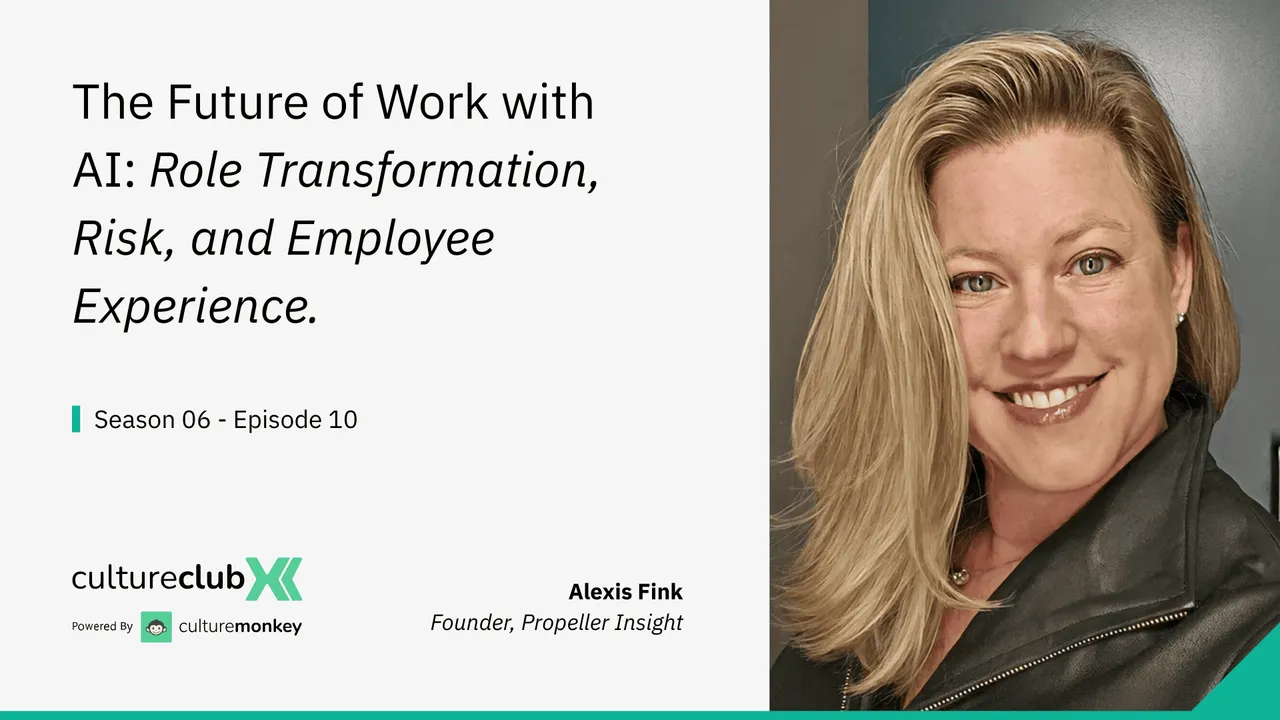
Will AI replace jobs or augment them? | Alexis Fink, former VP People Analytics at Meta
Fewer than half of successful AI implementations cut headcount, says Alexis Fink, former VP of People Analytics at Meta, citing Stanford research. Repetitive, well-described, lower-risk work such as scheduling is the most exposed; elsewhere AI lifts the quality of work. The hard part is process redesign, change management and employee anxiety, not the technology.
TL;DR
What you need to know from this episode
- AI transformations rarely fail because of the technology; they fail on integration, process redesign, change management, and absent executive sponsorship. Alexis Fink points to a recent Stanford study showing the frontier models can already do most of what organizations need; the real barriers are the human and organizational systems around the technology, not the model itself.
- The useful question is not which roles are disrupted, but which are being augmented versus replaced. Repetitive, well-described, lower-risk work (like scheduling) is genuinely replaceable; work where quality, innovation, or previously impossible capability is the goal tends to pull in more talent, not less. The history of industrial revolutions suggests new categories of work emerge faster than old ones vanish.
- Leaders consistently underestimate employee anxiety, and humans are wired to overestimate loss. Drawing on Tversky and Kahneman's loss-aversion research, Fink argues that when work is at risk, leaders must over-communicate and over-engage, because employees will over-index on what they might lose long before they see any upside.
- Mature listening is real-time, segmented, and treats rollouts as genuine experiments. Passive listening during announcements, minute-by-minute reaction analysis, and staggered rollouts that create real control groups let HR isolate what is working and why, combining objective throughput data with the emotional signals of frustration, confusion, excitement, and engagement.
- HR is uniquely positioned to lead the redesign of work, provided it forms tighter partnerships with IT, finance, and engineering. HR owns org design, job design, job pricing, and the architecture of performance management. Fink calls HR "the ones who build the rails the entire organization runs on," making it the natural owner of how AI reshapes work, not just who is affected by it.
- Survey fatigue is usually inaction fatigue; asking a question you will not act on can manufacture discontent. Fink's single non-negotiable for 2026 is a robust, transparent, two-way mechanism for connecting with people. Every question creates an expectation of response; closing the loop visibly ("you said X, we did Y") is what converts listening into trust.
Is AI really a technology problem?
Alexis Fink has spent her career at the intersection of technology, data, and talent, leading people analytics and workforce strategy at Meta, after earlier roles at Microsoft and Intel, and now advising organizations through AI strategy and organizational transformation as the founder of Propeller Insight.
Her path to AI is unusually long: before she ever entered the tech industry, she was building the underpinnings of AI (matrix algebra, optimization models) in manufacturing settings and in graduate research on performance and safety in aviation. So when she names the single biggest misconception leaders hold about AI, it carries weight.
The misconception is that AI adoption is fundamentally a technology decision. Most of the conversation, she observes, fixates on tooling: which model is marginally better, which contract to pursue, whether this frontier model edges out that one. But the data, including a recent and, in her words, excellent Stanford study, points somewhere else entirely.
Any of the frontier models can already do most of what organizations need (coding being a partial exception). The failures are not in the technology. They are in integration, in updating business processes, in reimagining how jobs work, in change management where people feel distressed, and in the absence of active executive sponsorship to remove blockers.
These are the things, she notes, that we already know matter whenever you fundamentally change how work happens.
The technology, of course, is important, but it is a yes-and situation. You need to get the technology right, and you need to do more in terms of tackling the right problem and rethinking habits we have had for a century of organizational management.
Fink reaches for a telling precedent: robotic process automation has existed for years, yet was never used widely, not because it was impossible, but because everything around it was hard. The low utilization rate of a technology that could scalably execute tasks tells us less about the tools and more about management, leadership, and the work of reconfiguring jobs.
Those are the lessons that genuinely transfer to the AI moment. For people leaders, the implication is direct: treating GenAI in HR tech as a procurement exercise rather than an organizational design challenge is the most reliable way to join the majority of stalled implementations.
Will a role be augmented or replaced by AI?
When Darcy asks how to separate roles that are truly being transformed from those merely being disrupted, Fink reframes the question in sharper terms: which roles are being augmented, and which are being replaced? Replacement-friendly work tends to share a profile: repetitive, relatively low-risk, well-described, and easily specified to a machine. Her example is the scheduler.
Threading the needle of mapping calendars together is exactly the kind of task that does not need a person; it is an excellent automation use case. In large organizations, some people's entire job was scheduling, and that job is genuinely replaceable.
But the more interesting question, she argues, is what the people in those roles were actually skilled at. Was scheduling really negotiation and diligence and expertise? Was it the first rung on a career ladder they can now climb? Or is it work that would simply be displaced?
On the other side of the ledger are roles where things that were never possible before suddenly are, or where the same work can now be done at a far higher level of quality. That is not a volume play that needs fewer people; it is a quality play, or an innovation play, and those tend to pull in excellent talent rather than shed it.
If you look at the history of industrial revolutions, those factory jobs did not go back to the farms; they spawned machinists, engineers, and marketers, an enormous new set of jobs we had never thought of.
Fink illustrates the augmentation case with her own former team, a group rich in PhDs who nonetheless spent enormous amounts of time cleaning data, building dashboards, and fighting with code, while fielding roughly three times more requests than they could fulfill because they were gated by capacity.
Remove the data-cleaning and code-wrangling, and that team does not shrink; it elevates: solving a higher volume of questions, with more precision, in closer partnership with clients, producing solutions that match the strategic requirement more tightly. She is candid that some work will involve fewer heads in some organizations.
But the radiology cautionary tale cuts against the panic: for a decade, people predicted AI would end radiology, yet, much as the MRI created more physicians rather than fewer, radiologists have not disappeared, and AI's probabilistic tendencies (describing images that were never uploaded) have introduced new problems that still require human judgment.
Building a credible view of employee skills beneath each role is what lets a workforce strategy distinguish a displaced task from a redeployable person.
How does loss aversion change the AI transition playbook?
Fink is direct about what leaders miss. They live in a bubble: excited about efficiency and innovation, anxious about falling behind, pushing hard to move forward. And organizations often have what she calls a clay layer through which information cannot travel up or down. The result is a persistent underestimation of how much anxiety employees carry.
The questions employees are actually asking are intimate ones: What does this mean for me? For my family? For my skills: am I still relevant? Will I still be able to afford the life I have committed to? That anxiety is not abstract.
She points to the wave of layoffs in recent years where people are being re-employed, but in many cases at substantially lower wages, which makes the fear about mortgages and college tuition entirely rational.
This is where her analytical background sharpens the point. Drawing on the loss-aversion research of Tversky and Kahneman, the work behind Thinking, Fast and Slow that won a Nobel Prize, Fink notes that humans systematically and dramatically overestimate loss. We over-index on it.
The leadership consequence is non-negotiable: when there is a genuine risk of loss, you have to over-communicate and over-engage, because people will overestimate and overprioritize that loss no matter what. And she pairs this with a second insight from the Stanford study: among successful AI implementations (real projects, not layoffs dressed up as AI), fewer than half resulted in headcount reductions.
The majority pointed toward upside potential rather than cuts, a fact most anxious employees never hear.
Most executives do not really know what the work is. They remember how they did it 20 years ago; that is not how it is happening now. You have to get close enough to the work to make thoughtful decisions about how to redesign it.
The redesign decisions that follow, covering how to design jobs, reporting relationships, and skills in ways that unlock upside rather than just subtract heads, depend on leaders being close enough to the actual work, or engaging people who are.
Getting this transition wrong does not just slow adoption; it erodes trust in leadership at precisely the moment organizations need it most, and accelerates the disengagement that feeds voluntary attrition among exactly the people you hoped to redeploy.
Mature AI-Era Listening: How Alexis Fink Measures the Human Impact of Adoption
Alexis Fink's approach to sensing the human side of AI transformation combines real-time passive listening, true experimental design, qualitative analysis at scale, and a disciplined response loop that turns sentiment into action.
Listen in Real Time, Not in Retrospect
Turn on passive listening through real-time channels during announcements and rollouts, even minute-by-minute during a talk, to see which parts resonate and which create anxiety or frustration as they happen, before employees have ruminated and reshaped the signal.
Treat Staggered Rollouts as Genuine Experiments
When one group goes live and another has not, you have a real control group sharing the same economic context. Segment by role and by rollout schedule to isolate what is genuinely working from what is noise, a rare and powerful form of organizational experimentation.
Combine Throughput Data With Emotional Signal
Do not measure only the objective metrics of widgets through the process. Track where people express frustration, confusion, and anxiety versus excitement, engagement, and creativity, because the emotional signal is what predicts whether a rollout sticks.
Qualitative Analysis at Scale: Applied Directionally
With tens of thousands of pieces of qualitative feedback, LLM or traditional NLP techniques can surface the factors driving positive versus negative emotion. It will not be perfect, but it is directionally useful; directional truth at scale beats precise data on a fraction of the population.
Hunt for Causal Mechanisms, Then Apply Them
Settings with natural case studies, such as retail with its store-level managers and community attributes, let you understand why one rollout went well and another did not. Capture that causal learning and apply it deliberately to the next tranche of implementations.
How should the HR function change to build the rails for AI?
Asked how CHROs should rethink HR's structure, skills, and mandate, Fink owns her bias as a people analytics person: data should be the central pillar holding the function up, even in traditionally expertise-led areas like learning and development or executive succession, where there is mounting evidence that data can matter more than organizations assume. But the structural shift she emphasizes is partnership.
HR needs tighter alignment, if not outright joining, not only with IT (a trend already a year underway) but with finance, the people who measure outcomes and care about them, and with engineering or manufacturing depending on the organization.
The point is that agentic and IT smartness alone is insufficient; you need the financial structures and disciplined thinking to make the best possible choices about technology while drawing out the best of what people bring.
And then comes her central claim about why this is HR's moment. HR is the specialty organization about work as well as about workers. It understands what people are capable of and how skills connect to other skills, which is what makes upleveling, sometimes across entirely different functions, possible.
HR has long done the org design, the job design, the pricing of jobs against the market, and the architecture of performance management.
We are the ones who build the rails on which the entire organization runs. The more HR embraces its partner organizations and that role in reinventing how work happens, the more opportunity organizations have to leapfrog.
The opportunity, in other words, is for HR to move from administering the consequences of change to authoring it: redesigning work and rewriting the inherited rules that may no longer fit.
That requires fluency in HR analytics and a willingness to revisit organizational design from first principles rather than defending the architecture of the past.
Sense the human side of AI transformation in real time
See how CultureMonkey's pulse survey tools and real-time sentiment tracking help people leaders detect anxiety early, segment by rollout group, and close the loop on feedback before survey fatigue becomes disengagement.
What is the one non-negotiable for leaders during AI change?
Pressed to name a single non-negotiable action for people leaders in 2026, one move to build AI capability while protecting trust and experience, Fink does not hesitate, even as she acknowledges it may sound like pandering. Leaders need a robust and transparent mechanism for connecting with their people.
She is deliberately hesitant to call it simply "listening," because it has to be two-way: a way to genuinely keep a finger on the pulse of what is happening inside the organization. In a moment defined by speed and anxiety, the connection itself is the capability.
Is survey fatigue really inaction fatigue?
On how platforms like CultureMonkey support leaders, Fink is emphatic about one failure mode: data must not go into a black hole. Sensing matters, but reflecting it back, "you said this, I heard you, and here is what I am going to do about it," matters more. Sometimes the honest answer is that you will do nothing, and that is acceptable, but you have to own it.
In fact, if you are genuinely unable to address something, she suggests you might consider not asking it at all, because every question creates an expectation of action. Fail to meet that expectation, and you can manufacture greater discontent than if you had stayed silent.
This reframes one of the most common complaints in the field. People talk about survey fatigue, but Fink, echoing many of her friends in the survey community, argues it is actually inaction fatigue: if I have told you five times that something is broken and you have never done anything about it, I will stop telling you.
The remedy is to design excellent, relevant questions you are genuinely willing to act on, then embed them in a regular rhythm: monthly reviews, spike alerts, weekly scans for anything unusual, high or low. Crucially, the solutions cannot live behind the scenes; they have to be tied directly back to the feedback.
A healthy employee feedback loop sounds like "you said X, we did Y," or "three months ago you said X, we did Y, and now X has improved, thank you for sharing it so we could move forward."
Anytime you ask something, you are creating an expectation that it will be addressed. If you do not meet that expectation, you can actually manufacture greater discontent.
Fink's final analytical move is to connect signals across the lifecycle. In past roles she has tied the employee survey to exit behavior, onboarding survey results, and candidate behavior, signals that surface at different time horizons and, taken together, tell a coherent story about particular segments or about weaknesses in the employee value proposition.
And she leaves leaders with a reassurance worth holding onto: when she works with large groups, everyone assumes everyone else is further along on their AI journey, when in reality most are still experimenting or struggling to get off the starting blocks. A Harvard economist friend reminded her it took roughly 40 years to figure out how to use electricity.
If you feel behind, you probably are not; stopping to be planful, getting out of panic mode, and acting on what your employee sentiment data is telling you may be the fastest way forward.

About the guest
Alexis Fink
People Analytics Leader, formerly Meta, Microsoft, Intel
Alexis Fink, PhD, is a technology executive with 20 years of leadership at Microsoft, Intel, and Meta, most recently as VP of People Analytics and Workforce Strategy. In her "post-corporate season," she is advising startups, speaking and writing, and helping organizations directly as they wrestle with organizational transformation, AI strategy and implementation, and organization effectiveness and design. She is an innovator who drives results at the intersection of technology, data, and talent, known for her strategic vision, inclusive leadership, and ability to translate technical challenges into actionable solutions that drive business value.
She is a Senior Research Scientist at the Center for Effective Organizations, leads the People Analytics Board for the Institute for Corporate Productivity, and is Past President of the Society for Industrial and Organizational Psychology. She is the author of two highly regarded books, Investing in People and Employee Surveys and Sensing.
Full episode transcript
Season 06, Episode 10 · Alexis Fink with Darcy Mehta · 31 min
Hello everyone and welcome to season six of CultureClub X powered by CultureMonkey. I'm your host, Darcy Mehta. CultureMonkey is an AI-powered employee engagement platform that helps organizations listen to their employees and strengthen workplace culture.
CultureClub X is our global thought leadership forum where CHROs and people leaders share insights, discuss trends, and exchange practical strategies for building future-ready organizations.
Today we're so pleased to welcome Alexis Fink, founder of Propeller Insight. Alexis, welcome. It's so great to have you here with us.
Thank you. I am really delighted and looking forward to this conversation.
Likewise, yes. And to give a little bit of your background, Alexis Fink is a technology executive with over 20 years of experience across Microsoft, Intel, and Meta, where she most recently led people analytics and workforce strategy. She now advises organizations on transformation, AI strategy, and organization design, with a focus on aligning technology, data, and talent to drive business outcomes. She's also actively involved in research and thought leadership in people analytics and organizational effectiveness, and has authored Investing in People and Employee Surveys and Sensing.
So, Alexis, your experience working at the intersection of AI, workforce strategy, and people analytics makes your perspective especially relevant for today's discussion. And we're so looking forward to exploring the topic: the future of work with AI, role transformation, risk, and employee experience. Before we begin, could you just briefly share your own leadership journey with us?
Sure. You did a great job in the intro. There are a couple of other things to mention. In the last year or so of my post-corporate season, I've been playing with AI as a key source of transformation. But ironically, before I moved into the tech industry, I was also playing with AI and some of the underpinnings of AI, matrix algebra and optimization models and these kinds of things, in the manufacturing setting and also through my graduate research, where I was building those kinds of models to really work on performance and safety, particularly in aviation and piloting contexts.
So this has really been a key theme of my entire career. And I'm really just so excited to see it being more accessible and being able to move into more kinds of contexts now.
Amazing. And I really like how you said "play", you just enjoy playing with it and learning about it. It shows you're obviously passionate about it, so you're working in the right realm for sure. Thank you for sharing that. So let's dive into our first question.
What is the most significant misconception organizations hold about how AI will transform roles? And what does research indicate compared to what leaders often assume?
That's such a great question, because so much of the conversation is about the technology. Which tool should I use? Is this model better than that one? How is this slightly better or slightly different than another? What contract should I pursue? And all of that is interesting and important, but most of the data, including a recent, really excellent study out of Stanford, showed that really the technology doesn't matter that much. In fact, any of the frontier models can do most of what you need. Maybe less so on the coding side, but most of your general applications.
And the barriers, the places, the failures are generally not the technology themselves. They're integration, they're updating business processes, they're reimagining how jobs might work, they're change management where people feel distressed, they are a lack of active executive sponsorship that removes blockers. They are all of those things that we know matter when you're fundamentally changing how work happens.
And so the technology, of course, is important, but it is a yes-and kind of situation. You need to get the technology right, but you need to do more in terms of tackling the right problem. You need to do more in terms of rethinking some of the habits we've had for a century of organizational management to fit into a new set of capabilities.
Absolutely. You said "yes-and," and my mind immediately went to improv, because that's what they teach you in improv class. And obviously things are moving so quickly that we need to be agile. So a lot of that same concept applies. And what you said about technology is so interesting, the technology is there, it's doing great things, but it's how are we using it, how are we learning to implement it in all the different areas.
Well, it's interesting, robotic process automation has been around for years and years and wasn't used very widely. Not because it wasn't possible, but because all the stuff around it was hard. Now, RPA has much more rigid requirements around the data used to feed it, so it's a more difficult implementation. But we've had technology that could scalably execute tasks for a long time. And the utilization rate suggests some things about management, leadership, reconfiguring jobs, all of those transformation elements that are lessons we really need to consider deeply.
That's why these interviews and podcasts are so important, right? Absolutely.
How do you distinguish between roles that are truly being transformed by AI versus those that are only being disrupted? And why is this distinction important for workforce strategy in 2026?
What a great question. And the way I'll reframe that is: which roles are being augmented and which roles are being replaced? Thinking through what kinds of work were never possible before, where you might be in more of an augmentation situation, versus the kinds of work that tended to be very AI-replacement friendly: things that were very repetitive, generally a little bit lower risk, things that were quite well described and that you can ask a machine to do.
One of the first places in organizations that many AI projects begin is somewhere in the recruiting space. And while a lot of attention goes to the candidate part of that, one of the early trends we saw were schedulers. And boy, you don't really need a person to walk through and try to thread that needle of making schedules map up. That is a great use case for technology, to look at all the relevant calendars and find something and manage all of that, as well as automation of updates. And so there are people in large organizations whose whole job was scheduling things, and that is a job that really is replaceable.
Now the question is: what were the skill sets of the people doing that scheduling? Was it negotiation and diligence? Was it expertise? Was that the first rung on a career ladder that now they can move up to? Or are those genuinely jobs that would be fully displaced?
On the flip side, there are all kinds of roles where things that were never possible before are suddenly possible, or things are possible at a much higher level of quality. Which doesn't mean that you need fewer people, because it's not a volume play, it's a quality play, or it's an innovation play. And those kinds of roles tend to pull in excellent talent as opposed to replacing it.
In my old team, we had an awful lot of people, which was marvelous, an awful lot of PhDs, and they still spent a bunch of their time data cleaning. They spent a bunch of their time fighting with code and making it do what they wanted. And we also had about three times the number of requests coming into our team than we could actually fulfill, because we were gated by capacity. So now that the team doesn't have to spend that amount of time cleaning data, building dashboards, fighting with their code, now they can focus much more on solving a higher volume of questions, solving with more precision, engaging more closely with clients, so the solutions are a closer match to the strategic requirement. All of those things suggest an elevation.
I don't want to sugarcoat the fact that there will absolutely be fewer heads involved in some work in some organizations. But if you look at the history of industrial revolutions, when work moved from farm to factory, those jobs didn't really go back to the farms, but they spawned an enormous new set of jobs that we had never thought of. They spawned machinists and engineers and marketers and all of these other things that were never really feasible or required in the prior framework. And so my expectation is we'll start to see some of that as well.
That's so true. Your example about the scheduler had me thinking, it used to go from pencil and paper and someone actually doing that. Then the computer came along, and maybe they thought they'd lose their job. But it's that idea that yes, there will be certain jobs that are replaced, but maybe there's that next rung on the ladder that person can move toward, or just completely new and different, exciting things.
It's been about ten years that we've been saying, golly, it'll be the end of radiology, right? Because one of the very early cases of AI and visual compute in particular was that AI can really help in diagnostic imaging. And it was really good at identifying cancers that were missed, which is true and great and incredibly powerful. But just like the MRI didn't get rid of physicians and in fact created more of them, we haven't seen radiologists disappear.
And in fact, I read a study recently that AI, unfortunately, is also very happy to describe images that were never uploaded. That's the probabilistic engine, it creates a new problem. And even if the diagnosis can be done, some of the conversation about meaning and what you're going to do with these results still remains. So like new innovations for millennia, we don't necessarily see a reduction in aggregate jobs. We see a shift in what's demanded. And an awful lot of that shift is away from things that are not that much fun to do, very repetitive, very boring, difficult vigilance tasks. I remember manually fixing large databases, and I'm really happy not to have to do that anymore.
Yes, data entry, things like that, where you just read so many hours it took. Terrible work. And the example with radiologists is so true. Of course we'd want to get a second opinion anyway, and with doctors you often do. But now maybe it's that your first or second opinion may be AI, but you're going to also want to have someone else check it. Very interesting.
So what did organizations underestimate about the human transition when AI entered the workplace? And what have you observed firsthand that leaders often overlook?
I think leaders are in such a bubble so often, where they're excited, excited about the efficiency, excited about the innovation, maybe anxious about falling behind, so wanting to push really far forward. And organizations often have a sort of clay layer through which information can't travel, either up or down. I do think a lot of organizations underestimate the amount of anxiety that their employees have. What does this mean for me? What does this mean for my partner, my family member, my kid? What does this mean for my skills, am I still going to be relevant?
If I was in a job that paid me very well, we're seeing this already with some of the trends coming out of these last several years of layoffs. People are being re-employed, but in many cases at substantially lower wages, substantially lower salary. So what does this mean about my ability to afford the life I've committed to, afford my mortgage, send my kids to college? That's real anxiety.
And the Stanford study I mentioned earlier showed that of successful AI implementations, where you're not just doing a layoff and AI-washing it and saying it's about AI, you're really doing a project, less than half of those resulted in headcount reductions. So the bulk of them are resulting in upside potential as opposed to headcount reductions.
But humans as a species are keyed to overestimate loss. We saw this in the Tversky and Kahneman work, if you picked up the book Thinking, Fast and Slow, they won a Nobel Prize for this, that people really, really overestimate loss. They over-index on it, and they're really anxious about it. So you have to over-communicate and over-engage when there is a risk of loss, because people will overestimate and overprioritize that loss.
So what are the things you can do to engage with the folks actually doing the work? How do you make sure you know what they're really doing, which, frankly, most executives don't? They remember how they did it 20 years ago. That's not how it's happening now. Make sure you're actually close enough to the work, or you're engaging people who are close enough to the work, that you can make thoughtful decisions about how to redesign work, how to design jobs, how to design reporting relationships, how to think about skills in ways that allow that upside potential and competitive growth, as opposed to ways that are just "how many people can I get rid of?"
Absolutely. It comes down to communication, which seems so simple, right? But it always bears repeating. And like you said, leaders often live in a bubble, and they're also learning AI and learning how to navigate everything that's going on. So sharing that, and finding out their employees' anxieties, is so key.
This leads to the next question: how should organizations use people analytics and real-time employee sensing to measure the human impact of AI adoption? And what does a mature listening approach look like today?
Oh my gosh, how much time do we have? In the past, I've been able to very successfully use passive listening of public-ish reactions. So for example, as things are being announced, many organizations have something like a Slack or some kind of real-time tool, CultureMonkey or another, that has some real-time capabilities. And you can often turn those on, not only when an event is happening so you can see in real time how people are reacting, but I've also been able to use it even during a talk or an announcement, to see what parts resonate well, where you'll get positive reactions or positive comments on a minute-by-minute analysis, or which parts are creating anxiety or challenge or frustration.
Also, the ability to parse out different segments based on their role, or different segments based on a rollout schedule, which is a really lovely form of genuine experimentation. You have a real control group when one group goes live and the other group hasn't. They have the same economic context and other things, and one has had the intervention and the other hasn't had that rollout yet. So it gives you an opportunity to find what things are working well, and to make sure that listening is not just on the objective measures of widgets through the process, but also on those things where people are expressing frustration, confusion, anxiety versus excitement, engagement, creativity.
And we're seeing more and more the ability to use qualitative analysis. While it's not perfect, and I struggle with some of the boundaries of imperfection as well, it is directionally useful. If you have tens of thousands of pieces of qualitative information that you need to make sense of, you don't necessarily need absolute perfection to get something directionally useful. Whether it's an LLM or more traditional natural language processing, the ability to make sense of where people are experiencing positive versus negative emotions, and what factors are leading to that, is powerful.
Retail establishments are great for this, because you have natural case studies. What are the behaviors of this store-level manager, and we did this rollout, and how did it go versus this store-level manager? Where you can really start to understand causal mechanisms, and then take that learning and apply it to the next tranche of implementations.
So true. It's easy in retail, like you said. And that passive listening during real-time events is so valuable, because you're getting those emotions, those feelings, those thoughts while something's going on, even before someone's had a chance to ruminate on it more. So valuable.
How should CHROs rethink the HR function, its structure, skills, and mandate, to remain effective as AI reshapes work?
I will own that I am a people analytics person, so of course I think data should be the key pillar that holds the whole thing up. Even if you're looking at something that traditionally has less data to it, learning and development, executive succession, organization development, which traditionally have a lot of expertise as opposed to dispassionate data, I think there's more and more evidence that those can really matter.
One of the things HR needs to get really good at is tighter partnerships, if not outright alignment or joining, with not just IT, which is a trend we've seen for the last year, but also with finance, because they're the folks who measure stuff and care about outcomes, and engineering or manufacturing, depending on the nature of your organization. In other words, we need not just the agentic or IT smartness happening here; we also need some of the financial structures and thinking through how we're going to make sense of all of this, so we can make the best possible choices that take advantage of the technology available to us while using the very best of what people in the system bring forward.
And I do believe HR has this really incredible opportunity in front of us at this moment, because HR is really the specialty organization about work as well as about workers. We are the ones who have a great idea about what people are capable of and how those skills and capabilities connect to other skills and capabilities, so we can uplevel them. Sometimes that means changing functions entirely, but it lets us drive to higher performance and higher levels of work.
Additionally, we are the folks who've been doing org design. We are the folks who've been doing job design. We are the folks who've been pricing jobs against the market. We are the folks who've been building the architecture for performance management. We are the ones who build the rails on which the entire organization runs. And so the more HR embraces its partner organizations and embraces that role in reinventing how work happens, and all of the rules that we grew up and cut our teeth on that may or may not fit us well, the more opportunity organizations have to really leapfrog in their capabilities and competitive advantage. It's an exciting time.
Absolutely, HR's the most important, right? And what you said about tighter partnerships works both ways. Obviously HR is understanding more, but if it's the finance department, if it's engineering, they're also going to be able to learn from HR. So it's going to work both ways. It is an exciting time.
This might be hard to answer, but what is one non-negotiable action people leaders must take in 2026 to build AI capability while maintaining trust and employee experience?
I only get to choose one? One thing they have to do to build capability while maintaining experience. As much as it may sound like pandering, I think they really need a robust and transparent mechanism for connecting with their people. I'm hesitant to use the word "listening," because it needs to be two-way, but some way to really make sure that their finger is on the pulse of what's going on inside their organization.
I agree. That's a good answer. It's hard to pick one, right? There are so many things.
So how can platforms like CultureMonkey support leaders in tracking real-time sentiment and managing engagement as AI changes how work is done?
It is really, really important to make sure that the data are not just going into a black hole. The sensing is important, but more than sensing is reflecting it back to the organization and saying, "You said this, and I heard you, and here's what I'm going to do about it." And sometimes what I'm going to do about it is nothing, but you need to own that. And if you are genuinely unable to address something, you might want to consider not asking it. Because anytime you ask something, you're creating an expectation that it will be addressed. And if you don't meet that expectation, you can actually manufacture greater discontent.
So the main thing you can do is make sure you are thoughtfully designing, analyzing, and responding to the feedback your population is offering you. People will talk about survey fatigue and not wanting to respond. I've got a lot of friends in the survey community who talk about the fact that it's actually just inaction fatigue. If I've told you five times that this is broken and you've never done anything about it, I'm going to stop telling you.
So design really excellent, relevant questions you're willing to do something about, and then embed that in a regular rhythm. Are you looking at these every month? Every time something spikes? Every week, addressing anything out of the ordinary, high or low? And how do you make sure those solutions, those places where you address something, aren't behind the scenes where no one knows about them? How do you directly tie those changes to the feedback you received? "You said X and we did Y to address it." Or, "Three months ago you said X, we did Y, and now X has improved. Thank you for being willing to share that, so we could do something about it and move forward." Really making sure that you're closing that loop.
Alexis, we've asked this question before, and we've talked with others about what's the point of a survey if you're not acting on it and on the feedback. But you expanded on this so well and gave me so many other things to think about. Making it regular is so important, and thoughtfully designing the questions, if you're not prepared to address those or make changes, it could actually work in the opposite direction and provide discontent. So being more thoughtful in that regard makes so much sense.
And it can be really useful. In my past roles, I've tried to connect the employee survey to exit results, exit behavior, onboarding survey results, and also candidate behavior. You tend to get signals that show up at different time horizons, and you can get some really helpful information about particular segments, about particular problems in your employee value proposition or the way you're engaging with folks, that can help you tie together a coherent and compelling story by adding in some of these extra signals that you're reviewing on a regular basis and actively and openly responding to.
So true. Well, Alexis, I could talk to you all day. Thank you so much for sharing your insights with us today. Is there anything else you'd like to share, or a topic we didn't get to?
This was great fun, I really appreciate it. I don't think I'd pick one thing we didn't get to, there are so many things to address in this moment. I'd just leave with the idea that over and over again, when I work with large groups, everybody thinks everybody else is farther along on an AI journey. And the number of folks who say, "Hey, we're just really still experimenting," or "We're having a hard time getting off the starting blocks, our experiments aren't paying off", if you feel like you're behind, you probably actually aren't. So taking a moment to stop, be planful, get out of panic mode, and really be thoughtful might be your best way forward.
That's great advice, because I think a lot of organizations and employees feel that way. It is moving so fast and changing so quickly, and it's coming at us so much, so we're always feeling that we're behind. It's great to know that in reality, if I'm feeling that way, so is everyone else. We're not as behind as we think we are, because everyone is experimenting and there's a lot to cover.
One of my friends, a Harvard economist, pointed out that it took us 40 years to really figure out how to use electricity. It just takes a while.
Forty years. Wow. We're doing good now, I think.
I think we'll shorten that time horizon by a little bit. But the point is, it's not overnight.
That's so fascinating. Well, your perspective highlights the importance of balancing technological advancement with a clear focus on the human experience. As organizations continue to adopt AI, it becomes essential to understand not just how work is changing, but how people experience that change. And this is where CultureMonkey adds value, through real-time listening and pulse surveys that help leaders understand employee sentiment and take timely, informed action. Before we conclude, Alexis, how can our listeners connect with you and continue the conversation?
Thank you very much. I am easiest to find on LinkedIn. There are not that many Alexis Finks, I'm the one who does surveys. And I would be delighted to talk with folks in your audience.
I'm sure many will connect with you, as will I. And to all of our listeners, thank you so much for joining us today. Don't forget to follow, share, and subscribe. And that's a wrap for this episode of CultureClub X powered by CultureMonkey. Until next time, I'm your host Darcy, signing off.
Frequently asked questions
Why do most AI transformations fail, if not because of the technology?
They fail on the organizational systems around the technology, not the model. Alexis Fink notes that frontier models can already do most of what organizations need, and recent Stanford research finds the real barriers are integration, updating business processes, reimagining jobs, change management, and the absence of active executive sponsorship. Getting the technology right is necessary but not sufficient; the harder work is rethinking management habits built over a century.
What is the difference between a role being augmented by AI and one being replaced?
Replacement-friendly roles tend to be repetitive, lower-risk, and well-described; scheduling is a classic example. Augmentation applies where AI makes previously impossible work possible, or lifts the quality of existing work, which usually pulls in more talent rather than less. Fink stresses looking beneath the task to the person's underlying skills: some replaced roles are first rungs on a ladder the employee can now climb, while others are genuinely displaced.
How should leaders communicate about AI when employees are anxious about their jobs?
Over-communicate and over-engage. Because humans systematically overestimate loss (a finding from Tversky and Kahneman's loss-aversion research), employees will over-index on what they might lose well before they see any upside. Leaders should also share the fuller picture: the Stanford study Fink cites found fewer than half of successful AI implementations led to headcount reductions. Getting close enough to the actual work is what lets leaders make credible, thoughtful decisions about redesign.
What does a mature real-time employee listening approach look like during AI adoption?
It is real-time, segmented, and experimental. Fink recommends passive listening through real-time channels during announcements, even minute-by-minute, to catch reactions before employees ruminate. Staggered rollouts create genuine control groups for clean comparison, qualitative analysis via LLM or NLP makes sense of large volumes of open text directionally, and combining throughput data with emotional signals (frustration, confusion, excitement, engagement) reveals the causal mechanisms worth applying to the next rollout.
Why is survey fatigue actually inaction fatigue?
Because people stop responding when feedback goes nowhere. As Fink puts it, if you have told someone five times that something is broken and nothing changes, you stop telling them. Every question creates an expectation of action, so asking something you will not address can manufacture discontent. The fix is to design relevant questions you are willing to act on, embed them in a regular rhythm, and visibly close the loop:"you said X, we did Y," so people see their input drives change.
How should CHROs rethink the HR function as AI reshapes work?
Make data the central pillar and build tighter partnerships with IT, finance, and engineering. Fink argues HR is uniquely positioned because it is the specialty organization about work as well as workers; it owns org design, job design, job pricing, and the architecture of performance management. By embracing those partner functions and its role in reinventing how work happens, HR can move from absorbing change to authoring it, helping organizations leapfrog in capability and competitive advantage.
Read the cross-episode roundups
More from CultureClub X
 S07 E03employee engagementWhy do grievance procedures damage workplace culture? | David Liddle, The TCM Group
 David Liddle
 S07 E02change leadershipHR as Chief Disruption Officer: Why Supporting the Business Is a Ceiling, with Jennifer McClure
 Jennifer McClure
 S06 E20change leadershipWhy does culture change stall? | Jamie Notter, culture scientist
 Jamie Notter
Never miss an episode
Every new episode, plus the takeaways that matter, posted on the CultureMonkey LinkedIn page as soon as they drop.
Free on LinkedIn. Unfollow anytime.