

S06 E05
Spotting Culture Erosion Before It Spreads
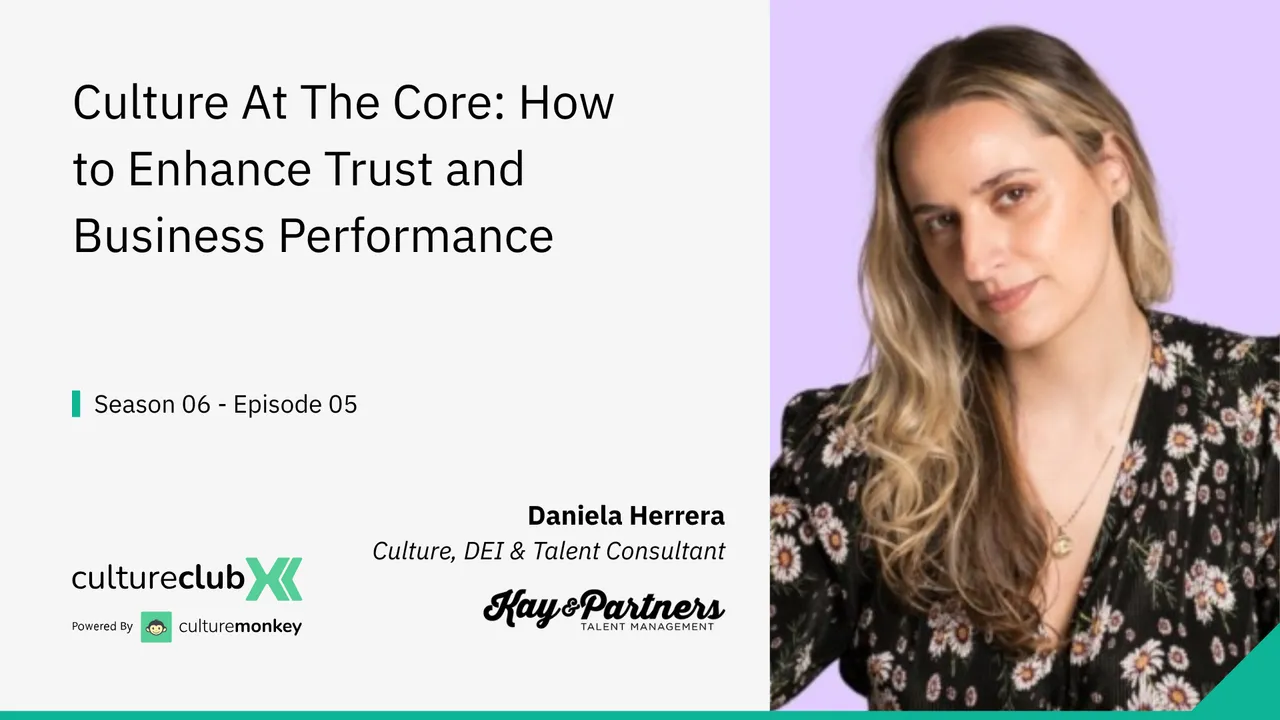
Dani Herrera, award-winning bilingual DEI consultant, trainer, and speaker joins us to break down how to read culture erosion before it surfaces in engagement scores, why DEI must be embedded rather than delegated, and how to rebuild trust after an organizational misstep.
TL;DR
What you need to know from this episode
- Engagement scores are the beginning of the analysis, not the final word. The more revealing signal is who is answering your surveys - and which demographic groups are silent. A uniform high score that masks missing voices is a culture warning, not a culture win.
- Culture is the software - your organization is the hardware. You cannot run the computer without software. The moment culture is treated as a nice-to-have or a checklist item, you start removing critical pieces of how the whole system runs.
- DEI that is "everyone's responsibility" is effectively no one's responsibility. Sustainable DEI requires a dedicated owner with C-suite access, embedded into every process and policy - not distributed as an implicit obligation across the workforce without structure or expertise.
- Trust is the easiest thing to break and the hardest to rebuild. Rebuilding requires three distinct steps - acknowledge, apologize, and act - plus continuous communication at every stage of recovery. Stopping after the apology is only half the work.
- Most managers share opinions, not feedback. Real feedback is clear, specific, actionable, and time-bound. When vague opinions pass as feedback and go uncorrected, they normalize into culture - and reversing normalized culture is far harder than preventing it.
- PTO data and one-on-one quality are two of the most overlooked culture signals. Who is not taking time off - and why - often reveals managerial dysfunction that surveys never capture. Whether managers conduct career conversations, not just project updates, is an equally telling indicator.
- Technology is only as good as the intention behind it. Going into a survey tool with the goal of "getting the quarterly check done" produces meaningless data. Entering with the goal of understanding why engagement is shifting produces strategic insight. The platform is the same - the purpose is not.
Why engagement scores can mask a culture that is quietly eroding
Dani Herrera has spent two decades working at the intersection of talent, equity, and culture - and the first thing she will tell a people leader reviewing strong engagement numbers is: look deeper. As a bilingual Latina immigrant and award-winning DEI consultant, Dani has worked with companies across industries where the scores looked fine and the culture was in early decline.
The problem is not the data - it is what the data does not show.
The diagnostic she recommends goes beyond headline scores. The more important question is who is answering your surveys. Not the individual - but the demographic pattern. Are responses clustering in one group? Are entire functions, levels, or demographic segments conspicuously underrepresented?
If a particular demographic is consistently flagging the same leader or the same policy, that signal is far more meaningful than an aggregate number.
According to culture metrics research, organizations that segment survey response data by team and demographic are significantly more likely to detect at-risk pockets before they turn into attrition events.
We tend to look at numbers as the final word. The way that I like to look at it is just the beginning. It is the foundation for us to start identifying what might be happening or might not be happening.
The second category of signals Dani tracks is data that surveys cannot capture at all. An employee can report high engagement on a survey while being quietly disengaged from their manager, staying only because of a personal situation that makes leaving impractical right now. The survey answer and the lived reality are not the same thing.
Building listening channels that go beyond structured surveys - informal conversation, behavioral observation, and qualitative data - is how organizations get closer to the truth.
Culture is the software: how to make the board understand what culture actually is
One of Dani's most repeatable insights is the analogy she uses when entering a C-suite or boardroom conversation about culture: culture is the software. Your organization is the hardware. You cannot run the computer without software. Strategy, finance, product - these are also software. But culture is the operating system that makes all of it run.
The moment you treat culture as a separate, optional add-on rather than an integrated system component, you start degrading the whole machine.
This framing matters because it removes the abstraction that allows boards to deprioritize culture investment. Companies that perform best on revenue, talent attraction, and client retention tend to be people-first organizations that build the business around their employees. That is not sentiment - it is a structural design choice.
Research on how strong company culture drives employee performance consistently shows that organizations with intentional cultures outperform their peers on key business metrics, including retention and productivity.
Culture is the software. You cannot run your computer without software. The moment that we start thinking about culture or DEI as a nice to have, as a checklist - that's when we fail the computer.
Dani is also candid about what holds CHROs back from making this case effectively. People functions frequently lack the air time at the board level that finance and product take for granted. And even when CHROs do have the floor, they sometimes fail to translate their work into business language that their colleagues can act on.
Dani's approach is to start by making sure everyone is on the same page about what culture and DEI actually mean before introducing strategy. Jargon does not build alignment - shared understanding does.
The Culture Erosion Early Warning System
Dani Herrera's multi-signal diagnostic framework for identifying culture erosion before it appears in engagement scores - using behavioral data, PTO patterns, manager quality signals, and qualitative listening to build a complete picture of organizational health.
Segment Survey Responses by Demographic
Do not read aggregate scores - read the response pattern. Who is answering, and who is not? Flag any demographic group that is significantly underrepresented or that is consistently pointing to a specific leader, process, or policy. Silence is a signal.
Audit PTO Utilization and Rejection Patterns
Track not just who is taking time off but who is not - and why. In unlimited PTO environments, chronically low uptake often signals managerial pressure. Rejected PTO requests, grouped by leader, reveal dysfunction that never surfaces in a survey.
Assess One-on-One Quality, Not Just Frequency
Are managers having only project conversations, or do they also hold regular career growth and personal check-in conversations? Whether every person in a meeting knows what action to take afterward is a real-time indicator of managerial effectiveness and psychological safety.
Read Written Survey Responses, Not Just Ratings
Data analysts default to quantitative scores. Dani goes directly to written answers - the text responses people give when given the opportunity to explain. These answers contain the nuance, the specific frustration, and the early signal that a one-to-five scale cannot carry.
Pattern-Find Across Exit Interviews
Exit interviews taken individually are anecdotes. Exit interviews analyzed for demographic patterns and recurring themes become a leading indicator. If a specific function, level, or identity group is overrepresented in exits, that is a structural signal - not a coincidence.
DEI ownership: why diffusing responsibility kills the work
One of Dani's most direct arguments is about DEI ownership. The instinct to make DEI "everyone's responsibility" sounds inclusive but produces the opposite outcome in practice. When something is everyone's responsibility, it becomes no one's responsibility.
The work gets diluted, de-prioritized, and handed to people who lack the training to do it well - and in some cases, doing it poorly creates more harm than not doing it at all.
The architecture Dani recommends starts at the top. Leadership must genuinely understand what DEI is - not as a talking point, but as a strategic practice - before any broader rollout begins. That requires a dedicated, experienced DEI leader with direct access to the C-suite and ideally the board. From there, DEI gets embedded into processes and policies rather than being added on as a programming calendar.
ERGs and awareness events are a small, supplementary piece of a much larger system. Tracking DEI metrics rigorously is how organizations move from intention to accountability.
If DEI is everyone's responsibility, it is actually no one's responsibility. We want to make sure we have someone experienced in the area - collaborating directly with the C-suite and the board - because even today in 2026, many leaders do not really understand what this work is all about.
Dani emphasizes that this is not a one-day initiative or a seasonal campaign. DEI affects every internal communication, every product decision, every hiring process, and every team interaction.
Organizations that perform it as a periodic event rather than an integrated operating principle will see the gap between stated values and lived experience widen - and the employees who take stated values most seriously are always the first to leave when that gap becomes undeniable.
Addressing bias in the workplace systemically, not reactively, is what separates performative DEI from effective DEI.
Surface culture erosion before it reaches the exit interview
See how CultureMonkey's employee trust surveys and demographic segmentation help CHROs identify which groups are disengaged - and act before high performers walk.
How to rebuild trust after an organizational misstep - and why communication is the step leaders forget
Trust, Dani argues, is the easiest thing to break and the hardest to rebuild. And the hardest part is not the acknowledgment or the apology - it is the sustained, transparent communication that must follow every step of the recovery process. Most organizations stop too early. They acknowledge the misstep, issue an apology, announce a corrective action, and then go quiet.
That silence reads as indifference, not progress.
The framework Dani applies to trust recovery has three core phases. First: acknowledge what happened, without qualification or defensiveness. Second: apologize specifically to whoever was harmed, not generically to "the organization." Third: take action to repair the harm - and simultaneously take action to ensure it cannot happen again.
The second half of that third step is what most organizations skip, because it requires structural change rather than a symbolic gesture.
We tend to believe that the moment we acknowledge the problem and apologize and start doing something about it, that's done. That is only half of the steps. You need to communicate what you are doing at every single step of the way - including when things are not going the way you planned.
The communication requirement extends beyond announcements. Leaders must update employees when a corrective step does not work as intended, explain the pivot, and name what they are doing next. That level of transparency is rare - and precisely because it is rare, it is powerful. It signals that the organization is operating in genuine partnership with its people rather than managing perceptions.
Building trust in the workplace requires consistency of action over time, not a single well-crafted statement.
Why managers share opinions instead of feedback - and how that becomes culture
One of the most consequential and underdiagnosed culture problems Dani encounters in her client work is the widespread conflation of opinions and feedback. Most managers, she observes, are giving opinions. Feedback that is genuinely useful is specific, observable, actionable, and time-bound.
Telling someone they "could do better next time" or that they "came across as a little too abrasive" is not feedback - it is an impression. And when impressions pass as feedback without being corrected, they normalize.
Normalization is the mechanism by which individual managerial habits become organizational culture. One manager's vague, subjective "feedback" becomes the standard for how people are evaluated across a team. That standard gets internalized by direct reports who then model the same behavior when they become managers.
Over time, an entire organization's feedback culture is shaped by a practice that no one consciously chose. Developmental feedback - structured, growth-oriented, and clearly actionable - requires training that most organizations do not invest in until the cultural damage is already visible.
Dani's diagnostic for this is straightforward: she looks not at the content of written feedback records, but at whether managers know how to give feedback at all. Does a framework exist? Is it followed? Are one-on-ones structured to include career conversations, or are they purely task reviews?
The quality of the one-on-one relationship between a manager and an employee, Dani argues, is where most culture issues actually begin - and where they can also be most effectively intercepted. Workplace culture is built or broken in these daily interactions long before any survey captures the signal.

About the guest
Daniela Herrera
DEI Consultant, Trainer and Speaker
Dani Herrera (she/her/ella) Culture, DEI & Talent Consultant · Trainer & Speaker · Kay & Partners Dani Herrera is an award-winning, bilingual Latina immigrant, Talent and DEI Consultant, Trainer, and Speaker with 20 years of experience helping organizations become more intentionally inclusive and more effective. Known for her bold voice, cultural fluency, and real-world strategies, Dani's work lives at the intersection of talent, equity, and culture.
She has trained and advised hundreds of people and companies across industries on inclusive leadership, equitable hiring, ERG strategy, equitable talent practices, and inclusive company cultures. Dani started her career in recruiting and talent operations, moved into leading global talent acquisition and operations teams, and then transitioned into the space where talent, DEI, and culture intersect - the work she does today through her platform at deibydani.com.
Full episode transcript
Hello everyone, and welcome to the latest episode of CultureClub X powered by CultureMonkey. I'm your host, Darcy Mehta. CultureMonkey is an AI powered enterprise employee engagement platform that helps people leaders listen to their employees and enhance workplace cultures.
CultureClub X is our global thought leadership forum where global CHROs and people leaders share insights, debate emerging trends, and exchange proven strategies for building thriving future ready cultures. Today, we're truly honored to host Dani Herrera, an award-winning talent and DEI consultant, trainer, and speaker. Dani, welcome. It's so lovely to have you on the show today.
Yeah, thank you so much for having me. It's great being here today.
And so Dani brings 20 years of bold, real-world expertise at the intersection of talent, equity, and culture. She's trained and advised hundreds of people and companies across industries on inclusive leadership, equitable hiring, ERG strategy, equitable talent practices, and building intentionally inclusive company cultures. Known for her cultural fluency and actionable strategies, Dani helps organizations become more effective and equitable from the inside out. She's passionate about turning bold voices into lasting change that drives trust and performance.
Dani, could you share a little bit about your own professional journey?
Yeah, of course. So I've been doing this work for about 20 years - I don't really want to do the math anymore. I actually started my career in recruiting and talent operations. I've done all of the things in that area from sourcing and interviewing and hiring. And then of course, I moved on to leading global teams for talent acquisition and talent operations. I did a little bit of internal training and workshops. I do have a background in education, so I shifted to learning and development. And then about eight years ago, I started working in the space that lives between all of those things - and DEI and culture. So that's where I am today.
So what are the subtle signs that culture is eroding even when engagement scores look okay?
So that is a really interesting question because sometimes we tend to look at the numbers as the final word. And the way that I like to look at it is just the beginning. It is the foundation for us to start identifying what might be happening or might not be happening.
Some of the signs that I actually really like looking into is who is actually responding to the surveys that we are putting out. And what I mean by who - I am not talking about the individual - but based on demographics, are we receiving way more responses from one particular demographic than another? And are there any flags in there that we should be looking at?
Like for example, are we getting a particular note from a particular demographic pointing out a leader in particular, or maybe a process or a policy that we have internally. So those are the things that I like to dig into. Not just looking at the numbers in general, but who is answering the questions and what they're telling us with their responses.
The other thing that I really like looking into is data and information that we cannot get from a survey - what is happening in the day to day. We might have someone who is saying that they're fully engaged with the company, that they are not looking for another job. But then internally, we know that the story is a little bit different. Like they are disengaged with their leader or their colleagues, or maybe the reason why they're not even considering looking for a new job right now is a deeply personal situation. Those are the things that we cannot actually get on a survey.
How can organizations make DEI everyone's responsibility - not just management - and how does it impact trust and performance?
So ideally it should always be everyone's responsibility. But that's actually not the best way to approach it. The best way to approach DEI and culture work is to make sure that first and foremost leadership is on board, that they fully understand what DEI is, what it is that we are going to be doing - because the only way to make DEI work is to actually embed it in every single process and every single policy that we have in place. And that's how we bring everybody on to the conversation and to the table.
But it's not an implicit type of responsibility. We are not saying DEI is now everyone's responsibility, because we know what happens if it's everyone's responsibility - it's actually no one's responsibility. So we want to start by making sure that we have someone who is experienced in the area - a DEI head or a VP or ideally at the C level - collaborating directly with the C-suite and with the board.
And once we have that, then we start trickling down with processes and policies, and then of course doing all of the other things that make DEI a little bit more engaging for everybody - like ERG programming. But that is just a teeny tiny piece of the entire puzzle. I don't love leaving this particular very important work to those who might not have experience in the area, because we might end up causing more harm than good at the end of the day.
If there's a major organizational change or misstep, how do you go about rebuilding trust after something like that?
So trust is actually one of the hardest things to rebuild. We have to start with that understanding - that we might be doing everything right to try to rebuild it, but it may not happen as quickly as we would like it to. So that is the very first thing to keep in mind.
The moment that we identify that there is something that went wrong, we have to acknowledge what's going on. We have to apologize to whomever was harmed in that particular situation. But then we have to take action not only to try to repair the harm that we've caused, but also to make sure that that harm doesn't happen again. That is the hardest thing to do.
And then we want to make sure that we are communicating what we are doing at every single step of the way. When things are going great, yes, let's communicate. But when things are not going great, we should be communicating that as well. That is part of building trust. We tend to believe that the moment we acknowledge the problem and apologize and start doing something about it, that's done - that we are rebuilding trust only by doing those steps. And that's only half of the steps, honestly.
How do you align culture work with business strategy conversations at the board level?
The way that I like to explain it in a language they might actually understand is: culture is the software. You cannot run your computer without software. Your company, your organization, is the hardware - it is the computer. Yes, you do have other parts of your business like strategy and finance and all of those things. Those are also pieces of software. But if you want to make sure that the whole computer works for you, you want to make sure that you have all of the pieces of software that you need to use every single day. And that is culture. And that's how we align it.
The moment that we start thinking about culture or DEI or equity or inclusion as a separate thing, as a nice to have, as a checklist that we are working with - that's when we fail. We fail the computer because we are removing important parts of how the software runs. Workplaces that actually do the best - that get better revenue, more clients, attract more candidates - are companies who tend to be people first and build the business around people. So that's why culture is important. We cannot make the company run without culture.
What's holding CHROs back from treating culture as the ultimate performance lever?
For many businesses, anything and everything related to talent or people is not seen with the same level of importance or urgency as finance or the product that we are building. It comes second, sometimes even lower than that. So CHROs may not even have enough air time with the board or the other C-level executives to talk about what we need as a company to build or rebuild culture or trust.
The other thing - and I'm generalizing - is that we sometimes fail at breaking down what we are working on in such a way that our colleagues fully understand it. We are all trapped in this conversation about KPIs and goals, but how do we actually translate that into the work that we need to do on an everyday basis? And sadly, many CEOs and founders do not put a lot of emphasis on people things and talent situations. That's how we end up with decisions that are harmful, mass layoffs that are not communicated properly, and all of those things. I am hopeful for the future, but this is where we are right now.
Gartner warns of culture atrophy undermining performance. What early warning signs do you track and how do you reverse it?
There are signs that will never show up in a survey. One of the things that I pay attention to is - if a company has an unlimited PTO policy - I want to take a look at who's taking PTO, who's requesting it, the demographics of those individuals, and if there's any leader who might be rejecting those PTOs. I want to know the reasons. And I also want to pay attention to who is not taking time off at all.
The other thing I like to look at is how talent is relating to their direct managers. Are they having one-on-one conversations? Are they having check-ins? Are those conversations only about the project at hand, or do they have monthly conversations allocated for career growth and their interests? Is every person in meetings fully engaged - meaning they know exactly what they need to do after the conversation takes place?
I also want to look at any reports or conversations around microaggressions and whether anything was done about them. I want to look at how learning and development is supporting every level of the business. And when I look at surveys, I actually pay a lot of attention to what data analysts don't really like to pay attention to - the written answers. Not just the one-to-five rating, but every single written explanation people provide.
And if things are getting more dicey, I really like looking into exit interviews - and finding patterns. Demographics. Commonalities in what people are sharing. Those are the things that will never show up on a standard survey.
And this actually leads to our last question - about feedback. How can technology and tech platforms integrate feedback to reinforce culture, trust, and performance?
I love tech. I will be the person trying and testing every single piece of software that comes to me. However, the one thing that I will always say is that technology is only as good as what we do with it, and as informed as we are with whatever that piece of technology can do.
Whenever we look at technology that can help us with feedback or with surveys, we want to make sure that whatever we are doing is fully customizable. Especially if we are working in a global environment - questions that might make sense for a US population might not make any sense for a population in Latin America or Europe.
And then the other thing is making sure that we are going into that platform with a very specific goal. If our goal is just to get the quarterly survey out of the way - we are not going to get any important data from it. If we go in trying to understand why our engagement numbers are decreasing or increasing, that is a different conversation. The questions we put into the survey will be different. And we will approach the data with a little bit more enthusiasm. So it really depends what our goal is, and making sure that we fully understand how to use that tool to our advantage.
My goodness, Dani, I could talk to you all day. This was so interesting. Your wisdom was just actionable and right on the target for centering culture as the engine of trust and results. And that's where CultureMonkey excels - with AI driven listening and instant analytics to detect drift, restore confidence, and fuel inclusive success. Dani, how can our listeners connect with you to keep this conversation going?
So you can all find me on LinkedIn, but you can also go to my website, deibydani.com.
Thank you so much for being here. Don't forget to follow, share, and subscribe. And that's a wrap for this episode of CultureClub X powered by CultureMonkey. I'm your host signing off until next time.
Frequently asked questions
What are the subtle signs that culture is eroding even when engagement scores look fine?
Engagement scores are the starting point, not the conclusion. The most revealing signal is who is answering your surveys and whether certain demographic groups are consistently silent or flagging specific leaders or policies. Beyond surveys, watch for low PTO utilization, one-on-ones that never cover career growth, and exit interview patterns clustering around specific functions or identity groups. These signals show up long before scores shift.
How should CHROs make the business case for culture at the board level?
Use the software analogy: the organization is the hardware, culture is the operating system. Strategy, finance, and product are also software - but culture is the layer that makes them all run. When boards treat culture as a nice-to-have, they are essentially choosing to run the computer without a fully functional OS. The companies that consistently outperform on revenue, retention, and talent attraction are people-first organizations that design the business around their employees.
How do you make DEI everyone's responsibility without losing accountability?
You do not diffuse DEI responsibility - you build a clear ownership structure first. A dedicated, experienced DEI leader with direct C-suite and board access is the starting point. From there, DEI gets embedded into every process and policy: hiring, onboarding, promotions, internal communications. ERG programming is a small supplement to that larger system, not the system itself. Without structural ownership, DEI becomes no one's real priority.
What are the steps to rebuilding trust after a major organizational misstep?
Trust recovery requires three phases executed in sequence: acknowledge what happened without defensiveness, apologize specifically to whoever was harmed, and take action both to repair the damage and to prevent recurrence. The step most organizations skip is the fourth: communicating progress at every stage of recovery - including when a corrective action does not work as planned. Silence after an apology reads as indifference, not resolution.
How can technology platforms reinforce culture, trust, and performance?
Technology is only as effective as the intention behind it. Going into a survey platform to check a compliance box produces meaningless data. Entering with a specific diagnostic goal - understanding why engagement is shifting in a particular team or demographic - produces actionable insight. Global organizations also need full customization: questions designed for a US workforce often do not translate meaningfully to Latin American or European contexts. Define the goal first, then configure the tool to serve it.
Read the cross-episode roundups
More from CultureClub X
 S07 E04employee engagementWhy don't employees come to work for the company mission? | Jessica Zwaan
 Jessica Zwaan
 S07 E03employee engagementWhy do grievance procedures damage workplace culture? | David Liddle, The TCM Group
 David Liddle
 S07 E01employee engagementWhy is employee wellbeing spending not paying off? | Gethin Nadin, Benifex
 Gethin Nadin
Never miss an episode
Every new episode, plus the takeaways that matter, posted on the CultureMonkey LinkedIn page as soon as they drop.
Free on LinkedIn. Unfollow anytime.