

S06 E03
Why AI Reskilling Fails Without Psychological Safety
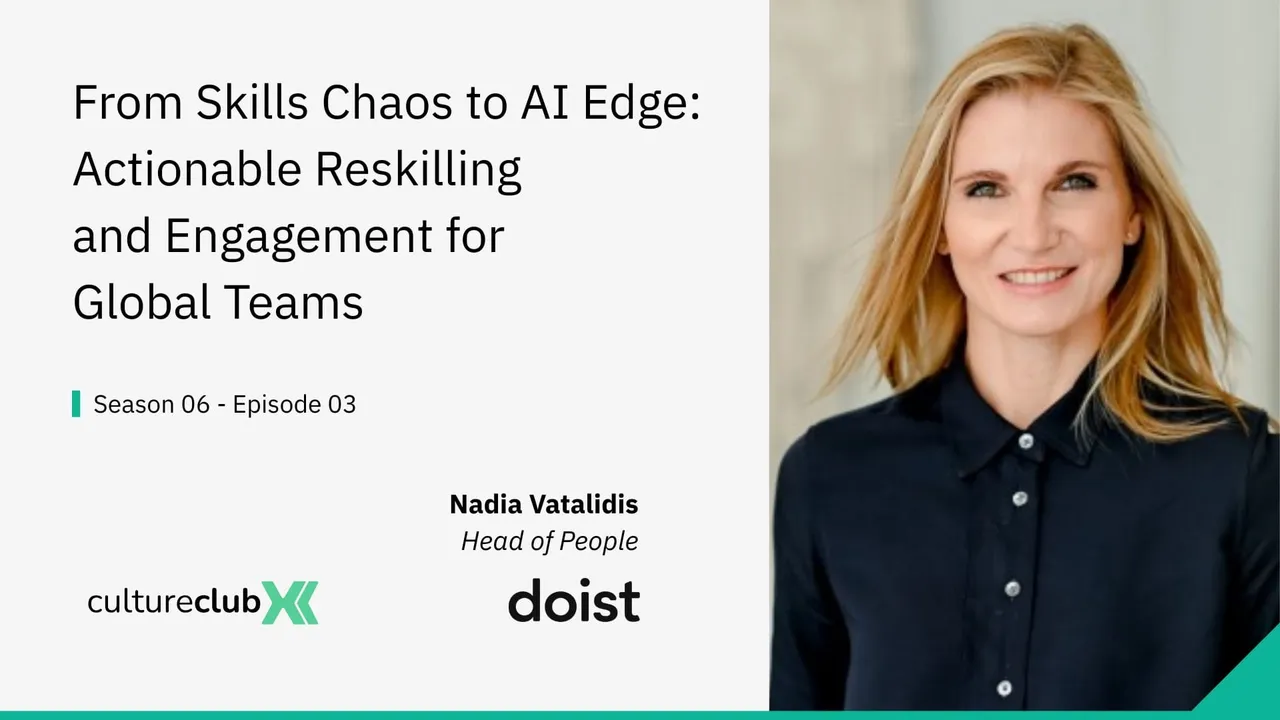
Most AI reskilling programs don’t fail because of tools. They fail because organizations skip psychological safety and behavior change. In this CultureClub X episode, Nadia Vatalidis explains why mindset, leadership behavior, and feedback loops determine whether learning actually sticks.

TL;DR
What you need to know from this episode
- Psychological safety comes before reskilling, always. Employees who don't feel safe to admit uncertainty will comply with AI adoption rather than genuinely embrace it. The conversation must start with fears, not features.
- Behavior change is harder than skill transfer, and more important. Teaching someone to use a new tool takes days. Changing how they think about their role, their process, and their identity at work takes consistent coaching over months.
- Equitable career frameworks unlock skills development. Before adding AI fluency or meta-skills, Doist rebuilt their career framework to create clear, role-agnostic expectations, removing complexity that would have blocked any skills layer on top.
- AI Lightning Talks democratize experimentation across the whole company. 5-15 minute show-and-tell sessions, including from non-engineers, built trust, curiosity, and a culture of safe experimentation faster than any formal training program.
- Involving people in redesigning their own work transforms buy-in. When leaders hand the question of "how could AI change this process?" to the person doing the work, resistance drops and ownership rises, immediately.
- Pulse surveys only work when leaders act on the results visibly and fast. Closing the feedback loop, telling people what changes are being made based on their input, is what makes employees want to give feedback again. Letting it go stale for months breaks trust permanently.
- Remote reskilling requires lightweight habits, not programs. In distributed teams across 35+ countries, the most durable learning comes from lightweight, repeatable habits embedded in existing work rhythms, not event-based training that evaporates on re-entry.
Why AI reskilling fails before it starts, and what Doist did differently
The most common mistake in AI reskilling is sequencing. Organizations rush to build technical skill capability, prompt engineering workshops, AI tool onboarding, coding bootcamps, before they have done the foundational work of building psychological safety. The result is employees who comply rather than engage: they show up to the training, tick the boxes, and revert to their old habits by Friday.
Nadia Vatalidis, Head of People at Doist, has built people systems at some of the most ambitious distributed companies in the world, Remote.com (70 to 1,000 employees in 80+ countries), GitLab (75 to 1,300 employees in 60+ countries, through IPO), and now Doist, the company behind Todoist, serving 50 million users with a 100-person team across 35+ countries.
Her approach to reskilling starts in a different place entirely.
"I think I always tend to start meeting people there, like where are they currently? How are they feeling about these changes? What are their fears? What are their greatest ambitions while they're going through this?" That starting point, before any tool, before any training, is the one most organizations skip.
The behavior change imperative: why mindset must come before skill
The central insight from Nadia's experience is deceptively simple: learning a new skill is easy. Changing the behavior that underlies how someone thinks about their role, their process, and their identity at work, that is the actual challenge of AI transformation. And most reskilling programs address the former while ignoring the latter entirely.
Leaders who approach reskilling with a rigid, top-down framework are producing compliant employees, people who do exactly what they're told with the new tools but who are not genuinely thinking about what their role could become. The organizations seeing real transformation are the ones where employees are actively re-imagining their own work, not just executing on a training roadmap handed to them.
To learn skills and competencies for any human being is absolutely easier than to change a behavior or to change a mindset. And so if someone has a very rigid or very closed mindset, it can be a really difficult time for them, but also for their leader to help unblock them.
Why leaders stall on AI reskilling, and how to unblock them
One of the most underexplored barriers to reskilling is not employee resistance, it is leadership avoidance. Many leaders feel the pressure to show up with a complete, confident picture of what AI transformation means for their team, even when they genuinely don't know the answer.
That pressure to appear certain makes them less likely to involve their people in the redesign, which is precisely the move that would unlock the most buy-in.
The leaders who are creating the most durable change are the ones who frame the question openly: "If we had to reimagine this 55-step process with AI, what would you build?" Handing that question to the person doing the work changes everything. The moment you involve the person, the buy-in transforms.
Track reskilling progress across your distributed team in real time
CultureMonkey's pulse surveys give people leaders the early signal they need, detecting reskilling resistance before it impacts team morale, and closing the feedback loop fast enough to actually change behavior.
The AI Lightning Talk model: how Doist built a learning culture in 100 people
Rather than mandating a reskilling curriculum, Doist created a lightweight, voluntary format that spread faster than any formal program could. The AI Lightning Talk is a 5-15 minute show-and-tell session, open to the entire company, where anyone, engineer or not, demonstrates something they've built or experimented with using AI tools, explains what worked and what didn't, and takes questions.
The most instructive example Nadia shares is from Andrew, a non-engineer on the people team who built a custom Gemini GEM, a context-specific AI coaching assistant trained on Doist's company values, career framework, performance review process, and feedback documentation.
The GEM allowed employees to soundboard peer feedback before performance reviews, using Doist's own cultural norms as guardrails rather than generic internet training data. A two-person people team scaling its coaching capacity by training an AI on its own institutional knowledge, that is the template.
It created space for people to even make mistakes. Some of the engineers were vulnerable enough to say the code said whatever and I have no idea what that means. And it was just so human, so kind. It really created that safe space to say, it's okay if it doesn't work, let's try something else.
The Doist Skills Architecture: how to build a durable reskilling foundation
Equitable Career Foundation
Rebuild career frameworks to create clear, role-agnostic expectations across every level and function. Remove over-complexity first, you cannot stack skills architecture on a broken foundation.
Psychological Safety Infrastructure
Create explicit space for employees to speak about fears, uncertainty, and ambition before any technical reskilling begins. Normalize not knowing, it is the prerequisite for genuine learning.
Behavior-First Coaching
Before teaching skills, identify which behaviors need to change on each team. Leaders who coach for adaptability and open-mindedness first create teams that learn any skill faster.
Lightweight Experimentation Loops
Run AI Lightning Talks, short, voluntary, cross-functional show-and-tell sessions, to build trust and curiosity. Include non-engineers. Celebrate mistakes. Make learning visible company-wide.
Closing the feedback loop: why pulse surveys fail without committed action
One of the most actionable insights from this episode is about what makes continuous listening actually work. Nadia's framing is direct: the survey is not the intervention, the action you take after the survey is. Organizations that run pulse surveys and then allow the results to sit for three to six months before taking action are actively eroding the trust they set out to build.
Employees stop giving feedback when they believe it will not be heard.
At Doist, the moment feedback arrives, the team starts working on the action. The commitment is explicit and public: here is what you told us, here is what we are doing about it. That visible, rapid loop is what keeps the feedback channel open, and what turns a survey tool into a genuine continuous listening infrastructure.
It doesn't help just doing a survey and saying thank you for participation. It's really about, great, people said we have no idea what this means, what are you doing with that feedback and what actions are you taking next? The moment we get the feedback, we start working on that action.
What you'll learn from this episode
| # | Topic | What you'll learn | Applicable to |
|---|---|---|---|
| 1 | Resistance detection | How to identify reskilling resistance before it impacts team morale, and why it starts with psychological safety, not tool adoption metrics | CHROsPeople Managers |
| 2 | Behavior vs. skill | Why behavior change is the harder and more important lever in AI transformation, and how leaders can coach for mindset before teaching tools | L&D LeadsHRBPs |
| 3 | Equitable career frameworks | How Doist rebuilt their career framework to create role-agnostic expectations, the prerequisite step before any skills architecture can be added | CHROsPeople Ops |
| 4 | AI Lightning Talks | How to run 5-15 minute cross-functional show-and-tell sessions that build AI curiosity, normalize mistakes, and democratize experimentation company-wide | HR DirectorsL&D Leads |
| 5 | Leader involvement tactics | Why involving employees in redesigning their own work is more powerful than top-down reskilling mandates, and exactly how to frame the invitation | People ManagersCHROs |
| 6 | Pulse survey action discipline | What separates organizations that build trust through listening from those that erode it, and the commitment structure that keeps the feedback loop alive | CHROsEngagement Teams |
| 7 | Remote reskilling at scale | How to build durable learning habits in distributed teams across 35+ countries, without relying on event-based training that evaporates on re-entry | Remote HR LeadersGlobal CHROs |

About the guest
Nadia Vatalidis
Head of People, Doist
Nadia Vatalidis Head of People, Doist · Johannesburg, South Africa Nadia Vatalidis is Head of People at Doist, the company behind Todoist, the world's leading task management app with 50 million users, where she leads people strategy and culture for a fully distributed team of 100+ across 35+ countries. Originally from South Africa, Nadia has spent over a decade building people systems at the frontier of remote-first work. She previously scaled Remote.com from 70 to 1,000 employees across 80+ countries, and GitLab from 75 to 1,300 employees across 60+ countries, playing a key role in GitLab's successful IPO.
She advises companies including PIN and is recognized for creating remote onboarding systems and social connection frameworks that have become industry benchmarks. Her expertise spans distributed team culture, AI reskilling, equitable career frameworks, psychological safety, and the engineering of high-trust remote organizations at scale.
Full episode transcript
Season 06, Episode 03 · Nadia Vatalidis & Darcy Mehta · ~28 minutes
Frequently asked questions
Why does AI reskilling fail before it even starts?
The most common mistake is sequencing: organizations rush into prompt workshops, tool onboarding, and bootcamps before building psychological safety. The result is employees who comply, tick the boxes in training, then revert to old habits by Friday rather than genuinely rethinking their work.
Why should mindset change come before skill training in AI transformation?
Learning a new skill is relatively easy; changing the behavior and identity underneath how someone thinks about their role is the real challenge. Leaders who coach for adaptability and open-mindedness first end up with teams that learn any new skill faster.
What is an AI Lightning Talk and why did it work at Doist?
It is a 5 to 15 minute voluntary show-and-tell, open to the whole company, where anyone demonstrates something they built or experimented with using AI and explains what worked and what did not. It spread faster than any formal curriculum and created a safe space where even engineers could admit they did not understand their own output.
How can a small people team scale coaching capacity with AI?
At Doist, a non-engineer on the people team built a custom Gemini GEM trained on the company's values, career framework, review process, and feedback documentation. It let employees soundboard peer feedback before performance reviews using Doist's own cultural norms as guardrails, so a two-person team could scale its coaching.
What makes pulse surveys build trust instead of eroding it?
The survey is not the intervention; the action taken afterward is. Doist starts working on the action the moment feedback arrives and commits publicly to what they heard and what they are doing about it. Letting results sit for three to six months teaches employees their feedback will not be heard.
Read the cross-episode roundups
More from CultureClub X
 S07 E02change leadershipHR as Chief Disruption Officer: Why Supporting the Business Is a Ceiling, with Jennifer McClure
 Jennifer McClure
 S06 E18ai in hrShould HR use AI to cut jobs or make people more valuable? | Steve Cadigan, LinkedIn's first CHRO
 Steve Cadigan
 S06 E17ai in hrHow do you build trust and belonging in the age of AI? | Jessica Smith, Reframing HR
 Jessica Smith
Never miss an episode
Every new episode, plus the takeaways that matter, posted on the CultureMonkey LinkedIn page as soon as they drop.
Free on LinkedIn. Unfollow anytime.