

S06 E02
Keeping Teams Engaged Through Constant Change
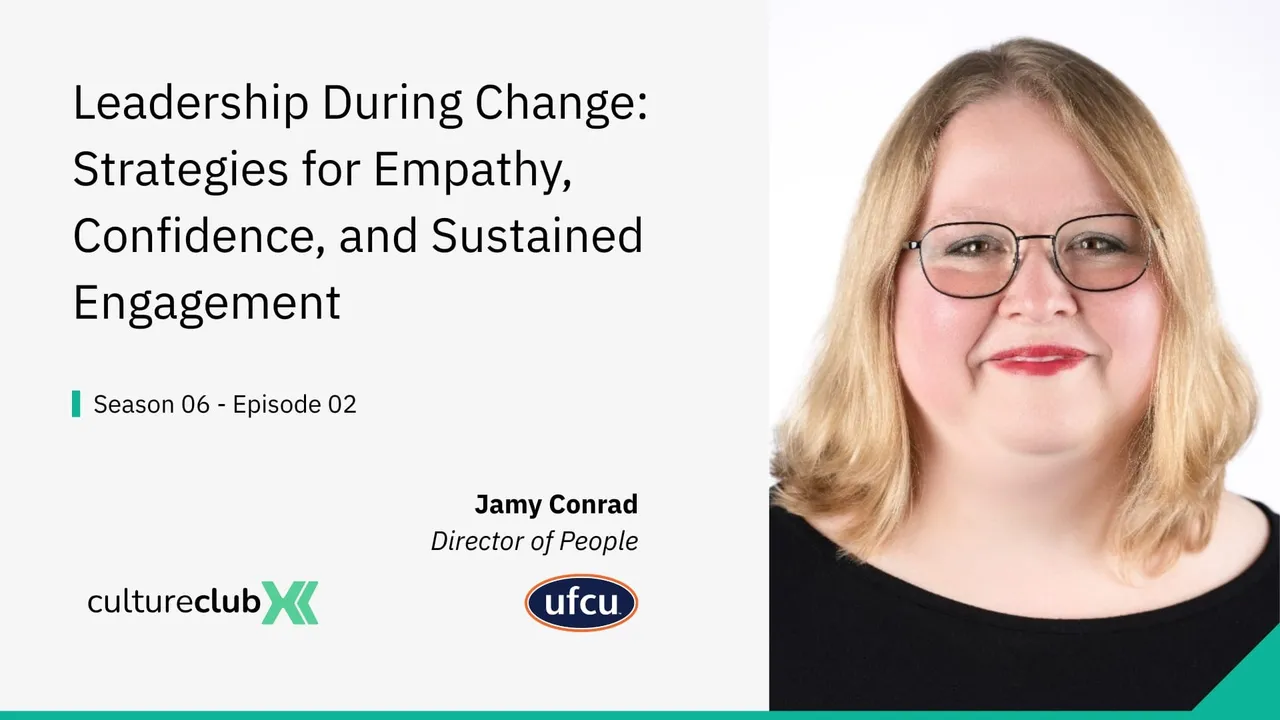
Most orgs treat change management as a project. Jamy Conrad treats it as a capability. In S06 E02 of CultureClub X, she shares how coaching skill, scenario planning, and real-time feedback work for CHROs navigating uncertainty in 2026.

TL;DR
What you need to know from this episode
- Coaching skill is the engagement multiplier. Leaders who deliver feedback with empathy and precision drive deeper, more durable team engagement than any retention program.
- Change-related turnover is almost always a communication failure. When mid-level managers cannot translate organizational changes into meaningful context, employees disengage - not because of the change itself, but because of the uncertainty it created.
- The biggest gap in leadership readiness is experience, not knowledge. Leaders freeze during uncertainty because they have never practiced navigating it. Scenario planning closes that gap before high-stakes moments arrive.
- Consistent language across the leadership team is non-negotiable. Peer accountability - including real-time course correction mid-meeting - prevents the message fragmentation that destroys employee trust during change.
- Empathy and resilience must be treated as learnable skills, not assumed traits. Organizations that build them systematically outperform those that treat them as innate - especially outside the HR function.
- Real-time feedback dramatically outperforms delayed feedback. One organization saw eNPS scores rise from negative 8 to positive 57 in 18 months by making immediate, respectful feedback a core leadership discipline.
- GenAI tools can accelerate human-centric leadership at scale. Manager nudges and AI coaching assistants help leaders practice empathy and resilience in the daily flow of work - without making leadership less human.
Why leadership during change is the defining HR challenge of 2026
Organizational change is no longer episodic - it is the permanent condition of modern work. Yet most organizations still treat change management as a project, not a capability. The result is predictable: engagement drops, trust erodes, and high performers leave precisely when the organization needs them most.
According to Gallup's 2024 State of the Global Workplace report, only 23% of employees worldwide are engaged at work - and engagement declines sharply during periods of organizational uncertainty.
Meanwhile, McKinsey's 2023 research found that 70% of change initiatives fail - and the primary reason is not strategy. It is people leadership.
Jamy Conrad brings a rare perspective: 25 years of navigating change across manufacturing, healthcare, tech, and now financial services, including leading HR through a pandemic, a corporate acquisition, and a digital transformation at UFCU.
How coaching skill directly drives team engagement during change
The failure of engagement during change follows a predictable pattern. It starts with a leader who cannot deliver feedback in a way that leaves employees feeling capable and motivated - and ends with disengagement, attrition, and eroded organizational trust.
"I remember working for a leader that when I went in for feedback sessions, I always walked away feeling like I was a million dollars," Jamy shared. "And then sometimes it would hit me later - that was more of a negative feedback than a positive. The coaching conversations were so good."
The more that we can encourage our leaders to show up in an empathetic way - that gives the employee a little bit of autonomy in how they receive that feedback and then what they do as a result - can just make all the difference in how that team member shows up the next day.
The telephone game: why mid-level managers are the change management failure point
Most change initiatives fail not at the executive level but at the mid-management layer, where decisions must be translated into daily context for frontline employees. When managers cannot clearly explain how a change affects an employee's role, contribution, and future - the message deteriorates.
"Not being transparent enough with information, leaders not understanding how to correlate the change that's happening into how it's impacting the day-to-day work of that employee - that's where it breaks down," Jamy explained.
See how CultureMonkey surfaces leadership gaps during change
CultureMonkey's continuous listening tools give HR leaders the real-time data to identify where manager coaching is working - and where change communication is breaking down - before it becomes a retention problem.
The Change Readiness Loop: a four-stage framework for sustained engagement
Jamy's experience across industries revealed a consistent pattern: the organizations that sustain engagement through change are not the ones with the best strategies - they are the ones whose leaders have built the muscle to communicate, coach, and course-correct in real time.
She distilled this into what she calls the Change Readiness Loop, a four-stage cycle designed to be repeated continuously rather than deployed once.
The framework is built on a simple premise: change readiness is not a state you achieve. It is a capability you practice. Each stage reinforces the next, creating a self-sustaining loop that strengthens the leadership team's ability to navigate uncertainty with empathy and confidence.
Scenario Planning
Run structured leadership conversations about potential change outcomes before they occur. Build muscle memory for uncertainty so leaders respond with confidence, not improvisation.
Language Alignment
Establish enterprise-level communication frameworks with consistent terminology. Every leader - from executive to frontline manager - uses the same language to describe the change.
Real-Time Feedback
Act in the moment, not at the end of the quarter. When a leader hears something in a meeting, they address it immediately - like a baseball coach on the mound, not reviewing tape after the season.
Peer Accountability
Leadership teams hold each other to agreed language and frameworks in real time - including course correction mid-meeting using a shared safe word protocol.
Scenario planning: the most underrated tool in leadership development
The biggest gap in leadership readiness is not knowledge - it is experience. Leaders who have never navigated major uncertainty tend to freeze when it arrives. The solution is deliberate rehearsal through scenario planning.
Jamy shared a compelling example: a team of new managers about to go through an acquisition the organization could not yet disclose. One scenario planning exercise happened to cover the exact situation - giving those managers a reference point when the real announcement came.
Leaders freeze in the moment or they go completely rogue because they just aren't sure what they're supposed to do. Scenario planning is how you give them at least a couple of tools to turn to.
The eNPS case: what real-time feedback actually does to engagement scores
Internal eNPS scores for one leader's organization rose from negative 8 to positive 57 within 18 months. The single driver: a Chief Revenue Officer who, when an employee said something in a meeting, got on the phone with them right away - not to manage the situation down, but to genuinely understand their perspective.
"The more I could do to feed him the information that he needed from a people standpoint, the stronger he became as their leader," Jamy noted. CultureMonkey's pulse surveys are not reporting mechanisms - they are leadership performance inputs.
Think of it like the coach going on the field in the baseball game and delivering that information to the pitcher right then and there. They're not waiting until the end of the game to make a change on the mound.
What you'll learn from this episode
| # | Topic | What you'll learn | Applicable to |
|---|---|---|---|
| 1 | Coaching skills & engagement | How leader coaching style directly influences whether employees stay engaged - and why empathetic delivery of even negative feedback increases motivation | CHROsPeople ManagersL&D Leads |
| 2 | Change-related turnover | The root causes of turnover during change - and why mid-level manager enablement with consistent language is the most effective intervention | HRBPsHR Directors |
| 3 | Feedback loops during change | How to build proactive feedback channels - office hours, open surveys, rapid town halls - that let leaders course correct before disengagement sets in | People OpsInternal Comms |
| 4 | Scenario planning | A practical approach that builds leadership muscle before crisis arrives - including preparing managers for an acquisition without disclosing confidential information | CHROsTransformation Leaders |
| 5 | Peer accountability | Why consistent language across the leadership team is non-negotiable - and a real example of using a safe word to course correct in live meetings | HR DirectorsExecutive Teams |
| 6 | Scaling empathy with GenAI | How manager nudge tools and AI coaching assistants make human-centric leadership more scalable - without making it less human | CHROsHR Tech Leaders |
| 7 | Continuous feedback & eNPS | How real-time feedback drove an eNPS improvement from negative 8 to positive 57 in 18 months - and the leadership behavior that made it possible | CHROsEngagement Teams |

About the guest
Jamy Conrad
Director of People, UFCU
Jamy Conrad Director of People, UFCU · Austin, Texas Jamy Conrad leads the people strategy at UFCU (University Federal Credit Union) through a major digital transformation. With over 25 years of HR leadership across tech, healthcare, and finance, including TrustRadius, HG Insights, PAM Health, and Travis Medical Sales Corp - she partners with executive teams to solve people problems that create lasting organizational change, not just short-term fixes.
Career highlights include reducing regrettable turnover from over 40% to under 5% in two years, saving nearly half a million dollars annually through benefits strategy optimization, and boosting new manager effectiveness scores by 28% in 12 months. She is a founding member and board advisor to multiple HR industry bodies.
Full episode transcript
Season 06, Episode 02 · Jamy Conrad & Darcy Mehta · ~28 minutes
CultureMonkey is an AI powered enterprise employee engagement platform that helps people leaders listen to their employees and enhance workplace cultures. CultureClub X is our global thought leadership forum where global CHROs and people leaders share insights, debate emerging trends, and exchange proven strategies for building thriving, future-ready cultures.
And today, we're truly honored to host Jamy Conrad, Director of People at University Federal Credit Union, Texas. So Jamy, welcome, we're so glad to have you on the show today.
She describes her mission as creating workplaces with trust, growth, and collaboration. She is fueled by her bottomless curiosity in understanding people, but always with one goal, empowering every person to hit their true potential.
Jamy, your drive is pure inspiration. We are so excited to have you today to discuss our latest topic, Leadership During Change, Strategies for Empathy, Confidence, and Sustained Engagement. Before we dive in, do you want to just share a bit about your own leadership journey?
So as a people leader, I got started with the profession working with a manufacturing company. And I wasn't in HR at that time, but I was partnering with them on rolling out different strategies and programs that they wanted to incorporate in the organization, and I was always just very curious about that.
And so when I had the opportunity to join a small company and take a chance with HR, I found something that really made me passionate about work and what I wanted to do with my career. And they were gracious enough to give me a shot in doing that, even though I had no experience or anything like that.
So I've been in human resources and in life coaching for years. Started with that small mom and pop, grew that organization. I was with them for 10 years in durable medical equipment sales, moved into the hospital space, had the fortune and opportunity to work in the hospital system during the global pandemic, moved into the tech space shortly into the pandemic, and then was with TrustRadius for four years before we went through an acquisition.
And now here I am in the financial industry and serving UFCU as their Director of People as they're going through digital transformation and change and they're designed for a digital experience. So I've had a lot of opportunities to partner with different communities and lead in different HR communities, founding member in several, and just continue to want to push our profession to be more, to be involved more, and to really make the difference that I know we can.
And then sometimes it would hit me later like, that was more of a negative feedback than a positive, but I didn't even realize it in the moment. The coaching conversations were so good and he was so skilled in those conversations, providing that feedback in such a way that just made me feel like, this is something that I can do for him, for the organization, and for myself.
And so I think about that a lot when I think about leadership skills and the connection between team engagement, how people want to show up for leaders that are able to take a situation, coach them effectively through that, and then give them the empowered feeling like they can take that information and do something meaningful with it.
The more that we can encourage our leaders to show up in an empathetic way that gives the employee a little bit of autonomy in how they receive that feedback and then what they do as a result, that can just make all the difference in how that team member shows up the next day.
The key themes that come through when I think about change related turnover is a lack of understanding how changes were going to impact their role going forward, or a negative understanding of their ability to continue to do good work as a relation to the change that was happening.
So for example, not being transparent enough with information, leaders not understanding how to correlate the change that's happening into how it's impacting the day-to-day work of that employee, also how that impacts their ability to make an impact on business outcomes and feel like they're contributing to the success of the organization.
And so I can't emphasize enough having your managers, especially your midline managers and your new managers, feel confident and comfortable in having those conversations. Making sure that they're enabled and empowered to understand how those things are happening, putting that into your comms plan or your rollout plan for change management is really important.
Because so often we'll see executives make decisions and those will cascade down to their next level. And then it's like the telephone game. If you don't provide them with the tools they're going to need to make sure that the message is consistent and the language is consistent, and that we're all focused on making sure that everyone comes along in that change journey, then things are going to get lost in translation. They're going to get forgotten about and people just aren't going to feel prepared and empowered to be part of the change.
Change is hard, change is constant. We've got a lot of things going on in the world right now, and that doesn't seem to be slowing down. I think it's really important that we make sure that our employees and our managers are empowered and enabled to go through that change journey with us. And the more that we can be transparent with that information, the more effective we'll be able to get through that change and get back to productivity as fast as possible.
Also, if we're talking about a true course correct, where things are just completely off the rails, it's probably important to bring everybody back together and get everybody back on the same page. So being ready for that, having that proactive approach: if things go off the rails, what are we gonna do? Here's where we're gonna meet. Here's how we're gonna meet. This is what we're gonna talk about. This is the agenda.
And then the other part is, you can have all those things and be proactive, but being able to adapt and be flexible within the moment is also important. So if you aren't proactive or you don't think there's a need for a town hall, great. But if you get into that change and things start to go in a way that you don't want them to go, then be okay and flexible with your communication and bringing people back together. That's going to be the most important part anyway.
People are going to want to understand when it comes to change, how this impacts them and what they can expect. And when you build in that psychological safety for people to ask questions and provide them with the opportunity to voice their concerns, then you're going to have the information you need to make sure that they have what they need to get through that with you.
And like you said, it's important to be prepared, but also to be able to adapt. And obviously if you have a plan in place, then it's easier to be a little flexible and adapt once you already have that framework. I think that's super interesting.
It takes you back a little bit to that enablement piece, making sure that when they start to freeze or they're not sure, you've already provided them with at least a couple of tools to turn to. But the way that I've approached that in the past is: let's run scenario planning. Let's have some of those conversations about potential outcomes as a leadership team so that we can feel more comfortable going into those situations.
You can't plan for everything, so that's unrealistic. And I've been in organizations where I've heard leadership teams talk about how scenario planning is a waste of time, how tabletop exercises are a waste of time. Usually it takes a situation to make them realize that that's not the case, that they really do have some benefit, unfortunately. But if you can plan for some of those cohort conversations, if nothing else, it can make a big difference.
We had a situation where we had several very new managers, and we were about to go through an acquisition situation. We couldn't really talk about it, we couldn't tell them exactly what was going on, but we did know that they were about to go through something that they had never gone through before.
And so in order to help prepare them for that, we ran some scenario planning around uncertainty. One of the scenarios just happened to be: you've been approached by a business and you're about to go through an acquisition, how do you handle that? So we were able to at least get them ready for and allow for that open dialogue in a less stressful environment before they actually got into the stress of going through that and having to navigate that.
And that's part of that peer accountability, once you've established some of the potential tools and toolkits, or you've gone through some scenario planning, it's really important that we hold each other accountable and that we're using the same language. That's why I think that at the organization level or enterprise level, there is a responsibility to provide what that language should be.
But then when it gets into the day-to-day and the tactical, it requires leadership to hold each other accountable as they're going into department meetings or cross-functional scenario planning and whiteboarding sessions, that they continue to use those frameworks and that language and then hold each other accountable when that doesn't happen, or course correct in the moment.
I had an organization where we were really sticklers about this and as a leadership team, we came up with our own safe word. So that if somebody started to go outside of the framework that we were working with, we would say the safe word even in the middle of a meeting with employees in the room. That was our cue. We all agreed, okay, we're going to stop what we're saying and we're going to redirect it to either back to the information we wanted, or to somebody else in the room that could take it to the next phase of the conversation.
We obviously know that that's not the case, but it's almost like there's an expectation. HR professionals tend to have those skills as their power skills, not everybody, but a good chunk of the profession do. And so we can't just assume that our peers outside of HR, that our other business professionals, also have those as highly developed skills.
So I think the first part is making sure that we understand and are putting into place opportunities for them to learn those skills. How do you make sure that those skills are being practiced in the day-to-day work and the day-to-day conversations, so that that does become part of the culture and the way that we lead as a leadership team?
Now with the automation coming in, I think that actually enables us to do so faster. I've seen a lot of emerging technology coming out with manager nudges and providing coaching and feedback from a GenAI aspect, from notes, from body language, and providing some of the tips and tricks based off of what your organization has decided are important.
And so I think there's a lot of opportunity to lean into those very human-centric qualities and skills in an automated way as we continue to see more HR tech coming into play. And hopefully they'll get out of the HR tech and become business tech, so we start to utilize that on a more broad scale rather than just thinking it's another thing that HR is making us do.
Classroom settings are less and less now when it comes to how we train people and how people learn. More and more it's that digital expectation in the moment where the work is happening. And so what are some of those ways that you can put that into place as people are experiencing it? I lean into some of those coaching tools that can come into your conversations, especially in a remote environment, that can be a fly on the wall and provide that manager with some feedback related to how they delivered messages or how they showed up, or did they use the language that we're trying to have cross-functionally.
So I think that there are ways to continue to push that very human-centric leadership and actually utilize GenAI and AI agents to make us more authentic and more human in the process.
And so it's realizing that and training for that. But I like your positive take on how to implement these AI tools with maybe little tips or prompts, like, did you ask this, or did you make sure to say thank you or give a compliment first and then the feedback? I'm just making things up, but that's kind of how I envision it, how you could use both. So that's super interesting.
They're making sure that we've got what we need for the team to be successful in the moment that it's happening. And so I think that's a really important way to think about leadership and coaching in the business world. You can't always be in real time, but the sooner you deliver that feedback and that information to somebody that needs to hear it, the faster you get through some of those things and the more effective you become in your leadership styles.
And the other side of that is I've seen leaders that are really good at this, if they hear something in a meeting, they immediately get on a call with the employee and they're like, here's what I'm hearing, tell me what's going on, right? Or help me understand what I'm hearing from your perspective. And employees love it, especially if it's a hard conversation, because they know that they're getting an opportunity to have a voice, they know that their voice is being listened to and respected, and they always know where they stand.
And what I've seen is, I give a lot of kudos to a former Chief Revenue Officer who had a leadership style that was this. And I watched their eNPS scores internally go from around a negative eight to I think their last one was a 57, and that was within an 18 month timeframe. And so the more I could do to feed him the information that he needed from a people standpoint, the stronger he became as their leader, and the more we saw those scores increase.
The opportunities to deliver that feedback in the moment, make sure that you know what is happening and have that respect for it from both parties, that just strengthens the team and the ability to deliver on those business outcomes.
But that in the moment, you know, means everything, because something just happened, or like you said, the employee just said something in a meeting. And so getting on the phone right away prevents things from festering too. It prevents it from being on their shoulders or in the back of your mind. I mean, we all know it feels so good to resolve things, the longer you stew on something. So to resolve it quickly and get that feedback right away, I agree, it's so important.
That's honestly where CultureMonkey shines, with continuous feedback and real-time insights to build trust and keep engagement strong. Before we end, Jamy, how can our listeners connect with you to keep this conversation going or to share their own perspectives?
Frequently asked questions
Why do most change initiatives fail even when the strategy is sound?
The breakdown happens at the mid-management layer, not at the executive level. When managers cannot translate a change into what it means for an employee's day-to-day role, contribution, and future, the message deteriorates like a game of telephone and trust erodes.
What is the Change Readiness Loop?
It is Jamy Conrad's four-stage cycle for sustaining engagement through change: scenario planning, language alignment, real-time feedback, and peer accountability. It is designed to be repeated continuously rather than deployed once, because change readiness is a capability you practice, not a state you achieve.
How does scenario planning help leaders during uncertainty?
Leaders tend to freeze or go rogue in a crisis because they have never practiced navigating one. Rehearsing potential outcomes in advance builds muscle memory, so leaders have a few tools to turn to when the real moment arrives. In one case a scenario exercise happened to mirror an acquisition managers were about to face.
Does empathetic feedback actually move engagement numbers?
Yes. In one organization, eNPS rose from negative 8 to positive 57 within 18 months. The single driver was a leader who responded to employee input in real time to genuinely understand their perspective, rather than waiting until the end of the quarter.
Why does consistent language across the leadership team matter during change?
When every leader from executive to frontline manager uses the same terminology to describe a change, the message stops fragmenting. Jamy's team even used a shared safe word protocol to hold each other accountable and course correct mid-meeting.
Read the cross-episode roundups
More from CultureClub X
 S07 E02change leadershipHR as Chief Disruption Officer: Why Supporting the Business Is a Ceiling, with Jennifer McClure
 Jennifer McClure
 S07 E01employee engagementThe Wellbeing Illusion: Why Most Organizations Are Spending More on Wellbeing and Getting Less in Return, with Gethin Nadin
 Gethin Nadin
 S06 E20change leadershipThe Culture Paradox: Why Hidden Patterns Keep Organizations Stuck and Good Conflict Sets Them Free, with Jamie Notter
 Jamie Notter
Never miss an episode
Every new episode, plus the takeaways that matter, posted on the CultureMonkey LinkedIn page as soon as they drop.
Free on LinkedIn. Unfollow anytime.