

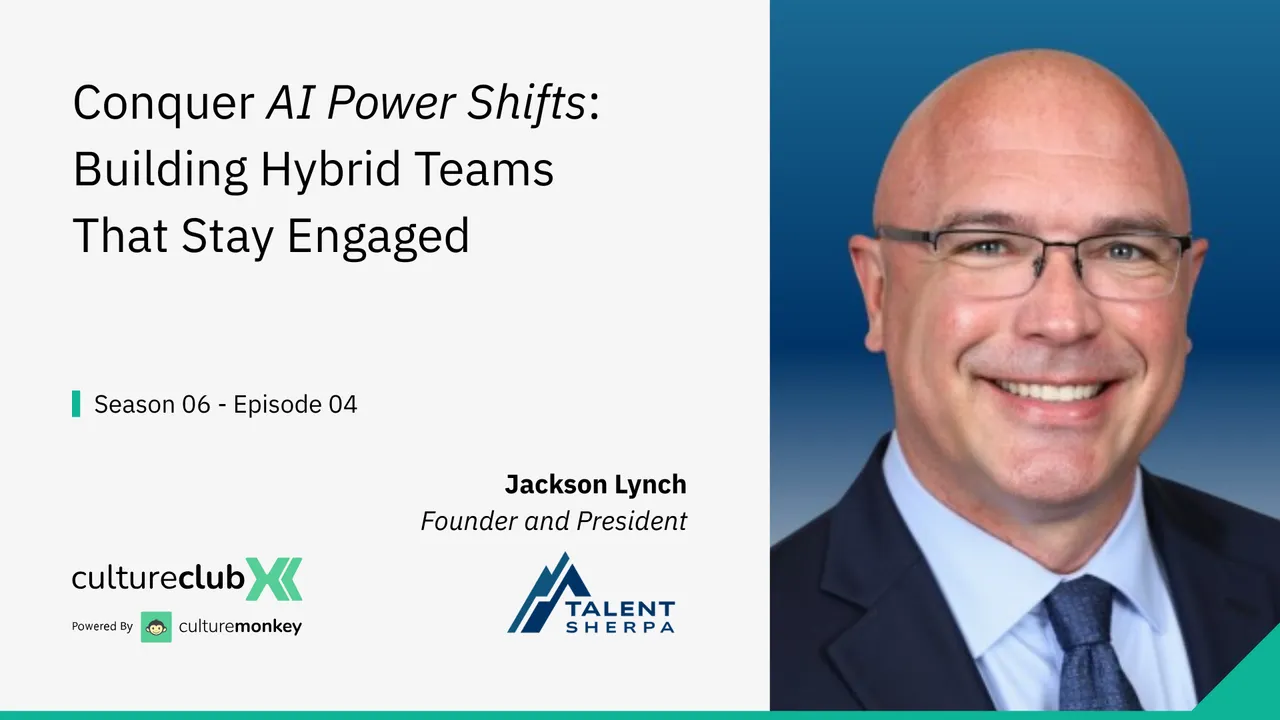
S06 E04
How CHROs Should Redesign Roles as AI Reshapes Work
Tasks get automated, roles get redesigned, conflating the two is where organizations lose people. Jackson Lynch, four-time CHRO and founder of Talent Sherpa, delivers a systems-design playbook for CHROs to redesign work alongside AI while protecting culture, engagement, and development pathways.

TL;DR
What you need to know from this episode
- Tasks get automated, roles get redesigned - and conflating the two demoralizes employees. The diagnostic question is not which tasks can AI do, but what does this role exist to accomplish. Eliminating tasks without redesigning the role destroys the invisible development pathways employees relied on.
- AI is a mirror, not an executioner. AI surfaces redundancy, delay, and approval layers - use that as a design invitation, not a headcount justification. The demoralizing move is eliminating the development pathway disguised as eliminating a cost line.
- Culture is decision residue - not what you put on the walls. To understand your real culture, examine your last hundred people decisions: who won, who lost, what trade-offs you made. The decisions you make in the first 30 days of redesign tell the organization whether change is being done with them or to them.
- The adaptability gap now matters more than the experience gap. A 25-year-old with deep AI tool fluency may outperform a veteran at targeted analytical work. Hire for learning agility - it best positions you to solve tomorrow's problems, not yesterday's.
- Managers were professional coordinators - that job is disappearing. With AI handling tracking, scheduling, and summarizing, managers must shift to coaching, capability building, and driving performance conversations - the work organizations always deprioritized.
- AI frees 8-10 hours per week, but less than 7% has been intentionally reallocated. Finding capacity is not the problem. The problem is what organizations choose to do with it - and most are choosing nothing, wasting the single greatest reallocation opportunity in a generation.
- Pulse checks must track where humans are being displaced from judgment calls - that displacement, not efficiency, drives disengagement. Listening systems must translate findings into business language. When the gap between stated and actual values widens, you lose high performers disproportionately.
Why role redesign, not task automation, is the real AI challenge for CHROs
Most organizations are approaching AI adoption with a fundamental misdiagnosis: they are automating tasks when they should be redesigning roles. Jackson Lynch - a four-time CHRO who has led HR transformations at Sunnova Energy, Clearwater Paper, Nestle, and PepsiCo - draws a hard line between the two. Tasks get automated, roles get redesigned. Conflating them is where organizations lose people.
The diagnostic question is not "which tasks can AI do?" It is: what does this role exist to accomplish right now, and how does AI involve itself in that? When you frame it that way, the conversation shifts from elimination to evolution. You automate where work is predictable and repeatable.
You augment where human judgment, context, credibility, and influence create a return that automation cannot replicate.
AI is a mirror, not the executioner. It has to help you surface the redundancy and the delay and the approval layers and use that as a design invitation.
The demoralizing move, Jackson argues, is eliminating the development pathway disguised as eliminating a cost line. The task was visible - but the growth that happened through the task was invisible. When organizations remove tasks without redesigning the role, they strip out the career development infrastructure that employees relied on, even if no one named it that way.
According to Gartner's 2025 Future of Work research, 58% of the workforce will need new skills to do their jobs successfully - but the failure rate of reskilling programs remains above 70% when role redesign is absent.
AI reveals who understands the business - and who is hiding behind process
One of the most provocative insights from Jackson's perspective is that AI is exposing a long-hidden asymmetry in organizations: the gap between people who truly understand how the business works and people who have been hiding behind process. That exposure is uncomfortable, but it is not unfair.
The adaptability gap, Jackson argues, now matters more than the experience gap. A 25-year-old with deep tool fluency may outperform a 40-year-old at targeted analytical work - and pretending that asymmetry does not exist does not make the team better. Sports teams figured this out long ago: you put the best player in the seat, regardless of seniority.
If you hire for experience, you're answering the question: can I solve yesterday's problems? Maybe today's problems. You have to hire for learning agility. That best positions you to solve tomorrow's problem.
The practical design principle Jackson recommends: machines handle detection, humans handle discernment. Communicate that allocation transparently in your role architecture. AI-driven role compression means leaders who excelled at high-volume routine tasks are now being asked to make more consequential calls with less cover - and that is a development need, not a performance failure.
Name it so you can address it.
For people leaders tracking this shift, employee engagement listening tools can surface where the adaptability gap is creating friction before it turns into attrition.
The 90-Day Role Redesign Playbook
Jackson Lynch's three-phase, 90-day playbook for CHROs to start redesigning roles alongside AI - proving the model before scaling it, protecting culture through transparency, and building organizational momentum through visible wins.
Month 1: Map One Work Stream End-to-End
Pick one team and one work stream. Map every step, handoff, data input, and wraparound process. Classify work as high, medium, or low value-added. Integrate AI support into targeted places. Build an exception playbook, run daily standups, and publish a one-page chain contract with owners, metrics, and service levels. Prove the model before scaling.
Month 2: Build Pipeline Math and Redesign One Role
Pull current hiring trends, extrapolate three years forward, price in external hiring costs under different market scenarios, and present that number to your CFO. Then design at least one role description defined by AI-amplified outcomes - not a task list. Shift from a legal compliance lens to a business constraint relaxation lens.
Month 3: Add an Adaptability Screen to Hiring
Audit your recent hiring decisions. Honestly assess whether you weighted adaptability or defaulted to experience, skills, and credentials. Add an adaptability screen for every new hire going forward. Track it. The decisions you make in the first 30 days of redesign tell the organization whether change is being done with them or to them.
Culture is decision residue: the phrase every CHRO needs to internalize
Jackson introduces a definition of culture that cuts through the noise: culture is not what you put on the walls - that is just marketing. Culture is decision residue. It is the byproduct of every people decision an organization makes. To understand your real culture, examine your last hundred people decisions: what did you decide, why, who won, who lost, and what trade-offs did you make?
This framing has direct implications for AI role redesign. The decisions organizations make in the first weeks of any redesign effort - who they involve, who they protect, what they communicate - become the culture. If redesign is done to people rather than with people, the culture shifts toward fear and compliance.
If it is done transparently, with clear ownership and visible outcomes, the culture shifts toward adaptability.
Culture isn't what you put on the walls. That's just marketing. Culture is decision residue. Go back and look at your last hundred people decisions - what'd you make them, why'd you make them, who won, who lost.
Why managers must shift from coordination to coaching - and what that actually means
The manager's role has changed more than nearly any other, Jackson argues. Managers were professional coordinators: tracking, scheduling, summarizing, and handling the logistical glue of teamwork. AI is absorbing that coordination layer. The question is no longer what managers do - it is what we actually want managers to do now that the coordination job is disappearing.
The answer has always been on the list but never at the top: coaching, building capability, driving performance conversations.
According to McKinsey's research on organizational effectiveness, companies that invest in manager coaching capability see 20-25% higher employee engagement scores - yet most organizations still train managers on process compliance rather than human development.
Jackson approaches this from a design thinking perspective: build role profiles for both humans and AI agents with explicit outcomes, define exactly where human-in-the-loop judgment is required (not implied, not assumed), and purposefully design every handoff.
The most important job description in the organization, Jackson argues, may in fact be your AI agent's - because you need to tell it what it is accountable for, where its handoffs are, and what it is not authorized to work on.
Spot AI power shifts before they drive disengagement
See how CultureMonkey's pulse surveys help CHROs track where humans are being displaced from judgment calls - and act before high performers walk.
The capacity paradox: AI frees 8-10 hours per week - and almost none of it is being used
Jackson surfaces a striking data point: organizations adopting AI tools are finding 8 to 10 hours of time capacity per week per employee. Yet less than 7% of that freed time has been intentionally reallocated toward something of higher value. The capacity is there. The design is not.
This is the central design choice facing CHROs: what do you do with the extra capacity? You can eliminate headcount - but that sacrifices institutional knowledge and future flexibility. You can ignore it - but that wastes the largest workforce reallocation opportunity in a generation. Or you can redesign roles so that people own results instead of task lists, making the work itself purposeful.
When people own a result instead of a task list, the work itself becomes purposeful. AI can remove that activity burden so that high-judgment work becomes the primary unit of performance. And with that clarity, meaning almost inevitably will follow.
Jackson's real-world example illustrates this vividly. Using Claude's co-working capabilities, he built an automated daily briefing system: an AI agent that scans his calendar each evening, pulls every prior conversation with the next day's contacts from his CRM, checks their LinkedIn activity, and delivers a three-minute pre-meeting brief.
Six months ago, this would have taken a full day of manual preparation - and would not have been as comprehensive. Today, it takes the push of a button. That time savings compounds: better preparation leads to better conversations, which lead to better outcomes.
For HR specifically, Jackson points to performance management season - the annual period where HRBPs spend the majority of their time on compliance tasks (did you do it? did you do it on time?) rather than quality improvement (is the feedback actually good?). AI can handle the compliance layer, freeing HRBPs to work with managers on the substance of feedback.
The question, as Jackson frames it: how do we not all win when that happens?
Continuous listening tools can help organizations track whether freed capacity is being channeled into higher-value work - or simply evaporating.

About the guest
Jackson Lynch
Four-time CHRO, Talent Sherpa
Jackson Lynch Founder & President, Talent Sherpa · Four-Time CHRO · CNBC Workforce Executive Council Jackson Lynch is a four-time CHRO, founder and president of Talent Sherpa, CHRO coach, board advisor, and CNBC Workforce Executive Council member. He has led high-stakes HR transformations at Sunnova Energy (NYSE: NOVA), Rent., BlueLine Rental (Platinum Equity), Clearwater Paper (NYSE: CLW), Nestle, and PepsiCo - guiding organizations through rapid growth, Chapter 11 restructurings, acquisitions, and digital pivots while delivering top-decile employee engagement, 90th-percentile organizational health, and Say-on-Pay votes above 90%.
Today, through Talent Sherpa - his multi-channel platform with 6,300+ weekly Substack readers, a top-rated podcast, and the CHRO Academy - Jackson helps CEOs and new CHROs replace inherited capability gaps, unclear decision rights, and activity masquerading as impact with clear people operating rhythms, AI-enabled talent strategies, and cultures that actually accelerate business results. Originally trained as an aerospace engineer, Jackson brings a systems design thinking perspective to human capital that is uniquely suited to the AI transformation era.
Full episode transcript
Hello everyone. Welcome to season six of CultureClub X powered by CultureMonkey I'm your host, Darcy Mehta. CultureMonkey is an AI powered enterprise employee engagement platform that helps people leaders listen to their employees and enhance workplace cultures.
Culture Club X is our global thought leadership forum where global CHROs and people leaders share insights, discuss trends and exchange proven strategies for building thriving future ready cultures. Today, we're truly honored to host Jackson Lynch, four-time CHRO, founder and president of Talent Sherpa. Jackson, welcome.
It's so great to have you here with us. It's great to be here with you and all your viewers. So Jackson has sat in the exact hot seat our listeners know so well.
He's led high stakes HR transformations at Sunova Energy, Rent, Blue Line Rental, Clearwater, Paper, Nestle, and PepsiCo, turning growth spurts, restructurings, acquisitions, and digital shifts into top decile engagement and strong business results. Today through Talent Sherpa with its widely read sub stack, top rated podcasts and CHRO Academy. coaches CEOs and new CHROs on building clear people rhythms, AI enabled talent strategies and cultures that actually move the needle.
Jackson, your battle tested perspective on leading through massive change and AI adoption is exactly what today's CHROs are so hungry for. So we're excited to have you discuss our latest topic. Conquer AI Power Shifts, building hybrid teams that stay engaged.
Before you dive in, Jackson, could you just share a little bit about your own leadership journey?
Well, I love your introduction, but all that makes it sound like is I'm old and I can't keep a job. Now I've actually grown up in a little different path than most HR leaders that you'll probably interview. I grew up in the factory of Florida, family business.
I love trucks, got into my first bar fight when I was 13 in Butte, Montana. I survived. uh And as you kind of go through the world from that to being an engineer in the aerospace industry and building aircraft, and then making the pivot over into the human capital space.
I think my leadership journey has really been about a systems design thinking. And so it is really helpful in this moment that we find ourselves because it is going to be for CHROs out there that systems design thinking and a way to relook at work from the ground up, I think is going to be critical for the work that we're going to be doing over the next 10 years. Because if we don't figure it out, somebody else is going to figure it out for us.
And that's going to be a problem. Exactly.
Well, thank you for sharing that. And honestly, I think that, you know, the non-traditional journeys make it the most interesting and you have so much different experience to draw on from, of course. So let's get down to our questions.
So first of all, how do you identify which roles should be augmented versus automated without demoralizing employees?
Well, I think the first thing that need to step back and think about, you what don't you want to do? You don't want to confuse this and conflate it with a task list. Tasks get automated, roles get redesigned.
And as I've seen different companies go into it, we've taken a very much, let me automate these works. But the diagnostic question is different. It is what does this role exist to accomplish right now?
And how does AI involve itself in that task. so what I think has been seen to be successful is you automate the work where it's predictable and repeatable. You augment it where human judgment and context and credibility and influence can create a return that automation can't replicate.
But you also recognize that AI is a mirror. not the executioner. And it has to.
help you surface the redundancy and the delay and the approval layers and use that as uh a design invitation where I think people get a little concerned into your question on demoralizing employees. It's not a headcount justification. So I think the demoralizing move, by the way, is eliminating the development pathway disguised as eliminating a cost line.
ah So the task was visible. The growth happened through the task that was invisible and you have to figure out a way to redesign the work in a way that allows people to do their best work even if there are fewer of them and that's how you manage through the change that's associated with it. so interesting and that's a great example that you said it's like a mirror, not an executioner.
I think that's a good thing to keep in mind. And I think it's also about education, know, so every employees are going to, you like you said, it might feel demoralized, but understanding better and the way you explained it and knowing it doesn't just mean that's it, it's the role is going to be redefined. So I think it's, you know, people understanding that too.
So how are you proactively involving employees in redefining their own roles alongside AI tools?
Yeah, so in my advisory work, one of the things I'm doing with CHROs is helping them answer that question inside of their teams. And the first step that we use is a uh yield conversation with every direct report. And that's really just trying to figure out where are they spending their time, how much of it can be done better with tools that you don't have access to.
And asking a question, how many of those things that you're working on fall into a strategic or a managerial or an executional bucket? And how much of those things are being done by you and you should be the only one with the capability of doing it. And what we find is you have a lot of stuff that is being managed two or three levels down.
And so if you unwrap all of that and you create, you know, just a redesign of the, of the role, I think that's the solution. You map the workflow of the team. You look at every step, every handoff, every data input.
You let them see the entirety of the change and then you kind of repackage the work so that they get the high value human in the loop work, not the broader uh administrative work that candidly took up most of their days before. Hmm.
You just got to name it because I look at A.I. is revealing who who truly understands the how the business works and who is hiding behind the process. That exposure, it's it's uncomfortable, but it's not it's not unfair.
So you have this thing that's an adaptability gap is what I see. And I think that's it's starting to matter more than the experience gap in in specific domains. So.
Think about a 25 year old with a deep tool fluency might outperform a 40 year old with targeted analytical work and pretending that a symmetry isn't there doesn't make the team better. So what do do? I think you design.
I think you build it within a design principle, and that is that machines handle, you know, detection, humans have discernment and you then can allocate it and communicate it. in your role architecture. And you do it in a way that is very, very transparent with people.
think, Darcy, think AI driven role compression is going to mean that leaders who excelled in high volume routine tasks are now going to be asked to make more consequential calls that can't really have a little less lever, less covering. So that's a development need. It's not a performance failure, but you have to name it so that you can address it.
Look, one of the things that I write about a lot in my my sub stack is what is culture? Because that's that's really going to be a focus areas. go through this in this uh evolution.
Culture isn't what you put on the walls. That's just marketing. Culture is decision residue.
And it is the it is the byproduct of the the the. all of the things and all of the decisions that you're making. So if you really want to understand what your culture is, take a step, go back and look at your last hundred people decisions.
What'd you make them? Why'd you make them? Who win?
Who lost? What trade-offs did you make? That broader gambit.
And it is in the process of that that you can really understand what your culture is supposed to do. And that culture is going to be an important one to unlock how you address those power shifts. Because AI, in some cases, is absolutely going to outperform what traditionally was done in by.
Absolutely.
I mean, it's so interesting. like you said, mean, the adaptability is the most important thing and being transparent. And I think, I mean, it's definitely as a learning curve, right?
I mean, I'm in the creative industry. So, you know, and I talk to people too, who do what I do, and there is that fear. ah But then there's also those that are like, well, it's here.
How can we use it? How can we adapt? And, you know, how can we use the tools?
to do things better or to do some of these smaller tasks quicker, obviously. So definitely that is very interesting. um So how do you balance efficiency gains from AI with the human need for meaning and growth?
I think that might be a little bit of a false comparison, okay?
Because they are not necessarily overlapping. So there are some people that are gonna tell you that AI is the doomsayer and Skynet is coming. And there are some that think it's gonna turn into a utopia where we will have all of the time in the world to find our best selves and focus on the things that bring us joy.
In reality, it's probably going to be somewhere in the middle of that. But but you bring up a really important question. There is a there is a question that management of companies is going to have, which is what do you do with the extra capacity that's built?
Because one of the things that's come out here recently uh is that it is we are finding eight to 10 hours of time capacity a week. And yet we have spent. less than 7 % of that time has been reallocated towards something intentional.
So we're finding the space. Like you get rid of people. Okay, that that's one way of doing it.
But but that's, that's not gonna not going to help your business going forward. And it's really hard to get people to work their way out of roles. It's another thing you can you can reallocate it towards more time, more value added work.
There companies out there that have redesigned the entirety of their frontline uh engineering functions so that those new roles defined in terms of outcomes are put in a place where folks have the ability to have new roles that don't include what they used to do before the AI uh tools became uh ubiquitous. So how you do it, I think is going to be, you know, Not well, how you do it is going to be a design choice. But here's where I think uh a great company and a great manager versus someone that is average at both will make a big difference.
You focus on clarity. And that clarity is going to when people own a result instead of a task list. The work itself becomes purposeful.
And. Right. And AI can remove that activity burden so that high judgment work becomes the primary unit of performance.
And with that clarity, think meaning almost inevitably will follow. Absolutely.
You can't really hide behind those easy tasks anymore when the work that you do, exactly, it's going to be a lot more purposeful. It's going to have more impact. And like you said, then you will find meaning in that and growth as well.
So I'd be curious to see more evidence of that as we go forward. think that's why. conversations like this are so important about the culture and kind of getting that understanding to people because there is, you know, that doomsday, like you said, kind of thought, but then the utopia thought and there's a lot of them.
Yeah, everyone's unsure and uncertain. oh Learning from people. Let me throw a real life, let me throw a real life example in if I could.
This scenario where it has freed up time for my assistant, it's freed up time for me, and it didn't replace any work. It actually did work that we've been trying to do for years better. oh I was able to work in, in coworking Claude and, I gave it access to my calendar.
I gave it access to my LinkedIn. I gave it access to my, to my emails. Now you have to get past the scary part of doing all those things.
And I had it go into my uh CRM and it goes in every evening and it will look at my meetings for the following day and it will identify who I'm meeting with and will pull every conversation that we've had together. It'll go onto LinkedIn and figure out what they're talking about, what changes they've been making. It'll look at our messaging and any sort of previous conversations that we've had, look in the CRM to to replicate that.
And what will come out is a three minute brief that three minutes before the top of the hour I can look at and remind myself of what happened, make sure I'm focusing on the things I need to have happen coming out of that meeting. Of course, now we have different note taking services that will then put that in and it'll pull that stuff in. For a entrepreneur, for a founder, That amount of information available is amazingly helpful.
What would it have taken six months ago? A full day. What does it take today?
And probably not as well. What does it take today? It takes me pushing a button once, scheduling it at six o'clock when I'm not doing anything else, and having it show up first thing in the morning before every single meeting.
That kind of time. As as changed what I worked on it's taken away the stuff that doesn't help taste say takes away the stuff that my assistant works on that doesn't help. But it is it is.
You know one of many examples, I think, as we look forward that the that the tools will enable us to do the work that we were put on the Earth to do not what we have been doing and that's going to make a major. I agree.
I think that's actually really exciting. you know, I myself have had uncertainty about AI and what it means for me and my work too. But actually you make me feel a little bit better about it.
I do think that's like, it's a really good example. And it's one of those things where it's probably, like you said, you and your team talk about, it be great if we had time to do this, you know, and you do your best you can look back at conversations and then, you know, be prepared. Obviously, like you said, that would take a whole day and it's taking someone's time.
Now you have that. And then it's like the trickle down effect because now you're better prepared, right? So you've got a really good summary.
You're going to have better questions. Then your next conversation is going to be even better. So it's like that trickle effect.
And so then the work you are actually interested in and meant to do and produce turns out even better. So I think that's an interesting way to look at it too. So I really liked that example.
Yeah, and for the CHROs who are listening in here and other HR folks, let's just pick one thing that we do every year and it's a pain in the butt. And that is performance management time. So imagine if you had a tool that would allow you in a friction free way to manage the compliance.
Did you do it when you said you were going to do it and is it of high quality? That is where we spend the majority of our time is on the first two, not on the third. What if by using these tools, an HR business partner has the ability to work with the manager to improve the quality of their feedback for their employees, rather than just figure out whether they've done their base level task.
And anyone who's lived through this knows that that in the HR Olympic season is you're not doing value added work in there. You're doing compliance angled work. And if we can use these tools to allow us to take the same time and apply it to something with a higher return, how do we not all win when that happens?
I give you all the downsides too, but we've got to be looking for ways we can be more effective as we apply our craft. And I think these tools are really helpful in that way. Yes, absolutely.
And we start that one again. First is I think we don't always think about this the right way. We think about automating tasks, we need to think about redesigning the work.
So the very first thing I would do is spend the first month picking one work stream, one team, and then mapping it end to end. Not only the things that the systems do, but all of the wraparound processes, the handoffs, all of those things. By the way, there are companies out there that can help you do that.
I'm sure we can put something in the show notes if you'd like. But there are companies out there that can help you map it end to end. And then you figure out what is the high value added work, what is the lower medium, and what's low value added work.
And you integrate AI support into targeted places. And then you would spend a little bit of time and you build an exception playbook. You have agile approaches to it.
So you have daily standups to capture the learnings. And then you publish a one page chain contract. Owners, metrics, service levels.
and you prove the model before you scale it. That's what I do in the first month. In the second month, I would build out that pipeline math for three years.
So pull current entry level hiring trends, extrapolate things forward, price in what external hiring costs looks like in a constrained market in 2028 or a wide open market, depending on the assumptions that you're making. And then put that number in a room with your CFO and then design at least one role description that is defined by an AI amplified output, not just a bunch of tasks. And again, there are companies out there in the space today that are doing that, which I think are super helpful.
We do a bad job of defining outcomes. We focus in on tasks. And one of the reasons we do that historically, Darcy, is because we grew up from a legal compliance lens.
The HR of the future is going to be in a business constraint relaxation lens. What's getting in the way? How do we get it out of the way?
The reality is we probably put it there, so it should be pretty easy for us to get out. And that kind of approaches in kind of month two. Month three would then be to think about how to add an adaptability screen to hiring.
So audit your own recent hiring decision and see honestly whether you weighted adaptability appropriately or if you defaulted to experience skills credentials. Adaptability is gonna be an unbelievably important element as we go through a change that no one here can predict what it's going to look like. And then I think you just need to track that for every new hire.
Again, we've we talked a little bit about culture is decision residue. I would tell you the decisions you make in the first 30 days of the redesign are going to tell the organization whether it is being done with them or to them. And so it's really important as you go through that 90 day process to to honor the people that are in the process.
And that's how you end up protecting the culture as you as you go through. And I guess I'd throw one I would throw one other thing there, and that is there's so much out there. And people are so tired already.
This change fatigue is real. Right. So so don't try to boil the ocean.
matter how much people tell you to find one thing, prove the model, make it work, point to it, and then let everything else come with you. Because because if you do that, now you have organizational momentum behind you versus. You know, it's being done to me and I have no agency and I'm just waiting.
for a kiddo. Everything's changing and what's going to happen next and mm-hmm. For sure.
I really like how you broke that down. Um, feels much more, you know, much more doable than like you said, like there is so much out there. There is a lot of fatigue right now.
So it's, know, picking that one, proving, proving it, um, and moving from there. And again, you brought up adaptability, which is always been an important, you know, to have, but I don't think it was always the most important. or realizing how big it would be and a willingness to want to learn new things and everything.
And so it's more important than your skills, like you said, your experience that you're coming in with. Yeah, look, if you if you hire for experience, you're answering the question, can I solve yesterday's problems? Maybe today's problems.
You have to you have to hire for learning agility. And that best positions you to be able to solve tomorrow's problem. m Exactly.
like that phrase, learning agility. That's for sure. Okay, so Gartner predicts blended human AI workforces as a core 2026 scenario.
How are you preparing managers to lead these hybrid teams effectively?
Well, Darcy, think the manager's role has changed more than just about any other. They they were professional coordinators, and now you have AI and they're going to be handling the tracking and the scheduling, the summarizing and the coordination part of the role largely disappear. So the question that we need to be able to answer is what do we actually want managers to do?
by the way, we have always. in a solutions order, put these farther down the list. And so they haven't been done at the level that I think all of us would aspire to.
Those are things like coaching and building capability and driving performance conversations. So I approach this from a design thinking perspective. I think you need to have human in the loop points and you have to make those explicit.
You have to build your role profiles. for both humans and agentic with outcomes in mind. uh And managers need to have the courage and the understanding of when judgment and discretion are required, not implied, not assumed, where those handoffs are.
And you have to purposefully design the handoffs. On my own pod, we talked about this about three months ago. And one of the things that we all agreed on is, the most important job description you'll have in the organization isn't going is in fact going to be your AI agent because you need to tell them what they're accountable for, what they where their handoffs are and what they are not authorized to go work on.
And and that is like we don't do that well for humans. It's going to be even more important for us to do well with the agent folks. And also, I'm sorry.
ahead. I'd also tell you, think as you look at every kind of work chain, they need an owner accountable for the end-to-end income. I think if you look at the overall work chain, you have to have an owner that's accountable for the end-to-end outcome, not just their little piece of it.
And again, that comes back to a broader systems thinking. And so that is a managerial accountability, in my view. You have to define it or the chain's gonna break.
And then I think the... The adaptability asymmetry is going to be a real management challenge. And Gardner talks about this and they're, they are right as you're looking at larger organizations.
I think they're a few years away when they're looking at smaller ones. And by the way, the whole confidential information with stuff going into the cloud, I think it's going to have have a slowing effect on, on, you know, adoption until people bring all of their systems back on premises. which is, as you recall, the last 15 years, we moved everything into the cloud and for scale and cost efficiency.
So I think it's probably unlikely to hit as fast as it otherwise would. But you have to recognize that with more junior people, given the environments they grew up in, they might become more fluent in the tools faster and more accurate. in the analysis than the folks that have been there for a while.
And that's going to cause a whole different issue. The folks in sports have figured this out a while ago. OK, so you have the have the junior in the college basketball team.
And she has done really good work and she is a very, very strong performer. And then you recruit the new person out of high school and they join and they are in fact better today. What does a college basketball team?
They put the best player in the seat. Business hasn't figured out that logic yet. We're going to have to.
Now, one of the huge pieces of it is how do you figure out a way to to reallocate tool people and talent into places where they can thrive? And you got to have outcomes to be able to drive that uh drive that approach. We don't do it naturally today.
uh All of our workforce planning is all. without a forcing function outside of somebody quitting. All of that is gonna have to be upended because it doesn't work today and it's gonna fail even faster because it's relied upon tomorrow.
Absolutely.
Well, I love the sports reference and we can learn a lot from sports at every scenario, right? So even something like that is so true. You put your best player in.
So businesses have to start acting like that too. Absolutely. So how can pulse checks and tech like CultureMonkey support managers in tracking power shifts and engagement in hybrid AI human teams?
Yeah, I think they're going to have it's kind of a very important role on it.
And I think pulse check design should track where humans are being displaced from judgment calls that they were previously allowed and enabled and empowered or whatever word to make, because I think it's that displacement, not the efficiency that comes with it. That's what's going to drive active disengagement. So if I were to talk to my CHRO colleagues out there, I would tell you, I think your job is to translate what the listening system finds.
into business language that allows us to communicate within an existing framework. So if the decision consistency is low, executional variance is going to go up. When the gap between stated and actual activities widen, you're going to lose people who take stated values the most seriously and disproportionately.
Those are going to be your high performers. So how you think about. using the listening systems to make sure that you know how people are reacting to what they're being bombarded with.
I think it's going to be really important, but it's not just a uh system that allows you to kind of look and point to the problem. You need to take that data and allow actual insights to be drawn from it and do something with it back. Because candidly, and you guys know this as well as anybody, if you ask a question and you get an answer and you stop doing anything after that, you might as well not have answered the damn thing to begin with.
Exactly.
It's one thing to get that feedback, but you need to use it and to take action on it for sure. So Jackson, you're straight talking advice on mastering AI power shifts while keeping hybrid teams motivated and human centered was incredibly valuable. I learned so much myself and it's clear winning in this new world means spotting role changes early, giving people real ownership and blending efficiency with purpose, so culture stays strong.
That's where CultureMonkey excels with pulse checks and real-time insights that help managers spot shifts fast and keep engagement high across hybrid AI human teams. Before we end, Jackson, how can our listeners connect with you to keep this conversation going or to share their own perspectives?
You can find all of my work over at my talent Sherpa.com. have a best selling sub stack. It's cleverly titled talent Sherpa dot sub stack.com and and you can look on on podcast and YouTube at my talent Sherpa.
And we we put stuff out on a regular basis there and would love to love to connect with anyone who thinks I might be helpful is you guys are going through a unbelievably challenging time is and our people are counting on us. So I'm here to help. Amazing.
Frequently asked questions
How do you identify which roles should be augmented versus automated without demoralizing employees?
The key is to stop thinking about automating tasks and start thinking about redesigning roles. The diagnostic question is: what does this role exist to accomplish? You automate where work is predictable and repeatable. You augment where human judgment, context, and influence create a return that automation cannot replicate. The demoralizing move is eliminating the development pathway disguised as a cost cut - the task was visible, but the growth that happened through the task was invisible.
What is the 90-Day Role Redesign Playbook for CHROs?
Jackson Lynch's playbook has three phases. Month one: pick one work stream, map it end-to-end, classify work by value, integrate AI into targeted places, and prove the model with a one-page chain contract. Month two: build pipeline math for three years, present hiring cost scenarios to the CFO, and design at least one role defined by AI-amplified outcomes. Month three: add an adaptability screen to hiring, audit recent hiring decisions for adaptability weighting, and track it for every new hire.
Why does the adaptability gap matter more than the experience gap in AI-era hiring?
Hiring for experience answers the question: can I solve yesterday's problems? Hiring for learning agility positions you to solve tomorrow's problems. With AI tools, a junior employee with deep tool fluency may outperform a veteran at targeted analytical work. Sports teams figured this out long ago - they put the best player in the seat regardless of seniority. Business has not caught up yet, but it will have to.
How should managers lead hybrid AI-human teams effectively?
Managers must shift from professional coordinators to coaches and capability builders. Design role profiles for both humans and AI agents with explicit outcomes. Define exactly where human-in-the-loop judgment is required - not implied, not assumed - and purposefully design every handoff. Every work chain needs an owner accountable for end-to-end outcomes, not just their piece. That is a managerial accountability you must define or the chain will break.
How can pulse surveys help track AI-driven power shifts and engagement?
Pulse checks should track where humans are being displaced from judgment calls they were previously empowered to make - because that displacement, not efficiency, drives active disengagement. CHROs must translate listening system findings into business language: when decision consistency drops, executional variance rises. When the gap between stated and actual values widens, high performers leave disproportionately. Ask the question, get the answer, and do something with it.
Read the cross-episode roundups
More from CultureClub X
 S07 E03employee engagementWhy do grievance procedures damage workplace culture? | David Liddle, The TCM Group
 David Liddle
 S07 E02change leadershipHR as Chief Disruption Officer: Why Supporting the Business Is a Ceiling, with Jennifer McClure
 Jennifer McClure
 S06 E20change leadershipWhy does culture change stall? | Jamie Notter, culture scientist
 Jamie Notter
Never miss an episode
Every new episode, plus the takeaways that matter, posted on the CultureMonkey LinkedIn page as soon as they drop.
Free on LinkedIn. Unfollow anytime.