

S06 E07
A Playbook for Reassuring Teams During AI Rollouts
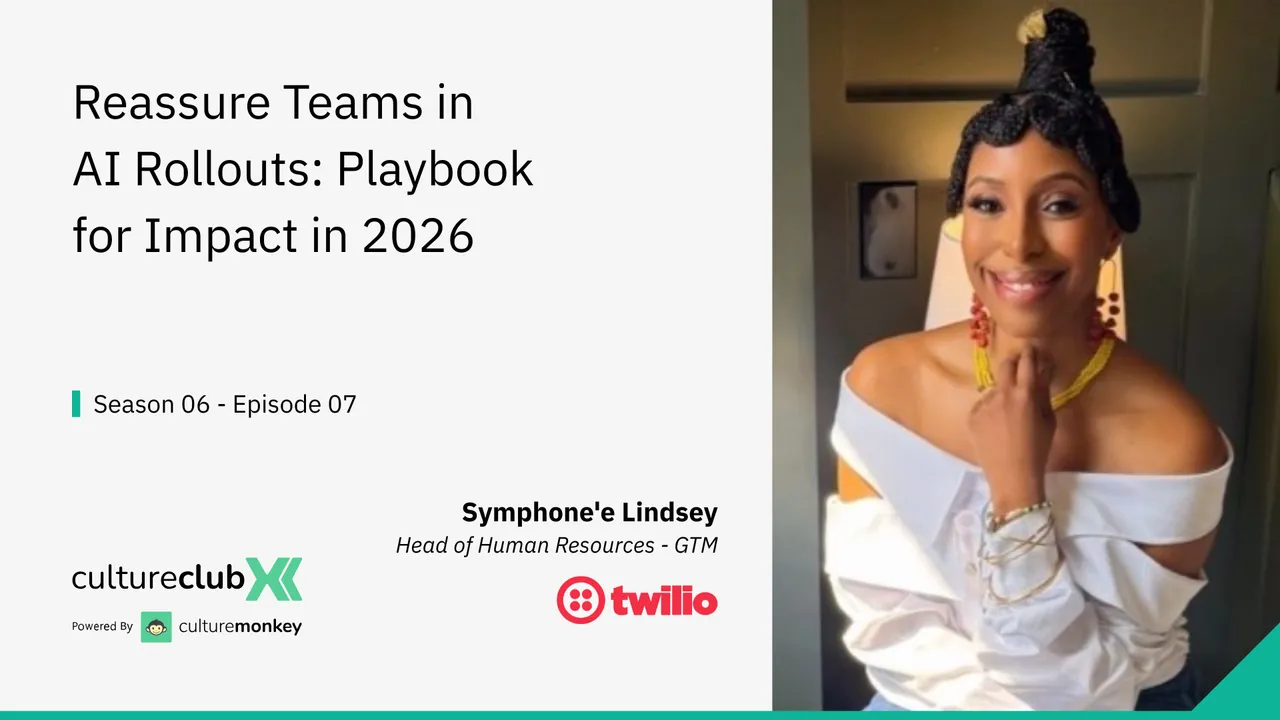
Symphone'e Lindsey, Head of HR, GTM at Twilio, shares her playbook for rebuilding conditional trust during AI rollouts, covering integration pauses, manager enablement, skepticism as a strategic asset, and how pulse surveys surface hidden AI risks before they become attrition.

TL;DR
What you need to know from this episode
- Employee trust in AI has not disappeared - it has become conditional. Workers will engage with AI when they understand the why, see how it benefits them personally, and feel it was introduced rather than imposed. Leaders who skip that foundation are not deploying AI - they are manufacturing resistance.
- Integration pauses are not a slowdown - they are a trust accelerant. Building deliberate recovery time into AI implementation gives employees space to experiment, process change at a human pace, and ask questions without pressure. Organizations that skip this step pay for it in disengagement and attrition.
- Managers are the most under-leveraged asset in any AI change program. They sit at the intersection of organizational strategy and employee lived experience. Their job is not to have all the answers - it is to normalize the conversation, acknowledge uncertainty, and model the learning journey alongside their teams.
- Employee skepticism about AI is an asset, not a problem to overcome. Skeptical employees are paying attention. Treating their concerns as resistance to manage shuts down exactly the kind of critical thinking organizations need to avoid AI missteps. The right response is curiosity, not countering.
- Pulse surveys are only as powerful as the discipline leaders bring to acting on them. Frequency matters, context matters, and honesty in the data depends entirely on whether employees believe their voice produces real change. A survey culture where nothing visibly shifts is a survey culture that produces checkbox responses, not signal.
Why AI trust has become conditional - and what leaders must do about it
Symphone'e Lindsey has spent over a decade navigating large-scale organizational change at companies like Amazon Web Services, PepsiCo, and now Twilio - and the pattern she sees repeating across AI rollouts is not hostility. It is conditionality. Employees have not stopped trusting their organizations.
They have started requiring a reason to extend that trust to AI. The distinction matters enormously for how leaders frame their communication strategy.
The shift happens, Symphone'e argues, at the point of introduction. When AI feels imposed - announced from above, tied to productivity targets, and associated in the news cycle with layoffs - employees default to self-protection. They ask whether their skills will still be relevant, whether their career trajectory still exists, and whether the organization sees them as a person or a workflow to be optimized.
These are not irrational fears. They are the natural response to a change that has not been adequately explained. Research on AI in HR consistently shows that transparency about purpose and scope is the single most reliable predictor of employee willingness to engage with new technology.
The more it feels imposed rather than introduced, that's when trust erodes. Employees are willing to engage with AI when they understand the why - and when they can see how it helps them, not just the company.
The WIIFM - what's in it for me - question is not a selfish one. Symphone'e is direct about this: in a moment of significant change, where multiple pressures are hitting employees simultaneously, it is entirely reasonable for people to ask how this particular change serves their own growth, not just the organization's efficiency goals.
Leaders who dismiss or sidestep that question leave a vacuum that speculation fills. Leaders who answer it directly and honestly create the conditions for genuine adoption.
Integration pauses: the practice most AI rollouts are missing
Change fatigue is real - and AI rollouts land on top of it, not instead of it. Symphone'e's most actionable contribution to the playbook is the concept of integration pauses: deliberate, structured breaks built into an implementation timeline that give employees space to process, experiment, and ask questions before the next wave of change arrives.
The pause is not passive. It is an active learning environment. Employees are given room to explore how AI works in their specific context, above and beyond their job requirements - how they might use it personally, what use cases they can identify, and what questions they still have.
The goal is to prevent the cognitive overload that comes from continuous roll-forward, where new tools arrive before employees have internalized the last ones.
When employees teach each other how to use tools, it normalizes AI as a resource rather than a threat. The recovery doesn't become passive - it's more structured, to allow and give permission to adapt at a human pace.
Peer learning is a critical component of this approach. In environments where employees teach each other - sharing prompts, use cases, and honest accounts of what did not work - AI adoption loses its top-down, compliance-driven character and becomes genuinely collaborative.
Symphone'e describes the organizations where she has seen this work best: employees coming to shared sessions with things they found on their own, techniques that surprised them, and questions that led to collective problem-solving. The result is not just faster adoption - it is adoption that sticks, because employees feel ownership over the process.
Effective change management depends precisely on this kind of participation being built in, not bolted on.
The AI Reassurance Playbook: Five Moves That Build Trust Through Change
Symphone'e Lindsey's practical framework for people leaders navigating AI rollouts - covering trust architecture, recovery time, manager enablement, honest communication, and listening discipline.
Introduce, Don't Impose
Lead with the why - not just the what. Employees engage with AI when they understand how it augments their role, not just how it improves company output. Answer the WIIFM question directly and early.
Build Integration Pauses Into Implementation
Create structured breathing room between waves of AI change. Give employees space to experiment, ask questions, and process what is shifting - before the next tool or policy arrives. Recovery time is not lost time.
Activate Managers as the First Line of Reassurance
Equip managers to normalize AI conversations in one-on-ones, acknowledge uncertainty honestly, and model the learning journey. They do not need all the answers - they need to be visibly on the same journey as their teams.
Have the Conversation You Have Been Avoiding
Silence does not create calm - it creates speculation. Host dedicated listening sessions where AI is the only agenda item. Employees are already forming opinions from external headlines; leaders who stay silent cede the narrative entirely.
Counter Skepticism With Curiosity, Not Defensiveness
Skeptical employees are paying attention - that is an asset. Treat their concerns as feedback to inform your enablement strategy, not resistance to overcome. Transparency about where AI has not delivered builds more credibility than overpromising.
The manager's role: normalizing uncertainty without pretending to have answers
Symphone'e is unambiguous on this point: managers are the most under-leveraged asset in any AI change program. They sit at the exact intersection where organizational strategy meets the lived experience of employees - which makes them uniquely positioned to either accelerate trust or quietly undermine it, depending on how they show up.
The instinct to wait until you have all the answers before communicating is precisely the wrong one. Employees do not expect their managers to have a complete AI roadmap. They expect their managers to be honest, present, and consistent.
A manager who acknowledges that they are also learning - and who creates space for their team to surface concerns, share experiments, and ask questions without judgment - is already doing the reassurance work that most AI rollouts leave entirely to an all-hands memo.
Managers are probably the most under-leveraged asset in any change program, and AI is no exception. Their job isn't to have all the answers - it is to be consistent and provide an honest, present perspective.
Symphone'e also highlights the generational dimension of AI fluency within teams. Some employees are arriving with deep familiarity and high comfort; others are encountering significant new terminology every week and feeling quietly behind. The manager's role includes recognizing who in their team holds AI expertise and creating opportunities for that knowledge to flow laterally - not just top-down.
This peer teaching model serves a dual purpose: it accelerates capability development across the team while giving individuals recognition for what they already know.
Employee well-being during organizational change is directly tied to people feeling capable and seen - and peer learning, well-facilitated, does both.
Spot hidden AI anxiety before it becomes attrition
See how CultureMonkey's pulse surveys and real-time sentiment tracking help people leaders detect fear, disengagement, and trust gaps during AI rollouts - and act before it's too late.
Have the conversation you have been avoiding - this month, not next quarter
When asked for the single most immediate step people leaders can take to neutralize fear of obsolescence, Symphone'e's answer is disarmingly direct: have the conversation you have been putting off. The worst thing a leader can do in a moment of high AI anxiety is stay silent.
Silence does not read as calm - it reads as confirmation of the worst-case scenario employees are already building in their heads from the headlines they see every day.
The format she recommends is a dedicated listening session where AI is the only agenda item - not a ten-minute slot in an all-hands. The goal is not to deliver a presentation.
It is to create space for employees to write vision statements, identify workflow opportunities, ask the questions they have been afraid to ask, and collectively develop a language for talking about AI change that feels human rather than corporate.
The absence of that language is itself a barrier: when employees do not have the vocabulary to articulate their concerns, those concerns do not disappear - they go underground.
Turning pulse survey data into a real-time AI risk detector
Symphone'e's perspective on pulse surveys is both enthusiastic and precise. She loves a good survey - and she is equally clear about everything that can go wrong with one. The gap between leader assumptions and employee reality is exactly what pulse surveys exist to close, but closing it requires more than fielding the questions.
It requires acting visibly on what the data surfaces, communicating about that action, and being honest even when the news is not good.
During AI implementations specifically, she recommends looking beyond traditional engagement scores to psychological safety indexes, manager-to-employee trust indicators, voluntary attrition trends, and - critically - AI tool utilization rates. If tools that are available are not being used, that underutilization is its own signal. The question is not just whether adoption is happening, but why it is or is not.
Pulse surveys timed to implementation milestones, rather than fixed annual or quarterly cadences, are far better positioned to capture the actual sentiment trajectory of an AI rollout.
Survey fatigue is a real constraint - especially when employees are already absorbing significant change. Symphone'e's guidance is to calibrate cadence deliberately, ensure questions are specific enough to yield actionable data, and make the feedback loop visible.
When employees see that their survey responses have produced a real change - or at minimum an honest explanation of why a change could not be made - participation quality goes up. When they see nothing happen, responses become checkbox exercises. The discipline is not just in collecting data. It is in being accountable for what you do with it.

About the guest
Symphone'e Lindsey
Head of Human Resources - GTM, Twilio
Symphone'e Lindsey is a Global HR Executive and Head of Human Resources for Twilio's Go-to-Market organization, a proven problem solver who aligns people strategy with business growth across complex global transformations. She has held senior HR leadership roles across Twilio's Data and Applications Business Unit (2,200+ employees across NA, EMEA, APAC, and LATAM), Global Services, Marketing, and Twilio.org, and previously at Amazon Web Services and PepsiCo. Her track record includes large-scale restructures affecting 28% of the workforce, 15-point engagement gains through a new Global HRBP Operating Model, a 25% boost in leadership representation for Black, Latinx, and Women, and EVP strategies that strengthened employer branding and talent pipelines, all while developing team members into senior leaders.
Full episode transcript
Season 06, Episode 07 · Symphone'e Lindsey with Darcy Mehta · 35 min
Frequently asked questions
Why do employees resist AI even when the technology is genuinely useful?
Resistance usually signals that AI was imposed rather than introduced. Employees engage with new technology when they understand the why, can see how it benefits their own growth, and are given space to experiment without pressure. When AI lands alongside layoff headlines and productivity mandates, even genuinely useful tools get caught in the crossfire of fear and distrust. The technology is rarely the problem - the communication and rollout approach usually is.
What are integration pauses and how do you build them into an AI rollout?
Integration pauses are deliberate breaks in your AI implementation schedule - structured periods where no new tools or mandates are introduced and employees have time to process, experiment, and ask questions about what has already changed. They are most effective when paired with peer learning environments: shared sessions where employees can teach each other what they have discovered, discuss what has not worked, and build collective vocabulary around AI. The goal is to let adoption happen at a human pace rather than forcing continuous roll-forward that produces surface compliance and hidden disengagement.
Which well-being metrics actually matter during AI implementations?
Traditional engagement scores are a starting point, not the answer. During AI rollouts, look additionally at psychological safety indexes, manager-to-employee trust indicators, voluntary attrition rates, escalation spikes, and - often overlooked - AI tool utilization data. If tools that have been made available are not being used, that gap is itself a well-being and adoption signal worth investigating. Pulse surveys timed to implementation milestones, rather than fixed quarterly cadences, are far better calibrated to capture how sentiment is actually moving in real time.
How should managers talk to their teams about AI when they do not have all the answers?
Honestly - which is precisely the point. Employees do not expect managers to have a complete AI roadmap. They expect consistency, presence, and honesty. A manager who says "I am on this learning journey too, here is what I know and here is what I do not" is modeling exactly the psychological safety that makes AI adoption less threatening. Managers should normalize AI conversations in one-on-ones, create space for questions without judgment, and actively identify team members who hold AI expertise and give them a platform to teach others.
How do pulse surveys help detect hidden AI risks before they become attrition events?
Pulse surveys close the gap between what leaders assume is happening and what employees are actually experiencing - but only when deployed with the right frequency, specificity, and follow-through. Segment sentiment by team to identify pockets of high anxiety that aggregate scores obscure. Time surveys to implementation milestones, not the calendar. And critically: make the feedback loop visible. When employees see their responses produce real change - or at minimum an honest explanation of why change was not possible - participation quality rises and the data becomes genuinely actionable. A survey culture where nothing visibly shifts produces checkbox responses, not signal.
Read the cross-episode roundups
More from CultureClub X
 S06 E20change leadershipThe Culture Paradox: Why Hidden Patterns Keep Organizations Stuck and Good Conflict Sets Them Free, with Jamie Notter
 Jamie Notter
 S06 E19change leadershipFrom Cost Center to Catalyst: How CPOs Turn People Strategy Into Business Advantage, with L. David Kingsley
 L. David Kingsley
 S06 E18ai in hrThe Human Edge: Why AI Should Make People More Valuable, with Steve Cadigan
 Steve Cadigan
Never miss an episode
Every new episode, plus the takeaways that matter, posted on the CultureMonkey LinkedIn page as soon as they drop.
Free on LinkedIn. Unfollow anytime.