

S06 E06
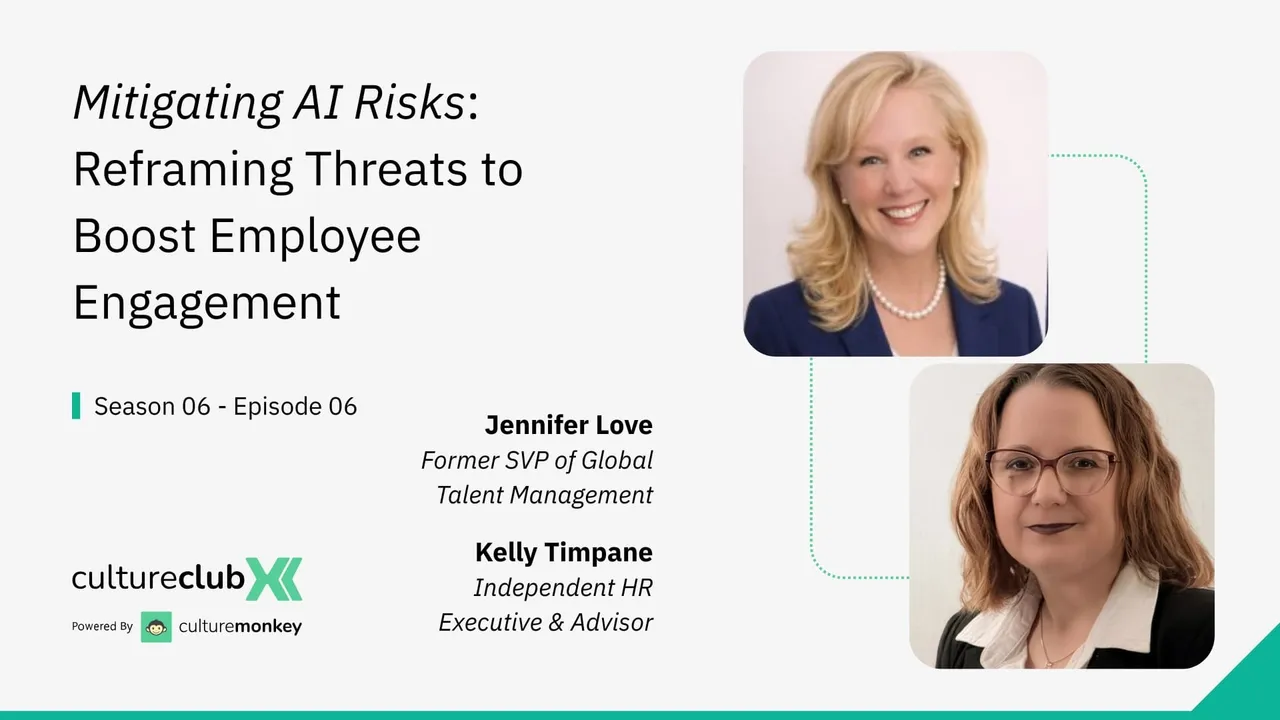
How do you adopt AI without losing employee trust? | Jennifer Love and Kelly Timpane
Set an enterprise AI strategy and governance before rolling out tools, say Jennifer Love and Kelly Timpane. Adoption fails when departments launch tools ahead of a company-wide plan, and trust erodes. Frame AI as a colleague that gives people time back, equip managers with talking points and training, and use pulse surveys to track anxiety.
TL;DR
What you need to know from this episode
- AI adoption fails when organizations skip the fundamentals. Executing before establishing enterprise strategy, governance, and data readiness is the single most common cause of failed AI rollouts - not the technology itself.
- Reframe AI as "done with employees," not "done to them." Messaging that positions AI as a colleague and copilot - one that extends employee expertise rather than replacing it - is the most effective driver of adoption and reduces anxiety at every level.
- Managers are the most influential voice in any AI rollout. They set the psychological safety of their teams, normalize the learning curve, and translate organizational strategy into daily practice. Ill-prepared managers are a direct liability to adoption.
- Silence breeds fear and rumors - seize the narrative early. If employees don't hear from leadership, they create their own stories. Consistent, frequent communication - calibrated to the right cadence - is a non-negotiable CHRO responsibility during AI transition.
- The AI Support Ecosystem requires multiple arms working in parallel. Effective well-being support during AI rollout is multifaceted: manager-led safety, micro-learning, peer forums, office hours, clear guardrails, and mental health access - no single lever is enough.
- The World Economic Forum projects nearly half the global workforce will need re-skilling as AI scales, making proactive learning strategy and continuous employee listening non-negotiable for CHROs in 2026.
- Pulse surveys are the real-time radar for AI anxiety. Two to three targeted questions - sent to specific groups, not necessarily the whole organization - surface sentiment fast. Closing the loop by sharing results publicly is what turns surveys into trust-building tools.
Where does AI adoption go wrong?
AI adoption is failing across organizations at a rate that has little to do with the technology itself.
The problem, as Kelly Timpane states directly, is that "organizations are skipping the fundamentals." Execution begins before strategy is set, individual departments race ahead with AI use cases before a company-wide vision is established, and governance - the connective tissue that holds it all together - is treated as an afterthought.
Three failure modes appear most frequently. First, putting execution before strategy: business units implement AI tools without a defined enterprise-level risk tolerance or governance policy. Second, data quality: AI amplifies whatever is in the data it accesses, and "garbage in, garbage out" is exponentially more damaging at machine speed.
Third, failing to account for the human experience - the erosion of trust that occurs when employees feel AI is being done to them, not with them.
AI adoption isn't failing because of AI. It's failing because organizations are skipping the fundamentals.
The governance gap is particularly acute in regulated environments. Organizations operating across multiple countries face a patchwork of AI regulations - what is permissible use in one market may be prohibited in another.
A governance committee with cross-functional representation is not optional; it is the operational foundation that allows AI to scale without creating compliance exposure or employee mistrust.
How do you reframe AI as a colleague?
The messaging that most reliably reduces AI anxiety is not a town hall announcement or a policy document. It is a lived experience - an employee who discovers, in their own daily work, that AI just saved them two hours they would have spent building a spreadsheet. Jennifer Love calls this the shift from "what is AI doing over there?" to "how is AI helping me?"
The reframe that works: AI is your colleague and copilot. It extends expertise, handles administrative load, and frees people to do more strategic, creative work. "It's not that AI is being done to you," says Jennifer Love. "It's done with them. And it's really about that colleague or that partnership."
It's not that AI is being done to you, it's done with them. And it's really about that colleague or that partnership if you can.
Equally important: continuous communication. AI changes fast enough that a single launch announcement becomes stale within weeks. Teams that build a regular cadence - sharing real use-case stories, failures, lessons, and quick wins - consistently outperform those who treat AI communication as a one-time event.
The goal is for employees to see their peers succeeding with AI and want to participate, not feel left behind.
How do you equip managers for an AI rollout?
Managers are the single most influential voice in any AI rollout. They determine whether their team feels psychologically safe to experiment, make mistakes, and share what they are learning. When managers are under-equipped - lacking talking points, training materials, or a place to escalate questions - the inconsistency that results is visible and damaging.
One team thrives; the one next to it has no idea what is happening.
Jennifer Love and Kelly Timpane co-developed a manager portal at Precision Medicine Group that became the definitive hub for manager enablement across a 4,000-person, 20-country organization. The portal housed development plan guides, performance review checklists, AI use-case examples, pilot case studies, communications templates, and escalation paths - all in one place.
Managers are the single most influential voice we have in every organization. They are literally setting the stage for the psychological safety of their team.
The portal served a second purpose: it gave managers permission to not know everything. A key design principle was including clear escalation paths - "here's what to do when a question comes up you can't answer." This normalized uncertainty and kept managers credible even during rapid change. Kelly Timpane notes: "Managers are the translators of change to their employees.
You have to equip them with the right tools, help them understand the value, help them to be change champions for you."
The practical implication for any CHRO: even a Teams channel or a simple intranet page is a start. The technology matters less than the intention - a consistent, always-available resource that tells managers you have their back.
The AI Support Ecosystem
-
1Manager-Led Psychological Safety Managers normalize uncertainty, model vulnerability, and communicate that mistakes and experimentation are expected - not penalized.
-
2Micro-Learning Pathways Bite-sized, role-specific AI learning integrated into daily workflows - not two-day seminars that pull people away from their work.
-
3Peer Learning Forums Structured peer-to-peer sharing - show-and-tell sessions, Teams channels, pilot retrospectives - where employees surface what is working and what went wrong.
-
4Dedicated Office Hours Open, always-available sessions - sometimes full, sometimes empty - that signal HR and tech teams are present and accessible for any question, at any stage of adoption.
-
5Clear Guardrails & Usage Policy A defined, accessible usage policy covering what AI can and cannot be used for, data privacy rules, and regulatory requirements - because most people operate best within a clear framework.
-
6Mental Health & EAP Access Active promotion of mental health benefits, EAP resources, and wellness tools so employees have a private channel to process AI anxiety that does not go through their manager.
What should CHROs prioritize to get ahead of AI anxiety in 2026?
CHROs who are ahead of AI anxiety in 2026 share four common practices. They establish data infrastructure and governance before rollout, not after a painful mistake. They seize the communication narrative early, calibrating message frequency so employees are neither overwhelmed nor left to fill the silence with fear.
They launch a tiered learning strategy - one that defines AI learning at the enterprise level and then adapts it for each department and function.
And they listen continuously, using employee listening tools to track sentiment in real time rather than waiting for an annual survey to reveal a problem that has been building for months.
Kelly Timpane places data readiness at the top of the list: "AI is going to surface that, and that's great for actually doing the data cleaning process.
Not so great if you throw it on a slide in front of the board." At Precision Medicine Group, the team built a master data governance committee - representatives from every function - to ensure that data fields were consistent across HR, ATS, finance, and operations systems before any AI tool was authorized to pull from them.
Before Your Next AI Rollout
- Establish a cross-functional AI governance committee with clear decision rights and a regular meeting cadence
- Audit data infrastructure - ensure master data elements are consistent across all connected systems before AI accesses them
- Define a written AI usage policy: what tools are approved, what data must never be uploaded to public AI platforms, and how regulatory differences by country are handled
- Build and populate a manager portal with talking points, escalation paths, training materials, and real use-case examples
- Design a tiered learning strategy - enterprise-level AI literacy plus department-specific upskilling - with realistic timeframes built into day-to-day work
- Deploy targeted pulse surveys before, during, and after rollout to track sentiment by team, role, and department
- Close every survey loop publicly: share what you heard, what you are doing about it, and when employees will see the change
How can pulse surveys detect AI anxiety early?
Pulse surveys are the most responsive tool available for tracking how employees are feeling about AI in real time. As Jennifer Love emphasizes, they do not need to be lengthy - two or three targeted questions are enough to gauge a team's anxiety level, confidence with tools, or clarity about the change management process.
They can be sent to a single department, a cohort of managers, or the whole organization, depending on where the risk is highest.
The critical success factor is what happens after the survey closes. Kelly Timpane is direct: "The worst thing a company can do is take a survey and then do nothing with it publicly." Closing the loop - sharing response rates, summarizing themes, and communicating concrete next steps - is what transforms a survey from a data-collection exercise into a trust-building moment.
It tells employees that sharing honestly is safe and that their input shapes decisions.
Pulse surveys are enormously effective. They can be run so quickly. You can do two, three questions at a time. You can do smaller subgroups of people. The flexibility is fantastic.
AI itself accelerates this process. Open-ended survey responses - which previously required hours of manual coding into themes - can now be summarized by AI in minutes. This frees people analytics teams to spend their time on interpretation and action rather than data processing, and enables faster feedback loops that keep pace with how quickly the AI adoption landscape is shifting.
For CHROs building a listening strategy around AI rollout, CultureMonkey's pulse survey question bank offers a curated set of prompts specifically designed for organizational change, engagement, and well-being - all optimized for the short, targeted format that gets the highest response rates.

About the guest
Jennifer Love
Chief Member at Chief, former SVP of Global Talent Management
Jennifer Love is an innovative, agile HR leader and business strategist with over two decades of experience guiding global teams through major organizational change. She builds scalable talent management programs that strengthen leadership capability, boost employee engagement, and drive long-term business growth. A SHRM and Chief member, Jennifer brings deep expertise in resilience, change leadership, inclusion and belonging, and high-trust management, and has served as a guest lecturer at colleges and universities.
She most recently served at Precision Medicine Group, a global life sciences organization, where she led talent strategy and people initiatives across 4,000 employees in more than 20 countries alongside Kelly Timpane. Her career began in marketing and brand strategy - an origin that gives her a distinct lens on how organizations communicate change and build trust at scale.

About the guest
Kelly Timpane
Independent HR Executive and Advisor, former SVP Global People Operations
Kelly Timpane is a global people and HR executive with more than 20 years of experience scaling teams across high-growth technology and life sciences companies. She specializes in operational excellence, people analytics, and AI-enabled HR transformation, and has led more than 30 acquisitions and divestitures in complex, highly regulated environments. A recognized thought leader and frequent speaker at HR conferences and industry podcasts, Kelly is known for her ability to connect data infrastructure with human strategy - ensuring that the systems organizations build are as people-ready as they are technically sound.
She most recently served at Precision Medicine Group, where she led HR operations across 4,000 employees in more than 20 countries, partnering with Jennifer Love to build AI-ready people strategies at scale. Her handle - the HR Ninja Nerd - reflects her rare combination of technical fluency and people-first thinking.
Full episode transcript
Hello everyone, and welcome to the latest episode in season six of CultureClub X powered by CultureMonkey. I'm your host, Darcy Mehta. CultureMonkey is an AI-powered enterprise employee engagement platform that helps people leaders listen to their employees and enhance workplace cultures.
CultureClub X is our global thought leadership forum where global CHROs and people leaders share insights, debate emerging trends, and exchange proven strategies for building thriving, future-ready cultures. And today, we're truly honored to host Jennifer Love and Kelly Timpane. Two leaders who've executed people's strategy at global scale and now help organizations navigate growth, culture, and transformation with real business impact. Jennifer and Kelly, welcome. It's fantastic to have you both here with us.
Hi, thank you, Darcy.
Thanks for having us on.
Absolutely. So Kelly is a global people and HR executive with 20 plus years scaling teams across high growth tech and life sciences companies. She specializes in operational excellence, people analytics and AI enabled HR transformation and has led 30 plus acquisitions and divestitures in complex, highly regulated environments. A recognized thought leader. She's a frequent speaker at HR conferences and industry podcasts.
Jennifer is an innovative, agile HR leader and business strategist who guides global teams through major change. She builds scalable talent management programs that strengthen leadership capability, boost engagement and drive long term business growth. A SHRM and Chief member, she brings deep training and resilience, change leadership, inclusion and belonging, and high trust management, and has been a guest lecturer at colleges and universities. Together, they've turned complex global transformations into measurable wins, exactly the kind of real world partnership our listeners have to learn from.
So thank you so much for both being here and your shared track record of turning complex global transformations into high engagement outcomes makes you the ideal duo to have for today's conversation. And we're excited to have you both discuss the latest topic, mitigating AI risks, reframing threats to boost employee engagement. Before we dive into our questions, could you each just share a little bit about your own leadership journey?
Sure, I can chime in. So I have, as you said, over two decades of experience in HR and pretty early on kind of moved up into leadership after six, seven years, smaller companies at first. And I started to really think about in the last 10 years, what do I want to do? Want to keep doing kind of general HR, do I want to specialize? And so I decided to go into larger companies, worked at one that was about 8,000 people. The most recent one where Jenny and I worked together for a number of years was about, by the time we left, about 4,000 people across 20 plus countries.
And so in those two most recent, I was specializing in leading total rewards and HR operations. And then in the last two years, in my most recent one, I then specialized just in HR operations. So again, the analytics, the HR systems and technology, M&A heavily, and just kind of that overall workflows process improvement.
And I started my career in marketing and advertising and really honed my skills in brand strategy, working on many large different accounts, McDonald's, Converse Sneakers, Fidelity, large accounts like that. And ultimately found my enjoyment, I worked on monster.com and ultimately found my enjoyment under people and wanting to really focus on the growth of people in my teams. And so I really started to lean into that and then that really got me into HR. So I really started in my marketing journey and felt much more drawn to the people aspect of business. And so that really drove me into doing that for agencies and then ultimately with Precision Medicine Group, which is the company that Kelly and I just were at for several years.
I think the opportunity to really build brand strategy and then look how you build strategy for people and people's strategies, whether it's for smaller departments or for larger organizations. I like working through that and extending that. And that's really where my strength comes from. Partnering with her has been amazing. We've worked together for many years. And me on the talent management side and Kelly on the technology and both meeting and strategy in the middle. It's really been a great partnership. So working together on this is exciting for me too.
It's amazing. You two are definitely the dynamic duo. And I think it's interesting to always find out how everyone got their start, how you ended up where you are, because we all have such different journeys and you realize there's no one path towards many things. So it's just always so interesting to hear. So thank you so much, both of you. And let's dive right into our questions.
So where do you see organizations getting AI adoption wrong today and what unintended consequences are you seeing as a result?
Sure, I can jump in on that. So AI adoption isn't failing because of AI. It's failing because organizations are skipping the fundamentals. So some of those, I would say, putting execution before strategy. I think there's a lot of maybe individual departments or business units in companies that have these ideas of like, here's what I want to do. And they start going and implementing and executing before they've really stopped as a company to say, what's our enterprise level strategy, vision, what level of risk are we open to?
Kind of along with that, the AI governance strategy, not just sort of your policy and vision strategy, but what's your governance strategy? You really need to have, you know, a committee or at least a couple people who look at those different use cases and say, is this acceptable? And also really keep an eye on the regulations. There's a lot of regulations out there in different countries about, hey, how AI can and can't be used in a business.
And then I think the other thing is just having outdated or incorrect data that the AI is accessing. We've all heard and said garbage in, garbage out, that's really amplified by AI. So I think the combination of those things, it really leads to a lot of incorrect uses of AI, but also a lot of mistrust by employees, I think.
And I think that that piece - I really love that you brought up mistrust - because I think the failing of the human experience is the part that we really lean into on this around talent management. And so you're focusing on the employees and like, what are the benefits of AI, right? But what is the benefits to me and to my role and to my team, right? It's not that AI is being done to you, it's done with them, right? And it's really about that colleague or that partnership if you can.
And so the threat, the nerves, the anxiety around AI is very real. And so how you can ultimately kind of manage that conversation for employees is important. The other thing is employees also create the scenarios in their head. What is this gonna become? What is this doing? So if no one's really saying anything and guiding them, whether it's managers, leaders, organizational communication, whatever it may be, that's where real trust erodes. And then the stories start, right? And then we just never know what the spiral will be.
I think another piece of this is over indexing on speed versus the psychological safety of it. So if you're racing to get AI out and you're not necessarily paying attention to how employees are adopting, how are they learning, who are the real stars that are seeing how to implement this? And are they sharing with the rest of organization of how they're doing it and their stories? And so we're seeing a lot of that. And then also managers, managers are so key to this. And if they are ill-prepared, they are not credible. They're not able to help the organization. So the best thing is to invest in your managers every step of the way.
Absolutely. You both made such good points and even touched on a similar one, which is not having that implementation without the strategy. And I like what you said about AI is not being done to me, it's being done with me and for me and it's in conjunction. And so that's a powerful reframing for sure. So what messaging has best reframed AI as an enabler rather than a threat? That's kind of what we already touched on and what tangible actions have actually shifted employee perceptions and practice.
I'll leave with this and say that AI is your colleague and almost copilot. We talk about copilot in general, but it really is. So it extends my expertise. It allows me to really be stronger in my role. And I think some of that piece and some of that messaging to employees is critical. Are also, the company's investing in you. They want to invest in you. They want you to learn. They want to bring you through this journey. So the more companies can explain that and train and want to upskill their teams matters.
And it's not about just once out of the gate too. I know a lot of times we launch something and then we talk about it and we don't talk about it again. I think with AI, this is a continual conversation because there's a lot of anxiety no matter what level you are in the organization. And so the most that companies can talk about it, the managers can meet about it and share the real stories. What's happening in this department? What's happening in that department? How did this person trip over it, right? How do they figure that out? What are the failures? If you look at failures, how do they learn from those and then adopt new practices because of it? So I think all of the sharing real stories, pilots, just ways that they can share case studies will really make a huge difference.
Yeah, I absolutely agree on that. I think what changes the perception and practice is first, obviously, as Jenny said, you know, needing to ensure employees are trained. And I think that actually starts with the basics of AI, because you can't really go into, you know, how is AI going to affect me if you don't even know what it is, right? So first, giving them at least a basic understanding of what it is, what it's not. It's not Skynet from Terminator. We're not there yet. You don't need to worry about that.
You know, it's really a tool and assistant, a thought partner, moving from what Jenny was saying from that messaging to a lived experience, finding out, you know, this isn't scary. Okay. This is actually a helpful tool and showing that visible impact, how is it impacting them on a day to day basis? You know, there's note taking assistance. It can help you research. It can help you brainstorm, write emails in a certain way, gather information for you. And it makes all of those things happen easier, faster. It moves processes along faster. And that gives you more time to do more, maybe to be more strategic and not as sort of tactical in things. So I think the more they see that, the more they'll understand this doesn't need to be scary to me. This is something that's really going to help.
And one real life example I have just for myself is, you know, I've pulled information for board meetings where they ask for a specific metric. And sometimes it can be really tough to get that. And I would have to pull multiple spreadsheets, put in a lot of formulas, take a lot of analysis. It would take hours, hours to get this data. I can do that now in an instant with AI. I can just ask the question. It goes boop, boop, boop, boop, boop, it says, here's the answer. So that to me was like, okay, this is really helpful. You know, I don't have to take hours doing this thing. So I just think as employees see that more and more for themselves, not like, it's helping this over here or that. How is it helping me? That's really, really going to help.
Yes, definitely. Absolutely. I have those same examples in my own life, too. And I think that perception of AI, it's not there to replace me, you know, not yet, hopefully, but it's more of a colleague. It's an assistant. I think when I started thinking about it a little more as an assistant of, here's a data admin annoying task research, right, that's going to take a long time. Can this help me get back hours of my own time to do something that's more creative, you know, like larger, different scale thinking and not waste my time on it. And then you're kind of like, okay, I see the value in that.
Definitely, and it's just, obviously the more you do it, the more you learn and see too. So this kind of does go into our next question of what role should managers play in day-to-day reassurance during AI adoption?
They really are the single most influential voice we have in every organization. I really look at them like this. They are literally setting the stage for the psychological safety of their team. They are able to say that we are to make mistakes. We are to test drive this together. We are to experiment the best way we can together, right? They can help us normalize this learning curve. And the more engaged the managers are with their teams and ultimately with the whole organization, the better off any organization will be overall.
The other thing to this is that it's about consistent training. So if every organization is looking at it as what are we doing to inform our managers? How are we absolutely leaning into them? Are we giving them all the tools they need to train their teams? Are we being consistent in that messaging? There's nothing worse than you walk in and you see one team who is thriving with a really strong manager who has an amazing training program set up, and another one who has absolutely no idea. And the only reason is because it really wasn't provided. They weren't trained in the same way, right? Everyone's gonna have their own unique style, but the piece of the training materials matters, right?
And then that also comes to communications. What are the communications that all the managers are saying? Are they really being consistent and are they all leaning in? What does good look like? How can we describe that? Can we describe that altogether? Right? So that really does align. So the consistency piece is probably the breakdown and consistency is probably the biggest thing. And if there's a way to really create that across the organization and ultimately down through managers and through the teams, that literally will be a game changer.
And I know consistency too for you, Kelly, you have this very big in tools.
Yeah, you know, the consistency in the application as well. You know, managers, they're the translators of change to their employees. And we have a lot of heavy expectations on managers. You know, we expect them to just know it without providing the tools and like, why don't you understand it? Why aren't you saying the same thing? You need to give them those tools. You have to equip them with the right tools, help them understand the value, help them to be change champions for you. The more they can sit in a meeting and go, yeah, I've used this. It's so exciting. It's gonna get their employees energized too.
And like I said, don't just assume they understand it. You have to give them consistent tools, talking points. Maybe the only thing that changes in their slide deck is the examples for their business unit or their department of, here's some of the things. But as long as it's like the same overall message, communication, that's where having those consistent policies, practices, training really is going to help those managers do their job.
And I think escalation and clarity, if there's questions, letting managers know, like it's okay to not know everything. If someone asks you something, you can say, that's a great question, let me jump into that and get back to you and then escalate it up to someone who does know and get back to that and follow up. That's fine, we're not expected to all know everything, right?
Exactly. It's the idea that managers are navigating this too. So this is such a big change, right? In all of our systems and work and there's a lot coming at us all the time. So it's that being clear that they're navigating it, sharing the wins, but having those tools, right? So that they can be consistent. So absolutely.
Yeah, I was gonna say - no, Jenny, I was gonna say like that reminds me of something that you developed.
Yeah, so we developed a manager portal at Precision and one of the best pieces about this is that it literally became the hub for all managers. So if you want to talk development strategy or development plans for your employees, you have that. If you're doing a performance review and you want the top 10 things to know as a manager when you're walking into that performance review, if you want to talk about celebration and acknowledgement and gratitude. What are the things you can do? So all of these various topics are in the portal and they literally live as this hub for managers.
What do I need to do? I'm going into one-on-one. What's the best top three things I need to know for effective one-on-one with my employee. The AI would sit there too, right? So all of these various tips, all of these tools, various ways, you know, it could be a pilot and some recap on a pilot that happened that actually there were various different things that went awry, but here's what we did about them. Here's communications about what's coming up for managers to know.
And so there's something about having a hub where you can really lean into for managers because we know that you're going to have these moments. You're gonna feel really confident sometimes. And even the most confident manager is still gonna have those moments of wondering, you know, what do I do? How do I navigate this? And it doesn't even matter if it's just AI. That could be any real topic in management, right? Management is so broad. Somebody asked me once, Jenny, how often do you expect people to manage each day? And I was like, if you're a manager, you manage all day. Kelly and I laugh. It's like that doesn't really ever end. It's like, when do you stop being a parent if you're a parent? Right. I mean, it's kind of one of those things.
One of the things I was talking to Kelly the other night about this when we were talking about this podcast, but there's an author, a podcaster. She's a doctor philosophy, Brené Brown. You probably heard of her. It well, Darcy, because I just love her. But she said this, when you are in uncertainty, when you feel at risk, when you feel exposed, don't tap out, stay brave, stay uncomfortable, stay in the cringey moment. I love that. Lean into the hard conversation and keep leading.
And I think that's the piece is like, Kelly and I are talking about, there's gonna be a lot of uncomfortable. There's a lot of navigating things as a manager you've never navigated before in your life. So as a manager, you lean into that uncomfortable, you can share that uncomfortable. That vulnerability is really wonderful. Some people need to feel that pride and that ego, but there's something nice about saying we're gonna lock arms and we're gonna do this together. And I think that Brene Brown thing just really encapsulated that piece of terms of managing.
Absolutely. Thank you for sharing that. I mean, she's amazing. It's amazing life advice. I like that too, is just the idea that we're growing if we're uncomfortable. If you're too comfortable, you're not growing, you're not learning. So it's getting used to being uncomfortable and being vulnerable is part of that.
And congratulations on that managers forum. It sounds incredible. And an organization I work with actually that supports associations and nonprofits, they have something called the President's Forum. And it's a similar thing where there's no recordings of it. It's not open to the public, but it's a safe space to discuss and to compare and here's what's going on with my board or my team and things. So it just kind of reminded me of that. But I love that. I think everyone should have that manager portal.
Yeah, even Teams chat, same thing where people can lean in and say, hey, I just had this dynamic happen. What could I do? And that's a perfect example of using the technology to help learn, to help share and have those moments together. So yeah, any way you can lean in.
You got it. Feel more psychologically safe.
Absolutely. And so I guess pivoting attention a little bit, what support systems have proven most effective for employee well-being during AI rollout? Because you just mentioned psychological safety too.
Yeah, I think honestly, we talk about a support ecosystem. And so it really is so many different facets. It's almost like this octopus, right? There's so many different facets that can support this whole AI world. One is in terms of, we talked about the manager-led and being ever-present, normalizing the uncertainty, right? Being transparent, that piece.
Having these micro-learning pathways, right? Not everybody wants to learn in these large-scale two-hour, two week seminars, right? What are the types of learning that your teams can have and establish what those are, right? And put timeframes to them too that seem really reasonable. So as they're doing their day-to-day work, they understand how they can learn alongside, right? There's lots of different pieces that. Peer learning, we talked about that, whether it's on a team's chat, whether it's a show and tell, live show and tell through Zoom, whatever it may be. It may be pilot tests that you're sharing. Also just where they went awry, where they really succeeded, and how we're making change based on that.
Dedicated office hours. Kelly knows I used to host office hours, her team did too, the tech side. We'd host office hours all the time with the company and be like, anytime you show up. Any question you've got, we're there. There'd be sometimes I'd sit there for time and no one would show. There'd be times we'd come and there'd be a line out the door. You never know what you'll get. But that's the beauty of it - you're always there. You're omnipresent. You wanna talk, you wanna share. And that really allows you to be safe in that space. And experiment, right?
And the guardrails are probably the most important too. Kelly can talk about this too in terms of the guardrails. But I mean, guardrails in terms of what we're really gonna pursue, what we're genuinely not going to do, because whatever it may be, the dynamic of your role, the dynamic of the team, what the organization is supporting. But, you know, Kelly, please, in terms of guardrails, you had talked a lot about that the other day.
I think one of the things that I was reading recently was, you know, the World Economic Forum estimates that nearly half the workforce is going to need re-skilling. So again, a lot of what we're seeing isn't fear of AI, it's that uncertainty about what comes next, how it's going to affect me. So having, you know, all those things that Jenny just talked about, having those guardrails in place about how to use those tools effectively, appropriately.
Again, making sure that you're paying attention to regulations as well, but also just guardrails around policy, structure. Most people operate best within a structure and kind of knowing, what are the rules? Like, what am I supposed to be doing? So having consistency in policy around usage. Even from just the start, you can just have an initial rollout of just copilot or chat GPT or whatever and here's some things you can use it for, here's the things you shouldn't do. Big tip, don't upload your entire policy handbook or any private information onto public chat GPT. That's a must no matter what, any organization.
Change management, again, having those advocates, those champions. That's going to help employees feel more comfortable. It's going to de-escalate some of those feelings that they're having, the anxiety. Jenny talked about this before, transparency. Engage them during the change. Embrace the challenges. Acknowledge mistakes. Don't try and sweep it under the rug. Don't over promise and then lose credibility. Bring them on that journey with you.
And I think also keep in mind there's multiple avenues of engagement and well-being. It's not just sort of the employer driven side, but also the tools that are available to employees to kind of seek out on their own, having, as Jenny said, kind of ad hoc on demand training, but also things like your mental health benefits through your benefits programs. There are, you know, EAPs, there's wellness resources a lot of times through your actual health providers. And just knowing they have access to that to just even talk about the anxiety. These people are not going to say, I've never heard that before. Really, there's no silver bullet answer. As Jenny said, it's really a whole ecosystem of support. It's a multifaceted approach.
Absolutely. Well, I like the octopus example - it helps me visually get that. It just has a lot of arms. I mean, it just does. And we wish there was one right. You wish there was one way to go about it. But I think that's the piece is that, you know, every manager will lean in it differently. So to that end, it's like, let's give a lot of different ways that you can get at this. And then you may have bigger strength in one area or not. But at least you understand just the different ecosystem of options. Better than others, but at least you've got options to try.
You know, we do operate, all of us, better within a framework. So that's why those guardrails, and especially this world is so big and chaotic and changing with AI, right? So having those guardrails and that framework does make a big difference.
So this, we may have kind of already answered this, but the next question is, what should CHROs focus on to get ahead of AI-driven workforce anxiety in 2026?
Yeah, I think the absolute first necessary thing is that AI governance, you know, going back to your data readiness, your infrastructure around it, governance in terms of compliance. Another thing is kind of your data readiness in terms of having multiple systems. I don't know very many companies that have one system that employees go into and that's it. You know, you've at least get your have your HR system and your applicant tracking and maybe a finance system or ERP, making sure that that data is connected and that the, I would call the master data elements are the same.
So, you know, if you've got a field called business unit in one system, but it's called org unit in another, you need to have a bridge between those in order to really get that data right. And that needs to happen before you roll it out, you know? AI is going to surface that and that's great for actually doing the data cleaning process. Not so great if you throw it on a slide in front of the board, right?
So, you know, in an organization where I worked actually at the place where Jenny and I worked together, not just for AI, but kind of for tech in general, we created a governance committee that was a master data governance committee where people who were representatives of the technology from all the different departments and functions. We would meet regularly and talk about, you know, here's some new stuff I'm putting into my system. Let's make sure it maps to your system. What's the timeline, the cadence. So, you know, really just making sure that infrastructure is there ahead of time and taking that proactive approach versus being reactive, you know, that technology needs to be there ahead of rollout.
Yeah. I think the other piece too is like seizing the narrative before employees run amok, right? Before employees start to believe whatever may be happening. And so there's something in like leading through fear. You know what I mean? There is that. And it's consistent and constant messaging. I mean, that's the piece.
So the Chief People Officer can really be dynamic in this space. Bring the organization along. Bringing leadership, honestly training and educating leadership on how to message this consistently and how often to. Sometimes it's so much that no one listens, right? Then it's not enough so everyone creates their own narrative. So how do you create that? Is it once a week? What is the cadence that feels right for your organization? But that really does matter. So you're constantly on that.
I think launching a learning strategy that would couple with what Kelly just talked about is: what is the learning strategy for the organization? And then what is the learning strategy for each of the groups and departments? That really can change. That really can evolve. But what is the organization's perspective of it? And so everyone can understand that from the broader perspective and then drill down of what makes most sense.
And then ultimately listen. That's the one thing is like we use a lot of listening mechanisms, whether it's pulse surveys, engagement surveys, you know, exiting surveys, onboarding surveys, there's lots of different ways to get at this. And I hate the word survey, because in reality, you just really want to just get some wonderful feedback from people. And so they don't have to be lengthy, they don't have to be more than three questions. They really don't have to be a lot to really gauge how people are feeling.
And anxiety is going to be a major culture signal, right? It is a big culture signal. So you're gonna feel that if you're getting a lot from managers and what they're saying around that, that they're uncertain of how to handle it. You know how to train them better, right? If you're getting employees, and you can also just pay attention to different departments, different groups, who's having a harder time? You can literally pulse anyone. It doesn't have to be full organization. It could be down to one group, right? And that's the beauty, the flexibility of it. But listening a lot as a chief people officer would be a huge benefit to the whole department, whole organization.
Definitely. And talking about anxiety, Forbes identifies rising fear of becoming obsolete, FOMO, which I think that's so funny. We've all heard of FOMO, right? Fear of missing out, but fear of becoming obsolete. What proactive steps have you taken to turn that fear into excitement and sustained engagement?
We really talk about how is it useful? Share how it's useful in every possible way. Share all the examples, have real life scenarios with employees, highlight the time saved, highlight the efficiencies that you saw, talk about the stress it reduced. Right, even if you just got out of a meeting and it recaps your meeting and gives you top five action steps immediately. Now you may have to evolve those to send it out to make it for the whole team. But think of what that just saved you. Talk about the most mundane even things like that that have saved and just made your actual day easier, right?
Educating managers, we're talking about that. Educate them on through the process. Don't stop at the first step. Continue to educate them and inform them and have them have the material so that they know how to educate others.
Recognize and reward the engagement. If people are very engaged, recognize those people, celebrate them. They're getting certifications in AI. Celebrate that, talk about that, encourage others to do as well. That's where the peer on peer really grows, right? Someone really learned something amazing. I'd like to do that too. I'm really interested in what Kelly just shared about X, Y, and Z. That's really it. So, and then again, leaning into all the listening mechanisms. There's so many different ways to gain information from employees. And so that's a really big piece is like what makes most sense for your organization and choose those pilot retrospectives or choose those peer on peer group sessions or the pulse surveys, whatever it may be, but lean into those.
Yeah. And I think around that anxiety and fear piece, you know, PwC recently had some stuff out about employees. They're both excited and anxious about AI at the same time. So I think kind of to your point of like what proactively can you do is really showing that it can be used to reduce fear and showing what those outcomes are, right?
You know, as Jenny said, I think in terms of surveys, having visibility into the results - the worst thing a company can do is take a survey and then do nothing with it publicly, right? You need to give some of that feedback. And by the way, AI can help you with that because especially if you're doing kind of open-ended questions, you don't have to sit there and read every one. And, you know, I used to then make like a spreadsheet of like, this is the rough topic. And you end up with like 300 different topics. AI can surface insights around those written themes too.
And I think, you know, another big thing is that skill visibility, being able to see, you know, the information is coming from the applicant tracking system to the HR system to a skill tracking or LMS, you know, and that is going to help with internal mobility. So, you know, managers are going to be able to ask AI who's skilled at this level in this specific thing, in this location, and they'll more easily be able to fill internally before going external. So I think that's that fear of becoming obsolete is again, just around showing them, no, this is a tool to help you. It's not something scary.
Right. It's just it's there to assist you, not replace you. It's a big difference. So what key AI related concerns are employee listening efforts revealing today? And how do Pulse surveys and tools like CultureMonkey support real time sentiment tracking?
I think the biggest word I would say is resistance. That we're finding there's major resistance. Resistance to even start. It's not even that they've entered into too much of it. They're very nervous about it. And then ultimately, what does it do to my role? And so the more that there can be communication and support around how to manage that resistance, that resistance is real for all of us.
And then that fear of being replaced. That can dissipate when they understand what's actually happening, when they understand what this tool is gonna be used. And actually, even when Kelly talked about guardrails, when they understand the guardrails that are being put on it as well. So it's not just running over the organization, right? There is structure put to it.
Pulse surveys, like I said, are enormously effective. They can be run so quickly. You can do even two, three questions at a time. You can do smaller subgroups of people to the broader organization as well. But to be able to have that flexibility and how you want to really get sentiment from employees, that flexibility is fantastic.
And to Kelly's point, sharing that real-time information, sharing that learning, and then what we can actually do about it together is a real benefit, right? Therein lies employees saying, okay, not only did I share something, I'm nervous to share, am I being honest? Should I be honest? Okay, now I'm honest. And then, wow, I actually heard back. We heard back within the next few days, this is how many people responded, this is how they're feeling. Well, there's other people in the organization that are feeling the same way as me. Or if it's for managers only, other managers are struggling with this too. They're struggling with training, they're struggling with how to communicate something, whatever it may be.
So it's a real gift and the open-ended side of Pulse surveys or engagement surveys is the ideal as well. Have it open-ended. Have them be able to share what's really specifically going on, that it's not just a drop down answer, if you will. Those are very effective in terms of getting answers, but you definitely wanna have the opportunity for someone to really share that back with the organization.
And I think from kind of the data and system side, AI is changing at an exponential level faster than any other technology adoption we've ever had, ever. And there's some of the systems and I won't start listing all the different ones, but they're releasing, putting out releases and little updates and little tweaks hourly, not quarterly, not monthly. Right. By the hour things change.
And so, having those pulse surveys, kind of continuous feedback, as opposed to just a monthly survey, things are moving so fast. You need to, if you're doing it weekly, monthly, you're getting old data. It might not be that anymore. It could be changing every day. So it's being able to kind of see that live real time sentiment and help address it.
The other thing you can see is adoption data and usage patterns. Backing away a little bit from the open sentiment part, but just using some of the numbers data. How often are you using this? What ways are you using it? Are you still seeing friction in workflow? And then on kind of the backend side, how many support tickets are we getting and what types of things? How many escalations? And then connecting that as Jenny said to insights of what type of action we need to take, what kind of feedback, you know, now that we know this, what do we need to do about it? And again, that's another area where AI can help - brainstorming, being a thought partner on how do you then move that needle? What are some suggestions of ways other organizations have helped to, you know, get better adoption or whatever it might be.
The other thing too is people can be nervous around responding to surveys, but the more that you're putting out a pulse and then you're actually providing the feedback and next steps, action steps from it, and then we do it again and do it again. Then they know they're participating. Then it becomes this conversation. So it's more about they actually are - these are actionable items and I'm seeing momentum. If I see the momentum, I want to participate in it.
Yes, absolutely. It's funny. You took the word out of my mouth. I was going to say it's like a conversation, right? That's what when you both were describing it and the speed at which it's all changing and updates are happening. So it's just a constant and every day a conversation. Where are we at now? Where are we feeling? And that's why that open-ended question is so important because you can't, you know, predict what people want to say. So you've got to have that open-ended space.
So that leads us to our final question, which is some actionable items to actually work on. So what are top three to-dos for our listeners to start mitigating AI risks and boosting engagement the right way?
Putting you on the spot. Yeah, for top three, again, make sure that data is clean and consistent before you roll things out. Keeping in mind AI is not just automation. It's also a thought partner. You can use it in multiple different ways. And then, building that confidence before all the complexity. So giving them some of those insights on how it's gonna help them personally, individually, day to day.
Board chair informed and committed managers are cornerstone to your success. And if you can lean into that, you will have tremendous success in terms of employee adoption, consistent messaging across the board and clarity creates momentum and adoption. And the last is be okay to be uncomfortable. You know, you are not alone. Absolutely. So embracing that, leaning into uncertainty as Brene Brown says, it would be a gift for all right now. And we couldn't encourage you to do more.
Absolutely. Everybody would be so fortunate to have the dynamic duo on their team because you guys are just full of insight. You never know - this might be the Kelly and Jenny team, it just could happen. You have a new podcast of you two. So thank you so much. I've learned so much. I'm enjoying hosting this show and your grounded, battle tested advice on reframing AI risks and turning anxiety into real engagement is exactly what CHROs need right now.
It's clear the smartest organizations treat AI as a partner, like you said, not a threat - by listening early, supporting managers and keeping people at the center of every change. And that's where CultureMonkey excels - with real-time pulse insights that help leaders catch sentiment shifts fast and protect engagement during AI rollouts. So before we end, can you both tell our listeners how to connect with you to keep this conversation going or to share their own perspectives?
Sure, so I love connecting with people. My biggest place is LinkedIn. I'm on there all the time. I do share updates of when I have another speaking engagement. I actually will be speaking at a Hacking HR AI Summit coming up in June and a couple other podcasts that will come out soon. So you can follow me there, you can connect with me. I'm happy to share tools, templates. I have no pride of ownership on that. And so - I don't know if you will provide the LinkedIn data - it's LinkedIn. The thread is, Kelly HR Ninja Nerd, kind of describes my techie nerdy side of HR. So, you know, feel free to read that.
That's fantastic, Kelly. I didn't know that was your LinkedIn. Same with me. LinkedIn is the best way to reach me. I am absolutely happy to share tools and ideas and anything. If anyone reaches out to me, I welcome that endpoint.
Amazing. Well, I'm definitely going to reach out to both of you as well and to all our listeners. Thank you so much for being here. Don't forget to follow, share and subscribe. And that's a wrap for this episode of CultureClub X powered by CultureMonkey. Until next time, I'm your host Darcy signing off.
Frequently asked questions
Why is AI adoption failing in most organizations?
AI adoption fails primarily because organizations skip the fundamentals - launching execution before establishing enterprise-level strategy, governance, and data readiness. As Kelly Timpane explains, putting individual department initiatives ahead of a company-wide AI vision leads to misaligned use cases, data quality problems, and erosion of employee trust. Governance committees, clean data infrastructure, and a clear usage policy must be in place before any AI tool goes live.
How should CHROs reframe AI to reduce employee anxiety?
CHROs should reframe AI as a colleague and copilot, not a replacement. Jennifer Love recommends messaging that emphasizes the company is investing in employees by giving them AI tools to extend their expertise, reclaim time from administrative work, and focus on higher-value strategic tasks. Sharing real-use-case stories within teams - where employees see AI saving hours of their own work - builds comfort faster than any top-down announcement.
What role should managers play during AI rollout?
Managers are the single most influential voice in any AI rollout. They set the psychological safety of their team - normalizing mistakes, encouraging experimentation, and sharing their own learning curve. Jennifer Love and Kelly Timpane recommend equipping managers with a dedicated portal or hub containing talking points, training materials, AI use-case examples, and escalation paths so they can answer employee questions consistently and credibly.
What is the AI Support Ecosystem framework?
The AI Support Ecosystem - developed by Jennifer Love and Kelly Timpane - is a multifaceted approach to employee well-being during AI adoption. Like an octopus with many arms, it draws on six interconnected support mechanisms: manager-led psychological safety, micro-learning pathways, peer learning forums, dedicated office hours, clear guardrails and usage policy, and access to mental health and EAP resources. No single arm is sufficient; resilient AI adoption requires all six working in concert.
How can pulse surveys help organizations manage AI-related workforce anxiety?
Pulse surveys are one of the most effective tools for tracking AI-related sentiment in real time. They can be as short as two or three questions, targeted at specific teams or the full organization, and deployed rapidly as new concerns arise. The critical step, as Kelly Timpane notes, is closing the loop - sharing results publicly so employees see their feedback acted on. AI itself can then help surface themes from open-ended responses, turning survey data into actionable people strategy.
What should CHROs prioritize to get ahead of AI-driven workforce anxiety in 2026?
In 2026, CHROs should prioritize four areas: establishing AI governance and data infrastructure before rolling out tools; seizing the communication narrative early so employees don't fill the silence with fear; launching a tiered learning strategy tailored to each department and role; and deploying continuous listening tools - including targeted pulse surveys - to monitor sentiment and adjust in real time. The World Economic Forum projects nearly half the global workforce will need re-skilling as AI scales, making proactive people strategy non-negotiable.
Read the cross-episode roundups
More from CultureClub X
 S07 E03employee engagementWhy do grievance procedures damage workplace culture? | David Liddle, The TCM Group
 David Liddle
 S07 E02change leadershipHR as Chief Disruption Officer: Why Supporting the Business Is a Ceiling, with Jennifer McClure
 Jennifer McClure
 S06 E20change leadershipWhy does culture change stall? | Jamie Notter, culture scientist
 Jamie Notter
Never miss an episode
Every new episode, plus the takeaways that matter, posted on the CultureMonkey LinkedIn page as soon as they drop.
Free on LinkedIn. Unfollow anytime.