

S06 E15
Building HR Infrastructure From Zero to Scale
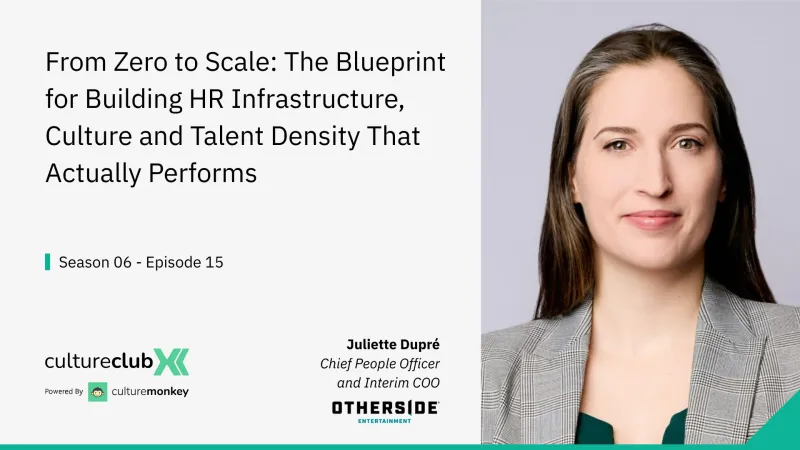
Scaling isn't about adding people. Juliette Dupre, Chief People Officer at Other Side Entertainment, shares her blueprint for zero to scale: building HR from scratch, why talent density is a ratio not headcount, listening that cut turnover from 20% to 4%, and using AI without losing the human touch.

TL;DR
What you need to know from this episode
- Scaling is not about adding people. It is about the systems, culture, and leadership that let talent perform. Juliette scaled an organization 80% while cutting HR costs 65%, and building HR from zero starts with performance management: a shared sense of what you are trying to accomplish and who is tracking it.
- Talent density is a ratio, not headcount. It measures how much of your workforce is genuinely high-impact. Most organizations follow a power law, a few people drive most of the impact, and the goal is to move that needle, measured through quality of hire and revenue per employee.
- Listening cut turnover from 20% to 4%. Experiences differ sharply between departments because managers shape them, so you cannot fix everything at once. But people appreciate being heard, and acknowledging a problem often matters as much as solving it.
- Protect the human touch as your differentiator. AI-enabled systems cut Juliette’s admin workload 40%, but she still refuses AI interviewers and automated rejections. Every candidate gets the dignity of a human response, and a list of resources, even when turned down.
- The foundation you cannot skip is a listening process. Monthly pulse surveys, regular one-to-ones, and a deeper annual dive. Grow, grow, grow without it and you end up with a bench of mediocre talent regressing to the mean.
Juliette Dupré is Chief People Officer and Interim COO at Other Side Entertainment, with two decades spent growing organizations from local teams to international operations through human-centered leadership and change management.
In this episode of CultureClub X, she lays out a blueprint for scaling from zero: how to build HR infrastructure when there is no playbook and no time, why talent density beats headcount, how listening reduced turnover from 20% to 4%, and how to weave AI into HR without losing the human touch.
You will learn what most leaders get wrong when they build HR from scratch, and the one foundation you cannot skip before you scale.
The through-line is that growth and engagement can quietly diverge. Juliette’s framing is that successful scaling is not simply adding people, it is creating the systems, culture, and leadership foundations that let talent perform.
CultureMonkey’s own benchmarks sharpen the point: enterprises score higher on engagement than microcompanies, 4.08 versus 3.8, and job-hunting risk doubles when engagement drops below 3.9.
The companies that invest early in culture and infrastructure are the ones that scale without growth outpacing employee engagement.
What building HR from zero actually means
When Juliette comes into a company to build HR from virtually nothing, there is usually a seed of infrastructure already: some payroll, some contracts, an early decision about how to engage the people doing the work. The piece she reaches for first is performance management, and she is careful about what she means. It is not performance reviews.
It is a shared sense of what the organization is trying to accomplish together, who is tracking what actually gets achieved, and how the investment in talent is paying off against where the business wants to go. Those are the pieces that either progress a company’s maturity to its next stage or quietly hold it back.
Something really important to start engaging with very soon is performance management, which is not to say performance reviews, but a sense of what are we trying to accomplish together, and who’s tracking what’s actually getting achieved.
Build more capability without adding people
Juliette scaled an organization by 80% while cutting HR costs by 65%, and the savings came from two familiar places. The first is payroll: with no one watching how the company grows, without real workforce planning, certain areas get over-hired. The second, and the one she finds most striking in smaller companies, is technology.
They accumulate a pile of contracts they either do not need or that were never negotiated, because before there is any infrastructure, individual managers are signing deals that may not be best for the business. Her job is to come in and, without layering on inordinate bureaucracy, sort through all of it and find a light process that makes sure resources, people and technology alike, are used the best way possible.
Talent density is a ratio, not headcount
Talent density is the term Juliette keeps returning to, and she is precise about it: by its very nature it is a ratio, so it has nothing to do with headcount and everything to do with proportion. It asks how much of your workforce is genuinely delivering high impact.
Most organizations, she notes, follow a power law: a few people create a huge share of the impact while many are doing work without moving the needle much.
The dream is to shift that ratio so most of your people are the high-impact ones, and you can track it through quality of hire, revenue per employee, and systems that surface the power-law dynamic that underpins a high-performance culture.
Talent density by its very nature is a ratio. It has nothing to do with headcount, it has to do with proportion, how much of your workforce is really delivering and having a high impact.
Listening is how you cut turnover
Asked how she spotted disengagement early and reduced turnover from 20% to 4%, Juliette’s answer is disarmingly plain: a lot of listening. The catch is that experiences inside a company are rarely uniform. A manager’s actions, beliefs, and values shape the experience of their people so strongly that one department can be thriving while another complains of the exact opposite problem.
That makes the design of a shared employee experience genuinely hard, and much of the reconciliation comes down to aligning managers on the values and the kind of business you want to be. But the starting point never changes. It is listening to what people value in the exchange of labor, and what would make them want to stay part of the group.
That listening is the front end of any real employee sentiment read and a serious retention lever.
It really is about listening to people and understanding what’s important, what brings value to them in this exchange of labor, and what is going to make them want to be part of your group.
Building a culture that performs under pressure
How do you build a culture that holds up when the organization is changing faster than people can adapt? Juliette does not pretend there is a silver bullet. But she returns to performance management systems: systematically arranging goals, thinking about the future, connecting the whole workforce into it, and being clear about who owns what.
The failure mode she sees most is the leader who says, we hired great people and we have goals, so let’s just go, go, go. A handful of famous companies claim to have scaled that way, but in her view they are the exception, not the rule. Most organizations do set goals, then stop short of building accountability at the individual or departmental level and actually measuring how things are going.
There’s way too much subjectivity in these analyses. We have not solved that in the workplace. But that doesn’t mean don’t try.
She is honest that performance is a touchy subject, full of politics and subjectivity that get in the way of an accurate read on who is really moving the business forward and who needs help. That is not a reason to throw up your hands.
Trying, she points out, is how you find out what works and what does not, and connecting goals to accountability is what keeps engagement and performance moving in the same direction.
Track culture and talent density as you scale
See how CultureMonkey’s pulse survey tools and real-time sentiment analysis help growing teams catch disengagement early, hear every department, and make sure growth never outpaces engagement.
AI without losing the human touch
Juliette deployed AI-enabled HR systems that cut administrative workload by 40%, but she is emphatic that the human touch is not just a value she holds, it is a differentiator for a smaller business that cannot outspend enterprise competitors on technology. So she draws a clear line. Inside the studio, she leans on automation for rote tasks, exactly the promise of freeing up time for human interaction.
But she has no interest in AI interviewers, and none in automated DNQ, the do-not-qualify process where an applicant tracking system rejects a candidate with no human ever looking at what they sent. Those systems make errors and miss exceptions, and she believes every candidate is owed the dignity of a human touch.
I think we owe any candidate the dignity of a human touch, to at least look at what they have sent to us. As a smaller company, I can actually do that.
The commitment is concrete. Apply for a role and you hear back from an actual person, not a no-reply address. If you are turned down, you get a list of industry resources to keep your search moving. It reflects well on the brand and upholds the humanistic culture she wants, and it is a reminder that AI works best in HR when it clears the rote work so people can spend more time on the human parts, not less.
The foundation you cannot skip before scaling
When Juliette is asked what HR foundation cannot be skipped before a company scales, her answer is a listening process, and she is not shy that it is her recurring theme. People genuinely appreciate being heard, and while you will never satisfy every request, complaint, or suggestion, simply having the information and understanding where frustrations sit is meaningful.
Come at it from an authentic place of wanting to help as far as you can, and that is what makes people feel valued.
Juliette’s Multi-Layer Listening System
How a small people team listens often enough to catch disengagement early, without waiting a year to find out what employees are thinking.
Talk to People Directly
Because the company is small, Juliette makes time to speak with people on a regular basis. Nothing replaces a real conversation for hearing what actually matters.
Monthly Pulse Surveys
Short and quick, run every month. Most organizations wait a quarter or a year, which is too far apart when things change week to week and day to day.
Annual Deep Dive
A bigger yearly survey on benefits and the things that still matter, so people always have a channel to give feedback on the deeper stuff.
Act and Acknowledge
You cannot solve every problem, especially externalities like healthcare. So acknowledge what you hear, help people maximize what is on offer, and deliver a concierge level of support. Being heard is often half the solution.
The layered rhythm matters because monthly cadence catches change while it is still small, and it makes the annual deep dive sharper because you already know what to track. Juliette is candid that her team does not get everything right and works with very few resources against much larger competitors. But doing their genuine best, and being seen to, is exactly what people find appealing.
It is the difference between a survey that gathers dust and a real employee feedback loop.
When growth quietly outpaces engagement
The risk Juliette wants scaling leaders to see is the grow, grow, grow reflex. Chase headcount and, before you know it, you have a bench of disappointingly mediocre talent and a workforce that is simply there for the paycheck.
She has no problem with people working to earn a living, but if that is all the engagement amounts to, and most people need more purpose than a paycheck to deliver their best, you end up with a slow organization that is not delivering, and the quality of your product or service degrades as your talent regresses to the mean.
You just grow, grow, grow, and then before you know it, you sort of have a bench of disappointingly mediocre talent.
That is the whole case for real-time listening as you scale: it lets HR leaders watch culture and talent-density signals in motion and catch disengagement before growth quietly outpaces it. Invest early in culture, infrastructure, and employee experience, and you scale sustainably.
Skip it, and you scale the problem.

About the guest
Juliette Dupré
Chief People Officer and Interim COO, OtherSide Entertainment
With 20 years of experience, Juliette has grown teams from local to international in size and impact, while emphasizing humanistic leadership, change management, and thoughtful MCOD. Juliette holds a Masters in Change Management (4.0) in 2020 from The New School, and in 2021 published a paper on leadership development in the International Social Science Review which was awarded Top Ten status and presented at the Triennial Conference.
Juliette has spoken on topics of talent and change management at institutions including MIT, Carnegie Mellon, and University of New Orleans, as well as on podcasts such as the Troy Vermillion Show, Cultivate for Good Podcast with Wendy Adams, Deconstructor of Fun, and MEA’s Better People Podcast. She has also been a fireside speaker and served on panels since 2011.
Full episode transcript
Season 06, Episode 15 · Juliette Dupré with Darcy Mehta · 24 min
Hello everyone, and welcome to season six of CultureClub X, powered by CultureMonkey. I’m your host, Darcy Mehta. CultureMonkey is an AI-powered employee engagement platform that helps people leaders listen to their employees and build stronger workplace cultures. CultureClub X is our global thought leadership forum where CHROs and people leaders share insights, discuss emerging trends, and exchange practical strategies for building thriving, future-ready organizations.
Today we’re delighted to host Juliette Dupré, Chief People Officer and Interim COO at Other Side Entertainment, a leader with two decades of experience building and scaling teams, leading organizational transformation, and creating people-first cultures that drive business performance. Juliette has spent the last 20 years helping organizations grow from local teams to international operations, focused on human-centered leadership, change management, and organizational development. She holds a master’s degree in change management from The New School and has shared her expertise at institutions including MIT, Carnegie Mellon, and the University of New Orleans. Juliette, welcome. Before we dive in, could you share a little about your own leadership journey?
Oh sure, and wow, what an intro that was. I didn’t see myself going into leadership as quickly as I did, and I’ve been very grateful for the colleagues in my life who spotted me early and said they thought it would be a great opportunity. That started back in my days at a law firm, quite a long time ago, and it really set the stage for me to grow from there.
I’ve learned a lot along the way, across a lot of different companies and particularly different types of situations. Every company is unique, every CEO is unique, so every experience I’ve had has added to my body of knowledge.
That variety is amazing to have, and it gives you such a unique perspective. Thank you so much for sharing that. Let’s dive into our first question.
What does building HR from zero actually mean, and what is the first thing most people get wrong when there’s no infrastructure, no playbook, and no time?
It depends on the individual situation. The companies where I’ve come in to build HR from virtually nothing usually have at least some payroll or some contracts going on. That’s a seed of infrastructure, because you’ve made a determination about how you want to engage the people doing the work, and that tells you something.
But something really important to start engaging with very soon is performance management, which is not specifically performance reviews. It’s a sense of what are we trying to accomplish together, who’s tracking what’s actually getting achieved, and how are we understanding whether our investments in talent are paying off and getting us where we want to go as a business. Those pieces of the puzzle are really valuable from HR leadership, and they can progress the maturity of the company to its next stage, or hold it back as an ignored but integral part of that maturity.
Absolutely.
You scaled the organization by 80% while cutting HR costs by 65%. For leaders new to talent density, what does it mean to build more capability without simply adding more people?
It comes in a couple of different places. Some of it is payroll, making adjustments and asking, is this really the right spread of talent in the right parts of the business? Often, if there hasn’t been much thought about how to grow the company, about workforce planning and where the business is headed, you get over-hiring in certain areas.
The other thing I find interesting about smaller companies is that they tend to get into a ton of technology contracts they either don’t need or that aren’t very value-intensive. That’s another area where a lot of savings come from, looking at where we’re investing in technology, in HR, operations, or elsewhere, and where we’re throwing money away on products that aren’t good, aren’t delivering, or were never negotiated. Before you have a lot of infrastructure, you often have individual managers signing contracts or making decisions that might not be best for the business. So my role is to come in, without overlaying inordinate bureaucracy, sort through all that, and find a light process to make sure our resources, whether human or technology, are being used the best way possible.
That’s a great example with technology. I’ve worked in small nonprofits like that, and you realize, why do we have so many different contracts? When you take a step back, it’s a lot of money, and it adds up month to month.
CultureMonkey benchmarks show enterprises were higher on engagement than microcompanies, 4.08 versus 3.8. When we talk about talent density, is the real differentiator headcount or the infrastructure that helps great people perform?
Talent density by its very nature is a ratio. It has nothing to do with headcount, it has to do with proportion. You’re talking about how much of your workforce is really delivering and having a high impact. Some folks listening are probably familiar with the power-law dynamic of impact in talent pools. It’s very common for an organization, whether a company, a nonprofit, or a governmental team, to have a few people who make a ton of impact and a lot of people who are doing work but not having most of the impact.
The dream scenario is that most of your workforce is those people with extraordinary impact. It’s not always possible, but that’s the needle you’re moving: how many of our people are really moving the business forward? You can measure it through things like quality of hire, revenue per employee, and systems that track that power-law dynamic. It’s not about pure headcount at all.
I appreciate that explanation, and the power-law dynamic is so fascinating. You’re right, it’s about impact, which makes sense but bears repeating.
The data shows job-hunting risk doubles when engagement drops below 3.9. What helped you identify disengagement early and reduce turnover from 20% to 4%?
Really a lot of listening to people. We can’t always deliver on every request or concern, and it’s important to realize that in any group there can be vastly disparate experiences of the company, the team, the groups. We talk a lot in HR and leadership about how much a manager’s actions, beliefs, and values impact the experience of individual employees. So if you have a management layer, which most listeners do, they’re impacting a lot, and from one department to another that experience is actually very different.
You can’t address everything in one fell swoop. You might hear that one team is having a certain experience while another is complaining of the exact opposite thing. So it’s always interesting on my side to reconcile how we design the employee experience when individuals have such disparate experiences. Much of that comes down to aligning managers on the values and the type of business you want to have, which is a whole other topic. But to get back to your question, it really is about listening to people and understanding what’s important, what brings value to them in this exchange of labor, and what’s going to make them want to be part of your group.
It seems so basic, listening to people, and the last guest I interviewed said the one thing people should do is listen more. It must be fascinating in your position when it’s the complete opposite problem in another department, figuring out how to meld those two together.
How do you build a culture that performs under pressure when the organization is changing faster than people can adapt?
That’s a tough one, and I’m not going to pretend there’s a silver bullet. To my earlier point about performance management systems, if you’re not systematically arranging your goals, thinking about the future, thinking about how your entire workforce connects into that, who owns what, and where the accountability for that progression sits, and you’re just hoping that because we hired great people great things will happen, that’s a problem. I know there are very successful organizations that claim to have started that way, but that’s more the exception than the rule.
You really do need goals, set goals, moving toward something specific. A lot of organizations get there but then stop short of accountability at the individual or departmental level, and of really measuring how things are going. Performance is a touchy subject, and let’s call it what it is, there’s way too much subjectivity in these analyses. We haven’t solved that in the workplace, there’s politics and all kinds of things that get in the way of an accurate assessment of who’s moving the business forward and who needs help. But that doesn’t mean don’t try. A lot of leaders throw up their hands and say we hired great people and we have goals, let’s just go, go, go. You need a bit more than that to be successful in most cases.
Exactly. Trying is how you find out what works and what doesn’t. It’s a great answer to a not-simple question.
Switching to AI, you deployed AI-enabled HR systems that reduced administrative workload by 40%. How do you integrate AI into HR infrastructure without losing the human touch that drives engagement?
The human touch is not only something I feel strongly about, it’s one of our differentiators as a smaller business that doesn’t have as much enterprise technology or expansive bureaucratic infrastructure. We differentiate ourselves by saying, if you’re a candidate applying for a role here, you’re going to hear back from an actual person, not a no-reply. If you’re not accepted, you’ll get a list of industry-related resources as a launching pad to continue your search, things you might not be aware of.
Within the walls of the studio, I lean more heavily on automation for rote tasks. Many of us talk about how AI can be leveraged to free up more time for human interaction, and that’s what I’ve leaned into. I’m probably never going to be interested in AI interviewers, or in DNQ, do-not-qualify, through complete automation. For anyone not in talent or recruitment, DNQ is when an applicant tracking system automatically rules out a candidate and sends a rejection without a human touching anything. I don’t generally use those systems, because there can always be exceptions and errors, and I think we owe any candidate the dignity of a human touch to at least look at what they’ve sent us. As a smaller company, I can actually do that, and it reflects well on our brand and the humanistic culture we want to uphold.
I’m so glad you do that, and I feel the same way about the human touch and AI. Giving people the dignity of a human response and a list of resources is an amazing human touch. If AI can free up time from rote and administrative tasks, that human touch becomes even more of a differentiator, especially as some companies lean into everything being AI.
When 17% of micro-company employees are already at risk of disengagement, according to CultureMonkey’s reports, what HR foundation cannot be skipped before scaling?
A listening process is essential, and you’re not shocked to hear me say that. People really appreciate being heard. You’re not going to satisfy every request or complaint, but having that information and understanding where frustrations are is meaningful. If you come at it from an authentic place of wanting to help to the extent you can, that’s the kind of partnership that makes people feel valued.
We have a number of ways to listen. One is that I just talk to people, because we’re small, so I make time to speak with folks regularly. We also do monthly pulse surveys, which are very quick and short. Surprisingly few organizations do anything monthly, most wait a quarter or even a year, which I think is too far apart. And we do a bigger annual deep dive on things like benefits. Healthcare is a perfect example of where I can’t change a lot, it’s an externality, but I can take the feedback and help people understand how to better leverage what we do have. Sometimes we make major changes in response to feedback. Helping people maximize what’s on offer gives them almost a concierge level of support, so they feel they’re getting the most out of the employment experience.
I love the concierge level of support. It strikes me it’s not even about solving every problem, it’s about acknowledging the problem and that people have been heard. At the end of the day, people just want to be understood. And doing it monthly makes the annual check-in easier, because you know what to track.
Last question. How can real-time listening tools like CultureMonkey help HR leaders track culture and talent-density signals as they scale, before growth quietly outpaces engagement?
A really common outcome for scaling companies is, let’s just grow, grow, grow. And then before you know it, you have a bench of disappointingly mediocre talent and a workforce that’s not that excited about what they’re doing, they’re just there. People work so they can have a paycheck, by and large, and I don’t have a problem with that, it’s how we survive. But if that’s all the engagement is, and a lot of people need more purpose than a paycheck to deliver their best work, then you end up with a slow organization that isn’t delivering its best. It has an exponential effect on the product or service you provide when your talent starts regressing to the mean.
Absolutely. Juliette, I could keep talking to you all day. Your insights highlight an important reality for growing organizations: successful scaling is not simply about adding people, it’s about creating the right systems, culture, and leadership foundations that let talent perform at its best. From building HR functions from the ground up to integrating technology thoughtfully, you’ve shared practical lessons leaders can apply wherever they are in their growth journey. Organizations that invest early in culture, infrastructure, and employee experience are far better positioned to scale sustainably while maintaining engagement and performance. That’s where CultureMonkey excels, with pulse surveys and real-time listening that help HR leaders monitor culture health, identify disengagement risks early, and ensure growth never comes at the expense of employee experience. Before we end, how can our listeners connect with you?
I’m on LinkedIn, that’s probably the main place I am. LinkedIn has its pros and cons, but it’s really the only social media I engage with these days.
It’s good for connecting with people, so I’ll definitely connect with you there. Thank you so much. And to all our listeners, thank you for being here, and don’t forget to follow, share, and subscribe. That’s a wrap for this episode of CultureClub X, powered by CultureMonkey. I’m your host, Darcy, signing off. See you next time.
Frequently asked questions
What does building HR from zero actually mean?
Juliette Dupré points out that most companies already have a seed of infrastructure, some payroll or contracts, before anyone builds HR formally. The first foundation she puts in place is performance management, and she means something specific: not performance reviews, but a shared sense of what the organization is trying to accomplish, who is tracking what gets achieved, and whether the investment in talent is moving the business where it wants to go. That clarity is what progresses a company’s maturity instead of holding it back.
What is talent density, and is it about headcount?
Talent density is a ratio, not a headcount. Juliette Dupré defines it as the proportion of your workforce that is genuinely delivering high impact. Most organizations follow a power law, where a few people create most of the impact and many are working without moving the needle much. The goal is to shift that ratio upward so more of your people are high-impact, and you can measure it through quality of hire, revenue per employee, and systems that track the power-law dynamic.
How do you reduce turnover when departments have very different experiences?
Juliette Dupré reduced turnover from 20% to 4% largely through listening. She stresses that experiences inside a company are rarely uniform, because a manager’s actions and values shape their team so strongly that one department can thrive while another complains of the opposite problem. You cannot fix everything at once, so much of the work is aligning managers on shared values, then listening for what people value in the exchange of labor. Acknowledging what you hear often matters as much as solving it.
How do you use AI in HR without losing the human touch?
Juliette Dupré uses AI-enabled systems to cut administrative workload by 40%, leaning on automation for rote tasks so people have more time for human interaction. But she draws a firm line: no AI interviewers and no automated DNQ, the do-not-qualify process that rejects candidates without a human ever reviewing them. She believes every candidate is owed the dignity of a human response, so applicants hear back from a real person and receive a list of resources even when turned down. For a smaller company, that human touch is a genuine differentiator.
What HR foundation cannot be skipped before scaling?
A listening process. Juliette Dupré runs it in layers: regular one-to-one conversations, short monthly pulse surveys, and a deeper annual survey on things like benefits. Monthly cadence is key, because waiting a quarter or a year is too far apart when things change week to week. The point is not to solve every problem, some, like healthcare costs, are externalities, but to acknowledge what you hear and help people maximize what is on offer. Skip listening and grow unchecked, and you end up with a bench of mediocre talent regressing to the mean.
Read the cross-episode roundups
More from CultureClub X
 S07 E02change leadershipHR as Chief Disruption Officer: Why Supporting the Business Is a Ceiling, with Jennifer McClure
 Jennifer McClure
 S06 E20change leadershipWhy does culture change stall? | Jamie Notter, culture scientist
 Jamie Notter
 S06 E19change leadershipFrom Cost Center to Catalyst: How CPOs Turn People Strategy Into Business Advantage, with L. David Kingsley
 L. David Kingsley
Never miss an episode
Every new episode, plus the takeaways that matter, posted on the CultureMonkey LinkedIn page as soon as they drop.
Free on LinkedIn. Unfollow anytime.