

S06 E14
Turning Engagement Data Into Culture Change
Engagement data is just a signal. 70% of team engagement comes down to the manager. Dr. Adam Hickman, VP at Partners Federal Credit Union, unpacks why managers are disengaging fastest, why you should develop performance instead of managing it, build capability through reps, and start by listening.
TL;DR
What you need to know from this episode
- Engagement data is a signal, not the change. Around 70% of team engagement variance traces back to the manager. The impact comes from managers who read the signal, take action, and build environments where people thrive, not from the dashboard itself.
- Managers are disengaging fastest. Manager engagement is down nine points since 2022 and global engagement sits at a 20% low. The squeeze is time, so the fix is protecting what matters most: start the day on coaching and developing people, then fold everything else in.
- Develop performance, do not manage it. Performance management is what you reach for once something has gone wrong. Performance development is a daily conversation. The same logic applies to delegation: done right, delegation is development.
- Managers need reps, not just courses. Only 44% of managers have had formal training, but capability is built through at-bats: calibration sessions and practising the pay conversation before the live one. Hire for the innate talent to lead, not for tenure.
- The one non-negotiable: stop talking and start listening. Talent falls out of people’s mouths every day if you listen for it. Listening is also the front end of AI readiness, because engaged people pick up new tools without an instruction manual.
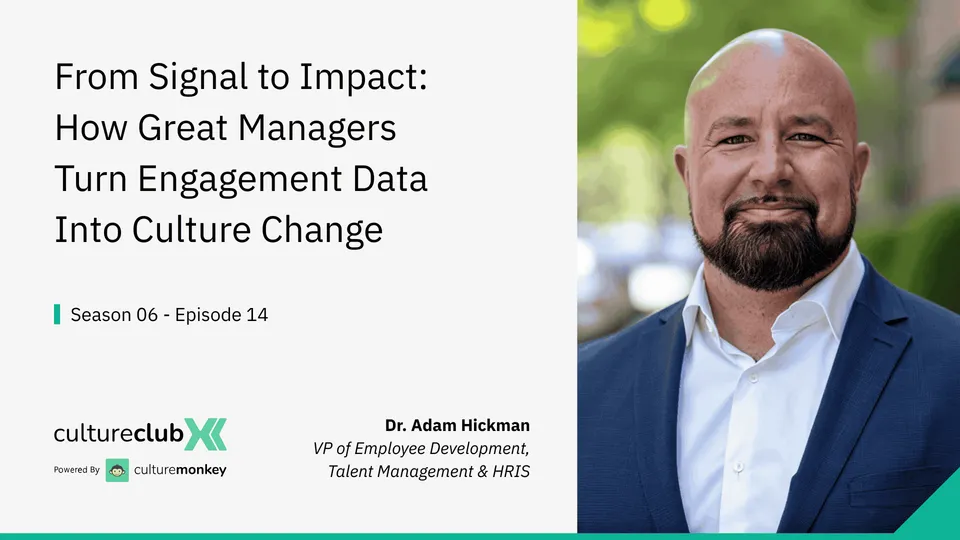
Dr. Adam Hickman is Vice President of Employee Development, Talent Management, and HRIS at Partners Federal Credit Union, a learning and organizational development leader with more than two decades inside HR and a PhD in management.
He has spent years living inside Gallup’s engagement research, and in this episode of CultureClub X he makes a pointed case: engagement data is only a signal, and the impact comes from what managers do with it.
You will learn why manager engagement is falling fastest, the difference between managing and developing performance, how to build manager capability through reps rather than courses, why manager engagement is the front end of AI readiness, and the one non-negotiable for stopping managers from quietly disengaging.
The backdrop is sobering. Global engagement has fallen to roughly 20%, its lowest level since 2020. Manager engagement has dropped nine points since 2022. And around 70% of the variance in a team’s engagement comes down to the manager.
Put those together and the conclusion is unavoidable: the manager is the leverage point for employee engagement, and a dashboard full of scores changes nothing until a manager acts on it.
The most misunderstood engagement signal
Adam starts not with a statistic but with a question, the first item in Gallup’s Q12: do you know what is expected of you at work? It sounds basic, yet he carries it around as a daily test. The tell is in how people answer. Ask someone if they know what is expected of them and they will say yes.
Ask how they know, and if they immediately pull up their calendar, they do not really know, because a calendar should not be dictating what matters today. The difference shows up in how Sunday night feels: a dreadful countdown to Monday, or a get-ready session for the week ahead.
If they immediately pull up their calendar, they don’t really know what’s expected, because their calendar shouldn’t be dictating what’s expected of you today.
Underneath clarity sits something deeper: experiences and beliefs. Everyone joins a workforce carrying a résumé full of experiences, and those experiences have shaped their beliefs about how work should run. When someone new enters a team, it is like a new element entering an organism: things get disrupted, and that is fine, but it takes time for new experiences to fit the culture, the team, and the customer base.
Adam’s instinct is to strip away the traditional HR machinery, the obsession with whether onboarding takes thirty days or thirty-two, and just be simple and human about it. Hire right, put the right talent in the right seat, and the rest folds into place.
Why managers are disengaging faster than anyone
If 70% of team engagement runs through the manager, the nine-point drop in manager engagement is the alarm worth hearing. Adam’s first answer for why is time. The most talented managers wake up asking how they will coach and develop their people, then have to fold everything else into a day that only holds so many hours.
The trap is letting disengagers, the meetings and busywork that pull you off course, quietly replace the priority you said mattered most.
His sharpest reframe is on performance itself. Organizations talk about performance management as a process, but Adam asks a better question: do you really manage performance, or should you develop it? Performance management is the path you go down once something has already gone wrong, the road toward discipline and documentation. Performance development is an ongoing, day-after-day conversation.
The same applies to delegation, which most managers treat as offloading. Done right, delegation is development. He points to employee development as the work that should sit at the center of a manager’s day, not the exception squeezed in at the end of it.
Do you really manage performance, or should you develop performance? You can develop performance without having to manage it.
The second driver is selection. Too many organizations promote on tenure, which Adam calls the worst mistake you can make. Doing well as an individual contributor does not predict success as a manager, and when the innate ability to lead is missing, you get the familiar puzzle of a brilliant contributor who turns into a struggling boss.
Talent is the answer to why that happens, and the time to find out whether someone can lead people is before you hand them a team, not after.
What the industry gets wrong about young and female managers
Young and female managers have been hit hardest by the engagement decline, and Adam is direct about it. Gallup’s research has long shown that women tend to have higher manager talent than men, and some of the best leaders he has worked for have been women.
The competing priority that historically pushed talented women out was the decision between staying in the workforce and raising children, and the companies that kept their top female leaders were the ones that recognized this and built in genuine flexibility rather than defaulting to a rigid eight-to-five.
Everybody’s in a different era of life. Until you’ve experienced those eras, it takes a while to figure out what you actually need.
His practical answer borrows a frame from pop culture: the eras tour of a career. People move through different eras of life, and what they need shifts with them. Someone may say they do not want the promotion right now, they want to focus on the job and family, but there will come a time when they are ready. The mistake is to wait passively to find out when.
Instead, poke your head in regularly and ask where they are, what development they need, and what their aspirations are. Consistent check-ins keep development moving and quietly dismantle the bias that leadership has to look a certain way.
What really happens when you flatten the management layer
Organizations are flattening structures and stripping out middle management, and Adam wants leaders to be honest about what that does. Any time you remove or add a person to a team, you have reorganized that team, full stop. You change the dynamic and the rhythm, so things feel different because they are different.
Reducing span of control can be healthy when it means limiting how many direct reports a manager carries. His rule of thumb: ten to twelve direct reports with high manager talent is the sweet spot for engagement. Exceed that with low talent and it only gets worse.
Ten to twelve direct reports with high manager talent is the sweet spot for engagement. If low talent exists and you exceed that, you’re in for a bad day.
Flattening can work in some settings. Adam describes coders who, once they know what is expected and how they are measured, need little oversight, or childcare workers who need schedules and support rather than someone hovering. But it only works when the culture is already healthy and engaged.
When organizations flatten to escape something, to avoid job eliminations or a performance conversation that has gone too far, they jump straight to the result and skip the action in the middle. The belief that flattening will make things better usually comes from a prior experience that no longer applies, because the people and the recipe have changed.
The org chart gets flatter, and the work that follows gets harder.
Build manager capability through reps, not courses
Only 44% of managers have ever received formal management training, and the average organization spends around fifteen hundred dollars a year per person on manager development. Adam is all for investment, but he insists much of the best development costs nothing but attention. What managers actually need is reps. A naturally gifted manager, the Ted Lasso type, can be cut loose to do what they do.
But Gallup’s old benchmark was that only one in ten people has real manager talent, which means roughly 90% of managers are in the seat without that innate ability and need to build their competencies through practice.
There are so many times where you don’t need to send somebody somewhere or swipe a card to get development. They need reps. That’s what you need.
The reps are concrete. Take the pay conversation, the stickiest, highest-risk moment a manager faces. Put it in front of someone with no experience and no talent and it can be a train wreck. So managers of managers should rehearse it: when this happens, let’s talk through what you would say, so people get their at-bats before they are in front of the live person.
Adam’s team runs end-of-year calibration sessions where managers meet the HRBP team and have to defend a rating, prove a three-out-of-five with documentation and a plan. No course, no spend beyond labor, but it would never show up in that 44% figure because it is not counted as manager development. It is just a conversation, and that is exactly the point.
Give your managers the signal, and the nudge to act on it
See how CultureMonkey’s manager effectiveness surveys and real-time pulse survey tools help people teams see which managers turn engagement signals into action, and which need support before disengagement spreads.
Manager engagement is the front end of AI readiness
Disengaged managers are also slower to adopt AI, which creates a double productivity risk. Adam’s analogy is the iPhone. Apple never shipped an instruction manual, because they knew their customers started engaged. The same holds at work: when you give an engaged team a new tool, you almost do not need a manual, they take off.
As his organization rolled out AI tools, the most engaged people simply asked for the guardrails from InfoSec and cybersecurity, then ran with it, using it in ways he could barely keep up with. The moderately and fully disengaged waited to be told what to use it for, because they were missing the spark.
When you have high engagement and you give them a tool, you almost don’t need an instruction manual. The most engaged say, tell me what I can’t do, and cut me loose.
Adam admits he was the resistor for a while, a self-described geriatric millennial who still reads the paper and takes notes on a notepad. What moved him was a simple experiment, run in two thirty-day sprints, that turned skepticism into genuine adoption without cutting a single role.
Adam’s Two-Sprint Method for AI Adoption
How Adam moved his team from AI resistance to real adoption, without eliminating a single position. Two thirty-day sprints that build engagement and purpose before scaling.
Sprint One: Go Nuts Within Guardrails
Pick a handful of tools, set the InfoSec and cybersecurity guardrails, then ask the team to put AI in front of every task for thirty days, work or personal. The goal is adoption, not output.
Listen for the Spark
At month end, talk through what people used it for: vacations, recipes, kids’ coloring pages, job descriptions. You are listening for genuine adoption and purpose, not policing the use cases.
Sprint Two: Work Only
Point the same energy at work. Where does it remove real friction? Job descriptions, course design documents, building slides. Find where it saves the most time.
Find Your Top Five
Settle on the handful of tools that earn their place, the ones that make the work higher quality and faster, like turning a slow design-and-edit cycle into slides in seconds.
Enhance, Don’t Eliminate
Use AI to raise quality and speed, not to cut roles. Keep the head and the heart of HR, and let the software be your best thought partner.
The one non-negotiable: stop talking and start listening
Asked for the single action every people leader should take right now to stop managers from quietly disengaging, Adam’s answer is almost disarmingly simple: stop talking and start listening. We have stopped listening, he says, because we think we know the answer before the sentence is even done. But talent falls out of people’s mouths every day if you are willing to hear it.
He credits Judge Judy for the observation that the letters in “listen” rearrange to spell “silent,” and that is the discipline: go quiet long enough to hear someone’s talent, then individualize back to them.
Talent falls out of people’s mouths every day, you just gotta listen for it. So stop talking, and start listening.
Listening is how you see a person through the lens of their talent, which is how they see the world, and adapting your language to that lens changes what it feels like to work for someone. Command and control still has its place, Adam notes, in moments of physical danger, like the energy world he came from, where you do not need a strengths conversation, you need someone to say get out of the way.
But on an everyday basis, people do not need a hovering manager. They need autonomy, trust, and a leader who works within the boundaries of their talents. The way in is not always an assessment. Sometimes it is as simple as: tell me your most successful story, and let go.
Don’t chase the survey number, explore what caused it
On manager effectiveness surveys, Adam is candid that the world has hit survey fatigue, the gas pump, the receipt, the tip screen on everything. But the answer is not to abandon listening, it is to use the data better. The smartest people he has worked with treat the score as the beginning, not the verdict: it is less about the survey number and more about the exploration of what caused it.
Acknowledge the number, good, bad, or indifferent, then go find the cause, because the cause is where the actual work lives. This is where a skilled OD and HR team turns employee sentiment into something a manager can act on.
It’s less about the survey number and more the exploration of what caused the number. Because the cause is where the work’s actually at.
He uses Gallup’s famous best-friend-at-work question to make the point. The action is not to assign best friends, which would be bizarre. It is to create environments where people can enjoy who they work with, with the organizational forms that allow collaboration on work and outside it.
When that becomes possible, engagement rises, and the downstream effects are concrete: fewer safety incidents, less absenteeism, the kind of numbers a CFO and CEO care about. The same goes for the expectations question. The easy button is to restate what is expected. The real work is asking where it went wrong, whether you failed to individualize the message enough for it to land, and then continuing the conversation.
Adam tells his directs that if they do not know what is expected at the end of the day, he expects a call or an email, because that means he missed something. That is what it looks like to turn a signal into impact, and to connect engagement and performance through the manager.

About the guest
Dr. Adam Hickman
VP of Employee Development, Talent Management and HRIS, Partners Federal Credit Union
Dr. Adam Hickman is a learning, talent, and organizational development executive with more than two decades of experience helping organizations build high-performing cultures, strengthen leadership capability, and accelerate business results. He currently serves as Vice President of Employee Development, Talent Management, and HRIS at Partners Federal Credit Union, who serves The Walt Disney Company, where he leads enterprise efforts focused on leadership development, talent strategy, succession planning, employee growth, and workforce technology.
A recognized speaker, educator, and consultant, Adam has worked with organizations across multiple industries and has taught doctoral learners in business and leadership programs. His expertise spans leadership development, talent management, organizational effectiveness, employee engagement, culture transformation, and strategic workforce planning. Adam is passionate about helping leaders and organizations create environments where people love what they do, grow professionally, and deliver exceptional results.
Full episode transcript
Season 06, Episode 14 · Dr. Adam Hickman with Darcy Mehta · 35 min
Hello everyone, and welcome to season six of CultureClub X, powered by CultureMonkey. I’m your host, Darcy Mehta. CultureMonkey is an AI-powered employee engagement platform that helps people leaders listen to their employees and build stronger workplace cultures. CultureClub X is our global thought leadership forum where CHROs and people leaders share insights, discuss emerging trends, and exchange practical strategies for building thriving, future-ready organizations.
Today we are so delighted to host Dr. Adam Hickman, Vice President of Employee Development, Talent Management, and HRIS at Partners Federal Credit Union. Adam has spent more than two decades building people-first strategies that help organizations strengthen performance through learning, leadership development, and culture. With a PhD in management specializing in organizational development and leadership, he is also an international keynote speaker and certified Strengths coach. Adam, welcome. It’s wonderful to have you here with us. Before we dive in, can you share a little about your own leadership journey?
Thanks for having me. That introduction gives me the signal that I don’t have any hobbies, all I do is work. But it’s at the intersection of purpose and the things that are meaningful to me, so I don’t mind it. I don’t just enjoy it, I love what I do.
About twenty years ago I fell into a role on the university side of business, and that pretty much turned the lights on to an area where I felt like I could offer the most and serve in different ways. Ever since, I’ve been in some sort of HR function across different industries. I’ve really just found a knack for grounding people on the principles I think we lose sight of sometimes, and for keeping the workplace an enjoyment to come to. You know the places where there’s an engaged workforce, it sounds different and feels different from the moment you pull in to when you walk in and interact. There’s an art to that, and there’s also a science.
Thank you so much for sharing. Like you said, it means you’re absolutely in the right place if you love what you do. I’m looking forward to our conversation, so let’s dive right into the first question.
Global engagement has fallen to twenty percent, its lowest level since 2020. As someone who has lived inside Gallup’s research, what is the single most misunderstood signal in this data?
Misunderstood would mean we all understand it, and I’m not sure we do. But let’s start at the basic needs. The first question in Gallup’s Q12 is, do you know what’s expected of you at work? I always walk around with that one, just to ask on a daily basis, do you know? It’s less about the confirmation and more about the inverse: what if you don’t? Then what are you doing today?
Here’s a good way to check it. You can ask somebody and they’ll say, yeah, I know what’s expected of me. And I’ll say, well, how do you know? If they immediately pull up their calendar, they don’t really know, because their calendar shouldn’t be dictating what’s expected of you today. You should know what’s on your radar, what this week and this month look like. It’s the difference between those who think of Sunday night as the dreadful night because work starts tomorrow, versus those for whom Sunday is a get-ready session: what do I have this week, and what do I need to make possible? It’s a whole different mindset.
Where I’ve tried to push the most work is one rung above experiences, which is beliefs. Anybody who joins a workforce has a ton of experiences, it’s all on the résumé, and that informs their beliefs. When you join a new organization, it’s almost like an organism: something new enters and it’s disrupted, it’s different, but that’s okay. Getting them to fit the mold of the culture, the team, the customer base, takes time. Too often I hear about the first thirty or sixty days, and I think, what if it’s thirty-two days, does anybody care? No. So I’ve tried to get rid of a lot of the traditional HR ways and just say, can we be simple and human about this? Hire right, in the right seat with the right talent, and the rest folds into play. I know that’s not what the book says, but it doesn’t have to be that way.
Thinking outside the box is never a bad thing. And I like what you said about checking the calendar right away being the clue that you don’t really know. That’s very true.
Manager engagement has dropped nine points since 2022, yet 70% of team engagement variance comes from the manager. Why are managers disengaging faster than anyone else?
There’s great Gallup research on manager perks and non-perks, but from what I’ve observed, the first thing is time. How do you fit everything into every day? The most talented managers wake up thinking, how do I coach and develop my employees? That should be the starting point, and then you fold everything else in. You only have so many hours, and nobody will tell you no if you work past them, but fitting development in daily is the hardest part.
This is where you flip some things on their side. People talk about performance management as a process. But do you really manage performance, or should you develop performance? Flip it to performance development. You can develop performance without having to manage it. If you go the performance management route, something’s gone wrong and now you’re heading down the path of discipline. In a development organization, it’s an ongoing conversation, day after day. Yesterday one of my directs had a question, and instead of giving the easy answer I said, nope, I’m going to send you an article, read it and come back when you’ve figured out what you’re after. Silly little activity, but it’s developmental, and it’s a start point so they self-coach next time.
So time, yes, but it depends on what you’re doing with your time. Here’s a calendar activity: name your top three priorities this month, then go back and line-item the hours you spent last month, and see if they translate to those priorities. More often than not, they don’t. Then it becomes, who do I delegate to, and if delegation’s done right, it’s development. The other piece is the innate ability to lead and develop people. You see a lot of hires based on tenure, which is the worst mistake you can make. Doing well in one role doesn’t mean you’ll be a great manager. Find out if they have the innate ability to lead before you make that move. When you don’t, you get the outcome of, I don’t understand how they were such a good individual contributor but they’re not a great manager. Talent is the answer to why.
Exactly. Being good at one thing doesn’t necessarily translate to being good at both.
Tagging onto that, young and female managers are being hit hardest by the engagement decline. What is the industry getting dangerously wrong about how it supports this group?
This is a good topic. Jane Miller, the former CEO of Gallup, put out a women’s report years ago that’s still relevant and a great read. It articulated that women had higher manager talent than men, and I a hundred percent believe it, some of the best leaders I’ve worked for have been women. The number one competing priority at that time was children, the decision on whether to stay in the workforce or raise kids. The better companies recognized they were losing top female talent because of that, and unless you offer services or flexibility that accommodate it, you’ll lose them. That’s when you saw childcare show up at workplaces and flexibility become more important.
On my team, three of them are mothers, some are new moms. The idea that we’re going to dictate an eight-to-five and that’ll hold, it doesn’t work. I’ve got three kids, I know how this goes. So flex their schedule on when and where they can, so they get the most out of their experience at home while it still matches business needs. That’s the best fit. The other part is the conversation about what you want in your career. I’m not a Swiftie, but I think the era thing applies: everybody’s in a different era of life, and until you’ve experienced those eras it takes a while to figure out what you need. Some people, women in particular in different eras, will say, I don’t need the promotions right now, I just need to focus on my job and family, but there will come a time when I’m ready. Don’t wait to find out when that ready state is. Poke your head in and ask, where are you, what development do you need, what are your career aspirations. That keeps development ongoing and eliminates the gender bias, because the research shows women are actually better leaders. Look at Patti Poppe, CEO of Pacific Gas and Electric, a phenomenal leader and the poster child for a successful female leader who came up through the automotive industry.
You hit on so many great points, and I agree with the eras idea, it’s an interesting way to think about things. But like you said, consistent check-ins are key too. It doesn’t mean just accepting where someone is.
Organizations are flattening structures and reducing middle management layers. What happens to engagement and culture when you remove the manager layer?
It’s interesting, and the bigger companies are doing it more than the smaller ones. Any time you remove or add a person to a team, you just reorganized your team, you just did a reorg. We say it’s not really, but it is. You change the dynamic, you change the rhythm. If you’re a night person and now you’re a morning person, you change the rhythm. New job, new house, you change the rhythm. Things feel different because they are different.
When you eliminate span of control, hopefully you’ve limited the number of direct reports a person has. Ten to twelve with high manager talent is the sweet spot for engagement, and if you subscribe to engagement being the front end of performance, that’s a great day. If low talent exists and you exceed ten to twelve, you’re in for a bad day, because it only gets worse. If you want to flush out bad managers, give them a bunch of direct reports, they’ll flush themselves out. When you remove the layer, what you’re signaling is keep doing what you’re doing, you don’t need oversight. That can work in some organizations. I did a research project with people who code all day; if they’ve got the basics and know what’s expected and measured, they don’t need much oversight, they love that isolated position. Same with childcare workers, they need schedules and administrative support, not someone hovering. So in some industries it can work.
But only if you’re a healthy, high-talent organization that’s already engaged. When you flatten things during disengagement, it’s because you’re escaping something else, you don’t want to do job eliminations, you don’t want the performance conversation. So the idea becomes, we’ll just flatten this and see what happens. It doesn’t work, because you jumped to the result and missed the action in the middle. Go back to experiences and beliefs: the belief is, if we flatten this, things will get better, because in someone’s prior experience it probably did. But they don’t have the same recipe anymore, the people and product have changed. So your result is the flattened org, but the actions after that are going to be tougher.
Exactly, you’re changing the dynamic. Some oversight is never a bad thing, though micromanaging can be an issue, and your coding and childcare examples make sense.
Only 44% of managers have ever received formal management training. How do you build manager capability to act on engagement data without overwhelming them further?
I saw a similar number, and what’s even more fascinating is the cost per employee, about fifteen hundred dollars a year on manager development. That’s great, and you should. But so many times you don’t need to send someone somewhere or swipe a card to develop managers. They need reps. That’s what you need. If you’re a gifted, talented manager because that’s how you’re hardwired, and you can predict that with psychometric assessments, there’s a natural knack that comes with it. Think of the Ted Lassos of the world, you don’t need to teach that person anything, so cut them loose. But Gallup’s number was one in ten has manager talent, so ninety percent of managers don’t have that innate ability but they’re in the seat.
That’s where competencies and values can be built during everyday conversations. Take pay. The pay conversation is the sticky one with the highest risk if you have no reps. The best day, you go in, everybody agrees with your rating and the percent and thanks you. The rest of the world says, I don’t agree with the rating, I don’t agree with the percent, I need to make more money, inflation is real, I can’t make rent. Put that in front of a manager with no experience and no talent, and it’s a train wreck waiting to happen. Unless the managers of managers have developed their teams to say, when this happens, let’s talk through what you would say. You’re getting your reps before you’re in front of the live person. It’s great if they get past the forty-four percent, but there are things that aren’t percents that still count as manager development. We do calibration sessions at the end of the year, managers meet our HRBP team, talk about the score, and the HR team challenges them: if you said three out of five, prove it with what you’ve documented. We didn’t send them to a course or pay for anything but their labor, but that would never hit the forty-four percent, because it’s not seen as manager development. It’s just a conversation.
That’s great that you do that, and like you said, it can be learned on the job. It doesn’t have to be so formal. Some are innate, like Ted Lasso, but most people aren’t, and they can learn it on the job if you set things up like that.
Disengaged managers are also slower to adopt AI, creating a double productivity risk. How does manager engagement connect to an organization’s AI readiness?
Here’s a good example. Remember your first iPhone, did you get an instruction manual with it? Apple never gave one out, because they knew their customer base started engaged. That’s your best indication of high engagement: when you give people a tool and you almost don’t need an instruction manual, they take off. As we’ve rolled out AI tools internally, the most engaged didn’t need a manual. Tell us the guardrails from InfoSec and cybersecurity, and they take off, using it for things I find hard to keep up with. The moderately to completely disengaged haven’t found a reason or purpose to use it, they’re missing the spark. They’re spectators waiting for us to say, use this for this. The most engaged say, tell me what I can’t do and cut me loose.
I’ll be honest, I was the resistor for a while. I’m the old-school, geriatric millennial, I still read the paper and take notes on a notepad. So I said, I want to see what everybody does with it. At conferences I’d hear all this AI hype, but nobody talked about what they were actually doing. So one day I said, fine, let’s try it. We picked five programs and I told my team, for thirty days, go nuts within these parameters. For every task, see if you can put AI in front of it. At the end of the month we talked about what people used it for, some work, some personal, people mapped out vacations, someone listed the ingredients in their fridge for a recipe, some made coloring pages for their kids. I didn’t care what they used it for, I was listening for whether there was adoption and purpose. So the next thirty days was, use it only for work. Our speed on job descriptions, design documents for courses, creating slides. There’s a tool called Gamma, I’m not affiliated, but it turns slides in seconds versus our old draft, edit, design, re-edit cycle. We found our top five programs, and we haven’t eliminated positions, because I don’t believe in that. We found ways to make the work higher quality and faster. Used right, it’s an enhancement. You still need the head and the heart of HR, but software can be your best thought partner.
You touched on so many interesting things. First, I’m like you, I enjoy a handwritten to-do list and the physical paper. I was also a little slow to jump on AI. But how you did it is so interesting, go crazy, try it in your personal life, then once there’s excitement, focus on work. And the iPhone example is exactly why I couldn’t remember the manual, there wasn’t one, because it was exciting.
This one might be hard. What is the one non-negotiable action every people leader should take right now to stop their managers from quietly disengaging?
This is going to sound crazy, but stop talking and start listening. A few reasons. One, talent falls out of people’s mouths every day, you just have to listen for it. But we’ve stopped, because for some reason we think we know the answer before the sentence is done. So much can be accomplished just by not talking. I love Judge Judy, and she has a great line that if you mix up the letters in listen, it spells silent. That’s the same thing with managers: if you just listen, you’ll hear their talent, which gives you the way to individualize back to them, which increases their engagement, because you’re seeing them through the lens of their talent, which is how they view the world.
And if it’s outside of talent, you hear so much that gives you keys for how to partner with them, not manage them, that’s super old school. That changes their everyday experience of work. Command and control worked for a short period, and it still works in certain industries, like when I was in the energy world and you’re about to step into something that could hurt you, you don’t need a strengths conversation, you need command and control: get out of that, don’t do that. But on an everyday basis, no, you don’t need the hovering manager. You need autonomy and trust, because you hired them, and you know their talents work within those boundaries. The only way you can do that, you can use an assessment, but you don’t even need one. Just say, tell me your most successful story, and let go. You’ll hear their talents popping in and out. The question is, are you listening for it or not?
I love Judge Judy too, my mom always watches her. That right there is the key. It’s not rocket science, just stop talking and start listening. I’ve enjoyed hosting this podcast because I’m learning so much just by listening to you and everyone we’ve had on.
Switching gears, how can manager effectiveness surveys help organizations identify which leaders are turning engagement signals into action, and which ones are letting them go to waste?
Surveys have such a bias toward fatigue these days. I was pumping gas the other day and the screen asked if I wanted to take a survey, and I just wanted to pump gas and leave. Every purchase, every restaurant, plus tips everywhere. But in the survey world, the smartest people I’ve heard say it’s less about the survey number and more the exploration of what caused the number. If your OD and HR teams are skilled up, when you get a result you say, I don’t care about the number, you earned it, let’s acknowledge what it is, good, bad, or indifferent, and go explore what caused it. Because the cause is where the work actually is.
Take Gallup’s best-friend-at-work question, the one people always tripped on. The action isn’t to go assign best friends, that would be weird. It’s, have you created environments where people enjoy who they work with, with organizational forms that allow collaboration on work and outside it? The goal is to make that possible, because when it is, you have a higher engagement score, and specific to that question the payoff was fewer safety incidents and less absenteeism, things with a monetary number that CFOs and CEOs care about. Same with knowing what’s expected. The easy button is to restate what’s expected. The real work is understanding where it went wrong, or whether I didn’t individualize it enough for you to hear it, and then continuing the conversation. I tell my directs, if you don’t know what’s expected at the end of the day, I expect a call or an email, because I messed up or missed something. Otherwise I trust that you know what’s ahead, with check-ins along the way to stay aligned.
The best-friend example is fascinating, because at a glance you wonder what the point is, but when you explain everything behind it, it makes perfect sense. Adam, thank you so much, I could honestly talk to you all day. Your insights highlight a critical reality: engagement data alone does not create change. The real impact comes from managers who know how to interpret the signals, take meaningful action, and create environments where people thrive. Manager effectiveness has become one of the most important drivers of culture, engagement, performance, and even AI readiness. That’s where CultureMonkey can help, with pulse surveys, manager effectiveness assessments, and real-time listening tools that help leaders understand engagement trends, prioritize action, and build stronger teams. Before we end, how can our listeners connect with you?
Thank you for asking. LinkedIn’s the best spot. I tried the other platforms and I don’t quite get them, maybe that’s the geriatric point, but LinkedIn is a great place to reconnect. There are also tons of conferences I try to attend and speak at, so if you’re going to be in the area, reach out. This Sunday I’ll be in Sydney, Australia, with a little meetup going, not to talk products or services, but because I’m always curious about the pulse of where people are working and whether there’s something we can collaborate on.
I wish I was in Sydney, I’d come myself. I agree LinkedIn is the best place, so I’ll connect with you there. And to all our listeners, thank you so much for being here. Don’t forget to follow, share, and subscribe. That’s a wrap for this episode of CultureClub X, powered by CultureMonkey. Until next time, I’m your host, Darcy, signing off.
Frequently asked questions
Why are managers disengaging faster than anyone else?
Manager engagement has dropped nine points since 2022, and Adam Hickman points to two causes. The first is time: the most talented managers want to start the day coaching and developing people, but disengagers and busywork crowd that priority out. The second is selection, because organizations promote on tenure rather than the innate ability to lead, so strong individual contributors end up as struggling managers. The fix is to protect development as the core of the role and to select for manager talent before handing someone a team.
What is the difference between managing performance and developing performance?
Adam Hickman frames performance management as the path you go down once something has already gone wrong, the road toward discipline and documentation. Performance development is an ongoing, day-after-day conversation that builds capability before problems appear. You can develop performance without ever needing to manage it. The same logic applies to delegation: done right, delegation is development, not just offloading tasks.
How can you build manager capability without expensive training?
Only 44% of managers have ever had formal training, but Adam Hickman argues much of the best development costs nothing but attention: managers need reps, not courses. Rehearse the high-risk moments, like the pay conversation, so people get their at-bats before facing the live situation. Run calibration sessions where managers defend a rating to the HRBP team with documentation and a plan. None of that shows up in training-spend figures, yet it is exactly how capability is built on the job.
How does manager engagement connect to AI readiness?
Engaged teams adopt new tools the way people adopted the iPhone, without an instruction manual, while disengaged employees wait to be told what to use AI for. Adam Hickman moved his own team from resistance to adoption with two thirty-day sprints: first, use approved tools for anything within the security guardrails to build the habit, then focus only on work to find where AI removes real friction. The aim is to enhance quality and speed, not to eliminate roles.
What is the one thing leaders should do to stop managers from disengaging?
Stop talking and start listening. Adam Hickman’s point is that talent falls out of people’s mouths every day if you listen for it, but leaders interrupt because they think they know the answer before the sentence is finished. Listening lets you see someone through the lens of their talent and individualize how you work with them, which raises engagement. On an everyday basis people do not need a hovering manager or command and control, they need autonomy, trust, and a leader who adapts to their strengths.
Read the cross-episode roundups
More from CultureClub X
 S07 E01employee engagementThe Wellbeing Illusion: Why Most Organizations Are Spending More on Wellbeing and Getting Less in Return, with Gethin Nadin
 Gethin Nadin
 S06 E20change leadershipThe Culture Paradox: Why Hidden Patterns Keep Organizations Stuck and Good Conflict Sets Them Free, with Jamie Notter
 Jamie Notter
 S06 E19change leadershipFrom Cost Center to Catalyst: How CPOs Turn People Strategy Into Business Advantage, with L. David Kingsley
 L. David Kingsley
Never miss an episode
Every new episode, plus the takeaways that matter, posted on the CultureMonkey LinkedIn page as soon as they drop.
Free on LinkedIn. Unfollow anytime.