

S06 E13
Why Engaged Employees Still Leave
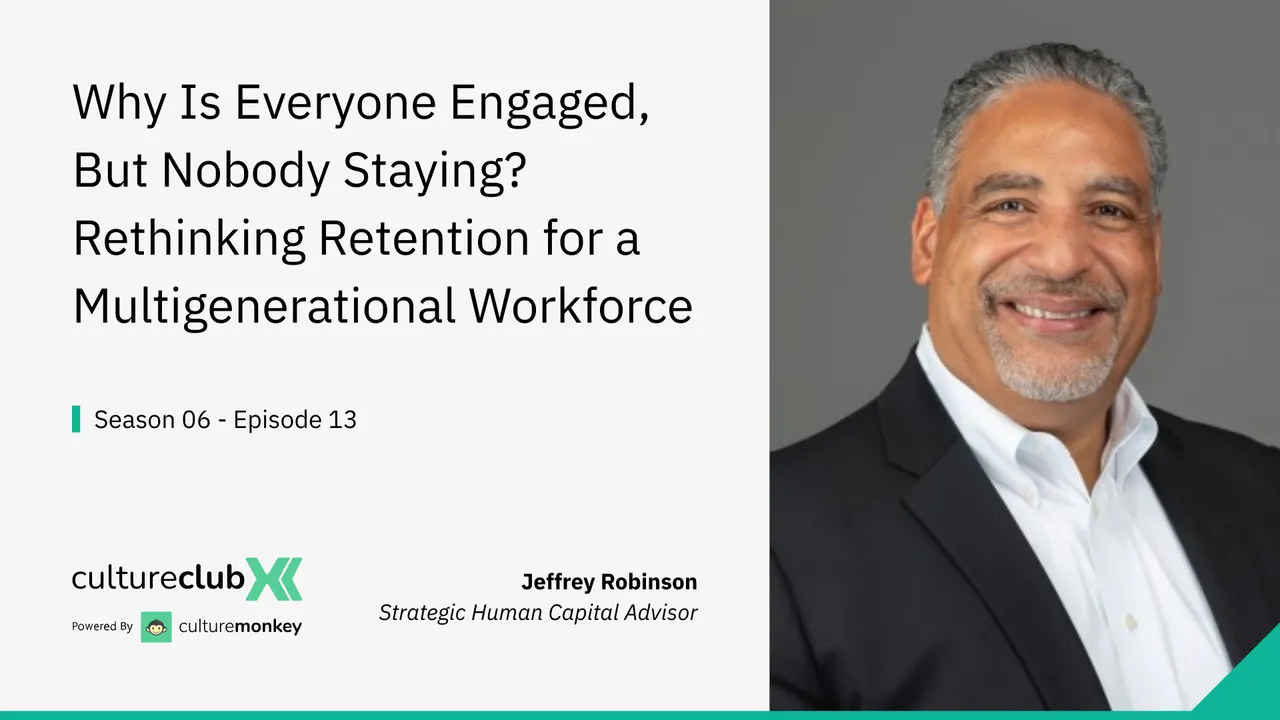
Engagement is rising, yet your best people still leave. Human Capital Advisor Jeffrey Robinson breaks down why engagement and retention are two different things, why one-size-fits-all engagement accelerates attrition, and how to design for career stage instead of age.
TL;DR
What you need to know from this episode
- Engagement and retention are not the same thing. Engagement is how people feel today. Retention is their confidence in the future. Companies celebrate strong engagement scores while underinvesting in career mobility, manager quality, workload, and development, which is exactly where people leave from.
- The gap hides in your best people, not your weakest. Retention risk rarely shows up as poor performance. High performers keep delivering while quietly stepping back from stretch roles and enterprise goals. By the time dissatisfaction is obvious, they are already gone.
- One-size-fits-all engagement accelerates attrition. Early, mid, and late career employees arrive with different priorities. Designing the whole organization around a single set of assumptions creates relevance for some and friction for everyone else.
- Design for career stage, not age. The universal drivers, trust, respect, growth, flexibility, meaningful work, and psychological safety, stay constant. What changes is how they are delivered, so the strategic lens is experience and life stage, not a generational label.
- Catch risk early with stay interviews and pulse data. Exit interviews are retrospective and too late. Structured stay conversations with high performers, paired with segmented pulse surveys, turn how we feel today into continuous workforce intelligence and stronger retention.
Jeffrey Robinson is a senior human resources executive and Human Capital Advisor at Mentone Avenue LLC, with a career spent working through nearly every role in HR and advising five CEOs through turnarounds and growth stories. In this episode of CultureClub X, he takes apart one of the most persistent puzzles in people strategy: why engagement keeps rising while retention stays stuck.
You will learn why engagement and retention measure two different things, where the gap actually hides, how to design for career stage instead of age, and how stay interviews and pulse surveys catch retention risk before your best people walk out the door.
The paradox is real. Organizations have never had more engagement data, yet many still watch valued employees leave without warning. Jeffrey’s argument is that the problem is not the survey, it is the assumption that an engaged employee is a retained one.
People can love their company, their colleagues, and their daily work, and still leave for stronger growth, greater flexibility, better rewards, or deeper alignment with their values. Treating engagement and retention as the same number is how leaders miss the signal until it is too late.
Why engagement and retention are not the same thing
Jeffrey’s starting point is blunt: employers conflate engagement and retention, and that conflation is costly. Engagement is a read on the present. How do I feel today, am I overwhelmed, am I stressed by what is happening in the company, or am I loving my project and delivering. Retention is something else entirely.
It is confidence in the future, whether an employee believes the company has what it takes going forward and can see themselves in that future. Companies love to celebrate a strong engagement score while underinvesting in the broader value proposition that actually keeps people: career mobility, manager quality, workload sustainability, and development pathways.
You can make someone feel good about today and still lose them tomorrow.
Retention, that’s confidence in the future. Does the employee believe that this company has what it takes into the future?
The two have to be managed together. Measuring how people feel is not wrong, it is just incomplete. The discipline is to balance initiatives that surface today’s sentiment with initiatives that build a credible future worth staying for. When an organization optimizes only for the daily mood, it ends up with employees who report high engagement one week and resign the next.
The fix is to pair an honest read on employee sentiment with a deliberate set of employee retention best practices, and to stop assuming the first guarantees the second.
People can love their company, love their coworkers, and have real day-to-day experiences they enjoy, yet they still leave for stronger growth, greater flexibility, better rewards, or deeper alignment with personal values.
The gap hides in your high performers, not your poor performers
The engagement-retention gap does not announce itself through poor performance. Poor performers are a separate issue, often a matter of fit. The gap lives in high performers who keep producing while quietly disengaging from the future of the organization. The early signals are subtle but visible if you are looking. The person who was always first to volunteer starts sitting quietly in meetings.
Interest in development and stretch assignments fades. Engagement with enterprise goals drops. Leaders routinely misread these signs, or miss them, because the output still looks strong. That is how disengaged employees slip through unnoticed until the resignation lands.
A high performer is going to be a high performer, they will do whatever they do well. But in the background, they are plotting the escape.
The mistake is to wait for visible dissatisfaction. By then the decision is made. Jeffrey’s rule is to stop scanning your weakest people for signs of trouble and start watching your strongest people for small withdrawals of discretionary effort, because those are the leading indicators of regret. If you only see the big signs, it is probably already too late.
By the time dissatisfaction is in your face, they’re already gone.
Why one-size-fits-all engagement accelerates attrition
A single engagement model applied to everyone accelerates attrition because it ignores a basic reality: employees do not experience work from the same life stage, career stage, or set of priorities. Early career talent wants rapid development, purpose, and mobility, and is often already eyeing the next role.
Mid-career professionals want flexibility, project progression, and balance, the room to step away and replenish. Late career employees want stability, mentorship, and the chance to leave a legacy. Design the whole organization around one set of assumptions and you create relevance for some and friction for everyone else.
Real engagement across a multigenerational workforce starts by accepting that difference rather than averaging it away.
Attrition rises when employees feel the organization understands the workforce in aggregate, but not in the individual context.
The answer is not infinite personalization of every policy. A benefits strategy is still global, and some requests simply cannot be accommodated. It is making sure someone understands what a specific employee needs in the context of their stage, and can act on it: why a certain project fits one person and not another, why a particular goal will land differently across the team. Purpose works the same way.
Define it too narrowly and you speak to a small group. Build a broad, credible mission that people across stages can connect with in their own way, through social impact, customer outcomes, expertise, mentorship, or legacy, and everyone can see themselves inside it.
Design for career stage, not age
Generational labels persist because they are simple, a tidy narrative for a complex workforce. But simple is not the same as accurate. Talk to employees across generations and the evidence is consistent: people value trust, respect, growth, flexibility, and meaningful work. Those drivers are universal. The strategic lens, Jeffrey argues, is not age but experience and career stage, and the two are not interchangeable.
Someone in their early thirties and someone in their late forties can both be mid-career, with the same priorities.
High-performing organizations move past generational shorthand and design around career stage, life circumstances, and individual motivation, supported by genuine psychological safety at work.
The strategic lens is not age, but experience.
That shift, from broad labels to career stage, is what makes decisions more precise and retention stronger. It asks more of managers, who now have to understand the people in front of them rather than a demographic, but it is the difference between a generic program and one that actually fits. The objective never changes: give yourself the best chance to retain the employee.
Standardize the Values, Personalize the Experience
Jeffrey Robinson’s operating principle for a generation-smart engagement strategy. Hold the culture and values constant across the company, then give managers the room to personalize how those values show up for each person, team, and career stage.
Standardize the Values
Define who you are as an organization and present it as a clear package. Company values are consistent and non-negotiable for everyone. That is the foundation that does not flex.
Personalize the Experience
It is the manager’s job to show each employee how their goals and contribution fit inside the organization’s purpose. Same values, different lived experience by career stage.
Flex the Learning and Work Models
People learn and work differently. Offer multiple career paths, varied learning modalities, and flexible work models, so the universal drivers reach each person in a way that fits.
Build Reverse Mentoring
Experienced employees carry wisdom, and early-career employees know things their senior colleagues do not. Create reverse mentoring across levels and functions so knowledge moves both ways.
Tailor Recognition
Let teams and cross-functional groups create their own forms of recognition for their own contributions. The objective is consistency in culture without rigidity in design.
The 90-day non-negotiable: stay interviews, not exit interviews
Asked for the one non-negotiable action a CHRO should take in the next ninety days, Jeffrey does not hesitate: institutionalize structured stay conversations with high-performing and high-potential employees. Most organizations lean too heavily on exit interviews, which are retrospective by definition.
They tell you why someone left after the decision is irreversible. Stay interviews are forward-looking. They reveal what is sustaining commitment while you can still act on it.
Most organizations rely too much on exit interviews. That’s retrospective by its own definition. It’s too late.
The conversation is direct. Why are you still here, what is keeping you in the chair, what is starting to bother you, where is friction building on your team, and what interventions would materially strengthen your reasons to stay. The point is to focus people internally, on what the organization can actually change, before a flight risk becomes a loss.
And companies already hold the inputs to know exactly who these people are, through performance reviews and nine-box succession data, so there is no excuse to wait for the resignation to start the conversation.
Catch retention risk before it becomes an exit
See how CultureMonkey’s pulse survey tools and real-time sentiment analysis help people teams read retention signals across every career stage, spot risk early, and act before your best people start plotting the escape.
Measure leading indicators, not just exits
Six months on, Jeffrey measures success through leading indicators rather than lagging exit data: internal mobility, manager effectiveness, intent to stay, and participation in development opportunities, tracked within critical talent segments. One number he always splits is turnover, voluntary versus involuntary, because the ratio tells a story a blended figure hides.
When my voluntary turnover is higher than my involuntary turnover, I know I have a problem. We are not managing our workforce.
High voluntary turnover means the organization is losing the people it wants to keep while failing to manage out the ones it should. The job is to do both: actively encourage strong performers to stay while managing poor performance with equal honesty.
How well you retain your people, Jeffrey argues, is a direct reflection of how you have done across those indicators, and it ties straight back to engagement and performance.
Turning pulse surveys into continuous workforce intelligence
This is where pulse platforms earn their place. Jeffrey is a strong believer in survey tools like CultureMonkey, used strategically rather than as a feelings thermometer. The shift he wants leaders to make is from this is how we are feeling to continuous workforce intelligence that drives real workforce improvement.
Combine pulse surveys with stay interviews and the retention picture sharpens. The risks rarely surface all at once, but patterns emerge across intent to stay, manager relationships, workload, recognition, career growth, and psychological safety.
Move from this is how we are feeling to continuous workforce intelligence, which can lead to workforce improvement.
The strategic value lies in segmentation and prediction. Compare experiences across generations, functions, and locations, identify the recurring themes and pressure points, and intervene early, while you can still translate feedback into a stronger retention strategy.
Used well, a pulse platform closes the employee feedback loop and lets you act before the talent is already out the door. Jeffrey’s through-line is simple to state and hard to live: engagement alone is no longer enough.
Standardize your values and personalize the experience, design for career stage instead of age, replace the post-mortem of the exit interview with the foresight of the stay interview, and use pulse data as an early warning system. Do that, and you stop asking why everyone is engaged but nobody is staying.
About the guest
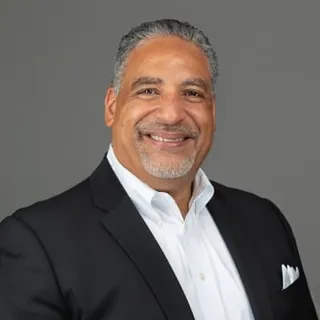
Jeffrey Robinson
Human Capital Advisor, Mentone Avenue LLC
Jeffrey Robinson is a senior human resources executive and Human Capital Advisor at Mentone Avenue LLC, with deep experience helping organizations build strong workplace cultures, develop talent strategies, and lead through periods of growth and change. Over his career he has guided businesses across multiple industries in aligning people, culture, and performance to achieve lasting results. He has worked through nearly every role in HR, from benefits to strategic recruiting, retention, and performance, with an eye toward the CHRO seat.
Along the way he has served five CEOs through their strategic growth stories, from companies on their last leg to leaders in their industry, which gives him a wide-angle view of what is happening in the workforce and how to respond. Jeffrey advises CHROs, CEOs, and the broader C-suite on culture, talent, and workforce strategy. He is based in Kent Lakes, New York, and is most easily reached on LinkedIn.
Full episode transcript
Season 06, Episode 13 · Jeffrey Robinson with Darcy Mehta · 33 min
Frequently asked questions
What is the difference between employee engagement and retention?
Engagement measures how employees feel today, whether they are stressed, overwhelmed, or enjoying their work. Retention is confidence in the future, whether they believe the company has what it takes going forward. Jeffrey Robinson argues that conflating the two is costly, because people can be highly engaged and still leave for stronger growth, greater flexibility, better rewards, or deeper alignment with their values. The discipline is to measure and manage both, not to assume a good engagement score guarantees people will stay.
Why do high performers leave even when they seem engaged?
Retention risk rarely shows up as poor performance. High performers keep producing while quietly withdrawing from stretch roles and enterprise goals. The early signals are subtle: reduced participation, lower interest in development, and stepping back from the goals that shape the organization’s future. Because the output still looks strong, leaders miss it. By the time dissatisfaction is visible, the decision to leave has usually already been made, so the answer is to watch your strongest people for small drops in discretionary effort rather than waiting for obvious signs.
Why does a one-size-fits-all engagement strategy increase attrition?
Because employees experience work from different career stages and priorities. Early career talent wants rapid development and mobility, mid-career professionals want flexibility and balance, and late career employees want stability, mentorship, and legacy. Designing the whole organization around a single set of assumptions creates relevance for some and friction for everyone else. Jeffrey Robinson recommends designing for career stage rather than age, delivering the universal drivers, such as trust, growth, flexibility, and psychological safety, in personalized ways.
What is a stay interview, and why is it better than an exit interview?
A stay interview is a structured, forward-looking conversation with high-performing and high-potential employees about what is keeping them, what is starting to bother them, where friction is building, and what would strengthen their reasons to stay. Exit interviews are retrospective by definition and arrive after the decision is irreversible. Jeffrey Robinson calls institutionalizing stay conversations the one non-negotiable action a CHRO should take in ninety days, because it lets you act on retention risk before a flight risk becomes a loss.
How can pulse surveys help detect retention risk early across a multi-generational workforce?
Used strategically, pulse platforms like CultureMonkey move organizations from a single read on how people feel today to continuous workforce intelligence. The strategic value is segmentation and prediction: compare experiences across generations, functions, and locations, surface recurring themes and pressure points across intent to stay, manager relationship, workload, recognition, career growth, and psychological safety, and intervene before the talent leaves. Jeffrey Robinson recommends pairing pulse data with stay interviews so the signals reinforce each other and feed a stronger retention strategy.
Read the cross-episode roundups
More from CultureClub X
 S07 E01employee engagementThe Wellbeing Illusion: Why Most Organizations Are Spending More on Wellbeing and Getting Less in Return, with Gethin Nadin
 Gethin Nadin
 S06 E20change leadershipThe Culture Paradox: Why Hidden Patterns Keep Organizations Stuck and Good Conflict Sets Them Free, with Jamie Notter
 Jamie Notter
 S06 E19change leadershipFrom Cost Center to Catalyst: How CPOs Turn People Strategy Into Business Advantage, with L. David Kingsley
 L. David Kingsley
Never miss an episode
Every new episode, plus the takeaways that matter, posted on the CultureMonkey LinkedIn page as soon as they drop.
Free on LinkedIn. Unfollow anytime.