

S06 E08
The Early Signs of Change Fatigue in Teams
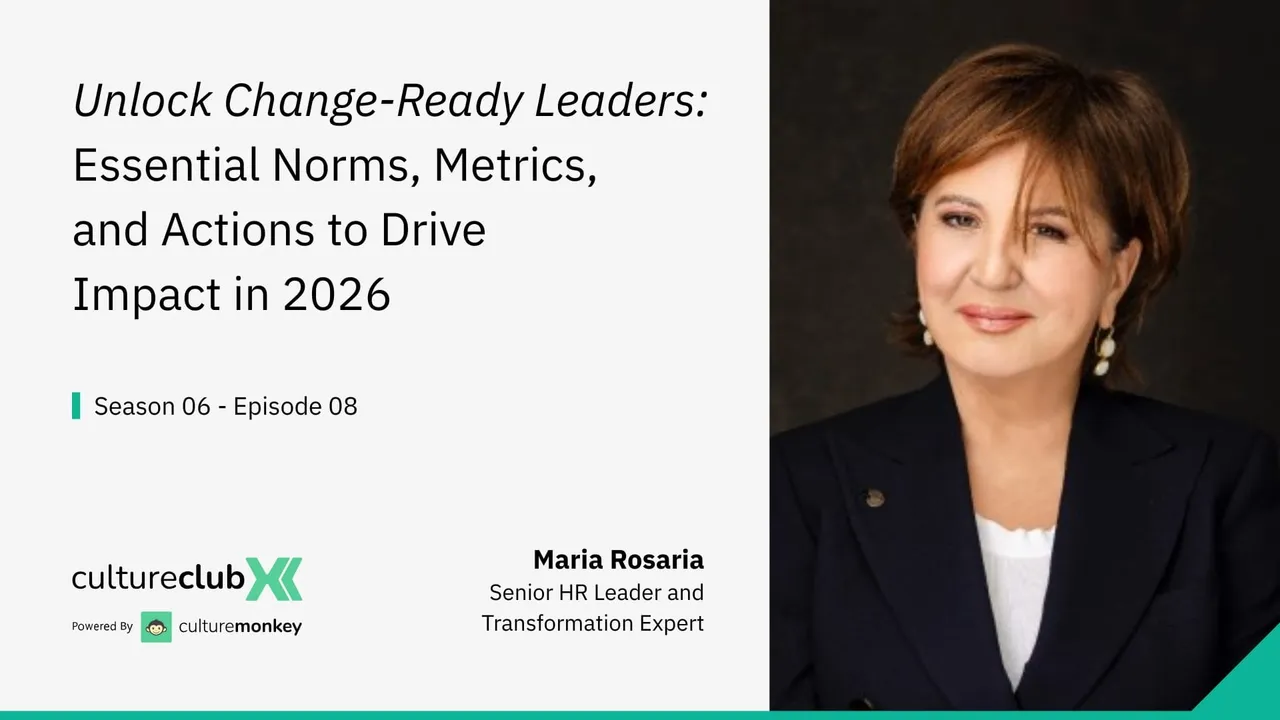
Maria Rosaria draws on 18 years of global transformation experience to share how to spot change fatigue early, build leader confidence in ambiguity, measure decision quality over KPIs, and why there is no AI without empathy.

TL;DR
What you need to know from this episode
- Change fatigue shows up long before burnout does, and leaders who can read the early signals hold a decisive advantage. When teams start making rushed decisions without strategic thought, or when previously vocal people go quietly passive, those are not personality shifts. They are structural warnings that the organization is absorbing more change than its leaders can process with clarity.
- Empathy and execution are not opposites, the skill is knowing when to use each. Acknowledging complexity openly and checking in on team progress are not soft additions to a change program. They are the mechanisms that keep leaders from becoming the very bottleneck they were hired to remove. Emotion is information; the discipline is in separating it from the decision itself.
- The cultures that navigate ambiguity best are not the ones with the clearest answers, they are the ones with the clearest direction and the most permission to disagree. Having a shared trajectory and actively making space for dissent are not contradictions. They are the two things that, together, allow organizations to move with confidence through uncertainty rather than stalling inside it.
- Leadership effectiveness in the AI era is no longer measured by outcomes alone, it is measured by the quality of the decisions behind them. AI can generate outputs faster than any leader can think. The leaders organizations need right now are not faster thinkers. They are sharper validators: people who can assess, challenge, and govern what AI produces before it becomes policy.
- AI-powered HR tools earn trust the same way human leaders do: through transparency about how they are used and visible action on what they surface. The debate is not whether to use sentiment tracking tools. It is whether organizations are honest enough about what those tools are for. Tools deployed like surveillance destroy trust. Tools deployed as listening mechanisms, with transparent outputs and genuine follow-through, build it.
Reading change fatigue before it reads your organization
Maria Rosaria has spent the last eighteen years living and leading across Sweden, Finland, Germany, the US, China, and India. That itinerary is not incidental context, it is the source of a deeply practical, cross-cultural lens on how organizations absorb and resist change.
Her starting point for this conversation is blunt: most organizations discover change fatigue far too late, long after it has already shaped the decisions their leaders are making.
The first signal she watches for is speed without substance. When leaders begin making decisions too quickly, operationalizing before thinking through strategy, that velocity is not efficiency. It is a symptom. Fatigued leaders default to action because deliberation feels too costly. The result is a string of poorly anchored decisions that compound the very instability they were meant to resolve.
You can spot people that are fatigued into the team when they take decisions too fast and when things are not well thought through, and then they go too much into operationalizing instead of having thought through topics strategically.
The second signal is silence. When previously engaged people stop contributing, when energy drops to a quiet, passive acceptance of whatever is decided, that is not harmony. It is disengagement dressed as compliance.
Maria Rosaria is direct about why this matters: healthy change processes require friction. People who think differently and say so, who push back and offer alternatives, are not obstacles. They are the immune system of the change effort. When that friction disappears, the organization has lost something it cannot easily recover.
Understanding employee sentiment in real time is how people leaders catch this shift before it becomes structural.
Balancing empathy and execution: the discipline leaders rarely talk about
The tension between empathy and execution is one of the most discussed challenges in leadership, and one of the most poorly resolved. Maria Rosaria's framework is notably practical, grounded in the discipline of knowing when each mode is appropriate rather than trying to perform both simultaneously.
Her first principle is acknowledgment. Before any execution can happen with real team buy-in, the complexity of the situation must be named openly. Not managed, not minimized, named. Teams that feel their leader has genuinely registered what they are navigating will follow direction far more readily than teams that feel the difficulty is being glossed over.
This is where empathy in leadership earns its place: not as a soft value, but as a practical precondition for execution.
Emotion is important, as far as you are aware that you have emotion in a certain situation. But when you need to take the decision, you need to try to keep emotion away in order to make a very good and sound decision.
Her second principle is structured progress visibility. Small, regular check-ins that allow leaders and their teams to track movement, to see that the work is going somewhere, serve a function that annual reviews cannot. They create a rhythm of shared acknowledgment that prevents the momentum loss that so often follows a difficult announcement or a major change.
The feeling of being supported, Maria Rosaria argues, is not a nice-to-have. It is what allows leaders to continue executing when the environment is at its most turbulent.
The Change-Ready Leader System: Five Norms That Build Confidence in Ambiguity
Maria Rosaria's operating framework for building leader confidence during complex transformation, covering direction, dissent, decision quality, coaching culture, and psychological safety.
Anchor Every Change to a Clear Trajectory
Leaders and teams cannot perform with confidence in ambiguity without a shared sense of where the organization is going. A visible direction, even an imperfect one, gives people a reference point that makes every difficult decision easier to take and defend.
Make Disagreement a Structural Asset, Not a Cultural Risk
Give teams the explicit space to express dissent and ensure those perspectives are genuinely heard and reused in shaping the change. Disagreement that is suppressed does not disappear, it resurfaces later as resistance, attrition, or failed implementation.
Shift Leadership Effectiveness Metrics from Outcomes to Decision Quality
In a world where AI can generate outputs at speed, the measure of leadership is no longer what was decided but how robustly. Was the decision thought through? Is it unbiased and solid? Can it be communicated with clarity? Those are the questions that matter now.
Position CHROs as Architects of Learning Environments, Not Just Change Managers
The non-negotiable CHRO action for 2026 is building organizations where leaders act as mentors and coaches rather than controllers, creating the conditions for continuous learning and guiding teams through new technology at a pace people can sustain.
Build Psychological Safety Through Transparent, Judgment-Free Feedback
The support system that protects leader well-being under rapid change is not a wellness program. It is an environment where leaders can express their views, contribute without judgment, and feel genuinely valued, which is the precondition for everything else.
What actually builds leader confidence in ambiguous environments
Culture norms that build leader confidence are not about eliminating uncertainty, they are about making uncertainty navigable. Maria Rosaria identifies two that are consistently underinvested in: shared direction and structured dissent. The first gives leaders a trajectory to work from even when the path is unclear. The second gives them the organizational permission to be told when the trajectory needs adjusting.
Resilient organizational cultures are the ones where both are present simultaneously.
The combination matters because each one fails without the other. A clear vision without space for dissent becomes an echo chamber that misses critical corrections. Space for dissent without a clear vision becomes rudderless noise.
The organizations that navigate ambiguity best are those where leaders communicate direction with enough conviction for people to commit, and with enough humility to integrate what they hear back.
Change leadership at its most effective looks like exactly this balance: firm in direction, genuinely open in execution.
Measuring leadership effectiveness when AI changes what decisions mean
The conventional answer to measuring leadership effectiveness is KPIs. Maria Rosaria sets that aside immediately. KPIs measure what happened; they do not measure how the decision that produced that outcome was made. And in an environment where AI can generate plausible outputs at speed, the quality and integrity of the decision process is precisely what leaders need to be accountable for.
Her alternative metrics focus on decision robustness: Was the decision thought through strategically? Is it solid and unbiased? Was it communicated with enough clarity that it signals genuine comprehension rather than delegation to a tool? These questions become more important, not less, as AI accelerates the pace of output.
Managerial effectiveness in 2026 is not about leaders who can move faster with AI, it is about leaders who can validate, govern, and take accountability for what AI produces on their behalf.
AI is changing the quality of decisions because it can give us immediate outputs and it's faster. What leaders need to do is verify, make sure the output of those decisions is valid, solid, and unbiased. The leaders required right now are leaders with a very good level of agility.
Agility here means something specific. It is not speed or adaptability in the generic sense. It is the cognitive capacity to assess information rapidly, understand what it contains, and make a judgment about whether it is fit for use.
That requires leaders who are genuinely curious about AI's limitations, not just its capabilities, and who understand that their role has shifted from producing decisions to governing the systems that inform them. Agile leadership in this sense is the defining competency of the current moment.
Detect change fatigue before it derails your leadership pipeline
See how CultureMonkey's pulse survey tools and real-time sentiment tracking help people leaders identify early signals of disengagement, track leader well-being, and act before fatigue becomes attrition.
The CHRO's non-negotiable: building organizations where leaders can learn
When asked for the single most important action CHROs must take in 2026, Maria Rosaria's answer is not a program or a metric. It is a structural orientation. The CHRO's role is to build an environment where leaders can engage with direction, learn continuously, and develop their teams, not from a position of control, but from a position of coaching.
The shift from manager-as-controller to manager-as-coach is not a new idea. What makes it urgent in 2026 is the pace of technological change. Leaders cannot instruct their teams on tools they are still learning themselves. The authentic posture is one of shared discovery: leaders who model curiosity, who acknowledge what they do not know, and who create space for team members to bring what they do know forward.
Trust, Maria Rosaria adds, is the third and most essential element, the precondition without which none of the rest takes hold. Trust in leadership is what makes learning possible under pressure. Without it, even the most well-designed change program produces compliance, not commitment.
Leaders in this period need to work as mentors, as coaches of their teams, not as controllers. And there is a third element that is trust. Leaders need to install trust so that people can follow them. If there is not trust, how can you follow them and learn alongside them?
The coaching leadership style Maria Rosaria describes creates something organizations often overlook: a feedback loop from the bottom up.
When leaders are visibly learning alongside their teams, team members who already have AI fluency or adjacent expertise can surface what they know without it feeling like a threat to the hierarchy. The knowledge flows laterally and upward, not just down. That is how capability develops at scale, and it is the only realistic model in an environment where no single leader has all the answers.
Protecting leader well-being: the support system that is hiding in plain sight
HBR has documented the mental health toll of rapid organizational change on leaders, the anxiety, the decision fatigue, the cumulative weight of communicating uncertainty while projecting confidence. Maria Rosaria's response to this challenge is deliberately simple. The support system that protects leader well-being is not a wellness initiative or a coaching program, though those have value.
It is the creation of an environment where leaders can express their point of view, offer feedback, and contribute without judgment.
That condition sounds obvious. In practice, it is rare. Most organizations nominally espouse psychological safety without building the structural conditions for it. When leaders cannot name what they are struggling with, when the culture treats uncertainty as weakness rather than information, the well-being consequences are predictable.
Manager burnout does not arrive suddenly. It accumulates in the gap between what leaders are experiencing and what the organization allows them to say. Closing that gap is not a soft investment. It is the precondition for sustained organizational performance through change.
Maria Rosaria frames this with characteristic directness: people who feel considered, valued, and genuinely able to contribute automatically become more capable of leading their teams and setting trajectory. The connection between leader well-being and organizational performance is not indirect. It is mechanistic.
And the employee feedback loop that makes this possible is the single most actionable investment any CHRO can make in their leadership pipeline right now.
AI-powered HR tools and the question of trust
The debate about whether to use AI-powered HR tools, sentiment tracking, real-time pulse surveys, engagement analytics, is one Maria Rosaria encounters constantly. Her position cuts through the noise: the debate is the wrong one. These tools are not inherently trustworthy or untrustworthy. Their trustworthiness is determined entirely by how they are deployed and communicated.
The framing that destroys trust is deploying these tools as surveillance: collecting sentiment data that employees do not know is being collected, or using it to make decisions without explaining the process.
The framing that builds trust is positioning them as listening mechanisms, tools that give the organization hints and signals about the human situation inside it, used to inform decisions that are then communicated transparently.
Employee sentiment data that is surfaced honestly, shared appropriately, and acted on visibly becomes a source of genuine organizational intelligence. The same data used covertly becomes a source of fear and disengagement.
These tools need to be seen not like police tools, but tools that give hints and sentiment to understand the situation of the people. If we show the output and share it transparently with employees, people will trust the tools and the usage of those tools. It is a matter really of transparent communication.
Maria Rosaria closes the episode with a thought that integrates everything that preceded it. At a conference she attended recently, a group of operational excellence leaders put it simply: organizations have become so focused on processes that they have forgotten the human part of change. The same, she argues, is true of AI. There is no artificial intelligence without empathy.
Emotional intelligence and artificial intelligence must be coupled, not treated as alternatives, not prioritized one over the other, but held together as the complete set of capacities a modern leader needs. Emotional intelligence for leaders is not the antidote to the AI era.
It is what makes the AI era work at a human scale.

About the guest
Maria Rosaria Bonifacio
VP and People Head, Nokia
Maria Rosaria is a Senior HR Leader with extensive experience driving organizational transformation in complex, global environments. She has led large-scale change initiatives across workforce strategy, organizational design, leadership effectiveness, and post-acquisition integration, working closely with executive leadership teams to align people, culture, and business priorities. In addition to her corporate leadership roles, Maria Rosaria brings board-level experience, contributing to discussions on governance, leadership capability, and long-term organizational sustainability.
This perspective allows her to bridge executive execution with boardroom expectations, particularly in periods of strategic change and uncertainty. Her work is focused on building change-ready leadership systems, reinforcing decision quality, resilience, and accountability. Alongside her professional roles, she contributes to executive education and business school programs, sharing a pragmatic, system-level view on modern leadership and the future of work.
Full episode transcript
Season 06, Episode 08 · Maria Rosaria with Darcy Mehta · 21 min
Frequently asked questions
What are the earliest signs that a leadership team is experiencing change fatigue?
Two behavioral patterns appear well before burnout does. The first is accelerated but poorly anchored decision-making: leaders begin operationalizing before thinking through strategy, moving fast without the depth that good decisions require. The second is a drop in constructive engagement: people who previously contributed ideas, challenged assumptions, or flagged concerns go quiet and begin passively accepting whatever is decided. Both patterns look superficially like competence or calm. They are actually signals that the organization is absorbing more change than its leadership can process with clarity.
How do you balance empathy with the need to make clear, timely decisions during change?
The key is sequencing, not choosing. Empathy comes first: acknowledging complexity openly, naming what the team is navigating, and making space for people to feel genuinely heard. That acknowledgment is not a delay to execution, it is what makes execution possible without resistance. Then, when the decision point arrives, the discipline is to separate the emotion (which is real and important information) from the judgment itself. Leaders who skip the empathy step tend to make faster decisions that take far longer to implement, because the team was never genuinely on board.
How do you measure leadership effectiveness when AI is reshaping the decision-making process?
Move the measurement from outcomes to decision quality. KPIs tell you what happened; they do not tell you how the decision that produced it was made. In an AI environment, where outputs can be generated faster than leaders can think, the critical question is whether those outputs were validated, verified for bias, and communicated with enough clarity to signal genuine comprehension. Leaders who can do that consistently, who can assess the robustness of AI-generated outputs and take accountability for them, are the leaders organizations actually need right now.
What is the most important thing CHROs must do to build change-ready leaders in 2026?
Build an environment where learning is possible and trust is structurally installed. This means positioning leaders as coaches and mentors rather than controllers, creating the space for their teams to develop capability with new technology at a pace they can sustain. It also means being explicit about trust as a design requirement, not an outcome. Leaders who feel trusted, who operate in an environment where they can express uncertainty and be supported rather than judged, are the ones who build the resilience their teams need. Trust is not a culture outcome. It is the mechanism that makes everything else work.
How should AI-powered HR tools like CultureMonkey be introduced so that employees trust them?
The single most important factor is transparent communication about how the tools are used. Employees do not inherently resist sentiment tracking or pulse surveys, they resist the sense that data is being collected about them for purposes they do not understand and cannot influence. When organizations explain clearly what the tools are for, share relevant outputs with employees, and act visibly on what the data surfaces, trust in those tools follows naturally. The tool becomes an instrument of listening rather than surveillance. What you do with the information, and whether employees can see that it produces real outcomes, is what determines whether the data is worth collecting at all.
More from CultureClub X
 S07 E02change leadershipHR as Chief Disruption Officer: Why Supporting the Business Is a Ceiling, with Jennifer McClure
 Jennifer McClure
 S06 E20change leadershipThe Culture Paradox: Why Hidden Patterns Keep Organizations Stuck and Good Conflict Sets Them Free, with Jamie Notter
 Jamie Notter
 S06 E19change leadershipFrom Cost Center to Catalyst: How CPOs Turn People Strategy Into Business Advantage, with L. David Kingsley
 L. David Kingsley
Never miss an episode
Every new episode, plus the takeaways that matter, posted on the CultureMonkey LinkedIn page as soon as they drop.
Free on LinkedIn. Unfollow anytime.