

S06 E09
How CHROs Build Change Leadership That Sticks
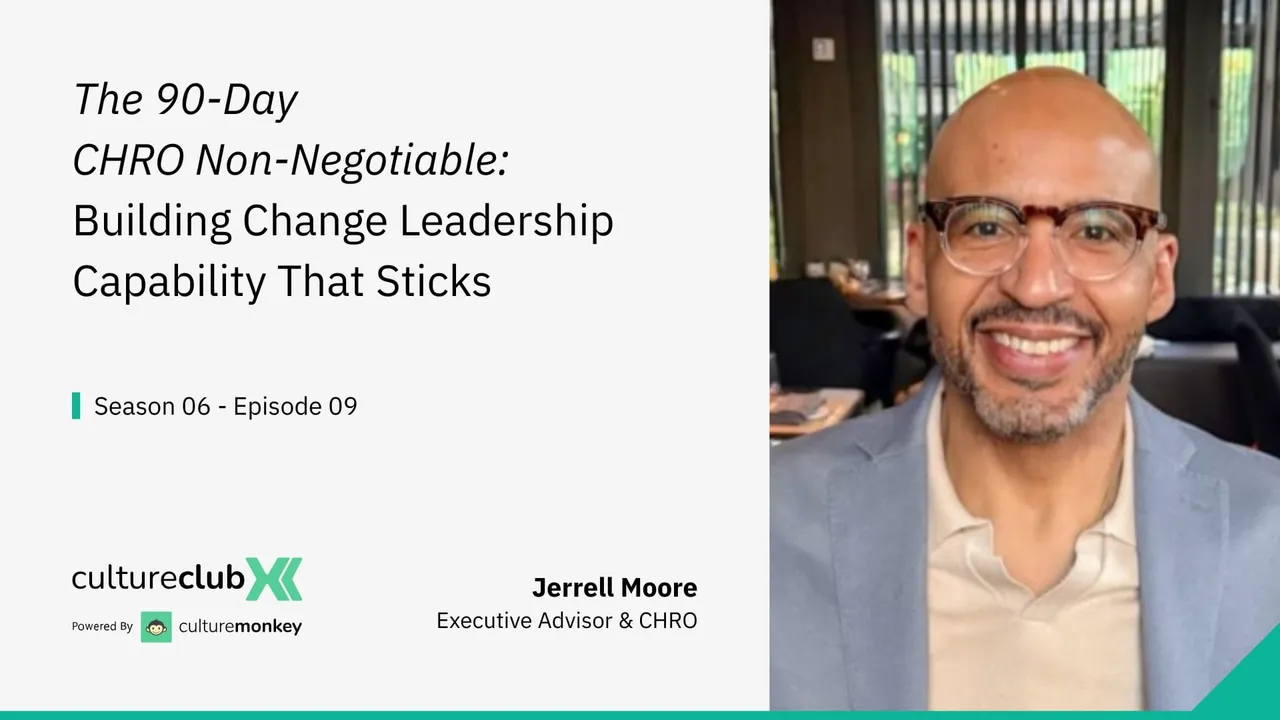
Jerrell Moore, Executive Advisor and former CHRO at Cadence Bank, shares how CHROs can build change leadership capability that sticks, from cultural norms and measurement frameworks to the one non-negotiable 90-day action every people leader must take to develop truly change-ready leaders at scale.
TL;DR
What you need to know from this episode
- Change is no longer episodic, it is constant, and the leaders who thrive are those who convert it into competitive advantage rather than merely enduring it. Jerrell Moore draws a sharp distinction between change-tolerant leaders, who ask how to survive disruption, and change-ready leaders, who ask how to harness it for progress. That orientation difference, not a program or a framework, is what separates high-performing organizations from those that fall behind.
- The three norms that quietly undermine resilience are consensus-seeking disguised as collaboration, over-indexing on politeness over candor, and silence during uncertainty. Each one feels like a safe default. Each one erodes the trust and speed that change-ready leadership actually requires. Employees want the truth, even when it is incomplete, and leaders who provide it build far more durable trust than those who wait for perfection.
- Psychological safety is not about comfort, it is about standards, accountability, and the organizational permission to challenge respectfully. Jerrell's framework anchors safety in structure: employees should be able to rely on governance and standard operating procedures regardless of who is leading. Safety built on clear expectations, not on avoiding discomfort, produces the feedback loops that make organizations genuinely better over time.
- Boards want causality, not activity, and the metrics that matter most during change link leadership behavior directly to business outcomes. Decision speed, communication quality, engagement trends in critical teams, regrettable attrition, and 360 feedback on clarity and trust are the indicators that give boards the narrative they need. Disconnected snapshots of HR data do not make the case; causal linkages do.
- The CHRO's 90-day non-negotiable is establishing a change leadership capability standard and inspecting it consistently, not rolling out one more competency that only surfaces at performance review time. Jerrell's framework defines what decision speed, communication effectiveness, and active engagement look like as measurable expectations, then monitors them in real time. Six months later, the signal is simple: faster execution, improved engagement in critical teams, and reduced regrettable attrition among top talent.
The difference between change-tolerant and change-ready: why it matters more than any program
Jerrell Moore has spent over two decades building HR strategy across some of the most demanding environments in global business, from Nike and Google Cloud to Burger King, Charter Communications, and Cadence Bank. The thread running through every role, he explains, is a consistent observation: organizations do not fail because of change. They fail because their leaders are not equipped to lead through it.
The gap shows up in predictable patterns, slow decision-making, unclear priorities, and cultures that have quietly confused alignment with consensus. The last of these is where Jerrell is particularly pointed. Consensus-seeking feels collaborative in the moment. In practice, it is often a way of avoiding the difficult opinions and inconvenient recommendations that genuine collaboration surfaces.
When organizations confuse the two, they build cultures that move slowly and safely toward the wrong outcomes.
At the enterprise level, change is no longer episodic. It is constant. The differentiator today is the leader's capacity to absorb, translate, and accelerate that change into company performance, into individual performance.
The distinction Jerrell draws between change-tolerant and change-ready leaders is not about degrees of resilience. It is about orientation. Change-tolerant leaders ask how we get through this. Change-ready leaders ask how we convert this into an opportunity to advance. They do not manage disruption, they harness it.
That requires three things working together: intentional norm-setting, measurable expectations, and real leadership accountability. Not just communication. When those three are in place, Jerrell argues, change stops being something organizations manage and starts being a source of competitive advantage.
Change leadership at this level is not a competency to develop, it is an organizational capability to build.
The norms that quietly destroy trust and the ones that build it
When Jerrell turns to cultural norms, he starts with the ones that undermine rather than enable, because they are the ones most organizations do not recognize as problems until the damage is visible. The first is consensus-seeking masquerading as collaboration. The second is the preference for politeness over candor. The third is leadership silence during uncertainty.
On silence, Jerrell is emphatic. One of the worst things a leader can do during change is remain quiet simply because they do not have all the answers. The vacuum that silence creates does not stay empty, employees fill it with speculation that is rarely fact-based and almost never helpful.
Showing up and saying "here is exactly what we know today, it is not much, but we will come back when we have more" is not a weak communication posture. It is the one that preserves trust when trust is most fragile. He traces this back to something he was recently quoted on in Inc. magazine: the most successful leaders he has observed consistently err toward transparency and candor over polish and perfection.
I've had employees say 99.9 percent of the time: just tell me the truth, even if it hurts. Do not sugarcoat it and share with me what you can in real time. Speed and trust reinforce each other when anchored in clarity.
The enabling norms he champions follow directly from this. Transparency over perfection: the first draft that is honest is more valuable to employees than the final version that has been polished into corporate speak. Disagree and commit: not everyone will agree with every decision, but leaders need the organizational culture to make commitments and hold to them.
And clear decision rights and accountability, during change, ambiguity about who the decision maker is and where accountability sits is itself a form of dysfunction.
Trust in leadership is built not through perfect messaging but through this combination of clarity, candor, and visible accountability.
Psychological safety is not about comfort, it is about standards and permission to challenge
Jerrell's framework for psychological safety is deliberately structural rather than cultural in the soft sense. His starting point is that employees should not have to wait for a specific leader to make them feel safe.
Safety should be embedded in the organization's standards, governance, risk management processes, and standard operating procedures, the things that are present regardless of who is leading at any given moment.
This structural foundation matters because it decouples safety from individual leadership style and makes it inspectable. When standards are in place, the question becomes whether leaders are being held accountable to them, and whether the organization has normalized what Jerrell calls respectful challenge.
When an employee raises a hand and says something does not make sense, is there a constructive process for testing it, improving it, and incorporating what is learned? That is collaboration in the genuine sense.
Psychological safety in the workplace that is built on this model produces better outcomes than comfort-preserving cultures that avoid the discomfort where real improvement lives.
When the employee feels heard, when the leader has said, I hear you, I see you, and I have done something about it, that creates such a positive feedback loop all around.
The generational dimension here is worth noting. Jerrell observes that some leadership generations are simply not used to employee pushback or dissent, it registered historically as insubordination rather than engagement. Younger generations, by contrast, often expect to be heard and want their workplace to improve as a result of their input.
The skill organizations need to build is equipping leaders to respond to dissent not punitively but inclusively, turning challenge into a signal that improves the system rather than a threat to the hierarchy.
Employee feedback loops that are built on this principle become an organizational asset rather than a compliance obligation.
The Change Leadership Capability Standard: Five Dimensions Every CHRO Must Define and Inspect
Jerrell Moore's operating framework for building and sustaining change-ready leadership capability at scale, covering decision speed, communication, accountability, engagement, and real-time monitoring.
Define Decision Speed as a Measurable Standard
Establish as an executive team what decision speed should look like in your organization's context. Slow decisions are one of the earliest signals of change saturation. When leaders are re-litigating decisions already made, the organization has stopped moving forward and started cycling. Speed must be a defined expectation, not an aspiration.
Distinguish Collaboration from Consensus-Seeking
Be explicit as a leadership team about what effective communication looks like and whether you are building consensus or truly collaborating. Consensus-seeking is a landmine: it masks itself as inclusion while filtering out the challenging input that makes change decisions stronger. Real collaboration means hearing opinions you did not want and recommendations you were not ready for.
Define Active Engagement as a Leadership Responsibility
Leaders must know how to actively engage and keep their teams engaged throughout change, not just at annual reviews or offsites. Engagement is a leadership behavior, not a survey outcome. Define what it looks like in practice: how leaders communicate progress, how they handle dissent, and how they create the conditions for team members to contribute at their best.
Equip Leaders with the Right Frameworks Before Expecting Results
Equipping leaders with the right tools and frameworks and then monitoring consistently is the only sequence that produces durable capability. Rolling out one more competency that surfaces only at performance review time does not build accountability. Real-time inspection, not annual assessment, is what establishes the standard as operational rather than aspirational.
Re-anchor Teams in Purpose and Progress Consistently
Purpose is not something to revisit at an annual offsite and not look at again for a year. Bringing mission, vision, and purpose to team conversations on a weekly, monthly, and quarterly basis, alongside real data on how the team is tracking, keeps everyone in lockstep and reduces the need for cadence resets. Clarity of purpose diminishes burnout far more effectively than any wellness program.
Measuring leadership effectiveness during uncertainty: what boards actually want to see
The conventional answer to measuring leadership effectiveness is KPIs. Jerrell sets that aside early. KPIs tell you what happened; they do not tell you why, or what the quality of the decision that produced it was. During uncertainty, when leaders are being evaluated in real time by their boards, the measurement framework needs to operate at multiple levels simultaneously.
The first level is execution: decision speed, delivery against milestones. These are the table stakes. The second is people: engagement trends, regrettable attrition, internal mobility, hot pockets of disengagement in specific departments.
The third, and the one Jerrell identifies as chronically underutilized, is the 360, specifically looking at what clarity, communication, and trust look like from the perspective of the people a leader is actually leading.
Managerial effectiveness measured through this lens produces a full view of the leader, not just their output.
Boards expect causality, not just activity. They do not want disconnected snapshots. They want to know how one metric is driving the other to the outcomes that we are setting our goals against.
The business case is built when these three levels are connected. Poor execution and low engagement, taken together, predict drops in business outcomes reliably enough to create an early warning system rather than a post-mortem. Jerrell also points to the value of external benchmarks, what should a leader in a comparable situation be delivering, and trend lines over time.
For organizations in constant M&A activity or ongoing transformation, the trend line tells you far more than any single snapshot. Employee engagement metrics that are linked causally to business performance are the ones that earn genuine board attention and sustained investment.
Spotting change saturation before it tips into burnout
Jerrell identifies three early signals that a leadership team is approaching change saturation. The first is slow decisions, and specifically, re-litigating decisions that have already been made. If an organization is revisiting a commitment from six months ago without a clear structural reason, it has stopped moving and started cycling.
The second is passive resistance: people beginning to disengage, pulling back from active participation without overtly pushing back. The third, and the most alarming, is when high performers start checking out.
High performers are, in Jerrell's phrase, the canary in the coal mine. They are the first to notice when leadership behavior has deteriorated, and the first to leave when they lose confidence in direction. Burnout, he argues, is driven more by lack of clarity than by workload alone. A team that knows exactly what it is doing, why it matters, and how it is tracking can sustain an enormous amount of work.
A team operating in ambiguity about priorities, without real-time data on progress, experiences the same workload as exhaustion. Manager burnout follows the same pattern: it accumulates in the gap between what is being asked and what the environment provides for people to work with.
The interventions Jerrell recommends are deliberate in their simplicity: ruthless prioritization (decisions made stay made), resetting leadership cadence and focus, and re-anchoring teams to purpose and progress in real time.
The goal is not to tear down what has been built but to validate whether the organization is still aimed at the right north star, and to make that visible to every team member consistently, not annually.
Track change saturation signals before your top talent checks out
See how CultureMonkey's pulse survey tools and real-time sentiment tracking help people leaders identify disengagement early, monitor leadership effectiveness, and act on the data before passive resistance becomes regrettable attrition.
The 90-day CHRO non-negotiable: building the capability that makes everything else possible
When Darcy asks for the single most important action a CHRO should take in the next 90 days, Jerrell does something notable. He does not lead with AI. He acknowledges the deliberate omission: in most conversations over the past two years, the answer to this question has defaulted immediately to AI readiness. His argument is that even AI readiness requires a prerequisite that most organizations have not yet built.
That prerequisite is a change leadership capability standard. Not a framework or a training program, but a defined and actively monitored organizational standard for how leaders navigate change. Everything else, AI adoption, performance management, cultural effectiveness, values alignment, depends on this capability being present.
Without it, even the best tools and frameworks produce compliance rather than capability.
Leadership development that is designed around this standard, with defined expectations, consistent monitoring, and real accountability, is what produces durable change readiness rather than temporary behavior change.
The six-month success indicators are direct: faster execution cycles, improved engagement in the organization's most critical teams, and reduced regrettable attrition among top talent. Those three outcomes together constitute proof that leadership behavior has genuinely changed, and leadership behavior, Jerrell concludes, is the only variable that determines whether anything else changes at all.
Engagement platforms and the intelligence leaders need in real time
On the role of platforms like CultureMonkey, Jerrell is both appreciative and direct about what they actually provide: visibility into organizational sentiment that would otherwise be invisible until damage is done. The CEO who sends one question a day, the organization that pulses weekly rather than annually, these are not just good listening practices.
They are early identification systems for risk areas that, left undetected, compound into structural problems.
Jerrell offers a concrete illustration. A company that ran a single engagement survey in January 2025 and waited until January 2026 missed an entire year of geopolitical and economic change that was directly shaping internal employee experience, even if the company controlled none of those external forces.
The insights that continuous listening platforms generate, layered by top performer segments, diversity lenses, team and department breakdowns, give leaders the specific, actionable data that allows interventions to be targeted and timely rather than generic and retrospective.
Employee sentiment data gathered this way becomes genuine organizational intelligence rather than a periodic compliance exercise.
Jerrell's closing principle pulls everything together: data builds trust when leaders act on it quickly and transparently. The tool is not the point. The point is what the tool makes possible, the candid conversations, the real-time collaboration, the transparent communication that the entire episode has been building toward.
When leaders use real-time data to act visibly and promptly, they send the signal that listening is not performative. It is operational. And that is what changes the relationship between leaders and their teams from one of managed communication to one of genuine partnership through change.
About the guest
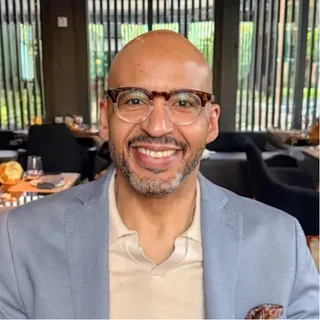
Jerrell Moore
Executive Advisor, former CHRO, Cadence Bank
Jerrell Moore is a former Chief Human Resources Officer at Cadence Bank and a proven problem solver who aligns culture, talent, and strategy to drive measurable business outcomes at scale. He has held C-suite people leadership roles at iconic global brands including Google Cloud as Chief Diversity Officer and Head of Global DEI, Assurant as Vice President and Head of Global Diversity, Equity and Inclusion, Charter Communications (Spectrum) as Chief Diversity Officer and Vice President, and Burger King as Vice President Community Affairs and Chief Diversity Officer, plus senior HR leadership at Nike and MassMutual. Across these organizations, Jerrell has repeatedly tackled complex challenges in merger integration, workforce transformation, talent acceleration, and large-scale cultural change.
He is a graduate of the University of South Carolina's Darla Moore School of Business and Joseph F. Rice School of Law (JD/MHR dual degree), with executive education from Dartmouth Tuck and Northwestern Kellogg. Jerrell brings a rare legal, business, and leadership lens to solving people problems that others find intractable.
Full episode transcript
Season 06, Episode 09 · Jerrell Moore with Darcy Mehta · 35 min
Hello everyone and welcome to season six of CultureClub X powered by CultureMonkey. I'm your host, Darcy Mehta. CultureMonkey is an AI powered employee engagement platform that helps organizations listen to their employees and build stronger workplace cultures.
CultureClub X is our global thought leadership forum where CHROs and people leaders share insights, explore trends and exchange practical strategies for building future-ready organizations.
Today we're so excited to host Jerrell Moore, a seasoned HR executive with over two decades of experience driving enterprise growth through people, culture, and leadership. Jerrell, welcome. It's so great to have you here with us.
Thanks, Darcy. It's great to join you today.
Jerrell is a seasoned CHRO known for scaling talent, strengthening leadership pipelines and aligning workforce strategies with business outcomes. He has played a key role in accelerating growth and resilience through M&A integration, strategic workforce planning, and leadership capability building. He has led human resource strategy across succession planning, talent management, organizational development and performance, ensuring strong alignment with companies' overall business direction.
Jerrell has held senior leadership roles at globally recognized organizations including Google, Assurant, Charter Spectrum, Burger King and Nike. He is also a recognized thought leader, having contributed to national discussions at the White House and being named among the top 100 influential Blacks in corporate America by Savoy magazine.
Your experience in building resilient organizations and translating workforce strategy into business outcomes makes you the perfect voice for today's discussion. We're so excited to explore our topic: The 90-Day CHRO Non-Negotiable: Building Change Leadership Capability That Sticks. Before we dive into our questions, could you just share a little bit about your own leadership journey?
Thanks, Darcy, and I really appreciate it. I've really been extremely blessed and a little lucky to have worked for some tremendous companies. My entire career has been in the HR space across a variety of different industries, from retail to communications to technology, and most recently, finance and banking.
In the entire time, the thread that's run through all of that is the importance of focus on people and talent and making sure that the needs of our most important asset, which are employees, is not only met, but anticipated. I've worked at great companies like Nike, like Google, but also some companies that may be less of a household name, but have tremendous stories and have great cadences as it relates to the way that they take care of their employed populations.
Amazing. Thank you so much for sharing, it's so fantastic to have worked across so many different organizations and have such a multitude of experience. It gives you, I'm sure, a very unique perspective. So let's dive right into our conversation.
What does a truly change-ready leader look, feel and behave like on the ground versus one who's merely change tolerant?
At the enterprise level, change is no longer episodic. It's really constant, it's always happening. And the differentiator today isn't just about having a strategy. It's really what's the leader's capacity to absorb, to translate, and to accelerate that change into company performance, into individual performance.
In my experience, especially at some of the organizations I've worked at, what I've seen is that organizations don't fail because of change. They fail because the leaders are not equipped to lead through it. This gap usually shows up in slow decision-making, unclear priorities, and cultures that often confuse alignment with consensus. And we're going to talk a little bit about consensus building today and how that can be a landmine.
Change-ready leadership is about creating clarity in ambiguity, driving disciplined execution, and really maintaining trust when you're trying to move really, really quickly. That requires intentional norm setting, setting measurable expectations and having leadership accountability, and not just communication. So if we get those three things right, the norms, the metrics and the actions, we don't just manage change. We really create a competitive advantage through change.
Change-tolerant leaders, they really just kind of endure the disruption. They say, how are we going to get through this? Change-ready leaders convert it into performance. They say, we're going to take this and make it an opportunity to get better, to progress, to advance, to convert. And so they try to harness that as an opportunity to progress the company forward.
I like what you said too, it's not just about managing the change, and that would kind of make you behind. It's about being ready for it, having all these procedures in place, because it is constant. But it gives you that competitive advantage if you're not just managing it, but you're ahead of the curve.
What cultural norms enable leaders to move fast without fracturing trust, and which ones quietly undermine resilience?
I'll start with the undermining norms first. Consensus-seeking, that's the sky's desk collaboration. A lot of times I've seen during the course of my career, some leaders in the spirit of wanting to bring people along and say that we're being collaborative, it's really just a mask for seeking consensus. We have to be clear because a lot of times if you're seeking to collaborate, that may mean hearing an opinion that you don't want to hear or a recommendation that you're not ready to implement. So we have to be really careful because that can undermine the work you're trying to achieve.
I think over-indexing on being polite versus being candid is a second one. Our employees are adults and they want the truth. I've seen the most successful leaders err on the side of being transparent and candid and being honest versus just being kind and being overly polite sometimes.
And then being silent during uncertainty. I was just quoted in an article for Inc. magazine where I shared that one of the worst things we can do as leaders during change, even if we don't have the answers, is remaining silent. Sometimes just showing up and saying, hey, this is exactly what we know today, I know it's not a lot of information, but here's what we can share with you, and we'll come back to you as soon as we have more. That eliminates the vacuum that is there where employees will usually fill that vacuum with things that are not fact-based.
What are some enabling norms? First and foremost, being transparent and putting transparency over perfection. For those of us that have worked in very large companies, we know that we like to communicate with the perfect touch, every T crossed, every I dotted. But sometimes getting out early and often may mean that it won't be the best draft. Sometimes the first draft that is transparent is more valued and more accepted by employees than the final draft that's perfect but has been watered down and is filled with corporate speak. So, transparency over perfection.
I think we have to, as leaders, be willing to disagree and commit to maintain momentum, which means that we may not agree with the direction that we're going, but someone has to make a decision and someone has to commit to that. That's what leadership is about, making the tough decisions that everyone may not agree with, but getting people on board with that decision and helping them understand that we've committed to this and this is the direction that we're going in.
And then clear decision rights and accountability. A lot of times when change is happening, no one knows who the decision maker is and where the buck stops. Being really clear with who's leading the charge, who's accountable, and who has responsibility for it, so that people know where the buck stops. That way, there's no uncertainty about how we got to where we're going.
It seems that it should be so obvious, right? Being transparent, communication of course is key, being clear. You have me thinking of that phrase, perfection is the enemy of progress. It's better to be candid than to wait and try to get it perfect. And that's how you establish trust. I like what you said about not worrying about being polite versus being candid, because if you're being polite but you're not being transparent, you're not telling exactly what's going on, then that breeds mistrust. What's the truth? What are they hiding?
Whether it's a benefits change, annual raises or bonuses, something that's really going to have a direct impact on something really personal and intimate with an employee, I've had employees 99.9 percent of the time say just tell me the truth, even if it hurts. Don't sugarcoat it and share with me what you can in real time.
And what I've learned over the course of my career, Darcy, is speed and trust reinforce each other when anchored in clarity. So if we can get you as much information as we can, you trust the information that we're telling you and we're anchored in it as clearly as we possibly can, then employees will give you some grace if you can't tell them everything upfront. They appreciate that versus something that's really glossy, something really well produced that really is, at the end of the day, hot air, it doesn't really convey a message. And you're more productive too, because if you know exactly what's coming down the line, they can prepare for it.
How do you build psychological safety in high-stakes environments without it becoming a cultural norm that protects comfort over candor?
This is a great question because being psychologically safe in uncertainty is paramount. When I don't know what tomorrow brings, as a leader, I want to anchor safety in standards and performance. So for the frontline employee, they shouldn't have to wait for me to make them safe. They should know that we have standards in place, processes, governance, risk management, day in and day out, standard operating procedures and expectations that we have for leaders, that they can rely on, that they can anchor themselves in. They should know that regardless of who's running the ship, we have standards in place.
And then for me as a leader, I'm going to hold those leaders leading those teammates accountable from a performance standpoint. Are you maintaining these standards?
So how do we normalize respectful challenge and make it expected? If there's something in these standards that doesn't make sense, let's normalize an employee raising their hand saying, hey, this doesn't make sense in this scenario. Do we have a process to maybe challenge, to test, to go and look at it and then bring maybe a better solution that we've collaborated, not consensus built, but collaborated together on, that really meets the need and gets to the heart of what we're trying to solve for?
And here's what's really critical: equipping leaders to respond constructively to dissent. We see this with generational differences. Some generations aren't used to employee pushback or to employee dissent. But now that's almost the norm where younger generations are used to being heard. They want to be in a company where they can speak up and say, hey, this is not working for me. What can I do about it? I want to make the place I work a better place for everyone. So how do we equip leaders to be able to handle that and respond to it, not in a punitive way, but in an inclusive and welcoming way?
Making sure we have standards in place, holding leaders accountable to manage those standards, having a great avenue to respectfully challenge, what that does is it really enables better outcomes from a psychological safety standpoint versus avoiding discomfort. Because what we don't want are leaders that are just trying to avoid being uncomfortable. We want leaders that can lean into that and say, hey, this doesn't make anyone feel good, so how do we make this a better situation for everyone?
When you've dealt with that discomfort on the front end, that's where the true psychological safety comes in, because an employee will feel heard. If the employee feels heard, they know that the leader has said, I hear you, I see you, and I've done something about it. It just creates such a positive feedback loop all around.
Having those standards in place, the guardrails, but having a safe place to adjust those if needed. And this is a positive loop because once the employee feels heard, the manager is able to manage better too. Those uncomfortable situations won't be as uncomfortable because you know that you're making it better all around.
How do you measure leadership effectiveness during uncertainty? And how do you make those metrics credible to a board or executive team?
You can look at it through a couple of different lenses. You can look at how is the leader executing, what's the speed of their decision-making, how are they delivering against milestones. Those are those table stakes that we always talk about when you're thinking about measuring leadership effectiveness.
But then there's also the people aspect of it. What are those engagement trends? Regrettable attrition, mobility, decreases in engagement and hot pockets, what does that look like across the company and in certain departments or areas?
And then from a leadership standpoint, if you broke out a leadership category, what does clarity, communication and trust look like if you're doing a 360 on the leader? I think 360s are often underutilized. Looking at the whole leader, looking at their performance and then looking at their employee engagement, those three lenses give you a couple of different drivers that we can then pull on.
We can go and look at external benchmarks, what should a leader be performing like in a similar situation? We can look at trend lines over time, because for some companies, they're in constant M&A activity all the time or they're in constant change. So we can say, hey, the last time this happened, you were performing at this level, but something's happened here. What other metrics should we be looking at?
And then let's see the clear linkages to business outcomes, because usually if we're having poor execution and low engagement, there's probably going to be a drop in business outcomes. Boards expect causality, not just activity. They don't want to just see graphs of these disconnected snapshots. They want to know how one is driving the other to the outcomes that we're setting our goals against.
How do you spot the early warning signs that a leadership team is approaching change saturation? And what interventions have you found most effective before it tips into full burnout?
Slow decisions are the death of a company, and re-litigating decisions that have already been made. We made this decision at our offsite last August. It's now April. Why are we coming back and re-litigating a decision that we've already made? When you say there's been some change saturation, I think passive resistance. Those people that are passively resistant are starting to disengage. And then clearly your high performers, that's the canary in the coal mine right there. When your high performers start pulling back, they start checking out, they start leaving the company. Those are three very early signals that will tell you that you've reached change saturation and we need to start intervening.
So what does that look like from an intervention standpoint? Ruthless prioritization. We've made this decision, let's move on. What are our other priorities? Resetting our leadership cadence and focus, instead of going back to the drawing board, maybe we need to look at how our leaders are showing up and engaging with one another and what we're focusing on. It's okay to revisit it and validate, do we need to tear it down to the studs and start over? No, but there's nothing wrong with resetting the focus to say, are we still focusing on the right north star?
And then re-anchoring teams in purpose and progress. That's why going back to real data intelligence and letting teams know how they're performing in real time, and always anchoring to our purpose, not just doing it at an annual offsite, but bringing that up on a weekly, monthly and quarterly basis: this is what our purpose is, this is how we're tracking against progress, and making sure that everyone's on the same page.
The takeaway for me here, Darcy, is that burnout is driven more by lack of clarity than workload alone. A lot of times it's not how much work you're doing, it's where you're spending your time and on what work. Having very clear goals and metrics and making sure that the team knows what they should be focusing on really helps diminish burnout and lack of engagement.
Completely agree with that about burnout. It's not about the actual amount of work, because if you know where you're going, you know what you're doing and you have a purpose for that reason, and you're enjoying it, you're not going to feel that burnout. And I think that slow decision-making is so frustrating, re-litigating decisions that have already been made. It's better to just have made the decision and move on.
This may be hard to give one, but our next question is: what is the one non-negotiable action every CHRO should take in the next 90 days to build change-ready leaders, and how would you measure six months from now that it worked?
Well, so it's funny. I want to tip my hat to you, Darcy, because we've been talking for a few minutes now and we haven't mentioned AI in any context. And it's dominated every conversation for the past two years. And so in most circles, the non-negotiable action would be something around AI.
But I think even to be ready for AI, you really need from a CHRO standpoint to establish a change leadership capability standard. Because in order for any leader to be effective in anything, AI, performance management, incentivizing employees, setting cultural effectiveness, setting great values and principles, you really need to have a strong capability for change leadership.
So what does that look like? As an executive team and as a board, defining what those expectations are. What does decision speed look like? How quickly can we make decisions? What does communication look like effectively, are we building consensus or are we truly collaborating? And then what does engagement look like, do I know how to actively engage and keep my team engaged throughout change?
But that starts with equipping leaders with the right tools and the right frameworks, and then monitoring that consistently. Because we can roll out one more great competency that only shows up at performance review time, or we can really inspect it consistently, because that really establishes accountability.
And then what does six-month success look like? If this is communicated effectively, trained properly, and leaders are equipped with the right resources and frameworks, I think you'll see faster execution cycles. You'll see leaders executing against their goals and priorities faster. You'll see improved engagement, especially in those most critical teams to the organization, is it the sales organization, is it your technology organization, or is it your business operations lead?
And you'll see reduced regrettable attrition among top talent, because your top talent, again, they're the canary in the coal mine. They will notice the change in leadership first. So if I notice that my leader is all of a sudden paying better attention to me, working to communicate with me better, working to engage me differently, and they're giving me more real-time data on how I'm performing, I'm probably going to be less likely to leave, and more importantly, I'm probably going to engage in a very different way.
So if leadership behavior doesn't change, nothing else will. But that would be what I would do as a CHRO given this challenge.
That's amazing. Thank you for that. And it's definitely a trickle down effect, like you said, if the top performers are seeing that, what they do is going to affect everyone else as well. So you're right, I was enjoying our conversation so much I hadn't realized we hadn't touched on AI, and I think almost every other conversation does. And there's a lot more to it too, so it was actually very nice not to have touched on that yet.
Leading us to our last question: how can engagement platforms like CultureMonkey assist leaders in tracking real-time sentiment to foster resilience during uncertainty?
What they do is they give visibility into organizational sentiment. I was listening to a podcast last week where a CEO sends out a question a day. Now companies can post on a daily basis, weekly, monthly, quarterly, and some companies still do it on an annual basis. But what it does is it gives you real-time visibility into organizational sentiment. You get that continuous true pulse versus the annual snapshot.
It also gives you an early identification of risk areas. If you do your annual post-survey in January and you're waiting for an entire year, think about what's happened in the last 16 months. For the company that did a survey in January of 2025 and did no pulse surveys between January of 2025 and January of 2026, think about what they missed out on. Because they weren't pulsing their employees during that time to understand what was going on. And even though the company may not have controlled anything geopolitically or economically outside the company, those things were drivers of internal engagement and having some level of impact.
It also gives you actionable insights at the leader level, because really good survey platforms and employee insight tools, they give you data points. You can layer it out so you can look at your top performers. You can look at it through lenses of diversity and inclusivity to really understand where those hot pockets and key areas of opportunity are for you, that you should be shifting your focus to. And maybe it's not even long term. Maybe it's just a check-in. Maybe it's just, how are things going? Or, we haven't provided an update in two quarters, let us check in with you and tell you how the company's doing. But let us tell you why we're making these changes.
Sometimes I think tools like this will go back and reinforce why we need to be having real candid conversations, collaborating with employees, and being transparent in real time. Data builds trust when leaders act on it quickly and transparently. And that's what tools like this platform allow leaders to do.
What good is data if it's not being acted on? And being consistent, having those real-time insights, and that example of the CEO sending one question a day, I like that. It doesn't have to be a whole massive survey, but even just a question like that. And not all of them are deep and cultural, some of them are really topical. Like have you seen a company violation in the last 30 days, or how are things going with your manager? It's a variety of different questions that the employee sees at their login screen.
When I heard it, I said I could go both ways on this. But what the CEO was signaling to employees is: I want to hear from you and I want you to have every opportunity to tell us how you're doing. Again, people watching this podcast will probably have some thoughts, but I thought it was interesting that the CEO was at least trying to check in and hear from their employees.
Not just sitting behind a desk, but saying: I'm here, I care, I want to know what you're thinking, what you're feeling. That goes a long way for sure.
So Jerrell, I could talk to you all day. Thank you so much for sharing your insights and your experiences with us today. Your perspective on what it truly takes to build change-ready leaders, from cultural discipline to measurable leadership effectiveness, is both practical and highly relevant in today's environment. It's clear that leadership in times of uncertainty requires more than adaptability. It demands clarity, resilience, and the ability to translate change into sustained performance.
That's where CultureMonkey plays a critical role, through real-time listening and pulse surveys that help organizations identify sentiment early, enable informed decisions, and support leaders in building resilience and high-performing teams. And before we conclude, Jerrell, how can our listeners connect with you and continue this conversation?
I am very active on LinkedIn. You can definitely reach out. Would love to connect and engage and continue the conversation there.
And to all our listeners, thank you so much for tuning in and don't forget to follow, share and subscribe. That's a wrap for this episode of CultureClub X powered by CultureMonkey. Until next time, I'm your host Darcy, signing off.
Frequently asked questions
What is the difference between a change-ready leader and a change-tolerant leader?
The distinction is about orientation, not degree. Change-tolerant leaders ask how we get through disruption. Change-ready leaders ask how we convert it into competitive advantage, how to harness change as an opportunity to progress, advance, and perform at a higher level. Change-ready leadership requires three things in combination: intentional norm-setting, measurable expectations, and real leadership accountability. Without all three, organizations manage change reactively rather than converting it into a structural edge.
What cultural norms quietly undermine organizational resilience during change?
Three norms cause the most damage, and each disguises itself as a virtue. Consensus-seeking that masquerades as collaboration filters out the challenging input that makes decisions stronger and slows execution in the name of inclusion. Over-indexing on politeness at the expense of candor breeds mistrust because employees sense that what is being communicated has been sanitized. And leadership silence during uncertainty, waiting for perfect information before communicating, creates a vacuum that employees fill with speculation. The combination of these three norms is enough to erode the trust and speed that change-ready leadership requires.
How do you build psychological safety without it becoming a culture of comfort avoidance?
Anchor safety in structure and standards, not in individual leadership style. Employees should be able to rely on governance, risk management processes, and clear standard operating procedures regardless of who is running the organization at any given time. On top of that foundation, hold leaders accountable for maintaining those standards and normalize respectful challenge, the expectation that employees can raise their hands when something does not make sense and that there is a constructive process for addressing it. Safety built this way produces better outcomes because it channels discomfort into improvement rather than away from it.
What is the 90-day non-negotiable action for CHROs building change-ready leaders?
Establish a change leadership capability standard and begin inspecting it consistently, not as a performance review item but as an operational standard monitored in real time. As an executive team, define what decision speed, effective communication, and active engagement look like in measurable terms. Equip leaders with the right frameworks and tools, then monitor against the standard consistently. Six months later, success looks like faster execution cycles, improved engagement in the organization's most critical teams, and reduced regrettable attrition among top talent. Leadership behavior is the only variable that determines whether anything else changes at all.
How should CHROs use engagement platforms like CultureMonkey to support leaders through change?
Use them as early identification systems for risk, not just as listening mechanisms. A company that ran one survey in January 2025 and waited until January 2026 missed an entire year of external and internal change that was directly shaping employee experience. Continuous listening platforms give leaders real-time visibility layered by team, function, top-performer segment, and diversity lens, the specificity needed to intervene early rather than respond retrospectively. The data builds trust when leaders act on it quickly and transparently. That visible action is what converts a survey platform from a reporting tool into genuine organizational intelligence.
Read the cross-episode roundups
More from CultureClub X
 S07 E02change leadershipHR as Chief Disruption Officer: Why Supporting the Business Is a Ceiling, with Jennifer McClure
 Jennifer McClure
 S06 E20change leadershipWhy does culture change stall? | Jamie Notter, culture scientist
 Jamie Notter
 S06 E19change leadershipFrom Cost Center to Catalyst: How CPOs Turn People Strategy Into Business Advantage, with L. David Kingsley
 L. David Kingsley
Never miss an episode
Every new episode, plus the takeaways that matter, posted on the CultureMonkey LinkedIn page as soon as they drop.
Free on LinkedIn. Unfollow anytime.