



Improving Workforce Morale in Healthcare Organizations

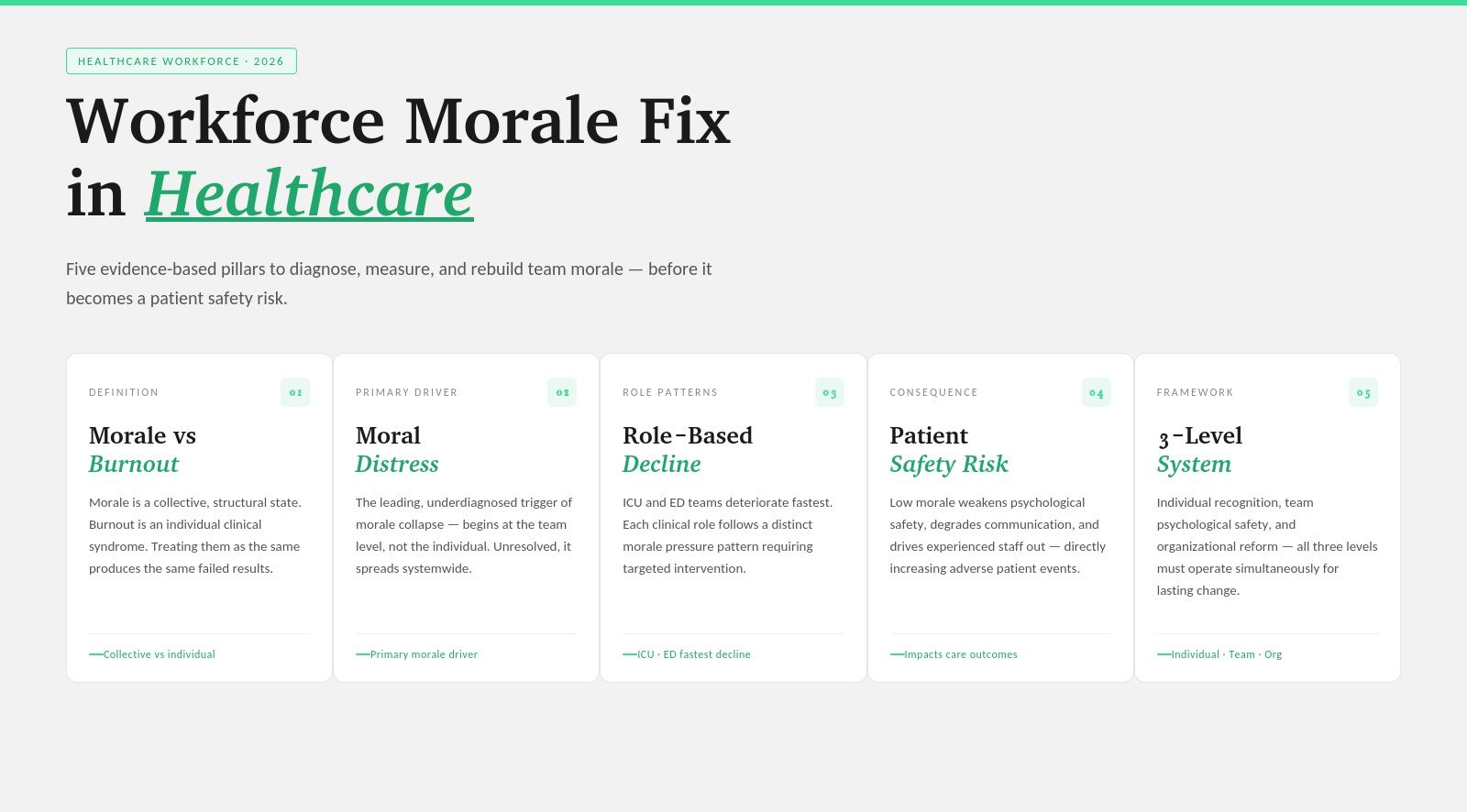
Workforce morale in healthcare isn't the same as burnout, and treating it the same way produces the same failed results. Morale is a collective state: it describes how a unit functions under pressure, how much institutional trust exists, and whether staff believe their work has an impact.
When it collapses, it does so through a predictable sequence, beginning with unresolved moral distress and ending in systemic disengagement that harms patients and organizations alike.
This guide names the 5 structural drivers of morale decline in healthcare and introduces a 3-level improvement system grounded in clinical reality.


- Morale and burnout are different — morale is collective and structural; burnout is individual and clinical
- Moral distress (acting against clinical values) is the primary, underdiagnosed driver of morale collapse in hospitals
- Morale declines at different rates across roles — ICU and ED deteriorate faster than administrative units
- Low morale is a patient safety issue, not just an HR problem
- Effective morale improvement operates at 3 levels simultaneously: individual recognition, team safety, and organizational structure
What is workforce morale in healthcare? (Not burnout)

Workforce morale in healthcare is the shared state of team confidence, trust, and energy. It reflects staffing, leadership clarity, communication, and the ability to deliver care consistently. In morale vs burnout healthcare, morale is collective and shifts quickly with conditions, while burnout is an individual clinical syndrome caused by prolonged stress.
Low morale appears as reduced initiative, weaker teamwork, rising absenteeism, and slower coordination. Moral distress can worsen it when clinicians cannot act on the right care decisions. Treating morale as burnout misses system issues, while ignoring burnout risks individual harm.
The moral distress-morale collapse model.
The Moral Distress–Morale Collapse Model is a 4-stage sequence showing how unresolved clinical conflict becomes systemic team disengagement.
Stage 1: Moral conflict
In moral distress healthcare, clinicians know the right action but cannot deliver it due to staffing limits, time pressure, or restrictive policies. Team members absorb this gap quietly. Job satisfaction begins to decline, and compassion fatigue starts building beneath routine clinical work.
Stage 2: Emotional withdrawal
When these situations repeat, staff begin to disengage to protect themselves. Nurse leaders notice reduced participation, lower trust, and minimal discretionary effort. Team morale weakens as employees stop believing the healthcare organization will address persistent issues affecting daily work.
Stage 3: Care quality slippage
As withdrawal spreads, coordination and communication begin to break down. Handoffs lose clarity, escalation slows, and teams miss critical information. This is where moral injury nursing becomes visible, increasing the risk of poor patient care and weakening work-life balance across teams.
Stage 4: System morale failure
Over time, these patterns normalize across units and departments. Expectations drop, and disengagement becomes embedded in daily work. Boosting morale becomes harder as trust declines. Healthcare leaders must enhance team morale by rebuilding credibility and restoring a healthy work-life balance.
The 5 structural drivers of healthcare morale decline

The five structural drivers of healthcare morale decline are moral distress accumulation, 24/7 shift fragmentation, leadership inconsistency, patient-load volatility, and recognition gaps in non-clinical roles.
1. Continuous care fragmentation across shifts (24/7)
Around-the-clock care creates disconnected workflows across shifts, teams, and departments. Team meetings rarely align across schedules, limiting shared context. This weak coordination creates poor morale, as team members feel unsupported and disconnected from decisions that impact daily care delivery.
2. Hierarchy-driven voice suppression
Strict hierarchies can limit open communication, especially for frontline staff. Psychological safety clinical gaps mean concerns go unspoken. When nurses feel valued less in decisions, nursing morale drops, and leaders lose early signals that could prevent larger operational and patient outcomes risks.
3. Patient-load volatility
Unpredictable patient volumes and acuity spikes stretch staffing beyond capacity. Without flexible work schedules or buffers, teams absorb constant pressure. This impacts mental health and well-being, leading to fatigue, errors, and a steady decline in engagement and performance.
4. Recognition and feedback gaps
When effort is not acknowledged consistently, employees disengage. Systems that fail to encourage employees or highlight contributions weaken a supportive work environment. Over time, this reduces employee retention as staff look for workplaces where their work feels seen and valued.
5. Leadership inconsistency
Variations in leadership style, communication, and follow-through create uncertainty. A healthy work environment depends on predictable leadership behavior. When expectations shift frequently, trust erodes, morale declines, and teams struggle to maintain alignment and consistent care standards.
Why morale declines differently across clinical roles.
Morale declines differently across clinical roles because workload intensity, decision-making control, and exposure to patient outcomes vary between ICU, ED, ward, allied health, and administrative teams.
- ICU teams, intensity-driven decline: ICU nursing teams work in high-stakes, continuous monitoring environments. Frequent exposure to critical outcomes impacts emotional load and decision-making processes. Even in a supportive environment, sustained pressure and limited recovery time can lower morale despite strong clinical skill development.
- Emergency departments, volatility pressure: ED teams face unpredictable inflow and constant prioritization. Staffing shortages and time-critical decisions create rapid stress cycles. Shift-based morale fragmentation is common, where morale fluctuates across shifts, making it harder for staff members to feel supported consistently.
- General wards, workload accumulation: Ward-based healthcare staff handle steady patient loads with administrative overlap. Over time, repetitive pressure without visible progress reduces engagement. Without systems to celebrate achievements or improve the work environment, morale declines gradually rather than suddenly.
- Allied health, recognition gaps: Allied roles often operate outside central clinical decision loops. Limited visibility in decision-making processes can reduce ownership. When contributions are not acknowledged, staff members may feel supported less, even when outcomes depend on their expertise and coordination.
- Administrative teams, indirect strain: Non-clinical staff support operational flow but are removed from patient interaction. When priorities shift frequently, clarity drops. Without a supportive environment and clear impact visibility, morale declines due to disconnect rather than direct clinical pressure.
How low morale flows into care quality.
Low morale directly affects patient care by weakening communication, coordination, and decision-making across teams. Morale as care infrastructure defines morale as a core system that enables safe communication and coordination. The morale care quality link shows how gaps in trust and clarity increase errors and disrupt outcomes for patients.
Communication failures contribute to 30% of malpractice claims, leading to 1,744 deaths and $1.7 billion in costs over five years.
- Low morale reduces psychological safety: When morale drops, nurses and team members hesitate to speak up. Concerns go unshared, especially during long hours. In a study of 526 nurses, higher psychological safety was linked to increased reporting of safety events and stronger teamwork behaviors that support patient safety.
- Psychological safety weakens communication: Without safety, communication becomes transactional. Handoffs lose clarity, updates get delayed, and assumptions increase. This affects the workday experience, where teams focus on getting through tasks instead of ensuring shared understanding across the team.

The key to improving workforce morale in healthcare organizations is not fixing individuals, but fixing the systems they work in.


- Communication gaps increase care errors: When information is incomplete or delayed, risks compound. Patients receive inconsistent care, and overall quality declines. Low morale amplifies this effect, especially in high-pressure units where quick, accurate communication is critical to outcomes.
- Care errors affect team stability: Repeated errors create stress, blame, and disengagement. Turnover rates rise as staff lose trust in the system. Preventing burnout becomes harder when teams operate in reactive mode without consistent support or recovery mechanisms.
- Breaking the cycle requires system fixes: Healthcare leaders must support teams through better communication systems, clear escalation paths, and realistic workloads. Strategies should provide opportunities for recovery, improve self-care practices, and rebuild morale to protect both staff and patient outcomes.
A 3-level morale improvement system.
A 3-level morale improvement system in healthcare includes individual recovery and recognition, team psychological safety and support, and organizational structural reform. In practice, hospitals applying structured engagement approaches have reduced RN turnover costs by $1.7 million while improving operating margins, showing how morale improvements translate into measurable outcomes.
How to measure workforce morale in healthcare.
Workforce morale in healthcare is measured using real-time indicators such as staff feedback, communication patterns, absenteeism trends, and team collaboration signals. These metrics reflect daily work conditions and help leaders identify risks early, before they impact care quality and patient outcomes.
- Real-time sentiment signals: Short, frequent check-ins help recognize early shifts in nurse morale in hospitals. These capture concerns, ideas, and uncertainty from healthcare staff in real time. Unlike annual surveys, they reflect the daily work experience and allow leaders to focus on immediate morale risks and emerging patterns.
- Communication and escalation patterns: Track how often teams raise issues, share ideas, or remain silent. A drop in open communication signals gaps in safety and trust. These patterns affect decision-making and coordination, offering insight into healthcare team morale decline causes across units and roles.
- Absenteeism and shift behavior trends: Sudden increases in callouts, shift swaps, or disengagement during work hours indicate declining morale. These behavioral trends often reflect deeper issues in culture, workload, and support. Over time, they directly affect operational stability and overall team performance.
- Peer support and collaboration signals: Observe how teams interact during high-pressure situations. Reduced collaboration or reluctance to assist others signals a morale decline. Strong peer support reflects a professional environment where staff feel safe, supported, and aligned in delivering consistent care across teams.
- Manager feedback and action closure rates: Measure how quickly leaders respond to concerns and close feedback loops. Delays create uncertainty and reduce trust. Consistent and visible action reinforces the importance of listening and supports healthcare staff morale improvement across departments.
Understanding these signals is essential, but measurement alone does not change outcomes. Leaders must translate insights into action and accountability. This is where a hospital workforce wellbeing strategy connects morale data to structured interventions that improve conditions, strengthen communication, and sustain performance over time.
For a deeper look at how to track engagement alongside morale, including survey cadence, metric frameworks, and benchmarking, see our guide on measuring workforce engagement in healthcare.
Conclusion
Improving workforce morale in healthcare organizations is critical to sustaining care quality, retaining talent, and maintaining operational stability. When morale declines, communication weakens, errors increase, and experienced staff leave. Addressing morale at a structural level helps leaders act early and prevent system-wide impact.
CultureMonkey enables organizations to capture real-time feedback, identify morale risks across teams, and act with clarity. Its platform helps leaders close feedback loops, improve communication, and build trust consistently.
By turning morale insights into action, CultureMonkey supports healthcare organizations in creating stable, high-performing environments where teams feel supported, and patient outcomes improve consistently across departments, shifts, and roles in complex healthcare systems.
FAQs
1. What causes low morale in healthcare organizations?
Low morale in healthcare organizations is caused by five structural drivers: moral distress accumulation, 24/7 shift fragmentation, leadership inconsistency, patient-load volatility, and recognition gaps in non-clinical roles. These system conditions reduce coordination, weaken trust, and disrupt consistent team performance.
2. How is moral distress different from burnout in healthcare?
Moral distress occurs when clinicians cannot act according to their clinical values due to constraints like staffing, hierarchy, or policy. Burnout is chronic individual exhaustion. Moral distress appears earlier and operates at the team level, while burnout reflects prolonged personal strain.
3. What strategies improve hospital workforce morale?
Effective strategies operate at three levels: individual (post-shift recovery blocks, micro-recognition loops), team (structured huddles, psychological safety protocols, peer support pairing), and organizational (staffing transparency dashboards, moral distress debriefs, leadership response SLAs). Single-level efforts fail to sustain improvement.
4. How does workforce morale affect patient care quality?
Workforce morale acts as a care infrastructure, shaping psychological safety and communication. Low morale reduces speaking up, degrades coordination, and increases cognitive load, leading to adverse events, medication errors, and higher readmission rates.
5. How do you measure morale in a hospital?
Morale in hospitals is measured through real-time sentiment checks, communication patterns, absenteeism trends, and peer collaboration signals. These indicators reveal breakdowns in trust, workload balance, and leadership response before they impact care quality and team performance.
6. What can healthcare leaders do this quarter to improve morale?
Leaders can implement three immediate actions: introduce post-shift recovery blocks, run structured team huddles to surface risks, and enforce response timelines for staff feedback. These steps improve trust, communication, and visible leadership accountability within one quarter.
7. Why does morale decline differently across clinical roles?
Morale declines differently because workload intensity, decision control, and exposure to patient outcomes vary across ICUs, EDs, wards, allied health, and administration. These differences shape how staff experience pressure, support, and recognition in daily work.
8. What is the fastest way to identify morale risks in hospitals?
The fastest way is through real-time pulse checks combined with communication and absenteeism signals. Sudden drops in speaking up, increased callouts, and reduced collaboration indicate early morale breakdown before it affects care quality.