


Reducing burnout in professional service teams guide

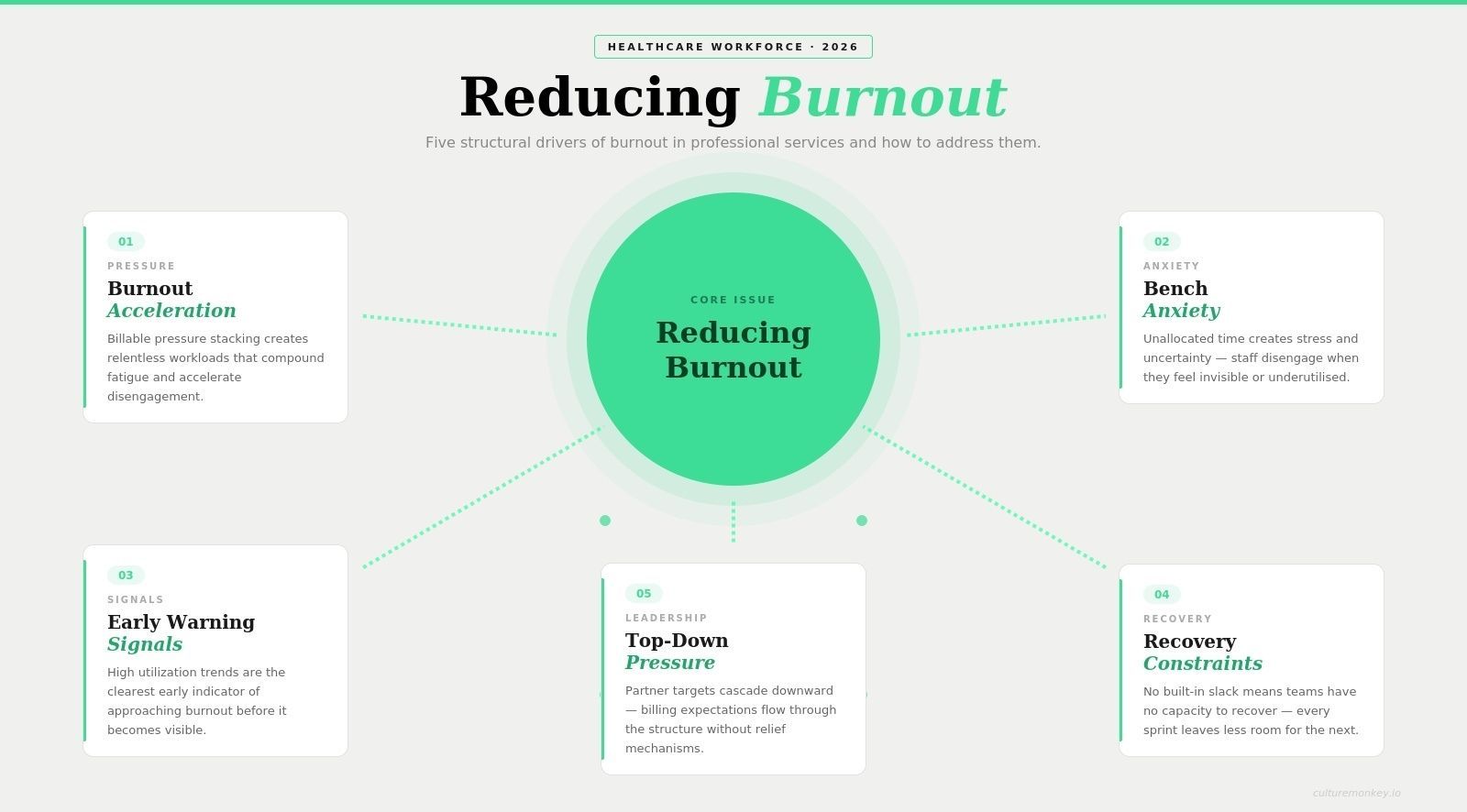
Reducing burnout in professional service teams requires addressing structural workload patterns, not isolated stress events. Burnout in professional services is driven by a compounding system where billable hour pressure, project-stacking, bench anxiety, and always-on client expectations continuously amplify strain across teams. This creates a delayed-visibility problem, where burnout signals appear in attrition data months after the peak stress period.
This guide introduces the Utilization-Burnout Acceleration Model and outlines a 4-stage burnout reduction framework designed specifically for professional service team dynamics.


- Utilization-Burnout Acceleration Model explains how billable pressure, project-stacking, and bench anxiety compound burnout in professional service teams.
- Bench anxiety is an underdiagnosed driver where unallocated time creates stress that generic wellness programs fail to address.
- Burnout signals appear first in utilization data, where sustained levels above 85% predict attrition risks weeks earlier.
- Recovery time is structurally blocked because billing models eliminate slack, requiring rest to be built into allocation systems.
- CultureMonkey helps professional service teams reduce burnout through continuous feedback, utilization insights, and early-warning data for proactive intervention.
What makes PS burnout structurally different

Burnout in professional services is structurally different because it is driven by utilization systems rather than isolated workload spikes. In professional services environments, billable hours, project delivery pressure, and client relationships combine to create sustained stress that accumulates over time rather than appearing as a single event.
Key structural differences
- Burnout in professional services is driven by billable hours and utilization rates, where employees are expected to consistently operate near maximum capacity across multiple projects.
- Professional services burnout prevention is harder because recovery time is not naturally built into the business model, forcing individuals to work more hours without structured breaks.
- High utilization burnout in professional services creates delayed warning signs, where employee burnout becomes visible only after productivity, engagement, and attrition are already affected.
- Burnout in audit and advisory teams often reflects competing priorities across clients, deadlines, and internal expectations, making stress accumulation harder to isolate.
| Factor | Professional Services | Other industries |
|---|---|---|
| Workload driver | Billable hour burnout consulting model | Task or output-based workload |
| Recovery time | Structurally constrained by utilization targets | Manager-controlled flexibility |
| Demand pattern | Client-driven variability across projects | Internal planning cycles |
| Visibility of burnout | Delayed signals in attrition and engagement | Immediate performance decline |
This structural model explains why reducing burnout in professional service teams requires system-level changes rather than individual stress management.
The utilization-burnout acceleration model
Burnout in professional service teams accelerates through a four-part sequence: billable hour pressure drives high utilization, project stacking adds cognitive overload, bench anxiety removes the recovery value of downtime, and always-on client expectations eliminate boundaries.
Each stage compounds the previous one, turning manageable stress into sustained organizational burnout risk. The Utilization-Burnout Acceleration Model maps this sequence so firms can intervene before attrition data reflects the damage. Here is the model breakdown.
Billable hour pressure
Billable hours create constant performance expectations, where employees feel pressure to maintain high utilization rates to justify value within the business. This pressure directly affects work-life balance and increases long hours across teams.
Project-stacking
Project managers often assign multiple concurrent responsibilities, leading to overlapping tasks and competing priorities that reduce focus and increase cognitive load.
Bench anxiety
Resource managers and employees experience stress during unallocated periods because being on the bench signals risk to job security, compensation, and future opportunities.
Always-on client expectations
Client relationships in professional services demand responsiveness beyond standard working hours, creating an environment where employees feel obligated to remain available continuously.

Employee burnout is not a workforce problem; it is an organizational design problem driven by how work is structured and managed.


Compounding effect
Billable hour pressure, project stacking, bench anxiety, and always-on client expectations do not act independently. Each force amplifies the others, creating a ripple effect where pressure builds across weeks, reducing recovery time and accelerating burnout risk across the entire professional services team.
Flow representation
The Utilization-Burnout Acceleration sequence in professional services follows this path: Billable pressure → Project stacking → Bench anxiety → Always-on expectations → Burnout acceleration. Each stage feeds the next, meaning intervention at any single point reduces but does not eliminate cumulative risk.
Bench anxiety: The underdiagnosed PS burnout driver
Bench anxiety is a professional services-specific burnout driver where unallocated time creates stress instead of recovery. In many firms, employees interpret bench periods as a threat to job stability rather than an opportunity for rest.
Why does bench anxiety happen
Bench anxiety exists because the professional services business model links value directly to billable utilization, making non-billable time feel unproductive and risky for individual employees.
What it looks like in Teams
Employees on the bench often increase internal visibility efforts, seek additional tasks, or accept suboptimal project assignments to avoid being perceived as underutilized.
Symptoms of bench anxiety
- Employees over-communicate progress and availability to project managers to maintain perceived value within the organization.
- Individuals accept additional projects even when already stretched, increasing stress and reducing overall productivity.
- Employees feel constant uncertainty about future assignments, affecting employee well-being and engagement levels.
- Bench periods fail to provide emotional support or recovery, leading to sustained burnout despite reduced working hours.
Bench anxiety explains why many firms fail to reduce burnout even when utilization temporarily decreases.
How burnout manifests differently by seniority level
Burnout manifests differently across seniority levels in professional services because responsibility, control, and expectations vary significantly between roles.
| Level | Burnout trigger | Behavioral signal | Risk outcome |
|---|---|---|---|
| Analyst | High workload and tight deadlines | Silent overwork and long hours | Early attrition |
| Manager | Coordination across projects without authority | Constant context switching | Chronic stress |
| Partner | Revenue pressure and client expectations | Always-on engagement | Strategic fatigue |
At junior levels, burnout is driven by workload and limited control over tasks. At mid-level roles, stress comes from managing projects and teams without full authority. At senior levels, pressure shifts to client relationships, revenue targets, and firm performance.
Addressing burnout requires role-specific strategies rather than a single organizational approach.
The 4-stage surnout reduction framework for PS firms
Reducing burnout in professional service teams requires four sequential interventions: detect early signals in utilization data, stabilize workload distribution, design structured recovery into project transitions, and redesign the systems that generate sustained pressure. Firms that address only one or two stages see temporary improvement. Durable reduction requires all four, applied at the organizational level. Unclear expectations and competing priorities.
The importance of this framework lies in helping employers move beyond surface-level solutions and build systems that enhance employee well-being, collaboration, and long-term success.
Stage 1: Detection
- Organizations must track utilization rates and identify sustained high workloads across teams to detect early burnout risk before it escalates.
- Managers should monitor warning signs such as declining productivity, reduced engagement, and changes in participation during ongoing conversations with employees.
- Early detection allows leaders to dig deeper into patterns affecting performance and address burnout before it impacts project delivery and retention.
Stage 2: Load stabilization
- Firms need to introduce clear limits on project stacking to reduce competing priorities and ensure employees are not consistently exceeding reasonable hours.
- Resource managers must actively manage workload distribution to create balance across projects, clients, and teams within the work environment.
- Stabilizing workloads helps employees stay engaged, improves collaboration, and reduces stress caused by constant context switching.
Stage 3: Recovery design
- Professional services business models often block recovery, so organizations must intentionally create structured downtime between projects.
- A supportive work environment that includes emotional support, open communication, and flexibility helps employees recover without fear of losing value.
- According to the World Health Organization, burnout is a workplace condition, reinforcing the importance of designing recovery into systems rather than relying on individuals.
Stage 4: System redesign
- Employers must align company culture and business strategy with sustainable ways of working to prevent burnout from recurring.
- Leaders should empower employees to manage workloads, set boundaries, and operate within clear limits across modern workplaces.
- System redesign addresses root challenges, enhances productivity, and creates conditions for long-term success across professional services organizations.
How to detect burnout before attrition data moves
Burnout in professional services can be detected early by tracking leading indicators rather than relying on lagging metrics such as attrition.
| Signal type | Indicator | Threshold | What it means |
|---|---|---|---|
| Utilization | Above 85% for 3 months | High | Sustained overload and burnout risk |
| Workload | Multiple concurrent projects | Medium | Cognitive overload |
| Behavior | Reduced participation and engagement | Early | Disengagement risk |
Leading firms focus on identifying burnout signals in utilization data, engagement scores, and behavioral patterns. These indicators provide a different story compared to traditional attrition data.
Early detection allows organizations to prevent burnout rather than react to its consequences.
Individual vs system-level burnout prevention in professional services
Burnout prevention in professional services typically falls into two categories: individual-level interventions and system-level interventions. Individual approaches focus on employee well-being through wellness programs, resilience training, and mental health support, while system-level approaches address structural drivers such as utilization rates, project stacking, and recovery design.
In practice, system-level interventions produce more sustainable outcomes because they reduce the root causes of burnout rather than placing the responsibility on individual employees to manage stress. This distinction is critical for organizations deciding how to reduce burnout without compromising productivity or client delivery expectations.
Individual-level vs system-level burnout prevention:
- Individual-level: Focuses on employee well-being through wellness programs, resilience training, and mental health support. It improves coping ability but does not change workload conditions driving burnout.
- System-level: Focuses on utilization rates, project stacking, and recovery design within the professional services business model. It reduces burnout at the source by fixing structural pressure across teams.
Measuring and reporting burnout risk to the partnership
Measuring burnout risk is critical for professional services leadership because burnout directly affects productivity, client outcomes, and business performance.
| Metric | What to track | Why it matters |
|---|---|---|
| Utilization variance | Fluctuation in billable hours | Identifies workload imbalance |
| Bench duration | Time between projects | Signals bench anxiety |
| Project overlap | Number of concurrent assignments | Indicates project stacking |
How to report to partners
- Present burnout risk using business impact language such as attrition cost, delivery delays, and reduced client satisfaction.
- Use trends instead of snapshots to show how burnout evolves over time across teams and projects.
- Link burnout data to outcomes such as employee engagement, productivity, and revenue impact.
Conclusion
Reducing burnout in professional service teams is critical because sustained pressure from billable hours, client demands, and competing priorities directly affects productivity, retention, and long-term business performance. Without structured intervention, burnout creates a ripple effect across teams, weakening collaboration and employee well-being.
CultureMonkey helps organizations address burnout by enabling continuous feedback, tracking early warning signs, and providing actionable insights at the team and manager level.By identifying risk patterns and improving ongoing conversations, CultureMonkey empowers leaders to build a supportive work environment, strengthen company culture, and implement data-driven strategies that reduce burnout and drive sustainable success.
“Last reviewed April 2024.”
FAQs
1. What causes burnout in professional services?
Burnout in professional services is caused by sustained high utilization, long working hours, billable hour pressure, and competing project deadlines. Bench anxiety during unallocated periods adds additional stress, creating a compounding cycle that standard wellness programs are not designed to address effectively.
2. How does billable hour pressure cause burnout?
Billable hour pressure causes burnout by requiring employees to sustain high utilization rates with little downtime. This constant expectation eliminates recovery windows, increases working hours, and creates chronic stress that compounds across project cycles until disengagement or attrition occurs across the team.
3. What are the early warning signs of burnout in PS teams?
Early warning signs of burnout in PS teams include declining engagement scores, reduced participation in team conversations, increased working hours, and withdrawal from collaboration. These signals appear in utilization and behavioral data weeks before they surface in attrition or performance review outcomes.
4. How do PS firms reduce burnout without reducing revenue?
PS firms reduce burnout without cutting revenue by capping project stacking, improving resource allocation, and designing structured recovery between assignments. Sustainable utilization targets, maintained below the 85% threshold, help preserve productivity while reducing the chronic stress that drives attrition and delivery risk.
5. How does bench anxiety contribute to burnout in professional services?
Bench anxiety contributes to burnout by turning unallocated time into a source of stress rather than recovery. Employees fear being seen as underutilized, so they accept unnecessary projects or overextend visibility efforts, which compounds fatigue and blocks the recovery needed to prevent long-term burnout risk.
6. Why is burnout harder to detect in professional services?
Burnout is harder to detect in professional services because it builds gradually through utilization patterns rather than single events. Visible signals like disengagement and attrition appear weeks after peak stress, while early behavioral changes stay hidden in daily performance and team participation data.
7. What role do managers play in preventing burnout in PS teams?
Managers prevent burnout in PS teams by monitoring workload distribution, enforcing reasonable utilization limits, and maintaining ongoing conversations with team members. Their visibility into project stacking and bench transitions gives them the earliest opportunity to intervene before stress becomes a chronic retention problem.
8. What is the Utilization-Burnout Acceleration Model?
The Utilization-Burnout Acceleration Model describes how billable hour pressure, project stacking, bench anxiety, and always-on client expectations compound sequentially to produce sustained burnout. It reframes PS burnout as a system failure driven by structural workload design rather than individual stress tolerance or personal resilience gaps.