



What is an employee engagement survey? A complete guide for HR and business leaders (2026)

An employee engagement survey is a structured tool that measures employee commitment, motivation, and alignment with business goals. For management teams, it converts workforce sentiment into measurable performance data.
Engagement levels often signal retention risk, productivity gaps, and leadership effectiveness before problems become visible. Without structured measurement, decisions rely on assumptions. With it, leaders gain early insight into what drives output, morale, and stability.
Engagement is not a soft metric; it is a business indicator. When treated seriously, it supports smarter workforce planning and stronger execution. If performance matters, engagement measurement cannot be optional. Let’s unpack how it works and why it matters.


- Employee engagement surveys measure commitment to predict retention and performance.
- Unlike satisfaction surveys, engagement links directly to measurable business outcomes.
- Effective strategies combine annual, pulse, lifecycle, and continuous listening into governance frameworks.
- Engagement data creates impact through manager-led action, transparent communication, and tracking.
- Organizations treating engagement as a performance metric achieve stronger retention and productivity growth.
What is an employee engagement survey and why does it matter for business performance?

Employee engagement surveys turn employee sentiment into measurable business intelligence. For leaders asking what an employee engagement survey is, it’s a structured workforce engagement measurement that highlights retention risk, productivity gaps, and performance trends.
The engagement survey's purpose is to surface issues affecting commitment and output early, so strategy, budgets, and leadership decisions are based on data, not assumptions.
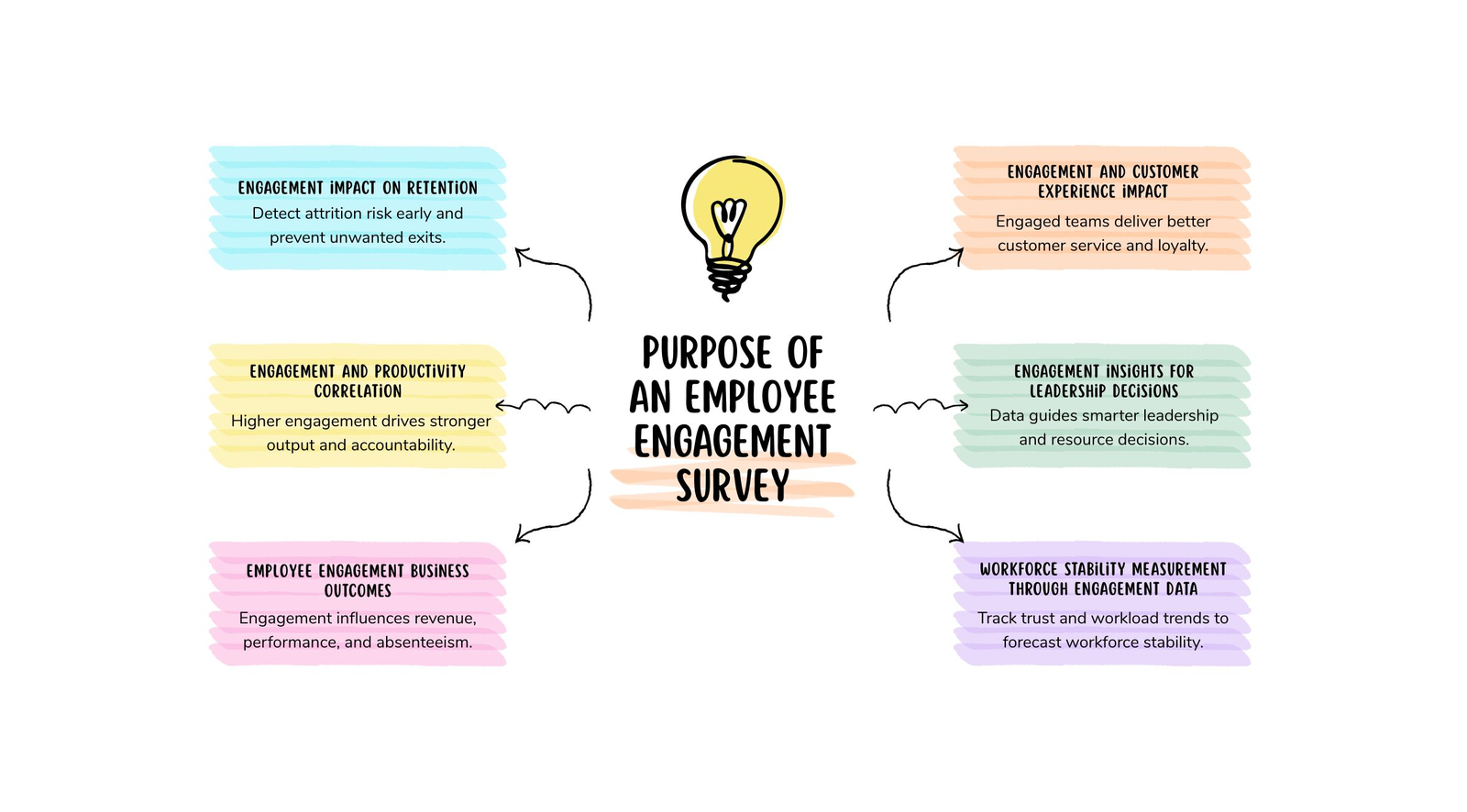
1. Engagement impact on retention
High engagement scores consistently correlate with lower voluntary attrition. Through structured employee commitment measurement, organizations identify early disengagement signals declining trust in leadership, unclear role expectations, or limited growth perception.
Analyzing survey data also helps organizations identify specific areas for improvement in the employee experience, allowing them to address issues that may contribute to attrition. This predictive visibility strengthens long-term workforce planning and reduces replacement costs.
2. Engagement and productivity correlation
Employee engagement surveys help organizations identify factors that contribute to a productive work environment, enabling targeted interventions to boost productivity. Employees who report clarity, recognition, and alignment with company goals typically demonstrate higher discretionary effort.
Engagement metrics often align with output per employee, quality benchmarks, and project delivery timelines. By capturing employee motivation insights, organizations can identify which departments or roles face performance drag due to disengagement.
3. Employee engagement business outcomes
The organizational performance impact of engagement surveys shows up in multiple KPIs: revenue per employee, innovation rates, absenteeism, and internal mobility. Engagement results provide executives with quantified drivers of performance rather than assumptions about morale.
It clarifies whether strategy execution gaps stem from structural issues, leadership effectiveness, or workforce sentiment, much like a focused culture index survey does for organizational culture. These valuable insights help inform action plans that address employee feedback and improve workplace culture.
4. Engagement and customer experience impact
Engaged employees are more likely to deliver exceptional service, which can lead to increased customer loyalty and improved business performance. Teams with higher engagement tend to demonstrate better responsiveness, ownership, and service quality.
Organizations tracking both engagement and customer satisfaction frequently find that improvements in engagement precede improvements in customer metrics. This reinforces the broader organizational performance impact of engagement data.
5. Engagement insights for leadership decisions
Engagement surveys provide structured employee motivation insights that inform leadership behavior and communication strategy, especially when complemented by focused manager feedback survey questions that assess leadership effectiveness from the team’s perspective. The leadership team plays a critical role in analyzing survey results and driving organizational change based on employee feedback.
This supports evidence-based decisions around policy changes, workload adjustments, leadership development, and resource allocation.
6. Workforce stability measurement through engagement data
Engagement results function as an early indicator of workforce stability. Trends in trust, workload sustainability, and recognition directly influence attrition risk. Through systematic employee commitment measurement, HR teams quantify the strength of the retention and engagement connection across business units.
Over time, this builds a predictive model linking engagement trends to stability forecasts.
How do engagement surveys differ from employee satisfaction surveys?
When leaders understand the engagement survey purpose clearly, they treat it as a governance mechanism rather than an HR formality.
Employee engagement surveys and employee satisfaction surveys are often used interchangeably, but they measure different workforce realities. The employee engagement survey definition centers on commitment, contribution, and alignment with company goals. Satisfaction surveys measure comfort and workplace contentment.
What are the core dimensions measured in employee engagement surveys?

We analyzed enterprise and SME engagement frameworks and identified six core dimensions consistently measured in structured workforce engagement measurement systems.
A well-designed employee survey is essential for gathering feedback across these key areas to drive meaningful improvements in engagement, communication, and overall workplace culture.
1. Leadership trust and communication measurement
- We examined how surveys measured transparency, credibility, and consistency of leadership messaging.
- We found that trust scores strongly influenced employee commitment measurement and retention forecasting, especially where surveys surfaced early signs of bad leadership impacting attrition.
- We observed that communication clarity directly affected employee motivation, insights, and strategic alignment. Constructive feedback from employees, supported by well-designed feedback mechanisms in the workplace, helps leaders improve their communication strategies and build trust.
2. Role clarity and Career growth perception
- We reviewed survey models assessing clarity of responsibilities and expectations.
- We noted that unclear roles weakened the workforce productivity link by reducing accountability.
- We identified growth perception as a major driver within the retention and engagement connection. Providing clear career development opportunities is essential for boosting employee engagement and retention.
3. Employee recognition and Value perception
- We evaluated how recognition frequency and fairness were measured, including the use of structured employee awards programs to celebrate individual and team achievements.
- We found recognition scores closely tied to employee motivation insights and discretionary effort.
- We observed measurable organizational performance impact where recognition aligned with performance outcomes.
- Effective recognition programs, including consistent employee shout-outs that reinforce positive culture, contribute to a motivated workforce, which drives higher engagement and performance.
4. Team collaboration and Workplace environment
- We assessed collaboration metrics, cross-functional support, and psychological safety indicators, often through targeted team collaboration survey questions.
- We found strong correlation between collaboration scores and workforce engagement measurement stability trends.
- We noted that healthy team dynamics strengthened the workforce productivity link across departments, and leaders often use curated teamwork quotes to motivate and unite employees around shared goals.
- Strong team collaboration and support are key components of a positive workplace culture, which enhances employee engagement and can be reinforced through creative team theme ideas that increase collaboration and depend heavily on healthy team dynamics in the workplace.
5. Workload sustainability and Well-being
- We analyzed workload balance, burnout risk indicators, and support systems, noting that a lack of support at work can trigger multiple negative effects on well-being and engagement.
- We observed that unsustainable workloads weakened employee commitment measurement and increased attrition signals.
- We identified workload balance as a critical predictor within the retention and engagement connection.
- Promoting work-life balance is crucial for maintaining employee well-being and sustaining high engagement levels, and real-world examples from companies with the best work-life balance and additional work-life balance examples to improve productivity show how this directly supports retention and performance as part of building a positive work environment.
6. Engagement drivers influencing retention
- We reviewed composite engagement indices combining trust, clarity, recognition, and growth.
- We found that these drivers collectively defined the engagement survey purpose in strategic planning.
- We confirmed that high composite engagement scores consistently demonstrated measurable organizational performance impact and improved workforce stability.
- Improving employee engagement surveys helps organizations identify and address key drivers to enhance retention and workforce stability.
Across all six dimensions, we found that engagement surveys moved beyond sentiment tracking. They structured employee commitment measurement, generated employee motivation insights, and strengthened the workforce productivity link, making them foundational to performance strategy rather than simple feedback tools.
What are the types of employee engagement surveys organizations can use?

1. Annual engagement surveys
Annual engagement surveys are comprehensive organization-wide assessments conducted once per year. We evaluated them as foundational workforce engagement measurement frameworks that establish baseline engagement benchmarks and long-term trends.
Best for: Enterprises and growing SMEs building structured employee commitment measurement systems.
Pros
- Strong organizational performance impact visibility supported by creative employee engagement activities and structured employee engagement workshops to elevate workplace culture, tailored to different work setups
- Deep employee motivation insights
- Well-designed surveys promote higher survey completion and meaningful feedback
Cons
- Limited agility; issues may surface too late
- May contribute to survey fatigue if questionnaires are lengthy
- May encourage overreliance on annual averages instead of driver trends
Who is it for: Organizations needing strategic workforce diagnostics.
Why we picked it: Provides the most comprehensive employee engagement survey definition baseline.
2. Pulse surveys
Pulse surveys combine short, recurring check-ins with lifecycle and topic-based surveys to create ongoing feedback systems. We tested them as modern engagement governance frameworks that can be reinforced by a planned employee engagement calendar of initiatives and listening touchpoints.
Pulse surveys are essential for improving employee engagement over time, as it enables organizations to track engagement trends, make data-driven decisions, and implement targeted initiatives, including fun employee engagement questions that boost morale, that can be scheduled and monitored through an employee engagement calendar.
Best for: Organizations seeking sustained retention and engagement connection monitoring.
Pros
- Early disengagement detection
- Consistent organizational performance impact monitoring
- Supports improving employee engagement through ongoing feedback
Cons
- Requires data governance discipline
- May create survey fatigue if run too frequently
Who is it for: Data-driven HR and leadership teams.
Why we picked it: Creates proactive engagement oversight rather than periodic review, and is vital for improving employee engagement over time.
3. Lifecycle employee feedback surveys
Lifecycle employee feedback surveys capture engagement data at key employment stages, onboarding, promotion, role change, and exit. We reviewed them as targeted employee commitment measurement tools.
Best for: Organizations analyzing attrition patterns and workforce stability.
Pros
- Identifies stage-specific disengagement
- Strengthens workforce planning
- Acting on feedback from lifecycle surveys helps build employee buy in and trust in organizational processes
Cons
- Requires structured HR process integration
- May overlook real-time engagement shifts between lifecycle events
Who is it for: HR teams optimizing talent lifecycle strategy.
Why we picked it: Connects engagement survey purpose directly to retention forecasting.
4. Topic-specific engagement surveys
Topic-specific engagement surveys focus on targeted issues such as leadership trust, workload sustainability, or recognition. We analyzed them as intervention-driven engagement tools.
Best for: Organizations addressing specific engagement drivers.
Pros
- Highly actionable
- Provides actionable feedback that can be used to address targeted engagement challenges
- Quick deployment
Cons
- Limited broad engagement context
- May overlook broader engagement drivers outside the selected topic
Who is it for: Teams solving defined engagement challenges.
Why we picked it: Enables precise corrective action.
How can organizations convert engagement insights into action plans in 2026?

Employee engagement surveys provide actionable insights that inform the development of a detailed action plan to address workplace challenges and improve organizational culture.
Drive employee buy-in by sharing survey insights, outlining clear steps with manager ownership, and tracking progress by aligning with your article's action planning and execution discipline for sustained gains.
1. Manager action planning from engagement results
Manager ownership remains the strongest predictor of engagement improvement.
Structured approach:
- Team-level dashboards with driver analysis
- Facilitated review within 2 weeks of results
- 2–3 focused priorities per quarter
- Written commitments shared with teams
- Emphasize gathering actionable feedback from engagement surveys to help managers prioritize and implement effective changes
Design principles:
- Prioritize controllable drivers (workload clarity, recognition, communication)
- Focus on actionable feedback to ensure insights lead to tangible improvements
- Avoid broad culture initiatives at team level
- Track progress in quarterly pulses
2. Engagement result communication practices
Transparent communication strengthens trust and future participation. Deloitte's 2025 Gen Z and Millennial Survey shows organizations closing feedback loops achieve significantly higher survey response consistency.
Effective model:
- Enterprise summary within 2 weeks
- Department-level breakdowns
- Clear “Top 3 priorities” announcement
- Quarterly status updates
Communication structure:
- What we heard
- What we will address
- What we cannot change (with explanation)
Clarity reduces skepticism and increases engagement with future surveys. When organizations communicate transparently and take visible action based on survey results, employees feel heard and valued.
3. Engagement improvement program execution
Sustained engagement gains require formal governance.
Execution framework:
- Dedicated engagement program owner
- Cross-functional action council
- Defined KPIs (eNPS, morale index, retention risk)
- Executive-level dashboard reviews
A disciplined approach to engagement program execution supports continuous improvement and long-term organizational success, especially when supported by tools such as employee engagement activities presentations that help communicate and align initiatives.
4. Tracking engagement improvements over time
Continuous tracking validates whether interventions are working. AIHR's 2026 Workforce Analytics Trends report states quarterly pulse users detect engagement shifts significantly faster than annual-only survey models through continuous monitoring. This supports your article's pulse survey benefits for early interventions and progress tracking.
Best practices:
- Track driver-level movement, not only overall score
- Segment by tenure, department, and performance band
- Compare engagement data with attrition and productivity metrics
- Identify persistent low-variance areas
- After conducting a survey, analyze the data to identify trends and insights that can inform action plans. Analyzing employee engagement survey results involves looking for trends, identifying areas of concern, and recognizing standout successes.
Core metrics used:
- Engagement index
- eNPS
- Burnout risk indicator
- Voluntary attrition rate
Longitudinal tracking prevents temporary perception spikes and ensures sustainable improvement.
5. For decision-makers
If engagement efforts are not producing results, reassess manager accountability, priority focus, and tracking cadence. Limit actions to controllable drivers and link them to retention and productivity metrics. Ensure executive visibility into progress. Engagement drives performance only when leaders own outcomes, not when it remains an HR reporting activity.
Focusing on actionable steps and targeted interventions is essential to improve engagement and achieve desired business outcomes.
.webp)
Build a Culture of Trust, by People Science Backed Data
- Multi lingual Surveys
- White Glove Onboarding
- People Science Backed Reports
- Enterprise Grade Security
Conclusion
Employee engagement surveys should serve as a workforce decision system, not a reporting exercise. Organizations that embed engagement insights into culture development and leadership planning see more consistent performance outcomes.
- Best overall: Structured feedback-to-action frameworks with executive accountability and continuous tracking.
- Best for SMEs: Focused engagement-led retention strategies driven by manager ownership and clear priorities.
- Best for Enterprises: Continuous employee listening culture adoption supported by engagement automation platforms such as CultureMonkey.
CultureMonkey helps organizations turn engagement insight into measurable progress. With pulse surveys, lifecycle feedback, anonymous listening channels, AI-powered analytics, and real-time dashboards, it enables leaders to track trends, prioritize action, and strengthen workplace culture.
Book a demo with CultureMonkey.
FAQS
1. What is an employee engagement survey?
An employee engagement survey measures employees’ commitment, motivation, and alignment with organizational goals. It identifies drivers such as leadership effectiveness, workload balance, recognition, and growth opportunities. Leaders use the results to guide action, improve retention, and strengthen workplace culture.
2. How often should engagement surveys run?
Engagement surveys should combine annual deep assessments with quarterly or monthly pulse surveys. Annual surveys set baseline engagement and key drivers, while pulse surveys track progress, detect burnout risk, and validate actions. The right cadence balances insight with the organization’s ability to respond and avoids survey fatigue.
3. What questions appear in engagement surveys?
Engagement surveys include questions on overall engagement, manager support, role clarity, workload, recognition, growth opportunities, leadership communication, and inclusion. Most use Likert scale questions such as strongly agree to strongly disagree, along with open-ended questions to capture deeper employee feedback.
4. What’s the difference between engagement and satisfaction surveys?
Employee engagement surveys measure emotional commitment, discretionary effort, and alignment with organizational goals. Satisfaction surveys assess short-term contentment with pay, benefits, or workplace conditions. Engagement predicts retention and performance, while satisfaction reflects how comfortable employees feel in their roles.
5. Can engagement surveys reduce turnover?
Engagement surveys can reduce turnover when paired with clear action plans. They identify drivers such as career stagnation, workload imbalance, and low manager support that increase attrition risk. Targeted interventions based on survey insights help lower voluntary exits and improve workforce stability.
6. How long should engagement surveys be?
Annual engagement surveys typically include 30 to 60 focused questions and take 15 to 25 minutes. Pulse surveys should include 5 to 10 key driver questions and take under five minutes. Keeping surveys concise improves participation, boosts completion rates, and increases the likelihood that results lead to meaningful action.
7. Are engagement surveys anonymous?
Engagement surveys can be anonymous or confidential. Anonymous surveys protect employee identity and encourage honest feedback, though they limit individual follow-up. Ensuring anonymity creates a safe environment for employees to share concerns and surface sensitive issues without fear of consequences.
8. Who should access engagement survey results?
Enterprise leaders and HR teams should access organization-wide engagement insights, while managers review team-level results to build action plans. Individual responses must remain confidential. Role-based access controls protect privacy, maintain trust, and ensure engagement data is used responsibly to drive targeted action.
9. Can engagement surveys predict attrition?
Engagement surveys can help predict attrition when combined with workforce data. Declines in engagement, eNPS, or manager effectiveness often signal turnover risk. Linking survey drivers with tenure and performance data improves prediction accuracy and supports targeted retention strategies.
10. What tools help run engagement surveys effectively?
Engagement survey platforms streamline data collection, driver analytics, and action tracking. Solutions like CultureMonkey’s employee engagement platform integrate with HRIS systems, support anonymous feedback, and provide dashboards for managers, and can complement other anonymous feedback collection tools available online.



)