


Lifecycle employee feedback in manufacturing: A practical guide to listening across the factory employee journey (2026)

Lifecycle employee feedback in manufacturing is no longer optional for leaders managing complex plants, rotating shifts, and safety-critical operations. If you only collect feedback once a year, you are operating with blind spots.
Workforce sentiment changes during hiring, onboarding, training, role transitions, safety incidents, and exits. Without structured listening across each stage, small concerns escalate into attrition, safety risks, and disengagement.
Lifecycle employee feedback in manufacturing creates consistent checkpoints from entry to exit. It gives plant leaders real-time insight into morale, communication gaps, supervision quality, and workload pressure, helping management act early rather than react late.


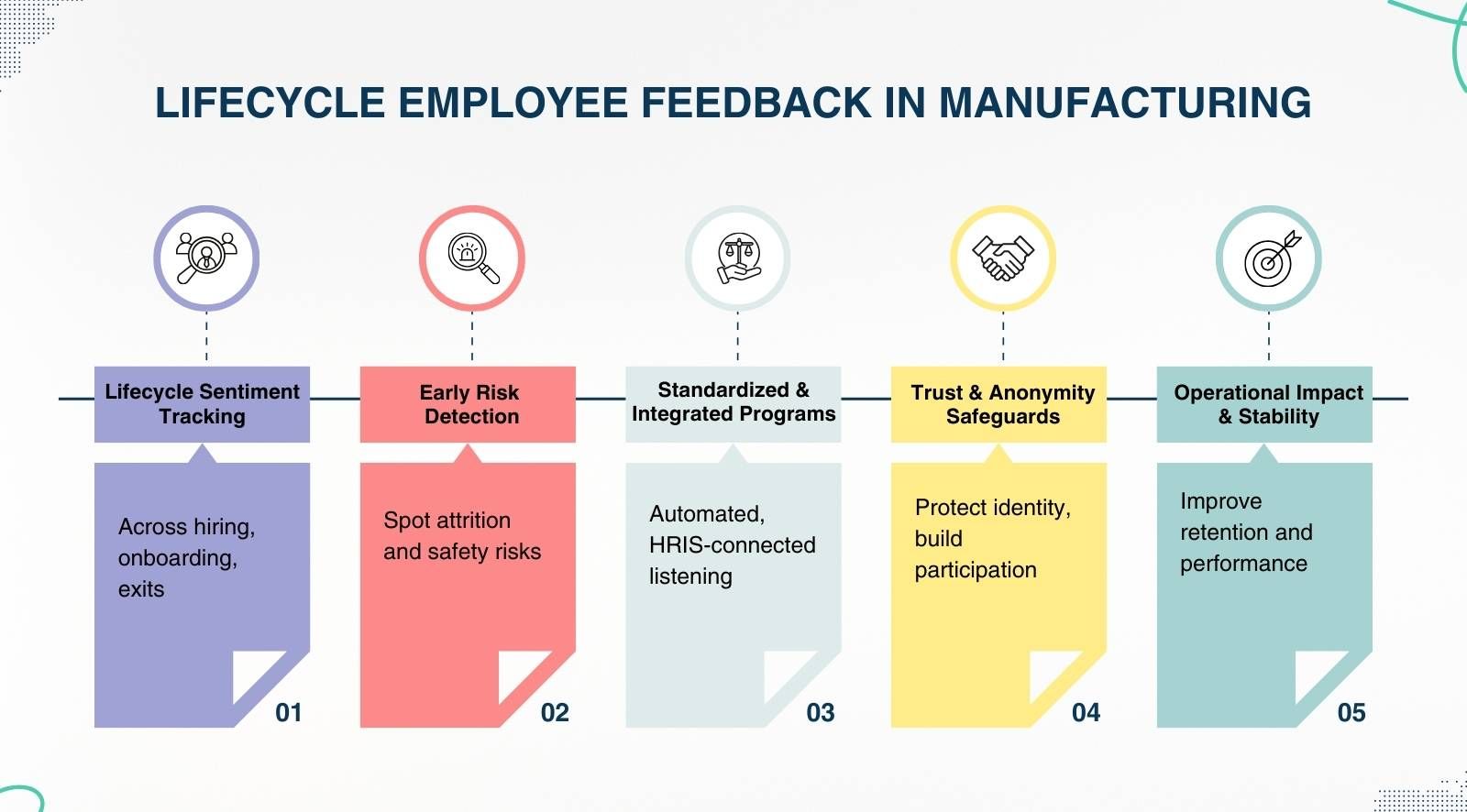
- Lifecycle employee feedback in manufacturing tracks workforce sentiment across hiring, onboarding, role changes, and exits to reduce blind spots.
- Structured listening at key lifecycle stages helps detect attrition, safety, and engagement risks early.
- Standardized, automated, and HRIS-integrated programs enable consistent feedback across plants and shifts.
- Trust, anonymity safeguards, and visible action drive honest participation and better data quality.
- Acting on lifecycle insights improves retention, safety performance, supervisor effectiveness, and overall operational stability.
Why lifecycle feedback matters in manufacturing workforces

Manufacturing plants operate across shifts, roles, and safety-sensitive environments where workforce sentiment changes quickly. Lifecycle employee feedback ensures engagement, retention, and satisfaction are tracked consistently, preventing small concerns from escalating into attrition, safety risks, or productivity decline.
- High early attrition among factory hires: When the onboarding process lacks structured employee lifecycle survey checkpoints, employees feel uncertain about expectations. Without meaningful feedback in the first 90 days, employee feedback plays little role in clarifying confusion, affecting employee retention, and shaping the long-term employee experience.
- Workforce fatigue across production cycles: Peak demand periods strain morale and workplace culture. If an employee's listening strategy does not capture employee satisfaction during intense cycles, employees feel overlooked, reducing employee engagement and increasing turnover risk across the employee lifecycle.
- Shift and role adjustments affecting morale: Frequent redeployments disrupt clarity and stability. Targeted employee feedback at transition points helps employees feel valued, improves employee experience, and ensures employee engagement remains consistent across changing roles within the employee lifecycle.
- Contract and seasonal workforce movement: Temporary staffing patterns fragment workplace culture. A structured employee lifecycle survey approach gathers employee feedback from contract workers, helping employees feel included and strengthening employee retention during fluctuating production demands.
- Loss of skilled labor due to retirement or turnover: When experienced operators exit without documented employee feedback, institutional knowledge leaves with them. A continuous employee listening strategy captures meaningful feedback earlier, improving employee satisfaction and protecting long-term employee retention.
Where manufacturing workforce drop-off happens across the employee lifecycle

Workforce drop-off in manufacturing rarely happens randomly. It typically occurs at predictable lifecycle stages such as onboarding, role transitions, supervision changes, and exits. Identifying these risk points early allows leaders to intervene before disengagement becomes turnover.
- First 90 days of employment: Early stages shape how employees form opinions about workplace culture and leadership credibility. Without a lifecycle survey during onboarding, employee input stays hidden, employee concerns grow quietly, and employees respond by disengaging before employee productivity stabilizes.
- Shift or line assignment changes: When employees evaluate new schedules or line pressures, stress spikes quickly. A continuous feedback loop during transitions gathers valuable insights, helps leaders apply best practices, and ensures existing employees feel heard rather than sidelined.
- Skill training and certification stages: Training milestones influence how employees form long-term commitment. Continuous feedback during certification captures employee input on clarity and support, surfaces employee concerns early, and protects employee productivity before frustration leads to preventable exits.
- Supervisor or leadership transitions: Leadership shifts disrupt trust faster than policy changes. A structured lifecycle survey during management changes helps employees respond constructively, provides valuable insights, and reduces rumor-driven uncertainty that weakens the employee journey.
- Role changes and promotions: Promotions reshape expectations and peer dynamics. Continuous feedback ensures employees evaluate workload realistically, share employee concerns openly, and maintain employee productivity instead of silently struggling through new responsibilities.
- Contract completion or seasonal exits: Temporary roles influence how employees form lasting impressions. Well-timed exit surveys generate valuable insights, strengthen best practices for rehire pipelines, and close the continuous feedback loop for both contract and existing employees.
Key lifecycle feedback moments in manufacturing operations
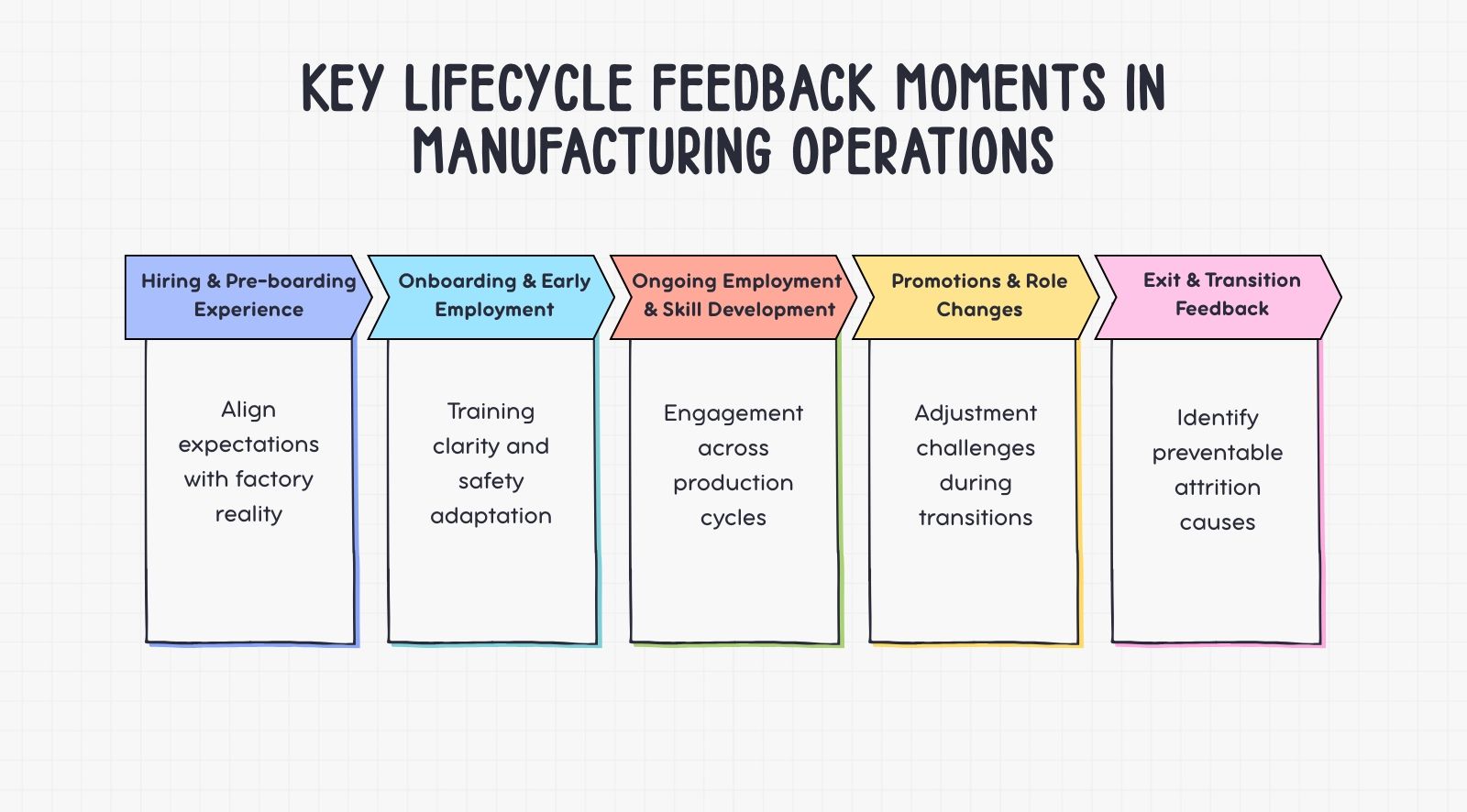
Lifecycle feedback in manufacturing must align with operational milestones. Hiring, onboarding, skill development, promotions, and exits represent structured listening points where employee sentiment shifts. Formalizing these checkpoints enables proactive workforce management instead of reactive retention efforts.
1. Hiring and pre-boarding experience
The hiring process shapes first impressions long before day one. Early engagement surveys capture constructive feedback on clarity, role expectations, and workplace safety messaging, giving manufacturing companies employee insights that strengthen organizational success before assembly line workers even start.
2. Onboarding and early employment
The first 90 days influence how assembly line workers adapt to systems and supervisors. A structured feedback loop during training gathers employee insights, improves workplace safety understanding, and supports operational efficiency before confusion impacts business performance.
3. Ongoing employment and skill development
During steady production cycles, engagement surveys reveal how employees decide to commit long-term. Continuous survey analytics convert constructive feedback into action, helping manufacturing organizations sustain operational efficiency and protect organizational success.
4. Promotions or role changes
Transition periods test confidence and clarity. Targeted engagement surveys during responsibility shifts provide employee insights, maintain workplace safety standards, and keep business performance stable while employees adjust to new expectations.
5. Exit and transition feedback
Departing employees often share the most honest, constructive feedback. Structured exit conversations and survey analytics close the feedback loop, giving manufacturing companies clear signals to strengthen workplace safety, operational efficiency, and long-term organizational success.
How to build a lifecycle feedback program across manufacturing plants
A scalable lifecycle feedback program requires standardized triggers, automation, and measurable reporting across all plants. Without structural alignment, feedback remains inconsistent. Integrating surveys with HR systems ensures continuous listening and actionable insights across locations.
- Standardize feedback triggers across plants: Define clear listening moments tied to hiring, role changes, safety protocols, and career growth. When plants follow shared triggers, new employees and existing teams experience consistent pulse surveys, enabling comparable key insights across diverse work environments.
- Automate lifecycle listening points: Use HR systems to trigger pulse surveys and training surveys automatically at defined milestones. Automation helps gather feedback in real time, supports continuous improvement, and ensures competitive benefits remain aligned with employee expectations.
- Integrate with HRIS employee events: Connect promotions, transfers, and exits to structured listening workflows. This integration captures key insights from new employees and experienced staff, strengthening team collaboration and improving safety protocols across locations.
- Track employee journey metrics over time: Measure response trends, engagement shifts, and feedback themes plant by plant. Longitudinal data from pulse surveys highlight continuous improvement opportunities and guide decisions around career growth and competitive benefits.
- Align lifecycle feedback with HR workflows: Embed training surveys and feedback checkpoints into onboarding, certification, and leadership programs. When feedback loops support team collaboration and diverse work environments, organizations convert insights into practical safety protocols and sustained performance gains.
Capturing feedback from contract, seasonal, and temporary workers
Contract and seasonal workers significantly impact production continuity in manufacturing plants. Excluding their voice creates blind spots in workforce strategy. Structured listening at defined moments ensures short employment cycles still generate actionable insights for retention planning.
- Temporary worker disengagement risk: Short-term staff often hesitate to speak up without ongoing dialogue. When employees understand their voice matters, discretionary effort rises. Ignoring these key moments weakens the organization's culture and disrupts team dynamics across mixed employment models.
- Short employment cycles limit insights: Compressed tenures mean feedback windows close quickly. Structured listening at key moments ensures employees leave behind actionable insights instead of silent exits, helping many organizations strengthen team dynamics before turnover patterns escalate.
- Vendor-managed workforce feedback gaps: Third-party staffing layers dilute accountability for listening. Without direct ongoing dialogue, employees understand little about expectations, and the organization's culture feels fragmented, reducing discretionary effort across blended teams.
- Inclusion challenges across contract labor: Temporary workers often feel peripheral to core operations. Embedding feedback at key moments fosters ongoing dialogue, improves team dynamics, and ensures employees leave with clarity rather than unresolved concerns.
Ensuring trust and participation in lifecycle feedback programs
Participation in lifecycle feedback programs depends on credibility and confidentiality. Employees respond honestly only when data protection and transparency are clear. Visible follow-through on results reinforces trust and strengthens engagement across manufacturing environments.
- Confidential data handling: Employees share honest feedback only when identity protection is clear and enforced. Secure systems, limited access by the hr team, and strict data controls reduce fear of exposure and protect the work environment from retaliation concerns.
- Aggregated reporting methods: Reporting trends instead of individual comments encourages open communication. When survey types present insights in grouped formats, employees understand that their voice contributes to overall productivity without singling anyone out.
- Transparent result sharing: Participation increases when leaders openly discuss findings from engagement surveys and exit interviews. Clear communication about themes and next steps shows employees that their feedback has a direct impact on decisions affecting the work environment.
- Visible improvement actions: Employees disengage when surveys feel repetitive and inactive. Demonstrating real changes after a single survey builds credibility, strengthens open communication, and reinforces that feedback directly influences overall productivity.
- Protection from supervisor identification: In small teams, anonymity risks are higher. Safeguards that prevent managers from tracing responses reassure employees, support open communication, and preserve trust within the work environment.
How to analyze lifecycle feedback across plants and roles
Lifecycle feedback must be segmented across plants, supervisors, tenure groups, and roles to uncover real patterns. Aggregated averages hide risk signals. Structured analysis connects workforce sentiment with retention, onboarding success, and operational performance outcomes.
- Detect early attrition patterns: Track drop-offs by tenure, shift, and team to spot repeat churn signals. Compare themes from new hires across various stages to identify areas where job satisfaction dips early, before exits become a pattern.
- Compare onboarding success across plants: Benchmark the onboarding experience using the same measures everywhere. When one site scores lower, drill into training clarity, supervisor support, and role fit issues that affect new hires quickly.
- Identify supervisor impact on retention: Segment scores by manager and team, then validate with comments. Weak coaching during market changes often shows up as confusion, low job satisfaction, and faster exits, especially among new hires.
- Track role transition success rates: Monitor feedback after promotions, transfers, and new responsibilities. If job satisfaction drops post-move, identify areas like unclear expectations, workload imbalance, or missing support during various stages of the change.
- Link lifecycle insights to productivity and turnover metrics: Connect feedback trends to attendance, safety incidents, and throughput shifts. This helps identify areas where market changes, onboarding experience gaps, or new responsibilities drive turnover before operations feel the hit.
Turning lifecycle feedback into workforce retention improvements

Retention improves when lifecycle feedback drives targeted action. Addressing onboarding gaps, supervision quality, workload balance, and career clarity converts insight into measurable workforce stability across shifts and plants.
- Improve onboarding training and safety readiness: Tighten day-one training with clear job demos, buddy support, and safety checks. Use early lifecycle feedback to spot confusing steps fast. When new hires feel confident and safe, they ramp quicker and stay longer.
- Strengthen supervisor coaching: Treat frontline leaders as retention owners, not messengers. Coach them on daily check-ins, fair workload calls, and quick issue follow-up. When feedback points to a team hotspot, fix the manager's habits first, then weekly re-measure.
- Improve scheduling and workload balance: Use lifecycle feedback to pinpoint where overtime, rotation gaps, or break coverage feels unfair. Compare signals by shift and line. Small scheduling tweaks, explained plainly, reduce fatigue spikes that drive transfers and exits.
- Clarify career and skill progression paths: Map what good looks like for each role, the skills to earn, and the steps tied to them. Ask for feedback after certifications and role moves. Clear paths turn “stuck” feelings into next steps.
- Address recurring workforce concerns: Group themes that keep showing up, then pick one fix per plant per month. Share what changed, who owns it, and by when. This closes the loop, builds trust, and lifts retention without launching another survey.
CultureMonkey’s lifecycle feedback software for manufacturing organizations
Manufacturing organizations require lifecycle feedback software that supports automation, HRIS integration, plant-level reporting, and anonymous participation safeguards. CultureMonkey enables structured listening across the employee journey with actionable analytics designed for complex plant environments.
- Automated lifecycle survey triggers: Launch the right survey at the right moment: day 14 check-ins, post-training, role moves, and pre-exit. This keeps coverage consistent across plants, without manual chasing, and helps you catch issues before they become resignations early.
- HRIS integration: Sync employee events like hire dates, transfers, and exits so surveys trigger automatically and reporting stays clean. Less spreadsheet work for HR, fewer missed cohorts, and faster root-cause analysis when one plant or shift starts slipping suddenly.
- Plant and role-level reporting: Slice results by site, line, shift, tenure, and job family to spot where drop-off begins. Leaders see what’s local versus systemic, and can prioritize fixes with the biggest retention and safety payoff without guesswork each week.
- Anonymous participation safeguards: Protect identities with minimum group thresholds, masked comments, and access rules, so people answer honestly even in small teams. Higher trust drives higher response rates, and the data reflects reality instead of what feels safe to say.
- Role-based analytics access: Give plant managers the insights they need, while keeping sensitive views with HR and leadership. This prevents data misuse, reduces noise, and speeds action because owners see the same metrics in the same place daily.
- Multilingual support: Run surveys in the languages your workforce actually uses, with consistent meaning across translations. That improves comprehension, boosts participation across shifts, and makes it easier to compare themes across plants without losing nuance in responses today.
- Omnichannel surveys: Reach deskless teams through QR codes, kiosks, mobile links, and shared devices, so participation fits the floor. When access is frictionless, feedback volume rises, and you get clearer signals across departments, not just office roles either.
Conclusion
Lifecycle employee feedback in manufacturing must move from periodic surveys to an embedded workforce strategy. Continuous lifecycle listening helps manufacturers detect workforce issues early, reduce preventable attrition, and stabilize performance across plants and shifts.
Feedback across onboarding, role transitions, production cycles, and exits directly influences retention, safety, and productivity outcomes. Plants that consistently act on workforce feedback build stronger engagement, clearer accountability, and greater operational resilience over time.
Modern engagement platforms like CultureMonkey enable manufacturers to automate lifecycle listening, integrate HRIS data, protect anonymity, and translate workforce signals into measurable action. The competitive advantage is not in collecting feedback. It is acting on it before risk compounds.
FAQs
1. What is lifecycle employee feedback in manufacturing?
Lifecycle employee feedback in manufacturing refers to structured listening at key stages of the factory employee journey, from hiring and onboarding to development, role transitions, and exit. It captures workforce sentiment at defined moments, helping plant leaders detect risks early, strengthen engagement, improve safety practices, and reduce preventable attrition across shifts and locations.
2. Why is onboarding feedback important in factories?
Onboarding feedback is critical in factories because the first 90 days strongly influence retention, safety behavior, and long-term engagement. Structured listening during early employment helps identify training gaps, unclear expectations, and supervisor support issues before they escalate into disengagement, safety incidents, or early turnover among new hires.
3. How does lifecycle feedback reduce factory attrition?
Lifecycle feedback reduces factory attrition by identifying disengagement signals at predictable risk points such as onboarding, shift changes, promotions, and exits. When manufacturers act quickly on recurring concerns, they address workload imbalance, leadership gaps, and unclear career paths, preventing small frustrations from becoming resignation decisions.
4. When should manufacturers collect lifecycle feedback?
Manufacturers should collect lifecycle feedback at defined milestones: pre-boarding, early onboarding, post-training, role transitions, leadership changes, contract completion, and exit. Trigger-based surveys aligned with HR events ensure consistent listening across plants and shifts rather than relying on annual engagement surveys alone.
5. Can lifecycle feedback improve safety performance?
Yes, lifecycle feedback can improve safety performance by identifying confusion around procedures, inadequate training reinforcement, or supervisor communication gaps. When employees report concerns early, manufacturers can adjust safety protocols and training clarity, reducing incident risk and strengthening compliance across high-risk production environments.
6. How can contract workers be included in lifecycle feedback?
Contract workers can be included through time-bound surveys triggered at assignment start, mid-cycle, and completion. Providing anonymous, accessible survey channels ensures temporary staff share insights about supervision, inclusion, and safety conditions, giving manufacturers visibility into risks that often go unreported.
7. Should lifecycle feedback be anonymous?
Lifecycle feedback should generally be anonymous, especially in plant environments where reporting lines are tight and teams are small. Confidential participation safeguards increase honesty, improve response rates, and ensure feedback reflects real workforce sentiment rather than filtered or cautious answers.
8. How often should lifecycle feedback programs be reviewed?
Lifecycle feedback programs should be reviewed quarterly at the enterprise level and monthly at the plant level. Regular evaluation ensures survey triggers remain aligned with workforce changes, production cycles, and retention trends, keeping listening efforts relevant and actionable.
9. Can lifecycle data help improve supervisor effectiveness?
Yes, lifecycle data can reveal patterns linked to specific teams or transition points, highlighting supervisor impact on engagement and retention. When coaching gaps or communication breakdowns appear consistently, manufacturers can provide targeted leadership development instead of broad, unfocused training programs.
10. What software capabilities support lifecycle listening in manufacturing?
Effective lifecycle listening software should offer automated survey triggers, HRIS integration, plant and role-level reporting, anonymity safeguards, multilingual access, and omnichannel participation. These capabilities ensure consistent listening across shifts while converting workforce signals into measurable, data-backed decisions.
)