



Reducing frontline healthcare workforce attrition: 2026 Guide

Reducing frontline healthcare workforce attrition means identifying, measuring, and intervening in the clinical drivers that cause nurses and allied health staff to leave. It focuses on measurable mechanisms and targeted interventions to help institutions stabilise their frontline workforce and reduce avoidable exits.
This guide outlines a structured, tested approach used in hospital settings to address frontline-specific triggers like patient-load pressure, early-career drop-off, and role-based exit patterns.


- Reducing frontline healthcare workforce attrition means identifying and intervening in the workload, role design, and lifecycle triggers that cause health staff to leave hospitals.
- Patient load escalation is the primary trigger that converts system strain into exits.
- The first-year attrition cliff drives the highest early-career nurse turnover within the first 12 months.
- Leading indicators like intention-to-leave and peer withdrawal appear months before resignation.
- CultureMonkey helps reduce frontline healthcare workforce attrition through real-time pulse surveys, role-level segmentation, and early risk signal detection across clinical teams.
What is healthcare workforce attrition?

Healthcare workforce attrition refers to the rate at which clinical staff leave roles over time, creating gaps in frontline workforce capacity.
In frontline settings, it reflects how workforce pressure, workload, and role design translate into actual exits, making it a key signal of workforce stability and system stress across clinical teams.
What is the current frontline attrition crisis?
Frontline healthcare attrition averaged 22.7% annually in 2025, with ICU and ED units reporting rates consistently above this baseline (IJRISS). High-acuity environments remain the most vulnerable, where sustained patient load accelerates exit risk beyond system recovery capacity.
Frontline healthcare attrition is high and varies by role, unit intensity, and experience level across hospitals. Healthcare frontline staff turnover is consistently elevated, with the highest concentration in high-acuity environments like ICU and emergency care.
The nurse attrition rate is significantly higher in early-career stages and high-pressure units, while allied health professionals show steady exit patterns linked to role constraints and limited progression.
Per Treva Workforce, replacing a single bedside RN costs between $40,000 and $64,000 when accounting for recruitment, onboarding, and productivity loss, making attrition a direct budget-line risk for hospital operations.
- RN turnover: highest in ICU, ED, and early-career stages.
- Allied health attrition: steady exits across physiotherapy, OT roles.
- ED technician churn: high due to sustained workload pressure.
- Replacement cost: major financial and operational burden per exit.
- Pipeline pressure: demand exceeds trained frontline workforce supply.
What is the ROI of reducing frontline healthcare workforce attrition?
The ROI of reducing frontline healthcare workforce attrition comes from lowering replacement costs, stabilising staffing, and improving care consistency.
Fewer exits reduce hiring cycles, onboarding time, and overtime dependency. Stable teams improve coordination and reduce operational disruption.
Over time, clinical staff attrition reduction delivers measurable gains in workforce efficiency, cost control, and patient care outcomes across hospital systems.

Your number one customers are your people. Look after employees first and then customers last.
Ian Hutchinson

Founder of Life by Design
What causes frontline healthcare attrition?

Frontline healthcare attrition is caused and followed by a connected progression that explains why nurses leave hospitals, where pressure accumulates and converts into exits.
Patient-load escalation
- Increasing patient ratios force repeated care compromises.
- Sustained overload reduces care quality and cognitive bandwidth.
Moral injury exit cascade
- Repeated compromises create unresolved psychological distress.
- Distress compounds into disengagement, withdrawal, and eventual exit.
1st-year attrition cliff in nursing
- New hires face high-pressure environments without full clinical confidence.
- Early exposure to overload accelerates exit risk within the first 12 months.
Shift inequity
- Uneven workload and scheduling create perceived unfairness.
- Persistent imbalance amplifies stress and weakens team stability.
Career ceiling visibility
- Lack of visible progression removes long-term incentive to stay.
- Accumulated strain without growth makes exit a rational decision.
What are the key attrition drivers and interventions for different frontline healthcare roles?
Attrition drivers and interventions vary by frontline healthcare role, with ICU nurses affected by patient load and moral injury, ED nurses by sustained workload pressure, and allied roles by career constraints, requiring targeted interventions such as ratio management, onboarding support, and role redesign.
How does patient load directly impact frontline healthcare attrition?

Patient load directly impacts attrition through a threshold-based escalation curve where increasing ratios shift systems from stable staffing to unstable exits. Patient load nurse attrition begins when workloads exceed sustainable care capacity, weakening nurse staffing retention.
Baseline state → Stable system
- Patient ratios within capacity maintain care quality and cognitive balance.
- Attrition remains low and predictable.
Rising load → Early strain
- Increasing ratios force care compromises and task prioritisation.
- Stress accumulates, but exits remain contained.
Threshold breach → Directionality shift
- Ratios cross sustainable limits; each additional patient adds disproportionate strain.
- Cognitive load, error risk, and emotional fatigue increase sharply.
A study in NLM found that each additional patient above a nurse's regular assignment was associated with a 23% increase in the odds of burnout.
Compounding phase → No recovery cycle
- Pressure carries across shifts without reset.
- Fatigue and distress compound rather than stabilise.
Unstable system → Accelerated attrition
- Sustained overload converts pressure into exits.
- Attrition accelerates non-linearly as nurse staffing retention breaks down.
These patterns highlight the core challenges in reducing healthcare attrition, where workload pressure compounds faster than systems can stabilise.
What is the 1st-year attrition cliff in nursing?
The 1st-year attrition cliff in nursing is the highest-risk exit period within the first 12 months, where new nurse attrition peaks due to early exposure to clinical pressure without enough support or experience. It reflects a breakdown in early career nurse retention across specific transition points.
Month 0–3 → Transition shock
- Training does not match real workload, creating immediate overload.
- Intervention: structured onboarding, lower patient load, consistent preceptors.
Month 3–6 → Capability gap
- Responsibility increases faster than confidence and skill.
- Intervention: guided autonomy, gradual increase in case complexity.
Month 6–9 → Emotional buildup
- Repeated stress accumulates into fatigue and moral strain.
- Intervention: debriefs, peer support, regular manager check-ins.
Month 9–12 → Exit decision
- No visible progress or stability leads to intent to leave.
- Intervention: career path clarity, growth checkpoints, role visibility.
Cliff mechanism → Compounding failure
- Early gaps remain unresolved and carry forward.
- Result: early career nurse retention drops, leading to predictable exits.
(Source: The Resource)
Last reviewed: April 2026. Data points reflect 2024-2025 reporting periods unless otherwise noted.
What is allied health attrition and why is it rising unnoticed?
Allied health attrition refers to turnover among roles like physiotherapists, occupational therapists, and speech pathologists. It is rising unnoticed because these roles operate differently from nursing, and physiotherapist OT speech pathologist retention fails when systems apply shift-based models to capacity-driven work and overlook external career alternatives.
Structural role design mismatch
- Work is capacity-driven (session quality), not shift-based like nursing.
- Overload reduces effectiveness directly, not just increases fatigue.
Career pathway compression
- Limited progression beyond senior roles reduces long-term growth visibility.
- Advancement often requires leaving clinical practice entirely.
Scope-of-practice constraint
- Skills are underused as specialised work gets replaced by routine tasks.
- System workflows restrict full clinical contribution and impact.
Dual-market pressure
- Private practice offers higher autonomy, flexibility, and earning potential.
- Hospitals struggle to compete, making exits easier and faster.
Why nursing retention strategies fail here
- Shift-based fixes ignore capacity limits and role autonomy differences.
- Engagement without role redesign in nurse attrition reduction strategies does not improve retention.
These five triggers do not contribute equally. Patient-load escalation and the 1st-year attrition cliff are the highest-frequency exit drivers, accounting for the majority of preventable frontline exits. Shift inequity and career ceiling visibility are secondary amplifiers that accelerate exits already in motion.
How does attrition reduction differ from retention strategies in healthcare?
Attrition reduction prevents frontline exits by targeting specific failure points, while retention strategies improve employee experience without directly stopping workforce loss. Healthcare attrition vs retention is not symmetrical. Reducing exits requires different interventions than improving engagement or satisfaction.
Key difference in practice:
- Attrition reduction targets specific exit triggers like workload, early-career risk, and shift imbalance before resignation happens.
- Retention strategies improve engagement and morale but may not prevent exits if structural issues remain unresolved.
- Hospitals need both, but attrition-focused interventions deliver faster impact when immediate workforce stability is at risk.
What is a frontline retention framework?

A 4-stage frontline retention framework is a structured model that reduces attrition by targeting key failure points across the workforce lifecycle: pre-employment alignment, onboarding investment, operational stability, and career pathway activation.
Nurse retention strategies hospital settings often fail without this structure, while a clinical staff retention plan must intervene at each stage to prevent predictable exits.
Step 1: Pre-employment alignment → Prevent early mismatch
- Trigger: Wrong role expectations lead to early exits.
- Intervention: Set realistic workload, shift patterns, and role clarity before hiring.
Step 2: Onboarding investment → Reduce 1st-year attrition cliff
- Trigger: New hires face pressure without support in first 12 months.
- Intervention: Structured onboarding, reduced load, consistent preceptors.
Step 3: Operational stability → Control patient-load escalation
- Trigger: Rising workload breaks system stability and drives exits.
- Intervention: Manage patient ratios, ensure fair rostering, stabilise daily operations.
Step 4: Career pathway activation → Prevent late-stage exits
- Trigger: Lack of visible growth makes exit a rational decision.
- Intervention: Define progression paths, role expansion, and growth checkpoints.
Attrition management compared to retention strategies focuses on preventing exits at trigger points, not just improving overall engagement levels.
4 Retention Strategies for Healthcare Employees
How to measure frontline attrition risk before exits happen?
Frontline attrition risk is measures by combining behavioural signals, workload patterns, and role-level indicators before exits become visible. Attrition prediction improves when signals are sequenced, helping maintain frontline healthcare workforce stability.
Leading vs lagging signals
- Leading signals: intention-to-leave, peer support withdrawal, overtime decline.
- Lagging signals: resignation, final disengagement, exit interviews.
Measurement logic
- Single signals are weak; combined signals improve prediction accuracy.
- Sequence matters more than frequency for early detection.
Intervention window
- Act on early and mid-stage signals for highest impact.
- Late-stage signals indicate limited recovery potential.
The core components of attrition management include early risk detection, stage-specific interventions, workload control, and career pathway visibility.
What does frontline healthcare workforce attrition cost hospitals?
Frontline healthcare workforce attrition increases hospital costs through recruitment, onboarding, overtime burden, and care delivery disruption.
Each exit creates replacement expenses, productivity loss during ramp-up, and added strain on existing staff. High turnover also increases error risk and reduces continuity of care.
These combined costs make attrition not just a staffing issue, but a direct operational and financial risk for hospitals.
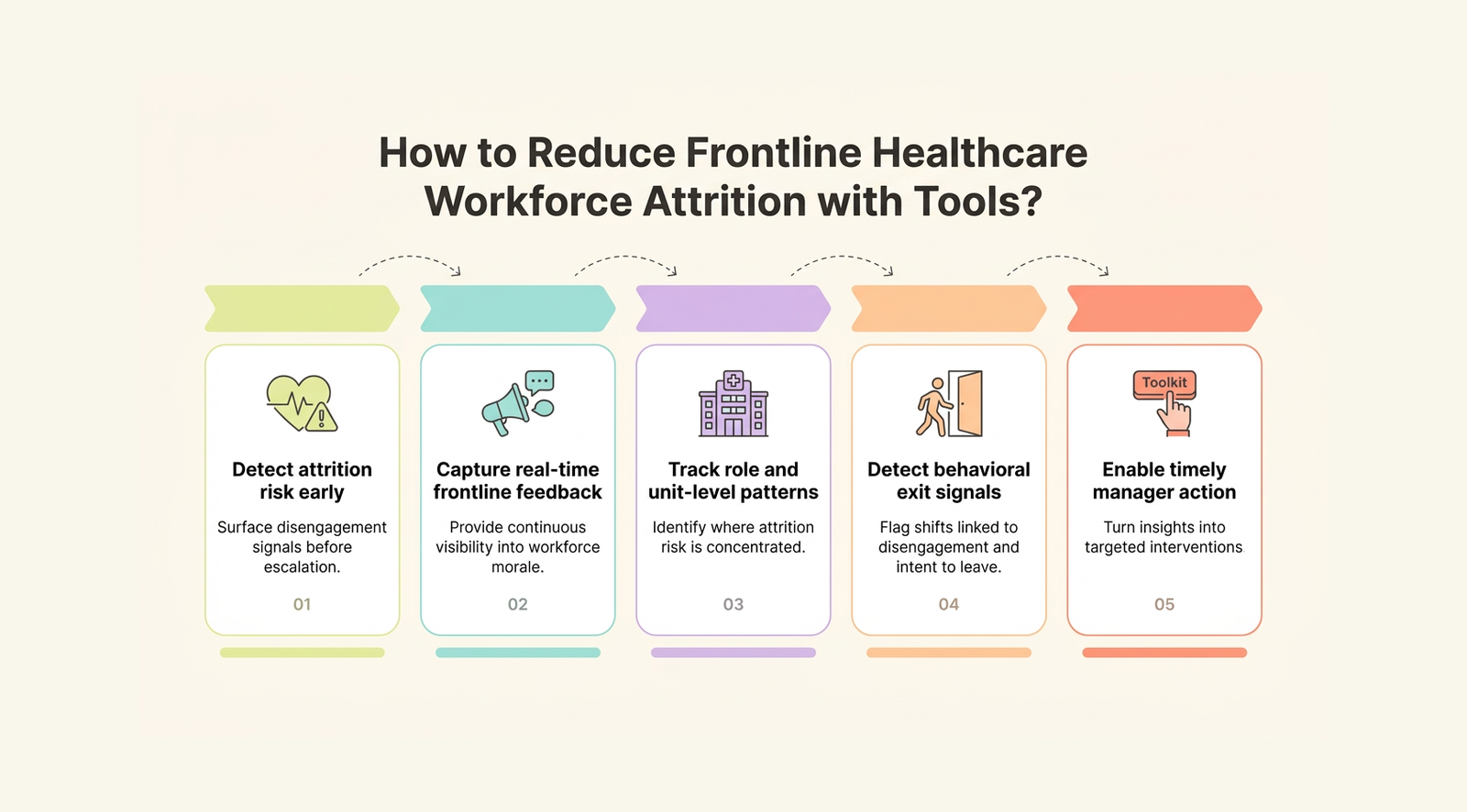
What tools help reduce frontline healthcare workforce attrition?
Tools that reduce frontline healthcare workforce attrition identify early risk signals, track workforce patterns, and enable timely intervention at the role and unit level.
Effective systems combine real-time feedback, behavioural indicators, and workforce segmentation to detect emerging exit risk.
These tools support managers with actionable insights, allowing hospitals to intervene before disengagement progresses into resignation across frontline teams.
How do you benchmark frontline attrition rates by role or unit?
Hospitals benchmark frontline attrition rates by comparing turnover across roles, units, and experience levels to identify where exits concentrate.
Effective benchmarking separates high-acuity units like ICU and emergency care from lower-intensity settings and tracks early-career versus experienced staff patterns.
Internal benchmarking over time helps detect rising risk areas, evaluate intervention impact, and maintain workforce stability across clinical teams.
Conclusion
Reducing frontline healthcare workforce attrition requires identifying where hospital staff exits begin and intervening before pressure becomes resignation. Knowing how to reduce attrition in frontline healthcare depends on acting at specific failure points across workload, early career stages, and role structure.
CultureMonkey supports this as an employee feedback system with effective attrition reduction features including real-time analytics that capture early signals and dashboard segmentation across roles.
Book a demo with CultureMonkey.
FAQs
1. What is healthcare attrition?
Healthcare attrition is the rate at which clinical staff exit roles over time, reducing workforce capacity. In frontline settings, it reflects how workload pressure, role design, and patient load convert into actual exits, weakening staffing stability across nursing and allied health teams.
2. Why does healthcare attrition occur?
Healthcare attrition occurs when sustained workload pressure, role mismatch, limited career growth, and insufficient early support push frontline staff toward exit. In clinical environments, patient load escalation and moral injury compound over time, converting accumulated strain into resignation decisions.
3. How can healthcare attrition be reduced?
Healthcare attrition is reduced by targeting exit triggers at each lifecycle stage. Organizations must manage patient ratios, support early-career staff through the first-year cliff, ensure fair scheduling, and create visible career pathways before disengagement and intention-to-leave take hold.
4. What causes high attrition among frontline healthcare workers?
High frontline healthcare attrition is caused by five compounding triggers: patient-load escalation, moral injury exit cascade, the first-year attrition cliff, shift inequity, and career ceiling visibility. Each adds pressure that, left unaddressed, converts into predictable and avoidable staff exits.
5. What is the average nurse turnover rate in hospitals?
The average nurse turnover rate in hospitals ranges from 15% to 27% annually, with rates highest in ICU and emergency units, according to PMC. Early-career nurses face the steepest exit risk in the first 12 months, where workload pressure and insufficient support accelerate departure before role stability is reached.
6. How does patient load affect nurse attrition?
Patient load drives nurse attrition when patient-to-nurse ratios exceed sustainable limits. Each increase raises cognitive strain, triggers moral distress, and reduces care quality. Sustained overload across shifts converts accumulated pressure into predictable and measurable frontline exits.
7. What retention strategies work best for frontline clinical staff?
Effective frontline retention strategies combine structured onboarding in the first 12 months, fair shift distribution, visible career progression, regular supervisor check-ins, and post-incident debriefs. These address exit triggers directly rather than improving engagement without reducing exits.
8. How is allied health attrition different from nursing attrition?
Allied health attrition differs from nursing because it is driven by role mismatch, scope-of-practice constraints, and private practice competition. Physiotherapists, OTs, and speech pathologists exit when capacity-driven work is poorly structured or career progression is compressed or blocked.
9. What leading indicators predict frontline attrition before resignation?
Leading attrition indicators include intention-to-leave signals, peer support withdrawal, and voluntary overtime decline. These appear months before resignation and allow targeted intervention. Acting on combined early signals delivers higher impact than responding to late-stage absenteeism patterns alone.