


Anonymous feedback at work: Encouraging honest input

Anonymous feedback at work lets employees share concerns, ideas, or risks without revealing their identity. Providing anonymous feedback allows employees to share honest input without fear of negative repercussions. Many organizations use anonymous feedback at work and anonymous company feedback channels to spot culture issues, leadership blind spots, and compliance risks early.
Recent Gallup Q2 2025 data shows that only 28% of employees strongly agree that their opinions count at work.
This guide reviews anonymous feedback at work frameworks tested and reviewed across SMEs and enterprise organizations. Collecting anonymous feedback is often facilitated by digital surveys, which allow organizations to build custom forms and surveys in minutes. It explains how anonymous feedback from employees supports psychological safety, leadership transparency, and accountable action without weakening manager trust.


- Anonymous feedback at work lets employees share concerns, ideas, and risks honestly without revealing their identity.
- It helps organizations detect cultural issues, leadership blind spots, and operational risks earlier.
- Psychological safety increases because anonymity reduces fear of retaliation or social consequences.
- Structured frameworks help convert anonymous feedback into patterns, ownership, and visible action.
- When leaders respond transparently and close the feedback loop, trust and engagement improve.
Why does anonymous feedback matter more than ever in modern workplaces?

Anonymous feedback at work helps organizations surface concerns that employees may hesitate to raise through identifiable channels. In many workplaces, hierarchy, performance evaluations, and workplace dynamics discourage candid conversations.
Allowing workers to provide feedback anonymously is crucial to gathering employee feedback and encouraging honest responses. Anonymous feedback channels give leadership earlier visibility into risks that might otherwise remain hidden.
Unlike open feedback, where comments are attributed to employees, anonymous company feedback removes traceability. This allows employees to share honest perspectives that may not appear in direct conversations.
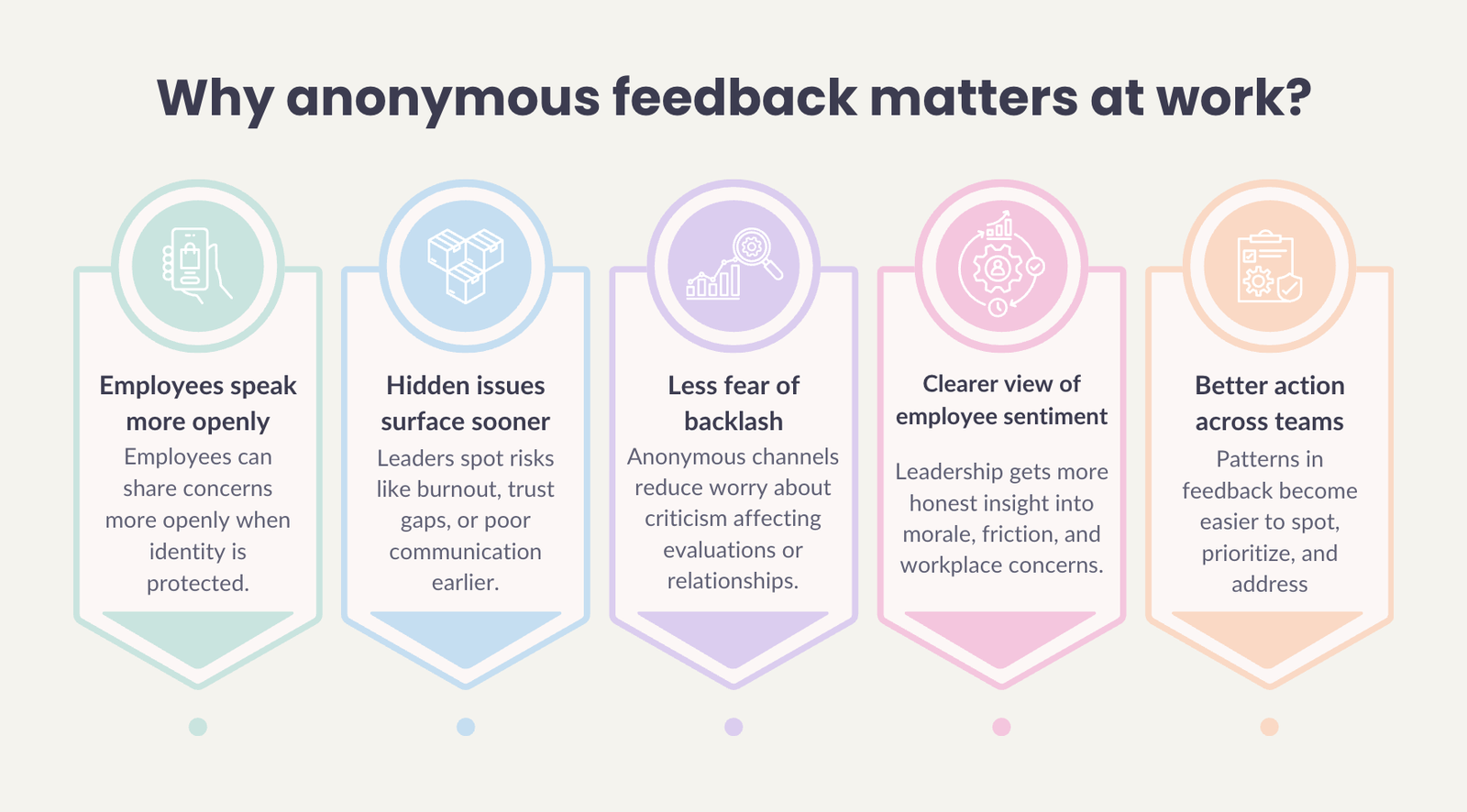
- Employees hesitate to raise concerns openly: Many employees avoid discussing sensitive issues in identifiable conversations. Anonymous feedback from employees creates a safer path for sharing concerns that might otherwise remain unspoken.
- Earlier visibility into cultural or operational risks: Company anonymous feedback helps leadership detect issues such as workload pressure, ethical concerns, or communication breakdowns before they escalate into larger organizational problems.
- Reduced fear of retaliation: Anonymous company feedback lowers the perceived risk associated with criticism. Employees can highlight problems or suggest improvements without worrying about negative consequences in performance evaluations.
- Better leadership awareness of employee sentiment: Anonymous feedback at work helps leaders understand concerns that may not surface during meetings or formal discussions, improving visibility into morale, communication gaps, and operational friction.
- Improved transparency across teams: Anonymous feedback from employees gives organizations a clearer view of workplace sentiment. This helps leadership identify patterns in employee concerns and respond before issues affect engagement or retention.
What psychological factors make anonymous feedback encourage safety, trust, and candor?
Anonymous feedback at work encourages candid communication because it removes social pressure tied to identity. Employees often filter their opinions when feedback can be traced to them. Anonymous channels reduce that pressure and allow individuals to express concerns or disagreements more openly.
Anonymous feedback tools help create a safe space where employees feel comfortable providing honest feedback, knowing their privacy is protected.
Anonymous feedback from employees also changes how people evaluate risk when speaking up. When identity is protected, employees feel safer discussing sensitive issues, which improves the honesty and reliability of feedback collected by organizations.
1. Reduced fear of social consequences
Employees may worry about embarrassment, conflict, or damaging relationships when sharing criticism openly. Anonymous company feedback removes those concerns, allowing employees to express candid opinions without social pressure. Anonymous channels also enable employees to share negative feedback constructively, without fear of damaging relationships.
2. Greater willingness to discuss sensitive topics
Issues such as workload stress, ethical concerns, or management practices often remain hidden in open discussions. Anonymous feedback from employees makes it easier to surface these topics without personal risk. Anonymity also encourages constructive criticism, allowing employees to address sensitive topics in a helpful and actionable way.
3. Stronger perception of psychological safety
When employees know their identity is protected, they feel more comfortable sharing honest input. Employees are more likely to feel psychologically safe when feedback channels are completely anonymous, as this ensures their privacy and encourages open communication. Anonymous feedback at work signals that organizations are willing to hear difficult feedback and address underlying issues.
4. Higher participation in feedback processes
Employees are more likely to participate when they trust the confidentiality of feedback systems. Allowing anonymous responses encourages honesty and increases participation, with anonymous channels boosting survey participation rates by a huge margin. Anonymous company feedback, therefore, increases response rates and helps organizations collect more representative employee sentiment.
What are the most common objections to anonymous feedback, and how can organizations address them?

Organizations often hesitate to adopt anonymous feedback at work because leaders worry about misuse, criticism without accountability, or damage to manager relationships. These concerns are common but manageable. When designed carefully, anonymous feedback systems strengthen transparency and help organizations detect issues employees may not raise through open channels.
- Accountability concerns: Leaders often worry that anonymous feedback from employees allows criticism without responsibility. Organizations address this by moderating submissions, encouraging constructive language, and focusing on patterns rather than individual comments when reviewing anonymous company feedback.
- Toxic feedback risk: Some managers believe anonymous channels invite complaints rather than useful insights. Clear guidelines help prevent this. Companies running anonymous feedback programs typically establish behavior rules and remove abusive content before feedback reaches leadership.
- Manager trust concerns: Managers sometimes assume anonymous feedback at work signals distrust toward leadership. Organizations address this by positioning anonymous channels as a complement to open conversations rather than a replacement.
- Missing context in responses: Anonymous comments may lack background details that help interpretation. Structured anonymous feedback programs solve this by using guided questions that allow employees to explain issues while maintaining anonymity.
- Preference for open feedback: Some leaders believe employees should raise concerns directly. In reality, employees may avoid raising concerns directly due to workplace sensitivity or uncertainty about how feedback will be received. Anonymous feedback from employees provides an alternative path for surfacing hidden concerns.
- Fear of excessive criticism: Another objection is that anonymous channels will focus only on problems. Organizations address this by collecting improvement ideas, recognition, and suggestions so anonymous company feedback remains balanced and constructive.
The feedback process should be continuous, with organizations always seeking ways to improve after each round of feedback.
What signs indicate your organization needs an anonymous feedback channel?
Organizations need an anonymous feedback channel when employees are unlikely to share concerns through identifiable systems or when leadership lacks reliable visibility into workplace sentiment. Employee surveys, especially anonymous employee feedback surveys, can help identify issues such as work-life balance that employees may not feel comfortable discussing openly.
Observable signals such as delayed issue reporting, filtered feedback, or sudden engagement changes often indicate the need for anonymous feedback at work. The following indicators help leaders determine when anonymous company feedback channels are necessary to surface concerns earlier and improve transparency.
- Concerns appear mainly during exit interviews: When employees raise culture issues only while leaving the organization, it suggests existing feedback systems are not trusted. Anonymous feedback from employees helps surface these concerns earlier.
- Employee engagement scores decline unexpectedly: Sudden drops in engagement or morale scores can indicate unresolved concerns that employees hesitate to discuss openly. Anonymous company feedback can reveal underlying issues affecting sentiment.
- Managers receive consistently positive feedback: Uniformly positive responses may indicate filtered communication rather than genuine sentiment. An anonymous feedback channel helps uncover hidden frustrations or operational challenges.
- Sensitive topics rarely appear in formal feedback: If issues such as workload pressure, leadership communication, work-life balance, or ethical concerns rarely appear in surveys, employees may not feel safe discussing them openly. Anonymous surveys at work helps surface these topics.
- Repeated complaints escalate to HR: When employees bypass managers and raise concerns directly with HR, it often signals limited trust in current feedback channels. Anonymous company feedback provides a safer reporting path.
- Leadership perception differs from employee sentiment: Large gaps between leadership assumptions and employee experience suggest limited visibility into workplace concerns. Anonymous feedback from employees helps leaders understand the real employee experience.
How can organizations introduce anonymous feedback without undermining manager trust?
Organizations can introduce anonymous feedback at work without weakening manager trust by positioning it as a complement to open dialogue rather than a replacement. When implemented transparently, anonymous company feedback channels help surface concerns employees hesitate to raise directly while preserving healthy manager–employee relationships.
Introducing anonymous feedback from employees requires clear governance, communication, and leadership alignment. The following practices help organizations deploy anonymous channels while maintaining trust and accountability across teams.
1. Clarify the purpose of anonymous feedback
Anonymous feedback at work is a powerful tool designed to surface concerns employees may hesitate to share openly. It should be positioned as an additional listening mechanism, not a substitute for direct conversations.
The real value of anonymous feedback lies in how organizations use it, by identifying trends and common themes in the responses, managers can act on these insights to drive meaningful improvements in culture, processes, and leadership transparency.
2. Establish guidelines for constructive input
- Define expectations for respectful and solution-focused anonymous feedback from employees.
- Use structured and specific questions, including open-ended questions, to guide company anonymous feedback toward actionable insights. Open-ended questions encourage detailed and honest responses, while specific questions help avoid vague or non-committal comments.
- Avoid leading questions or making assumptions about what employees are thinking to ensure clarity and accuracy in responses.
- Moderate submissions to prevent abusive or non-constructive comments.
3. Combine anonymous and open feedback channels
- Encourage employees to continue sharing ideas directly with managers when comfortable.
- Provide anonymous company feedback options for sensitive topics that employees may not raise openly. Feedback forms can be designed to include both long-form and multiple-choice questions, allowing for structured, quantifiable feedback alongside open-ended responses.
- Maintain multiple listening channels so employees can choose the safest option.
4. Share aggregated insights with managers
- Provide managers with summarized trends rather than individual responses.
- Use aggregated anonymous feedback from employees to highlight recurring themes. When reviewing survey responses, managers should look for common themes by analyzing both qualitative and quantitative data using appropriate techniques.
- Focus discussions on improvement opportunities rather than individual criticism.
5. Prepare managers to interpret feedback constructively
- Train managers to view anonymous feedback at work as insight rather than personal criticism.
- Encourage leaders to ask follow-up questions and seek clarification where possible.
- Reinforce leadership behaviors that support transparency and learning.
- Emphasize that constructive handling of feedback can support conflict resolution and help build stronger relationships between managers and employees.
6. Communicate actions taken from feedback
- Share examples of improvements driven by anonymous company feedback.
- Update employees on how leadership is addressing recurring concerns.
- Clearly communicate an action plan in response to feedback and regularly track progress on its implementation; this not only demonstrates leadership commitment but also increases employee trust and retention, as employees are more likely to stay when they see their feedback leads to real change.
- Demonstrating action strengthens trust in anonymous feedback from employees.
How can organizations turn anonymous feedback into action through an accountability framework?

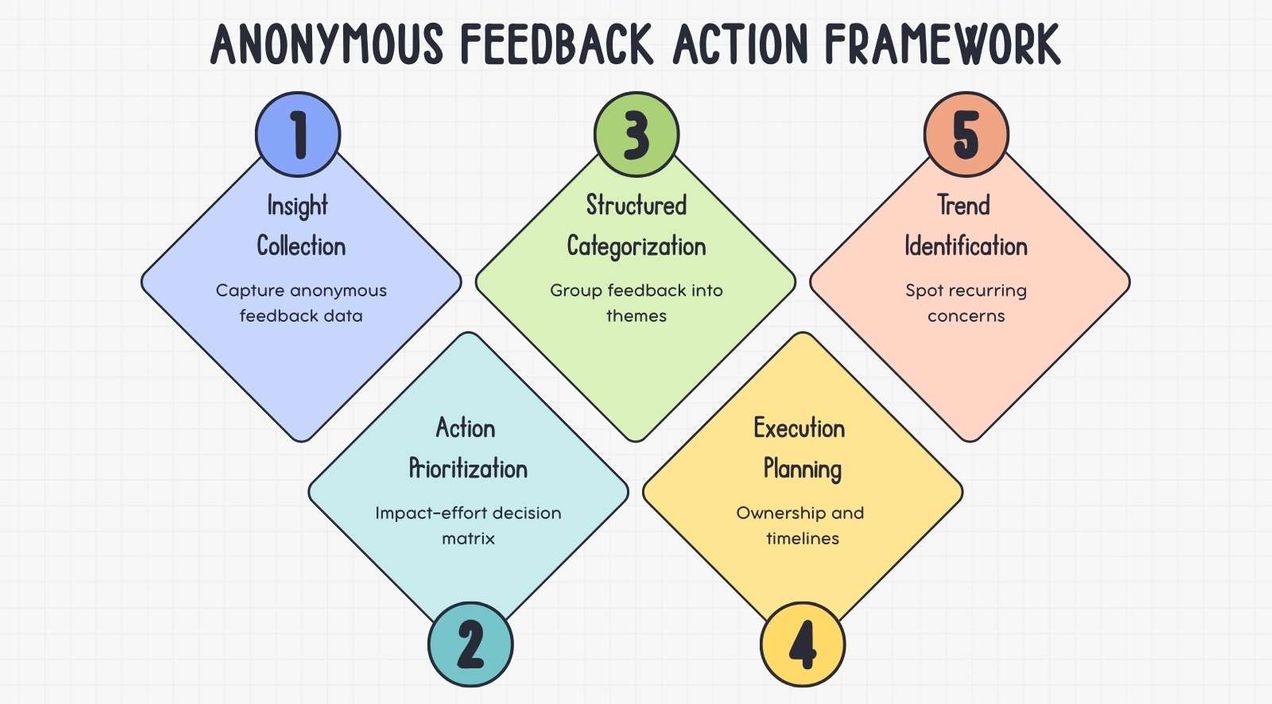
Organizations turn anonymous feedback into action by using a clear accountability framework that captures feedback, identifies recurring patterns, assigns responsibility, and communicates outcomes. Structured anonymous feedback programs help leaders translate anonymous feedback from employees into visible improvements and measurable organizational change.
Capture feedback systematically
Organizations should collect anonymous feedback at work through recurring surveys or listening programs rather than one-time initiatives. Consistent listening helps identify trends in employee sentiment and ensures anonymous feedback from employees becomes a continuous signal for leadership awareness.
Identify patterns across teams
Individual comments rarely provide enough context. Organizations should analyze anonymous company feedback in aggregate to detect recurring themes across departments or leadership groups. Pattern-based interpretation reduces blame and helps leaders identify systemic cultural or operational issues.
Assign ownership for resolution
Anonymous feedback should always have clear ownership. When patterns emerge, leaders or department heads must take responsibility for addressing them. Assigning accountability ensures that company's anonymous feedback leads to corrective action rather than passive reporting.
To maintain true anonymity and protect user privacy, organizations should avoid storing IP addresses when collecting feedback.
Communicate insights to employees
Employees trust feedback systems when leadership shares what was learned. Transparent communication about insights from anonymous feedback at work shows employees their input is taken seriously and encourages continued participation.
Using anonymous employee survey software to collect and analyze feedback can help organizations generate valuable insights. These insights should always be communicated to the relevant stakeholders, such as managers, leadership, or HR, to ensure that feedback leads to meaningful action and workplace improvement.
Implement visible improvements
Action strengthens credibility. Organizations should translate insights into policy adjustments, leadership training, or operational improvements. Gallup research shows employees who receive meaningful feedback weekly are up to 3x more likely to be engaged, boosting speak-up culture.
Close the feedback loop
Closing the loop sustains participation. Leaders should explain what actions were taken and how employee feedback influenced decisions. When employees see outcomes from anonymous company feedback, psychological safety improves and employees remain willing to share honest input.
How can organizations build psychological safety alongside anonymous feedback channels?

Organizations build psychological safety alongside anonymous feedback channels by ensuring employees feel safe to speak honestly, both anonymously and openly. Organizations can get anonymous feedback using user-friendly platforms and anonymous feedback tools that make it easy for employees to share their input.
Anonymous feedback at work helps surface concerns, but trust grows only when leadership behaviors, policies, and communication practices consistently protect employees who share input. The following practices help organizations strengthen psychological safety while maintaining effective anonymous company feedback systems.
- Encourage constructive leadership responses: Leaders should respond calmly to criticism or difficult feedback. When employees see that anonymous feedback from employees leads to thoughtful discussion instead of defensive reactions, trust in leadership and feedback systems increases.
- Normalize open discussions about concerns: Organizations should create regular forums where employees can raise ideas or concerns openly. Anonymous feedback at work then acts as a complementary channel for sensitive topics that employees may hesitate to discuss publicly.
- Maintain clear non-retaliation policies: Employees must believe that sharing feedback will not harm their careers. Clear policies that protect employees from retaliation strengthen trust in the company's anonymous feedback systems.
- Acknowledge employee input publicly: Recognizing employee ideas or suggestions reinforces that feedback is valued. When organizations highlight improvements inspired by anonymous feedback from employees, participation and trust increase.
- Train managers to support psychological safety: Managers influence whether employees feel comfortable speaking up. Leadership training helps managers interpret anonymous company feedback constructively and respond in ways that encourage honest dialogue.
- Demonstrate consistent follow-through: Psychological safety strengthens when employees see action taken on feedback. Communicating outcomes from anonymous feedback at work shows employees that leadership listens and acts on their concerns.
Which companies improved organizational culture using anonymous feedback?
Several organizations, such as Microsoft, Airbnb, Shopify, and many more have used anonymous feedback at work to strengthen psychological safety, leadership transparency, and employee trust. Anonymous feedback from employees helps surface concerns that often remain hidden in traditional reporting systems, enabling leaders to understand workplace issues and improve organizational culture.
By integrating anonymous feedback into performance reviews and employee engagement surveys, organizations can better assess and improve company culture. In fact, implementing anonymous feedback in the workplace can lead to 21% higher profitability and 50% lower turnover.
Microsoft
Microsoft expanded internal listening programs where employees can share anonymous feedback about leadership communication and collaboration. Leadership reviews aggregated feedback trends to identify culture gaps across teams. Discussing insights internally strengthens transparency and improves employee trust in leadership.
Airbnb
Airbnb collects anonymous company feedback to gauge employee views on inclusion, leadership communication, and workplace experience. Leaders review aggregated sentiment and share insights team-wide. This fosters psychological safety and honest input.
Shopify
Shopify uses company anonymous feedback within internal listening initiatives to surface operational challenges and leadership blind spots. Leaders review recurring themes instead of individual comments. This approach helps teams address structural issues while maintaining trust and fairness.
Intel
Intel encourages open communication through feedback systems that allow employees to share concerns safely. Anonymous feedback at work helps leadership identify issues related to management practices and workplace culture. Insights from aggregated feedback guide leadership development and cultural improvements.
Salesforce
Salesforce integrates anonymous feedback from employees within broader employee listening programs. Leadership analyzes sentiment insights to understand culture gaps and improve transparency. Communicating actions taken from employee feedback helps reinforce trust across teams.
Adobe
Adobe gathers anonymous feedback from employees through internal listening programs that measure workplace sentiment and leadership communication. Leaders review insights across departments to identify culture gaps and improve collaboration.
Toyota
Toyota encourages employee input through structured feedback systems that allow workers to raise concerns safely. Anonymous company feedback helps identify operational or cultural issues within teams. Leadership reviews feedback patterns to support continuous improvement and strengthen trust across the organization.
Conclusion
Anonymous feedback at work strengthens organizational culture when it enables honest employee input without fear of consequences. Companies that combine anonymous feedback channels like CultureMonkey with transparent leadership responses, clear accountability, and psychological safety practices create environments where employees feel comfortable sharing concerns and ideas.
Organizations that listen consistently and act on anonymous feedback from employees build stronger trust and engagement across teams. When leaders review feedback patterns, communicate insights, and demonstrate visible improvements, anonymous company feedback becomes a reliable foundation for transparency, learning, and long-term cultural improvement.
Book a demo with CultureMonkey.
FAQS
1. What is anonymous feedback at work, and why does it matter?
Anonymous feedback at work allows employees to share concerns, ideas, or risks without revealing their identity. It matters because employees often hesitate to speak openly about sensitive issues. Anonymous feedback from employees helps organizations detect culture problems, leadership blind spots, and workplace concerns earlier.
2. How do you prevent anonymous feedback from becoming toxic?
Organizations prevent toxic anonymous feedback by setting clear guidelines for respectful input and moderating submissions. Structured questions also encourage constructive responses. When employees understand the purpose of anonymous company feedback and see leadership act responsibly, feedback tends to remain focused on improvements.
3. Should managers be able to see anonymous feedback about them?
Managers can review anonymous feedback about them, but it should be shared in an aggregated form rather than as isolated comments. This approach helps leaders understand recurring themes without targeting individuals. Aggregated anonymous feedback from employees supports improvement while maintaining fairness and trust.
4. How often should organizations collect anonymous employee feedback?
Organizations typically collect anonymous employee feedback quarterly or through periodic pulse surveys. Regular listening cycles help leaders track sentiment changes over time. Consistent anonymous feedback at work also signals that leadership values employee input and is committed to understanding workplace concerns.
5. Does anonymous feedback actually improve employee engagement?
Anonymous feedback can improve engagement when employees see that leadership listens and acts on their input. Anonymous feedback from employees helps surface concerns that might otherwise remain hidden. When organizations respond transparently, trust increases, and employees feel more comfortable sharing ideas and concerns.