


Employee engagement survey vendor RFP template: A complete evaluation framework in 2026

An employee engagement survey vendor RFP template is a structured evaluation framework used to assess survey platforms against clearly defined operational, analytical, security, and commercial requirements. An RFP is a formal document issued to prospective vendors from an organization that intends to buy a product or service.
At this stage, HR leaders are reviewing distribution capabilities, validated engagement drivers, benchmarking depth, anonymity safeguards, integrations, compliance standards, implementation models, and pricing transparency.
This guide is built on tested frameworks used to provide feedback to institutions on evaluating employee engagement survey vendors systematically, ensuring vendor selection search and decisions reflect long-term strategic fit rather than surface-level feature comparisons.


- An employee engagement survey vendor RFP template is a structured framework to evaluate vendors across scope, analytics, security and implementation.
- It defines distribution, data depth, anonymity, compliance, and governance before vendor comparison.
- Clear commercial terms and structured rollout planning reduce bias and cost surprises.
- Standardized scoring improves alignment across HR, IT, finance, and leadership.
- CultureMonkey’s enterprise engagement survey platform aligns with these RFP standards, supporting analytics, confidentiality, and scalable implementation.
What to include in your employee engagement survey vendor RFP overview?
An employee engagement survey vendor detailed RFP overview establishes the strategic foundation for vendor evaluation. It clarifies what business problems the survey design must address and what outcomes leadership expects to measure.
At this stage, buyers are not comparing features but defining operational realities. Scope, workforce structure, and listening cadence shape vendor responses and pricing models.
A precise overview also sets governance expectations, integration boundaries, and measurable success criteria. Without this clarity, proposals become inconsistent and difficult to compare.
- Define business objectives and workforce scope clearly.
- Specify user groups and role-based access expectations.
- Outline survey cadence across annual and pulse cycles.
- Establish governance ownership and decision rights early.
- Define measurable success metrics tied to outcomes.
A well-designed employee engagement survey ensures the validity and reliability of the survey results. Using a pre-designed employee engagement survey template can save organizations time and money in survey design and administration.
Employee engagement survey vendor RFP: Distribution requirements
Distribution capabilities determine whether your survey design reaches the entire workforce or only desk-based employees. Your RFP process must clearly define required channels so vendors scope pricing and technical feasibility accurately.
Multi-channel delivery improves response rates, supports frontline inclusion, and reduces sampling bias. Defining distribution expectations early prevents underpowered solutions and hidden cost adjustments later.
- Email distribution: Enables structured delivery, reminders, and tracking for desk-based teams across locations.
- SMS distribution: Reaches frontline employees quickly without requiring corporate email access.
- Kiosk access: Supports shared-device environments like plants, warehouses, and hospitals.
- QR code access: Allows fast mobile participation without login barriers.
- Teams and Slack integration: Embeds surveys directly into daily workflow platforms.
Employee engagement surveys provide actionable insights that organizations can use to improve the workplace. Poor communication, lack of support, or inadequate training can lead to employee dissatisfaction and decreased productivity.
What are the data and analytics required for an employee engagement survey RFP?

Data and analytics requirements define how an employee engagement survey vendor RFP template evaluates actionable insight depth across platforms. Like an HRIS RFP template, this section clarifies evaluation standards before vendors respond.
A well-structured RFP survey design must specify expected analytics sophistication, not just a short list reporting access. Without a clear criteria system, pricing and capability comparisons become inconsistent and misleading.
- Require validated engagement drivers aligned to business outcomes.
- Include internal and external benchmarking capabilities.
- Specify heatmaps for team-level and location comparisons.
- Enable automated alerts for risk and disengagement signals.
- Support advanced segmentation and demographic filtering controls.
Employee engagement surveys are crucial to maintaining a healthy workplace. Vendors must guarantee confidentiality to encourage honest feedback during the survey process.
What are the anonymity and confidentiality requirements to include in your RFP?
Anonymity and confidentiality are structural requirements in any employee engagement survey vendor RFP template. At the evaluation stage after market research, HR leaders must assess how vendors protect identity, control data access, and prevent misuse.
These safeguards influence the nature of participation rates, legal exposure, and platform pricing. Similar to an HRIS RFP template, this RFP survey section must clearly define technical and governance standards before vendor comparison begins.
Anonymity requirements
As an important RFP requirement, anonymity standards determine whether employees respond honestly. Your RFP survey must define technical safeguards clearly. The RFP process is the workflow and steps required to select the right vendor while minimizing cost and risk.
Weak anonymity design reduces participation and distorts results. Strong, clearly documented protections improve trust and data reliability.
- Define minimum response thresholds before results are visible.
- Require automated data suppression for small demographic groups.
- Prevent identification through cross-filtering combinations.
- Restrict raw comment visibility to authorized roles only.
- Ensure anonymity rules apply across all reporting levels.
Project purpose should clearly state the reasons for conducting the survey, such as improving retention or measuring culture after a merger.
Confidentiality requirements
Confidentiality governs who can access data and how it is handled. They must specify governance, storage, and accountability controls. The RFP process consists of three main steps: Creation, administration, and evaluation.
Without clear confidentiality terms, vendors may provide analytics without adequate oversight safeguards.
- Define role-based admin access with approval workflows.
- Require encryption for data in transit and at rest.
- Specify data retention and deletion timelines clearly.
- Prohibit unauthorized data exports without audit logs.
- Mandate full audit trails for administrative activity.
An RFP should request relevant information about the vendor, including descriptions of their experiences and examples of previous relevant work. An employee engagement survey template provides actionable insights that organizations can use to improve the workplace.
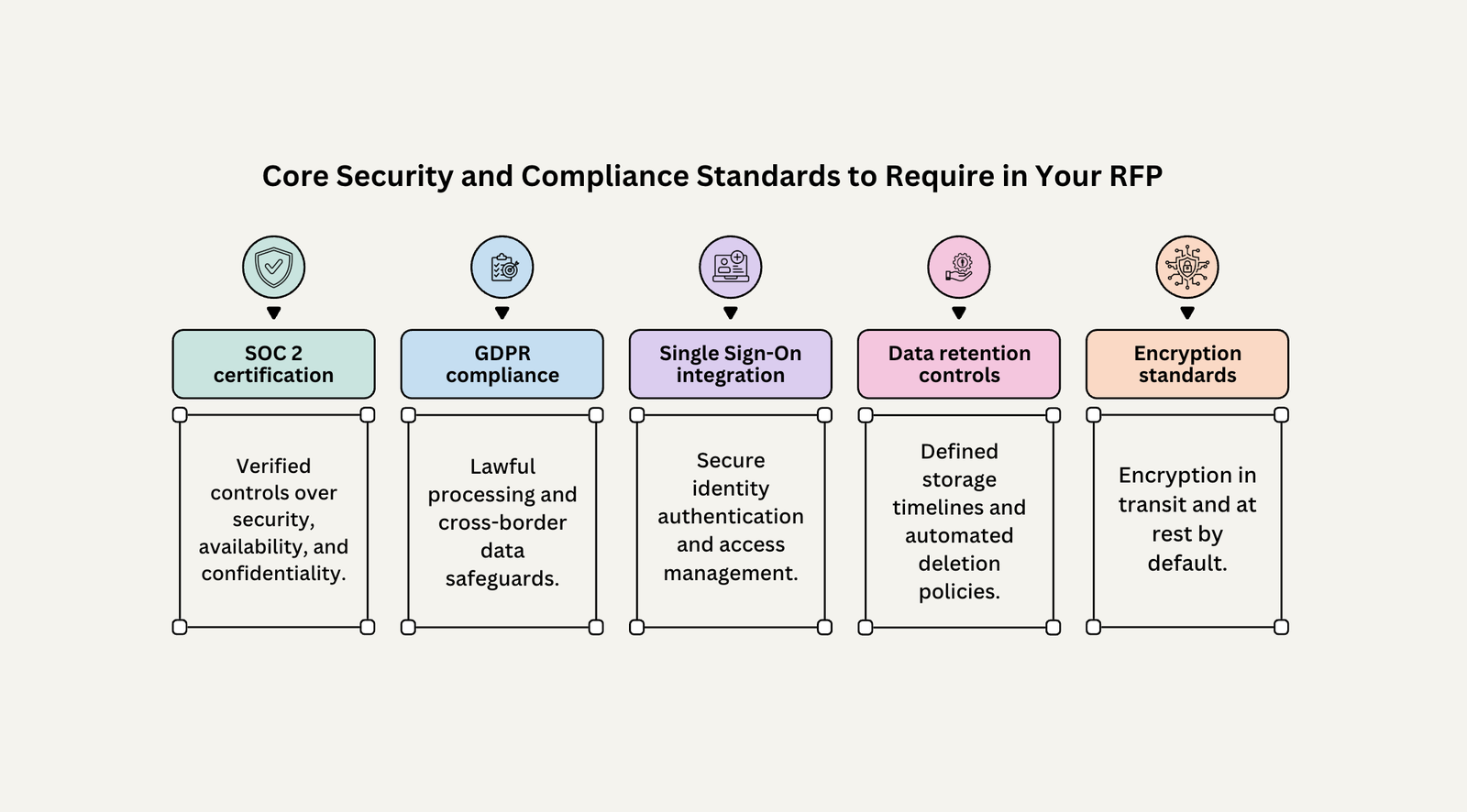
What are the security and compliance requirements for an engagement survey vendor RFP?

Security and compliance define whether a survey platform can operate at enterprise scale. This section of your RFP process should clarify technical safeguards, regulatory alignment, and identity controls before vendor comparison begins.
These requirements influence pricing, procurement approval, and long-term risk exposure. Without clearly documented standards, vendors may meet functional needs but fail internal audit or IT review.
- SOC 2 certification: Require verified controls over security, availability, and confidentiality.
- GDPR compliance: Ensure lawful data processing and cross-border transfer safeguards.
- Single Sign-On integration: Support SSO with secure identity federation protocols.
- Data retention controls: Define storage duration and automated deletion policies.
- Encryption standards: Mandate encryption in transit and at rest.
Survey design includes collaborating on questions that cover demographics, Likert scale items, and open-ended questions. Guaranteed confidentiality of responses and adherence to standards like GDPR must be clearly defined in vendor proposals.
Security readiness checklist for internal stakeholders
Vendors must demonstrate experience and qualifications relevant to similar industries, quality of survey methodology, reporting capabilities, and cost/value considerations. Proposals should include company information, methodology, technology and security details, reporting examples, project team identification, references, and pricing.
| Internal question to clarify | Why it matters | Who should approve |
|---|---|---|
| Do we require regional data hosting? | Impacts vendor eligibility and pricing | IT + Legal |
| Is SSO mandatory or optional? | Affects implementation complexity | IT department |
| Are we allowed external cloud storage? | Determines vendor shortlist scope | IT + Security |
| What is our acceptable data retention window? | Influences platform configuration | Legal |
| Do we require formal audit documentation annually? | Affects vendor reporting obligations | Compliance |
| What is our breach notification tolerance? | Defines acceptable risk exposure | Legal + Risk |
The choice of employee engagement survey vendor must evaluate technical fit, scientific validity, and post-survey support.
What are the implementation and support requirements to define in your RFP?
Implementation and support requirements determine whether your survey program delivers sustained impact or stalls after launch. The RFP process should clearly document rollout structure, enablement depth, and post-launch accountability to prevent gaps between purchase and execution.
Vendors differ significantly in the elements of onboarding models, training intensity, and success ownership. Documenting these expectations ensures proposals reflect operational capacity, internal resource planning, and long-term program sustainability.
Implementation timeline
Implementation timeline requirements in an employee engagement survey vendor RFP define how rollout will be structured and stabilized. This section should outline deployment phases, fill internal responsibilities, and activation milestones.
Undefined timelines often lead to delays and cost overruns. Clear staging improves accountability and resource planning.
Define clearly:
- Specify phased rollout milestones with accountable stakeholders.
- Require documented configuration and testing stages.
- Confirm go-live support during initial survey launch.
The RFP process typically ranges from 4 to 8 weeks from start to finish.RFPs include a statement of work describing the tasks to be performed by the winning bidder and the timeline for finishing the job.
Training requirements
Training requirements in an employee engagement survey vendor RFP define how administrators and managers will build data interpretation capability. This section should specify enablement depth beyond basic platform onboarding.
Vendor-led demos alone do not ensure adoption. Despite being time consuming, structured training improves analytical confidence, action planning quality, and long-term program effectiveness.
Ensure the vendor provides:
- Role-based training for administrators and managers.
- Practical sessions on interpreting engagement analytics.
- Scheduled refresher training after major survey cycles.
Tools that offer automated best practice recommendations for managers based on survey results are beneficial. The selected vendor will be responsible for survey design, administration, confidentiality, data analysis, reporting, and support.
Success plan and ongoing support
Success plan requirements in an employee engagement survey vendor RFP define post-launch governance and accountability. This section should clarify how the vendor supports continuous improvement after deployment.
Ongoing support influences adoption, renewal, and measurable impact. Without structured follow-up, survey programs lose strategic momentum.
Look for:
- Named success manager with defined engagement cadence.
- Quarterly reviews tied to measurable engagement outcomes.
- Action planning guidance aligned to survey insights.
Vendors should provide a summary of their experience with organizations of a similar size or in the relevant industry. Surveys should be conducted at regular intervals to measure changes in employee engagement over time.
What are the commercial requirements to include in your RFP?

Commercial requirements define total financial exposure, contractual flexibility, and service accountability. This section ensures prepared vendor comparisons achieve long-term value, not just headline pricing.
Clear commercial terms also reduce negotiation risk and prevent post-contract cost surprises. Each requirement below should be documented before final vendor selection.
Pricing structure
Pricing structure in an employee engagement survey vendor RFP determines how costs scale over time. It should clarify workforce bands, feature inclusions, and hidden cost triggers.
Surface-level pricing comparisons often ignore expansion, add-ons, and implementation charges. Transparent structure improves budgeting accuracy.
Specify clearly:
- Define employee-based pricing tiers and scalability bands analysis.
- Clarify included features versus paid add-ons.
- Require informed visibility into implementation and configuration fees.
An employee engagement survey template is a tool used to gather feedback from employees about their level of satisfaction and overall workplace engagement. Employee engagement surveys typically include questions related to job satisfaction, career development, company culture, communication, and leadership.
Renewal terms
Renewal terms influence long-term vendor leverage and financial predictability. This section should document contract duration, notice periods, and escalation clauses.
Poorly defined renewals create lock-in risk and unplanned cost increases. Structured terms protect institutional flexibility.
Confirm that vendors provide:
- Clear renewal notice timelines and termination conditions.
- Defined pricing protection for multi-year agreements.
- Transparent cost adjustments for workforce growth.
Defining your metrics involves deciding between an annual, in-depth survey or shorter, quarterly pulse surveys. A well-written RFP conveys the intention behind the proposal and ensures that the end result will meet expectations.
Service Level Agreements (SLAs)
SLAs formalize performance accountability beyond feature delivery. They establish measurable standards for uptime, response time, and potential issue resolution.
Without defined SLAs, service quality becomes subjective and difficult to enforce. Contractual clarity strengthens potential vendors' accountability.
Ensure the contract includes:
- Guaranteed uptime commitments with defined thresholds.
- Response time standards for critical service issues.
- Escalation pathways for unresolved performance failures.
The RFP should request relevant information about the vendor, including examples of previous relevant work and key project staff. The RFP should indicate whether the proposed contract will stipulate a fixed price or will provide for reimbursement of costs incurred by the contractor.
Building a vendor response scoring rubric for RFP evaluation
A vendor scoring rubric is a structured way to compare proposals received using predefined criteria. It helps your team gather information and evaluate the best vendor in the list consistently instead of relying on presentations or persuasive demos.
Instead of treating every feature equally, you assign importance levels and ask specific questions to identify what matters most. This makes decision-making clear and defensible.
- Identify the most important evaluation criteria first.
- Assign higher importance to critical business requirements.
- Use the same scoring scale for every potential vendor.
- Record clear reasons for each score given.
- Compare total scores before final selection.
To be successful, requests for proposals require tremendous coordination among various stakeholders. RFPs often start with an individual, department, or team that requests a purchase or solution.
Conclusion
A well-structured RFP ensures vendor comparisons are consistent, transparent, and aligned to institutional priorities. When scope, analytics depth, security standards, implementation expectations, and commercial terms are clearly defined, procurement teams can evaluate proposals confidently. This reduces bias, prevents hidden costs, and improves long-term program sustainability.
Once your framework is finalized, explore our curated hub of employee engagement survey vendors to identify providers to send your RFP to. Comprehensive reports delivered by the vendor should include executive summaries, benchmark data, and actionable insights. If you are evaluating enterprise-grade softwares, CultureMonkey supports advanced analytics, strong confidentiality controls, and structured implementation to help you execute with clarity and confidence.
Book a demo with CultureMonkey.
FAQs
1. What is an employee engagement survey vendor RFP template?
An employee engagement survey vendor RFP template is a structured evaluation document used to compare survey providers against defined operational, analytical, security, and commercial requirements. It ensures vendors respond to the same criteria, making pricing, scalability, and capability comparisons objective.
2. Why is an RFP important before selecting a survey vendor?
An RFP standardizes vendor evaluation before selection. It prevents decisions driven by polished demos and ensures proposals address analytics depth, anonymity safeguards, integration requirements, and long-term pricing structure. This improves procurement transparency and reduces selection risk.
3. What should be defined before issuing a survey RFP?
Before issuing an RFP, organizations should define workforce scope, survey cadence, analytics expectations, confidentiality thresholds, specific needs of integration, and budget range. Clear internal requirements reduce vague vendor responses and prevent misaligned proposals that inflate costs later.
4. How does analytics capability affect vendor selection?
Analytics capability determines whether survey data drives action or remains descriptive. Vendors offering validated drivers, benchmarking, segmentation, and automated alerts provide stronger insight maturity. Limited analytics may reduce pricing but also limit strategic decision value.
5. How do anonymity requirements impact participation?
Defined anonymity thresholds and suppression rules increase employee trust and honest participation. Weak confidentiality controls can lower response rates and distort results. Clear technical safeguards ensure survey insights are credible and ethically protected.
6. What security standards should survey vendors meet?
Survey vendors should demonstrate recognized security certifications, defined encryption practices, access controls, and documented data handling policies. These safeguards in a software protects employee information and support internal IT and legal approval processes.
7. How should pricing be evaluated in a survey RFP?
Pricing should be evaluated alongside feature scope, scalability, implementation depth, and renewal terms. A lower subscription cost may exclude advanced analytics or support. Total long-term value matters more than initial platform pricing.
8. Why are implementation requirements critical in an RFP?
Implementation requirements define rollout structure, stakeholder ownership, and activation timelines. Without documented expectations, vendors may underestimate onboarding complexity. Clear planning improves adoption speed and long-term program stability.
9. How can vendor responses be scored objectively?
Vendor responses can be scored using predefined evaluation criteria and assigned importance levels. Using the same scoring scale for all vendors of date reduces bias, improves transparency, and strengthens cross-functional alignment during final selection.
10. When is an enterprise survey platform necessary?
An enterprise survey platform is necessary when organizations require advanced analytics, multi-channel distribution, regulatory compliance, strong confidentiality controls, and structured success management. Smaller tools may lack scalability and governance depth required for complex institutions.