



Employee feedback tools benchmark by industry (2026): Analysis of 10M+ employee responses

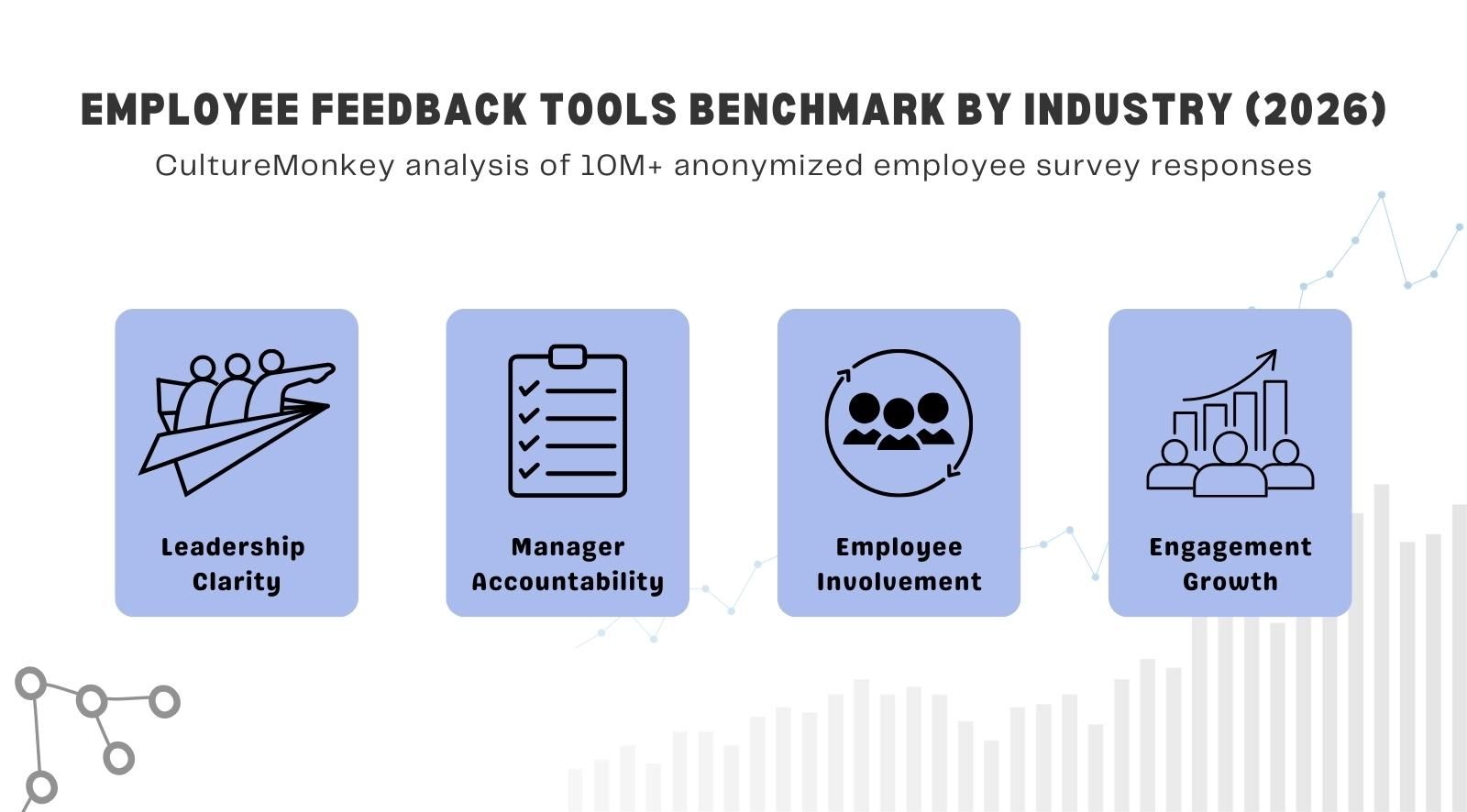
This benchmark report is part of CultureMonkey Research, analyzing global employee engagement trends using anonymized employee feedback data.
Employee feedback tools have evolved rapidly over the past decade. What started as annual engagement surveys has expanded into a broad ecosystem of pulse surveys, always-on listening platforms, AI-powered sentiment analytics, and workplace intelligence dashboards.
Today, most medium and large organizations already use some form of employee feedback software.
Yet one challenge persists.
Many companies collect feedback — but far fewer convert that feedback into measurable workplace improvement.
This raises an important question for leaders:
If organizations are collecting more feedback than ever before, why does engagement improvement remain inconsistent?
To explore this question, CultureMonkey analyzed more than 10 million anonymized employee survey responses across industries and regions.
Rather than examining engagement scores at a single point in time, this benchmark focuses on how engagement evolves across survey cycles and industries.
The analysis reveals a crucial insight.
Employee feedback does not influence organizations in the same way across sectors.
Some industries show clear engagement improvement when feedback systems are integrated into leadership decision-making. Others show limited movement even with extensive survey programs.
Understanding this difference helps explain why some employee feedback tools become strategic decision systems while others remain simple reporting platforms.
The dataset behind this benchmark
This report is based on CultureMonkey’s global engagement benchmark dataset containing:
- 10M+ anonymized employee responses
- Multi-cycle engagement surveys
- Industry-level segmentation
- Five-point standardized engagement scale
- Longitudinal engagement growth analysis
Instead of analyzing a single survey snapshot, we evaluated engagement growth percentage across industries over time.
This methodology focuses on movement rather than sentiment snapshots.
This benchmark is part of CultureMonkey’s ongoing research initiative aimed at understanding how employee feedback tools influence engagement outcomes at scale.
Industry benchmark for employee feedback tools
The first major insight from the CultureMonkey dataset is that engagement growth varies significantly between industries.
Some industries show consistent improvement, while others show decline despite running employee feedback programs.
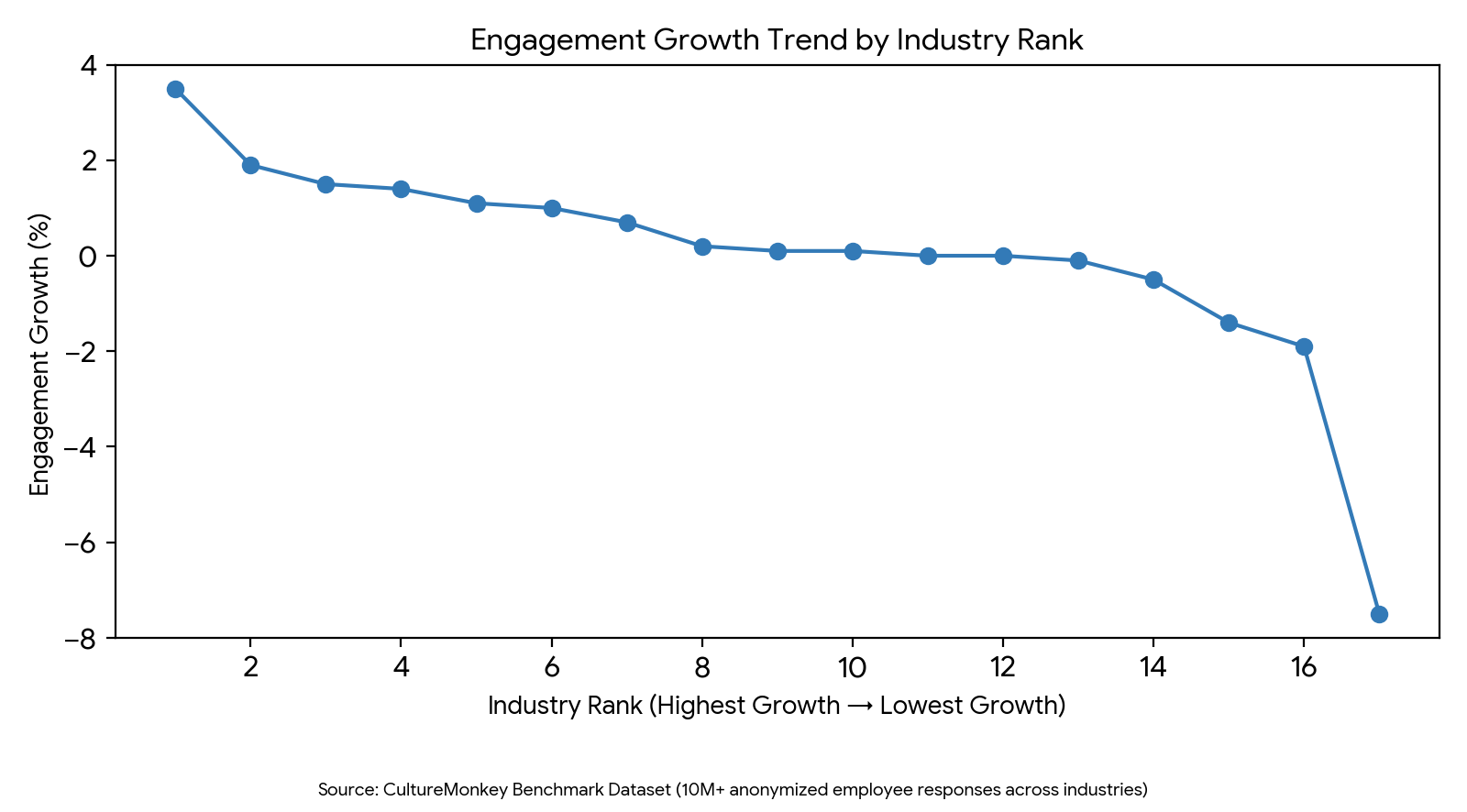
The difference between the highest-growth and lowest-growth industries exceeds 14 percentage points, indicating structural differences in how engagement evolves across sectors.
This variation highlights an important insight:
Employee feedback tools do not produce uniform outcomes across industries.
Instead, engagement movement depends on how organizations activate leadership systems and manager accountability after collecting feedback.
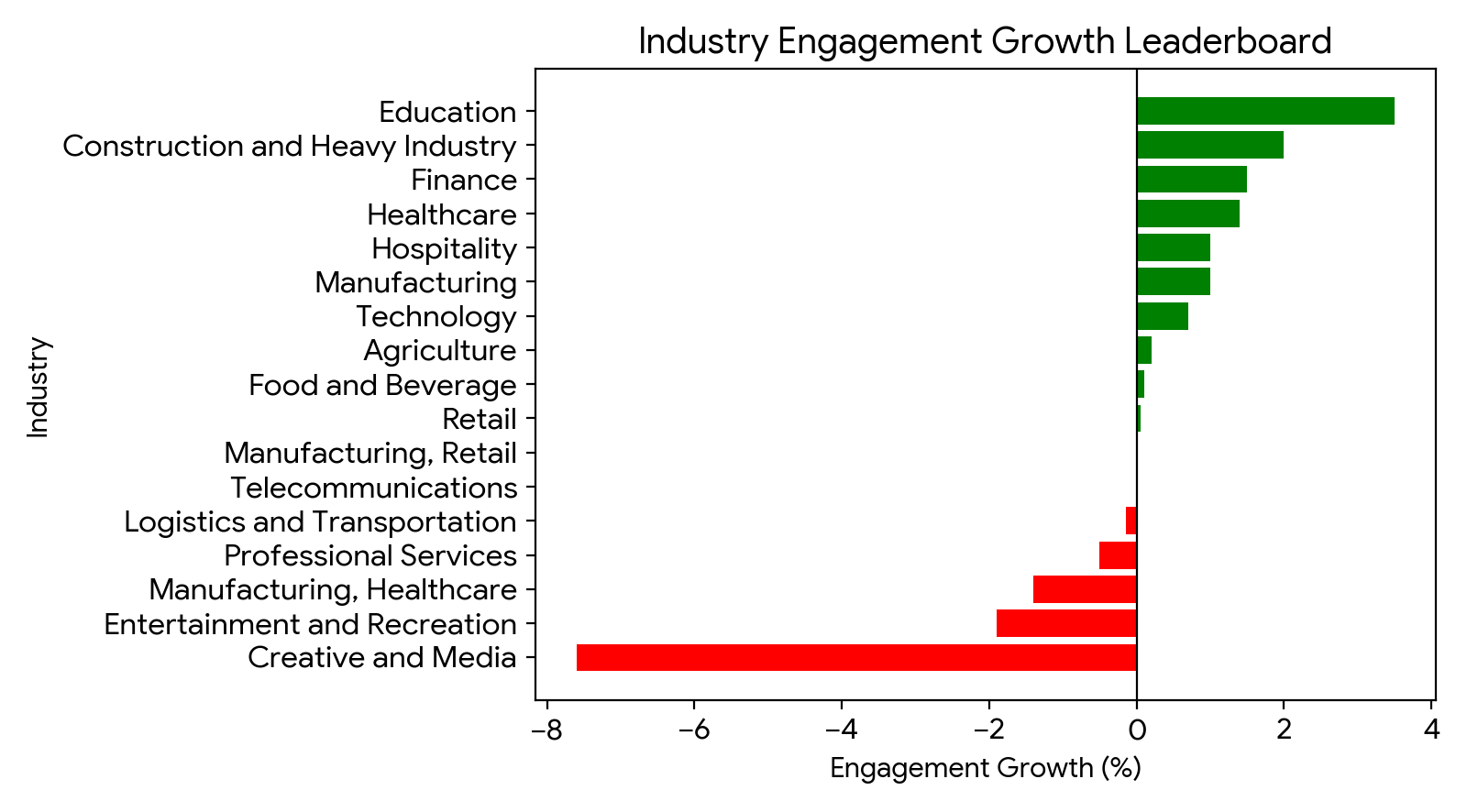
Source: CultureMonkey Benchmark Dataset (10M+ anonymized employee responses across industries)
This visualization highlights the full industry ranking based on engagement growth.
Current trends in employee feedback tools (2026)
While the benchmark analysis highlights how engagement evolves across industries, the broader market for employee feedback tools is also changing rapidly.
Organizations are no longer treating feedback platforms as periodic survey tools. Instead, they are becoming continuous workplace intelligence systems that influence leadership decisions, team management, and organizational strategy.
Based on CultureMonkey research and industry observations, several major trends are shaping the evolution of employee feedback tools in 2026.
1. From annual surveys to continuous listening
Traditionally, organizations relied on annual engagement surveys to understand employee sentiment. Today, many organizations are shifting toward continuous listening models.
This includes:
- quarterly pulse surveys
- always-on feedback channels
- team-level sentiment tracking
- real-time employee voice analytics
Continuous listening allows organizations to detect engagement issues earlier and respond before problems escalate.
However, the benchmark data shows that frequency alone does not drive engagement improvement. Organizations that run more surveys without operational follow-through often see limited engagement movement.
2. Manager activation is becoming the critical layer
Another emerging trend is the increasing focus on manager effectiveness within feedback platforms.
In many organizations, frontline managers influence the daily employee experience more than company-wide policies.
Modern employee feedback tools are therefore introducing features such as:
- manager dashboards
- micro-action recommendations
- team-level engagement insights
- manager coaching guidance
The benchmark data reinforces this trend. Industries with strong engagement growth typically demonstrate consistent manager accountability and follow-through on feedback insights.
3. AI-powered feedback analysis
Artificial intelligence is increasingly being integrated into employee feedback tools.
AI capabilities now help organizations analyze large volumes of feedback through:
- sentiment analysis
- theme clustering
- topic detection
- trend prediction
These capabilities allow leaders to move beyond simple survey scores and understand the underlying drivers behind employee sentiment.
However, AI analysis alone does not guarantee engagement improvement. Organizations must still prioritize action planning and leadership accountability.
4. Benchmarking is becoming a key decision tool
Organizations increasingly want to understand how their engagement performance compares with others in their industry.
This has led to growing demand for benchmark datasets and cross-industry comparisons.
Benchmarking helps leaders answer questions such as:
- Are our engagement scores above or below industry averages?
- Which drivers influence engagement most in our sector?
- How quickly are other organizations improving engagement?
The CultureMonkey dataset used in this report helps provide this context by analyzing engagement movement across industries over time.
5. From reporting platforms to engagement operating systems
Perhaps the most important trend is the transformation of employee feedback tools themselves.
Earlier platforms focused primarily on data collection and reporting. Today, the most advanced platforms function as engagement operating systems that integrate:
- feedback collection
- analytics and benchmarking
- manager activation
- action tracking
- continuous improvement workflows
Organizations increasingly expect feedback tools to drive change, not just produce reports.
Top industries showing engagement growth
Several industries in the dataset demonstrate strong engagement improvement.
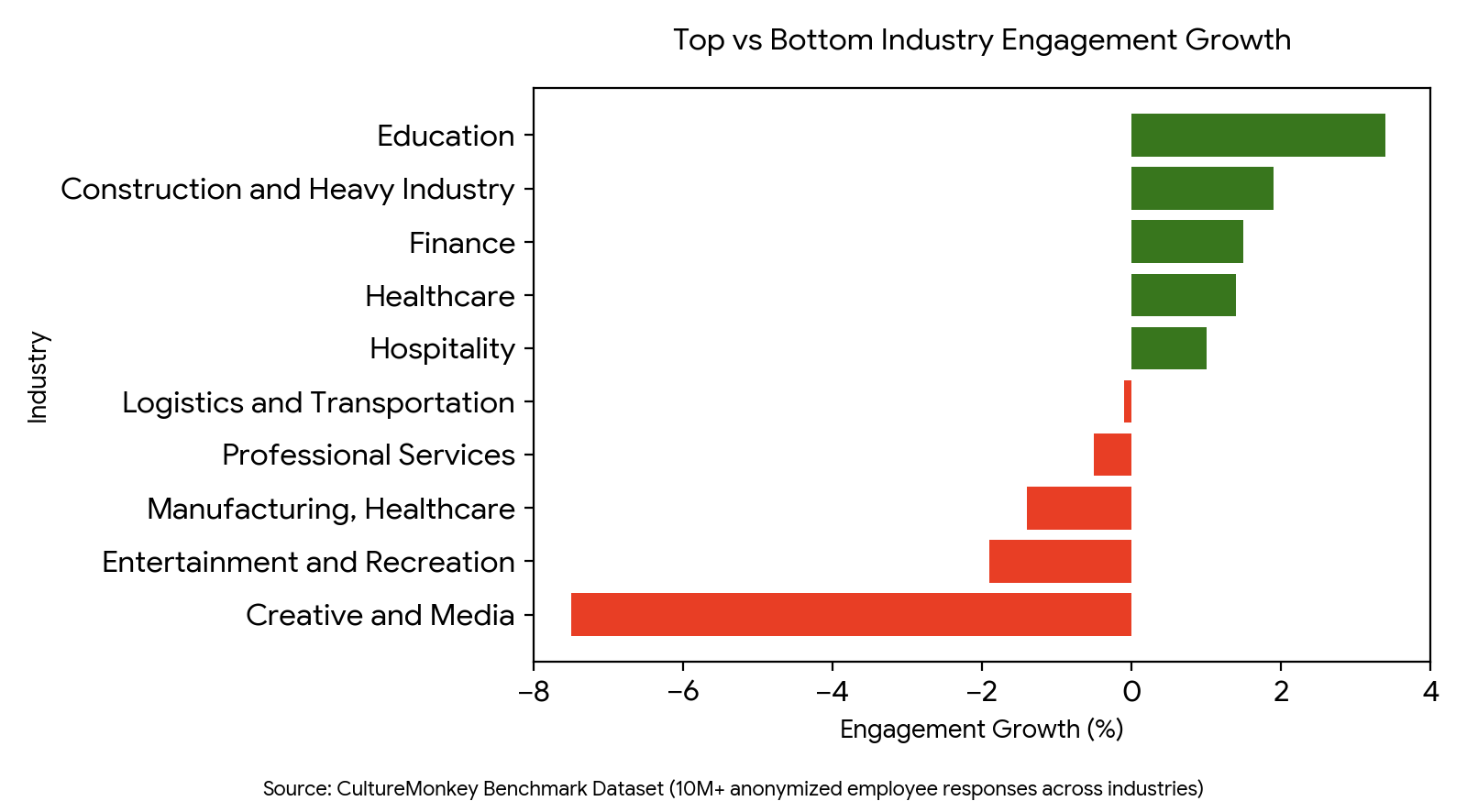
Source: CultureMonkey Benchmark Dataset (10M+ anonymized employee responses across industries)
The strongest engagement growth appears in the following industries:
These results highlight industries where employee feedback systems are more effectively translated into workplace improvements.
While engagement drivers vary by sector, organizations in these industries tend to share several operational characteristics.
Interpretation
Industries showing stronger engagement growth typically demonstrate:
- clear leadership alignment around organizational goals
- strong sense of purpose and mission clarity
- consistent manager accountability for team experience
- structured feedback loops between employees and leadership
In these environments, employee feedback tools are not treated as periodic survey platforms. Instead, they function as ongoing feedback systems that influence management decisions and team-level improvements.
For example:
- Education organizations often have strong mission-driven cultures, which can amplify the impact of employee voice.
- Construction and industrial sectors benefit when frontline managers actively address workforce concerns related to safety, communication, and operational clarity.
- Financial institutions often implement structured leadership and governance systems that make it easier to operationalize employee feedback.
The common thread across these industries is not simply the presence of employee feedback tools.
It is the organizational ability to convert feedback insights into consistent managerial and leadership action.
When feedback becomes part of everyday operational decision-making, engagement improvement becomes more sustainable over time.
Industries showing engagement decline
Not all industries in the benchmark experienced positive engagement movement.
Several sectors showed declining engagement scores across survey cycles, indicating structural challenges in translating employee feedback into meaningful workplace improvements.
Source: CultureMonkey Benchmark Dataset (10M+ anonymized employee responses across industries)
The lowest performing industries include:
These results suggest that engagement decline is often linked to industry-specific operational pressures rather than the absence of employee feedback tools.
For example:
- Creative and media organizations often experience rapid project cycles and evolving business models, which can create uncertainty in leadership communication and career clarity.
- Professional services firms frequently operate in high-pressure client environments, where workload intensity and billable-hour expectations can influence employee experience.
- Logistics and transportation sectors face operational complexity, shift-based work structures, and frontline workforce challenges that require consistent manager engagement.
Across these industries, employee feedback tools may still be widely used. However, engagement improvement often depends on how effectively organizations translate feedback insights into leadership communication, managerial action, and operational change.
Declining engagement does not necessarily indicate that feedback systems are ineffective. Instead, it highlights the importance of aligning employee listening programs with organizational decision-making and frontline management practices.
In industries with high operational complexity, engagement improvement typically requires stronger integration between feedback data, leadership priorities, and day-to-day management practices.
Engagement growth distribution across industries
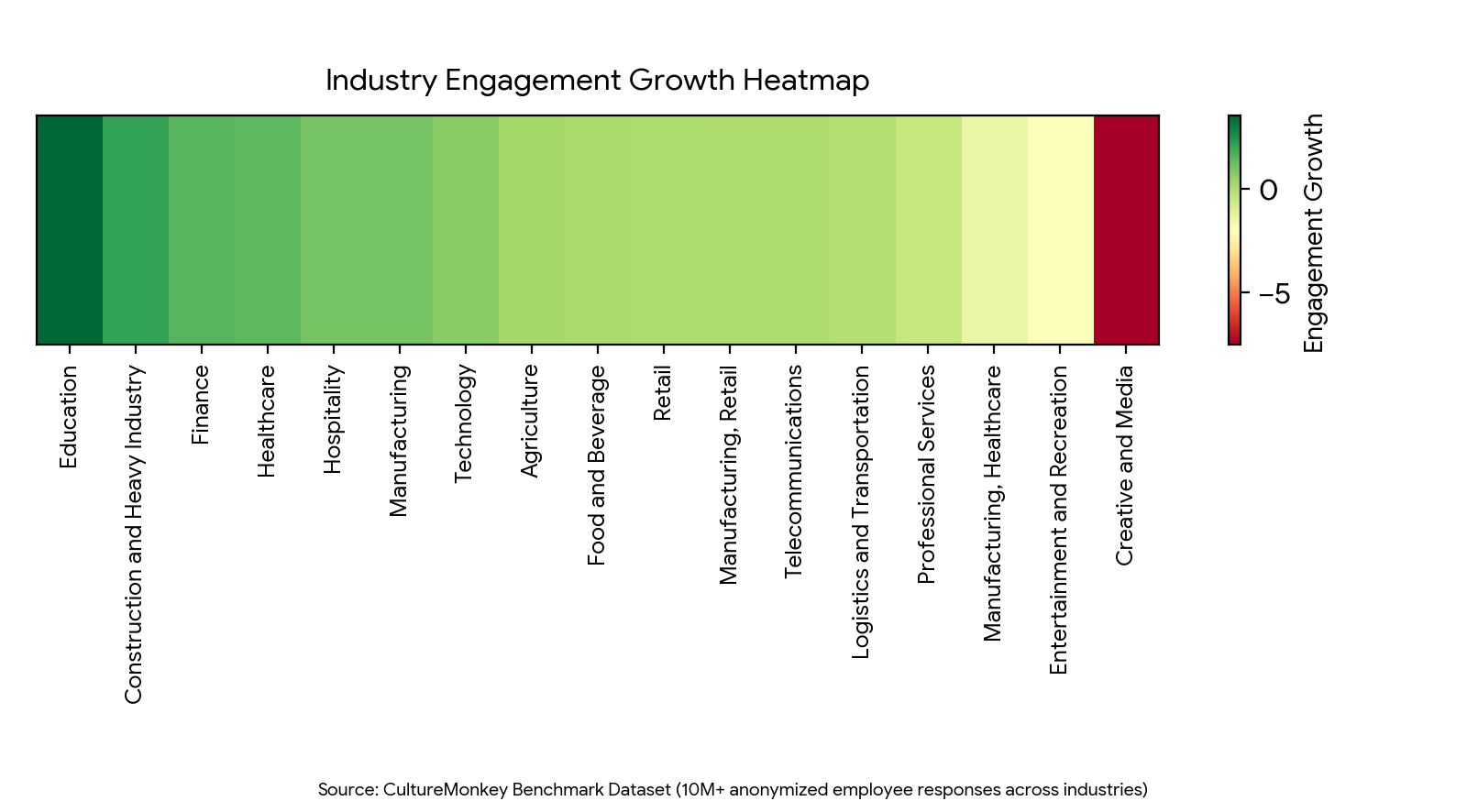
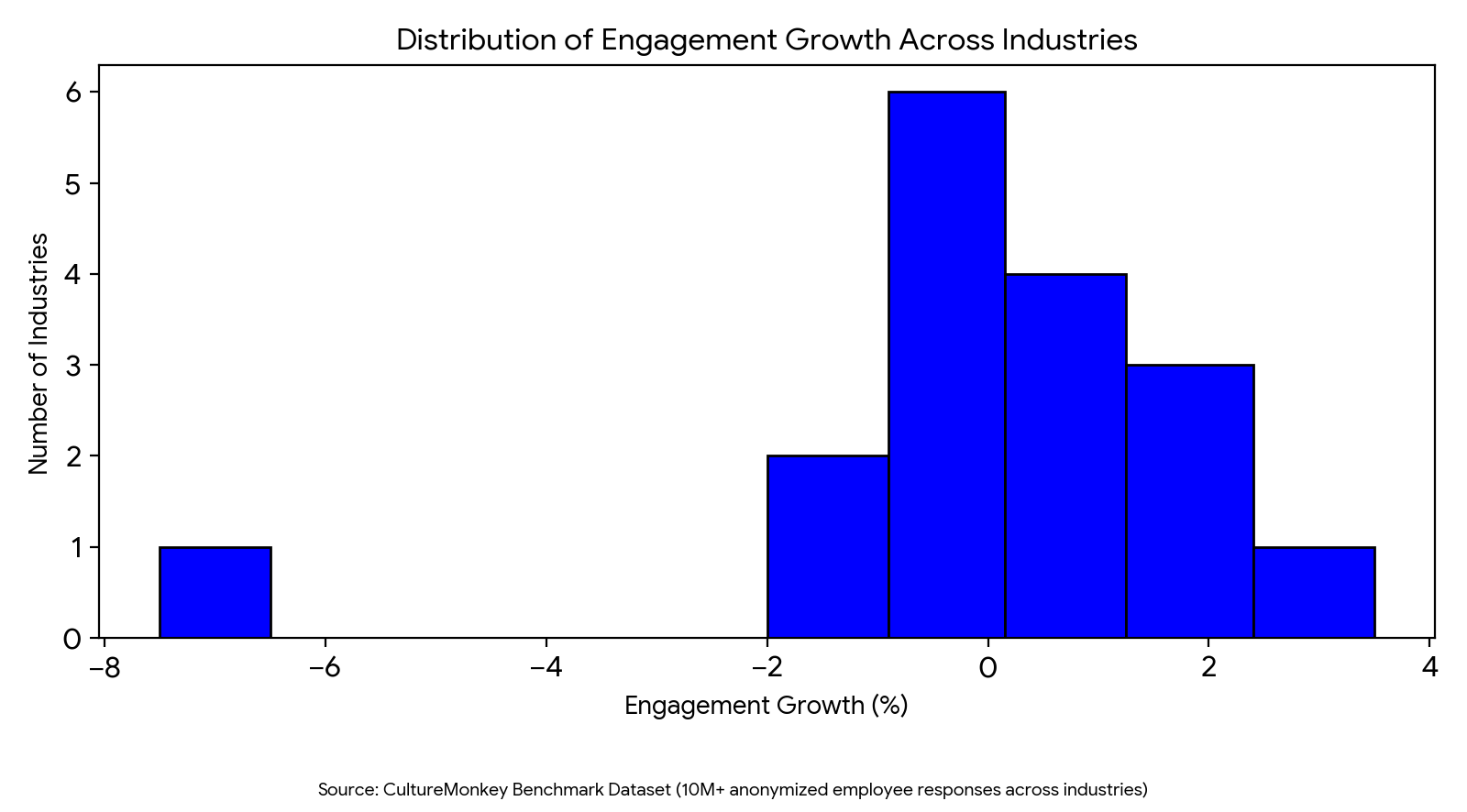
The dataset also reveals that engagement growth across industries follows a clustered distribution pattern rather than a broad upward trend.
Source: CultureMonkey Benchmark Dataset (10M+ anonymized employee responses across industries)
Most industries show engagement movement within a narrow band of -1% to +2%, while only a small number of sectors demonstrate larger engagement improvements.
This pattern highlights an important benchmark insight:
Engagement growth is concentrated rather than universal.
In other words, engagement improvements are typically driven by specific organizational conditions, not by the widespread adoption of employee feedback tools alone.
Industries that show stronger engagement growth tend to combine employee listening programs with:
- clear leadership communication
- consistent manager accountability
- structured action planning after surveys
- continuous feedback loops between employees and leadership
In contrast, industries where engagement remains clustered around minimal movement often treat employee feedback tools primarily as reporting systems rather than operational decision tools.
The distribution pattern observed in the dataset reinforces a key takeaway: Organizations that actively translate feedback insights into leadership and management actions are significantly more likely to achieve measurable engagement improvement over time.
The CultureMonkey Engagement Growth Model
Based on analysis of more than 10 million employee responses, CultureMonkey identified a consistent structural pattern.
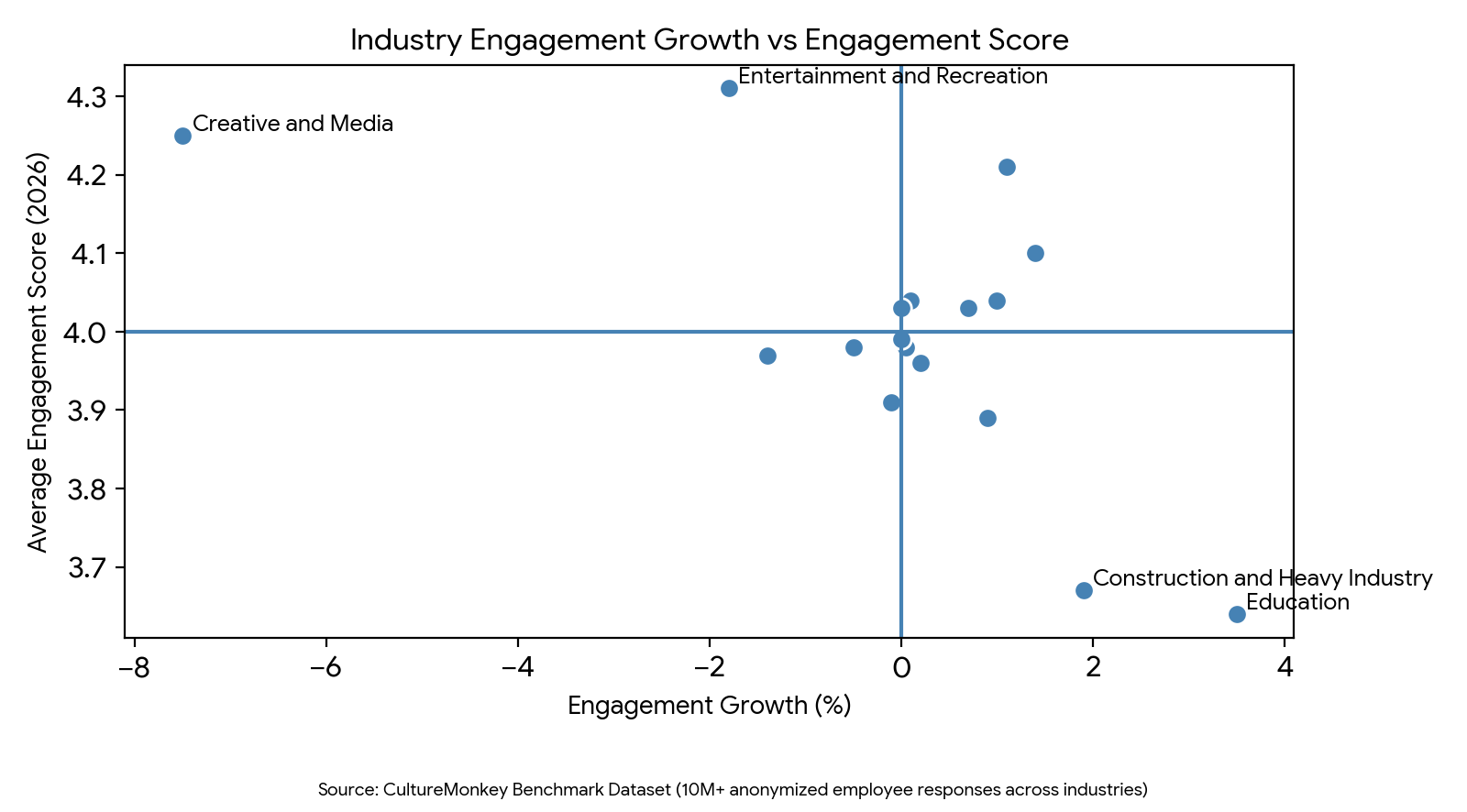
Source: CultureMonkey Benchmark Dataset (10M+ anonymized employee responses across industries)
Engagement Growth = Leadership Clarity + Manager Activation + Employee Involvement
This framework, known as the CultureMonkey Engagement Growth Model, explains why some organizations see measurable engagement lift while others plateau.
Organizations that strengthen these structural drivers consistently outperform organizations that focus primarily on tactical engagement initiatives.
What this means for employee feedback tools
The benchmark reveals that employee feedback tools fall into three categories.
1. Measurement platforms
These tools primarily focus on:
- collecting surveys
- generating dashboards
- reporting sentiment trends
They provide visibility but limited operational impact.
2. Insight platforms
These platforms provide deeper analytics including:
- driver diagnostics
- benchmarking comparisons
- text sentiment analysis
They improve understanding but still require organizations to translate insights into action.
3. Engagement operating systems
The most advanced employee feedback tools enable:
- driver prioritization
- manager accountability
- action tracking
- operational follow-through
CultureMonkey benchmark suggests that organizations using structured execution systems experience significantly higher engagement growth.
Why do most employee feedback tools fail to improve engagement?
One of the most consistent findings across the dataset is that engagement improvement requires prioritization.
Many organizations attempt to improve too many areas simultaneously:
- recognition programs
- wellness initiatives
- culture initiatives
- communication improvements
While these programs matter, they rarely produce sustained growth in engagement without structural alignment.
The data suggests that engagement improvement occurs when organizations focus on a small number of high-impact drivers.
How high-performing companies use employee feedback tools
When selecting employee feedback tools, organizations should evaluate capabilities that drive action, not just insight.
Source: CultureMonkey Benchmark Dataset (10M+ anonymized employee responses across industries)
Key questions include:
- Does the platform highlight the highest-impact engagement drivers?
- Does it provide industry benchmarks?
- Does it activate managers with guided actions?
- Does it track improvement across survey cycles?
- Does it integrate feedback into operational cadence?
The differentiator between platforms is execution architecture not visualization.
What high-growth organizations do differently
Across industries in the dataset, organizations with strong engagement growth follow similar patterns:
- Focus on 2–3 engagement drivers
- Maintain concise survey structures
- Publish results quickly
- Assign clear action ownership
- Empower managers with micro-actions
- Track engagement movement over time
This disciplined approach ensures feedback leads to real change.
CultureMonkey: An Engagement Intelligence Platform
CultureMonkey was built to help organizations convert feedback into engagement improvement.
The platform provides:
- Industry benchmarking
- Driver prioritization frameworks
- Manager activation workflows
- Action tracking systems
- Pulse survey orchestration
By focusing on structural engagement drivers, CultureMonkey enables organizations to move from measuring engagement to improving it.
Book a demo with CultureMonkey.
Final insight
After analyzing more than 10 million employee responses across industries, one pattern becomes increasingly clear. Organisations that improve engagement are not simply better at collecting feedback.
They are better at acting on it consistently.
In high-performing organizations, employee feedback is treated as an operational input that influences leadership behavior, manager effectiveness, and everyday workplace decisions.
In lower-performing organizations, feedback often remains trapped inside dashboards and reports.
The difference is not the amount of feedback collected. It is how organizations translate insight into action.
As employee feedback tools continue to evolve, the most valuable platforms will not be those that generate the most data. They will be the ones who help organizations close the loop between employee voice and organizational change.
For companies looking to build sustainable engagement, the real opportunity lies not in listening more frequently but in acting more deliberately on what employees already say.
FAQs
1. What are employee feedback tools?
Employee feedback tools are platforms that help organizations collect and analyze employee input through surveys, pulse feedback, and listening channels. These tools help leaders understand engagement drivers, workplace sentiment, and opportunities to improve employee experience.
2. Do employee feedback tools increase engagement?
They can increase engagement when feedback insights are translated into real action. Organizations that combine employee listening with leadership accountability and manager follow-through tend to see the strongest engagement improvements.
3. Which industries benefit most from employee feedback tools?
Industries with strong leadership alignment and operational follow-through benefit the most. Sectors such as education, finance, healthcare, and construction show higher engagement growth when employee feedback systems are integrated into leadership decision-making.
4. What is the biggest mistake organizations make when using employee feedback tools?
The most common mistake is trying to improve too many engagement areas at once. High-performing organizations typically focus on two or three high-impact drivers rather than launching multiple initiatives simultaneously.
5. What are the best employee feedback tools in 2026?
The best employee feedback tools combine employee listening, engagement driver analytics, benchmarking, and action tracking. Platforms that activate managers and guide leaders toward the right engagement priorities outperform tools that only measure sentiment.
6. How do employee feedback tools improve engagement?
Engagement improves when feedback insights lead to visible changes. Organizations that prioritize leadership clarity, manager effectiveness, and employee involvement tend to experience the strongest engagement growth over time.
7. How often should companies run employee feedback surveys?
Most high-performing organizations run an annual engagement survey supported by quarterly pulse surveys. The most important factor is not survey frequency but the organization's ability to act quickly on employee feedback.



%3A%20Analysis%20of%2010M%2B%20employee%20responses)