Back to Blog

10+ Best employee pulse survey tools that you should know in 2026

Santhosh
by Santhosh Senior Content Marketer with 4+ years of experience, having written 200+ articles on workplace culture and engagement, bringing research-backed perspectives to every story.
| 56 min read

Employee pulse survey tools help organizations collect frequent, short employee feedback to track engagement, identify workplace issues early, and guide leadership decisions.

To help HR leaders choose the right platform, we reviewed and compared leading pulse survey tools used by organizations across the US, Europe, and Asia. Our evaluation considered survey capabilities, analytics depth, integrations, security standards, pricing transparency, and user reviews.

According to Deloitte’s Global Human Capital Trends report, organizations with continuous listening programs are significantly more likely to improve employee engagement and retention outcomes.

eNPS Dashboard Illustration

Capture Quick Employee Feedback With Deeper Pulse Insights

  • Automated Pulse Scheduling
  • Mobile-First Survey Access
  • Protected Anonymous Feedback
  • Enterprise Grade Security
Talk to Sales

What are pulse survey tools?

Employee pulse survey tools are platforms that help organizations collect frequent, short employee feedback surveys to monitor engagement, workplace sentiment, and team morale. HR leaders use them to identify issues early, track engagement trends over time, and take data-driven actions to improve employee experience and retention.

Employee pulse survey tool best practices

Top employee pulse survey tools comparison

Name Best for G2 score Pricing
CultureMonkey Enterprises running continuous pulse surveys with anonymous feedback and analytics 4.7 Contact sales
Vantage Circle Companies combining pulse surveys with employee recognition and rewards programs 4.7 Contact sales
TINYpulse Small to mid-sized teams seeking simple pulse surveys and anonymous employee suggestions 4.4 Contact sales
Workday Peakon Large enterprises running global employee listening and engagement benchmarking programs 4.6 Contact sales
15Five Teams linking pulse surveys with performance check-ins and goal tracking 4.6 From $4 per user/month
Qualtrics Enterprises running advanced employee experience and workforce research programs 4.4 Contact sales
Culture Amp Organizations measuring engagement drivers alongside employee development insights 4.5 Contact sales
Officevibe Small and mid-sized teams looking for simple manager-focused engagement tracking 4.3 From $3.50 per user/month
WorkTango Companies combining pulse surveys with recognition and employee experience programs 4.7 Contact sales
Leapsome Organizations connecting pulse surveys with performance and learning tools 4.5 Contact sales
Lattice Companies integrating pulse surveys with performance reviews and goal management 4.7 From $11 per user/month
Quantum Workplace Organizations measuring engagement trends with benchmarking and analytics 4.4 From $4 per user/month

10+ Best employee pulse survey tools

Here is the list of the top 10+ best employee pulse survey tools and their unique features that help you boost your company culture:

1. CultureMonkey

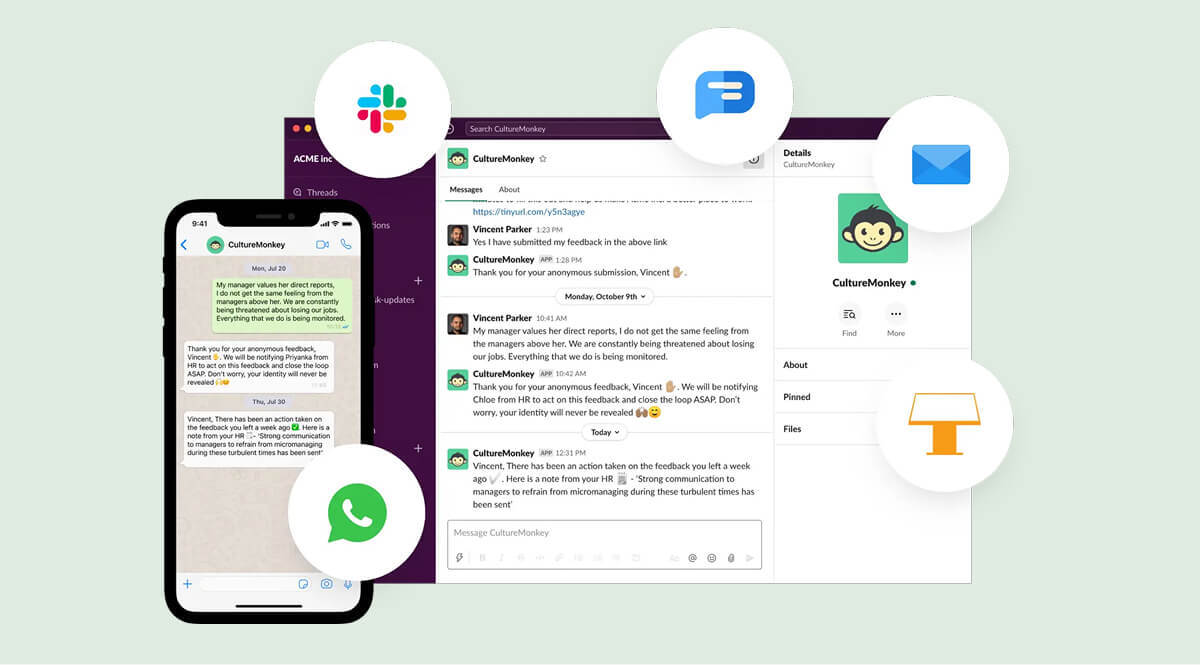
CultureMonkey is an employee pulse survey tool designed for organizations that want to run frequent engagement surveys and turn feedback into clear action. HR teams use it to collect anonymous employee feedback, analyze engagement drivers, and identify workplace issues early through dashboards, AI insights, and manager-level analytics.

Brands using CultureMonkey

See why leading enterprises
choose CultureMonkey over
other pulse survey tools

Feature Advantages
Real-time feedback and analytics Collect and analyze employee feedback as surveys are completed, helping HR teams identify engagement trends and address workplace concerns quickly.
Easy survey creation with research-backed templates Create and launch pulse surveys quickly using pre-built, research-backed templates designed to capture meaningful employee feedback.
HRIS and workplace integrations Connect with HR systems and collaboration tools such as Darwinbox, Zoho People, Slack, Microsoft Teams, and WhatsApp to distribute surveys and manage employee data seamlessly.
Mobile-friendly multilingual surveys Enable employees across locations and roles to participate through mobile-friendly surveys available in multiple languages.
Anonymous employee feedback Encourage honest responses by allowing employees to share feedback anonymously, helping organizations capture more accurate workplace insights.
Engagement analytics and benchmarking Visual dashboards, engagement heat maps, and industry benchmarks help HR teams understand engagement drivers and compare results over time.
AI-powered insights and text analysis Analyze open-ended responses and feedback themes using AI-powered sentiment analysis to surface key engagement patterns and action areas.

Susan Gardner

In just seven days, CultureMonkey designed and launched our survey to 2,000 employees across multiple geographies and in five languages. A feat that would normally take 45 days.

Susan Gardner CHRO

CultureMonkey overview

Pricing: Contact sales

Rating: 4.7 / 5 (G2)

Best for: Enterprise organizations running pulse surveys and lifecycle listening across distributed or frontline workforces.

Why we picked it: Provides pulse surveys, lifecycle listening, and manager dashboards in one platform, helping HR teams analyze engagement trends and act on employee feedback faster.

Cons: Exporting advanced analytics or presentation-ready reports may require additional configuration.

Key features:

  • Multi-channel survey distribution through Slack, Microsoft Teams, email, WhatsApp, SMS, and QR codes
  • Lifecycle listening programs covering onboarding, engagement, and exit feedback
  • Manager dashboards that translate employee feedback into team-level insights and action plans

Take a quick interactive tour inside CultureMonkey:

See how United Bank boosted participation by 80% with CultureMonkey.
Download case study


2. Vantage Circle

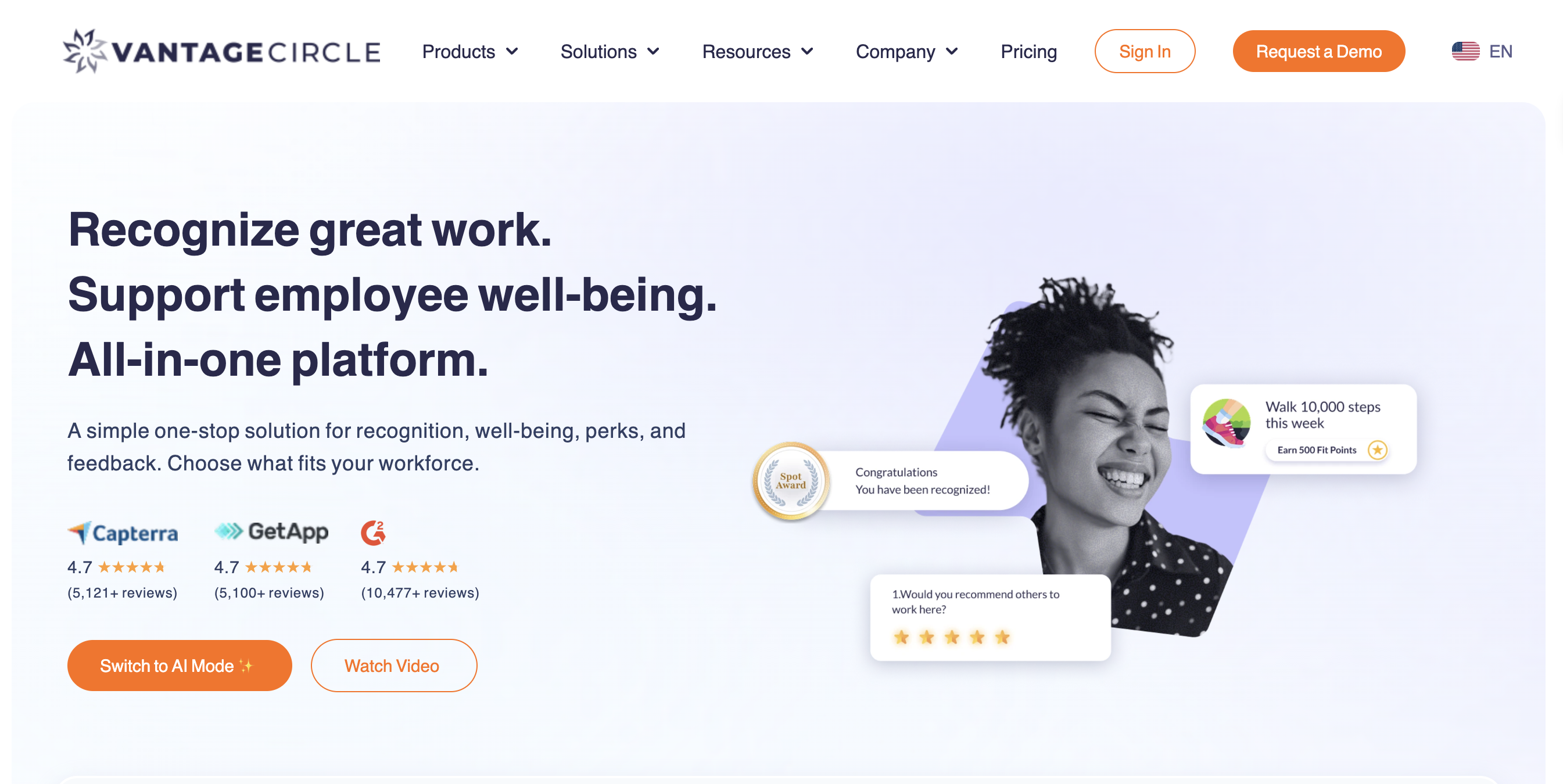
Vantage Circle is an employee engagement and pulse survey platform used by HR teams to measure employee sentiment and track workplace culture trends. It provides eNPS surveys, feedback analytics, and recognition tools to help organizations monitor engagement levels and identify areas where employee experience improvements may be needed.

Feature Advantages
eNPS-Based Surveys Quickly measure employee loyalty and satisfaction through concise, standardized questions.
Real-Time Analytics Dashboard Access immediate insights into employee engagement levels, facilitating prompt decision-making.
Automated Survey Scheduling Set up recurring surveys effortlessly, ensuring consistent feedback collection without manual intervention.
Multi-Language Support Cater to a diverse workforce by offering surveys in over 14 languages, enhancing inclusivity.
Anonymous Feedback Mechanism Encourage honest responses by guaranteeing respondent anonymity, leading to more genuine insights.

Vantage Circle's overview

Pricing: Contact sales

Rating: 4.7 / 5 (G2)

Best for: Organizations that want to combine employee pulse surveys with recognition and rewards programs to monitor engagement and workplace sentiment.

Why we picked it: Combines pulse surveys, eNPS measurement, and recognition tools in one platform, allowing HR teams to track engagement trends while reinforcing positive workplace behaviors.

Cons: Organizations primarily looking for deep employee listening analytics may find some survey insights less advanced than specialized engagement platforms.

Key features:

  • Pulse surveys and eNPS measurement to track employee sentiment regularly
  • Real-time engagement dashboards that highlight workplace culture trends
  • Integrated recognition and rewards programs that encourage peer appreciation


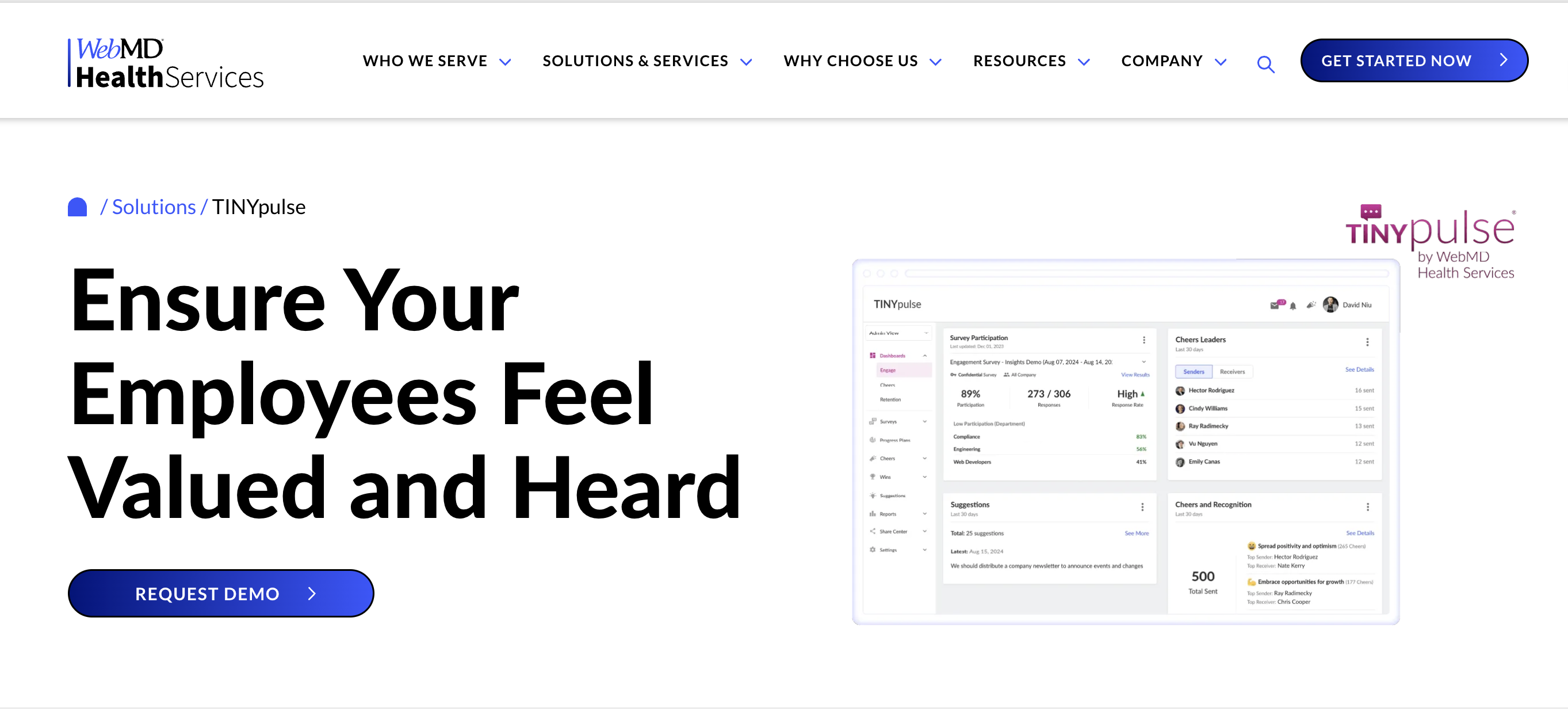
3. TINYpulse

TINYpulse is a pulse survey and employee listening tool that helps organizations collect regular employee feedback through short surveys and anonymous suggestions. HR teams use it to monitor engagement trends, encourage peer recognition, and understand workplace sentiment across teams through recurring pulse checks.

Feature Advantages
Weekly Pulse Surveys Regularly gauge employee sentiment with brief, focused surveys, allowing for timely interventions.
Cheers for Peers Recognition Tool Foster a culture of appreciation by enabling employees to recognize each other's contributions.
Anonymous Suggestions Platform Provide a safe space for employees to share candid feedback and innovative ideas anonymously.
Customizable Survey Questions Tailor surveys to address specific organizational needs and areas of interest.
Comprehensive Reporting and Analytics Analyze feedback trends over time with detailed reports, aiding in strategic planning.

TINYpulse overview

Pricing: Contact sales

Rating: 4.4 / 5 (G2)

Best for: Small and mid-sized organizations that want simple pulse surveys and anonymous feedback channels to monitor employee sentiment.

Why we picked it: Offers lightweight pulse surveys and anonymous suggestion tools that help HR teams gather frequent feedback and identify workplace concerns without complex survey setup.

Cons: Advanced analytics and enterprise-scale reporting capabilities may be limited for larger organizations managing complex engagement programs.

Key features:

  • Weekly pulse surveys designed to capture quick employee feedback
  • Anonymous suggestion channels that encourage candid employee input
  • Recognition features that support peer appreciation and positive workplace culture


4. Workday Peakon

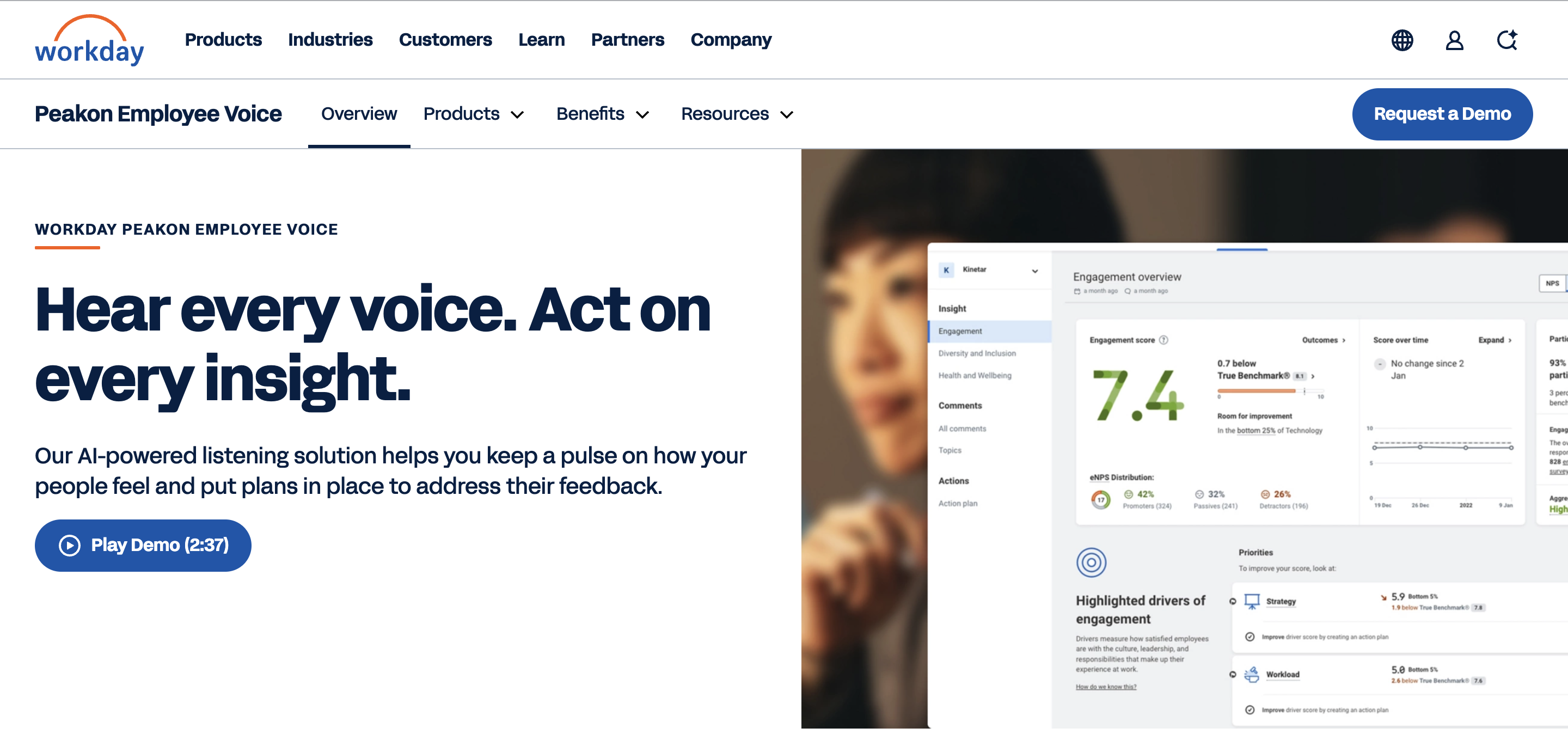
Workday Peakon is an employee engagement platform that helps enterprises run continuous listening programs using pulse surveys and analytics. HR leaders use it to monitor engagement trends, benchmark employee sentiment, and generate insights that support leadership decision-making across large and distributed organizations.

Feature Advantages
Continuous Listening Mechanism Collect employee feedback continuously to monitor engagement in real time and respond quickly to emerging workplace issues.
Personalized Insights for Managers Provide managers with tailored recommendations and team-level insights to address engagement challenges effectively.
Benchmarking Against Industry Standards Compare organizational engagement metrics with industry peers to identify strengths and improvement opportunities.
Advanced Natural Language Processing (NLP) Analyze open-ended feedback using NLP to surface sentiment patterns, themes, and emerging employee concerns.
Integration with Workday HCM Suite Combine engagement insights with HR data from the Workday HCM platform for a unified view of workforce experience.

Workday Peakon overview

Pricing: Contact sales

Rating: 4.6 / 5 (G2)

Best for: Large enterprises running continuous employee listening programs across global teams.

Why we picked it: Offers continuous pulse surveys with advanced analytics and benchmarking, helping HR leaders monitor engagement trends and identify drivers of employee experience at scale.

Cons: Implementation and analytics configuration may require more time and expertise compared to lighter pulse survey tools.

Key features:

  • Continuous pulse surveys designed for large workforce listening programs
  • Advanced engagement analytics with driver analysis and benchmarking
  • Integration with Workday HCM to connect engagement data with HR metrics

Read: Peakon alternatives.


5. 15five

15Five is a performance management and employee engagement platform that includes pulse surveys to help HR teams monitor employee sentiment and team alignment. Organizations use it to collect regular feedback, track engagement trends, and connect employee insights with performance goals and manager check-ins.

Feature Advantages
Weekly Check-Ins Maintain consistent communication between employees and managers, helping teams stay aligned and improving workplace transparency.
High Five Recognition Feature Promote a positive work culture by enabling employees to recognize and appreciate peers for their contributions.
Customizable Pulse Surveys Create pulse surveys that align with organizational priorities and current initiatives to gather targeted employee feedback.
Objective and Key Results (OKR) Tracking Align individual and team objectives with company goals, helping employees stay focused on measurable outcomes.
Comprehensive Reporting Dashboard Track engagement trends and performance insights through visual dashboards designed to support informed decision making.

15Five overview

Pricing: Starting at $4 per user / month

Rating: 4.6 / 5 (G2)

Best for: Organizations that want to combine pulse surveys with performance management and regular manager check-ins.

Why we picked it: Connects employee pulse surveys with weekly check-ins, goal tracking, and performance conversations, helping managers monitor team sentiment alongside productivity and development.

Cons: Organizations primarily looking for deep employee listening analytics may find the survey capabilities less specialized than dedicated engagement platforms.

Key features:

  • Pulse surveys and engagement check-ins designed for continuous feedback
  • Weekly employee check-ins that help managers monitor team sentiment
  • Goal tracking and performance insights linked to engagement feedback

Read: 15Five alternatives.


AI-powered insights with CultureMonkey

Track Workforce Sentiment with Smarter Pulse Surveys

Capture real-time employee feedback and detect engagement shifts early with pulse surveys designed for honest responses.


6. Qualtrics XM

Qualtrics XM is an enterprise experience management platform that offers employee pulse surveys as part of its broader employee experience suite. Large organizations use it to run structured feedback programs, analyze workforce sentiment, and connect engagement insights with operational and HR data.

Feature Advantages
Flexible Survey Scheduling Customize the frequency and timing of pulse surveys to match organizational needs and collect feedback at the right moments.
Advanced Analytics and Reporting Use robust analytics and reporting tools to interpret survey results and support data-driven HR decisions.
Integration with Existing Systems Connect with HRIS and enterprise systems to consolidate engagement insights alongside broader workforce data.
Action Planning Tools Turn employee feedback into structured action plans using built-in tools designed to support continuous improvement.
Global Benchmarking Compare engagement scores against global industry benchmarks to identify strengths and improvement opportunities.

Qualtrics XM overview

Pricing: Contact sales

Rating: 4.4 / 5 (G2)

Best for: Large enterprises that want pulse surveys as part of a broader employee experience and research platform.

Why we picked it: Provides advanced survey design, workforce analytics, and experience management tools that allow HR teams to analyze employee sentiment alongside operational and customer experience data.

Cons: Implementation and platform complexity can be higher for organizations looking only for simple pulse survey capabilities.

Key features:

  • Pulse surveys designed for continuous employee listening programs
  • Advanced analytics and reporting for workforce sentiment analysis
  • Integrations with HR systems and operational data platforms

Read: Qualtrics XM alternatives.


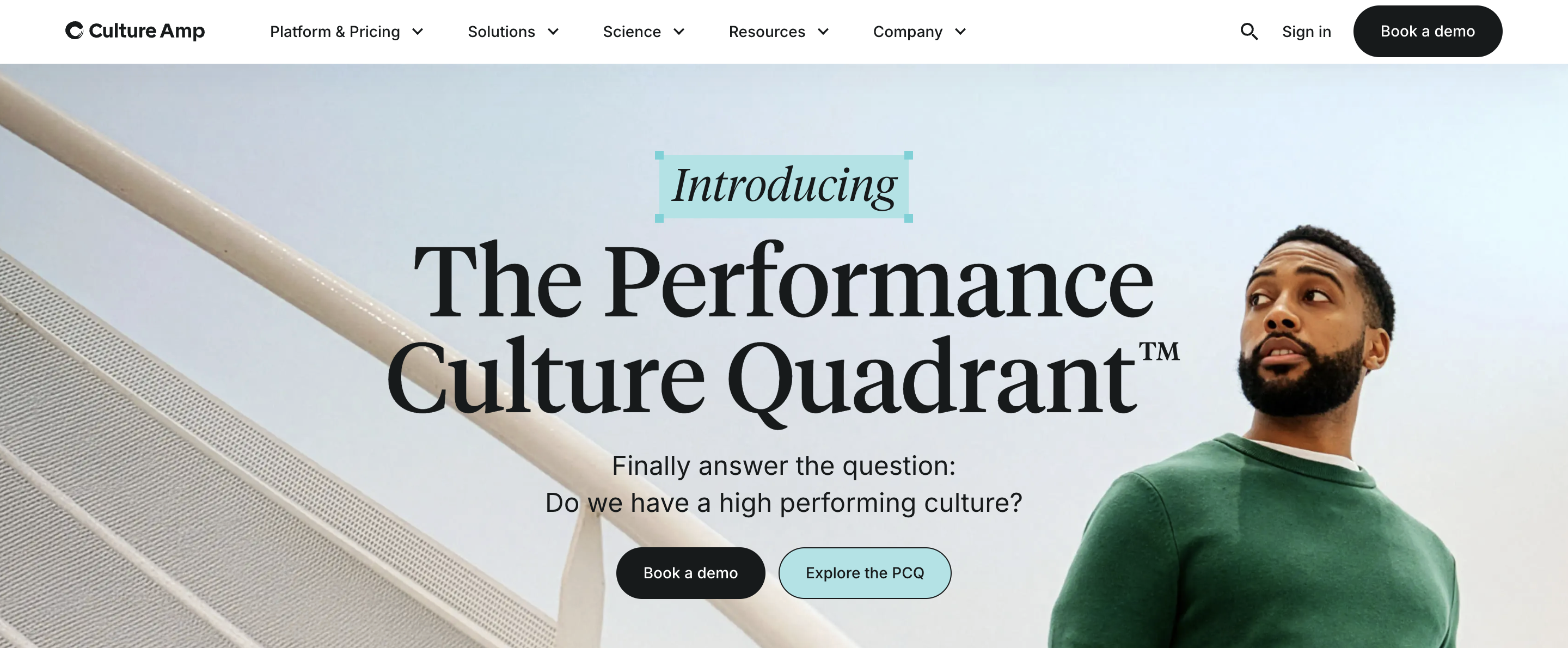
7. Culture Amp

Culture Amp is an employee engagement platform that supports pulse surveys, engagement surveys, and employee development programs. HR teams use it to measure employee sentiment, analyze engagement drivers, and generate insights that help leaders improve workplace culture and employee experience.

Feature Advantages
Research-Backed Survey Templates Access a library of scientifically designed survey templates that help organizations collect reliable and meaningful employee feedback.
Real-Time Feedback Mechanism Gather immediate employee feedback to identify workplace concerns early and respond quickly to engagement challenges.
Comprehensive Reporting Dashboard Visualize engagement insights through interactive dashboards that make it easier to track trends and highlight improvement areas.
Manager-Specific Insights Provide managers with team-level insights and tailored recommendations to help them improve engagement and team performance.
Continuous Development Tools Enable ongoing employee growth through integrated development tools that encourage continuous feedback and learning.

Culture Amp overview

Pricing: Contact sales

Rating: 4.5 / 5 (G2)

Best for: Mid-to-large organizations that want pulse surveys combined with engagement surveys and employee development programs.

Why we picked it: Provides pulse surveys and engagement analytics with tools for leadership development and employee feedback, helping HR teams monitor workplace sentiment and identify engagement drivers.

Cons: Some organizations may require additional customization to align survey analytics with specific internal reporting frameworks.

Key features:

  • Pulse surveys designed to track employee engagement trends
  • Engagement analytics with driver analysis and benchmarking
  • Manager insights that help leaders act on employee feedback

Read: Culture Amp alternatives.


8. Workleap Officevibe

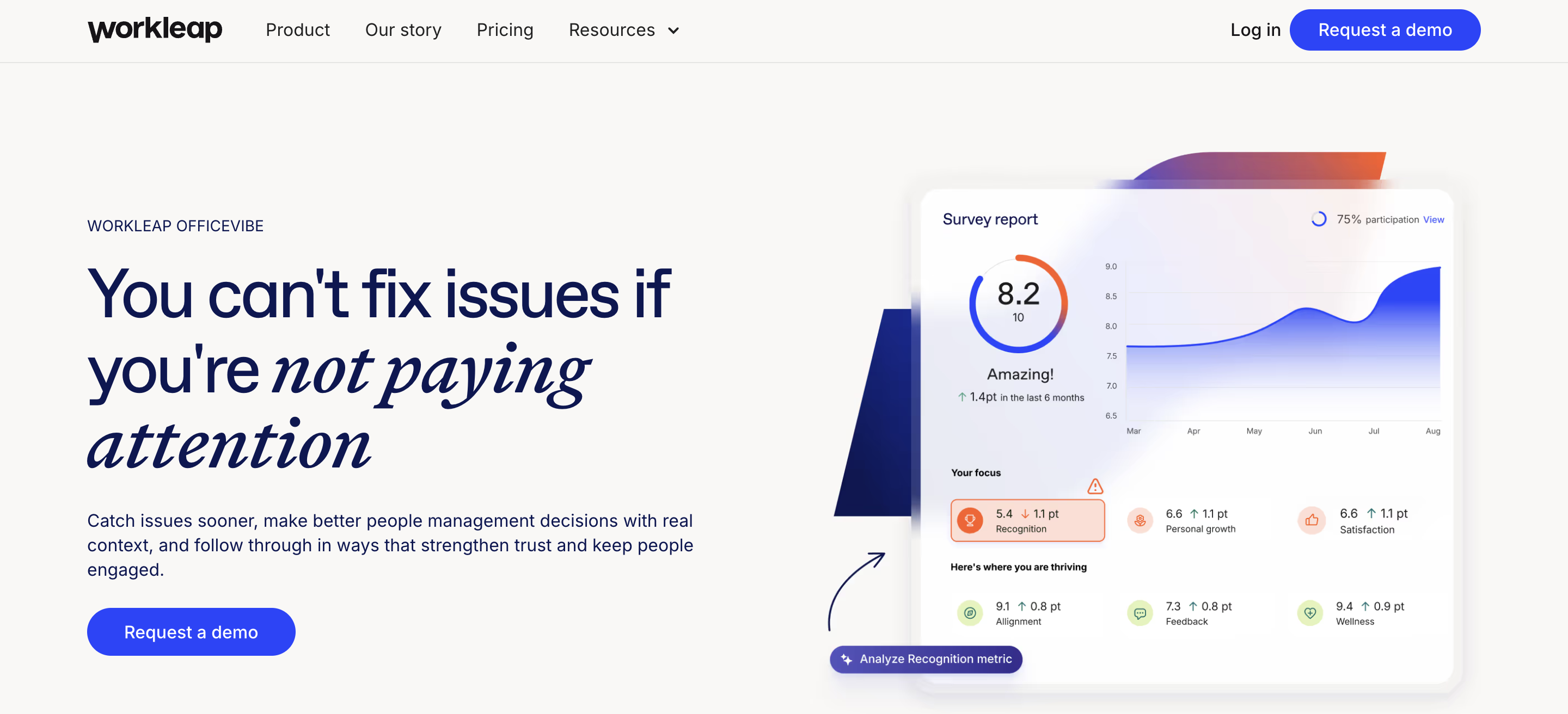
Officevibe is a pulse survey and employee feedback platform designed to help managers collect regular team feedback and monitor engagement. Organizations use it to run short pulse surveys, identify workplace concerns, and track employee sentiment through simple dashboards and reporting tools.

Feature Advantages
Automated Pulse Surveys Schedule recurring surveys easily, helping organizations collect employee feedback consistently without manual effort.

Anonymous Feedback Channels Enable employees to share feedback confidentially, encouraging more honest and open communication across the workplace.
Customizable Survey Questions Design surveys that address specific organizational challenges and priorities, making feedback more relevant and actionable.
Real-Time Reporting and Analytics Access immediate engagement insights through dashboards that help leaders identify issues and respond quickly.
Integration with Collaboration Tools Integrate with platforms such as Slack and Microsoft Teams to distribute surveys and collect feedback within existing workflows.

Officevibe overview

Pricing: Starting at $3.50 per user / month

Rating: 4.3 / 5 (G2)

Best for: Small and mid-sized teams that want simple pulse surveys and manager-focused engagement insights.

Why we picked it: Offers lightweight pulse surveys and manager dashboards that help teams track employee sentiment and identify workplace concerns without complex survey configuration.

Cons: Organizations requiring advanced workforce analytics or enterprise-scale benchmarking may find the reporting capabilities more limited.

Key features:

  • Automated pulse surveys that collect frequent employee feedback
  • Manager dashboards that highlight engagement trends and team sentiment
  • Anonymous feedback channels that encourage open employee input

Read: Officevibe alternatives.


Compare Clipart

Build Stronger Teams with Continuous Pulse Feedback

Explore how CultureMonkey turns pulse feedback into insights leaders can act on.

Speak to experts


9. WorkTango

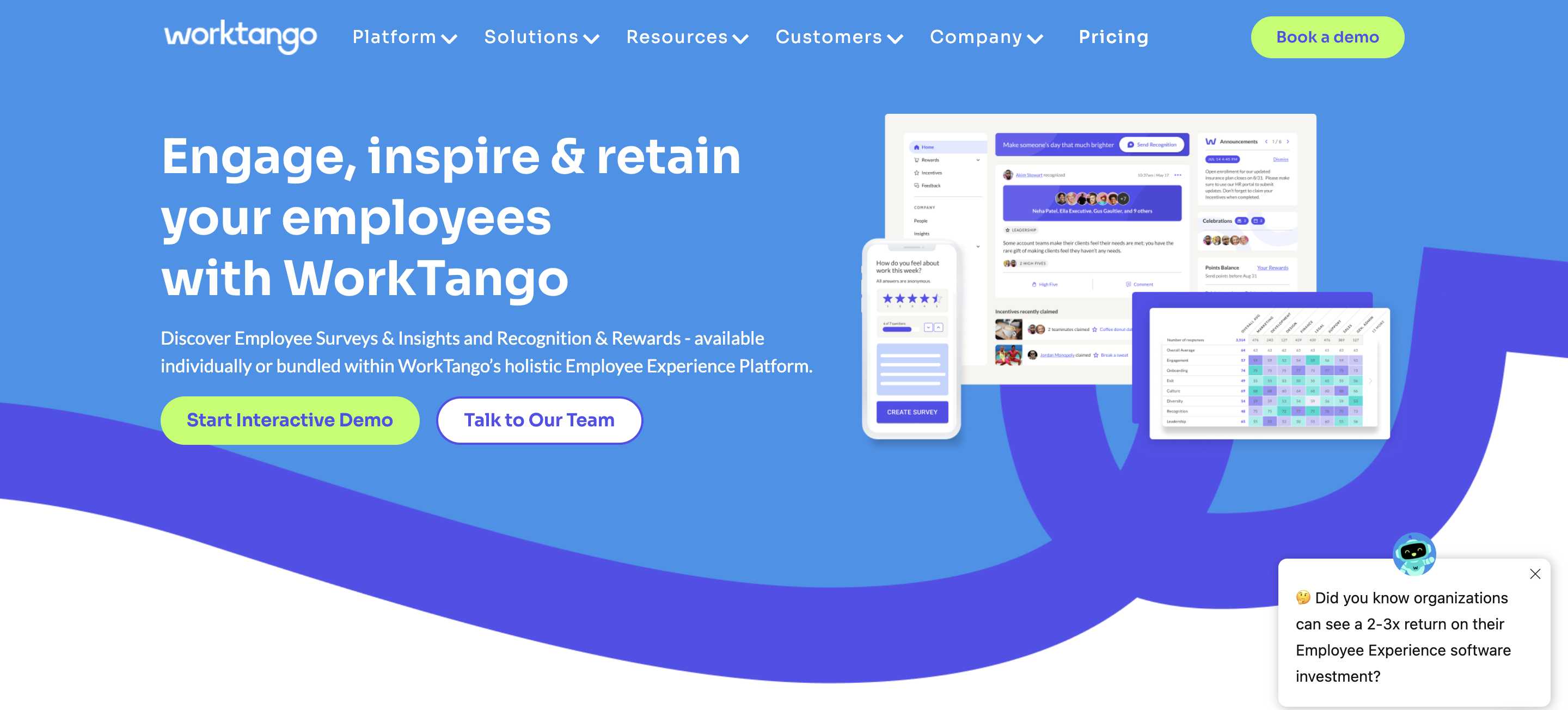
WorkTango is an employee experience platform that includes pulse surveys, recognition tools, and engagement analytics. HR teams use it to collect ongoing employee feedback, monitor engagement levels, and convert survey insights into action plans that support workplace culture and employee experience improvements.

Feature Advantages
Employee Lifecycle Surveys Capture employee feedback across key moments such as onboarding, engagement, and exit, helping organizations understand the full employee experience.
Real-Time Dashboards and Insights Provide immediate visibility into engagement metrics through dashboards that help leaders identify issues and act quickly.
Anonymous Conversations Enable employees to share honest feedback through anonymous dialogue channels that promote openness and psychological safety.
Action Planning Tools Convert engagement insights into structured action plans that support continuous improvement and accountability.
Benchmarking Capabilities Compare engagement results against industry benchmarks to highlight strengths and identify areas that need improvement.
WorkTango overview

Pricing: Contact sales

Rating: 4.7 / 5 (G2)

Best for: Organizations that want pulse surveys combined with recognition and employee experience programs.
Why we picked it: Provides pulse surveys, engagement analytics, and recognition tools that help HR teams monitor employee sentiment and translate survey insights into structured action plans.

Cons: Organizations looking primarily for lightweight pulse survey tools may find the broader platform features more extensive than required.

Key features:

  • Pulse surveys designed for continuous employee listening
  • Engagement dashboards that track workplace sentiment and trends
  • Action planning tools that help convert survey insights into improvements


10. Leapsome

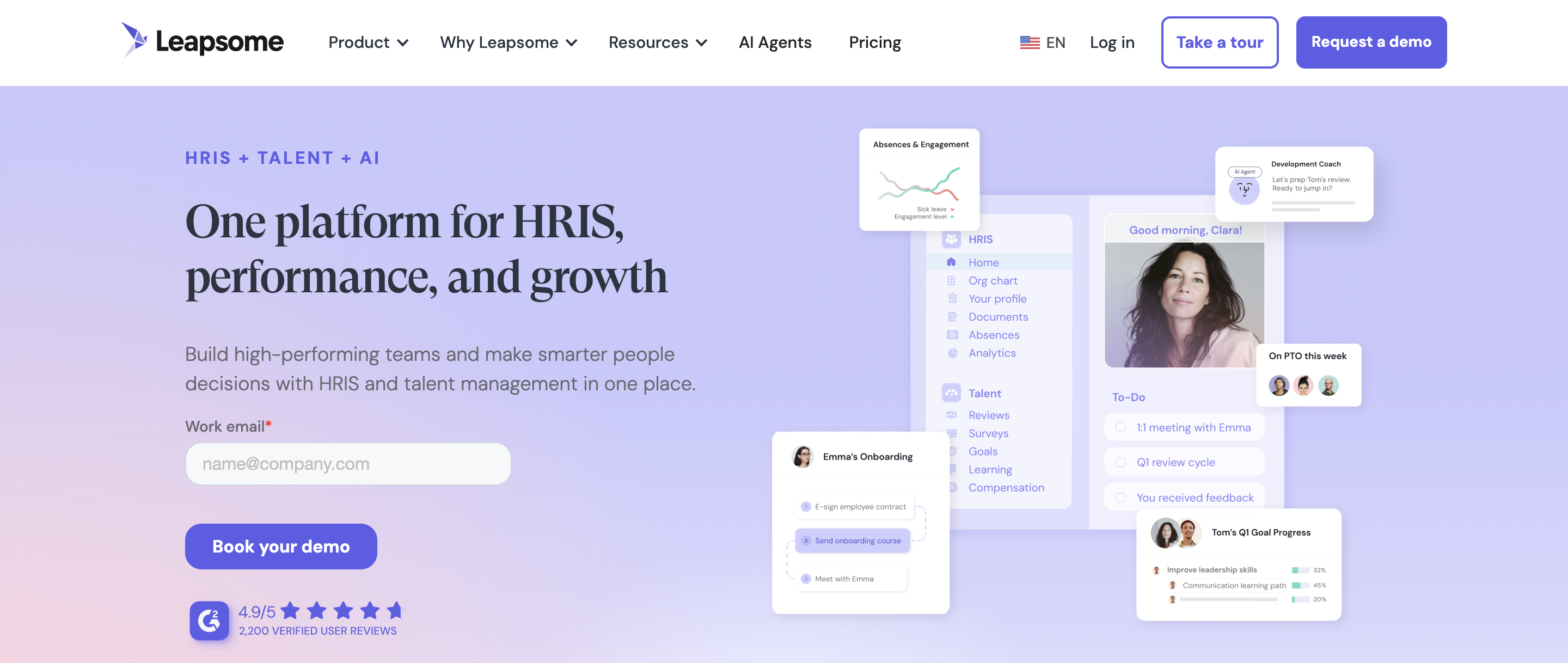
Leapsome is a people enablement platform that combines pulse surveys with performance management and employee development tools. Organizations use it to gather employee feedback, track engagement signals, and connect survey insights with performance and learning initiatives across teams.

Feature Advantages
Customizable Pulse Surveys Allows organizations to tailor surveys to specific goals and priorities, helping collect feedback that reflects real workplace needs.
Sentiment Analysis with AI Uses AI to analyze open-ended responses and uncover deeper employee sentiment patterns and feedback themes.
Anonymous Conversations Supports follow-up discussions with employees while maintaining anonymity, encouraging open and honest communication.
Integration with Performance Metrics Connects engagement insights with performance data to provide a broader understanding of employee well-being and productivity.
Actionable Analytics Provides analytics that highlight relationships between engagement and performance, helping leaders make informed strategic decisions.

Leapsome overview

Pricing: Contact sales

Rating: 4.5 / 5 (G2)

Best for: Organizations that want pulse surveys integrated with performance management and employee development.

Why we picked it: Combines pulse surveys with performance reviews, goal tracking, and learning tools, allowing HR teams to monitor employee sentiment alongside development and performance insights.

Cons: Organizations focused primarily on advanced engagement analytics may find some survey insights less specialized than dedicated employee listening platforms.

Key features:

  • Pulse surveys designed to monitor employee engagement and sentiment
  • Engagement analytics that highlight trends and feedback patterns
  • Integration with performance management and employee development programs

Read: Leapsome alternatives.


eNPS Dashboard Illustration

Strengthen Workplace Culture with Pulse Survey Insights

  • Automated pulse surveys for continuous feedback
  • Secure anonymous feedback employees trust
  • Real-time dashboards to surface engagement risks
Talk to Sales


11. Lattice

Lattice is a performance management and employee engagement platform that offers pulse surveys to help organizations monitor workforce sentiment. HR teams use it to collect regular feedback, track engagement trends, and connect employee insights with performance reviews and development programs.

Feature Advantages
Pulse Surveys Collect continuous, real-time insights into employee engagement, helping organizations identify improvement areas early.
Employee Engagement Surveys Provide deeper survey insights that help organizations understand employee sentiment and workplace experience.
Real-Time Reporting Enable leaders, managers, and teams to access engagement metrics instantly through shared dashboards.
Actionable Insights Track how initiatives influence employee experience and adjust strategies quickly based on feedback data.
Integration with Performance Management Connect engagement insights with performance metrics to deliver a more complete view of employee well-being and outcomes.

Lattice overview

Pricing: Starting at $11 per user / month

Rating: 4.7 / 5 (G2)

Best for: Organizations that want pulse surveys connected with performance reviews and employee development workflows.

Why we picked it: Combines pulse surveys with performance management, goal tracking, and engagement insights, helping HR teams monitor employee sentiment alongside team performance.

Cons: Organizations focused mainly on deep employee listening analytics may find the engagement survey capabilities less extensive than specialized platforms.

Key features:

  • Pulse surveys that capture regular employee feedback and engagement signals
  • Engagement dashboards that track workplace sentiment and trends
  • Integration with performance reviews, goals, and employee development workflows

Read: Lattice alternatives.


12. Quantum Workplace

Quantum Workplace is an employee engagement platform that helps organizations measure workplace sentiment using pulse surveys and engagement analytics. HR leaders use it to track engagement trends, benchmark results, and identify opportunities to improve employee experience across teams and departments.

Feature Advantages
Scientifically Validated Survey Models Measure employee engagement using research-backed survey models designed to produce reliable and meaningful insights.
Custom Demographic Filters Segment survey data by employee demographics to uncover engagement trends across different teams and groups.
Integrated Action Planning Tools Translate employee feedback into structured action plans that help teams drive continuous improvement.
Benchmarking Against Industry Standards Compare engagement scores with industry benchmarks to identify strengths and improvement opportunities.
AI-Powered Analytics Use artificial intelligence to analyze survey data and uncover deeper engagement insights that support better decision making.

Quantum Workplace overview

Pricing: Starting at $4 per user / month

Rating: 4.4 / 5 (G2)

Best for: Organizations that want pulse surveys combined with engagement analytics and performance management insights.

Why we picked it: Provides pulse surveys, engagement analytics, and performance feedback tools in one platform, helping HR leaders track employee sentiment and connect engagement insights with talent development and retention strategies.

Cons: The platform includes multiple engagement and performance modules, which may feel complex for teams primarily looking for lightweight pulse survey tools.

Key features:

  • Pulse surveys that track employee engagement and workplace sentiment
  • Engagement dashboards and analytics to identify trends and retention risks
  • Integration of engagement insights with performance management and feedback workflows


What are the benefits of pulse survey tool?

Benefits of pulse survey tool
What are the benefits of pulse survey tool?

Employee pulse survey tools help organizations collect frequent employee feedback and monitor engagement trends across teams. By running short surveys regularly, HR teams can identify workplace concerns early, improve communication, and take informed actions that strengthen employee engagement and workplace culture.

  • Real-time employee feedback: Pulse surveys allow organizations to collect feedback continuously instead of relying only on annual engagement surveys, helping HR teams identify emerging issues quickly and respond before they affect morale or productivity.
  • Stronger employee engagement: Regular pulse surveys show employees that their opinions matter, which helps build trust, improves job satisfaction, and encourages higher participation in engagement initiatives.
  • Flexible and customizable surveys: Most platforms allow HR teams to customize pulse survey questions based on business priorities such as engagement, leadership effectiveness, workload, or collaboration, enabling organizations to gather more relevant insights.
  • Anonymous and confidential feedback: Many pulse survey tools support anonymous responses, allowing employees to share honest opinions without fear of identification, which leads to more accurate feedback about workplace challenges.
  • Data-driven insights and trend tracking: Pulse survey tools provide analytics dashboards that help HR leaders track engagement trends, compare results across teams, and monitor improvements over time to support better workplace decisions.

Importance of pulse surveys in boosting employee engagement and maintaining a healthy work culture

Pulse surveys help organizations collect frequent employee feedback to understand engagement, morale, and workplace sentiment. By running short surveys regularly, HR teams can identify concerns early, address issues quickly, and strengthen communication, helping organizations maintain higher engagement and a healthier work culture.

  1. Promotes open communication – Regularly collecting feedback fosters a culture of transparency and trust, where employees feel comfortable sharing their thoughts and opinions.
  2. Tracks engagement trends over time – Pulse surveys help organizations identify patterns in employee engagement, allowing for proactive interventions to address emerging issues before they escalate.
  3. Strengthens employee connection to company goals – By aligning survey topics with organizational priorities, employees can see how their feedback contributes to meaningful changes and overall success.
  4. Improves morale and reduces turnover – Acting on pulse survey results demonstrates a genuine commitment to employee well-being, boosting job satisfaction and reducing turnover rates.
  5. Identifies hidden challenges – Pulse surveys can reveal issues that might otherwise go unnoticed, such as employee dissatisfaction, communication gaps, or team conflicts.
  6. Enables data-driven decision-making – Leaders can make informed choices about policies, initiatives, and strategies based on concrete feedback and data collected through pulse surveys.

How to choose the right pulse survey software?

What to look for in an employee pulse survey tool?

Employee pulse survey tools are essential for organizations to keep track of employee satisfaction and engagement levels and identify improvement areas.

However, not all employee engagement pulse survey tools are created equal, and organizations should carefully consider what features to look for when selecting a tool. Here are some key things to consider when evaluating employee pulse survey tools:

  • Ease of use: The employee survey software should be user-friendly for both employees and administrators, allowing for easy participation and analysis.
  • Customizability: The ability to customize survey questions to fit the specific needs and goals of the organization is important. This includes adding open-ended questions, skipping logic, and more.
  • Data analysis: The employee pulse software should provide robust data analysis and reporting features, including real-time tracking of response rates, visualization of data, and the ability to segment data by various criteria, such as department or location.
  • Security and privacy: A best employee survey tool should provide strong data security and privacy features to protect employee data and ensure compliance with relevant regulations.
  • Integration: The tool should integrate with popular HRMS, such as Darwinbox, Zoho People, Okta, SAP, or Keka, for seamless data transfer and analysis.
  • Support and customer service: Finally, the best employee survey tools should offer excellent customer support and resources, including training, guidance, and responsive technical support to ensure a smooth implementation and ongoing use of the tool.

Now that you’ve seen how to choose the right pulse survey software, here’s a quick video that walks you through how CultureMonkey works.

CultureMonkey surveys are so easy to setup and launch within hours

Common mistakes to avoid when deploying pulse surveys

Several common mistakes can undermine their effectiveness. Here’s what to avoid and why it matters:

  • Not communicating the purpose of the surveys – When employees don’t understand why they’re being surveyed, they’re less likely to provide thoughtful responses or see the value in participating.
  • Making surveys too long or complexLengthy employee surveys lead to fatigue and low participation rates; pulse surveys should be short and focused to maintain engagement.
  • Ignoring employee feedback or failing to act on survey results – When employees see no follow-up actions, trust erodes, and participation in future employee surveys drops.
  • Using non-anonymous surveys – Without anonymity, employees may withhold honest feedback out of fear of repercussions, skewing your data.
  • Conducting surveys too frequentlyOver-surveying can lead to burnout and make employees feel overburdened or unheard.
  • Asking irrelevant or poorly formulated questions – Generic or unclear questions fail to provide actionable insights and leave employees feeling frustrated.
  • Not involving leadership in the survey process and outcomes – When leaders aren’t engaged, any proposed changes based on survey feedback may lack follow-through and credibility.
  • Providing vague or unclear action plans post-survey – Employees expect tangible outcomes; unclear plans show a lack of commitment to addressing their concerns.
  • Failing to align surveys with organizational goals or priorities – Surveys disconnected from business objectives produce insights that may not drive meaningful change.
  • Not maintaining confidentiality of responses – Breaching confidentiality erodes trust and can lead to employees opting out of future employee surveys or providing guarded responses.

Checklist Clipart

Research-Backed Questions to
Evaluate Pulse Survey Tools

Download now

Employee pulse survey tool best practices

A pulse survey effectively measures employee engagement, job satisfaction, and overall organizational culture. Here is a step-by-step guide on how to conduct a pulse survey:

  1. Define the purpose: Determine the objective of the survey and what information you want to gather. This could be related to employee satisfaction, communication, or leadership effectiveness.
  2. Choose a survey tool: Many online employee survey tools are available that make it easy to create and distribute employee pulse surveys. Some popular options include CultureMonkey.
  3. Design the survey questions: Keep the survey short and to the point, with questions that are specific and easy to understand. Avoid using industry jargon or technical language that may confuse employees.
  4. Ensure anonymity: Guarantee confidentiality to encourage honest responses from employees without fear of repercussions.
  5. Determine the frequency: Decide how often you will conduct the survey, whether it is weekly, bi-weekly, monthly, or quarterly. The frequency will depend on the objectives of the survey and the resources available.
  6. Distribute the survey: Send the survey to all employees through email, messaging apps, or other internal communication channels. Encourage employees to respond honestly and provide feedback.
  7. Analyze the results and take action: Once you have collected responses, it's important to analyze the data and identify improvement areas. Look for patterns or themes that emerge from the data, and prioritize the areas that need the most attention. Then, take action on the feedback you receive.
  8. Communicate the results: After taking action on the feedback, it's important to communicate the results to your employees. Let them know what changes have been made and how their feedback was instrumental in driving those changes.

Run pulse surveys the right way with CultureMonkey's People Science.
Talk to Sales

Conclusion

Employee pulse survey tools help organizations collect frequent employee feedback, monitor engagement trends, and identify workplace concerns before they affect morale or productivity. By running short surveys regularly, HR teams gain continuous insights into employee sentiment, leadership effectiveness, and workplace culture, enabling them to address issues early and improve communication across teams.

While many platforms offer pulse survey capabilities, the depth of analytics, reporting, and action planning features can vary depending on the organization’s needs and scale. Selecting the right tool depends on factors such as survey flexibility, analytics capabilities, integrations, and ease of use.


Participation trend and CultureMonkey adoption marker Seven-year participation trend with a dashed vertical line marking CultureMonkey adoption. X-axis shows years, Y-axis shows participation percent. Values: 42, 45, 49, 53, 63, 72, 80.
Survey participation trends post-CultureMonkey adoption.

Among the tools compared in this guide, platforms like CultureMonkey and Culture Amp stand out for their focus on continuous employee listening, anonymous feedback, and actionable engagement insights that help HR teams move beyond collecting feedback and start driving meaningful workplace improvements.

Book a demo with CultureMonkey.


FAQs

1. What is the difference between regular employee survey and pulse survey?

Traditional employee surveys are conducted annually or quarterly and often contain many questions. Pulse surveys are shorter and run more frequently, such as monthly or bi-weekly, to capture timely employee feedback. This helps organizations monitor engagement trends and respond to workplace issues faster.

2. Best practices of pulse survey tools

Effective pulse surveys follow a few key practices: keep surveys short, run them regularly, ensure employee anonymity, and act on feedback quickly. Modern pulse survey tools also provide analytics dashboards and customizable questions, helping HR teams track engagement trends and take informed actions.

3. Are pulse surveys really anonymous?

Yes, pulse surveys can be anonymous when the survey platform supports anonymity controls and response protection. Anonymous surveys encourage employees to share honest feedback without fear of identification. This helps organizations gather more accurate insights into engagement, workplace challenges, and employee sentiment.

4. How do you introduce a pulse survey to an employee?

Introduce pulse surveys by clearly explaining their purpose and how employee feedback will be used. Communicate that responses help improve workplace culture and engagement. Keep the process simple, share how to access the survey, and reassure employees that their feedback is valued and treated confidentially.

5. What questions should you ask in a pulse survey?

Pulse surveys typically include short questions about employee engagement, leadership support, workload, recognition, and workplace culture. The goal is to capture quick feedback on key engagement drivers. Well-designed questions help HR teams identify trends, understand employee sentiment, and take targeted actions.

6. What is a good pulse survey?

A good pulse survey is short, relevant, and easy for employees to complete. It focuses on a few important topics such as engagement, leadership, and team collaboration. Effective pulse surveys also provide clear insights through analytics so HR teams can identify issues and improve employee experience.

7. What is pulse score?

A pulse score is an engagement metric calculated from employee responses in a pulse survey. It reflects overall employee sentiment about factors such as leadership, workplace culture, and job satisfaction. HR teams track pulse scores over time to monitor engagement trends and identify areas that need improvement.

8. Is a weekly pulse survey a good idea?

Weekly pulse surveys can work when they are short and focused on specific topics. They help organizations track changes in employee sentiment quickly. However, surveys that are too frequent or too long can cause survey fatigue, so most teams balance weekly check-ins with monthly pulse surveys.

9. How do pulse survey tools help leaders make faster, data-driven decisions?

Pulse survey tools give leaders real-time visibility into employee sentiment and engagement trends. By analyzing survey results, HR teams can identify issues early, prioritize actions, and measure the impact of workplace initiatives. This helps leaders make faster, evidence-based decisions to improve employee experience.

10. What features should you look for in a pulse survey tool?

HR teams should look for features such as anonymous feedback, customizable survey questions, automated survey scheduling, and engagement analytics. The best pulse survey tools also provide integrations with HR systems and dashboards that help leaders track engagement trends and act on feedback.

11. How do pulse surveys improve employee engagement over time?

Pulse surveys improve employee engagement by giving organizations continuous insight into employee sentiment. When leaders review feedback regularly and act on it, employees feel heard and valued. Over time, this feedback loop strengthens communication, trust, and workplace culture.


Santhosh

Santhosh

Senior Content Marketer with 4+ years of experience, having written 200+ articles on workplace culture and engagement, bringing research-backed perspectives to every story.

TRUSTED BY TEAMS WORLDWIDE