15+ Best 15Five Alternatives & Competitors for 2026
For performance and engagement needs, Lattice, Culture Amp, and CultureMonkey lead this review of 15Five alternatives across anonymity, workforce reach, pricing, and buyer fit.
Writes about employee engagement platforms, survey design, and where most feedback programs break down. 250+ articles published.
4 years in HR tech
Verified by
People Science Team
Cross-referenced G2 reviews, vendor documentation, and integration partner pages for all 16 tools listed.
15+ tools reviewed
Updated
14 min read
Fact-checked June 2026
15Five Alternative Finder
Not sure which tool fits? Answer 5 questions.
Question 1 of 5
How many employees are you surveying?
Question 2 of 5
Which HR platform are you already on?
Question 3 of 5
Do you need to reach frontline or deskless workers?
Question 4 of 5
How important is anonymous survey delivery?
Question 5 of 5
What is your primary goal?
Based on your answers, start with:
Step 1 of 5
What you need to know before scrolling
15Five is a continuous performance management tool. If your primary need is structured engagement listening, you are using the wrong category of software.
We scored every alternative against 7 criteria: anonymity, workforce reach, survey science, analytics, integrations, action planning, and security.
The right tool depends on your company size and workforce type. SMBs need simplicity; enterprises need data residency and SSO; frontline workforces need mobile-first delivery.
Lattice leads for unified performance + engagement. Culture Amp leads for research-backed survey science. CultureMonkey leads for full-workforce anonymous reach.
This guide does not rank CultureMonkey at position #1. Every tool is scored on the same criteria, with the same editorial standards.
How we evaluated these tools
No vendor paid for placement. No affiliate commissions influenced rankings. Here is exactly what we checked and what we did not.
What we checked
Public documentation for security, privacy, and compliance claims
Customer reviews on G2, Capterra, and TrustRadius (minimum 25 reviews)
Integration partner pages and HRIS connector availability
Pricing transparency: published pricing or confirmed quotes
What we did not do
Accept payment, sponsorship, or affiliate fees from any vendor
Use vendor-supplied demo environments with curated data
Rank tools based on relationship, partnership, or revenue share
Fabricate statistics, benchmark data, or customer quotes
What is 15Five?
15Five is a continuous performance management platform sold at 15five.com. It bundles four core modules: weekly check-ins, OKR and goal tracking, performance reviews delivered through its Best-Self Review cycle, and peer recognition through high fives, with pulse surveys and an HR Outcomes Dashboard layered on top. Its Engage plan starts at $4 per user per month, it holds a G2 rating of 4.6, and it integrates natively with BambooHR, Rippling, Slack, and Microsoft Teams.
The product is built around the manager, not the HR function. Each weekly check-in asks employees to surface wins, blockers, and sentiment, so the manager is the primary consumer of the data and the weekly conversation is the unit of measurement. Its Predictive Impact Score flags which drivers correlate most strongly with overall engagement for a given team, and the HR Outcomes Dashboard connects engagement scores to business metrics such as turnover and performance ratings. The review module takes its name from the Best-Self Management philosophy 15Five publishes as the thinking behind the product.
What 15Five is not is a dedicated employee listening platform. Engagement measurement sits alongside performance management rather than underneath it, which is why anonymity architecture, frontline and deskless survey delivery, validated question banks, and lifecycle surveys are the areas buyers most often find missing. Those gaps are the reason organizations start looking for alternatives, and they are covered in detail below.
Why organizations look for 15Five alternatives
15Five is a strong continuous performance management tool. But performance management and employee listening are different disciplines with different requirements. Here are the six gaps that drive the search for alternatives.
⚠Common 15Five limitations6 gaps identified
01
Limited anonymity architecture
15Five's continuous performance model ties feedback to named employees, making it structurally difficult for workers to share sensitive concerns without fear of attribution. Organizations that need honest climate signals from frontline or deskless populations find this a dealbreaker. A dedicated anonymous employee feedback tool solves this architecturally.
Choose platforms with enforced anonymity thresholds and multi-channel delivery
02
Narrow survey customization
15Five's check-in format is effective for weekly manager-report touchpoints but constrains organizations that need custom survey instruments: branching logic, validated question banks, or lifecycle-triggered surveys tied to onboarding, exit, or promotion events. Dedicated pulse survey tools offer significantly more flexibility.
Look for platforms with 100+ survey templates and conditional logic builders
03
Weak frontline and deskless reach
15Five is built for desk-based knowledge workers with corporate email. It does ship an Engage survey module and a mobile app, but delivery still runs through email and app logins: there is no SMS, WhatsApp, kiosk, or QR code channel for workers who never open a corporate inbox. Organizations with manufacturing floors, retail locations, or field teams see sub-40% participation from those populations. Platforms with multilingual and omni-channel survey delivery close this gap.
Prioritize platforms with SMS, WhatsApp, kiosk, and QR code delivery
04
Analytics depth plateaus at scale
At the mid-market and enterprise level, 15Five's analytics lack the depth organizations need: heatmaps by department and location, predictive attrition flags, driver-level trend analysis, and cross-cycle benchmarking against industry baselines.
Evaluate tools with AI-powered theme extraction and industry benchmarks
05
Integration ecosystem gaps
While 15Five integrates with common HRIS platforms, organizations running Darwinbox, SAP SuccessFactors, or regional payroll systems report manual CSV workarounds. Native connectors for Slack and Teams survey delivery are limited compared to dedicated engagement platforms.
Confirm native HRIS connectors and in-channel survey delivery before committing
06
Performance-first positioning creates blind spots
15Five's DNA is continuous performance management, not employee listening. This means engagement surveys, climate measurement, and culture diagnostics are secondary features rather than core competencies, leading to gaps in question science, benchmarking, and action planning workflows.
Separate your performance management and employee listening tool decisions
7 criteria for choosing a 15Five alternative
What to evaluate and the vendor question that separates strong platforms from weak ones. Start with the right employee survey questions, then evaluate how each platform handles them.
The Scorecard7 evaluation criteria
June 2026
01
Anonymity Architecture
15Five ties feedback to named employees. The alternative you choose must enforce minimum response thresholds (5+ per group), strip metadata from open-text responses, and provide visible confidentiality guarantees employees can inspect. Without this, participation rates from sensitive populations collapse.
Ask: What is the minimum group size before results are shown to managers?
02
Workforce Reach
If any portion of your workforce lacks corporate email or desk access, email-only survey distribution will miss them. Evaluate whether the platform offers SMS, WhatsApp, QR code, kiosk, and mobile-first survey experiences. The right tool should reach every employee through the channel they already use.
Ask: Can the platform deliver surveys via SMS, WhatsApp, and kiosk modes?
03
Survey Science & Templates
15Five's weekly check-in format is not a substitute for validated survey instruments. Look for platforms with research-backed question banks mapped to engagement drivers (trust, belonging, growth, recognition, manager effectiveness), conditional logic, and lifecycle-triggered surveys for onboarding, exit, and promotion. CultureMonkey's people science methodology details how validated instruments are built.
Ask: Are survey questions validated by I/O psychologists or people science teams?
04
Analytics & AI Depth
Basic dashboards show you what happened. The platforms worth investing in show you why and what will happen next. Look for: AI-powered theme extraction from open-text responses, heatmaps by department and location, driver-level trend analysis, predictive attrition flags, and statistically significant change detection. See how workforce intelligence approaches this.
Ask: Does the platform flag statistically significant changes, or just any score movement?
05
Integration Ecosystem
A platform that cannot pull employee data from your HRIS in real time creates manual upload overhead that kills adoption at scale. Check for native connectors to Workday, BambooHR, SAP SuccessFactors, Darwinbox, and ADP. Slack and Teams integrations for in-channel survey delivery reliably lift participation over email alone, because employees answer where they already work.
Ask: Does the platform offer native HRIS sync, or only CSV import?
06
Action Planning Workflows
A dashboard nobody acts on is a cost center. Evaluate whether the platform pushes actionable nudges to managers after survey results land: recommended next steps, pre-built action plans, and follow-up pulse checks to close the loop. The gap between insight and action is where most engagement programs fail.
Ask: Does the platform generate manager-level action plans, or just reports?
07
Security & Compliance
Employee feedback data is sensitive. At minimum, require SOC 2 Type II certification, GDPR compliance with data residency options, and encryption at rest and in transit. For regulated industries, ask about HIPAA BAA availability and third-party penetration testing within the last 12 months.
Ask: Can the vendor provide SOC 2 Type II and recent penetration test reports?
Dani HerreraDEI Consultant, Trainer & Speaker
"When we look at survey technology, we want to make sure it is fully customizable. Questions that make sense for the United States population might not make any sense for the population in Latin America or Europe."
All tools scored against the same criteria. Pricing is listed as provided by vendors or confirmed through published sources. "Custom pricing" means the vendor does not publish a standard rate.
Engagement varies by 0.81 points across industries. Know where yours stands before choosing a tool.
From CultureMonkey's dataset of 10M+ anonymized survey responses across 8 industries and 4 global regions (Jan 2024 to Mar 2026). Scores are aggregated means on a 5-point Likert scale.
"Pulse surveys are still underutilized. People resent over-surveying, but when you're continuously trying to improve behavior and skills, it's probably one of the most useful tools to close the loop rapidly and pivot your training and leadership coaching."
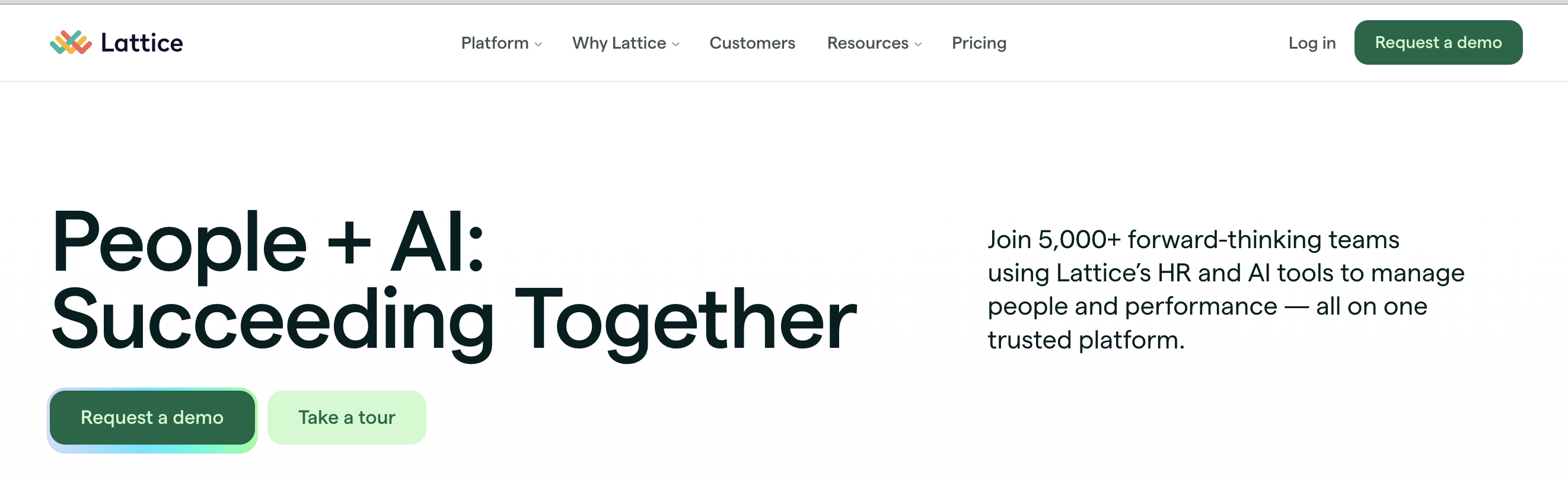
Lattice is the most widely adopted option for mid-market organizations that want performance management and engagement listening under a single vendor, connecting survey scores directly to OKR progress and calibration workflows. Published pricing starts at $11 per person per month, and it syncs with Workday, BambooHR, Slack, and Teams. G2 reviewers consistently flag the HRIS side of the product as the least developed part of it.
What stands out
Tight integration between performance reviews, goals, and engagement surveys in a single workflow
Manager-level engagement dashboards with team-specific action recommendations
Clean, intuitive interface that HR generalists can administer without training
Strong onboarding experience with dedicated CSM for mid-market accounts
⚠Where it falls short via G2
Survey customization depth is limited compared to dedicated listening platforms
Anonymity controls are less granular than purpose-built anonymous feedback tools
Frontline and deskless workforce reach is limited to email and Slack delivery
Best forUnified performance + engagement for mid-market teams that want one platform
The strongest option for mid-market organizations that want performance management and engagement surveys in a single platform. Less suited for organizations where anonymous listening or frontline reach is the primary need.
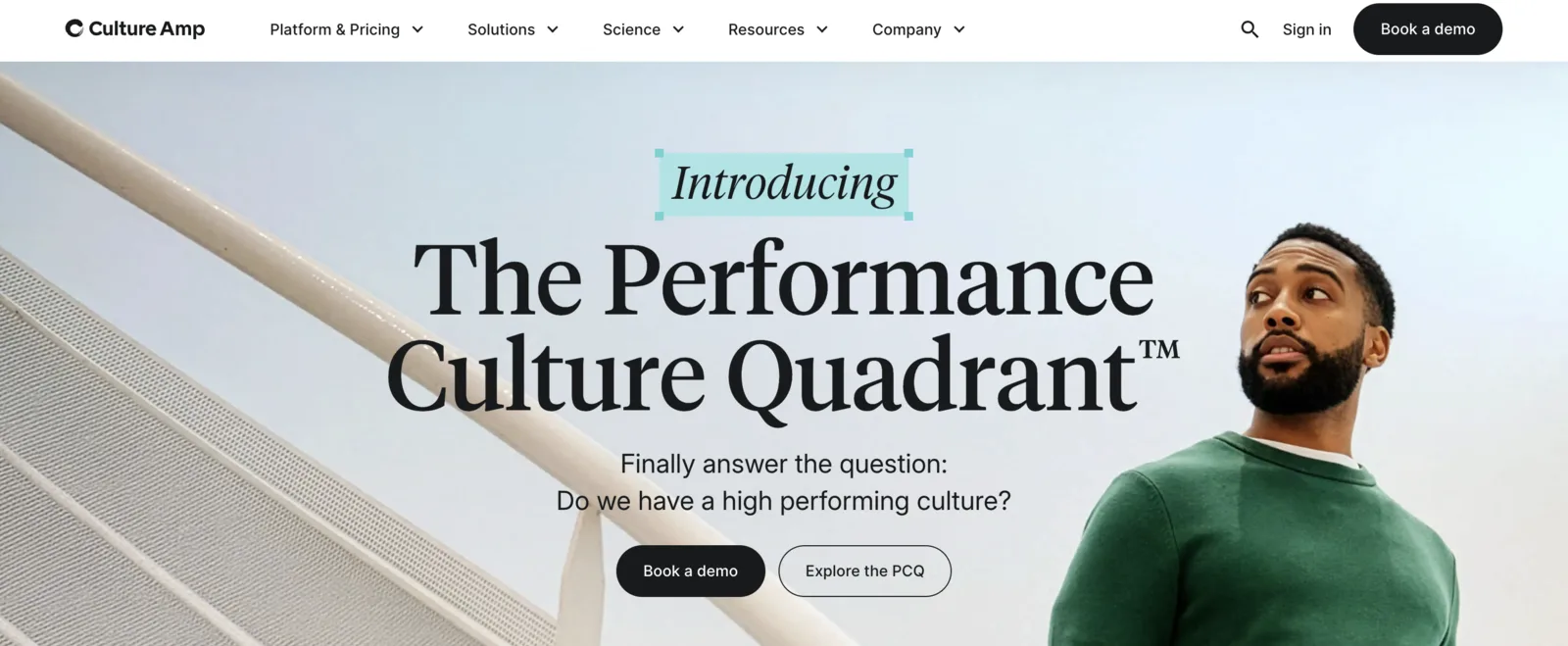
Culture Amp's benchmark dataset covers 1.61 billion survey questions answered across thousands of organizations globally, and its frameworks span engagement, DEI, manager effectiveness, and exit inside one suite. The question bank was built with I/O psychologists and validated across 6,000+ organizations. Pricing is custom and typically involves an annual commitment plus implementation fees.
What stands out
Research-backed question bank developed with I/O psychologists and validated across the 6,800+ organizations Culture Amp reports as customers
Inclusion and belonging survey modules are among the most mature in the category
AI-powered summarization surfaces engagement themes from open-text responses
External benchmarks built on Culture Amp's cited 6,800+ organizations and 1.5B+ data points provide meaningful context for results
⚠Where it falls short via G2
Mobile survey experience needs improvement for frontline and deskless populations
Building fully custom survey instruments beyond pre-built modules requires workarounds
Pricing is opaque and typically requires annual commitment with implementation fees
Best forResearch-backed engagement surveys with deep DEI and inclusion measurement
The strongest option for organizations that treat DEI and inclusion as core engagement dimensions and need external benchmarking. Less suited for frontline-heavy workforces or organizations that need highly custom survey instruments.
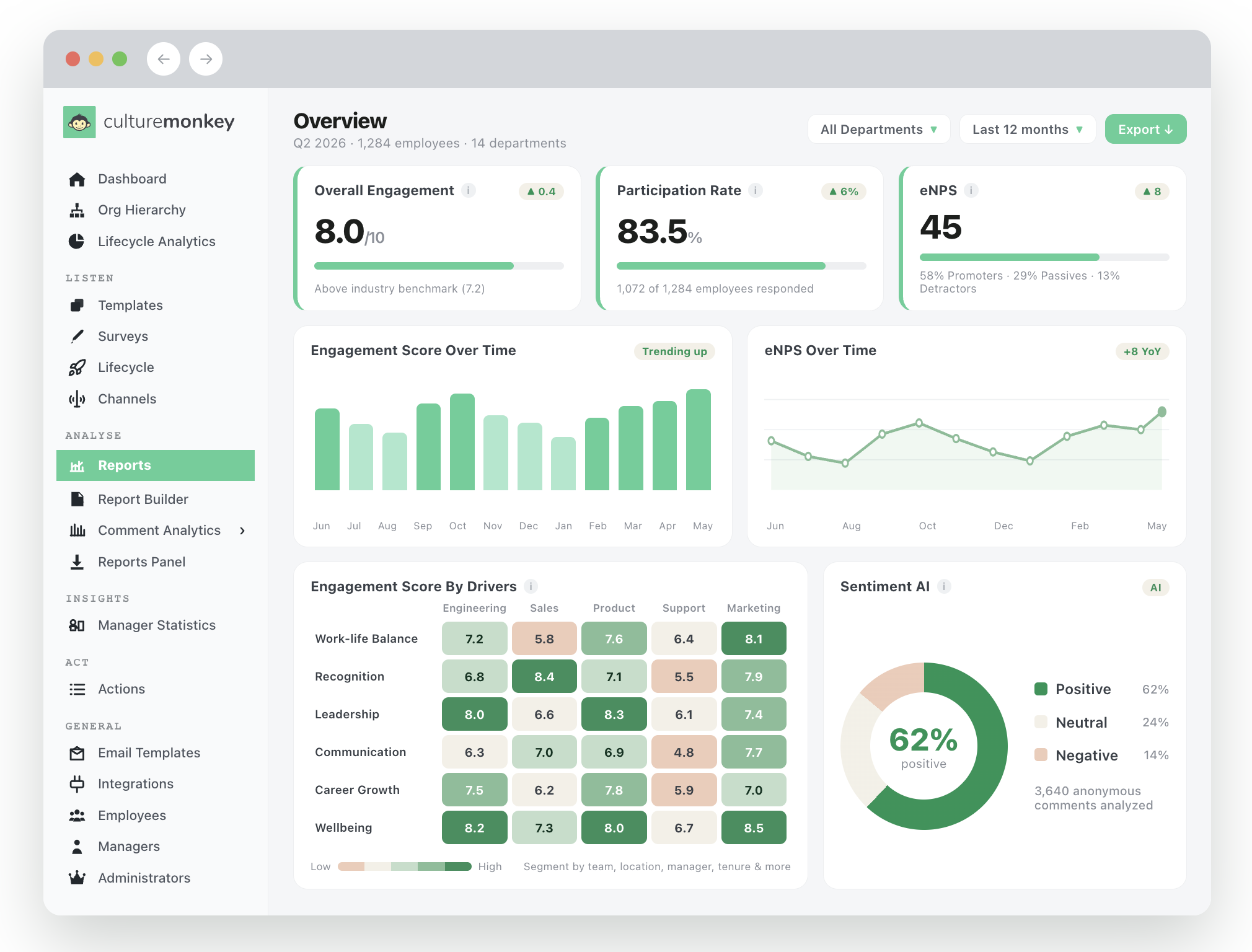
CultureMonkey is engagement-first listening: lifecycle surveys, AI theme extraction, manager dashboards, and heatmaps without the broader people-suite overhead. It integrates with 17+ HRIS platforms including SAP SuccessFactors, ADP, Darwinbox, Oracle, and Workday, supports 100+ languages, and delivers surveys through WhatsApp, SMS, QR codes, and kiosk mode alongside email, Slack, and Teams. Robertshaw used it to reach 4,500 frontline employees across 14 locations and 9 languages.
What stands out
Multi-channel anonymous delivery reaches employees through email, Slack, Teams, WhatsApp, SMS, and kiosk modes
Heatmaps that visualize engagement variation by department, location, and tenure band
The strongest reach for full-workforce engagement programs. Multi-channel delivery and heatmaps make it the right fit for distributed organizations with mixed desk and frontline populations that need honest signals from every segment.
Case Study
How Robertshaw reached 4,500 frontline employees across 14 locations and 9 languages
4xeNPS growth (9.21 to 38.11)
71%Reduction in actively disengaged
8.7Engagement score (from 7.5)
84%+Managers rated 8+ by teams
"CultureMonkey solves getting to a mostly frontline workforce in nine different languages, half a dozen of which aren't common. It makes it easy, so we can spend more time on the output that actually matters."
Heather Kane, Change Management & Employee Engagement Lead
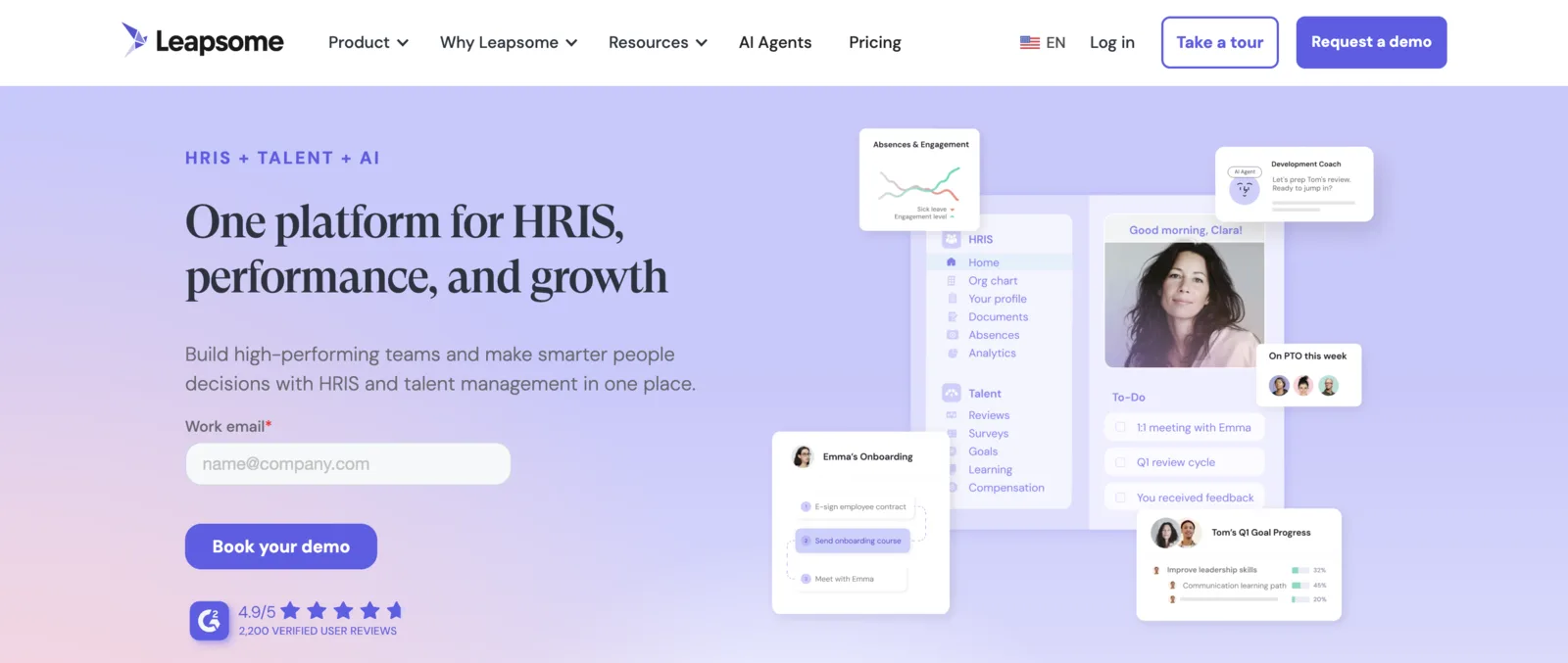
Leapsome connects engagement survey results to performance reviews, goal tracking, and learning paths inside a single people-enablement platform, so results feed development conversations rather than sitting in a separate dashboard. It holds the highest G2 score on this list at 4.8 and integrates with BambooHR, Personio, Slack, and Teams.
What stands out
Distinctive bridge between engagement survey data and manager development workflows
Intuitive admin experience with deep customization for access and visibility rules
Onboarding materials structured well enough that adoption happens without heavy training
Process flexibility that adapts to your organization rather than forcing rigid templates
⚠Where it falls short via G2
Goal tracking could offer more granular intervals for engagement action follow-ups
Review interface would benefit from more segmented sections for engagement-specific inputs
Harder to distinguish environment feedback from individual performance commentary
Best forConnecting engagement findings to manager development and competency frameworks
PricingCustom pricing
IntegrationsBambooHR, Personio, Slack, Teams, HRIS API
Verdict
Uniquely positioned to close the gap between engagement measurement and manager development. Less suited as a standalone engagement-only tool for organizations that do not need the performance management layer.
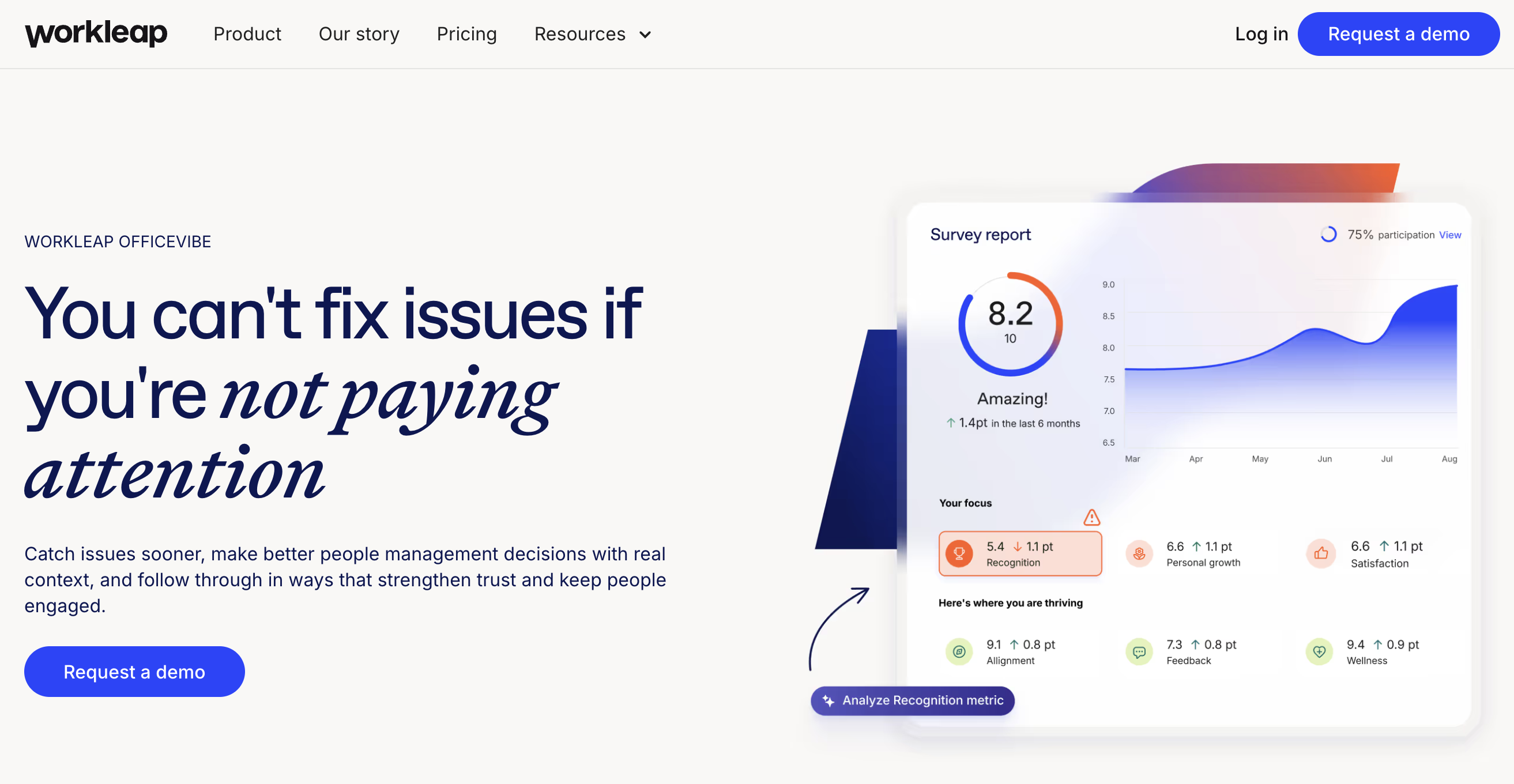
Workleap Officevibe delivers a rotating bank of science-backed pulse questions through Slack or Teams with no HR configuration required. Its anonymity threshold is five respondents, and results for smaller teams are suppressed. A free tier makes it the fastest entry point for small teams, with the Pro plan starting at $3.50 per person per month.
What stands out
Free tier with core pulse survey functionality makes it accessible to startups and small teams
Automated weekly pulse surveys require minimal HR overhead to maintain
Anonymous feedback channel lets employees surface concerns between survey cycles
Simple, clean interface that requires no training for managers or employees
⚠Where it falls short via G2
Analytics depth is limited compared to mid-market and enterprise platforms
Survey customization options are constrained on the free and lower-tier plans
Lacks multi-channel delivery: no SMS, WhatsApp, or kiosk modes for frontline workers
Best forLightweight pulse surveys for small teams with budget constraints
PricingFree tier available; Pro from $3.50/person/mo
IntegrationsSlack, Teams, BambooHR, API
Verdict
The lowest-friction entry point for small teams that want automated pulse surveys without a major investment. Plan to outgrow it when you need custom surveys, deep analytics, or frontline reach.
Qualtrics XM is the most analytically sophisticated platform on this list, built for organizations with a dedicated people analytics function. Its employee experience module includes predictive attrition modeling, Text iQ open-text analysis, and org-hierarchy drill-downs that most dedicated engagement platforms do not offer, backed by SOC 2, GDPR, and FedRAMP coverage. Organizations without analysts to operationalize it will underuse it at enterprise pricing.
Department-level dashboards with org-wide baseline comparisons per engagement driver
Enterprise security and compliance: SOC 2, GDPR, FedRAMP, data residency options
People Analytics teams can build custom engagement indices with full statistical rigor
⚠Where it falls short via G2
Implementation complexity and cost put it out of reach for most SMBs and mid-market organizations
Requires dedicated People Analytics staff to configure and interpret effectively
Smaller HRIS vendors require CSV uploads and manual reconciliation
Best forEnterprise-grade custom engagement research with statistical modeling
PricingCustom pricing
IntegrationsWorkday, SAP SuccessFactors, ServiceNow, Slack, SAML SSO
Verdict
The enterprise standard for custom engagement research. The implementation complexity makes it better suited for organizations with dedicated People Analytics teams and Workday or SAP infrastructure.
Quantum Workplace is best known for powering the Best Places to Work benchmarking program across thousands of US employers, and that external benchmark dataset is its clearest differentiator. Its validated outcome questions classify employees as engaged, not engaged, or actively disengaged rather than reporting driver scores alone. G2 reviewers repeatedly flag dashboard complexity for non-analyst managers.
What stands out
Strong manager action planning workflows that push recommended next steps after survey results land
Recognition and feedback tools complement engagement surveys in the same platform
Benchmarking against their dataset of organizations for industry and size-band context
Intuitive results dashboards designed for managers, not just HR administrators
⚠Where it falls short via G2
Frontline and deskless delivery options are limited compared to multi-channel platforms
Survey design flexibility is constrained compared to research-grade tools like Qualtrics
Mobile experience could be more polished for on-the-go survey completion
Best forManager-driven engagement action planning with built-in coaching nudges
Strong for organizations where manager adoption of engagement data is the primary challenge. The action planning workflows close the gap between insight and behavior change.
Bonusly is a peer recognition platform built on micro-bonus points and a public appreciation feed, with published pricing from $2 per user per month. Recognition activity creates a continuous stream of engagement signal between formal survey cycles, delivered inside Slack and Teams where it stays visible. It is a recognition tool first, not a survey platform.
What stands out
Peer-to-peer recognition creates a continuous stream of engagement signals between formal surveys
Transparent pricing starting at $2/user/mo makes it accessible for growing teams
Strong Slack and Teams integration makes recognition visible and social
Analytics on recognition patterns can surface engagement risks before survey data catches them
⚠Where it falls short via G2
Not a dedicated survey platform: engagement measurement is secondary to recognition
Lacks anonymous feedback channels, lifecycle surveys, and climate measurement
Analytics are recognition-focused, not engagement-driver-focused
Best forPeer recognition with lightweight engagement signals for small to mid-size teams
PricingFrom $2/user/mo
IntegrationsSlack, Teams, Workday, BambooHR, HRIS API
Verdict
A strong complement to a dedicated engagement survey tool, not a replacement. The recognition data fills the gap between survey cycles, but you will still need a survey platform for structured measurement.
CultureMonkey Trend Data
Engagement is not rising or falling. It is diverging.
Year-over-year engagement momentum across 15 industries. Education surged +7.68% while Creative and Media fell -7.50%. The industry spread narrowed from 1.045 to 0.514 points. Source: CultureMonkey Employee Engagement Momentum Report, 10M+ responses, 1,247 organizations, Jan 2024 to Mar 2026.
Education+7.68%
Construction+1.84%
Healthcare+1.77%
Retail+1.28%
Technology-0.42%
Telecom-2.18%
Creative & Media-7.50%
Q1 2025 to Q1 2026 · Global median: 4.036 · CultureMonkey Momentum Report 2025-2026View full trend analysis →
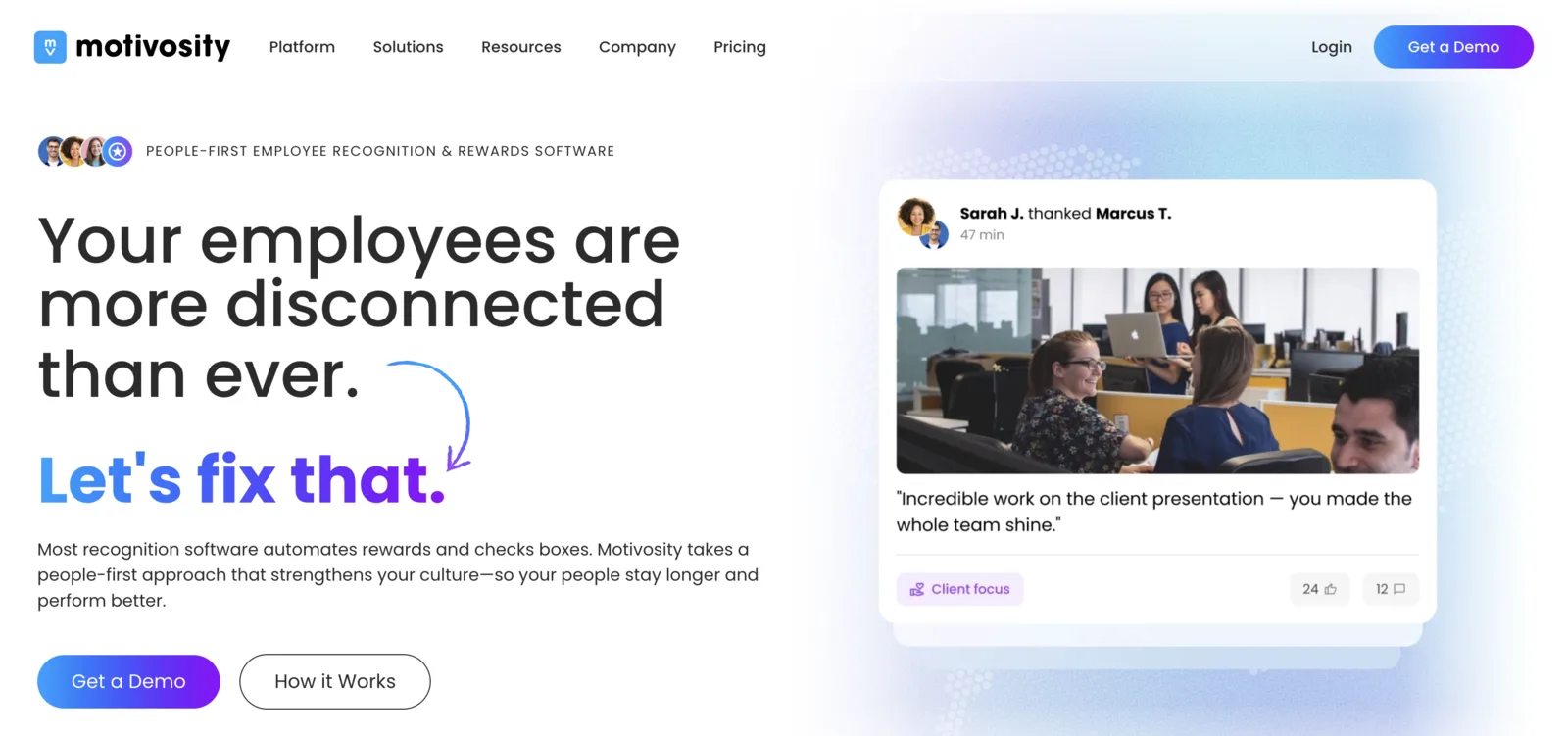
Motivosity is a peer recognition and appreciation platform whose ThanksMatters module drives visible, social recognition and whose Lead module surfaces manager coaching prompts. Pricing starts at $2 per user per month, with connectors for BambooHR, Workday, ADP, Slack, and Teams. It fits mid-market and SMB teams where engagement is primarily an appreciation problem.
What stands out
ThanksMatters recognition system creates visible, social appreciation that reinforces engagement
Lead module provides manager coaching prompts based on team engagement patterns
Budget-friendly pricing makes it accessible for organizations of all sizes
⚠Where it falls short via G2
Survey depth is limited: not designed for complex engagement research or custom instruments
Lacks multi-channel survey delivery for frontline populations
Benchmarking capabilities are less mature than dedicated engagement survey platforms
Best forManager-employee relationship building through recognition and micro-feedback
PricingFrom $2/user/mo
IntegrationsBambooHR, Workday, ADP, Slack, Teams
Verdict
Best for organizations that believe engagement starts with manager-employee relationships and recognition culture. Not a replacement for structured engagement measurement with validated survey instruments.
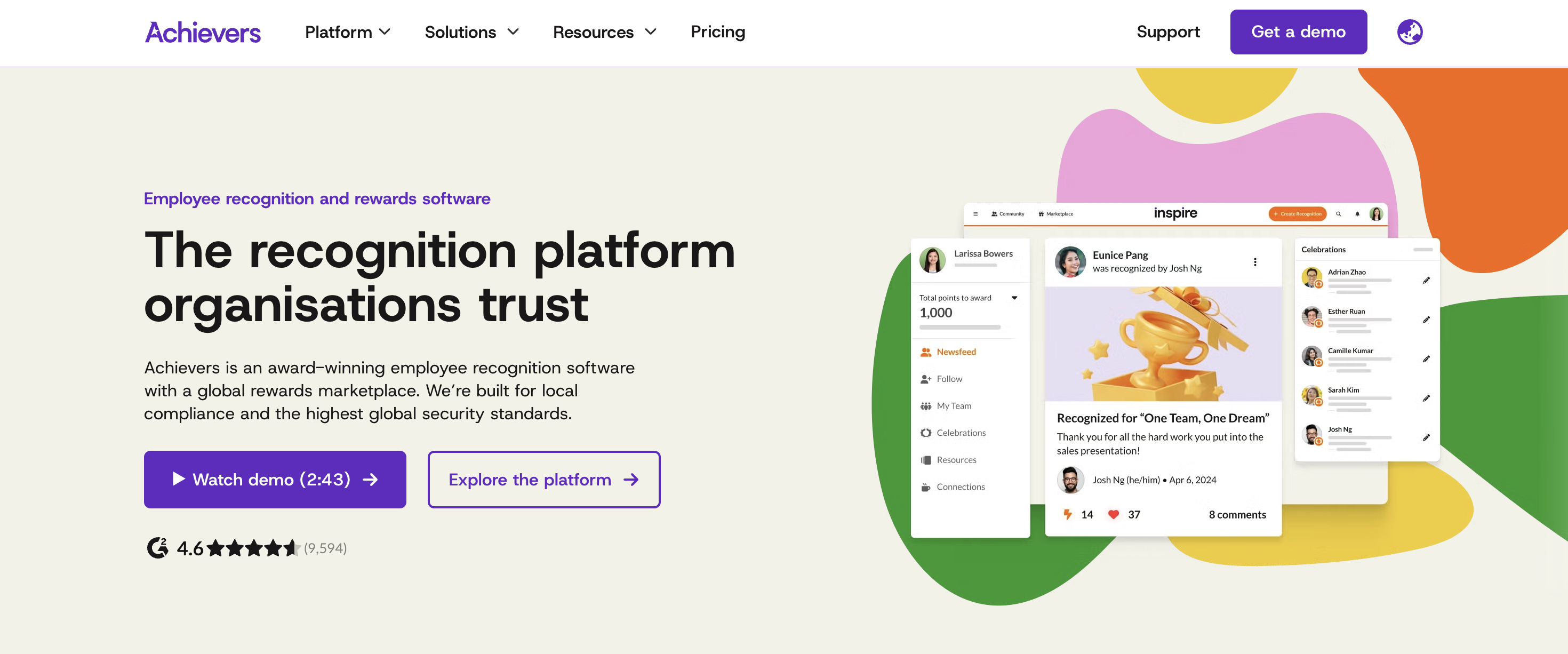
Achievers is an enterprise recognition and rewards platform that layers engagement listening on top of a points-based rewards marketplace rather than the other way around. It integrates with Workday, SAP, Oracle, Slack, and Teams behind SAML SSO, and is custom-quoted on headcount and module selection. Survey depth is the tradeoff you accept for the recognition infrastructure.
What stands out
Recognition and rewards platform with engagement listening built in, rather than the reverse
Points-based rewards system with a marketplace that gives employees choice in how they are recognized
Enterprise-grade security and compliance suitable for regulated industries
Strong analytics connecting recognition frequency to engagement and retention outcomes
⚠Where it falls short via G2
Engagement survey capabilities are less deep than dedicated listening platforms
Implementation timeline and cost are enterprise-focused, not suited for SMBs
Custom survey instrument design is limited compared to research-grade tools
Best forEnterprise recognition and rewards with engagement survey integration
The right choice for enterprises that want recognition and rewards as the primary engagement lever, with survey listening as a supporting function. Not suited as a standalone engagement survey platform.
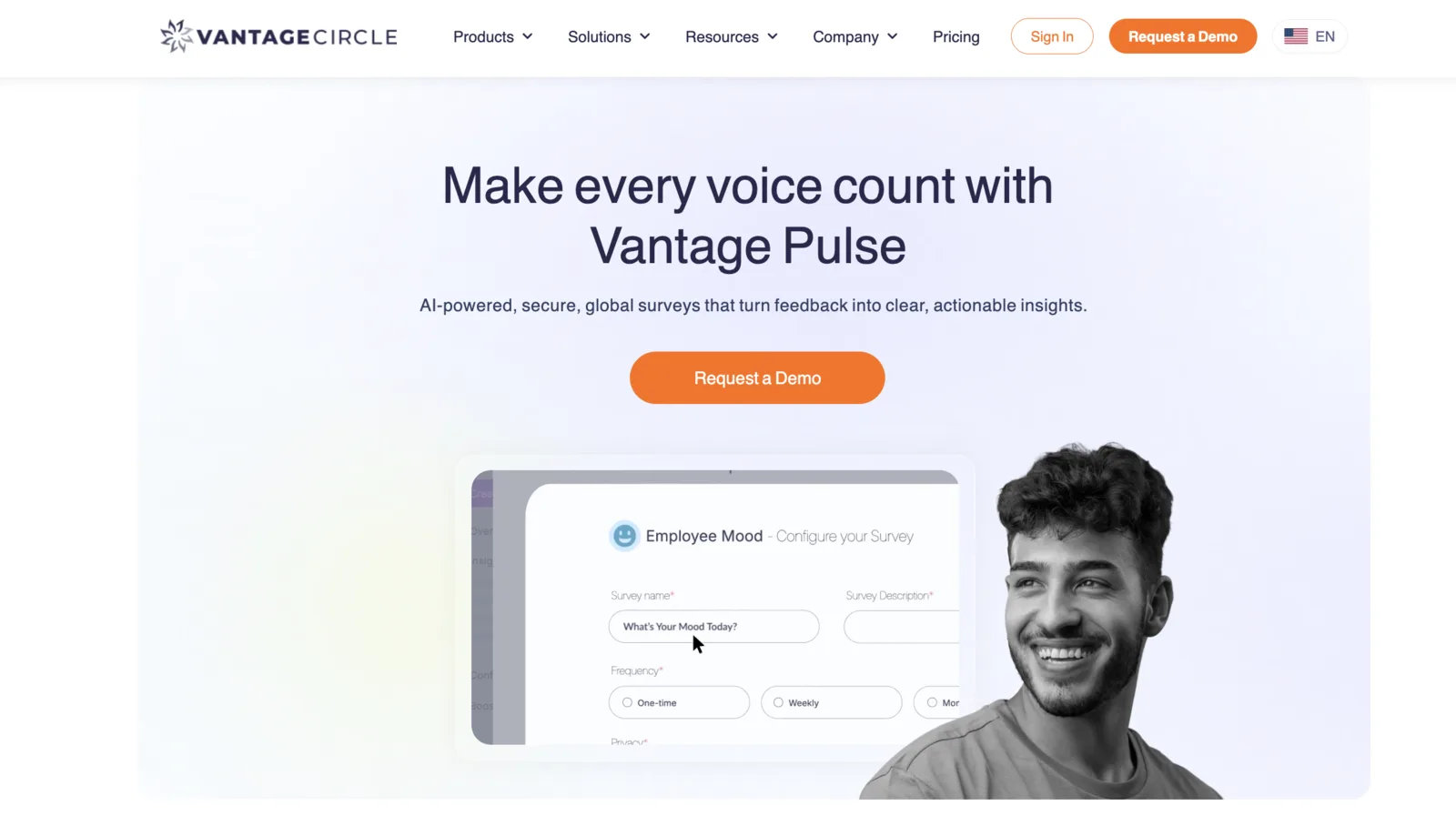
Vantage Circle combines four modules in one platform: recognition, a global rewards marketplace spanning 70+ countries, wellness, and eNPS-style pulse surveys. The survey layer tracks sentiment while the rewards layer handles appreciation without switching tools, with connectors for SAP, Workday, BambooHR, Slack, and Teams. Survey customization is shallower than in dedicated listening platforms.
What stands out
Four integrated modules: recognition, rewards, wellness, and pulse surveys in one platform
eNPS and pulse survey tools provide structured engagement signals alongside recognition data
Wellness program integration connects physical and mental health to engagement outcomes
Competitive pricing for mid-market organizations that want multiple engagement levers
⚠Where it falls short via G2
Survey depth and customization are limited compared to dedicated engagement platforms
Analytics on engagement drivers are less sophisticated than purpose-built listening tools
Frontline reach depends on email and app access, with limited SMS or kiosk delivery
Best forAll-in-one recognition, rewards, wellness, and pulse surveys for mid-market
PricingCustom pricing
IntegrationsSAP, Workday, BambooHR, Slack, Teams
Verdict
A solid all-in-one option for mid-market organizations that want recognition, wellness, and pulse surveys without managing multiple vendors. Expect to supplement with a deeper listening tool as you scale.
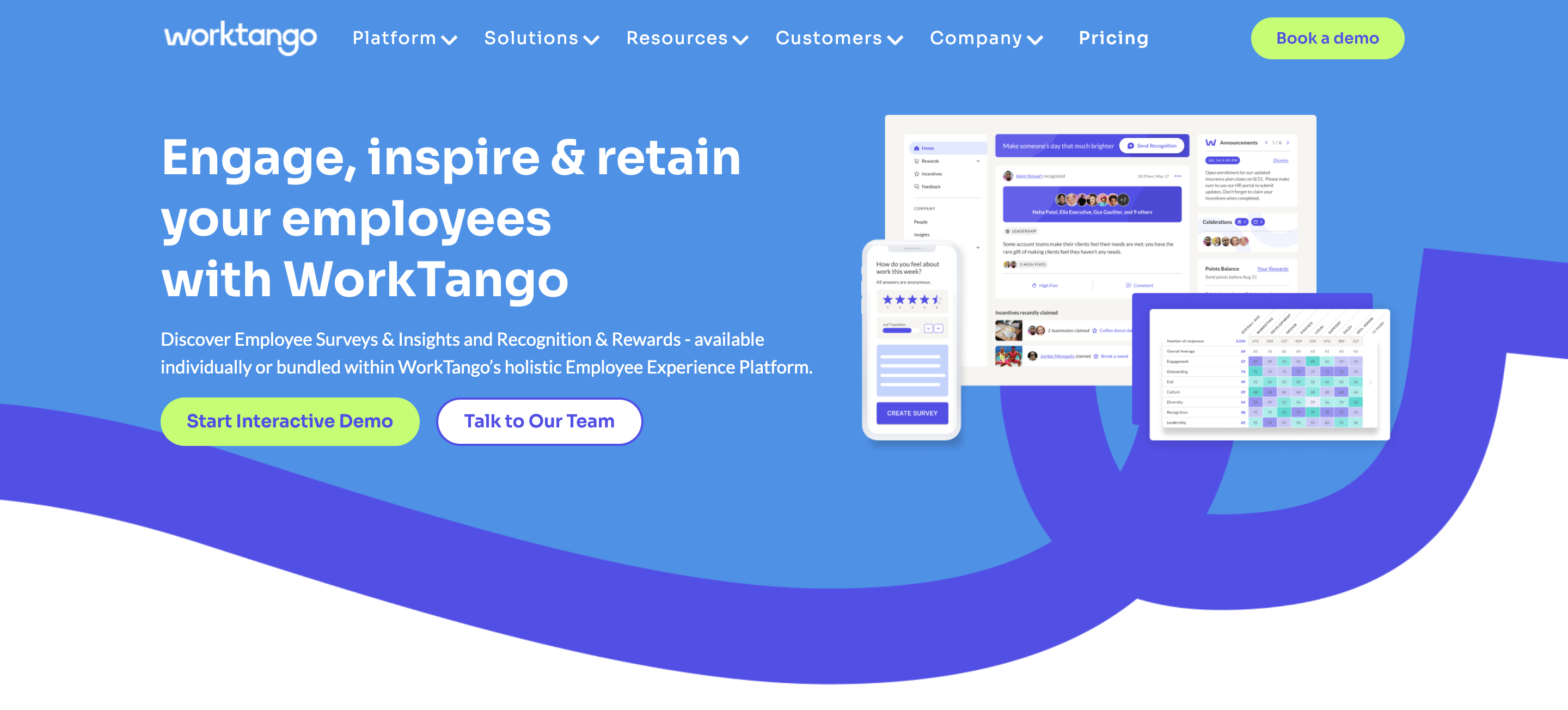
WorkTango combines surveys, peer recognition, and anonymous employee conversations into a single employee voice program, then pushes recommended next steps to managers once results land. It connects to Workday, BambooHR, ADP, Slack, and Teams behind SAML SSO. The breadth suits mature HR teams and can overwhelm smaller ones.
What stands out
Continuous listening approach combines surveys, recognition, and feedback into a unified voice program
Action planning workflows push recommended next steps to managers based on survey results
Flexible survey design with templates and custom question options
Recognition features complement survey insights for a more complete engagement picture
⚠Where it falls short via G2
Platform complexity can create a steep learning curve for first-time HR administrators
Some integration connectors require middleware or manual configuration
Frontline and deskless reach is improving but not as mature as dedicated multi-channel platforms
Best forEmployee voice programs with continuous listening and recognition
Well-suited for organizations that want a continuous listening and recognition platform combined. The breadth of features is a strength for mature HR teams but can overwhelm smaller organizations.
Peer recognition (Cheers for Peers) adds a social engagement layer alongside listening
Simple enough that any manager can administer without HR overhead
⚠Where it falls short via G2
Single-question format limits the depth of engagement insights you can extract
Analytics and benchmarking are basic compared to platforms designed for structured engagement research
Integration ecosystem is narrow: no native HRIS connectors for automated employee sync
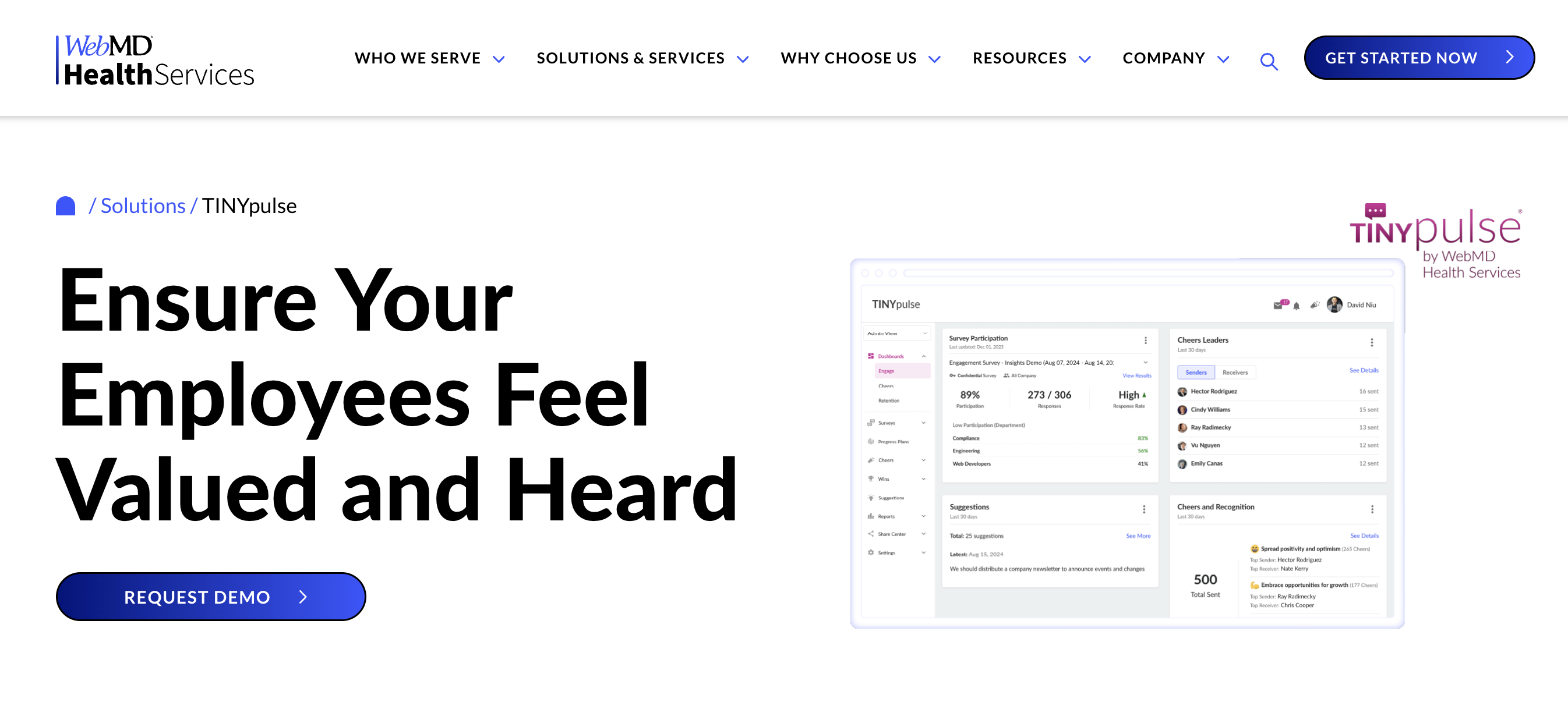
Best forSimple one-question pulse checks, now sold only inside WebMD Health Services' wellbeing suite
PricingCustom pricing
IntegrationsSlack, Teams, email
Verdict
Still the simplest pulse survey format on this list, with one caveat that changes the buying decision: TINYpulse is no longer sold as a standalone product. WebMD Health Services renamed Limeade Listening back to TINYpulse in 2024, and tinypulse.com now redirects to webmdhealthservices.com, where the product lives inside the wellness suite. Shortlist it only if you are already evaluating WebMD's wellbeing platform; the single-question format remains a strength for team-level health checks but a limitation for organization-wide engagement measurement.
Nectar HR is a recognition-first platform built on points, a curated rewards catalog covering Amazon, gift cards, branded swag, and charity donations, and automated milestone and anniversary celebrations. Published pricing starts at $2.75 per user per month with a free tier for small teams, and it connects to Slack, Teams, BambooHR, and Gusto. There is no structured engagement survey layer underneath it.
What stands out
Points-based recognition with a curated rewards marketplace (Amazon, gift cards, branded swag, charity donations)
Automated milestone and anniversary celebrations reduce manual HR overhead
Core values tied to recognition moments reinforce culture alongside engagement
Transparent, published pricing with a free tier for small teams
⚠Where it falls short via G2
Not a survey platform: lacks structured engagement surveys, lifecycle surveys, or climate measurement
Analytics focus on recognition patterns, not engagement drivers or organizational health
Frontline reach depends on app adoption, with no SMS or kiosk survey delivery
Best forRecognition-first engagement with rewards marketplace and milestone automation
PricingFrom $2.75/user/mo
IntegrationsSlack, Teams, BambooHR, Gusto, HRIS API
Verdict
A strong recognition and rewards tool that complements a dedicated engagement survey platform. Not a standalone 15Five alternative for organizations whose primary need is engagement measurement.
Eletive is a continuous listening platform with real-time dashboards and predictive attrition analytics, built around a self-leadership model that hands employees ownership of their own action plans. It positions itself as deliberately HRIS-agnostic, integrating with BambooHR, Personio, SAP, Slack, and Teams, and its GDPR-first architecture reflects a strong Nordic and European footprint.
What stands out
Distinctive self-leadership model gives employees ownership of their own engagement action plans
Real-time dashboards update continuously rather than waiting for survey cycle completion
OKR and performance management integration connects engagement to goal progress
Strong presence in Nordic and European markets with GDPR-first architecture
⚠Where it falls short via G2
Self-leadership model requires organizational readiness and cultural buy-in to be effective
Less established in North American markets compared to US-based competitors
Frontline reach is improving but currently less mature than dedicated multi-channel platforms
Best forSelf-leadership engagement model with employee-driven action planning
A distinctive approach for organizations that want employees to own their engagement outcomes, not just respond to surveys. Requires cultural readiness for self-directed action planning to deliver value.
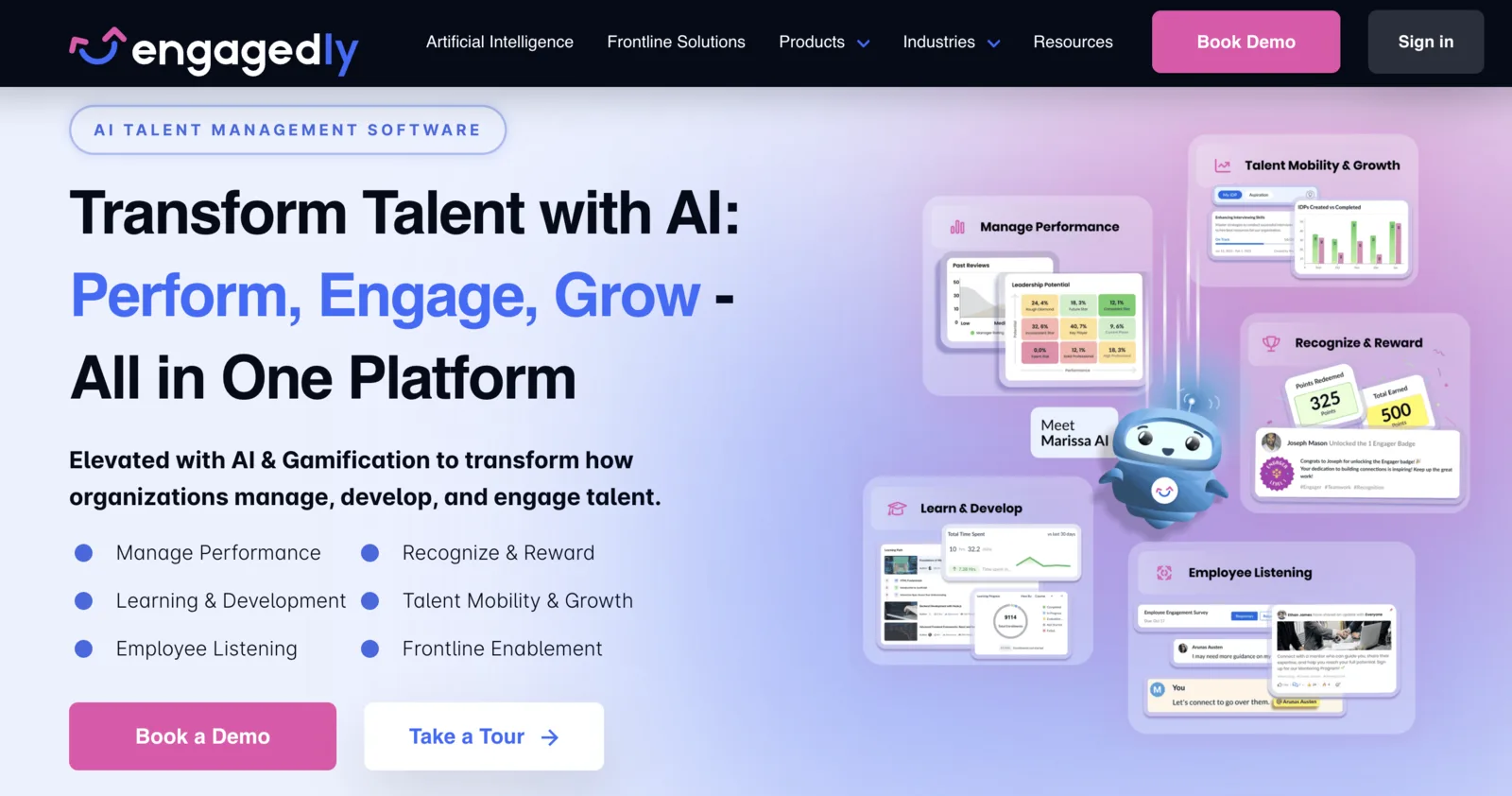
Engagedly is a talent management suite that combines performance management, OKR tracking, learning, recognition, and engagement surveys with a gamification layer of points, badges, and leaderboards. Published pricing starts at $2 per user per month billed annually with a $7,500 annual minimum, and it connects to BambooHR, ADP, Slack, and Teams.
What stands out
Engagement survey findings live alongside goal-setting and continuous feedback in one platform
Managers see how team engagement correlates with goal progress and feedback patterns
Combined performance and engagement dataset creates a more complete picture than either alone
Transparent pricing starting at $2/user/mo with clear feature tiers
⚠Where it falls short via G2
New features sometimes ship before foundational usability is fully polished
Interface can feel complex for first-time administrators managing both engagement and performance
Steeper learning curve than simpler single-purpose engagement tools
Best forLinking engagement signals to performance and growth in mid-market teams
Solid for mid-market teams that want engagement insights embedded inside a performance platform. Not the right fit if standalone engagement measurement is the primary need or if the organization lacks the maturity to manage a multi-module platform.
Case Study
How StudyIn achieved 93.9% survey participation across 800+ employees in 40+ countries
93.9%Survey participation rate
7.9Overall engagement score
70.6%Highly engaged employees
"Achieving over 90% participation comes down to trust, transparency, and action. Employees engage when they feel confident that their feedback is anonymous and will be taken seriously."
Shiwali Arora, Head of People & Culture, SI-Global
The bottom line: which 15Five alternative should you choose?
Start with the problem, not the product. 15Five is a capable continuous performance management tool. If your primary need is weekly check-ins, OKRs, and performance reviews, it may still be the right fit. But if your primary need is structured employee engagement measurement with anonymous surveys, validated question science, and analytics that surface systemic patterns, you need a different category of tool.
Use the 7-criteria framework to narrow your shortlist to 2-3 tools that match your company size, workforce type, and integration requirements. Compare your results against industry benchmarks to understand where you stand. Then run a pilot with your lowest-engagement department. If participation exceeds 70% and managers receive actionable insights within 72 hours, you have found your fit.
If your workforce includes frontline, deskless, or multilingual populations, and you need engagement signals from every segment, not just the employees with corporate email, CultureMonkey is built for that. Anonymous surveys delivered through WhatsApp, Slack, Teams, SMS, and kiosk modes, with heatmaps that show exactly where engagement gaps live across your organization.
See how CultureMonkey measures employee engagement
Anonymous surveys across every channel, with heatmaps and action planning for every manager.
Frequently asked questions
The best alternative depends on your organization's size, workforce type, and primary engagement challenge. For organizations with frontline or deskless workers who need multi-channel anonymous surveys, CultureMonkey provides the broadest reach. For mid-market teams that want performance and engagement unified, Lattice offers the tightest integration. For research-backed survey science with DEI measurement, Culture Amp has the most validated question bank. See industry benchmarks to contextualize your results.
CultureMonkey is purpose-built for employee engagement surveys, while 15Five is primarily a continuous performance management tool. CultureMonkey offers multi-channel anonymous survey delivery (email, Slack, Teams, WhatsApp, SMS, kiosk), 100+ validated survey templates, AI-powered theme extraction, engagement heatmaps by department and location, and lifecycle-triggered surveys. 15Five focuses on weekly check-ins, OKRs, and pulse surveys with engagement measurement as a secondary feature.
Organizations typically consider 15Five alternatives for six reasons: limited anonymity architecture that ties feedback to named employees, narrow survey customization beyond the weekly check-in format, weak frontline and deskless workforce reach, analytics depth that plateaus at scale, integration ecosystem gaps with regional HRIS platforms, and performance-first positioning that creates blind spots in employee experience measurement.
Yes. Small organizations (under 500 employees) often find that 15Five's performance management features are more than they need, while the engagement survey capabilities are less than they need. Platforms like Workleap Officevibe offer free tiers with core pulse survey functionality, and Bonusly starts at $2/user/month for recognition with engagement signals. The key is matching tool complexity to organizational maturity.
Seven criteria separate effective engagement platforms from generic tools: anonymity architecture (minimum response thresholds, metadata stripping), workforce reach (multi-channel delivery for frontline workers), survey science (validated question banks, conditional logic), analytics depth (AI theme extraction, heatmaps, predictive flags), integration ecosystem (native HRIS connectors, in-channel delivery), action planning workflows (manager nudges, follow-up pulses), and security compliance (SOC 2, GDPR, data residency). Use our employee engagement survey software comparison to see how vendors stack up.
Pricing falls into three bands. Lightweight tools for small teams (Officevibe, Bonusly, Nectar HR) range from free to $5/user/month. Mid-market platforms with HRIS integration and analytics (Lattice, Leapsome, Quantum Workplace) range from $6-15/user/month. Enterprise platforms with custom analytics and data residency (Qualtrics XM, CultureMonkey, Culture Amp) are typically custom-quoted. Watch for hidden costs: implementation fees, per-module charges, and minimum annual commitments.
15Five's weekly check-in model is designed for desk-based knowledge workers with corporate email. The Engage module and mobile app extend its reach, but delivery still depends on email and app logins, and organizations with manufacturing, retail, hospitality, or field service workers typically see sub-40% participation from frontline populations. If reaching every employee is a priority, evaluate platforms with SMS, WhatsApp, QR code, and kiosk delivery modes. A dedicated pulse survey tool with native channel integrations will consistently outperform delivery that stops at the inbox and the app.
Migration timelines vary by platform complexity. Lightweight tools like Officevibe can launch a first survey in 1-2 weeks. Mid-market platforms with HRIS integration and custom question banks typically take 3-6 weeks. Enterprise rollouts spanning multiple geographies and languages range from 6-12 weeks. The biggest time sink is not the technology but internal alignment on survey design, communication strategy, and manager training.
They serve different purposes. 15Five's named check-ins are effective for ongoing manager-employee conversations about goals and performance. Anonymous surveys are more effective for surfacing sensitive concerns (trust issues, manager effectiveness problems, fairness gaps) that employees will not share when their name is attached. A strong employee feedback software platform supports both modes. Most mature engagement programs use anonymous surveys for organizational health signals and named check-ins for individual performance conversations.
For enterprise-grade custom analytics with statistical modeling, Qualtrics XM leads. For AI-powered theme extraction and engagement heatmaps accessible to HR generalists (not just data scientists), CultureMonkey and Culture Amp are the strongest. For manager-level action planning driven by analytics, Quantum Workplace stands out. The right choice depends on whether you have a dedicated People Analytics team or need the platform to do the analytical heavy lifting.
Yes, and many organizations do. 15Five handles continuous performance management (weekly check-ins, OKRs, performance reviews) while a dedicated engagement survey tool handles structured listening (anonymous surveys, lifecycle surveys, climate measurement). This approach avoids the compromise of using a performance tool for engagement or vice versa. The integration between the two platforms is typically manual (comparing results side by side) rather than automated.
Engagement surveys measure the employee's relationship with the organization: belonging, trust, growth opportunities, manager effectiveness, and intent to stay. They are anonymous, periodic, and designed to surface systemic patterns. Performance check-ins measure the individual's progress on goals, blockers, and development needs. They are named, continuous, and designed for manager-employee dialogue. 15Five excels at check-ins; the alternatives in this guide excel at engagement surveys.
Frame the switch around business outcomes, not features. Calculate the cost of disengagement: Gallup estimates that disengaged employees cost organizations 18% of their annual salary in lost productivity, and Gallup's State of the Global Workplace 2026 puts global engagement at just 20%, draining an estimated $10 trillion from the world economy, roughly 9% of global GDP. Show the participation gap: if 15Five check-in completion is below 70%, a significant portion of your workforce is invisible. Present the anonymity argument: employees raise sensitive concerns (trust issues, manager problems, fairness gaps) far more readily when their name is not attached, which is exactly the signal named check-ins cannot capture.
For enterprises (2,000+ employees), evaluate three factors: data residency (EU, APAC requirements), SSO integration (SAML/OIDC), and multi-entity support (multiple business units, geographies, languages). Qualtrics XM and CultureMonkey are the strongest options. Qualtrics for organizations with dedicated People Analytics teams and Workday/SAP infrastructure. CultureMonkey for organizations that need multi-channel delivery across mixed desk and frontline populations.
The primary ROI comes from participation rate improvement and faster action cycles. Organizations that switch from performance-first tools to dedicated engagement platforms typically see participation climb, especially among frontline populations that inbox-based delivery missed, and the lag between survey close and manager action shrink from weeks to days. In CultureMonkey deployments, measurably lower regrettable attrition tends to follow within 12 months. The cost of one regrettable departure (one-half to two times the employee's annual salary, per Gallup) typically exceeds the annual platform investment.
Plan the transition in three phases. Phase 1 (weeks 1-2): run a parallel pilot with your lowest-engagement department on the new platform while maintaining 15Five. Phase 2 (weeks 3-6): expand to additional departments, configure HRIS integration, and train managers on new dashboards. Phase 3 (weeks 7-8): sunset 15Five check-ins for engagement (keep for performance if needed) and launch the first annual employee engagement survey. Communicate the change to employees as an upgrade in how you listen, not a replacement of a tool they have never heard of.
What changed in this update
Jul 2026Flagged TINYpulse as no longer sold standalone (it now lives inside WebMD Health Services' wellness suite) and removed it from quiz recommendations. Corrected the description of 15Five's survey delivery to reflect its Engage module and mobile app. Added Gallup State of the Global Workplace 2026 figures, re-attributed the replacement-cost range to Gallup, and added a 15Five pricing FAQ. Updated Culture Amp's customer count to its cited 6,800+ and removed percentage claims we could not source.
Jun 2026Refreshed G2 scores for all 16 tools to June 2026 sourced data. Updated "Where it falls short" sections with latest G2 reviewer feedback. Added two CultureMonkey benchmark data blocks (industry engagement scores and YoY engagement trends).
Aug 2025Original publication with 15 tools reviewed. Evaluation criteria, interactive quiz, comparison table, and FAQ section established.