



Pulse surveys in logistics and supply chain operations: A practical guide for HR and operations leaders (2026)

Logistics and supply chain operations move fast, but workforce sentiment often goes unchecked. Many leaders still depend on annual engagement surveys or informal feedback to understand what is happening across warehouses, fleets, and distribution hubs. By the time concerns surface, they may already be affecting safety, service levels, or retention.
Pulse surveys in logistics & supply chain provide a more responsive approach. Short, recurring check-ins capture real-time signals on workload pressure, communication gaps, and shift coordination challenges.
For management teams overseeing complex networks, this is not just about engagement. It is about protecting operational stability through early, structured insight.


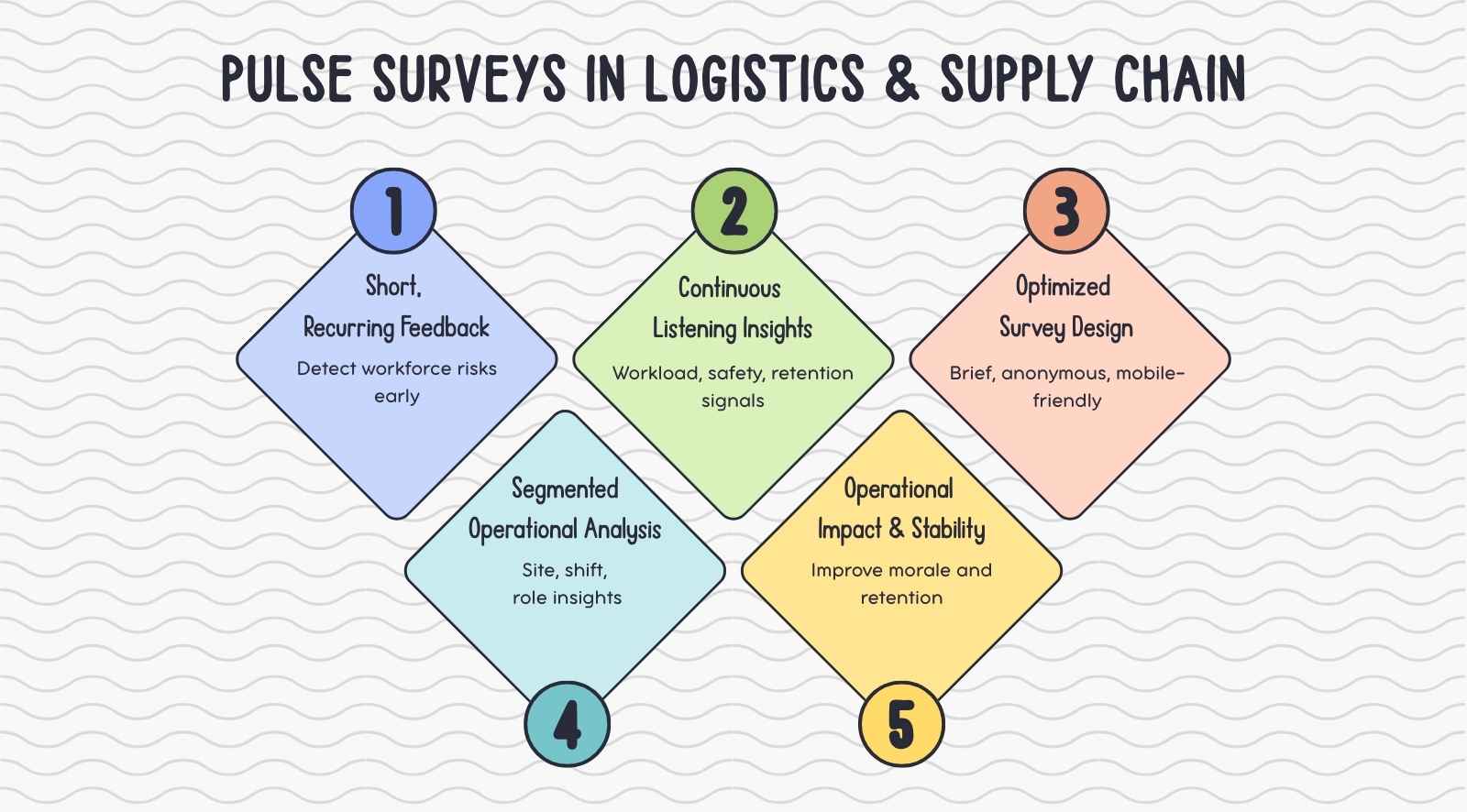
- Pulse surveys in logistics and supply chain operations provide short, recurring feedback to detect workforce risks early.
- Continuous listening helps identify workload strain, safety concerns, communication gaps, and retention risks across warehouses and delivery networks.
- Well-designed surveys are brief, anonymous, mobile-friendly, and aligned with operational cycles to maximize participation.
- Segmented analysis by site, shift, and role turns sentiment data into actionable operational insights.
- Acting on pulse survey feedback improves morale, reduces attrition, and strengthens supply chain stability and service reliability.
Why continuous workforce listening matters in logistics and supply chain

Logistics and supply chain environments operate under constant operational pressure. Small workforce issues can quickly escalate into safety incidents, missed SLAs, or rising attrition. Continuous workforce listening helps leaders detect strain early and maintain operational control across warehouses, fleets, and distribution hubs.
- Shift coverage clarity: Track whether crews feel staffed for pick, pack, loading, and last-mile runs across day and night shifts. When coverage dips, small shortcuts grow. Frequent check-ins show where overtime, absenteeism, or training gaps are creating risk.
- Peak-season pressure signals: Measure workload variability during surges, not after the backlog hits. If people report rushed handoffs or missed breaks, errors rise, and rework follows. Pulse trends help you adjust labor, slotting, or cutoffs before SLAs slip.
- Network-wide visibility: A distributed workforce across warehouses, cross-docks, and transport lanes can hide local friction. Short surveys segment by site, route, and role. You learn which node is struggling, why it is happening, and what support will fix it fastest.
- Planning-to-floor alignment: Communication gaps between planners and frontline execution teams show up as confusion, not complaints. Ask if targets, scans, and exception rules are clear today. When clarity drops, delays multiply. Listening weekly helps you tighten SOPs and messaging.
- Retention risk early warning: High attrition in delivery and warehouse roles rarely starts with resignations. It starts with fatigue, unfair rosters, or tools. Pulse surveys surface patterns by supervisor or shift, so you can fix root causes before exits spike.
- Safety and near-miss context: Safety perception shifts before incidents show up in logs. Ask if pace, equipment, and aisle congestion feel manageable this week. When teams flag risk, you can slow the line, reroute traffic, or retrain before harm.
Engagement challenges unique to logistics and supply chain workforces
Logistics workforces face structural challenges that differ from traditional office environments. Distributed teams, shift-based schedules, cost volatility, and global trade disruptions create unique engagement risks. Understanding these realities is essential before designing any effective pulse survey strategy.
- Warehouse workload intensity: Warehouse teams absorb cost volatility and significant price increases through faster turns and tighter picks. When rising costs push output targets higher, fatigue grows quietly. A well-timed pulse survey surfaces pressure early, helping risk management address strain before errors multiply across supply chains.
- Delivery route and time compression: Delivery crews operate at the sharp edge of global trade disruptions and tariff policies. Route changes and cost pressures compress schedules daily. Data analytics can flag delays, but only a pulse survey captures frustration signals that predict turnover and downstream supply chain risk.
- Shift fatigue and irregular schedules: Shift workers feel the direct impact of rising costs and demand swings before leadership does. In global supply chains, extended hours often mask deeper morale drops. Artificial intelligence can track patterns, yet regular pulse survey feedback reveals whether schedules are sustainable.
- Contract and gig workforce fragmentation: Contract and gig contributors experience cost volatility without long-term security, creating uneven engagement across supply chains. Procurement professionals may optimize vendor spend, but frontline sentiment often goes unseen. Pulse survey insights help risk management teams spot disengagement before service levels slip.
- Operations to frontline disconnect: Communication breakdown between planners and execution teams amplifies supply chain risk during significant price increases or sudden global trade shifts. Artificial intelligence models forecast disruption, yet people feel it first. Consistent pulse survey listening closes gaps before small misalignments trigger larger operational failures.
How pulse surveys help monitor engagement across logistics operations
Pulse surveys provide structured, recurring visibility into workforce sentiment across complex logistics networks. Instead of relying on lagging indicators, leaders gain timely insight into morale, workload pressure, and communication gaps that directly influence service reliability and operational stability.
- Spot engagement dips during peaks: During seasonal spikes and tariff impacts, logistics teams absorb sudden workload shifts. When three-quarters of respondents flag pressure, leaders get an early warning. A short survey captures these signals quickly, helping business teams act before disruption spreads across the industry.
- Track morale across regions: In global logistics networks spanning the Middle East and beyond, local disruption affects sentiment differently. Most companies see an uneven impact from price increases. A segmented survey highlights where risk is rising, allowing targeted support before business performance weakens.
- Identify delivery workload strain: Price increases and tariff impacts often compress timelines in logistics operations. Respondents may not raise concerns openly. A structured survey surfaces workload strain early, helping leaders reduce risk before service delays ripple through the industry.
- Capture frontline concerns in real time: When disruption hits global trade routes or regional hubs, business continuity depends on fast information. Survey responses give context behind operational metrics. This reduces blind spots and strengthens risk oversight across logistics teams.
- Enable rapid response to volatility: Uncertainty amplifies industry risk during economic shifts. In periods of price increases, three-quarters of business leaders anticipate disruption. Regular survey cycles help logistics organizations respond faster and stabilize operations.
How to design pulse surveys for logistics and supply chain environments
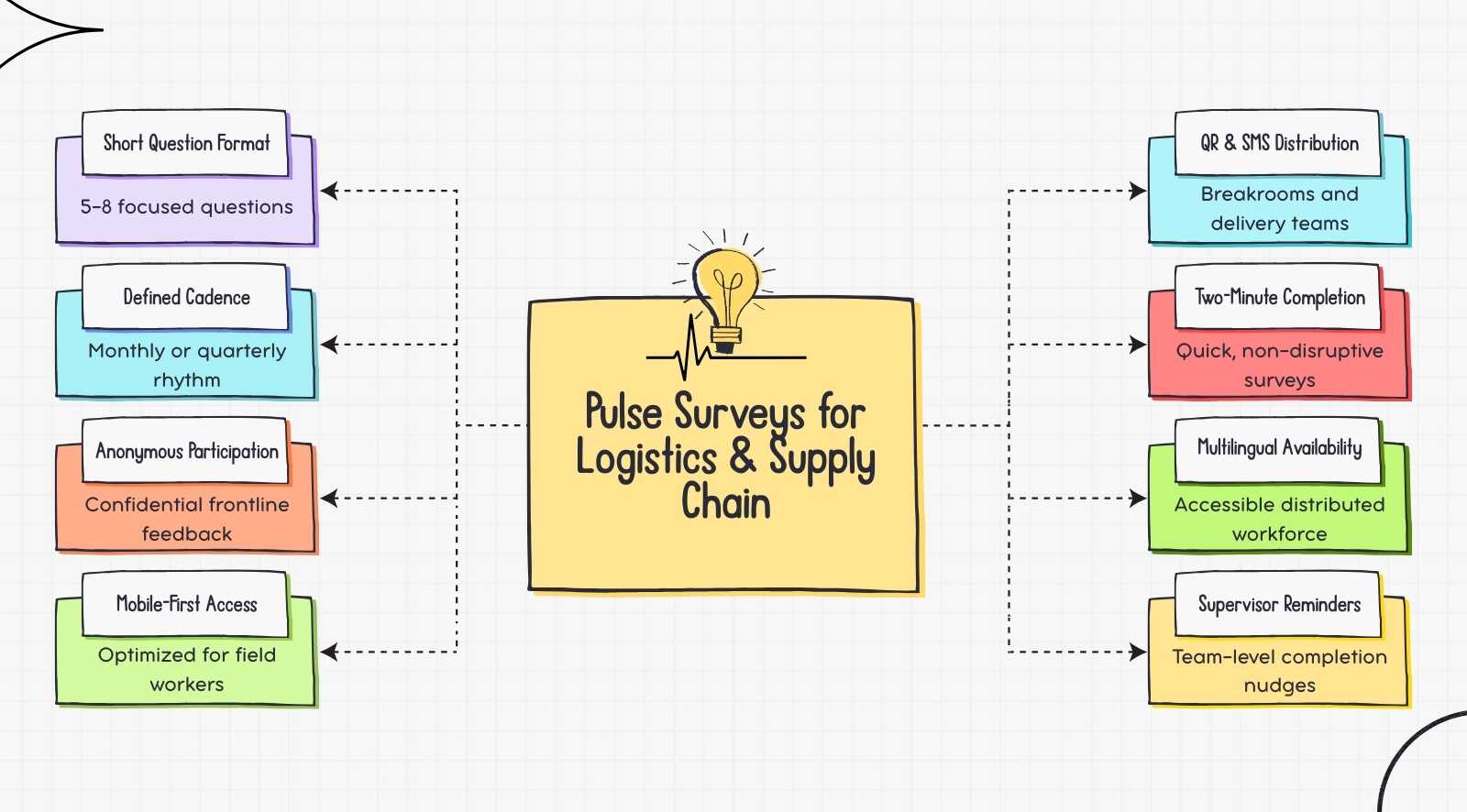
Designing pulse surveys for logistics requires operational awareness and discipline. Surveys must respect time constraints, distributed teams, and shift-based workflows. A focused design improves response rates, protects anonymity, and ensures insights are relevant to real operational conditions.
- Limit questions to what matters: In a sector shaped by demand swings and supply disruption, attention is scarce. Keep each survey focused on five to eight clear questions tied to current challenges. This improves access, reduces fatigue across shift teams, and increases honest report rates.
- Time surveys around operational cycles: Logistics companies operate across manufacturing peaks, tariff changes, and supplier delays. Run surveys monthly or quarterly based on demand intensity. This ensures leaders capture sentiment before uncertainty impacts customers, consumers, and overall supply performance.
- Protect anonymity to surface concern: When rising tariffs or supply shortages increase pressure, frontline teams may hesitate to speak openly. Anonymous design builds trust across shift workers and suppliers. Higher participation improves report accuracy and gives leaders clearer signals across the sector.
- Ensure mobile-first access: Many logistics teams operate in warehouses, on delivery routes, or across manufacturing sites without desk access. Mobile survey access removes friction. This improves response rates and ensures companies capture feedback even during peak supply challenges.
- Keep completion under two minutes: In environments where leaders juggle customers, suppliers, and sudden demand shifts, long surveys fail; short formats respect time pressure. Quick surveys increase completion rates while still capturing meaningful report data to guide decision-making.
- Use practical distribution channels: QR codes in break areas, text links for delivery teams, and supervisor reminders improve access. Multilingual availability supports diverse shift groups. These tactics help companies gather balanced input across supply, manufacturing, and logistics networks.
Best pulse survey topics for logistics and supply chain employees

Selecting the right pulse survey topics determines whether insights translate into action. In logistics environments, questions must reflect workload variability, safety exposure, supervisor support, and communication clarity to generate meaningful, operationally relevant data.
Workload and scheduling pressure
Freight volatility and fluctuating prices strain transportation schedules daily. Ask whether shift patterns feel sustainable and whether priorities stay clear during peak demand. This tracking gives organizations early data on burnout risk and helps leaders adjust operations before costs rise further.
Safety and work conditions
In logistics operations where freight moves at scale, safety must stay visible. Pulse survey questions should assess equipment reliability, pace, and environmental risks. Clear data helps organizations maintain the highest level standards while improving adoption of safer technology practices.
Supervisor and team support
During volatility, employees expect steady guidance from frontline managers. Ask whether supervisors communicate priorities clearly and respond quickly. Strong response systems improve the adoption of new processes and reduce confusion across transportation and warehouse operations.
Communication and operational clarity
When procurement decisions, freight costs, and technology upgrades shift priorities, confusion spreads fast. Survey questions should measure clarity of updates and instructions. Better visibility improves response speed and strengthens coordination across organizations operating at scale.
Tools, systems, and technology use
Half of operational friction often links to poor technology adoption or unclear data usage. Ask whether tools support daily tasks and tracking accuracy. Reliable insights help leaders align systems with real transportation and freight workflows.
How often should logistics companies run pulse surveys?
Survey cadence should balance insight frequency with survey fatigue. Logistics companies must align pulse cycles with operational peaks, restructuring periods, and expansion phases to ensure consistent visibility without overwhelming frontline teams.
- Monthly during peaks or change: Use a monthly pulse survey when shipping pressure spikes, new systems launch, or routes shift. This cadence catches issues fast without overchecking. Example: after a tariff-driven volume jump, track sentiment for four weeks, then reset.
- Quarterly in a stable environment: When operations are steady, a quarterly survey gives organisations trend visibility without fatigue. Keep questions consistent so professionals can compare results across sites. If the environment stays stable for two years, revisit topics rather than frequency.
- After warehouse or route restructuring: Run a pulse survey immediately after layout, slotting, or route redesigns. Early feedback shows whether systems and handoffs work in real shifts. Use a two-step plan: week one for issues, week three to confirm fixes.
- During rapid expansion or new sites: When you’re expanding capacity, keep a survey rhythm for the first 60 days. Focus on onboarding clarity, supervisor support, and workload balance. As shipping stabilizes, widen the range back to quarterly to avoid burnout.
How to analyze pulse survey data across warehouses and supply chain teams
Effective analysis turns pulse survey responses into operational decisions. Leaders should segment results by site, shift, and role, track trends over time, and link engagement signals to safety, turnover, and performance metrics.
- Benchmark sites and regions: Compare scores across warehouses, hubs, and regions using the same question set and time window. Focus on gaps, not averages, so you can spot the few locations quietly dragging service, safety, or staffing stability.
- Split by shift patterns: Break results by day, night, and weekend shifts, then compare the same role groups. If one shift reports low support or high fatigue, treat it as a leading indicator of incidents, errors, and exits.
- Map workload stress hotspots: Cross-tab workload answers with department tags like picking, packing, linehaul, and last mile. Look for clusters where stress stays high for two cycles, because that is where delays, shortcuts, and quality slips usually start.
- Track trends, not snapshots: Plot results over time by site and shift, then flag sharp drops after policy, schedule, or process changes. A single bad week can be noise, but a sustained slide needs a clear action owner.
- Link sentiment to hard metrics: Correlate engagement signals with turnover, absenteeism, safety events, and throughput at the team level. When a score drop precedes a KPI dip, you have repeatable cause-and-effect evidence to prioritize fixes and prove impact.
Using pulse surveys to reduce attrition and operational risks in logistics

Pulse surveys are most valuable when tied directly to risk reduction. Early detection of burnout, morale drops, and workload strain enables faster intervention, lowering attrition and strengthening service reliability.
- Detect burnout before it exits: Track fatigue, overtime, and schedule fairness to spot patterns by shift and supervisor. When scores dip for two cycles, intervene with staffing tweaks, rest breaks, or roster resets. Early action reduces frontline resignations and churn.
- Cut absenteeism with fast fixes: Ask whether tools, lanes, scanners, and handoffs work smoothly today. Small friction raises frustration, then no-shows. Use comments to assign owners, set a 7-day fix window, and close the loop publicly. Engagement lifts, absenteeism falls.
- Improve reliability through morale signals: Monitor clarity of targets, support from leads, and safety confidence during volume. When morale drops, error rates and rework rise next. Pair survey trends with incidents and throughput to prioritize coaching, SOP refresh, or rebalancing.
- Stabilize service with workforce stability: Track intent-to-stay, fairness, and recognition across sites. High turnover disrupts pick accuracy, dispatch, and customer delivery experience. Use pulse results to tighten onboarding, support, and supervisor follow-ups, so teams stay stable, and service remains consistent.
Why choose CultureMonkey’s pulse survey software for logistics
Selecting pulse survey software for logistics requires practical evaluation. The platform must support anonymity, multi-site reporting, mobile access, and system integrations while operating reliably in high-volume, shift-driven environments.
- Anonymous participation safeguards: CultureMonkey is built to help protect confidentiality through configurable anonymity thresholds and controlled views. This matters in small shift teams where people worry about being identified. When anonymity is clear, response rates and honesty usually improve.
- Warehouse and shift-level reporting: Segment results by site, region, shift, and role so you can see where issues cluster, not just overall averages. Leaders can compare hotspots between warehouses and delivery units, then assign owners and timelines for fixes.
- Mobile-friendly survey delivery: Reach frontline logistics teams with links that work on personal phones and shared devices. Short surveys that load fast reduce drop-offs during busy windows. This supports higher participation across drivers, dock teams, and floor supervisors.
- Multilingual workforce support: Offer surveys in multiple languages so distributed teams can answer in the language they think in. That reduces misunderstandings and improves data quality. It is especially useful where hubs mix local staff, migrant workers, and contractors.
- Offline survey options: For sites with weak connectivity, offline capture can help teams respond without waiting for stable networks. Responses can sync when devices reconnect. This keeps listening consistent in yards, remote warehouses, and on-the-move transport contexts during peak periods.
- Role-based reporting access: Give leaders, HR, and operations managers access to the views they need, without overexposing sensitive comments. This supports accountability while protecting trust. It also helps multi-site organisations standardise reviews across warehouses and routes with clear audit trails.
- HRIS integrations: Connect survey programs with core people systems so segments stay current as rosters change. This reduces manual tagging and keeps reporting clean. When teams move sites or shifts, your listening stays aligned over time.
Conclusion
Continuous listening should not be treated as a periodic HR activity. In logistics environments, it is an operational safeguard. When organizations consistently monitor workforce sentiment, they detect early signs of burnout, safety strain, and coordination gaps before they disrupt frontline execution.
Regular feedback strengthens morale, improves retention, and reinforces safety culture across warehouses and delivery networks. More importantly, acting on that feedback builds operational resilience.
CultureMonkey help logistics companies structure, automate, and scale listening programs, turning workforce insight into measurable improvements in reliability, stability, and long-term supply chain performance.
FAQs
1. What is a pulse survey in logistics operations?
A pulse survey in logistics operations is a short, recurring employee feedback tool used to monitor real-time workforce sentiment across warehouses, fleets, and supply chain teams. Unlike annual surveys, it focuses on immediate operational themes such as workload pressure, safety perception, communication clarity, and shift coordination to detect risks early.
2. How often should logistics companies survey employees?
Most logistics companies run pulse surveys monthly during peak seasons, restructuring phases, or rapid expansion, and quarterly in more stable environments. The ideal cadence balances timely insight with survey fatigue, ensuring leaders receive consistent signals without overwhelming frontline teams operating under constant delivery and performance pressure.
3. How can warehouses improve survey participation?
Warehouses improve participation by keeping surveys under two minutes, ensuring anonymity, and using mobile-friendly access such as QR codes or text links. Supervisor reminders and multilingual availability also help. Clear communication about how feedback leads to visible changes significantly increases trust and response rates.
4. Can pulse surveys reduce warehouse attrition?
Yes, when used consistently and acted upon. Pulse surveys identify early signs of burnout, unfair scheduling, safety strain, or management gaps before employees resign. Addressing these signals quickly improves morale and stability, reducing avoidable turnover in high-pressure warehouse and delivery environments.
5. Do surveys improve delivery workforce engagement?
Surveys improve engagement when they capture real concerns and leaders respond visibly. Delivery teams often face route compression and time pressure. Regular feedback helps management adjust schedules, clarify expectations, and improve support systems, strengthening trust and long-term engagement across distributed logistics networks.
6. How do logistics companies ensure survey anonymity?
Logistics companies ensure anonymity by setting minimum reporting thresholds, restricting identifiable filters, and limiting comment visibility to authorized roles. Communicating these safeguards clearly is essential. When employees understand that their identity is protected, they are more likely to share honest and actionable feedback.
7. Can pulse surveys help detect workload stress?
Yes. Pulse surveys surface early workload stress signals such as fatigue, missed breaks, unclear targets, or unrealistic timelines. Tracking these trends across shifts and sites allows leaders to rebalance staffing, adjust operational pacing, and reduce safety risks before stress escalates into incidents or resignations.
8. Who should review logistics engagement data?
Engagement data should be reviewed by HR leaders, warehouse managers, regional operations heads, and executive stakeholders responsible for workforce and performance outcomes. Shared accountability ensures feedback translates into corrective action, not static reports, strengthening operational reliability and employee trust.
9. How long should logistics pulse surveys be?
Logistics pulse surveys should typically contain five to eight focused questions and take no more than two minutes to complete. Short surveys respect frontline time constraints, reduce fatigue, and improve participation while still delivering meaningful insights for operational decision-making and workforce risk management.
)