



What is an Employee Engagement Survey? How to Create and Run One (2026)

An employee engagement survey is a structured tool that measures employee commitment, motivation, and alignment with business goals. For management teams, it converts workforce sentiment into measurable performance data. CultureMonkey runs these surveys end to end, from question design through to manager-level action plans, with industry benchmarks so scores are interpretable rather than isolated.
Engagement levels often signal retention risk, productivity gaps, and leadership effectiveness before problems become visible. Without structured measurement, decisions rely on assumptions. With it, leaders gain early insight into what drives output, morale, and stability.
Engagement is not a soft metric. It is a business indicator. When treated seriously, it supports smarter workforce planning and stronger execution.
This guide covers what engagement surveys measure, how they differ from satisfaction surveys, how to create and run one step by step, the questions to ask, the mistakes to avoid, and how to turn results into action.


- Employee engagement surveys measure commitment to predict retention and performance.
- Unlike satisfaction surveys, engagement links directly to measurable business outcomes.
- Effective strategies combine annual, pulse, lifecycle, and continuous listening into governance frameworks.
- Engagement data creates impact through manager-led action, transparent communication, and tracking.
- Organizations treating engagement as a performance metric achieve stronger retention and productivity growth.
What is an employee engagement survey and why does it matter for business performance?

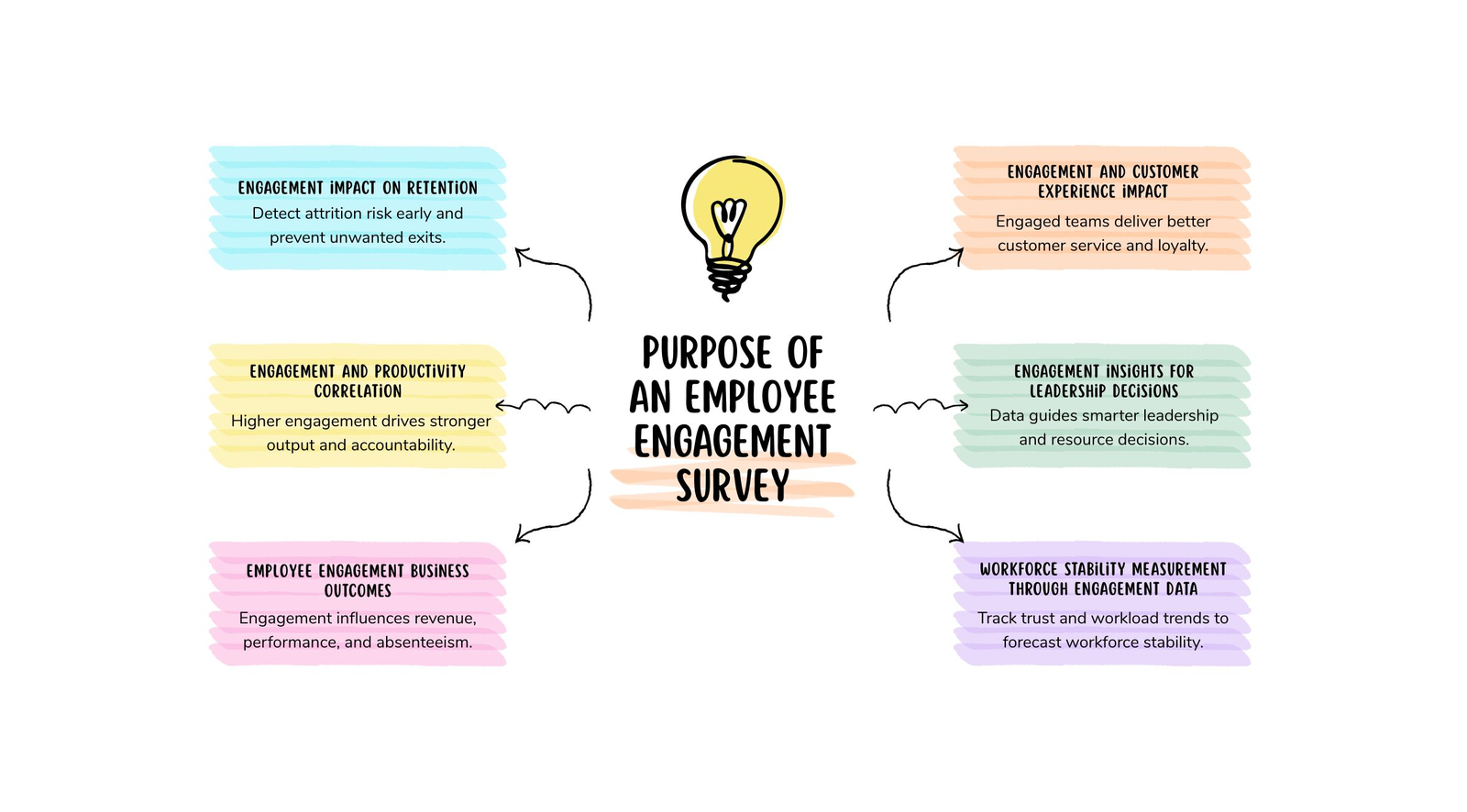
An employee engagement survey turns employee sentiment into measurable business intelligence. It is a structured measurement that highlights retention risk, productivity gaps, and performance trends.
Its purpose is to surface issues affecting commitment and output early, so strategy, budgets, and leadership decisions rest on data rather than assumptions.
1. Engagement impact on retention
High engagement scores consistently correlate with lower voluntary attrition. Structured measurement helps organizations identify early disengagement signals: declining trust in leadership, unclear role expectations, or limited growth perception.
Survey data also pinpoints specific areas for improvement in the employee experience, letting teams address issues that contribute to attrition. This predictive visibility strengthens long-term workforce planning and reduces replacement costs. If retention is your primary concern, pair your engagement survey with dedicated employee retention survey questions.
2. Engagement and productivity correlation
Engagement surveys help identify the factors behind a productive work environment, enabling targeted intervention. Employees who report clarity, recognition, and alignment with company goals typically demonstrate higher discretionary effort.
Engagement metrics often track alongside output per employee, quality benchmarks, and project delivery timelines, revealing which departments or roles face performance drag from disengagement.
3. Business outcomes
The organizational impact of engagement shows up across several KPIs: revenue per employee, innovation rates, absenteeism, and internal mobility. Results give executives quantified drivers of performance rather than assumptions about morale.
They clarify whether strategy execution gaps stem from structural issues, leadership effectiveness, or workforce sentiment. You can compare your own results against the 2026 employee engagement driver benchmarks.
4. Customer experience impact
Engaged employees are more likely to deliver strong service, which supports customer loyalty. Teams with higher engagement tend to show better responsiveness, ownership, and service quality.
Organizations tracking both engagement and customer satisfaction frequently find that improvements in engagement precede improvements in customer metrics.
5. Leadership decisions
Engagement surveys inform leadership behaviour and communication strategy, especially when complemented by focused manager feedback survey questions that assess leadership effectiveness from the team's perspective.
This supports evidence-based decisions on policy changes, workload adjustments, leadership development, and resource allocation.
6. Workforce stability measurement
Engagement results work as an early indicator of workforce stability. Trends in trust, workload sustainability, and recognition directly influence attrition risk. Over time this builds a predictive model linking engagement trends to stability forecasts.
How do engagement surveys differ from employee satisfaction surveys?
The two are often used interchangeably, but they measure different realities. Engagement centres on commitment, contribution, and alignment with company goals. Satisfaction measures comfort and workplace contentment.
An employee can be satisfied and disengaged at the same time: comfortable, well paid, and contributing the minimum. That gap is exactly what engagement measurement is designed to catch.
For a closer comparison of survey formats, see pulse survey vs engagement survey.
What are the core dimensions measured in employee engagement surveys?

Engagement surveys typically measure six dimensions. Together these define what the survey is for and what leaders can act on.
1. Leadership trust and communication
Surveys measure transparency, credibility, and consistency of leadership messaging. Trust scores strongly influence retention forecasting, and communication clarity directly affects motivation and strategic alignment.
2. Role clarity and career growth
Unclear responsibilities weaken accountability and reduce productivity. Growth perception is one of the strongest drivers of retention, so questions on advancement paths and development opportunities belong in every engagement survey.
3. Recognition and value perception
Recognition frequency and fairness tie closely to discretionary effort. Where recognition aligns with performance outcomes, the effect on results is measurable.
4. Team collaboration and workplace environment
Collaboration metrics, cross-functional support, and psychological safety indicators correlate with engagement stability. Targeted questions from our employee engagement questionnaire can go deeper where scores are weak.
5. Workload sustainability and well-being
Workload balance, burnout risk, and support systems. Unsustainable workloads weaken commitment and raise attrition signals, making workload balance a critical predictor of retention.
6. Composite engagement drivers
Composite indices combine trust, clarity, recognition, and growth. High composite scores consistently correlate with improved workforce stability. See drivers of employee engagement for the full breakdown.
What are the types of employee engagement surveys organizations can use?

1. Annual engagement surveys
Comprehensive organization-wide assessments run once a year. They establish baseline benchmarks and long-term trends.
Best for: Enterprises and growing SMEs building structured measurement systems.
Pros
- Strongest visibility into organizational performance
- Deepest driver-level insight
- Well-designed versions drive high completion rates
Cons
- Limited agility; issues may surface too late
- Long questionnaires contribute to survey fatigue
- Encourages reliance on annual averages over driver trends
2. Pulse surveys
Short, recurring check-ins that create an ongoing feedback system. They let organizations track trends and intervene early.
Best for: Organizations seeking sustained monitoring of the retention and engagement link.
Pros
- Early disengagement detection
- Continuous performance monitoring
- Supports iterative improvement
Cons
- Requires data governance discipline
- Creates fatigue if run too frequently
Compare platforms in our roundup of pulse survey tools.
3. Lifecycle surveys
Feedback captured at key employment stages: onboarding, promotion, role change, and exit.
Best for: Organizations analysing attrition patterns and workforce stability.
Pros
- Identifies stage-specific disengagement
- Strengthens workforce planning
- Builds trust when acted upon
Cons
- Requires structured HR process integration
- Misses real-time shifts between lifecycle events
4. Topic-specific surveys
Focused on a single issue such as leadership trust, workload sustainability, or recognition.
Best for: Organizations addressing a defined engagement driver.
Pros
- Highly actionable
- Quick to deploy
Cons
- Limited broader context
- Can miss drivers outside the chosen topic
How do you create an employee engagement survey?
Creating an engagement survey takes planning if it is going to deliver insight you can act on. These twelve steps take you from objective to action.
- Identify what you want to measure. Define the goal. Focus on specific areas such as role clarity, teamwork, recognition, or leadership trust rather than trying to cover everything.
- Devise the questions. Build questions that map to the areas you chose. Mix closed-ended questions for quantitative scoring with open-ended ones for context.
- Ask actionable questions. Favour questions that produce insight you can act on. Instead of asking whether employees like their job, ask whether they have the tools and resources they need.
- Select the survey methodology. Choose the format: online forms, mobile apps, or paper questionnaires. Match it to how your workforce actually works, including deskless and frontline teams.
- Select the right survey tool. Look for anonymity controls, analytics, and ease of distribution. Our comparison of employee engagement survey tools covers the main options.
- Design the survey. Keep the layout clean, the instructions clear, and the formatting consistent. Do not overwhelm people with length. For a starting structure, use a ready-made employee engagement survey template.
- Ensure anonymity and confidentiality. People answer honestly when they trust the process. Set and publish your anonymity thresholds so teams know the minimum group size for reporting.
- Communicate the purpose clearly. Explain why the survey is running and how results will be used. A well-written survey invitation email measurably lifts participation.
- Plan distribution channels. Decide how and when to share it. Use multiple channels such as email, intranet, and mobile app to reach everyone.
- Launch and monitor. Roll out with a planned launch. Track response rates and send reminders to lift participation before close.
- Analyse and interpret results. Look for trends, patterns, and problem areas. Our guide on how to interpret engagement survey results walks through driver analysis.
- Take action. Implement changes and tell people what you are doing and why. Acting visibly on results is what makes the next survey work.
How do you design employee engagement survey questions?
Good questions are specific, unbiased, and tied to something you can change. Use a mix of Likert-scale items for scoring and open text for context. Keep scales consistent across the survey so results stay comparable year on year.
25 questions to start from:
- Do you feel proud to work at this company?
- Do you understand how your role contributes to the company's goals?
- Do you have the tools and resources needed to do your job well?
- How satisfied are you with the level of communication from leadership?
- Do you feel your contributions are recognized and appreciated?
- Do you receive regular feedback that helps you improve?
- How well does your manager support your professional growth?
- Do you feel your opinions are valued by your team?
- Are you inspired by the company's mission and values?
- Do you feel connected to your coworkers?
- Is the workload you are expected to manage reasonable?
- Do you have opportunities to develop new skills?
- Would you recommend this company as a great place to work?
- How satisfied are you with your work-life balance?
- Do you feel safe sharing honest feedback?
- Are company goals and expectations communicated clearly?
- Does your team collaborate effectively?
- Do you feel motivated to go above and beyond in your role?
- Are you confident in the company's leadership?
- Do you feel your work makes a meaningful impact?
- Are changes and updates within the organization communicated promptly?
- Do you feel empowered to make decisions in your role?
- How open is leadership to new ideas and suggestions?
- Do you feel there are clear paths for advancement here?
- What is one thing we could do to improve your experience?
Question 13 is your eNPS item. Keep it worded identically every cycle so the trend stays valid.
How do you customize surveys for different teams or roles?
Tailoring surveys to departments or job functions makes the feedback more relevant and more actionable.
- Segment by department or function. Deliver targeted questions reflecting the challenges specific to each group.
- Adapt language and terminology. Match the wording to how each team actually talks about its work.
- Align questions with role-specific KPIs. Ask about outcomes people are genuinely accountable for.
- Include role-relevant examples. Concrete examples familiar to that team improve question clarity.
- Vary frequency by team dynamics. Some teams benefit from more frequent check-ins than others.
- Use flexible templates. Pick tools that let you adjust without rebuilding from scratch.
- Involve managers in customization. Team leaders should review and suggest adjustments.
- Benchmark within teams. Compare across roles to find gaps.
- Keep core questions consistent. Retain a baseline set so organization-wide comparison and trending still work.
Distributed teams need particular attention. If a large share of your workforce is remote or hybrid, pair survey design with practical employee engagement activities.
What mistakes should you avoid when creating an engagement survey?
Small missteps produce inaccurate results or disengaged respondents. These are the ten that cause the most damage.
- Setting undefined objectives. Launching without clear goals produces vague, irrelevant questions.
- Asking too many questions. Length and redundancy frustrate people and cause drop-off.
- Ignoring actionable questions. Vague queries waste everyone's time.
- Using biased or leading questions. Wording that hints at a right answer skews the data.
- Neglecting anonymity. If people think responses are traceable, they withhold honest feedback.
- Failing to communicate intent. Without a clear reason, people do not take it seriously.
- Choosing the wrong timing. Busy periods or moments just after major change distort results.
- Skipping pre-survey testing. Untested surveys surface glitches and confusing questions live.
- Ignoring the results. Collecting responses and doing nothing damages trust more than not asking.
- Overlooking follow-up. One-off surveys give no continuous read on engagement.
What are employee engagement survey best practices?
An effective survey is a process, not a questionnaire. These practices produce honest input and build trust.
- Use employee-friendly language. Clear, simple, conversational. No corporate jargon.
- Include scaled and open-ended questions. Rating scales give you comparability; open text gives you the why.
- Ensure a mobile-friendly format. Many people will answer on a phone. Design for it.
- Engage leadership in the process. Visible leadership backing lifts participation.
- Use incentives carefully. Small recognition can raise response rates. Keep them neutral so they do not bias answers.
- Tailor to teams and departments. Custom questions address the challenges each group actually faces.
- Establish a feedback loop after the survey. Share survey results and planned actions promptly.
- Publish your anonymity rules before launch. State the minimum reporting group size up front.
- Keep core questions stable between cycles. You cannot trend what you keep rewriting.
What is HR's role in designing an engagement survey?
HR acts as the bridge between employees and leadership, and owns the integrity of the process.
- Aligns survey goals with organizational objectives. Ensures the survey serves company priorities, not just curiosity.
- Designs balanced, relevant questions. Clear, unbiased, and matched to the stated objectives.
- Ensures anonymity and builds trust. Guarantees confidentiality and communicates it clearly so people answer honestly.
- Communicates purpose and drives participation. Articulates why the survey matters to employees and to the business.
- Analyses results and facilitates action plans. Translates data into strategy and works with managers to execute.
How do you measure the success of an employee engagement survey?
Success is not the response rate alone. It is whether the survey changed anything.
Track driver-level movement rather than the headline score, and segment by tenure, department, and performance band. Compare against attrition and productivity data. For methodology, see how to measure employee engagement.
How can organizations convert engagement insights into action plans in 2026?

Surveys produce insight. Action plans produce change. Share results, set clear steps with named manager ownership, and track progress.
1. Manager action planning
Manager ownership is the strongest predictor of engagement improvement.
- Team-level dashboards with driver analysis
- Facilitated review within two weeks of results
- Two or three focused priorities per quarter
- Written commitments shared with the team
Prioritise controllable drivers such as workload clarity, recognition, and communication. Avoid broad culture initiatives at team level, and track progress in quarterly pulses.
2. Communicating results
Transparent communication strengthens trust and future participation.
- Enterprise summary within two weeks
- Department-level breakdowns
- A clear "top three priorities" announcement
- Quarterly status updates
Structure the message as: what we heard, what we will address, and what we cannot change with the reason why. Naming the constraints reduces scepticism more than avoiding them.
3. Programme execution
Sustained gains require governance: a named programme owner, a cross-functional action council, defined KPIs (eNPS, engagement index, retention risk), and executive dashboard reviews.
4. Tracking improvement over time
Continuous tracking validates whether interventions worked.
- Track driver-level movement, not only the overall score
- Segment by tenure, department, and performance band
- Compare engagement data against attrition and productivity metrics
- Identify persistent low-variance areas
Core metrics: engagement index, eNPS, burnout risk indicator, voluntary attrition rate. Longitudinal tracking prevents temporary perception spikes from reading as real improvement.
5. For decision-makers
If engagement work is not producing results, reassess manager accountability, priority focus, and tracking cadence. Limit actions to controllable drivers and link them to retention and productivity metrics. Engagement drives performance only when leaders own outcomes.
.webp)
Build a Culture of Trust, by People Science Backed Data
- Multi lingual Surveys
- White Glove Onboarding
- People Science Backed Reports
- Enterprise Grade Security
Conclusion
Employee engagement surveys should work as a workforce decision system, not a reporting exercise. Organizations that embed engagement insight into culture development and leadership planning see more consistent performance outcomes.
- Best overall: structured feedback-to-action frameworks with executive accountability and continuous tracking
- Best for SMEs: focused engagement-led retention strategies driven by manager ownership and clear priorities
- Best for enterprises: continuous listening supported by an engagement platform
CultureMonkey helps organizations turn engagement insight into measurable progress, with pulse surveys, lifecycle feedback, anonymous listening channels, AI-powered analytics, and real-time dashboards. Explore the employee engagement survey platform.
Still choosing a provider? Compare the top employee engagement survey vendors.
FAQS
1. What is an employee engagement survey?
An employee engagement survey measures employees' commitment, motivation, and alignment with organizational goals. It identifies drivers such as leadership effectiveness, workload balance, recognition, and growth opportunities. Leaders use the results to guide action, improve retention, and strengthen workplace culture.
2. How often should engagement surveys run?
Combine an annual deep assessment with quarterly or monthly pulses. The annual survey sets the baseline and driver picture; pulses track progress, detect burnout risk, and validate actions. The right cadence balances insight against your ability to respond, and avoids survey fatigue.
3. What questions appear in engagement surveys?
Questions cover overall engagement, manager support, role clarity, workload, recognition, growth opportunities, leadership communication, and inclusion. Most use Likert scales such as strongly agree to strongly disagree, plus open-ended questions for depth.
4. What's the difference between engagement and satisfaction surveys?
Engagement surveys measure emotional commitment, discretionary effort, and alignment with goals. Satisfaction surveys assess short-term contentment with pay, benefits, or conditions. Engagement predicts retention and performance; satisfaction reflects comfort.
5. Can engagement surveys reduce turnover?
Yes, when paired with clear action plans. They identify drivers such as career stagnation, workload imbalance, and low manager support that raise attrition risk. Targeted interventions based on those insights lower voluntary exits.
6. How long should engagement surveys be?
Annual surveys typically run 30 to 60 focused questions and take 15 to 25 minutes. Pulse surveys should be 5 to 10 driver questions and under five minutes. Concise surveys improve participation and completion.
7. Are engagement surveys anonymous?
They can be anonymous or confidential. Anonymous surveys protect identity and encourage honest feedback, though they limit individual follow-up. Publish your minimum reporting group size so people know their responses cannot be isolated.
8. Who should access engagement survey results?
Leaders and HR see organization-wide insight; managers see team-level results to build action plans. Individual responses stay confidential. Role-based access controls protect privacy and maintain trust.
9. Can engagement surveys predict attrition?
Yes, when combined with workforce data. Declines in engagement, eNPS, or manager effectiveness often signal turnover risk. Linking survey drivers with tenure and performance data improves prediction accuracy.
10. What tools help run engagement surveys effectively?
Engagement platforms streamline collection, driver analytics, and action tracking. Look for HRIS integration, anonymous feedback support, and manager-level dashboards.
11. What are the best ways to encourage employees to participate?
Explain the purpose before launch, secure visible leadership backing, keep the survey short, guarantee anonymity in writing, and show what changed after the last cycle. Demonstrated follow-through raises participation more than incentives.
12. What should companies do if engagement survey results are negative?
Acknowledge the results openly rather than reframing them. Pick two or three controllable drivers, assign named owners, publish the plan with dates, and re-measure in the next pulse. Suppressing poor results damages trust more than the results themselves.
13. What's the best way to encourage honest feedback?
Guarantee and enforce anonymity thresholds, avoid leading questions, include open-text fields, and never pair survey responses with performance data at individual level. Honesty follows evidence that speaking up carries no cost.
14. Can engagement surveys be linked to performance reviews?
Aggregate team-level engagement data can inform manager development and coaching. Individual survey responses should never feed individual performance reviews; doing so breaks anonymity and destroys data quality permanently.
15. How soon should results be shared after the survey closes?
Share an organization-wide summary within two weeks and department breakdowns shortly after. Delay is read as suppression. Even a partial update with a date for the full analysis preserves trust.




)