



The pros and cons of anonymous employee feedback

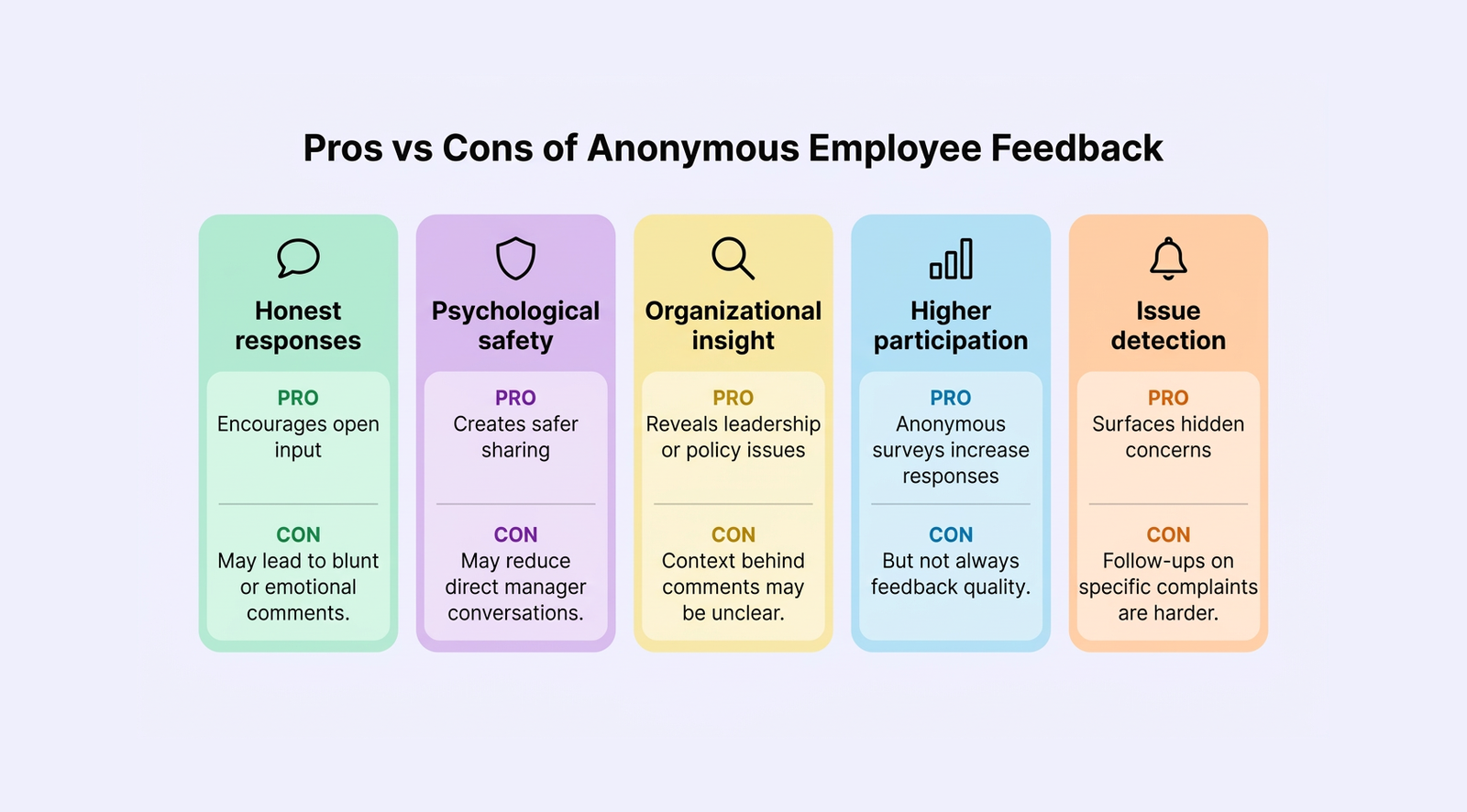
Anonymous employee feedback has clear advantages and trade-offs. The pros and cons of anonymous employee feedback include more honest employee input and higher participation, but also reduced accountability and limited follow-up.
Organizations evaluating anonymous surveys must weigh these factors carefully before adopting them.
This guide examines the pros and cons of anonymous employee feedback using tested frameworks used by institutions to assess whether anonymous feedback systems improve employee insight, participation, and decision-making.


- Anonymous employee feedback allows employees to share workplace concerns without revealing their identity.
- Employee feedback improves honesty and participation but may limit follow-up or accountability.
- It works the best for sensitive topics like culture, leadership issues, and psychological safety.
- Anymous employee feedback works best for sensitive topics like culture, leadership issues, and psychological safety.
- CultureMonkey helps organizations collect anonymous employee feedback securely with analytics, anonymity protection, and actionable insights.
Is anonymous feedback good or bad?

Anonymous employee feedback can be both useful and problematic. It encourages honest input from employees who may hesitate to speak openly, which explains why anonymous feedback is important in many organizations. At the same time, HR leaders highlight why anonymous feedback is bad, since comments submitted without accountability can be vague or difficult to investigate.
So is the anonymous good or bad in workplace feedback systems? The answer depends on governance, survey design, and how leaders respond to honest feedback. Anonymous systems can surface hidden concerns, but they work best when combined with structured anonymous employee surveys and follow-up conversations.
Pros vs cons of anonymous employee feedback
The pros and cons of anonymous surveys often reflect a trade-off between honesty and accountability. Organizations rely on anonymity to encourage participation, but anonymous systems can also introduce challenges in interpreting survey responses.
| Aspect | Pros of anonymous employee feedback | Cons of anonymous employee feedback |
|---|---|---|
| Honesty | Encourages open responses in anonymous surveys at work, allowing employees to raise issues they might avoid. | Feedback may be blunt or emotional because identities are hidden. |
| Culture | Supports an anonymous culture in the workplace where employees feel safer sharing concerns. | Over-reliance on anonymity may reduce conversations between employees and managers. |
| Organizational insight | Helps organizations collect anonymous company feedback about leadership, policies, or workplace problems. | Managers may struggle to understand the context behind certain comments. |
| Participation | Response rates often increase in an anonymous employee survey compared with identifiable surveys. | Higher participation does not always guarantee high-quality feedback. |
| Sentiment visibility | Anonymous systems capture broad anonymous opinions about workplace conditions and leadership decisions. | Anonymous comments can be difficult to validate or investigate. |
| Issue detection | Organizations often uncover hidden concerns through anonymous surveys that might otherwise remain unreported. | Anonymous submissions make it harder to follow up on specific complaints. |
Anonymity in employee surveys encourages honest feedback on sensitive issues like workload, psychological safety, and fairness.
Pros and cons of anonymous employee feedback for managers
Anonymous employee feedback helps managers see issues employees hesitate to raise openly, but it also limits accountability and follow-up. Reviewing anonymous employee reviews can reveal leadership blind spots, but anonymous systems may create challenges when managers need context or clarification.
Advantages for managers
Anonymous feedback channels can reveal concerns that remain hidden in direct conversations or formal meetings.
- Better employee honesty: Employees are more willing to raise concerns about negative feedback on culture, or workplace issues through anonymous feedback.
- Broader employee voice: Anonymous systems help capture perspectives from employees who might not speak openly in meetings or group discussions.
- Higher participation in feedback initiatives: When organizations run anonymous employee surveys, participation rates typically increase because employees feel safer sharing opinions.
- Reduced fear of retaliation: Anonymity removes the power dynamic that often prevents employees from raising concerns about managers or workplace practices.
- Early detection of workplace risks: Reviewing anonymous employee reviews can reveal patterns related to communication breakdowns, leadership issues, or operational problems.
- Focus on feedback rather than the individual: Managers are encouraged to evaluate the message itself instead of reacting to who submitted the feedback.
Combining rating-scale and open-ended questions helps capture measurable trends and deeper insights in anonymous employee surveys
Challenges for managers
Anonymous feedback can also create operational limitations for leaders.
- Limited accountability in responses: One of the common disadvantages of anonymous questionnaires is that managers cannot identify who submitted the feedback.
- Difficulty investigating complaints: Anonymous comments may highlight problems but often lack the detail needed to investigate further.
- Trust concerns around anonymity: Some employees still question “Are anonymous surveys really anonymous?”, which can affect how openly they respond.
- Lack of direct follow-up opportunities: Managers cannot clarify concerns or resolve issues through conversation when feedback is fully anonymous.
Anonymous employee surveys can reduce social desirability bias, leading to more genuine and unfiltered responses from employees.
(Source: PwC)
Pros and cons of anonymous employee feedback for employees

Anonymous employee feedback helps employees share concerns safely, increasing honesty and participation. However, it can also reduce accountability, encourage harmful criticism, and create mistrust if anonymity is misused.
Advantages for employees
- More honest responses: Employees provide candid input in anonymous employee surveys without fear of retaliation.
- Greater psychological safety: Anonymous systems allow quieter employees to speak openly about workplace concerns.
- Hidden problems surface earlier: Organizations often detect issues through an anonymous staff survey before they escalate.
- Higher survey participation: Organizations benefit from higher response rates, one of the key benefits of anonymous employee surveys.
- Safer channel for raising ideas or concerns: Employees may prefer using an anonymous suggestion box for sensitive workplace feedback.
Specific questions receive specific answers, so avoid vague and non-committal comments by asking pointed questions on distinct aspects of employees' experience.
Challenges employees may face
- Feedback may lack clarity: Managers cannot request clarification when responses are anonymous.
- Anonymity can be misused: Some individuals may leave emotional or harmful criticism.
- Team trust may decline: Overreliance on anonymity can create suspicion between colleagues.
- No accountability for comments: Anonymous responses remove ownership of feedback.
- Feedback may be ignored: Employees may disengage if concerns submitted through an anonymous feedback box are not addressed.
Organizations that implement anonymous employee surveys can identify issues sooner and understand trends across teams, contributing to a healthier workplace.
When anonymous employee feedback works best
Anonymous employee feedback works best when organizations need honest input on sensitive issues such as leadership behavior, workplace culture, or misconduct. Conducting anonymous surveys helps employees share concerns without fear of retaliation.
Handling sensitive workplace issues
- Employees report harassment, discrimination, or misconduct without fear of retaliation.
- Organizations capture honest insights about leadership and workplace policies.
Preventing fear of retaliation
- Anonymous channels protect employees who hesitate to criticize management openly.
- Staff provide candid responses through an anonymous feedback form.
Assessing organizational culture
- Organizations evaluate engagement and morale using anonymous employee surveys.
- Leaders identify cultural issues before they escalate into conflict or turnover.
Encouraging broader participation
- Introverted employees share ideas more comfortably when responses remain anonymous.
- Underrepresented or minority groups can raise sensitive concerns without social pressure.
- Higher response rates often reveal the real benefits of anonymous feedback as positive changes.
Running pulse surveys
Short anonymous surveys capture real-time sentiment without reducing participation.
- Pulse surveys track employee morale during change or organizational transitions.
- Anonymous surveys increase honesty in responses through frequent engagement measurements.
Short, frequent employee engagement surveys can provide actionable survey data on current events and prevent survey fatigue. Anonymous feedback works best when organizations ensure anonymity, follow up on concerns, and act transparently on survey results.
When anonymous employee feedback may not work

Anonymous employee feedback may not work when organizations need detailed context, accountability, or direct dialogue to resolve issues. In such cases, anonymous systems can limit follow-up conversations, reduce trust, and make it harder for managers to investigate concerns or implement solutions.
When issues require detailed follow-up
Anonymous systems can limit the ability to clarify concerns or gather additional information.
- Managers cannot ask follow-up questions on future surveys when responses lack important details.
- Collecting feedback through an anonymous feedback form may highlight problems but lack context.
When performance management requires accountability
Anonymous feedback is not suitable for performance evaluations or disciplinary decisions.
- Performance reviews require identifying information, transparent dialogue and clear responsibility for comments.
- Leaders often question should feedback be anonymous when discussing individual performance.
When anonymity encourages unconstructive criticism
Anonymity can sometimes enable emotional complaints instead of constructive suggestions.
- Some employees may leave harmful or exaggerated comments without accountability.
- Organizations must assess should employee surveys be anonymous when feedback becomes unproductive.
When teams are too small to ensure anonymity
In smaller teams, anonymity may be difficult to guarantee.
- Employees may fear their responses could be identified by role through demographic questions.
- Low trust may lead employees to doubt are employee engagement surveys really anonymous.
When open communication already exists
Highly transparent teams may benefit more from direct conversations than anonymous channels.
- Strong workplace trust reduces the need for anonymous reporting mechanisms.
- Leaders sometimes reconsider should employee engagement surveys be anonymous in open cultures.
When anonymity is clearly protected, employees are more likely to speak openly about leadership, communication, workload, and workplace culture. Organizations often balance this by using anonymous tools to measure sentiment while encouraging direct discussions for issues that require accountability or problem-solving.
How to collect anonymous employee feedback without revealing identity?
Organizations collect anonymous employee feedback by using secure survey systems, avoiding identifiable questions, and reporting results in aggregated form so individual responses cannot be traced.
Use independent feedback platforms
- Deploy an anonymous employee feedback tool that removes identifiable metadata like ip addresses.
- Strong systems improve the security of anonymous feedback systems.
Design surveys to prevent identification
- Use an anonymous feedback form that does not collect feedback on personal identifiers.
- Avoid questions about specific roles or projects that may reveal the employee identity.
Offer additional anonymous channels
- Employees can submit written concerns through an anonymous suggestion box.
- Organizations may also run periodic anonymous staff survey initiatives.
Protect anonymity in reporting
- Combine responses from small teams to prevent personally identifiable information or ip addresses of respondents.
- Aggregated reporting supports employee feedback compliance standards.
Build trust through transparency
- Clearly communicate how gathered feedback will be used.
- Act on recurring concerns so employees trust the feedback process.
Anonymous systems work best when anonymity is protected and organizations respond visibly to the feedback they receive.
Anonymous employee feedback vs confidential feedback

Anonymous employee feedback hides respondent identities completely, while confidential feedback links responses to individuals but restricts access to authorized personnel. Anonymous systems increase honesty, while confidential surveys enable follow-up and targeted action.
Organizations evaluating feedback systems often ask should employee engagement surveys be anonymous. The honest answer depends on whether psychological safety or actionable follow-up is the priority.
Anonymous feedback: Should organizations use it?
Organizations should use anonymous feedback when they want honest input on sensitive issues such as leadership behavior, or workplace concerns. Anonymous systems improve candor and participation, but they can also limit follow-up conversations and require strong governance to prevent misuse.
When anonymous feedback is valuable
Improves psychological safety
- Employees share concerns in anonymous mode without fear of retaliation or judgment.
- Honest responses strengthen trust in workplace listening systems without attaching the feedback to a person's identity.
Encourages broader participation
- More employees respond when feedback channels are anonymous.
- Anonymous systems capture actionable insights from quieter or hesitant employees.
Surfaces hidden organizational issues
- Anonymous responses reveal leadership problems or cultural concerns early.
- Patterns across responses highlight systemic workplace issues.
Supports inclusive feedback channels
- Employees from underrepresented groups may feel safer raising concerns.
- Anonymous channels enable participation from employees who avoid public discussions.
Challenges organizations must consider
Limited follow-up opportunities
- Anonymous responses may lack context needed to investigate issues.
- Managers cannot always clarify or verify specific complaints.
Risk of misuse or emotional criticism
- Some feedback may become unconstructive or overly critical.
- Clear guidelines are needed to maintain constructive dialogue.
Action is required to maintain trust
- Employees expect visible responses to recurring concerns.
- Ignored feedback can increase disengagement and cynicism.
Best practices for responsible implementation
- Define clear expectations for constructive feedback.
- Focus on patterns across responses rather than individual comments.
- Communicate openly about actions taken based on feedback.
- Use independent platforms to guarantee anonymity designed for collecting employee feedback.
- Analyze patterns across responses rather than focusing on single complaints.
- Establish clear guidelines to keep anonymous feedback constructive.
Organizations benefit most from anonymous feedback when it complements open communication and when leadership actively responds to the insights collected.
Conclusion
Anonymous employee feedback can improve honesty, participation, and visibility into workplace concerns, but it also introduces challenges. Organizations must balance these pros and cons of anonymous surveys carefully, using anonymous channels for sensitive insights while encouraging direct conversations for issues that require accountability and context.
See how the pros and cons anonymous employee feedback influence participation, honesty, and workplace culture. CultureMonkey, built for anonymous surveys at work, protects anonymity, analyzes engagement trends on feedback, and helps leaders act on insights through secure systems and structured reporting.
Book a demo with CultureMonkey.
FAQs
1. Why can anonymous feedback sometimes be bad in the workplace?
Anonymous feedback can become unconstructive if comments lack context, accountability, or evidence. Managers may struggle to investigate concerns or follow up on vague responses. Without governance and clear guidelines, anonymous channels may encourage emotional criticism instead of actionable workplace improvements.
2. How can organizations collect anonymous feedback from employees effectively?
Organizations collect anonymous feedback by using secure survey tools, avoiding identifiable questions, and reporting results in aggregated groups. Clear communication about anonymity and visible action on feedback are essential to build employee trust and encourage honest participation.
3. How do managers usually feel about receiving anonymous feedback from their teams?
Managers often value anonymous feedback because it reveals concerns employees hesitate to raise openly. However, some leaders find it difficult to act on comments that lack context or accountability. Anonymous responses are most useful when they highlight patterns that help managers improve communication and leadership practices.
4. What is the purpose of anonymous feedback in organizations?
The purpose of anonymous feedback is to help employees share honest opinions about leadership, culture, and workplace conditions without fear of retaliation. Organizations use anonymous channels to identify hidden issues, measure engagement, and understand employee sentiment more accurately.
5. What is anonymous employee feedback?
Anonymous employee feedback is feedback shared by employees without revealing their identity. Organizations use it to collect honest opinions about leadership, culture, and workplace conditions while protecting employees from retaliation or social pressure.
6. How are anonymous employee feedback software pricing models typically structured?
Anonymous employee feedback software pricing is usually based on employee count, feature tiers, or subscription plans. Organizations may pay monthly or annually depending on platform capabilities, reporting features, integrations, and support services included.
7. Is anonymous feedback a cost-effective way to collect employee insights?
Anonymous feedback can be cost-effective because it increases participation and reveals issues early, helping organizations address problems before they escalate. When combined with structured surveys and action plans, anonymous systems provide valuable employee insights with relatively low operational cost.