


Employee engagement challenges in the hospitality industry

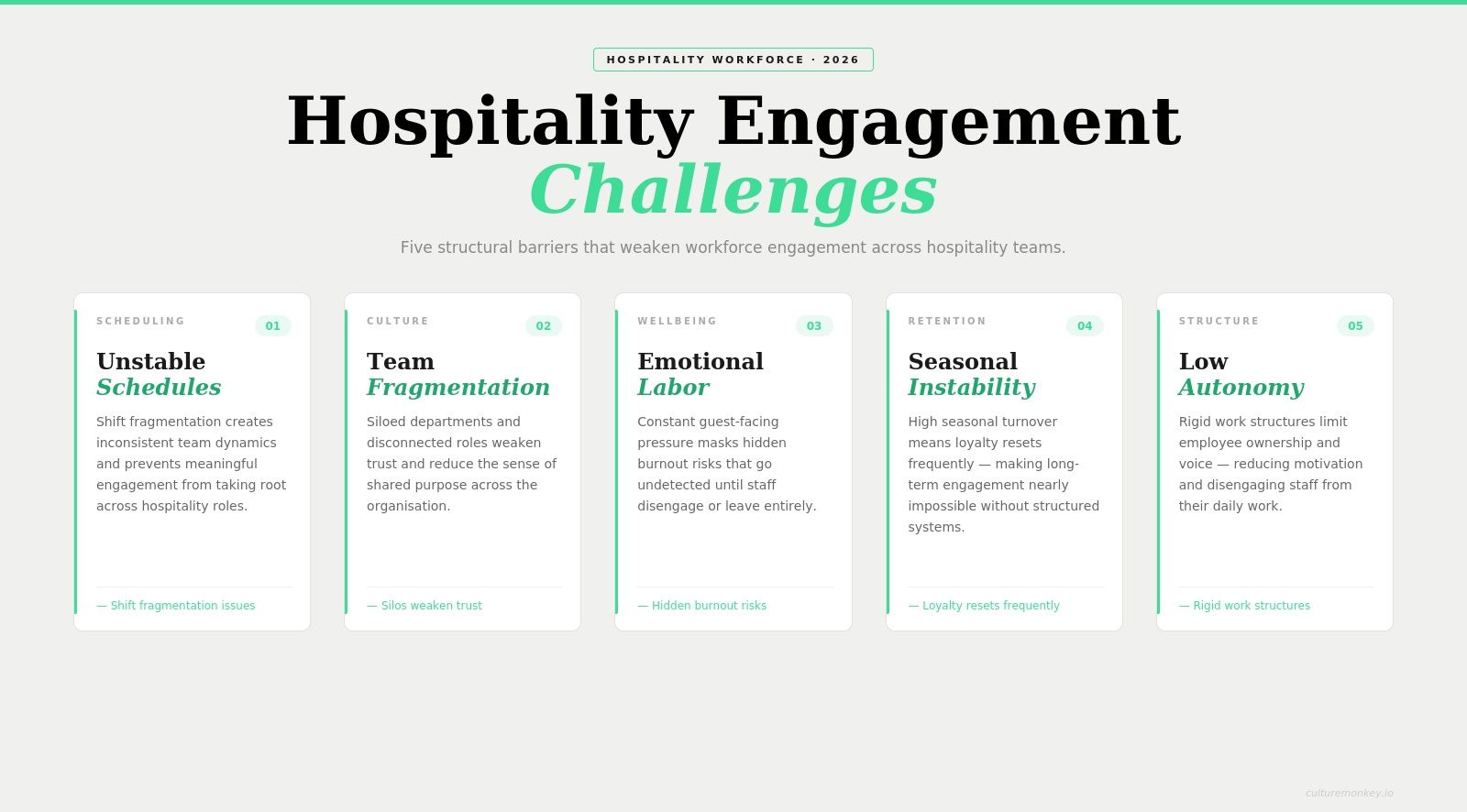
Employee engagement challenges in the hospitality industry are driven by structural conditions, not individual motivation gaps. Most engagement strategies fail because they are built for stable, desk-based teams, not shift-driven, high-churn hospitality environments.
Shift rotation disrupts team identity. Tipping income creates inter-departmental tension. Seasonal hiring resets loyalty every few months. Zero-hours contracts create income uncertainty that no recognition program can offset.
This article breaks down the 7 structural employee engagement challenges in the hospitality industry and maps each one to a practical response direction.


- Hospitality engagement is uniquely difficult because unstable schedules, high turnover, and fragmented teams disrupt consistent employee engagement.
- Shift fragmentation and department silos prevent stable team identity, weakening trust, communication, and long-term employee engagement significantly.
- Emotional labour in guest-facing roles creates hidden burnout, reducing morale and increasing employee turnover across hospitality teams.
- Seasonal hiring cycles and tipping culture create instability, resetting loyalty and driving disengagement across frontline and back-of-house staff.
- CultureMonkey helps hospitality businesses track engagement through real-time feedback, enabling early detection of disengagement and reducing employee turnover effectively.
What makes hospitality engagement uniquely difficult
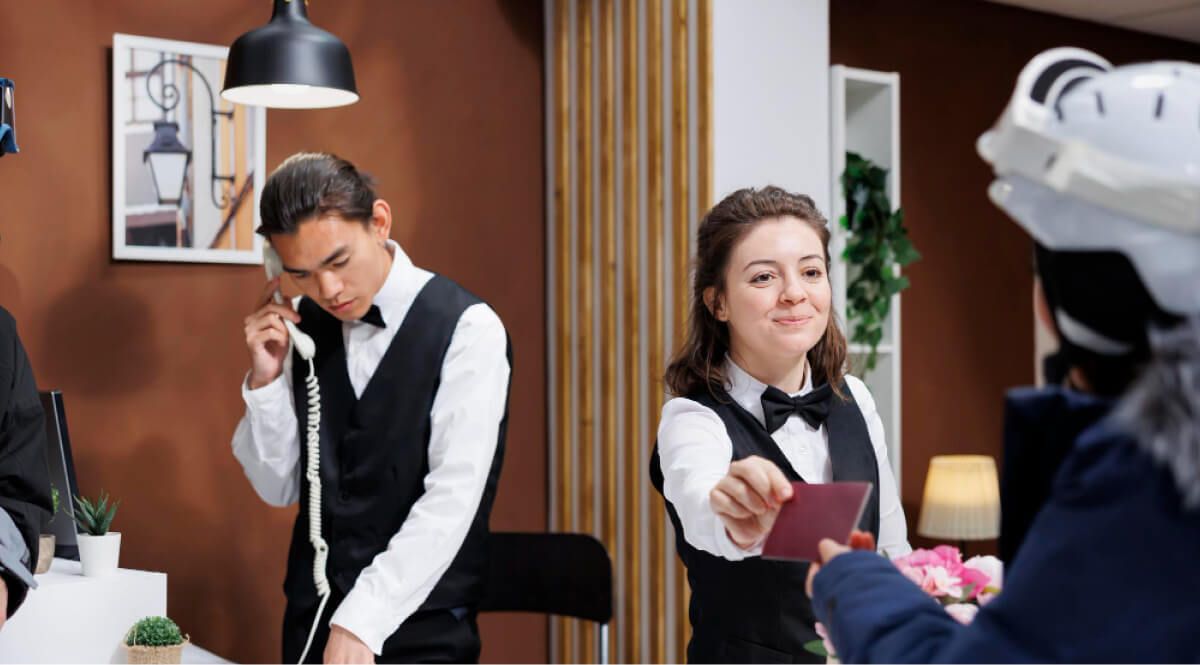
Employee engagement challenges in the hospitality industry are driven by structural conditions rather than individual motivation gaps. Unlike many businesses where teams operate with stability, the hospitality sector runs on constant movement, variability, and short-term workforce cycles. These conditions reshape how employees experience work, making traditional engagement models ineffective.
What defines hospitality work environments
Hospitality businesses operate in fast-paced, guest-driven environments where frontline workers are expected to deliver consistent service under unpredictable conditions. Daily operations depend on fluctuating demand, last-minute schedule changes, and long working hours.
Many hospitality employees work split shifts, seasonal roles, or casual contracts. This means their experience of work is fragmented across time, teams, and responsibilities. Unlike other industries where employees build routine and familiarity, hospitality workers often operate without consistency, which directly impacts engagement.
Why traditional engagement models fail here
Most engagement strategies assume stability. They assume employees work with the same team, follow predictable schedules, and build long-term relationships within the workplace. These assumptions do not hold in hospitality.
Hotel managers and hospitality employers cannot rely on fixed teams or consistent workforce availability. Engagement scores collected through traditional surveys often fail to capture the reality of frontline teams, where conditions change week to week. As a result, many hospitality businesses invest in engagement strategies that do not address the root causes of disengagement.
| Factor | Hospitality | Retail | Customer Service |
|---|---|---|---|
| Shift variability | Very high | Moderate | Moderate |
| Emotional labour | Extreme | Moderate | High |
| Income volatility | High (tips) | Low | Low |
| Seasonal impact | Severe | Moderate | Low |
| Department silos | Severe | Moderate | Low |
The 7 structural challenges shaping engagement

These structural conditions lead to recurring patterns of disengagement across the hospitality industry. The biggest challenges are not isolated issues, but systemic constraints built into how the industry operates.
- Shift fragmentation and identity loss
- Emotional labour burnout in guest-facing roles
- Seasonal hospitality engagement issues
- Tipping culture disengagement
- Multi-department silo hotel operations
- Brand standard pressure on frontline teams
- Zero-hours contract engagement in hospitality
| Factor | Why does it break engagement |
|---|---|
| Rotating schedules | Prevent stable team identity |
| High turnover | Resets trust and relationships |
| Seasonal hiring | Disrupts long-term loyalty |
| Income variability | Reduces perceived fairness |
Challenge 1: Shift fragmentation and identity loss
Rotating shifts prevent a stable team identity by breaking consistent human connections. Hospitality employees working different schedules do not develop shared team bonds, weakening communication, trust, and engagement.
This happens because team identity depends on repeated interaction. In many hospitality jobs, employees rotate across shifts and teams, limiting familiarity. Over time, workers see themselves as independent shift-fillers rather than part of a team, reducing emotional investment and increasing turnover.
How rotating shifts break team continuity
In many hospitality jobs, employees rotate across different shifts, departments, and team members. A worker on a morning shift may never interact with someone consistently assigned to evenings. Over time, this creates a workplace where people share responsibilities but not relationships.
This lack of continuity weakens communication. Instructions get passed across shifts instead of within teams, leading to gaps, misunderstandings, and reduced accountability. For frontline teams, this translates into daily friction that directly affects service quality and morale.
Why is identity required for engagement?
Employee engagement is not just about satisfaction or recognition. It is built on a sense of belonging. When hospitality employees identify with a team, they are more likely to collaborate, support each other, and stay committed during high-pressure situations.
In fragmented environments, this identity never fully forms. Workers see themselves as individuals filling shifts rather than members of a team. This reduces emotional investment in the workplace and increases the likelihood of disengagement and turnover.
What consistent engagement looks like in shift environments
Some hospitality employers are beginning to address this by introducing structured shift patterns or micro-team models. Instead of fully rotating staff, they create smaller groups that work together more frequently.
This does not eliminate operational flexibility, but it introduces enough consistency for relationships to develop. When employees recognise familiar faces, communication improves, trust builds, and engagement becomes more sustainable.
| Fixed teams vs rotating shifts | Engagement impact |
|---|---|
| Fixed teams | Strong identity, higher engagement |
| Rotating shifts | Low connection, disengagement |
Key takeaway: Stable team structures are critical to improve engagement in hospitality teams.
Challenge 2: Emotional labour burnout
Emotional labour in hospitality creates hidden burnout by forcing employees to constantly regulate their emotions during guest interactions. This reduces morale and engagement even when performance appears positive.
Unlike traditional burnout, emotional labour accumulates through repeated interactions where employees suppress genuine reactions. Over time, this leads to internal fatigue, reduced patience, and disengagement, making it difficult for managers to identify early warning signs.
What emotional labour means in hospitality
In guest-facing roles, employees are expected to remain calm, polite, and attentive regardless of the situation. Whether handling complaints, managing difficult guests, or working under pressure, hospitality workers are required to regulate their emotions as part of the job.
This constant emotional regulation becomes part of daily operations. Over time, it shifts from a skill to an expectation, making it harder for employees to recover between interactions.
Why is it different from traditional burnout
Traditional burnout is often linked to workload, long hours, or physical exhaustion. Emotional labour operates differently. It builds through repeated interactions where employees must suppress genuine reactions and replace them with expected behavior.
Because it is less visible, it is often overlooked by managers. Employees may appear engaged on the surface while experiencing internal fatigue that gradually reduces morale and commitment.
How it accumulates across guest interactions
Each interaction may seem minor in isolation, but across a shift, the cumulative effect becomes significant. Over days and weeks, this leads to stress, reduced patience, and eventual disengagement.
This is one of the key hospitality employee disengagement causes that directly affects service quality and guest satisfaction.
| Burnout | Emotional labour |
|---|---|
| Workload-driven | Emotion-driven |
| Visible fatigue | Hidden exhaustion |
| Easier to detect | Difficult to identify |
Key takeaway: Recognising emotional labour is essential to improving engagement in hospitality teams.
Challenge 3: The seasonal identity crisis
Seasonal hiring cycles reset employee loyalty by breaking workforce continuity across hospitality businesses. Employees identify with seasons or events rather than the employer, weakening long-term engagement.
This happens because many hospitality workers are hired temporarily during peak demand. Each cycle disrupts relationships, culture, and engagement programs, making it difficult to build a consistent workplace identity or retain talent over time.
Why seasonal hiring resets loyalty
Many hospitality businesses scale their workforce up and down depending on peak periods, events, or tourism cycles. While this supports operational efficiency, it disrupts long-term relationship building.
Each hiring cycle effectively resets engagement. Employees who return may not feel a strong connection to the organisation, while new hires start without any existing cultural context.
How workers form short-term identity cycles
In this environment, workers often associate their identity with the season, the event, or the location rather than the employer. For example, someone may see themselves as part of a “summer season team” rather than part of a specific hospitality business.
This limits long-term engagement because the psychological connection is temporary by design.
Why engagement programs fail across seasons
Most engagement strategies assume continuity. However, when teams change frequently, these programs lose effectiveness.
- Peak season brings temporary motivation and high energy
- Off-season leads to disengagement or workforce exit
- Rehiring creates disconnect, even among returning employees
This cycle contributes to high turnover rates and makes it difficult for hospitality employers to build a stable workplace culture.
Key takeaway: engagement strategies in hospitality must be designed for cyclical workforce patterns.
Challenge 4: Tipping culture inequity
Tipping culture creates income inequality between roles, leading to disengagement and fairness concerns across hospitality teams. Frontline and back-of-house staff experience different earning potential despite shared responsibilities.
This imbalance affects perceived fairness, which is critical to employee engagement. When employees compare compensation across roles, it creates tension, reduces collaboration, and contributes to disengagement and turnover in hospitality environments.
How tipping creates income asymmetry
In many hospitality settings, front-of-house staff have access to tipping income, while back-of-house employees rely entirely on fixed wages. This creates a clear and ongoing difference in earning potential.
Even when both roles contribute equally to service quality, compensation structures do not reflect that shared effort.
Why perceived fairness drives engagement
Employee engagement is strongly influenced by perceived fairness. When hospitality employees compare their earnings with others in the same workplace, visible gaps can create dissatisfaction.
This is especially relevant in environments where teamwork is critical. When compensation feels unequal, collaboration begins to break down.
Where resentment builds across teams
Over time, this imbalance leads to tension between departments. Back-of-house teams may feel undervalued, while frontline teams may experience pressure to maintain performance tied to tipping.
| Role | Income type | Engagement risk |
|---|---|---|
| Front-of-house | Tips + base pay | Higher short-term motivation |
| Back-of-house | Fixed pay | Higher disengagement risk |
This dynamic is a major contributor to hotel staff engagement problems and impacts both morale and retention.
Key takeaway: perceived fairness in compensation is critical to sustain engagement in hospitality teams.
Challenge 5: Multi-department communication silos
Multi-department silos reduce communication and shared visibility, weakening coordination and employee engagement across hospitality teams. Departments operate independently with limited interaction.
This creates communication gaps between the front desk, housekeeping, and operations, leading to delays and frustration. Employees lack visibility into how their work connects to others, reducing ownership, collaboration, and overall workplace engagement.
How departments operate in isolation
Hospitality operations are typically divided across departments such as front desk, housekeeping, maintenance, and food and beverage. While each function is essential, they often operate independently with limited interaction.
This separation is reinforced by shift patterns, reporting structures, and physical workspaces.
Where communication breakdown happens
Information does not always flow smoothly between departments. A request from the front desk may not reach housekeeping in time, or maintenance issues may not be communicated clearly.
These breakdowns create friction in daily operations and increase stress for employees who depend on coordination.
Why engagement depends on shared visibility
Employees feel more engaged when they understand how their work contributes to the larger operation. In siloed environments, this visibility is limited.
- Front desk → housekeeping coordination gaps
- Housekeeping → maintenance delays
- F&B → operations misalignment
| Department | Communication gap | Impact |
|---|---|---|
| Front desk | Limited feedback loop | Service inconsistency |
| Housekeeping | Low visibility | Reduced ownership |
| F&B | Operational disconnect | Guest experience gaps |
These silos reduce collaboration, increase frustration, and weaken overall workplace culture.
Key takeaway: improving cross-department visibility is essential to improving engagement and service quality.
Challenge 6: Brand standard pressure on frontline staff
Rigid brand standards reduce employee autonomy by forcing scripted interactions, limiting authentic engagement in hospitality roles. Frontline staff must follow predefined behaviors instead of responding naturally.
This reduces emotional connection with guests and decreases job satisfaction. Over time, employees feel restricted, which impacts morale, engagement, and service quality across hospitality businesses.
What scripted service actually demands
Frontline teams are often required to follow strict service scripts to ensure consistent guest experiences. These scripts define how employees speak, behave, and respond in different situations.
While this helps maintain service quality, it also reduces flexibility.

In hospitality, the employee experience is the customer experience. If your people feel fragmented, unsupported, or undervalued, your guests will feel it immediately.


Why authenticity drives engagement
Employees feel more engaged when they can express their personality and adapt to situations naturally. Authentic interactions create stronger connections with guests and increase job satisfaction.
Where brand standards suppress autonomy
When service becomes overly scripted, employees may feel restricted. Instead of responding naturally, they are focused on meeting predefined expectations.
| Scripted service | Authentic interaction |
|---|---|
| Controlled responses | Flexible communication |
| Predictable delivery | Personalized service |
| Limited autonomy | Higher engagement |
This tension affects both employee morale and the quality of guest interactions.
Challenge 7: Zero-hours and casual contract insecurity
Zero-hour contracts reduce engagement by creating income instability and unpredictable schedules for hospitality workers. Employees cannot rely on consistent work or earnings.
This uncertainty limits long-term commitment, as workers prioritize immediate financial security over engagement. Over time, this leads to disengagement, higher turnover rates, and difficulty retaining talent in hospitality businesses.
How zero-hours contracts affect stability
In many hospitality jobs, employees are not guaranteed a fixed number of hours. Schedules change frequently based on demand, leaving workers uncertain about their income and workload.
Why uncertainty reduces engagement investment
When employees cannot predict their schedules or earnings, they are less likely to invest emotionally in their work. Engagement requires a level of security that allows workers to focus beyond immediate concerns.
What predictable work signals look like
Hospitality employers that introduce more predictable scheduling practices often see improvements in engagement and retention.
- Income unpredictability
- Shift volatility
- Reduced commitment to long-term roles
This instability is one of the key reasons why hospitality workers leave and contributes to high turnover across the industry.
How to measure and improve hospitality engagement

Hospitality engagement can be improved by stabilizing schedules, strengthening communication, and continuously capturing frontline feedback. Measuring engagement requires tracking real-time workforce signals, not relying only on periodic surveys.
How to improve hospitality engagement
Improving employee engagement in the hospitality industry requires addressing the structural challenges that drive disengagement rather than relying only on recognition programs or surface-level initiatives.
- Stabilize shift scheduling to reduce unpredictability and improve consistency across hospitality teams
- Introduce micro-team structures to build identity and improve collaboration among frontline workers
- Improve cross-department communication to reduce silo effects and operational friction
- Address pay fairness and transparency to reduce disengagement caused by tipping culture inequity
- Reduce emotional labour strain through better support systems and realistic service expectations
- Strengthen training and management practices to improve clarity, support, and team alignment
These engagement strategies help hospitality businesses move from reactive fixes to structured improvements that directly impact retention and service quality.
How to measure engagement in hospitality
Measuring employee engagement in hospitality requires tracking both perception and behavior. Traditional engagement scores alone are not enough to identify early warning signs of disengagement.
Key metrics to track include:
- Survey participation rate to measure trust and willingness to share feedback
- Engagement scores to understand overall workforce sentiment
- Employee turnover rates to identify retention risks
- Absenteeism trends as indicators of stress or disengagement
- Manager action completion rates to measure follow-through on feedback
| Metric | What it indicates |
|---|---|
| Participation rate | Employee trust and openness |
| Engagement score | Overall sentiment |
| Turnover rate | Retention risk |
| Absenteeism | Burnout or disengagement signals |
| Manager actions | Accountability and response quality |
Tracking these metrics consistently allows hospitality employers to identify early warning signs and respond before disengagement leads to turnover.
Tools to track and improve engagement
Hospitality businesses need tools designed for frontline and shift-based environments to capture accurate engagement data.
Effective tools include:
- Real-time feedback platforms that collect input across shifts and roles
- Multi-channel survey tools that reach hospitality employees through mobile, kiosk, or messaging platforms
- Analytics dashboards that give hotel managers visibility into engagement trends and workforce patterns
These tools help many hospitality businesses move beyond static surveys and create continuous engagement systems that align with daily operations.
Conclusion
Employee engagement challenges in the hospitality industry directly shape workplace stability, service quality, and long-term business performance. When these structural issues are ignored, hospitality employees disengage, turnover increases, and guest satisfaction declines. Addressing these challenges requires continuous visibility into frontline realities, not occasional surveys.
CultureMonkey helps hospitality businesses measure employee engagement in real time through multi-channel feedback, capturing insights across shifts, departments, and roles.With actionable analytics and manager-level visibility, it enables organisations to identify early warning signs, improve engagement strategies, and build a stronger workplace culture that supports both employees and consistent guest experiences.
FAQs
1. Why do hospitality employees disengage so quickly in companies?
Hospitality employees disengage due to unstable schedules, high turnover, and lack of predictability. These structural conditions disrupt team identity, prevent long-term relationships, and reduce perceived fairness. Unlike stable industries, hospitality's shift, fragmentation and seasonal hiring reset engagement cycles continuously.
2. What are the early warning signs of disengagement in hospitality teams?
Early warning signs include reduced participation, poor communication, declining service quality, and increased absenteeism. Hospitality managers must identify these signals through feedback tools and daily operations monitoring to prevent deeper disengagement and rising turnover rates across teams.
3. How do unpredictable schedules affect employee engagement in hospitality?
Unpredictable schedules reduce consistency, disrupt personal routines, and increase stress among hospitality workers. This instability prevents employees from feeling valued or committed, leading to lower morale, reduced engagement, and higher turnover across restaurants, hotels, and hospitality.
4. Why is employee turnover higher in restaurants and hospitality businesses?
Turnover is higher in hospitality due to seasonal hiring cycles, emotional labour demands, and inconsistent management. Weak recruitment and training practices further limit retention. These structural factors make it difficult for hospitality businesses to build long-term workforce stability.
5. What tools help improve employee engagement in hospitality companies?
Real-time feedback and multi-channel engagement tools are most effective. These systems provide shift-based insights, cross-department visibility, and manager-level data to identify gaps early. CultureMonkey enables hospitality businesses to track engagement continuously and prevent turnover.
6. How can training and management improve engagement in hospitality?
Effective training and clear expectations help hospitality workers feel supported and valued. When employees understand what's expected and receive consistent guidance, engagement improves, performance increases, and service quality strengthens across teams and departments in restaurants and hotels.
7. How can a business owner improve engagement and retain talent in hospitality?
Focus on addressing structural challenges: improve scheduling predictability, create cross-department communication, and implement real-time feedback systems. CultureMonkey helps owners track engagement trends, identify early warning signs, and retain talent by addressing root causes of disengagement.