


Employee engagement survey software for enterprise guide

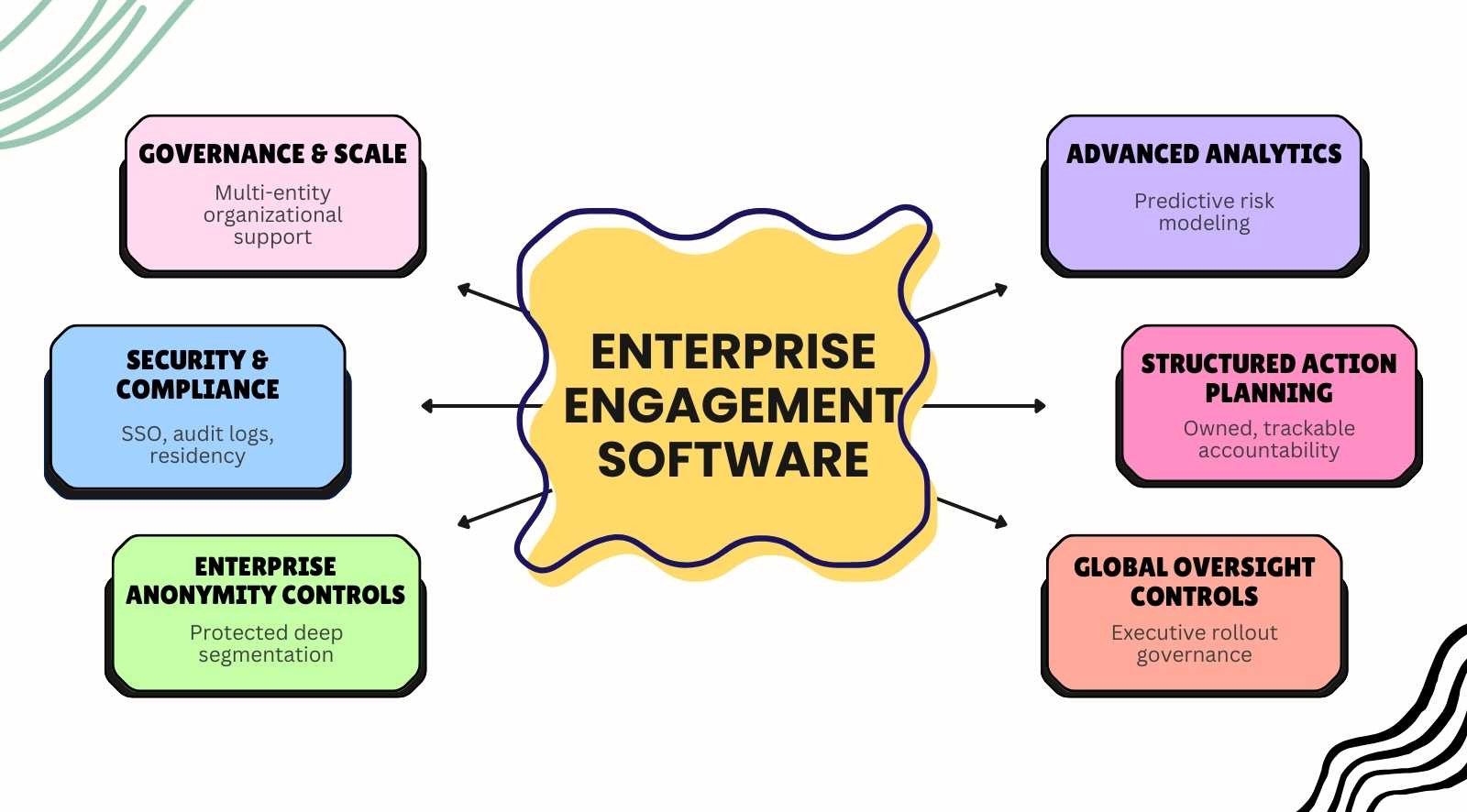
Employee engagement survey software for enterprise must handle governance, security, and operational complexity across global regions while protecting anonymity and compliance. Unlike SME tools, enterprise platforms support structured access, audit visibility, and scalable deployment across business units and reporting layers, enabling consistent survey results and reliable team insights.
The right platform strengthens an organization’s culture by empowering leaders with deeper insights and equipping manager support frameworks that turn feedback into action. It also helps empower employees by ensuring their voices shape decisions throughout the entire process.
This guide explains requirements, risks, and best practices for organizations moving from SME tools to enterprise solutions, based on real multi-country deployment experience.


- Enterprise engagement survey software must support governance, security, anonymity, and multi-entity complexity at scale.
- Role-based access, SSO, audit logs, and data residency are mandatory for compliance and risk control.
- Enterprise-grade anonymity enables deep segmentation without exposing individual identities.
- Advanced analytics like driver modeling and predictive risk turn feedback into measurable business outcomes.
- Structured action planning, global rollout controls, and executive oversight ensure engagement insights translate into accountability.
What changes when employee engagement software scales to the enterprise level?

Enterprise employee engagement survey software introduces governance layers, structured access control, and operational complexity required by large, multi-entity organizations. It is used by CHROs, HR operations, IT, and risk leaders to manage employee feedback across regions. Most deployments are cloud-based, though regulated firms may require private cloud or on-prem hosting.
1. Expanded governance structure
Governance expands from HR ownership to cross-functional oversight involving HR, IT, Legal, and Compliance. Clear policies define survey cadence, access rights, data retention, and reporting thresholds to reduce regulatory and reputational risk. Governance structures also help ensure that engagement initiatives are aligned with the organization's goals and support goal alignment across teams.
- Formal steering committees approve survey cycles and question frameworks.
- Data retention policies align with GDPR and regional privacy laws.
- Audit logs track report access, exports, and configuration changes.
- Standardized survey taxonomy ensures consistency across business units.
Measuring engagement at the governance level provides key insights into motivation, goal alignment, and overall morale, directly impacting productivity.
2. Advanced access control and permissions
Access control at enterprise scale requires structured role-based permissions to prevent data misuse while enabling managerial visibility. Reporting hierarchies must mirror complex org structures without exposing identifiable responses.
- RBAC restricts view access by role, region, and business unit.
- SSO ensures secure authentication across enterprise systems.
- Minimum response thresholds protect anonymity in small teams.
- Layered dashboards separate executive, HR, and manager views.
3. Organizational and structural complexity
Organizational complexity increases due to matrix reporting, acquisitions, and global operations. Engagement platforms must support multi-level segmentation without fragmenting reporting integrity.
- Dynamic org mapping syncs automatically with HRIS systems, a capability often found in comprehensive employee engagement platforms like CultureMonkey.
- Multi-country rollouts account for regulatory differences, and some smaller regions may initially rely on anonymous employee feedback with tools like Google Forms before transitioning to enterprise-grade platforms.
- Integration with HR analytics tools and seamless integration with existing systems and HRIS is crucial for automatic user management and unified reporting.
- Scalability is essential, enabling the software to handle thousands of users while maintaining data privacy.
- Role-based dashboards provide customized insights for managers and executives, allowing them to view relevant team data.
4. Enterprise risk and accountability exposure
At enterprise scale, engagement data intersects with compliance risk, attrition cost, and leadership accountability. Weak configuration or fragmented ownership can create governance gaps.
- Poor anonymity safeguards reduce participation rates.
- Inconsistent segmentation produces unreliable insights.
- Weak access controls increase data security exposure.
- Lack of executive oversight limits the effectiveness of corrective action.
How does enterprise-grade anonymity enable multi-dimensional segmentation without risk?

Enterprise-grade anonymity, as businesses measure employee engagement, allows them to segment data by function, region, tenure, and manager level without exposing individual identities. It is used by large enterprises to balance granular analytics with strict privacy controls. The objective is to protect respondents while maintaining actionable insight depth.
Survey responses and survey data collected through employee engagement survey software for enterprise help HR teams and people leaders gauge how employees feel in real time. Continuous feedback and continuous listening mechanisms are most effective when embedded within structured feedback mechanisms in the workplace, enabling organizations to assess employee satisfaction and motivation and address concerns quickly.
- Dynamic minimum response thresholds adjust automatically when multiple filters are applied, preventing identification in small cohorts.
- Attribute suppression hides sensitive demographic fields when sample sizes fall below compliance-safe limits.
- Aggregated reporting ensures cross-tab views cannot isolate individuals through layered segmentation.
- Privacy-by-design architecture removes personally identifiable tracking at the data capture level.
- Real-time anonymity validation blocks report exports that violate anonymity rules.
Enterprise-grade anonymity directly impacts participation rates. Research from Gallup indicates that business units in the top quartile of engagement, supported by confidential surveys, experience 78% less absenteeism.
Advanced platforms also support differential access models. Executives may view enterprise-wide heatmaps, while managers access only their validated team aggregates. This separation preserves privacy while enabling leadership accountability.
What security capabilities must enterprise engagement survey software provide?

Enterprise employee engagement survey software for enterprise must provide SSO, RBAC, audit logs, encryption, and controlled data residency to meet regulatory and internal security standards. These safeguards are required by HR, IT, and risk teams in large organizations operating across multiple jurisdictions and must complement broader anonymous feedback collection practices used across the organization.
Security at enterprise scale requires identity control, traceability, encryption, and geographic data governance. Each protocol must operate independently yet integrate within enterprise IT frameworks. Weak controls increase breach exposure and delay procurement approval.
Enterprise security protocols breakdown
Single sign-on integration
- Supports SAML 2.0 or OAuth 2.0 authentication standards.
- Integrates with identity providers such as Azure AD or Okta.
- Enforces centralized password policies and MFA requirements.
- Enables automatic user provisioning and de-provisioning.
Role-based access control
- Defines permissions by role, geography, and reporting line.
- Restricts export and segmentation rights to approved users.
- Separates executive, HR, and manager dashboard access.
- Prevents cross-business unit visibility without authorization.
Audit logs and activity monitoring
- Records login attempts and authentication history.
- Tracks report downloads and data exports.
- Logs survey configuration edits and permission changes.
- Maintains tamper-resistant records for audit review.
Data residency and hosting controls
- Allows region-specific data storage selection.
- Supports EU, US, UK, or APAC hosting options.
- Complies with GDPR and local data sovereignty rules.
- Documents sub-processor transparency and hosting certifications.
Encryption standards
- Encrypts data in transit using TLS protocols.
- Encrypts data at rest using AES-256 standards.
- Secures backup storage and archival environments.
- Protects API connections with token-based authentication.
IBM reports that the global average data breach cost reached USD 4.44 million in 2025. Enterprise-grade security controls reduce financial exposure and strengthen audit readiness in regulated sectors.
How should enterprise engagement software support global deployment?
Enterprise employee engagement survey software must support multilingual distribution, standardized communication, and governed rollouts across regions while respecting local regulations and culture. A custom survey framework ensures consistent engagement results, enabling informed decisions through a data-driven approach without compromising global comparability.
- Multilingual survey capability: Platforms must support 50+ validated languages, allow in-survey language switching, preserve scoring equivalence across translations, and ensure compatibility for non-Latin scripts. Localization should reflect regional compliance terminology without altering engagement constructs.
- Standardized communication templates: Enterprise systems should provide branded email and intranet templates, executive endorsement formats, localized reminders aligned to regional calendars, and controlled customization without modifying core survey logic or metrics.
- Structured rollout governance: Deployment must include phased regional launches, centralized participation dashboards, legal approval workflows for regulated countries, and monitoring for response disparities across geographies to maintain comparability and audit traceability.
How should enterprises manage action planning after engagement surveys?
Employee engagement survey software for enterprise must include structured action management that assigns ownership, defines timelines, and aligns review cycles with leadership governance. Large organizations require disciplined follow-through to convert survey insights into measurable operational improvements, supported by thoughtfully designed employee engagement initiatives to maximize workplace engagement.
Defined ownership structure
Clear ownership ensures engagement actions are not diluted across layers. Responsibility must be mapped to executives, business unit heads, and frontline managers based on control over identified drivers.
- Assign actions at the enterprise, regional, and team levels.
- Link accountability to existing reporting hierarchies.
- Provide visibility of assigned owners within dashboards.
- Enable escalation when actions remain unaddressed.
Time-bound execution framework
Action plans must include defined due dates and review checkpoints. Without timelines, initiatives lose priority within competing operational demands.
- Set realistic completion deadlines aligned to business cycles.
- Configure automated reminders for overdue actions.
- Include interim milestone reviews for longer initiatives.
- Archive completed actions with documented outcomes.
Alignment with leadership operating rhythm
Engagement actions must be embedded within existing governance forums. Isolated HR follow-ups limit enterprise impact.
- Review progress in monthly leadership meetings.
- Integrate key actions into quarterly performance management reviews.
- Include engagement risks in enterprise risk discussions.
- Track improvements alongside business performance metrics.
Centralized progress monitoring
Enterprise platforms should provide consolidated dashboards tracking action status across divisions. Visibility drives consistency and leadership accountability.
- Monitor completion rates across business units.
- Identify recurring unresolved themes.
- Compare action velocity across managers.
- Maintain audit trails for action history.
What analytics capabilities matter in enterprise engagement survey software?

Employee engagement survey software for enterprise must deliver driver analysis, longitudinal trends, multi-level segmentation, manager accountability insights, and predictive risk modeling. Enterprise analytics must identify causation, detect risk concentration, and support governance decisions across complex organizational structures.
1. Driver analysis and impact modeling
We tested platforms that isolated statistical drivers influencing engagement outcomes across business units. Driver modeling identified which factors most affected employee retention, exposure, and performance stability. This allowed leadership teams to prioritize high-impact issues instead of reacting to surface-level score declines.
2. Longitudinal trend tracking
We tested multi-cycle dashboards covering 12 to 24 months of engagement data. Tracking engagement trends over multiple survey cycles helps organizations identify long-term patterns and address emerging issues proactively, especially when those trends are mapped against a planned employee engagement activity calendar. Trend analysis revealed a gradual deterioration in trust and workload balance that single-cycle reporting did not detect. Sustained pattern visibility enabled earlier intervention and improved planning discipline.
3. Multi-dimensional segmentation
We tested segmentation across geography, tenure, business unit, and manager layer with enforced anonymity safeguards. Structured segmentation revealed localized engagement disparities within large enterprises. This prevented enterprise-wide generalizations and supported targeted corrective action, particularly when supported by well-crafted anonymous survey questions for employees that encourage candid feedback at scale.
4. Manager-level accountability analytics
We tested manager dashboards aligned with reporting hierarchies and controlled access permissions. Manager-level employee engagement analytics connected outcomes with leadership effectiveness indicators. This created visibility into improvement velocity and recurring trust gaps within specific reporting lines, which can be complemented by targeted manager feedback survey questions to assess leadership effectiveness.
5. Predictive risk and attrition modeling
We tested predictive models linking engagement indicators with voluntary turnover, absenteeism, and performance volatility. Predictive analytics identified high-risk segments before attrition spikes occurred. By leveraging these insights, organizations can reduce turnover and boost retention by identifying at-risk segments and enabling proactive interventions, especially in areas where poor leadership is damaging company culture.
What enterprise buyers should include in an rfp for engagement survey software?
An RFP for employee engagement survey software for enterprise must evaluate governance readiness, security controls, analytics depth, global scalability, and vendor reliability. It should also specify key features such as automated pulse surveys, actionable AI-driven insights, integration with HR systems, and advanced capabilities like employee sentiment analysis and workplace culture survey questions that assess organizational health.
Effective employee engagement software must prioritize advanced analytics, data security, and seamless integration with existing HRIS and communication tools. Enterprise buyers must assess operational fit and compliance alignment rather than focusing only on survey features.
Enterprise RFP evaluation criteria
- Governance architecture that supports multi-level access control and cross-functional oversight.
- Configurable anonymity thresholds with automated suppression safeguards.
- Documented enterprise security architecture with independently validated compliance artifacts.
- Advanced analytics, including driver modeling, trend analysis, and predictive risk capabilities.
- Global deployment readiness with multilingual support and legal workflow controls.
- Native HRIS and identity provider integrations with secure API architecture.
- Transparent implementation timelines and structured onboarding methodology.
- Dedicated enterprise support model with SLA commitments.
- Clear data ownership terms and exit data portability clauses.
Enterprise RFP processes should include IT security review, compliance validation, and stakeholder scoring matrices. Structured evaluation prevents misalignment between HR expectations and enterprise risk requirements.
What is the recommended evaluation path for enterprise engagement software?
When evaluating solutions, organizations should consider how the software will impact the overall employee experience and empower HR teams to capture engagement data and measure the impact of engagement initiatives, including whether it can orchestrate diverse employee engagement activities for remote, hybrid, and onsite teams.
Structured shortlist validation
We tested shortlisted vendors against enterprise requirements rather than feature breadth. Evaluation focused on governance readiness, anonymity controls, and integration maturity.
- Reviewed core capabilities, including driver analysis and segmentation controls.
- Assessed integration compatibility with HRIS and identity systems.
- Verified security documentation and audit readiness artifacts.
- Screened pricing models for scalability beyond initial headcount tiers.
Shortlisting narrowed options to platforms aligned with enterprise complexity.
Controlled enterprise demos
We tested vendor demonstrations using real enterprise use cases instead of scripted walkthroughs. Scenario-based validation exposed configuration depth and usability constraints.
- Evaluated dashboard clarity across executive and manager roles.
- Tested anonymity safeguards under layered segmentation.
- Assessed workflow configuration for action management.
- Reviewed system responsiveness under large dataset simulations.
Structured demos revealed operational gaps not visible in marketing materials.
Pilot deployment phase
We tested platforms through limited-scope pilots across selected business units. Controlled pilots validated scalability and governance controls under live conditions.
- Measured user adoption and manager dashboard usage.
- Monitored integration stability with HR systems.
- Validated support responsiveness and SLA adherence.
- Compared pilot analytics with existing internal benchmarks.
Pilots reduced implementation risk and clarified long-term suitability before enterprise-wide rollout.
Conclusion
Employee engagement survey software for enterprise must align governance, security, analytics, and global scalability within a single structured framework. At enterprise scale, engagement data intersects with compliance exposure, leadership accountability, and workforce stability. Platforms must therefore support controlled access, protected anonymity, and measurable action execution.
Engaged employees are more productive, consistently deliver higher-quality work, and are more innovative. This is crucial as Gallup estimates that low engagement costs the global economy $8.8 trillion annually, representing 9% of global GDP.
CultureMonkey’s employee engagement survey vendor helps organizations understand workforce sentiment and strengthen workplace culture while providing actionable insights from engagement data. When employees feel heard, motivation improves, and acting on survey feedback enhances employee satisfaction, retention, and even customer satisfaction outcomes.
FAQs
1. What makes employee engagement survey software enterprise-grade?
Enterprise-grade employee engagement survey software for enterprise supports advanced governance, SSO, RBAC, audit logs, and regional data residency. It enables structured feedback processes, scalable analytics, and alignment with complex business needs across multi-entity global organizations.
2. How is enterprise engagement software different from mid-market employee engagement tools?
Enterprise engagement software differs through deeper security, structured governance, and advanced analytics that spot trends across large datasets. Mid-market tools prioritize speed and usability, while enterprise platforms support complex reporting structures that drive performance and organizational alignment.
3. What security features should enterprise engagement platforms provide?
Enterprise platforms should provide SSO integration, role-based access control, encryption in transit and at rest, immutable audit logs, and configurable data residency. These controls protect sensitive workforce data and ensure compliance readiness without disrupting regular feedback cycles.
4. How do enterprise survey platforms handle anonymity at scale?
Enterprise platforms enforce anonymity through dynamic response thresholds, attribute suppression, and aggregated reporting. These safeguards allow segmentation while protecting individuals, enabling leaders to track overall satisfaction and gather honest, regular feedback across complex organizational structures.
5. Can enterprise engagement software integrate with HRIS and SSO systems?
Yes. Enterprise engagement software integrates with HRIS platforms through secure APIs and automated provisioning, while SSO aligns authentication with corporate identity systems. This ensures accurate organizational mapping from new hire onboarding to leadership-level access controls.
6. How do global enterprises run engagement surveys across multiple countries?
Global enterprises deploy multilingual surveys, localized communication templates, and phased rollouts aligned with labor laws. Central dashboards deliver real-time insights, helping leaders compare participation, spot trends, and address varying business needs across regions.
7. What analytics capabilities do enterprise HR teams need?
Enterprise HR teams require driver analysis, multi-cycle trend tracking, segmentation, and predictive modeling. These capabilities help interpret overall satisfaction, identify risk patterns, and generate insights that drive productivity and support enterprise workforce planning.
8. How do large organizations manage action planning after surveys?
Large organizations assign ownership, set timelines, and track progress through centralized dashboards. Structured accountability ensures insights translate into initiatives that drive performance, improve overall productivity, and reinforce ongoing feedback mechanisms.
9. What compliance standards should enterprise engagement platforms meet?
Enterprise engagement platforms should meet GDPR, SOC 2, and regional data protection requirements. They must provide documented controls, configurable hosting locations, and audit transparency, ensuring compliance regardless of company name or geographic footprint.
10. How do you evaluate enterprise employee engagement survey software?
Evaluate enterprise software through structured shortlisting, scenario-based demos, and pilot deployments. Assess analytics depth, scalability, integrations, and governance readiness to confirm the platform supports regular feedback, real-time insights, and evolving business needs.