


Managing morale in contractor-heavy workforces: A system-level guide

Managing morale in contractor-heavy workforces requires structured systems that track engagement, detect early disengagement, and enable action at the project and manager level.
Standard engagement models break down as contractor-heavy workforce challenges due to fragmented accountability, limited workforce visibility, and inconsistent incentives across teams.
This guide presents tested frameworks to address contractor morale management and boost employee morale in mixed and high contractor ratio workforce environments.


- Managing morale in contractor-heavy workforces means building structured systems to track engagement signals, define ownership, and enable consistent supervisor action.
- Contractor morale is shaped by immediate work conditions: task clarity, supervisor consistency, fair pay, and site inclusion.
- Disengagement warning signs appear at the site level as absenteeism spikes, silence in briefings, work-to-rule behavior, and peer-only complaints.
- Responsibility for contractor morale is shared across the client, subcontractor employer, and foreman, but most of it is shaped by the site supervisor.
- CultureMonkey supports contractor morale management through multi-channel feedback collection, role-based segmentation, and real-time site-level dashboards.
What is morale in a contractor-heavy workforce?
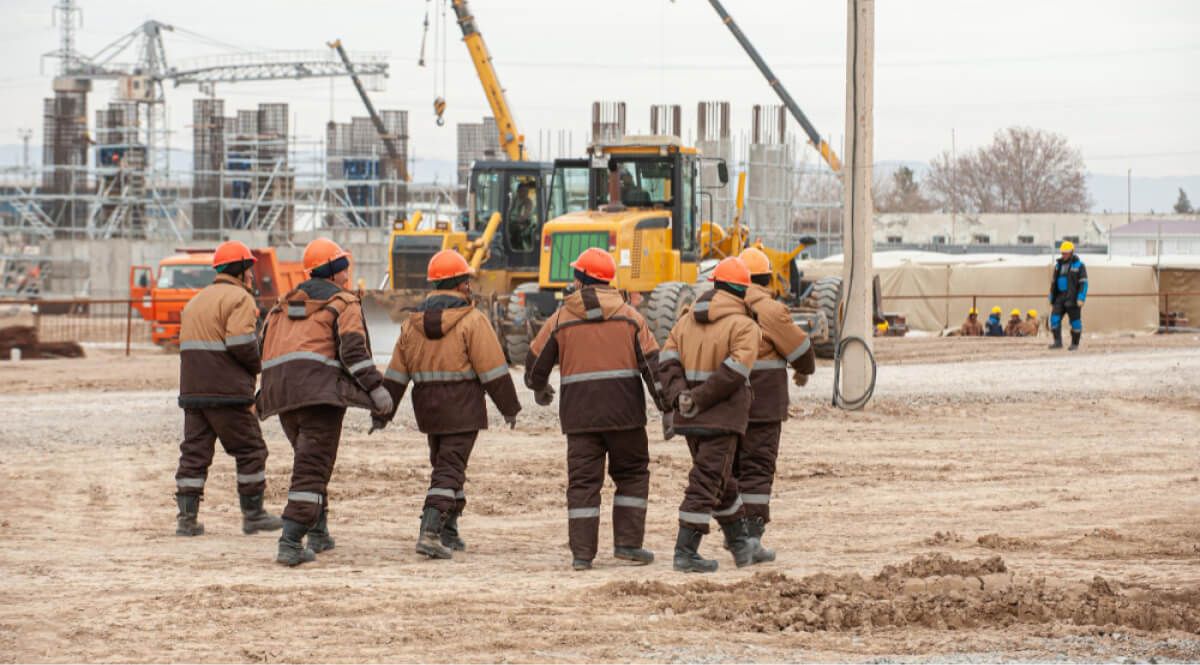
Morale in contractor-heavy workforces is the level of motivation and commitment among contractors working without long-term organizational attachment. It is shaped less by company culture and more by immediate work conditions such as task clarity, payment reliability, site-level treatment, and supervisor consistency.
Because contractors operate across short cycles and multiple employers in the construction industry, morale becomes transactional and unstable, requiring active tracking rather than assumption.
What is the importance of morale in contractor-based work?
Morale is critical in contractor-based work because it directly affects reliability, coordination, and retention across short project cycles. The importance of morale in contractor-based work lies in how quickly disengagement converts into delays, rework, and workforce instability.
- Work reliability: Low morale leads to contractor disengagement, increasing absenteeism, delays, and inconsistent task completion across job sites.
- Coordination efficiency: Strong contractor workforce engagement reduces rework by improving alignment between contractors, supervisors, and full-time motivated construction teams.
- Retention stability: Managing temporary worker morale reduces churn, preventing repeated onboarding costs and loss of experienced contractors mid-project.
A tailored onboarding process should include company mission, core values, and team norms to build a sense of purpose for contractors.
How do you measure morale in a contractor-heavy workforce?
Morale in contractor-heavy workforces is measured through a combination of behavioral signals and role-segmented survey data, tracked at weekly or bi-weekly intervals rather than through annual engagement cycles.
Your score
Morale is stable. Continue pulse monitoring and maintain current communication and site practices.
Engagement is slipping. Supervisor-level intervention is required before disengagement becomes structural.
Escalate to project leadership immediately. Review site conditions, pay practices, and communication consistency — a pulse tool alone will not fix this.
What is the cost of low contractor morale on project delivery?
Low contractor morale costs project delivery through absenteeism, rework, mid-project attrition, and coordination breakdown, with each becoming into timeline delays and cost overruns that frequently exceed the savings made by using contractors in the first place.
- Absenteeism: Unplanned absences in contractor teams create immediate resourcing gaps that delay dependent tasks across the project schedule.
- Rework costs: Disengaged contractors produce lower-quality output, increasing rework rates and consuming the budget allocated to forward progress.
- Mid-project attrition: Contractor exits mid-cycle trigger re-onboarding costs, knowledge loss, and coordination gaps that slow the entire construction crew, unable to managing motivation.
- Coordination breakdown: Low morale reduces contractor participation in briefings and handovers, increasing miscommunication between contractor and full-time teams.
- Compounding timeline risk: Each disengagement signal left unaddressed piles up and absenteeism leads to rework, rework leads to delays, delays lead to further disengagement across the wider workforce.
Morale vs productivity in contractor-heavy teams
Morale vs productivity in contractor-heavy teams differs in that morale drives consistency and retention, while productivity reflects short-term output that can remain high even when morale declines.
What are the components of effective morale management?
Effective morale management includes four core systems: signal capture, workforce segmentation, action enablement, and consistency enforcement. Each must operate at high frequency at the supervisor level, where contractor experience is directly shaped.
- Signal capture: Track morale warning signs frequently at the role and job site level, not through delayed, organization-wide surveys.
- Workforce segmentation: Contractor workforce management must separate subcontractors, temporary workers, and full-time construction workers to prevent misleading averages.
- Action systems: To manage morale, the contractor workforce requires mapping specific issues to supervisor-led actions within defined timelines.
- Consistency control: Stable subcontractor morale depends on standardized practices across project managers, reducing variation in contractor experience between construction sites.
Completion bonuses foster a sense of commitment and accomplishment, driving workers to remain engaged and loyal throughout the project's duration.
How to create engaged employees for your business
What are the common morale problems in contractor teams?
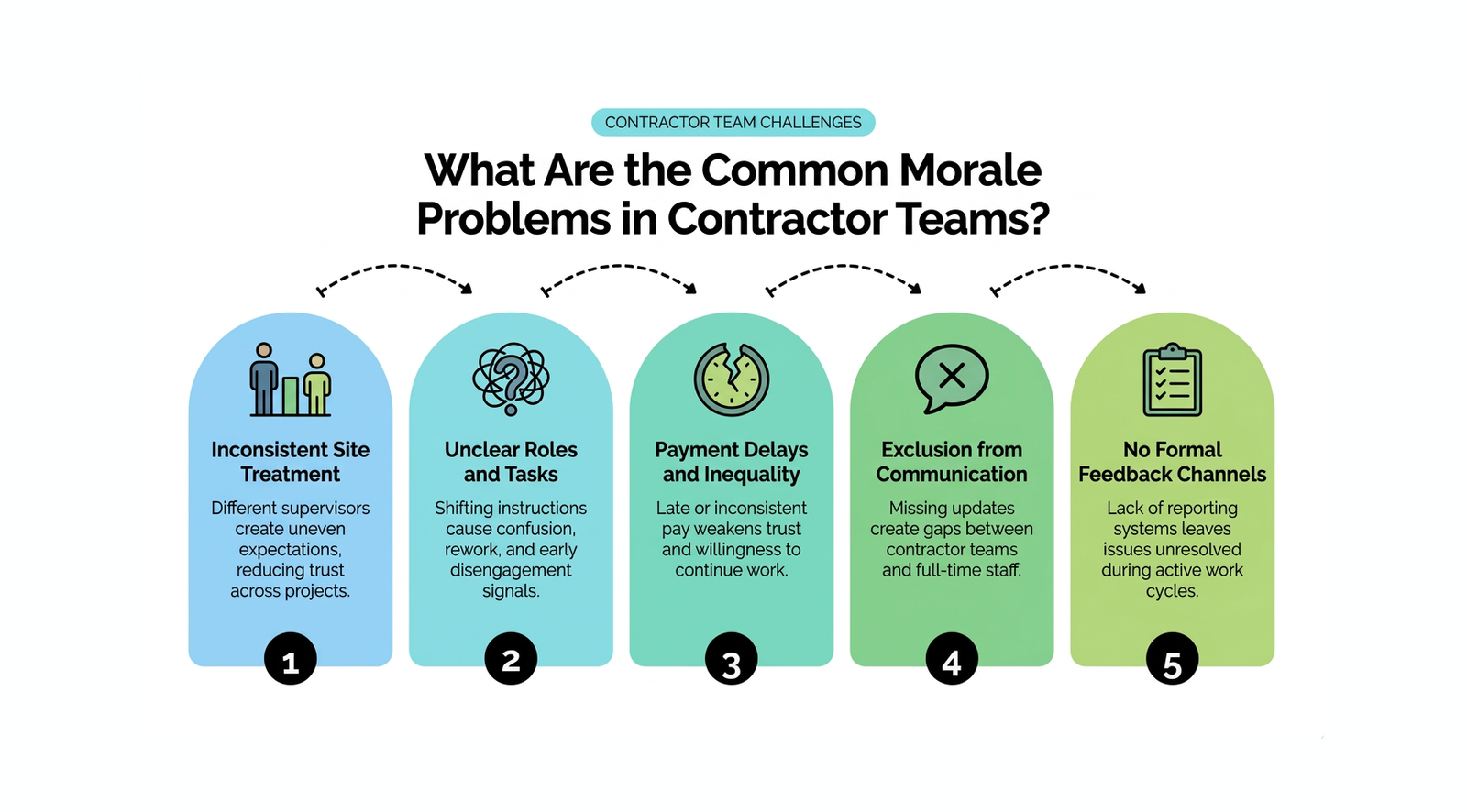
Common morale problems in contractor teams include inconsistent treatment, unclear roles, payment issues, communication gaps, and lack of feedback systems. These problems are driven by system gaps and supervisor-level variation, not individual behavior.
Inconsistent site-level treatment
- Different supervisors and construction project managers create uneven expectations, communication, and support across projects.
- This inconsistency weakens subcontractor morale construction and reduces trust in the system.
Unclear roles and shifting tasks
- Unclear roles and shifting task assignments are a leading cause of contractor disengagement.
- When contractors receive changing instructions mid-project, they experience confusion that reduces output quality and triggers early disengagement signals.
- Role clarity must be set at the start of each work cycle and reinforced at daily briefings.
- Contractors receive changing instructions, causing confusion and repeated rework.
Payment delays and uncertainty
- Late or inconsistent payments such as paying different workers if not equal or more money, reduces trust and willingness to continue work. Timely and accurate payment is crucial for maintaining high morale among contractors.
- This delay directly impacts managing temporary worker morale across projects.
Exclusion from communication
- Contractors are not included in updates that affect their tasks without respecting work life balance.
- This exclusion creates execution gaps between contractor workforce and full-time construction teams.
No formal feedback channels
- Contractors cannot raise issues during active work cycles.
- Without a formal channel to raise concerns during active work cycles, contractors leave problems unresolved, thus accelerating contractor disengagement across the project.
(Source: Associated General Contractors of America)
Last reviewed: April 2026. Data points verified against Bureau of Labor Statistics and Associated General Contractors of America publications.
Why is contractor engagement structurally different from employee engagement?
Contractor morale is structurally different because contractors operate without stable attachment, consistent identity, or long-term employer relationships. In contractor morale management, this creates a system where engagement is conditional, short-term, and driven by immediate work conditions rather than organizational alignment.
- No employer loyalty: Contractors are not tied to one organization, increasing volatility and risk of contractor disengagement across projects.
- Episodic commitment: Engagement resets with each project, making morale dependent on current experience, not past association.
- Dual identity: Contractors navigate expectations between their subcontractor employer and the principal contractor on the construction site, creating role confusion and a reduced sense of ownership over outcomes.
- Supervisor dependency: Morale varies by project manager behavior, not company policy, making employee experience and keeping workers engaged inconsistent across construction sites.
- Transactional engagement: Contractor workforce engagement depends on pay, clarity, and treatment, not long-term culture.
Providing high-quality, clean, and comfortable on-site facilities shows respect for contractors' well-being. Using SMART goals to define clear KPIs helps in managing expectations for contractors.
What is the psychological ownership framework for contractor morale?
Psychological ownership in contractor environments is built through four work conditions: task autonomy, craft identity recognition, high pressure construction site belonging, and perceived fair treatment. This framework explains how to motivate contractors by creating ownership without long-term attachment, improving contractor workforce engagement at the task and site level.
Step 1: Autonomy
Contractors engage more when they control how work is executed within defined outcomes.
- Clear task ownership with minimal micromanagement increases accountability and execution quality.
- Defined decision boundaries reduce delays and improve responsiveness during project changes.
Step 2: Craft identity
Contractors respond to recognition of skill and trade, not organizational affiliation.
- Work aligned to expertise strengthens pride in output and consistency in performance and improves employee engagement. When people are never recognized for doing a good job, they may not think it matters if they only do the bare minimum.
- Visible acknowledgement and weekly or monthly recognition of skill reinforces how to build team morale contractors on site.
Step 3: Site belonging
Temporary workers still require inclusion at the site level to sustain engagement.
- Inclusion in daily briefings improves mixed workforce morale and coordination. Offering training opportunities or bonus programs can lead to higher job satisfaction among employees as they improve their qualifications.
- Access to shared information reduces isolation during project execution and keeps workers engaged.
Step 4: Fair treatment
For HR teams confused on how to manage morale with a contractor workforce, perceived fairness drives trust more than culture in contractor systems.
- Consistent pay and workload distribution strengthen subcontractor morale across teams.
- Transparent practices improve morale in a contractor workforce. Project managers should listen to employee feedback to foster loyalty and improve motivation on construction sites.
This framework is grounded Toward a Theory of Psychological Ownership in Organization (Pierce, Kostova, and Dirks, 2001) and has been adapted by CultureMonkey for contractor-specific workforce environments.
What are the early signs of contractor morale collapse?

Early signs of contractor morale collapse appear as observable behavior changes at site level. Contractor disengagement signs and morale warning signs show up in attendance, participation, and work patterns before exits.
Spike in absenteeism
Unplanned absences are the earliest measurable signal of contractor disengagement and typically cluster by supervisor or crew, not randomly across the site.
- An increase in unplanned absences signals early withdrawal.
- Patterns often cluster within specific teams or supervisors.
Work-to-rule behavior
Work-to-rule behavior is a deliberate withdrawal of discretionary effort; contractors do only the minimum required and stop contributing beyond their assigned scope, making projects slower and more brittle when conditions change.
- Contractors only do assigned tasks, avoiding extra effort.
- Contractor flexibility drops, slowing project execution when site conditions or instructions change.
Silence in toolbox talks
Reduced participation in daily briefings signals disengagement.
- Reduced questions or input during daily briefings.
- Safety and operational risks go unraised, lowering coordination between the contractor and full-time teams on site.
Informal complaint clusters
Concerns shift from formal channels to peer conversations.
- Issues shift to peer discussions, not formal channels.
- Negative contractor sentiment spreads peer-to-peer without reaching supervisors or formal reporting channels.
Drop in task ownership
Contractors disengage from responsibility beyond assigned work.
- Contractors avoid responsibility beyond assigned work.
- Errors and rework increase as contractors avoid accountability for outcomes beyond their minimum assigned scope to complete projects.
How does contractor morale affect safety on site?
Low contractor morale directly increases on-site safety risk. Disengaged contractors are less likely to follow safety protocols consistently, raise hazards during briefings, or take ownership of safety outcomes beyond their minimum assigned scope.
- Reduced safety compliance: Disengaged contractors follow safety procedures at minimum threshold, increasing the likelihood of protocol breaches across the site.
- Silence on hazards: Low morale suppresses contractor participation in toolbox talks, meaning live site risks go unreported until an incident occurs.
- Fatigue and absenteeism: Morale-driven absenteeism of unmotivated workers forces remaining contractors to cover gaps, increasing fatigue-related safety incidents across crews.
- Weak safety culture ownership: Contractors with low site belonging do not treat safety as a shared responsibility, creating gaps between contractor and full-time team safety behavior.
- Supervisor disengagement: When morale of unmotivated workers collapses at the supervisor level, safety briefing quality drops, reducing the consistency of safety communication across the workforce.
What daily management actions improve contractor morale?
Daily management actions that improve contractor morale include consistent recognition, equitable treatment, regular check-ins, and clear task communication. If you’re wondering how to manage a morale contractor workforce, it depends on daily supervisor behavior, not policy.
Acknowledgement rituals
- Daily recognition of work improves subcontractor morale and reinforces effort.
- Public acknowledgment in team meetings encourages employees and supports people confused about how to motivate contractors on projects without formal rewards.
Equitable treatment signals
- Equal access to tools and information reduces bias across the mixed workforce morale.
- Fair task allocation strengthens trust and improves contractor workforce management.
Informal check-ins
- Short conversations surface contractor disengagement signs early.
- Regular check-ins help manage morale management high contractor ratio environments.
Clarity reinforcement
- Daily priority alignment of exceptional jobs reduces confusion and rework.
- Clear expectations support managing temporary worker morale across teams. Communicating clear expectations to employees can lead to better outcomes and increased loyalty to the company.
Who is responsible for contractor morale: Client or contractor employer?

Responsibility for contractor morale is shared between the client, subcontractor, and site supervisors, but each controls different parts of the contractor experience. Managing temporary worker morale requires clear role definition, while contractor workforce management depends on closing gaps between these actors.
Responsibility breakdown
Closing the responsibility gap
- Define ownership clearly: Assign who tracks contractor disengagement signs at each level to avoid blind spots.
- Align incentives: Ensure the client, subcontractor employer, and site supervisor are each accountable for workforce stability, not just delivery timelines, in high contractor ratio workforce environments.
Implementing regular anonymous feedback systems helps understand contractor concerns effectively.

On what high-performing companies should be striving to create: A great place for great people to do great work.
Marilyn Carlson Nelson
Former CEO of Carlson Companies
Morale building activities that work for mixed workforces
Morale-building activities that work for mixed workforces include milestone recognition, trade-specific acknowledgement, and stage-based closure. If you want to know how to improve team morale, it depends on various motivational techniques that cater to visible, role-specific inclusion, not generic team events.
Milestone celebrations
- Recognizing project milestones improves mixed workforce morale and shared progress.
- Site-level celebrations avoid exclusion from corporate-only events.
How to execute: At project stage completion, hold a site-level acknowledgment within 48 hours. Include all workforce types. Name specific contributions by trade. Keep it under 15 minutes. The goal is visible closure, not ceremony.
Trade-specific recognition
- Acknowledging trade skills reinforces credibility and relevance.
- Recognition tied to output motivates contractors consistently. You can also provide them training and education programs to improve workers skill sets.
End-of-stage acknowledgements
- Formal closure at stage completion reduces drop-off between phases.
- Supports managing temporary worker morale across project cycles.
Inclusive briefings
- Including all workforce types improves coordination.
- Reduces gaps between employment contract workforce and full-time teams.
Drawbacks of morale initiatives for contractors
Drawbacks of morale initiatives for contractors include low relevance, short-term impact, perceived unfairness, lack of ownership, and poor measurement. If your feedback model includes more criticism than praise, it isn't going to take long for your employee morale to start dropping.
Low relevance
- Initiatives ignore pay, clarity, and site conditions that drive behavior.
- Participation remains low with minimal impact.
Short-term impact
- Contractors rotate across projects, limiting continuity and contributing to poor employee morale.
- Construction workers feel that the effects do not sustain beyond current work cycles.
Perceived unfairness
- Unequal access to benefits challenges employees and creates visible bias.
- Often, the employees' trust reduces, lowering the acceptance of future efforts.
Lack of ownership
- No clear responsibility across client, subcontractor, and supervisors or too much of a formal process affects negatively.
- Execution remains inconsistent due to lack of positive attitude.
Measurement gaps
- Standard surveys miss real-time contractor experience that construction employees require.
- Issues surface only after visible disengagement. Employees rarely receive recognition when they do a good job, and often the employees who do get recognition don't get enough of it.
When does a high contractor ratio become a morale risk?
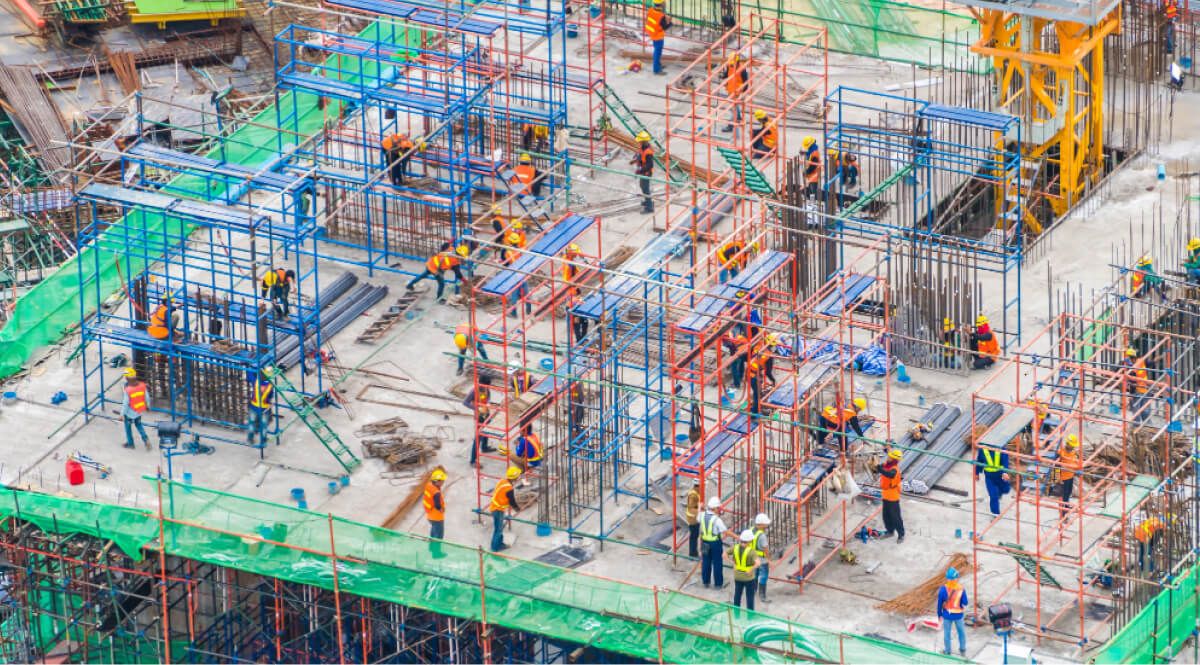
A high contractor ratio becomes a morale risk when contractors exceed 50–60% of the workforce, making engagement unstable and management inconsistent. In a high contractor ratio workforce, this shift makes contractor-heavy workforce challenges structural rather than isolated.
50–60%: Coordination strain begins
- Mixed workforce morale weakens as alignment between contractors and full-time construction workers becomes harder to maintain.
- Supervisor bandwidth is reduced, increasing uneven treatment across teams.
60–75%: Visibility loss and inconsistency
- Contractors outnumber core construction workers, reducing oversight and increasing gaps in contractor workforce management.
- Morale depends more on individual supervisors than system controls.
75%+: Structural morale breakdown
- Systems fail to track morale warning signs, leading to widespread disengagement.
- Contractor-heavy workforce challenges become persistent across sites, not isolated incidents.
What to do when thresholds are crossed
- Increase measurement frequency: Track signals weekly at role and site level to detect early shifts.
- Standardize supervisor actions: Define daily practices to reduce variation in managing temporary worker morale.
Engaging employees by introducing new challenges can keep them motivated and make them feel part of the bigger picture.
What to look for in a contractor workforce engagement software?
Contractor workforce engagement software must reach workers without email, segment by role, and surface disengagement signals fast enough to act within a project cycle. Here is what to evaluate:
- Multi-channel survey delivery: Distributing surveys through WhatsApp, text messages, QR codes, and kiosks reaches every contractor on site regardless of device, email access, or connectivity level.
- Anonymous pulse survey feedback: Short pulse surveys with anonymity response thresholds protect individual identity in small crews and capture employee morale shifts without survey fatigue.
- 100+ multilingual survey support: Surveys delivered in each on-site worker's preferred language improve response rates across diverse, internationally staffed contractor crews.
- AI-powered insights and sentiment analysis: Sentiment analysis, disengagement prediction, and action recommendation turn open-text responses and driver scores into specific next steps for project managers and HR teams.
- Role-based segmentation and dashboards: Survey results are separated from permanent construction workers and contractors across every report by role, site, project, and project managers, but visualised accumulatively as heatmaps in the manager dashboard.
Conclusion
Managing morale in contractor-heavy workforces requires structured systems that track signals, define ownership, and enable consistent action at the site level. As contractor ratios increase, morale shifts from individual experience to system-level risk, making visibility, segmentation, and supervisor consistency critical to prevent disengagement from spreading across teams.
CultureMonkey supports contractor morale management through multi-channel feedback, role-based segmentation, and real-time dashboards that help teams act early and maintain stability across contractor-heavy workforce challenges.
Book a demo with CultureMonkey.
FAQs
1. Why do contractors have lower morale than direct employees?
Contractors have lower morale due to structural factors: no long-term job security, loyalty split between subcontractor employer and principal, exclusion from culture programs, and episodic work cycles. Without deliberate inclusion practices, contractors identify as hired resources rather than team members.
2. How do you manage morale when most workers are contractors?
Apply the psychological ownership framework: give contractors autonomy over how work is executed, acknowledge craft identity through trade-specific recognition, build site belonging through inclusive daily briefings, and enforce fair treatment standards equal to those for direct hire employees.
3. What motivates contracted workers on construction projects?
Contractors are primarily motivated by: fair and equitable treatment relative to direct hires, craft recognition (acknowledgement of trade skill, not just output), project-identity pride (being part of a notable build), and clear, consistent communication about project status and their role within it.
4. At what contractor ratio does morale become a risk?
Morale instability begins when contractors exceed 50-60% of the workforce. At 60-75%, visibility and consistency break down. Above 75%, morale management becomes a structural problem that requires weekly tracking, standardized supervisor protocols, and dedicated contractor feedback infrastructure.
5. What are the early signs of contractor disengagement?
Early signs include unplanned absenteeism clusters, work-to-rule behavior (no effort beyond assigned tasks), silence during toolbox talks, informal peer complaints replacing formal channels, and contractors declining ownership of errors. These behavioral shifts appear before productivity drops are visible.
6. Who is responsible for contractor morale on a project?
Responsibility is shared: the client controls site conditions and timelines, the subcontractor employer controls pay and work continuity, and the foreman controls daily communication and treatment. Morale breaks when these three actors have misaligned incentives or undefined accountability.
7. How do you measure morale in a contractor-heavy workforce?
Use role-segmented pulse surveys at weekly or bi-weekly frequency, separating contractors from full-time staff to prevent data averaging. Track behavioral signals, including absenteeism, participation in briefings, and task completion rates, alongside survey scores for a multi-source morale indicator.
8. What is the cost of low contractor morale on project delivery?
Low contractor morale increases absenteeism, rework rates, and mid-project attrition. Each contractor exit triggers re-onboarding costs and direct knowledge loss. Sustained disengagement compounds into timeline delays and coordination failures that can exceed the original contractor cost savings.