



Supervisor effectiveness in construction projects explained

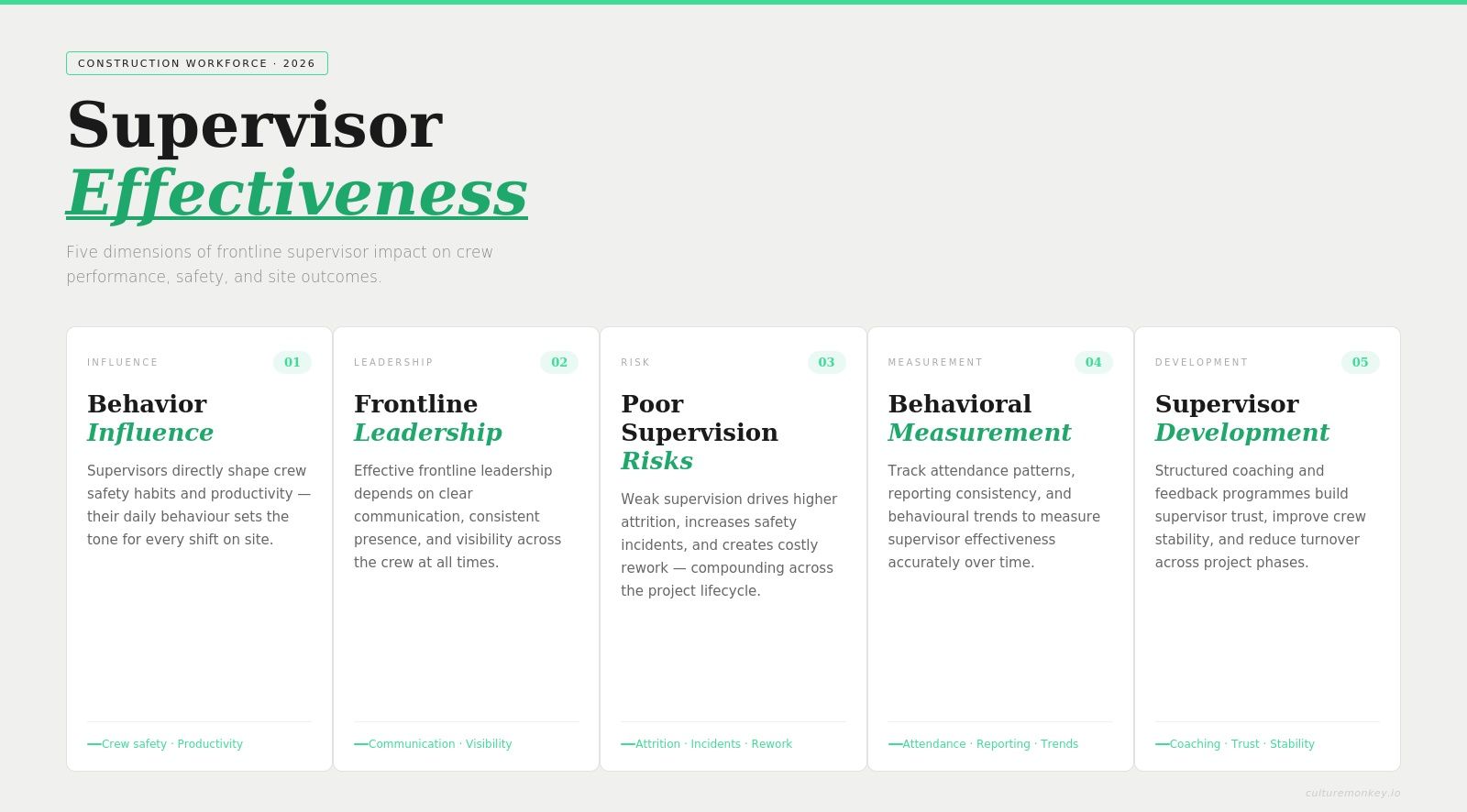
Supervisor effectiveness in construction projects is the strongest driver of crew engagement, safety behavior, and site productivity. On most sites, how a supervisor leads matters more than pay, project conditions, or company policies.
Research shows that supervisor quality explains most team-level engagement variance across construction environments. Yet supervisors are rarely trained, rarely measured, and often promoted based on technical skill instead of people capability.
The gap between technical promotion and leadership readiness directly impacts safety compliance, workforce stability, and project outcomes in construction. Most construction supervisors are promoted for technical skill, not people capability, and receive little structured training afterward. This creates measurable risk: lower engagement, higher attrition, and weaker safety records at the crew level.
This guide defines the five behaviors of effective supervisors and introduces a practical framework to measure supervisor effectiveness in real site conditions, supported by the right employee survey tools to capture crew-level feedback consistently.


- Supervisor effectiveness in construction projects directly shapes crew behavior, safety compliance, and daily productivity outcomes.
- Frontline supervisors influence engagement through communication, consistency, and visible leadership across high-pressure construction site environments.
- Poor supervision increases attrition, safety incidents, and rework, especially across fragmented crews and multiple project sites.
- Measuring supervisor effectiveness requires behavioral signals, not surveys, including attendance, reporting patterns, and crew feedback trends.
- Developing supervisors through site-based coaching improves trust, engagement, and long-term workforce stability in construction operations.
- CultureMonkey helps construction companies track supervisor effectiveness through feedback, analytics, and engagement signals that identify gaps.
What is supervisor effectiveness in construction projects
Supervisor effectiveness in construction projects refers to how consistently a construction supervisor drives safety compliance, crew engagement, and task execution on site. It is measured through observable behaviors such as communication clarity, hazard response, task coordination, and team performance.
In construction environments, supervisor effectiveness determines how work is executed daily. A construction supervisor influences safety outcomes, work quality, and crew retention more directly than policies or project plans.
Why supervisors are the make-or-break factor in construction engagement
Supervisor effectiveness in construction projects determines how crew members behave, communicate, and perform on-site. In the construction industry, frontline supervisors influence daily execution more than policies, pay structures, or upper management directives.
On a construction site, engagement is shaped through direct interaction. Construction supervisors control work allocation, safety enforcement, and communication, making them the primary drivers of team performance and work quality.
Why supervisors matter more than other factors:
- Direct oversight of individual workers and daily construction activities
- Control over safety management, safety procedures, and safety awareness
- Influence on communication skills and clarity across crews
- Impact on morale, trust, and retention within construction projects
- Ability to implement corrective measures promptly
In short, supervisor effectiveness in construction projects drives engagement, safety behavior, and overall team performance on site.
construction supervisor vs project manager
Construction supervisors and project managers play distinct roles in construction projects, but their responsibilities are often confused. Supervisors focus on daily site execution and crew management, while project managers oversee scope, budget, and stakeholders, making their impact on engagement and site performance fundamentally different.
| Role | Primary Focus | Crew Relationship | Engagement Impact |
|---|---|---|---|
| Construction Supervisor | Daily site execution, safety, and crew | Direct, daily | Highest |
| Project Manager | Scope, budget, schedule, stakeholders | Indirect | Moderate |
The construction supervisor's dual role: manager and safety culture carrier
Construction supervisors operate in a dual role, balancing project coordination and safety management simultaneously. In construction projects, supervisors are responsible for both delivering work and ensuring compliance with safety protocols.
This dual responsibility makes construction supervisors critical to both productivity and safety records across construction companies.
| role | responsibility | impact |
|---|---|---|
| manager | planning, scheduling, project coordination | productivity, cost control, meeting project deadlines |
| safety culture carrier | enforcing safety procedures, conducting daily safety briefings, and identifying hazards | safety compliance, reduced workplace incidents |
Supervisors translate company policies and legal requirements into daily site behavior. Their leadership ability determines whether safety awareness becomes practice or remains documentation.
In short: construction supervisors drive both output and safety culture, making them central to the success of construction supervision.
The 5 behaviors of highly effective construction supervisors

Highly effective construction supervisors demonstrate specific, repeatable behaviors that directly impact safety, team performance, and crew trust on site. These behaviors are observable, measurable, and consistent across high-performing construction projects.
1. Clarity-setting
What it looks like in practice: The supervisor defines task scope, quality standards, safety requirements, and deadlines before each shift begins on the construction site.
Observable signal: Crew members can clearly explain their assigned tasks, expected outcomes, and safety protocols without needing clarification.
2. Equitable treatment
What it looks like in practice: The supervisor assigns tasks based on skill, experience, and workload, avoiding favoritism across crew members and construction supervisor teams.
Observable signal: Task allocation remains consistent across shifts, and no repeated complaints or conflict resolution issues arise from perceived unfairness.
3. Daily acknowledgement
What it looks like in practice: The supervisor recognizes completed work, effort, and adherence to safety procedures during daily interactions or toolbox talks.
Observable signal: Crew members actively participate in discussions, and engagement levels remain stable across shifts with low disengagement signals.
4. Hazard responsiveness
What it looks like in practice: The supervisor identifies hazards during regular safety inspections and implements corrective measures in a timely manner.
Observable signal: Safety issues are reported and resolved within the same shift, and safety records show consistent incident reporting.
5. Crew advocacy
What it looks like in practice: The supervisor communicates crew concerns to project manager roles and upper management while aligning expectations with project scope.
observable signal: Fewer escalations from crew members, smoother project coordination, and improved trust between frontline supervisors and teams.
In short: supervisor effectiveness in construction projects is defined by behaviors that are visible, measurable, and consistently applied on site.
Effective vs ineffective construction supervisors
Effective and ineffective construction supervisors differ in how they manage safety, communication, and crew performance on site. In construction projects, supervisor behavior directly determines whether teams operate consistently, safely, and efficiently, or experience errors, disengagement, and instability across daily operations.
Span of control: the hidden constraint on supervisor effectiveness
Span of control directly impacts supervisor effectiveness in construction projects. When construction supervisors manage too many workers, the quality of communication, safety oversight, and team performance declines.
Construction supervisors often manage large crews, especially in commercial development projects, which can make effective supervision difficult.
| Team size | Risk level | Supervisor effectiveness |
|---|---|---|
| 5–10 workers | low | high visibility, strong communication, better safety management |
| 10–20 workers | moderate | manageable but requires strong organizational skills |
| 20–30+ workers | high | reduced oversight, increased errors, weaker safety compliance |
What breaks at a high span of control:
- Reduced communication clarity across the job site
- Delayed decision-making and problem-solving
- Lower safety awareness and missed hazards
- Decline in work quality and team performance
- Increased pressure on construction supervisors
In short: supervisor effectiveness decreases as the span of control increases without structural support.
How supervisor behavior drives crew trust
Supervisor behavior directly shapes construction site crew trust and influences attrition in construction projects. Crew members respond to how supervisors communicate, enforce rules, and manage daily work.
Trust is built through consistent actions, while poor supervision leads to disengagement and workforce instability.
Cause → effect relationships:
- inconsistent instructions → confusion and reduced work quality
- ignoring safety protocols → distrust and unsafe work environment
- favoritism in task allocation → disengagement among individual workers
- poor communication skills → breakdown in team coordination
- delayed decision making → missed project deadlines and frustration
When trust declines, construction workers are more likely to leave or disengage, affecting construction supervisor performance and overall site productivity.
Supervisor behavior acts as the mechanism linking leadership ability to retention outcomes.
(Source: Gallup)
In short: supervisor behavior determines crew trust, which directly impacts attrition and performance in construction projects.
How to measure supervisor effectiveness without 360-degree surveys
Supervisor effectiveness in construction projects can be measured using behavioral and operational metrics instead of traditional surveys. In construction environments, observable signals provide more accurate insights than self-reported feedback.
These metrics reflect real supervisor impact on construction team engagement and supervisor performance metrics.
| Metric | Signal | What it indicates |
|---|---|---|
| Toolbox participation rate | Attendance in daily safety briefings | Supervisor engagement and communication effectiveness |
| Absenteeism by a supervisor | Crew attendance patterns | Team morale and leadership impact |
| Safety incident reporting rate | Frequency of reported hazards | Safety awareness and trust levels |
| Turnover by the construction supervisor | Attrition within teams | Supervisor's impact on retention |
| Task completion consistency | Adherence to project deadlines | Organizational skills and coordination |
How to track this on site:
- Use daily logs and safety records to monitor behavior trends
- Track crew-level data linked to specific supervisors
- Compare performance across construction supervisors
- Review trends over time, not isolated incidents
In short: supervisor effectiveness is best measured through real site behavior, not survey responses.
Developing construction supervisors: a site-based learning model
Developing construction supervisors requires a structured, site-based progression model that builds leadership ability, technical knowledge, and decision-making through real construction activities.
stage 1 (month 1–3): foundational exposure
- on-site observation of experienced supervisors managing construction activities
- daily feedback loops to improve communication, safety awareness, and basic leadership skills

Leadership is not a rank; it is a responsibility. Leadership is not about being in charge; it is about taking care of those in your charge.


stage 2 (month 3–6): guided application
- real-time coaching during construction activities and decision making
- peer learning across construction supervisors to improve consistency and problem-solving
stage 3 (month 6–12): independent execution
- task-based exposure across construction methods, equipment operation, and building codes
- responsibility expansion into project coordination, client relationships, and crew management
Outcome: Supervisors develop the ability to effectively manage teams, maintain safety protocols, and handle a span of control of up to 15 workers independently.
In short: effective supervisor development in construction projects follows a structured progression from observation to independent leadership on site.
Conclusion
Supervisor effectiveness in construction projects is critical to workplace performance because it directly shapes safety management, team performance, and work quality on site. Strong construction supervisors ensure compliance, improve communication, and drive consistent execution across construction activities, while poor supervision leads to delays, safety risks, and disengaged crews.
To measure and improve this at scale, organisations need the Best employee survey tools for construction companies that enable real-time feedback, supervisor-level insights, and site-based workforce visibility.
CultureMonkey helps construction companies measure supervisor effectiveness through real-time feedback, behavioral insights, and site-level analytics across projects and teams.
With multi-channel feedback collection, anonymity controls, and crew-level analytics, CultureMonkey enables organizations to identify leadership gaps early, improve training outcomes, and strengthen supervisor impact on construction team engagement and overall project performance.
Last reviewed: April 2026
FAQs
1. How does supervisor quality affect construction project outcomes?
Supervisor quality directly shapes safety compliance, team performance, and work quality on construction sites. Effective supervisors reduce incidents, meet deadlines, and retain engaged crews. Poor supervision drives delays, rework, safety gaps, and disengagement across project phases.
2. What makes a good construction supervisor?
A good construction supervisor combines technical knowledge, leadership skills, and hands-on experience. They communicate clearly, allocate tasks fairly, enforce safety protocols, resolve conflicts, and support crew members while maintaining alignment with project scope, timelines, and quality standards.
3. How do you measure supervisor effectiveness on a construction site?
Supervisor effectiveness is measured using behavioral signals instead of surveys. Key metrics include toolbox participation, crew absenteeism, safety incident reporting, team turnover, and task completion consistency. These indicators reflect real supervisor impact across construction projects.
4. How does supervisor behavior affect safety in construction?
Supervisor behavior directly determines safety compliance on construction sites. Supervisors who enforce procedures, conduct safety briefings, and identify hazards reduce incidents. Inconsistent supervision creates safety gaps that increase risk across crew members and project phases.
5. What role does continuing education play in construction supervisory roles?
Continuing education helps construction supervisors build leadership skills, improve decision-making, and expand technical knowledge. Organizations that invest in training prepare supervisors for more responsibility and reduce leadership gaps across growing construction projects.
6. How can supervisors gain advancement opportunities in construction firms?
Advancement depends on hands-on experience, consistent performance, and leadership ability. Construction supervisors who demonstrate communication, conflict resolution, and coordination skills progress into higher roles such as construction superintendent or project manager positions over time.
7. What is an effective span of control for a construction supervisor?
An effective span of control is typically five to ten workers. Larger crews reduce communication clarity, increase safety risks, and weaken performance. When team size exceeds this range, additional support structures are required to maintain supervision quality.
8. How does poor supervision affect worker retention in construction?
Poor supervision is a major driver of attrition in construction projects. Supervisors who communicate poorly, show favoritism, or ignore safety concerns create disengagement. High turnover linked to supervisors is a strong signal of leadership issues affecting project stability.