



Construction workforce motivation techniques: 2026 guide

Construction workforce motivation techniques are practical methods used to improve productivity, safety, and retention on job sites. They work by aligning site conditions, supervision, and incentives with what motivates construction workers in real environments.
This guide uses tested frameworks built for construction teams to explain different types of construction motivation, why programs fail, and how to apply phase-based techniques that supervisors can use directly on site, supported by the right employee survey tools to capture real-time workforce signals.


- Construction workforce motivation techniques are site-specific methods that improve productivity, and retention by aligning supervision, recognition, and incentives.
- Workers are motivated most by three things: craft pride, peer recognition, and project ownership.
- Most motivation programs fail on construction sites because they use office-designed tools, apply a single approach across all trades, and do not adapt when project phases change.
- Non-monetary techniques including schedule transparency, role clarity, and daily briefings deliver measurable results with no budget.
- CultureMonkey helps construction teams through multilingual pulse surveys, QR and kiosk access for site workers, and role-based dashboards.
What is construction motivation?

Construction motivation is the set of factors and techniques that drive construction workers to perform safely, consistently, and efficiently on site. It includes pay, recognition, supervision quality, work conditions, and clear communication aligned to site realities.
In construction, motivation is shaped by daily site conditions, not abstract engagement programs. Safety practices, workload pressure, crew coordination, and supervisor behavior directly influence how workers perform each day.
Managers can track motivation levels through attendance and punctuality trends, rework rates, and supervisor observation of crew energy during briefings. Pulse surveys deployed via QR codes or kiosks give site workers a structured way to flag issues without requiring desk access or digital literacy.
What motivates construction workers on site?
Construction workers on site are motivated by three core factors: craft pride, peer recognition, and project ownership. These motivation drivers reflect how work is experienced daily, not how it is designed in policy.
For people wondering how construction motivation techniques work in practice, the functionality of construction workforce motivation depends on reinforcing these drivers through daily site decisions, not standalone programs.
- Craft pride: Workers stay motivated when they can see the quality and progress of their work. Clean execution and strong task visibility reinforce pride. Frequent errors and high rework impact reduce it quickly.
- Peer recognition: Respect from the crew has more impact than top-down praise. Construction work depends on crew dependency, so being recognised for reliability and skill builds accountability. Immediate, on-site recognition is far more effective than delayed programs.
- Project ownership: Motivation increases when workers are responsible for a defined scope. Clear roles, decision visibility, and ownership of outcomes improve consistency. When work is fragmented or controlled without input by project managers, motivation drops.
Construction workforce motivation techniques have a direct impact on productivity. Sites with higher craft pride and peer recognition report lower rework rates, fewer delays caused by disengagement, and faster task completion across trades.
When workers feel ownership over their scope, supervisors spend less time re-instructing and more time progressing work.

When people are financially invested, they want a return. When people are emotionally invested, they want to contribute.
Simon Sinek



Founder and CEO at TalentCulture
Which motivation techniques actually work for construction site workers?

Motivation ideas for construction techniques that work on site are simple, visible, and immediate. Effective construction worker recognition happens during work, not after it, and is tied to real output, safety, and reliability.
These methods improve morale and encourage employees to be productive by making construction worker recognition visible to the entire construction team:
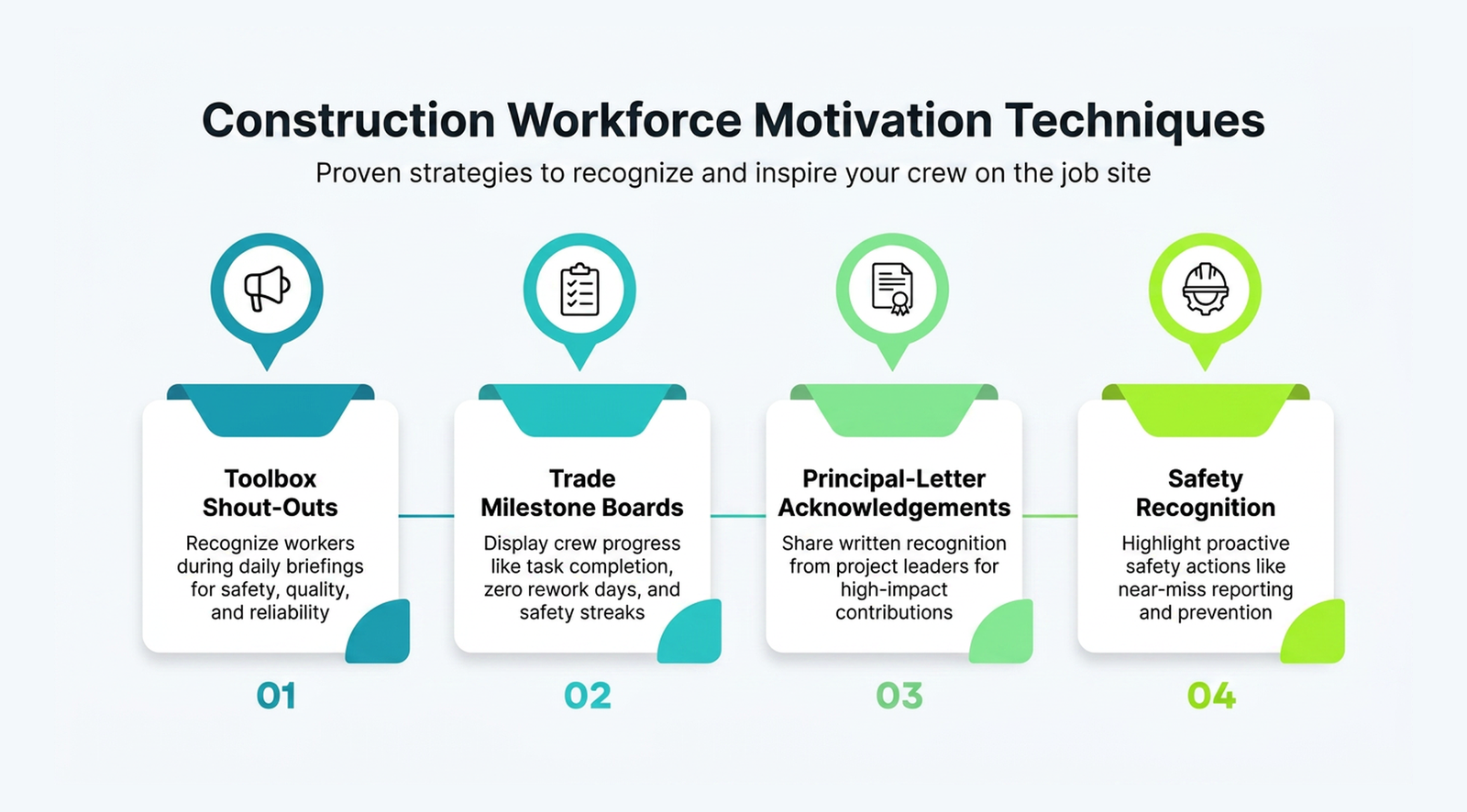
Toolbox shout-outs
Toolbox shout-outs are verbal recognitions delivered during daily site briefings that call out specific worker behavior in front of the crew.
- Recognise workers during daily briefings for quality work, safety actions, or reliability.
- Keep it specific and immediate to reinforce the behaviour in front of the crew.
Trade milestone boards
Trade milestone boards make crew-level progress visible and comparable by displaying task completions, zero rework days, or safety streaks by trade.
- Display milestones like task completion, zero rework days, or safety streaks by trade.
- Make employees' and organization's progress visible so crews can see their contribution and compare performance.
Principal-letter acknowledgements
Principal-letter acknowledgements are short written recognitions from project leaders with a named record of performance.
- Share short written recognition from project leaders and construction managers for high-impact contributions.
- Use it for major milestones or consistent performance to reinforce importance.
Safety recognition
Safety recognition acknowledges proactive behavior on site, such as near-miss reporting and preventive actions, not just incident-free days.
- Acknowledge proactive safety actions and stress, not just incident-free days.
- Highlight near-miss reporting and preventive behaviour in production to build accountability.
A motivated construction team gets great results for your company by completing high-quality work in the required time period. Construction managers should avoid micromanagement, as providing autonomy can lead to increased motivation, worker confidence, and productivity.
How do construction workforce motivation techniques differ for subcontractors vs. direct labor?
Subcontractors and direct labor respond to different motivation drivers because their relationship to the project, the principal contractor, and job security is structurally different. Applying the same techniques across both groups reduces effectiveness for both.
Supervisors managing mixed crews should run separate recognition approaches for each group rather than applying a single program across the full site.
What are the signs of low motivation on a construction crew?
Signs of low motivation on a construction crew include increased absenteeism, rising rework rates, slower task completion, and reduced communication between trades. Unlike office environments, low motivation on site shows up in output and behavior before workers verbalize it.
Key indicators to watch:
- Attendance and punctuality declining without a clear site reason
- Rework rates increasing on tasks that were previously completed cleanly
- Workers waiting for instruction rather than progressing autonomously
- Reduced communication during handovers between trades
- Crew energy and engagement visibly dropping during briefings
Supervisors who track these signals early can adjust recognition frequency, role clarity, or communication intensity before motivation loss affects project timelines.
Why do motivation programs fail in construction sites?

Motivation programs fail in construction sites because they are designed for office environments, applied identically across all trades, and built without sensitivity to how motivation needs shift across project phases.
Three root causes explain most failures:
- Office-designed tools: Programs that rely on apps, emails, or delayed reward systems do not reach workers during active site hours. Low accessibility means low usage.
- One-size approach: Applying the same program to concrete crews, electricians, and finishers ignores how differently each trade experiences pace, visibility, and accountability.
- No phase sensitivity: A motivation program that works during structure rising becomes irrelevant during formwork or weather delays. Static programs lose credibility when they do not adapt.
Construction managers and project managers who apply generic programs often see initial uptake followed by rapid disengagement, because workers recognize when a system does not reflect how their work actually operates.
How do construction workforce motivation techniques change by project phase?
Construction workforce motivation techniques by project phase are specific tactics used at each stage of a project to match how work, pressure, time frame and priorities change on the job site. These construction site motivation ideas work because construction project phase motivation depends on timing, not just tactics.
This section presents key takeaways of construction motivation techniques explained across each phase:
Effective leadership in construction involves understanding one's own limitations and seeking self-improvement, which demonstrates commitment to the team and the business.
(Source: Oxford Economics)
How do you motivate a construction workforce without spending money?
Non-monetary motivation construction workforce approaches that work without budget focus on improving clarity, visibility, and communication on site. These include schedule transparency, role clarity, and informal progress briefings, which are practical low-cost motivation ideas.
Schedule transparency
Crews who know their daily and weekly workload in advance experience less idle time, frustration, and last-minute disruption.
- Share daily and weekly work plans so crews know what is coming next.
- Update changes early to prevent confusion, idle time, and frustration.
Role clarity
Role clarity gives each trade a defined scope with no overlap or gaps. Workers perform more consistently when they know exactly what they are responsible for.
- Define responsibilities for each trade and task with clear expectations so each team member can work effectively within the construction team.
- Avoid overlap or gaps that lead to conflict, delays, or rework.
Informal progress briefings
Informal progress briefings connect individual task completion to overall project movement.
- Run short on-site updates to show progress and next steps. Conducting daily morning huddles helps workers understand their tasks and timeframes, linking individual work to the overall project success.
- Maintain good communication so motivated workers stay aligned and to reduce uncertainty and delays.
Offering training, upskilling opportunities, and clear paths to promotion can motivate construction workers to view their roles as part of a career rather than a dead-end job. Basic safety and environment upgrades often provide more immediate motivation than generic corporate rewards in the construction industry.
How To Manage Workers On A Construction Site
Which construction worker incentive programs work and which ones fail?

Construction worker incentive programs that work on site include attendance bonuses and milestone rewards, while performance bonuses and profit share often fail due to complexity or low visibility. Tradespeople incentives are effective only when they are simple, immediate, and tied to daily work.
Monetary vs. non-monetary construction motivation: Key differences
How do construction workforce motivation techniques reduce site turnover?
Construction site turnover is reduced when workers feel recognized, have clearly defined roles, and can see visible progress in their own work. Motivation-driven retention requires consistency from supervisors and phase-aligned recognition that reflects how work actually changes across a project.
Three practices that directly reduce turnover:
- Role clarity at mobilization: Workers who understand their scope from day one are less likely to disengage during slow phases.
- Phase-aware recognition: Adjusting acknowledgment intensity to match project momentum prevents the motivation dip that typically triggers early exits.
- End-of-project acknowledgment: Closing out with visible team recognition gives workers a sense of completion that makes them more likely to return for the next project.
What foreman motivation techniques should be used daily on construction sites?
Foreman motivation techniques to use daily on construction sites include morning acknowledgement, task autonomy signals, and end-of-shift recognition. These motivation techniques for site supervisors show how to motivate tradespeople sites through consistent, on-site actions.
Morning acknowledgement
Morning acknowledgement sets the motivational tone for the day by naming specific effort or reliability in front of the crew before work begins.
- Start the day by recognising specific effort, skill, or reliability in front of the crew.
- Set a positive tone early so expectations and standards are clear.
Task autonomy signals
Task autonomy signals give workers clear goals while letting them decide how to execute within their scope. Workers with control over their method take greater ownership of the outcome.
- Give clear goals, then allow workers to decide how to execute within their scope.
- Avoid over-instruction, which reduces ownership and slows work.
End-of-shift recognition
End-of-shift recognition calls out completed work, quality output, or problem-solving before the crew disperses.
- Close the day by calling out completed work, quality output, or problem-solving.
- Reinforce consistency in the work environment so workers know what behaviors matter.
Morning acknowledgement, task autonomy signals, and end-of-shift recognition help build a motivated crew by giving each team member control and accountability.

Conclusion
Construction workforce motivation techniques work when they reflect how work happens on site, not how programs are designed in offices. Motivation improves when it is timely, visible, and aligned to project phase, crew dynamics, and supervisor actions.
To sustain this at scale, organisations need the Best employee survey tools for construction companies that enable real-time feedback, frontline participation, and project-phase aligned insights.
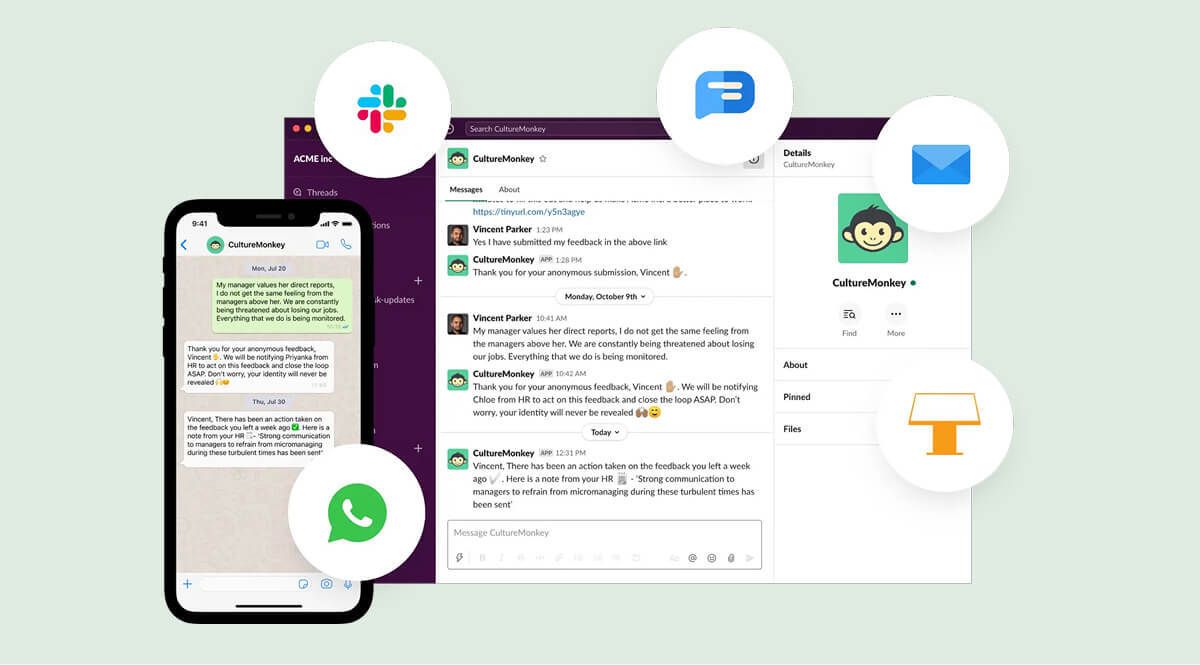
CultureMonkey helps operationalize construction workforce motivation techniques through multilingual pulse surveys, QR and kiosk access for site workers, and role-based dashboards. It enables real-time feedback, crew-level insights, and action tracking so supervisors can respond quickly and sustain motivation across projects.
Book a demo with CultureMonkey.
Last reviewed: April 2026. Statistics and phase frameworks updated to reflect 2025-2026 construction industry conditions.
FAQs
1. What motivates construction workers on site?
Construction workers are primarily motivated by craft pride (seeing quality work completed), peer recognition (respect from their crew), and project ownership (having clear responsibility for a defined scope). Financial incentives matter but consistently rank below these three drivers in site-based motivation research.
2. How do project phases affect worker motivation?
Motivation peaks during visible progress phases like structure rising or fitout nearing completion, and dips during pre-pour, formwork, and weather-delay periods. Phase-aware management adjusts recognition frequency, communication intensity, and acknowledgment style to match the motivation curve of each stage.
3. Which recognition programs work best for construction site workers?
The most effective recognition formats for site workers are toolbox shout-outs (immediate and peer-witnessed), trade milestone boards (visible crew-level progress), principal contractor letters (formal but personal), and safety recognition for near-miss reporting. Digital-only programs have low reach on active sites.
4. How do you motivate construction workers without a budget?
Non-monetary construction motivation relies on schedule transparency, role clarity, and informal progress briefings. Sharing daily work plans, defining each trade's responsibilities clearly, and running short morning huddles reduce uncertainty and keep workers aligned without requiring any financial investment.
5. What foreman motivation techniques work on a daily basis?
Foremen can drive daily motivation through three actions: morning acknowledgment (naming specific effort in front of the crew), task autonomy signals (setting goals without over-instructing), and end-of-shift recognition (calling out quality output and problem-solving). Consistency matters more than any single gesture.
6. Why do construction worker incentive programs fail?
Construction incentive programs fail when they are hard to measure fairly across trades, delayed beyond the point of relevance, or too abstract for workers to connect to their daily output. Performance bonuses and profit share underperform because workers cannot see a link between their effort and the reward.
7. How do you reduce turnover on a construction site through motivation?
Construction site turnover is reduced by addressing the motivators workers value most: clear role definition, consistent recognition from supervisors, visible progress on their specific work, and a sense of ownership over a defined scope. Sites that run phase-aligned motivation programs report stronger retention across project durations.
8. How can managers measure motivation levels on a construction site?
Managers can measure construction site motivation through pulse surveys deployed via QR codes or kiosks, attendance and punctuality tracking, rework rate trends, and supervisor observation of crew energy and communication. CultureMonkey enables structured feedback collection from site workers without requiring digital literacy or desk access.