

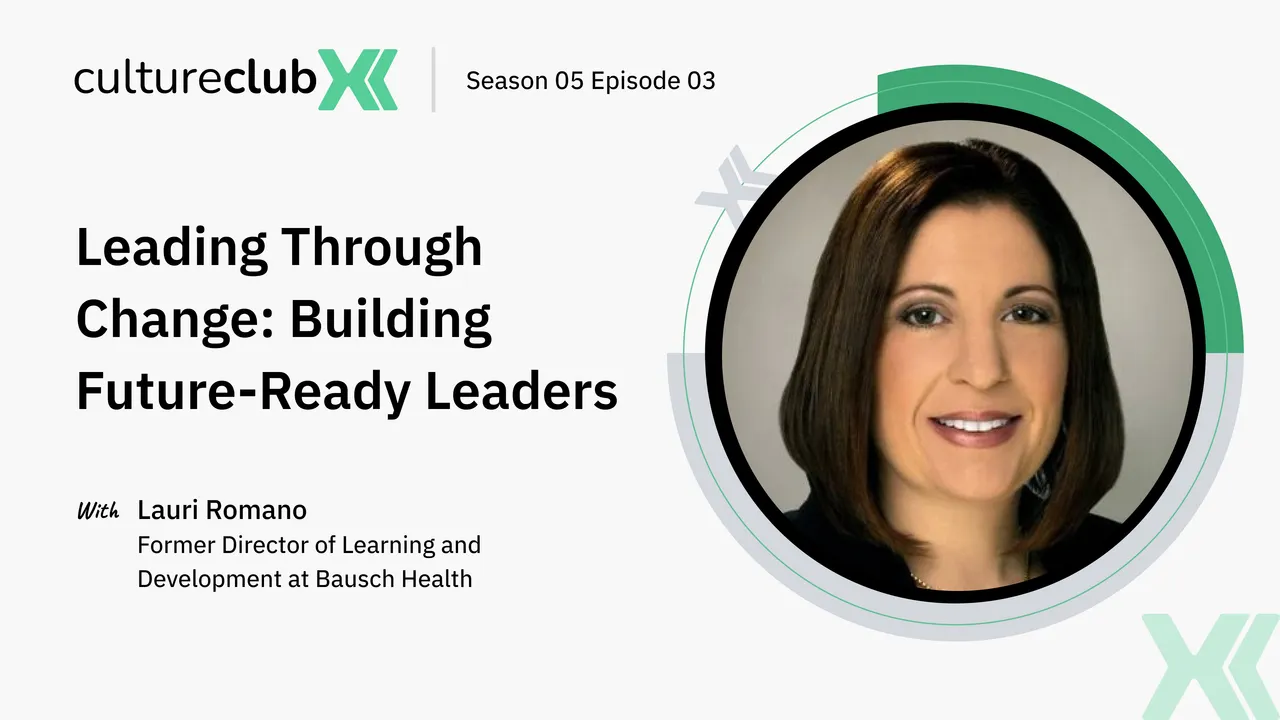
S05 E03
Leading Through Change: Building Future-Ready Leaders
In this episode, Lauri Romano unpacks how leaders can guide teams through uncertainty, balance speed with sustainability, and build psychological safety. She shares why empathy, adaptability, and purpose are core to future-ready leadership, and how tech and human skills now go hand in hand.

TL;DR
What you need to know from this episode
- Change is an emotional event before it is an operational one. The hardest part of leading through constant change is the emotional and cognitive toll on people, so leaders must pair clarity with emotional intelligence, transparent communication, and deep listening.
- Balance speed with sustainability. Quick wins are tempting in fast paced environments, but real transformation needs space for reflection, skill building, and trust, so pace change deliberately and align it with purpose.
- Develop mindsets, not just skill sets. Static competencies like delegation do not prepare leaders for ambiguity; comfort with discomfort, experiential learning, coaching, and real-time problem solving do, delivered as a living system rather than a one-time event.
- Resilience starts with modeling. Leaders who show vulnerability, acknowledge uncertainty, and still move forward with purpose give their teams permission to do the same, while consistent communication and inclusive decision-making build psychological safety.
- Technology amplifies culture when used intentionally. Engagement surveys, 360 feedback tools, and optimized LMS platforms create scalable, transparent systems that reinforce values, drive connection, and help leaders listen better and respond faster.
How do you lead a team when the ground will not stop shifting? That question sits at the heart of the third episode of CultureClub X season five, where host Jodie welcomes Lauri Romano, former director of learning and development at Bausch Health, for a conversation on leading through change and building future ready leaders.
Lauri has spent two decades building leaders who can thrive through uncertainty. At Bausch Health she led enterprise wide leadership and learning initiatives for managers navigating a complex, changing health care landscape. Before that, she spent more than eight years at Horizon Blue Cross and Blue Shield of New Jersey driving programs that fostered resilience, agility, and continuous development across teams.
She is candid about how much the craft has changed. She started out in learning and development when trainers still relied on overhead projectors; today, she says, the job is just-in-time training that makes leaders ready instantly for the challenges coming their way. That shift frames the whole episode: future ready leadership is less about content delivery and more about mindsets.
Why constant change takes an emotional and cognitive toll
Asked about the biggest challenge leaders face today, Lauri does not point to project plans or rollout logistics. The real work, she argues, is guiding teams through the emotional and cognitive toll of constant change: helping people navigate ambiguity, maintain engagement, and stay resilient while the ground keeps shifting beneath them.
That calls for leaders who show up with both clarity and emotional intelligence. In practice it means communicating transparently, listening deeply, and creating psychological safety so teams feel supported even when outcomes are uncertain. It also means staying adaptable, remaining open to feedback, learning in real time, and showing vulnerability when appropriate.
The second challenge she names is balancing speed with sustainability, and it may be the one transformation programs most often get wrong.
In fast-paced environments, it's tempting to push for quick wins but real transformation requires space for reflection, skill building, and trust.
Her prescription is intentional pacing: align change with purpose and equip teams with the tools and mindsets to thrive, not just survive. The leaders who succeed, she says, are those who treat change not as a disruption but as a catalyst for growth, and who bring their teams along with empathy, vision, and a steady hand.
What traditional leadership development keeps getting wrong
Why do so many organizations still struggle to prepare leaders for uncertainty? Lauri's diagnosis is that traditional leadership development focuses on static competencies, things like decision-making, delegation, and communication, without equipping leaders to thrive in ambiguity.
Uncertainty demands a different skill set: adaptability, emotional intelligence, systems thinking, and the ability to lead through complexity without clear answers. What is missing, she says, is the intentional development of mindsets, not just skill sets. Leaders need to build comfort with discomfort, learn how to pivot quickly, and foster resilience in themselves and their teams.
Practically, that means moving beyond workshops and frameworks into experiential learning, coaching, and real-time problem solving, with space for reflection, vulnerability, and growth when the path forward is not linear. Organizations that succeed treat leadership development as a living system rather than a one-time event: they invest in continuous learning, build psychological safety, and empower leaders to lead with both clarity and compassion.
Which qualities keep employees engaged through transformation
Pushed on which qualities matter most, Lauri names three: empathy, adaptability, and clarity of purpose. Employees are not just looking for direction, they are looking for connection. Leaders who communicate transparently, listen actively, and show genuine care for their teams build trust, and trust is the foundation of engagement.
Adaptability is equally vital because transformation almost always means ambiguity. Leaders have to be comfortable navigating the unknown without pretending to have all the answers, staying open to learning, pivoting when needed, and empowering others to do the same.
Purpose closes the loop. When employees understand the why behind a change and can see how their work contributes to something meaningful, engagement skyrockets. Leaders who align transformation with values and vision create momentum that is not just strategic but deeply human.
How leaders create resilience and psychological safety when change hits
When change hits, people look to their leaders not just for direction but for stability, empathy, and trust. A leader's presence and behavior, Lauri notes, often set the emotional tone for the entire organization. That is why resilience work starts with the leader's own behavior rather than with a program.
Resilience starts with modeling. Leaders who show vulnerability, acknowledge uncertainty, and still move forward with purpose give their teams permission to do the same.
It is not about having all the answers. It is about creating space for learning, adapting, and growing together. Psychological safety, meanwhile, is built through consistent communication, active listening, and inclusive decision-making.
When leaders invite diverse perspectives, respond with empathy, and make it safe to speak up even when things are messy, they create a culture where people feel valued and supported. Building that kind of psychological safety at work is slow, deliberate work, but it is what lets a team absorb disruption without losing trust.
Can leadership programs actually teach empathy, inclusivity, and trust
Lauri's answer is yes, but only when they are treated as strategic capabilities that drive team performance and culture, not as soft skills bolted onto a curriculum. It starts with intentional design: programs must go beyond theory and create space for self awareness, reflection, and real world practice.
Concretely, that means integrating tools like 360 feedback, emotional intelligence assessments, and coaching conversations that help managers understand how their behavior impacts others. Empathy is cultivated when leaders learn to listen actively, suspend judgment, and respond with curiosity. Inclusivity grows through exposure to diverse perspectives, bias interruptors, and exercises that challenge assumptions.
Trust, in her framing, is the outcome: the product of consistent values based leadership reinforced through role modeling, transparent communication, and accountability. The most effective programs embed these capabilities into everyday leadership moments such as performance reviews, team meetings, and goal setting, so they are not just learned but lived.
How technology amplifies culture instead of replacing it
Lauri believes leadership development must evolve from static, one size fits all models into dynamic, personalized ecosystems that prepare managers to lead in a tech driven world. As AI and emerging technologies reshape how work gets done, leaders need adaptive mindsets, emotional intelligence, and the ability to lead with both data and humanity.
Programs should integrate real time learning, coaching, and scenario based experiences that mirror the pace and complexity of today's workplace. They should also teach leaders to handle data ethically, foster inclusive innovation, and navigate the human impact of automation, building digital literacy and empathy side by side.
On culture itself, she calls technology a game changer. From optimizing LMS platforms to deploying engagement surveys and 360 feedback tools, she has used tech to create scalable, transparent systems that reinforce values and drive connection.
When used intentionally, technology doesn't replace culture, it amplifies it.
Why future ready leadership comes back to listening
Jodie closes the episode with a summary worth keeping: future ready leadership is not about one off programs or rigid frameworks, it is about equipping managers and employees alike to thrive amid change. The leaders who succeed will be those who can listen deeply, adapt quickly, and lead with trust.
It is striking how much of Lauri's playbook depends on listening infrastructure. Transparent communication, psychological safety, engagement surveys, and 360 feedback all assume the organization has a reliable way to hear its people, especially in moments of change when speaking up feels riskiest.
That is the gap continuous listening is built to close. A well run pulse survey tool gives leaders the real time signal Lauri describes: where ambiguity is eroding engagement, whether the why behind a change is landing, and which teams need support before disruption turns into disengagement.
Jodie's sign off makes the same point in plain language: keep listening to your people and leading with purpose. For leaders navigating constant change, that is not a tagline. It is the operating model Lauri spent the whole episode describing.

About the guest
Lauri Romano
Former Director of Learning and Development, Bausch Health
Lauri Romano is a former director of learning and development at Bausch Health, where she led enterprise-wide leadership and learning initiatives that helped managers navigate highly complex and changing health care landscapes. She has spent two decades shaping organizational growth by building leaders who can thrive through uncertainty. Before Bausch Health, she spent more than eight years at Horizon Blue Cross and Blue Shield of New Jersey, designing and driving programs that fostered resilience, agility, and continuous development across teams.
Her earlier career included pivotal roles in talent management and organizational development across sectors like pharmaceuticals and engineering. An alum of Villanova University, she holds a bachelor's degree in sociology and a human resource management certificate, and she has spent her entire career in the learning and development space.
Full episode transcript
Season 05, Episode 03 · Lauri Romano with Jodie O'Brien · 15 min
So what role do you feel like leaders actually play in fostering that resilience and psychological safety during moments of change? That can be really hard for employees.
Leaders play a pivotal role in fostering resilience and psychological safety during moments of change. Resilience starts with modeling. Leaders who show vulnerability, acknowledge uncertainty, and still move forward with purpose give their teams permission to do the same. It's not about having all the answers. It's about creating space for learning, adapting, and growing together. Ultimately, leaders are the bridge between strategy and humanity. During change, their ability to connect, clarify, and care is what transforms disruption into opportunity.
Hello everyone and welcome to the fifth season of CultureClub X powered by CultureMonkey. I'm your host Jodie. CultureMonkey is an enterprise employee engagement platform that helps people leaders listen to their employees and enhance workplace cultures. CultureClub X is our community initiative where global leaders share best practices from their experience and discuss all things company culture. For the third episode of CultureClub X, we are honored to have with us Lauri Romano, a former director of learning and development at Bausch Health. Welcome Lauri. It's a pleasure to have you on today.
Thank you. Thank you for having me. I'm excited.
We're so glad to have you and we understand that you have spent two decades shaping organizational growth by building leaders who can thrive through uncertainty and these are uncertain times. At Bausch Health, you led enterprise-wide leadership and learning initiatives helping managers navigate highly complex and changing health care landscapes. Before that, you spent more than eight years at Horizon Blue Cross and Blue Shield of New Jersey designing and driving programs that fostered resilience, agility, and continuous development across teams.
It sounds like in your earlier career too, that included a lot of pivotal roles in talent management, organizational development across sectors like pharmaceuticals and engineering and it all gave you a broad perspective on how culture and leadership intersect in different industries. You're alum of Villanova University and hold a bachelor's degree in sociology and a human resource management certificate and it grounds you in an approach in both people, science, and business pragmatism. And so now you're reflecting on your career and you're continuing to share your expertise with us and organizations and leaders everywhere building that culture, future readiness. We're so glad to have you Lauri.
I love the introduction.
You have a tremendous amount of experience to bring to this podcast.
Yes, I do. I've been in this space my entire career, one of the few that can probably say that.
I bet that's true because a lot of people change careers. They hop from one industry to the next and you've been at it for a long time so thank you for joining us today on this episode of CultureClub X, leading through change, building future ready leaders. So before we dive in to this conversation and this discussion, can you tell us a little bit more about yourself and your leadership journey?
Yes, I started out in learning and development a long time ago when we still used overhead projectors and had no technology to really teach people and leaders and we did things that were fun and we like to do and now the world has changed. We need to do just-in-time training and really make leaders ready instantly to face the challenges that are coming their way.
That's fantastic, Lauri. It's so true. The age of overhead projectors might be over but we still like them, right? We'll bring up a PowerPoint every now and then. I love that. Well, thank you so much for just sharing a little bit about your journey today and to get started with our conversation, I obviously have my first question for you which is, what do you see as the biggest challenges that leaders face today in guiding teams through this constant change?
One of the biggest challenges leaders face today, I believe, in guiding teams through the emotional and cognitive toll of constant change. It's about managing logistics or rolling out new initiatives. It's about helping people navigate ambiguity, maintain engagement, and really stay resilient when the grounds keep shifting beneath them because that's what happens when a change occurs. Leaders are being called to show up with both clarity and emotional intelligence which we hear a lot about these days and what that translates to is communicating transparently, listening deeply, and creating psychological safety so teams feel supported even when outcomes are uncertain. It also means being adaptable, being open to feedback, learning in real time, and really showing vulnerability when appropriate.
Another challenge is balancing speed with sustainability. In fast-paced environments, it's tempting to push for quick wins but real transformation requires space for reflection, skill building, and trust. Leaders must be intentional about pacing change, aligning it with purpose, and equipping their teams with the tools and mindsets to thrive, not just survive. Ultimately, leaders who succeed are those who can treat change not as a disruption but as a catalyst for growth and who can bring their teams along with empathy, vision, and a steady hand.
So Lauri why do you think that so many organizations struggle to prepare their leaders for that uncertainty and what's missing in traditional leadership development?
Many organizations struggle to prepare leaders because traditional leadership development often focuses on static competencies. Things like decision-making, delegation, and communication without equipping leaders to thrive in ambiguity. The reality is uncertainty demands a different skill set, adaptability, emotional intelligence, systems thinking, and the ability to lead through complexity without clear answers.
That's definitely a challenge especially when you're preparing leadership programs.
What's missing is the intentional development of mindsets not just skill sets. Leaders need to build comfort with discomfort, learn how to pivot quickly, and foster resilience in themselves and their teams. That means moving beyond workshops and frameworks into experiential learning, coaching, and real-time problem-solving. It also means creating space for reflection, vulnerability, and growth especially when the path forward isn't linear. Organizations that succeed in this space are those that treat leadership development as a living system not a one-time event. They invest in continuous learning, build psychological safety, and empower leaders to lead with both clarity and compassion even when the future is uncertain.
So what qualities or skills do you think are most critical for leaders today to implement for their people especially for keeping employees engaged during that transformation. I know you said vulnerability is a big one.
Yeah in today's landscape of constant transformation I think the most critical qualities for leaders are empathy, adaptability, and clarity of purpose. Employees aren't just looking for direction. They're looking for connection. Leaders who can communicate transparently, listen actively, and show genuine care for their teams, build trust, and that is the foundation of engagement. Adaptability is equally vital. Transformation often means ambiguity and leaders must be comfortable navigating the unknown while modeling resistance and optimism. That doesn't mean having all the answers. It means being open to learning, pivoting when needed, and empowering others to do the same. And finally purpose. When employees understand the why behind the change and see how their work contributes to something meaningful, engagement skyrockets. Leaders can align transformation with values and vision, create momentum that's not just strategic but deeply human.
So what role do you feel like leaders actually play in fostering that resilience and psychological safety during moments of change? That can be really hard for employees.
It sure can. Leaders play a pivotal role in fostering resilience and psychological safety during moments of change. In fact their presence and behavior often set the emotional tone for the entire organization. When change hits people look to their leaders not just for direction but for stability, empathy, and trust. Resilience starts with modeling. Leaders who show vulnerability, acknowledge uncertainty, and still move forward with purpose give their teams permission to do the same. It's not about having all the answers. It's about creating space for learning, adapting, and growing together.
Psychological safety meanwhile is built through consistent communication, active listening, and inclusive decision-making. When leaders invite diverse perspectives and respond with empathy and make it safe to speak up even when things are very messy they create a culture where people feel valued and supported. Ultimately leaders are the bridge between strategy and humanity. During change their ability to connect, clarify, and care is what transforms disruption into opportunity.
That makes a lot of sense and everybody talks about leadership programming. How can that leadership program embed empathy, inclusivity, and trust as core capabilities for managers?
Leadership programs can embed empathy, inclusivity, and trust not just as soft skills but as strategic capabilities that drive team performance and culture. It starts with intentional design. Programs must go beyond theory and create space for self-awareness, reflection, and real-world practice. That means integrating tools like 360 feedback, emotional intelligence assessments, and coaching conversations that help managers understand how their behavior impacts others. Empathy is cultivated when leaders learn to listen actively, suspend judgment, and respond with curiosity. Inclusivity is built through exposure to diverse perspectives, bias interruptors, and exercises that challenge assumptions, and trust well that's the outcome of consistent value based leadership reinforced through role modeling, transparent communication, and accountability.
The most effective programs also embed these capabilities into everyday leadership moments. Performance reviews, team meetings, goal setting, so they're not just learned but they're lived. When empathy, inclusivity, and trust become part of how managers lead, they create an environment where people feel safe, seen, and empowered to grow.
Really well said, absolutely. So leadership development is core to all of that and evolving it to help managers adapt and thrive in a changing workplace is key. So what practices have helped strengthen culture that you've seen?
Leadership development I believe must evolve from static one-size-fits-all models to dynamic personalized ecosystems that prepare managers to lead in a tech driven world. As AI and emerging technologies reshape how we work, leaders need more technical fluency. They need adaptive mindsets, emotional intelligence, and the ability to lead with both data and humanity. Programs should integrate real-time learning, coaching, and scenario-based experience that mirror this pace and complexity of today's workplace. We need to teach leaders how to interpret data ethically, foster inclusive innovation, and navigate the human impact of automation. That means embedding digital literacy alongside empathy and helping managers build trust even as workflows become more digitized.
As for streamlining culture, technology has been a game-changer. From optimizing LMS platforms to deploying engagement surveys and 360 feedback tools, I've used tech to create scalable transparent systems that reinforce values and drive connection. When used intentionally, technology doesn't replace culture, it amplifies it. It allows us to be better listeners, respond faster, and personalize development in ways that truly meet people where they are.
Really well said. Thank you, Lauri. Well, it's definitely clear from today's conversation that future-ready leadership isn't about one-off programs or rigid frameworks. It's about equipping managers and employees alike to thrive amid that change. We touched on how resilience and psychological safety anchor culture, why empathy and inclusivity need to be at the heart of leadership, and how technology is actually reshaping what it means to grow and adapt in the workplace. At the end of the day, the leaders who succeed will be those who can listen deeply, adapt quickly, and lead with trust. Lauri, it's been such a privilege to have you on CultureClub X today. Before we sign off, could you share with our viewers how they can connect with you if they'd like to continue that conversation?
Sure, they can connect with me via LinkedIn. I'm on LinkedIn. I have a lot of information there. And also, if they would like, they can email me at lauriannromano@gmail.com. And that's L-A-U-R-I-A-N-N-R-O-M-A-N-O at gmail.com.
Perfect. Lauri, your wealth of experience has been just a delight to listen to today. Some really innovative ideas for people. So thank you once again for your time and wisdom. And to our listeners, thank you for tuning in. Don't forget to follow, share, and rate this podcast. As always, keep listening to your people and leading with purpose. That's all we have for you in this episode of CultureClub X powered by CultureMonkey. Until next time, this is your host Jodie, signing off.
Frequently asked questions
What is the biggest challenge leaders face when guiding teams through constant change?
According to Lauri Romano, the biggest challenge is the emotional and cognitive toll constant change takes on people. Beyond rolling out initiatives, leaders have to help teams navigate ambiguity, maintain engagement, and stay resilient while the ground keeps shifting, which requires clarity, emotional intelligence, transparent communication, deep listening, and psychological safety.
She also flags balancing speed with sustainability: quick wins are tempting in fast paced environments, but real transformation needs space for reflection, skill building, and trust.
Why does traditional leadership development fail to prepare leaders for uncertainty?
Traditional programs focus on static competencies such as decision-making, delegation, and communication without equipping leaders to thrive in ambiguity. Uncertainty demands adaptability, emotional intelligence, systems thinking, and the ability to lead through complexity without clear answers.
What is missing is the intentional development of mindsets, not just skill sets: experiential learning, coaching, real-time problem solving, and treating leadership development as a living system rather than a one-time event.
How can leaders build psychological safety during organizational change?
Psychological safety is built through consistent communication, active listening, and inclusive decision-making. Leaders who invite diverse perspectives, respond with empathy, and make it safe to speak up even when things are messy create a culture where people feel valued and supported.
Resilience starts with modeling: when leaders show vulnerability, acknowledge uncertainty, and still move forward with purpose, they give their teams permission to do the same.
What leadership qualities keep employees engaged during transformation?
Lauri names empathy, adaptability, and clarity of purpose. Employees are looking for connection as much as direction, so leaders who communicate transparently, listen actively, and show genuine care build the trust that engagement rests on. When employees understand the why behind a change and see how their work contributes to something meaningful, engagement skyrockets.
How should leadership development evolve for an AI driven workplace?
Lauri argues it must move from static, one size fits all models to dynamic, personalized ecosystems. Leaders need adaptive mindsets, emotional intelligence, and the ability to lead with both data and humanity, supported by real time learning, coaching, and scenario based experiences.
Used intentionally, technology amplifies culture rather than replacing it, from LMS platforms to engagement surveys and 360 feedback tools that reinforce values and drive connection.
Read the cross-episode roundups
More from CultureClub X
 S07 E02change leadershipHR as Chief Disruption Officer: Why Supporting the Business Is a Ceiling, with Jennifer McClure
 Jennifer McClure
 S06 E20change leadershipWhy does culture change stall? | Jamie Notter, culture scientist
 Jamie Notter
 S06 E19change leadershipFrom Cost Center to Catalyst: How CPOs Turn People Strategy Into Business Advantage, with L. David Kingsley
 L. David Kingsley
Never miss an episode
Every new episode, plus the takeaways that matter, posted on the CultureMonkey LinkedIn page as soon as they drop.
Free on LinkedIn. Unfollow anytime.