


6 Workforce engagement challenges in construction industry explained

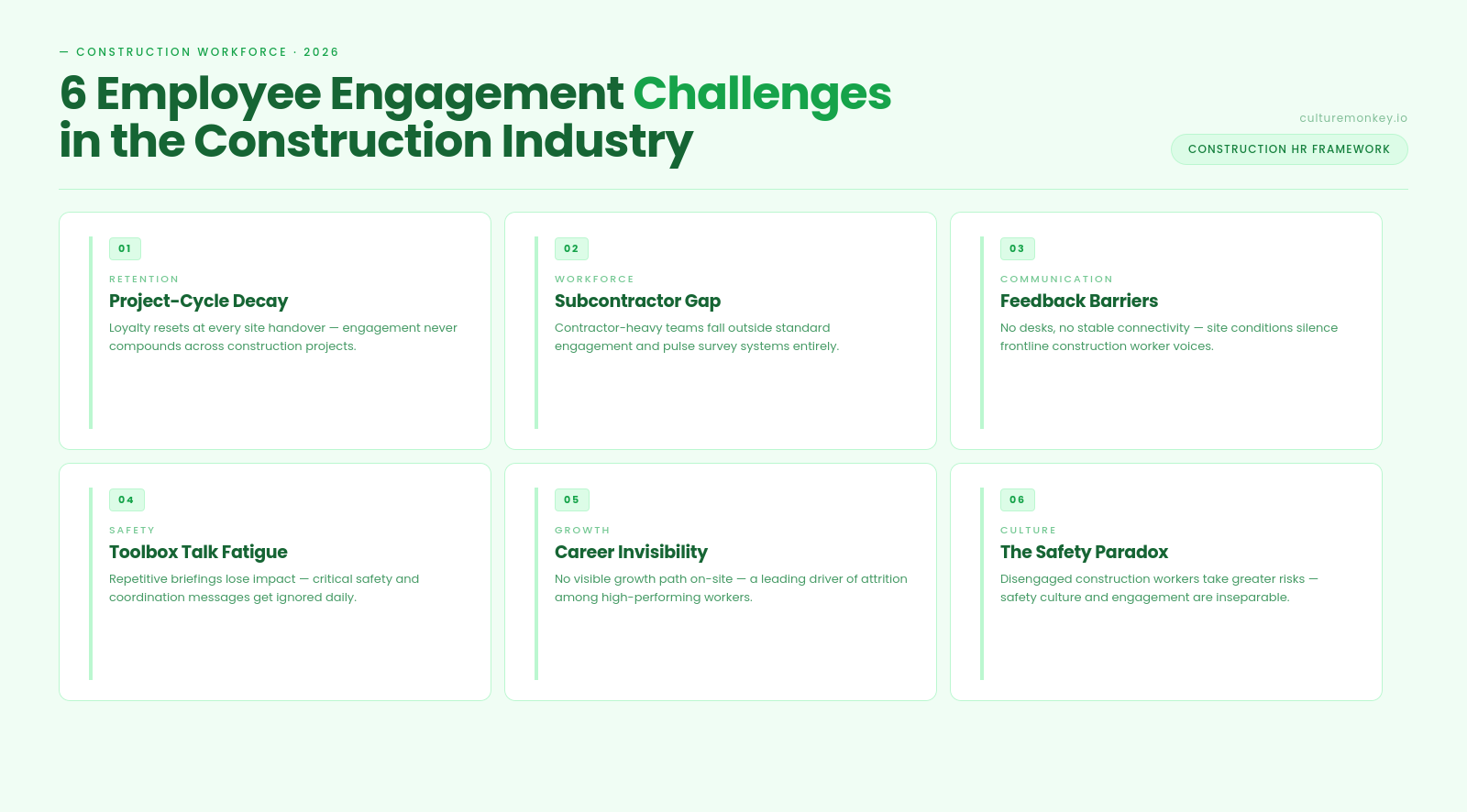
Workforce engagement challenges in construction industry arise because most HR frameworks do not align with how sites operate, leading to six structural issues: project-cycle engagement decay, subcontractor loyalty gaps, physical environment barriers, communication breakdowns at the toolbox, career invisibility on site, and the safety-culture paradox.
Workers move between projects, report through subcontractors, and often lack access to digital communication tools. This leads to disengagement that builds quietly until it impacts safety, productivity, or retention. Unlike traditional workplaces, engagement here is shaped by project cycles, site conditions, and fragmented communication.


- Construction engagement fails at the project handover point — loyalty resets with every new site
- Subcontractors aren't engaged because they don't see themselves as your employees
- Physical environments block the digital feedback tools most HR teams rely on
- Safety culture and engagement are linked — disengaged workers take more risks
- Career invisibility (no promotion path visible on-site) is an underrated driver of attrition
- Toolbox talk fatigue leads to communication breakdowns, where repeated briefings lose impact and critical safety and coordination messages are ignored
This article introduces the “6 Structural Challenges” framework, a practical model for understanding workforce engagement challenges in construction industry, shaped by project cycles, site conditions, and workforce dynamics.
What is workforce engagement in construction?
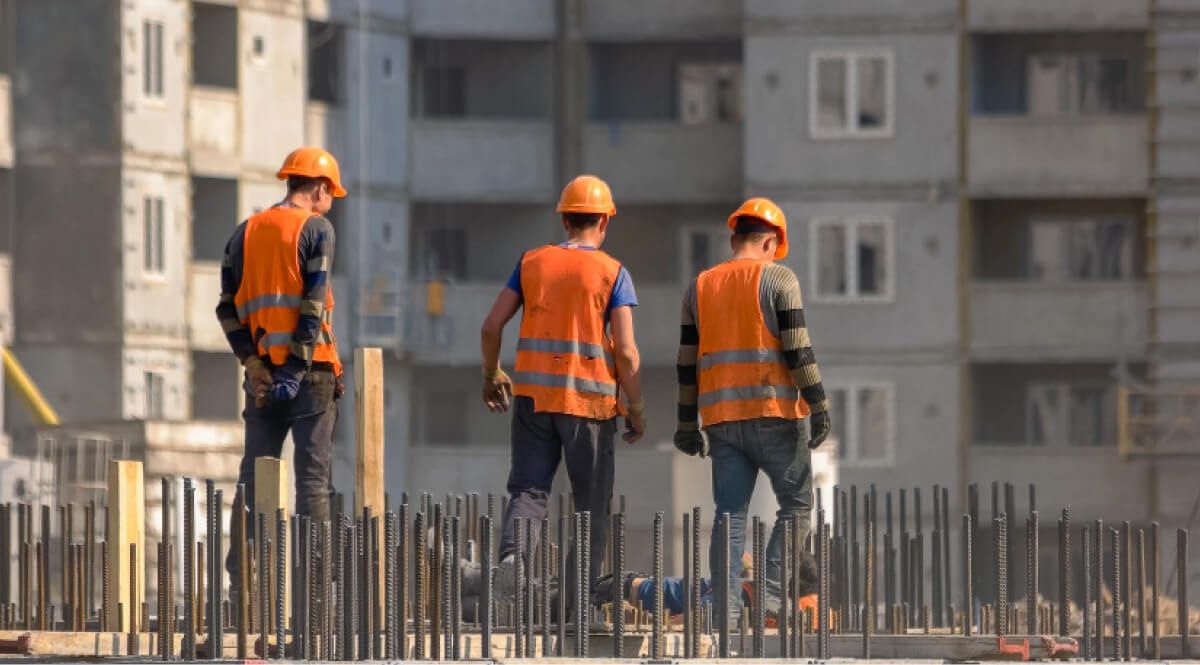
Workforce engagement construction refers to the commitment, involvement, and motivation of construction workers toward their tasks, safety, and project outcomes. It includes construction employees, subcontracted labour, and skilled workers across sites, where engagement is shaped by conditions, communication, and access to tools.
In construction companies, engagement differs from traditional employee engagement because work is distributed, physical, and project-based. Construction firms must engage experienced workers and frontline crews in environments with limited digital access. Strong engagement improves safety, productivity, retention, and overall project performance.
Challenge 1: Project-cycle engagement decay
Project-cycle engagement decay occurs when engagement drops at the end of construction projects as teams disperse and continuity breaks. In the construction sector, frequent movement, construction labour turnover, and fragmented ownership prevent engagement from building over time, making it difficult for HR management to sustain consistency.
1. Why it happens
High construction labour turnover and shifting construction projects disrupt stability and continuity. Workers move frequently, limiting alignment and trust. HR professionals struggle to maintain consistent communication, employee training, and safety training across sites, weakening engagement foundations across the construction sector.
2. What it costs
Engagement loss affects workplace safety, productivity, and retention across construction companies. Disengaged construction workers contribute less and are more likely to leave. Engaged teams experience 78% less absenteeism and 14% higher productivity, clearly showing the cost of disengagement.
3. Fix signal
Anchor engagement at mobilisation and rebuild it at every project handover. Use site-level onboarding resets, crew-based check-ins, and foreman-led communication to re-establish continuity. Track engagement by project and worker movement, not organisation, to prevent repeated disengagement resets across sites.
Challenge 2: The subcontractor loyalty gap.
The subcontractor loyalty gap appears when construction companies rely on a contractor-heavy workforce but measure engagement only among direct payroll teams. On a job site, qualified workers may follow safety regulations, yet still feel outside employer ties, lowering job satisfaction and limiting open communication.
1. Why it happens
Standard engagement systems follow payroll, company email, or manager lines. In a contractor-heavy workforce, subcontractor engagement is missed as qualified workers rotate across employers and job site teams, weakening open communication, ownership, and consistency in ongoing safety training and safety training programs.
2. What it costs
When subcontractors feel excluded, job satisfaction drops, and high employee turnover rates increase. Construction companies struggle with labour shortages, inconsistent safety regulations adherence, and difficulty retaining skilled workers, leading to gaps in safety training programs and uneven performance across projects.
3. Fix signal
Treat subcontractor engagement as core to operations. Extend surveys, ongoing safety training, health insurance communication, and safety regulations updates to all job site workers. Build open communication loops that include subcontractors to improve job satisfaction and support retaining skilled workers.
Challenge 3: Physical environments block feedback.
Frontline worker engagement construction is limited because construction workforce environments lack stable access to communication tools. In a mobile workforce, workers operate without desks, consistent connectivity, or quiet spaces. Feedback becomes difficult to capture, causing construction HR challenges to remain hidden until they impact worker safety and performance.
1. Why it happens
Construction workforce settings are built for output, not response. Physically demanding work, strict safety protocols, and constant movement leave little room for surveys or check-ins. For a mobile workforce, weak access and timing turn simple feedback into one more operational obstacle.
2. What it costs
When feedback is hard to give, construction HR challenges surface late, and workplace culture weakens. Teams miss early signs of why construction workers leave jobs, where skilled labour feels stuck, and how worker safety, training programs, and the skills gap connect.
3. Fix signal
Use practical strategies that match site realities. Offer mobile-first feedback, short pulse formats, offline options, and supervisor-led collection points. Pair listening with career development opportunities and training programs, so skilled labour sees support beyond daily output and compliance.
Challenge 4: toolbox talk fatigue and communication breakdown construction
Toolbox talk fatigue drives communication breakdowns in construction when repeated briefings lose effectiveness across a project-based workforce. On multiple sites, workers hear similar updates daily, leading to disengagement. This reduces clarity, increases safety risks, and weakens subcontractor engagement and coordination.
1. Why it happens
Toolbox talks are often one-way, repetitive, and disconnected from the real job site context. In a labour hire workforce and subcontractor engagement model, workers hear generic updates daily, leading to toolbox talk fatigue and weakening attention across multiple sites.
2. What it costs
When communication breaks down, safety risks increase, and coordination suffers. Skilled labour shortages worsen as teams struggle to retain workers. Poor clarity becomes one of the most pressing hr challenges, impacting productivity, morale, and alignment across a project-based workforce.
3. Fix signal
Replace static toolbox talks with job-specific briefings tied to daily tasks and risks. Use quick crew huddles, foreman-led check-ins, and end-of-shift debriefs to capture input. Rotate speakers across crews and log key issues at the job site to improve clarity, safety, and coordination.
Challenge 5: career invisibility on site.
Career invisibility on site occurs when construction teams cannot see clear promotion pathways despite consistent performance. Workers complete physically demanding tasks without visibility into future roles, reducing employee satisfaction. This disconnect drives high turnover and reinforces construction HR challenges around retaining and motivating site-based employees.
1. Why it happens
Site roles often lack visible promotion markers, so construction managers focus on delivery more than progression. Site foreman leadership may spot strong performers, but growth steps stay informal. In physically demanding roles, workers rarely see how today’s effort leads to future responsibility.
2. What it costs
When workers cannot picture advancement, some construction labour turnover reasons become easier to predict. High turnover rises as employees leave for clearer options. This hurts employee satisfaction, weakens a company's reputation, and makes it harder to retain employees across construction teams.
3. Fix signal
Make progression visible at the job level, not just in HR documents. Tie site foreman leadership, safety programs, and skill milestones to advancement. Link worker health, safety standards, and a strong safety culture with growth so development feels practical and earned.
Challenge 6: the safety-culture paradox.
Safety culture construction breaks down when engagement is low, even with strict rules in place. Disengaged workers' safety risks increase as teams follow processes without ownership. This shifts safety toward compliance instead of behavior, making it harder for hiring managers and the HR department to ensure compliance across changing job conditions.

You cannot improve safety outcomes without improving engagement first. Disengagement is often the hidden variable behind most workplace risks.
Jim Clifton

Chairman of Gallup
1. Why it happens
Safety systems often focus on rules, not engagement. In safety culture construction, workers follow instructions but lack ownership. Disengaged workers' safety risks increase when workforce management prioritizes output over involvement, leaving safety concerns unspoken across teams.
2. What it costs
Low engagement increases safety concerns and incident risks, even when processes exist. High employee turnover and a rising construction turnover rate weaken consistency. This creates pressure on hiring managers, the hr department, and health administration to maintain standards while ensuring compliance with labor law.
3. Fix signal
Link engagement directly to safety outcomes at the job site level. Run daily crew check-ins before shifts to surface risks, log near-misses during work, and review them in end-of-shift debriefs. When workers speak up early, hazards are addressed before incidents, improving safety culture construction and reducing disengaged workers' safety risks.
These 6 challenges show that workforce engagement in construction industry requires site-specific approaches, not generic HR solutions, to improve safety, retention, and performance across changing project environments.
Workforce engagement challenges in construction industry: standard vs site-specific fixes
Construction workforce engagement challenges require different responses than standard HR practices due to site-level realities and workforce dynamics. This table highlights how construction managers can address unique challenges using fixes that improve employee satisfaction, strengthen engagement drivers, and build a strong safety culture.
How to start fixing these challenges.

Top fixes include ensuring project-level continuity, including subcontractors in engagement efforts, enabling mobile-first feedback, replacing toolbox talks with job-specific communication, making career paths visible on-site, and aligning safety practices with engagement across construction sites.
(Source: Employer News)
- Fix project-cycle engagement decay: Create continuity across construction projects using portable engagement systems. Track workers, not sites, and re-engage teams at mobilisation. This reduces reset effects and stabilizes performance. Explore how to build cross-project engagement systems that sustain continuity.
- Close the subcontractor loyalty gap: Extend engagement efforts to subcontractors and contractor-heavy teams. Include them in communication, feedback, and safety processes. This improves belonging and retention. See how to design subcontractor engagement models that work across mixed employment structures.
- Remove physical environment barriers: Enable frontline worker engagement through mobile-first, offline-capable feedback tools. Use QR codes and supervisor-led collection points. This ensures access despite site conditions. Learn how to capture real-time feedback across distributed construction sites.
- Fix communication breakdown in construction: Replace repetitive toolbox talks with two-way communication formats. Use role-specific updates and quick check-ins to reduce toolbox talk fatigue. This improves clarity and reduces safety risks. Discover better alternatives to traditional toolbox talks that drive real engagement.
- Solve career invisibility on site: Make growth paths visible within construction roles. Link skill progression, site foreman leadership, and responsibilities to advancement. This improves retention and motivation. See how to design clear progression pathways for construction teams.
- Address the safety-culture paradox: Align safety culture construction with engagement, not just compliance. Use feedback loops and digital tools to surface risks early. This reduces incidents and improves accountability. Learn how improving employee engagement strengthens safety outcomes across projects.
Conclusion
Workforce engagement challenges in construction industry directly impact safety, productivity, and retention across projects. These challenges are structural, not behavioral, making them harder to solve with generic HR approaches. Addressing them requires systems that reach frontline workers, adapt to project cycles, and capture real-time feedback.
This is where CultureMonkey helps organisations move beyond surface-level insights. Enabling continuous listening, anonymous feedback, and site-level visibility, it helps teams identify risks early and act faster.
As construction environments evolve, solving engagement challenges becomes essential to building safer, more stable, and high-performing workplaces.
Book a demo with CultureMonkey.
FAQs
1. What are the biggest workforce challenges in construction?
Project-based churn, subcontractor disengagement, physical environment barriers, communication breakdowns, career invisibility, and the safety-culture paradox. These six challenges are structural and represent a major HR challenge, as they stem from how construction operates, not individual worker attitudes.
2. Why is employee engagement hard in construction?
Construction workforces rotate across projects, include mixed employment types, and work in environments where standard tools fail. Site conditions and access limitations reduce consistency, causing engagement to drop between projects and compound over time.
3. What causes disengagement among construction site workers?
Key causes include a lack of visible career paths, poor toolbox communication, physical distance from management, weak belonging in contractor-heavy teams, and the psychological reset at project completion, which disrupts continuity and reduces engagement across projects.
4. How does project-based work affect engagement?
Project-based work creates episodic loyalty, where workers commit to a project instead of a company. When projects end, engagement resets, requiring deliberate re-engagement at mobilisation to rebuild alignment and continuity across teams.
5. Can construction companies measure engagement effectively?
Yes, but standard surveys rarely reach site workers. Effective methods include QR-code pulse surveys, supervisor-led check-ins, and project-level tracking. These approaches address a major HR challenge by capturing real-time feedback despite access constraints.