



Anonymous vs. confidential surveys

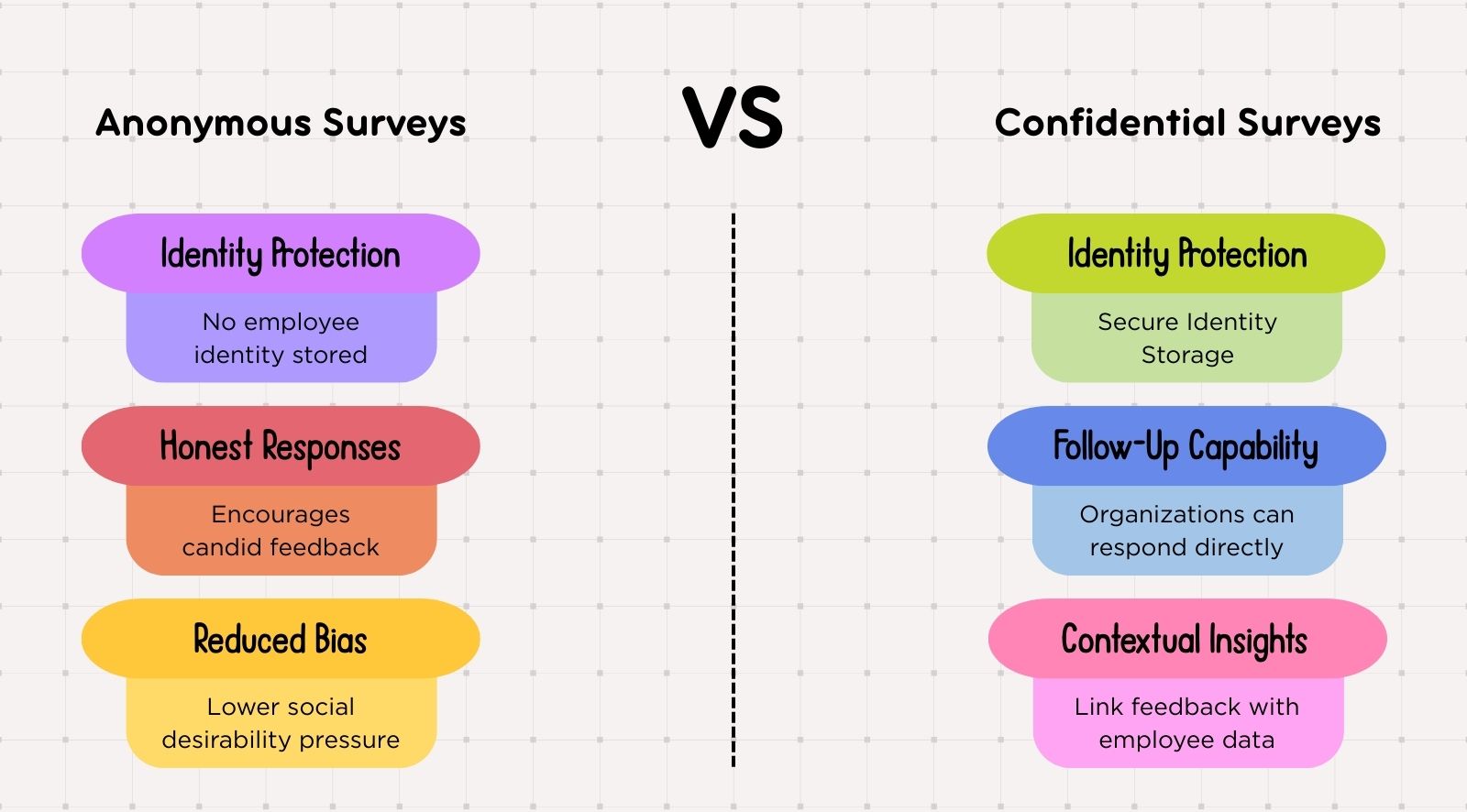
Organizations rely on surveys to understand opinions, experiences, and concerns that rarely surface in everyday conversations. But how feedback is collected matters. When respondents worry their identity could be linked to their answers, they may hold back or soften their responses, which affects the quality of insights gathered.
This is where understanding anonymous vs confidential surveys becomes important. While both approaches protect respondent privacy, they function differently.
Anonymous surveys collect feedback without linking responses to identities, while confidential surveys gather identifiable information but promise to keep it secure. Knowing the difference helps organizations choose the right method for collecting honest, reliable feedback and turning survey data into meaningful decisions.


- Anonymous surveys hide respondent identities completely, encouraging honest feedback and reducing fear of repercussions in workplace surveys.
- Confidential surveys collect identifiable information but protect it securely, allowing organizations to follow up on feedback.
- Anonymous surveys at work encourage candid employee feedback, uncover hidden issues, and reduce social desirability bias.
- Anonymous vs confidential surveys differ mainly in identity traceability, follow-up ability, and depth of contextual insights.
- Choosing anonymous or confidential surveys depends on survey goals, sensitivity of topics, and required follow-up actions.
What is an anonymous survey?
An anonymous survey collects feedback without recording or linking any identifying information to respondents. Because identities are not captured, responses cannot be traced back to individuals. This anonymity often encourages people to share clearer opinions and more honest feedback.
An anonymous survey collects responses without linking answers to personal identity. Anonymous employee surveys avoid capturing names, email addresses, employee IDs, or similar identifiers, meaning the survey data cannot be traced back to individuals. Because of this protection, respondents feel safer sharing anonymous employee feedback. Many employee engagement surveys rely on anonymity to encourage open responses and reveal insights that might otherwise remain hidden.
What is a confidential survey?
A confidential survey collects feedback while recording the respondent’s identity but keeping it protected. The information is visible only to authorized individuals managing the survey. This approach allows organizations to link feedback with context while maintaining privacy and responsible data handling.
Confidential employee surveys collect identifiable details such as names, emails, or employee IDs along with survey responses. However, this information is restricted to authorized teams or secure survey platforms that manage the data responsibly. Because identities are known internally, organizations can perform deeper employee feedback analysis and better understand employee experience while still protecting respondent privacy.
This approach also allows organizations to follow up when needed. Leaders can clarify responses, address concerns, or provide support based on the feedback received. As a result, confidential employee surveys often generate actionable insights. Many organizations combine confidential surveys with pulse surveys or anonymous feedback programs to balance honest input with meaningful follow-up.
What are anonymous surveys at work?
Anonymous surveys at work are like the company water cooler discussions but with a cloak of invisibility. Imagine a space where your thoughts can roam freely, your opinions dance without judgment, and your experiences can take center stage—all while keeping your identity incognito.
1. Spilling beans without spilling names
Anonymous surveys are the superheroes of candid feedback. You know that pesky project that's been driving you up the wall? With anonymity, you can vent without worrying about anyone pointing fingers. These anonymous employee engagement surveys create a safe haven for expressing concerns, sharing grievances, or praising a colleague's stellar work without the fear of repercussions.
2. No sugarcoating allowed
Picture this: you're asked about your thoughts on the latest office policy. In a non-anonymous setup, you might temper your response, fearing it could be traced back to you. But with anonymity, you can unleash the unfiltered truth. No more holding back—say it like it is, whether it's applause-worthy or needs a serious rethink.
3. The bias busters
We all want to be the model employee, right? Anonymous surveys cut through the social desirability bias—the tendency to give answers that paint us in a favorable light. When respondents know their identities are under wraps, they're more likely to share genuine insights, unburdened by the need to conform to perceived expectations.
4. Addressing sensitive topics
Some workplace issues are like the proverbial elephant in the room. Sensitive topics, like workplace harassment or discrimination, can be challenging to discuss openly. Enter anonymous surveys. They provide a platform for employees to share experiences, enabling organizations to address concerns and foster a more inclusive and supportive environment.
5. Boosting employee engagement
When employees feel heard and valued, their engagement levels rise. Anonymous surveys empower employees to voice their opinions gather feedback and ideas, contributing to a culture of continuous improvement. This sense of involvement can lead to increased job satisfaction and loyalty. Additionally, engaged employees are more likely to be proactive and invested in the company's success.
6. Identifying hidden issues
Anonymous surveys can uncover underlying problems that might not be visible on the surface. By providing a channel for honest feedback, organizations can detect patterns and address issues that could otherwise go unnoticed, ensuring a healthier and more productive workplace. This proactive approach helps in creating effective strategies for long-term improvement and employee well-being.
Anonymous or confidential surveys

Organizations often choose between anonymous employee surveys and confidential employee surveys, depending on how feedback will be collected and used. Both approaches gather employee input, but they affect privacy, follow-up ability, and how survey answers are analyzed to understand employee voice and improve decisions.
Anonymous surveys
- Identity remains hidden: Anonymous employee surveys remove identifying details so employee data cannot be traced to individuals. This protects employee anonymity and ensures survey answers remain detached from the person submitting anonymous employee feedback surveys.
- Encourages honest participation: Anonymous employee feedback surveys often encourage employees to share meaningful feedback because they know their identity cannot be linked to responses. This makes anonymous employee feedback tools useful when organizations want an open and unfiltered employee voice.
- Improves response openness: When organizations survey employees anonymously, participants feel safer sharing views about leadership, culture, or work-life balance. This openness often improves data quality and reveals issues that may not appear in identified feedback.
- Protects respondents through thresholds: Many anonymous employee survey tools apply a minimum response threshold before showing employee survey results. This prevents leaders from identifying respondents and helps maintain employee anonymity across teams or departments.
Confidential surveys
- Identifiable but protected responses: Confidential employee surveys collect identifiable employee data but keep it restricted to authorized teams. While organizations can identify respondents internally, access controls protect privacy and prevent public exposure of survey answers.
- Allows follow-up conversations: Because confidential employee feedback surveys can identify respondents, leaders can follow up on employee survey results. This allows teams to address concerns, provide support, or clarify feedback shared through confidential employee surveys.
- Supports deeper feedback analysis: Confidential employee surveys provide richer context for employee feedback analysis because responses can be connected to roles, teams, or departments. This helps organizations track progress and interpret survey answers with greater clarity.
- Useful for structured feedback programs: Organizations often use confidential employee feedback surveys within pulse surveys or continuous listening programs. Linking responses to context helps leaders track progress over time and convert employee voice into actionable improvements.
What is an example of confidentiality vs anonymity?
Organizations often use different survey approaches depending on how identity is handled. Anonymous surveys collect feedback without identifying respondents, while confidential surveys record identities but restrict access. Both methods support workplace survey privacy and anonymity, but they affect how employee sentiment is analyzed and how organizations act on feedback.
- Example of anonymity in practice: An organization runs employee sentiment surveys using anonymous feedback tools for employees, where responses remain strictly anonymous. Participants share candid feedback without entering names or employee ID numbers, ensuring responses stay completely anonymous while leaders analyze patterns and trends.
- Example of confidentiality in practice: A company uses confidential employee survey tools that record identifying details while restricting access to authorized analysts. Individual employees submit survey responses linked to internal records, but confidential employee feedback systems protect identities while still allowing detailed insights from responses.
- Impact on feedback quality: Anonymous formats often help protect anonymity and encourage people to share candid feedback about leadership or culture. Confidential surveys may still reassure employees about privacy, but some participants adjust their responses if they know identities exist in the system.
- How organizations use each approach: Anonymous employee feedback tools help gather employee sentiment and detect trends across teams. Confidential employee feedback systems, however, support deeper employee feedback analysis, allowing leaders to connect responses to roles, situations, or departments.
- Effect on decision making: Anonymous survey results highlight patterns that drive meaningful change at the group level. Confidential surveys can connect feedback to individual employees when follow-up support is needed, helping organizations translate survey insights into measurable business outcomes.
Can a survey be both anonymous and confidential?

Organizations design surveys based on how respondent identity is handled. Anonymous workplace surveys remove identifiers entirely, while confidential workplace surveys collect identity but restrict access. Some organizations use both approaches together to protect privacy, maintain psychological safety, and still allow follow-up when individual feedback requires action.
Anonymous surveys
- Identity is fully removed: Anonymous workplace surveys collect anonymous survey data without recording names, emails, or employee identifiers. This structure helps guarantee anonymity and protects respondents, encouraging people to share anonymous employee feedback more openly.
- Supports psychological safety: When identities are removed, respondents feel safer expressing honest views. Anonymous workplace surveys help strengthen psychological safety, allowing participants to share candid opinions about leadership, culture, and daily experiences without fear of being identified.
- Focuses on patterns rather than individuals: Anonymous survey data helps leaders track trends across teams instead of examining individual feedback. Organizations use survey results to understand employee sentiment, identify recurring issues, and guide improvements that affect the wider workforce.
Confidential surveys
- Identities are recorded but protected: Confidential workplace surveys collect confidential survey data that includes identifying information but restrict access to authorized analysts. This allows organizations to connect responses to context while still protecting privacy.
- Enables follow-up with respondents: Because confidential workplace surveys can identify respondents internally, leaders can respond to individual feedback. This approach allows teams to clarify responses, offer support, or address concerns raised during the survey.
- Useful for targeted actions: Confidential survey data helps organizations interpret survey results with more context. Linking responses to teams or roles allows leaders to track trends while also resolving issues that affect specific individuals or groups.
Are anonymous surveys more accurate?
Anonymous surveys often yield more accurate and genuine responses due to their emphasis on protecting respondent identities. When individuals know their feedback cannot be traced back to them, they are more inclined to provide honest and unfiltered opinions. This openness encourages participants to disclose their true feelings, even on sensitive topics, without fear of judgment or backlash.
By eliminating the potential for social desirability bias—the tendency to answer in a way that aligns with perceived expectations—anonymous surveys foster a candid feedback environment. This authenticity can unveil critical insights that may remain hidden in confidential or non-anonymous formats.
While anonymous surveys boost data accuracy by promoting genuine expression, they come with limitations. The inability to follow up with specific respondents or clarify ambiguous responses can hinder deeper analysis.
However, for organizations seeking to gain a broad, honest pulse on sentiments, behaviors, and perceptions, anonymous surveys often deliver unparalleled accuracy and depth of understanding.
When to use anonymous and confidential survey?
Organizations choose survey types based on how identity and follow-up will be handled. Anonymous feedback surveys remove identifying information to encourage honest responses, while confidential feedback surveys record identities securely. Each approach affects response rates, trust, and how organizations act on feedback about workplace problems.
Anonymous surveys
- Use when honest opinions matter most: Anonymous feedback surveys work well when organizations want employees to speak openly about culture, leadership, or workplace problems. Removing identifying information helps improve response rates and encourages more candid responses in anonymous employee engagement surveys.
- Use for sensitive topics: Anonymous employee engagement surveys are effective when questions involve fairness, trust, or difficult experiences. Because identifying individuals is not possible, employees feel safer sharing opinions without worrying about personal consequences.
- Use for organization-wide insights: Anonymous feedback surveys help leaders analyze trends across specific groups or departments without exposing individuals. The focus shifts to patterns in survey responses rather than a single employee, helping teams understand broader employee sentiment.
Confidential surveys
- Use when follow-up is required: Confidential feedback surveys allow organizations to review confidential employee feedback while still identifying individuals internally. This makes it possible to contact a single employee for clarification or support when serious concerns appear in survey responses.
- Use when context matters: Confidential feedback surveys collect identifying information such as role or department, helping leaders interpret survey results with greater accuracy. This helps organizations connect responses from specific groups and better understand the root causes of workplace problems.
- Use for structured improvement programs: Confidential survey types are often used when organizations plan to turn insights into an action plan. Because responses include identifiable context, leaders can track progress, address issues directly, and improve outcomes for employees.
Difference between anonymity vs confidentiality

Anonymity and confidentiality both protect respondent privacy, but they function differently in surveys. Anonymity removes all identifying information so responses cannot be traced back to individuals. Confidentiality collects identifiable data but restricts access, ensuring personal information remains secure while feedback is analyzed.
What is the difference between anonymous and confidential data?
Here is the difference between anonymous and confidential survey data:
Anonymous data
- Identity concealment: Anonymous data refers to data collected without any link to the respondents' identities. Respondents in anonymous surveys provide feedback without revealing personally identifiable information (PII).
- Complete privacy: With anonymous data, respondents can freely share their thoughts, opinions, and experiences without the fear of their identities being disclosed. The focus is on fostering an environment where respondents feel comfortable expressing their honest views.
- Untraceable responses: Since anonymous data is detached from personal identities, it is impossible to trace back individual responses to specific individuals. This protects respondents from any potential consequences or biases that may arise from their feedback.
- Trust and openness: Anonymity promotes trust and encourages respondents to provide unbiased feedback. It enables individuals to speak their minds without fear of judgment or repercussions, leading to more authentic and valuable insights.
- Limited follow-up: Anonymity often restricts the ability to follow up with individual respondents for further clarification or additional support. This aspect should be considered when deciding on the survey method, as some situations may require personalized employee engagement.
- Elimination of bias: Anonymity can help eliminate response biases, such as social desirability bias, where respondents may provide answers they think are expected or socially acceptable. It allows for more objective and candid responses.
- Generalized analysis: Analyzing anonymous data usually involves looking at trends, patterns, and overall group-level insights rather than focusing on individual responses. It provides a broader understanding of the collective opinions and experiences.
- Limited context: Without identifiable information, anonymous data lacks context about individual respondents. This might limit the ability to tailor interventions or support specific individuals based on their unique circumstances.
- Survey flexibility: Anonymous employee surveys offer flexibility as they can be used in various scenarios, such as customer satisfaction surveys, opinion polls, or feedback data collection, where respondents' identities are not crucial to the analysis.
- Privacy assurance: When conducting anonymous surveys, it is essential to communicate clearly to respondents about the anonymity of their data and assure them that their privacy will be respected throughout the process.
- Data sharing possibilities: Anonymous data, due to its lack of identifiable information, is often more shareable and can be used for aggregated industry reports or benchmarking without privacy concerns.
- Security measures: Anonymous data, not being linked to individuals, might require less stringent security measures during storage and transmission.
- Informed consent: Anonymous surveys may require less detailed informed consent since respondents are not providing personally identifiable information.
- Response accountability: Anonymous responses may lack accountability as there is no way to trace feedback back to specific individuals.
- Legal implications: The legal implications of handling anonymous data may be less complex, as it generally involves less regulatory oversight.
- Cost-effectiveness: Conducting anonymous surveys can be more cost-effective as it reduces the need for extensive data protection measures and compliance with stringent privacy regulations.
- Time efficiency: Anonymous surveys can be quicker to implement and analyze since they bypass the need for managing personal data and ensuring individual-level security measures.
Confidential data
- Identifiable information: Confidential data includes information that can be linked back to the respondents' identities. This may involve collecting personally identifiable information (PII) such as names, email addresses, or employee IDs.
- Privacy protection: In confidential surveys, respondents' information is collected with the promise of strict confidentiality. This means that any personally identifiable data provided will be kept secure and not disclosed to unauthorized individuals.
- Follow-up possibilities: Confidential data allows for individual follow-up with respondents based on their specific answers. It enables personalized employee engagement and the opportunity to address specific concerns or provide tailored support.
- Supportive environment: Confidentiality in surveys creates a safe and supportive environment, assuring respondents that their information will be handled with care. This can lead to increased trust and a willingness to provide more detailed and nuanced feedback.
- Sensitive topic exploration: When dealing with sensitive topics, collecting confidential data allows respondents to share their experiences and opinions while also providing identifiable information. This enables researchers to offer appropriate assistance or interventions where needed.
- Customized interventions: Confidential data allows the designing of interventions or support strategies based on individual responses. It allows for targeted actions that address specific concerns or challenges faced by respondents.
- Individual-level analysis: Analyzing confidential data often involves examining responses at an individual level. This approach can provide deeper insights into each respondent's unique perspectives and experiences.
- Contextual understanding: With identifiable information, confidential data allows for a more comprehensive understanding of respondents' backgrounds, demographics, or roles. This additional context can enrich the analysis and inform decision-making processes.
- Data privacy compliance: When collecting confidential data, it is crucial to adhere to data privacy regulations and ensure proper safeguards are in place to protect respondents' personal information.
- Personalized engagement: Confidential surveys enable personalized interactions with respondents, fostering a stronger connection between the surveyor and the participants. This can lead to increased participant satisfaction and engagement.
- Data sharing possibilities: Confidential data, being tied to specific individuals, may have limitations on sharing, requiring careful consideration of data sharing agreements and privacy regulations.
- Security measures: Confidential data demands robust security measures to protect sensitive information, including encryption, access controls, and secure storage systems.
- Informed consent: Confidential surveys often necessitate more explicit informed consent, outlining how the collected data will be used, stored, and protected.
- Response accountability: Confidential surveys provide a level of accountability, encouraging respondents to take ownership of their responses, which can be crucial in certain research contexts.
- Legal implications: Confidential data requires careful adherence to privacy laws and regulations, with potential legal consequences for mishandling or unauthorized disclosure.
- Improved accuracy: With the assurance of confidentiality, respondents may provide more accurate and truthful information, enhancing the quality of the data collected.
- Comprehensive reporting: Confidential data allows for detailed reporting and analysis, offering actionable insights that can lead to effective organizational changes and improvements.
Understanding the difference between anonymous and confidential data is vital when designing surveys and conducting research. By choosing the appropriate approach, you can create an environment that encourages open and honest feedback while respecting respondents' privacy and confidentiality.
What is the difference between keeping data confidential and keeping it anonymous?
Understanding their differences is crucial for businesses, researchers, and organizations aiming to strike the right balance between transparency and safeguarding sensitive information.
The difference between keeping data confidential and keeping it anonymous lies in the level of identity linkage and the subsequent implications for data handling.
Confidential data
Confidential data pertains to information that can be directly linked back to an respondent's identity. This may include personally identifiable information (PII) such as names, IP addresses, or employee IDs. The essence of confidentiality lies in safeguarding this sensitive data, ensuring that it remains secure and protected from unauthorized access.
When data is kept confidential, respondents in surveys or data collection processes are assured that their personal information will be handled with the utmost care. This level of security creates a safe and supportive environment, fostering trust and willingness among individuals to provide detailed and nuanced feedback.
The promise of confidentiality enables personalized follow-ups with respondents, addressing specific concerns and tailoring interventions based on individual responses.
Confidential data facilitates individual-level analysis, offering deeper insights into each respondent's unique perspectives and experiences. With identifiable information, it provides a more comprehensive understanding of backgrounds, demographics, or roles, enriching the analysis and informing decision-making processes.
Anonymous data:
On the other hand, anonymous data refers to information collected without any link to the respondents' identities. In anonymous surveys or data collection methods, individuals provide feedback without revealing PII. This anonymity encourages a level of openness and honesty, as respondents can freely share their thoughts and experiences without the fear of their identities being disclosed.
Anonymity eliminates the traceability of responses back to specific individuals, providing a layer of protection against potential consequences or biases that may arise from their feedback. It promotes a generalized analysis approach, focusing on trends, patterns, and overall group-level insights rather than delving into individual responses.
However, this lack of identifiable information limits the ability to tailor interventions or provide specific support based on unique circumstances.
While anonymity allows for flexibility in survey deployment, especially in scenarios where respondents' identities are not crucial to the analysis, it also comes with limitations. Follow-up possibilities are often restricted, as anonymity aims to detach individual responses from personal identities.
Are confidential surveys really confidential?
Confidential surveys collect identifiable responses but restrict access to authorized individuals managing the data. Privacy depends on how the survey is designed, how data is stored, and who can view responses. Clear controls and transparent communication determine whether confidential survey responses remain truly protected.
- Yes, but not automatically: Confidential surveys can protect respondent identity when access is limited to authorized reviewers. Privacy depends on clear processes, secure storage, and controlled visibility, not simply on calling a survey confidential in the invitation or survey description.
- Tool design matters: Survey platforms that restrict permissions, mask personal details, and separate response data from reporting views offer stronger protection. When tools lack these controls, confidential responses may still be visible to more people than respondents expect.
- Small groups increase risk: Even when names are hidden from reports, responses from very small teams can still feel identifiable. That is why confidentiality often depends on reporting thresholds, grouped results, and careful handling of role or department data.
- Clear communication builds trust: Respondents are more likely to share honest feedback when organizations explain who can view responses, how data is stored, and what follow-up may happen. Vague privacy language weakens trust, even if the survey process is technically secure.
- Confidential does not mean anonymous: Confidential surveys collect identifiable information and protect it from broad access. That allows follow-up and deeper analysis, but it also means organizations must handle privacy carefully if they want respondents to feel genuinely safe.
How to decide on anonymous or confidential survey?
Choosing between anonymous and confidential surveys depends on your survey goal and workplace culture. The format affects how safe respondents feel sharing feedback and how leaders can act on it. Organizations should select the method that supports clear communication and enables turning feedback into meaningful action.
- Start with the survey goal: If the main goal is honest input on trust, fairness, or workplace culture, anonymity usually works better. If you need context, follow-up, or support for specific cases, a confidential survey is often the stronger choice.
- Consider how safe respondents will feel: If respondents may hesitate to speak openly, anonymous surveys can reduce fear and improve response quality. When trust is already strong, confidential surveys may still work well, especially if clear communication explains how responses will be protected.
- Match the method to the action required: Use confidential surveys when turning feedback into direct support, clarification, or case-specific action. Use anonymous surveys when the goal is to spot patterns, compare themes, and understand broad issues without linking responses to individuals.
- Think about reporting and follow-up needs: Anonymous surveys are better for trend analysis and group-level reporting. Confidential surveys are more useful when leaders need to revisit responses, understand context, or act on concerns that require direct follow-up after the survey closes.
- Review tools, privacy controls, and communication: The decision should also depend on how securely the survey will be managed. Strong privacy settings and clear communication help respondents trust the process, whether you choose anonymous or confidential surveys for collecting feedback.
Are there legal implications for breaching confidentiality or anonymity?
Breaching confidentiality or anonymity in surveys and data collection can have serious legal implications. Ensuring these aspects are upheld is crucial for maintaining trust, complying with regulations, and avoiding legal consequences.
Violation of data protection Laws
In the European Union, the GDPR imposes strict guidelines on data privacy. Breaching confidentiality by exposing identifiable information without consent can result in significant fines, potentially up to 4% of the organization’s annual global turnover or €20 million, whichever is higher.
In the United States, HIPAA protects patient information. Unauthorized disclosure of protected health information (PHI) can lead to penalties ranging from $100 to $50,000 per violation, with a maximum annual penalty of $1.5 million.
Breach of contract
Often, employment contracts include clauses on confidentiality. Breaching these terms can lead to legal actions for breach of contract, resulting in compensation claims or termination of employment.
Organizations often enter into confidentiality agreements with employees, contractors, and third parties. Violating these agreements can lead to lawsuits and financial damages.
Reputational damage and financial loss
Breaching confidentiality or anonymity damages the trust between an an organization's perspective and its stakeholders, including employees, customers, and the public. This loss of trust can lead to a decline in participation in future surveys and overall engagement.
Apart from regulatory fines, organizations may face financial losses due to lawsuits, compensation claims, and the costs associated with damage control and restoring trust.
Legal recourse for affected parties
Individuals whose confidentiality or anonymity has been breached may have the right to sue for damages. This can include claims for emotional distress, defamation, and other related damages. In cases where a breach affects a large group, class action lawsuits may be initiated. If you have been a part of such breach you can reach out to legal counsellors or legal applications as you might be eligible to gain a part of unclaimed money class action settlements. These can result in substantial financial liabilities for the offending organization.
Ethical and compliance issues
Breaching confidentiality or anonymity is not only a legal issue but also an ethical one. Organizations are expected to uphold ethical standards, and failing to do so can lead to investigations by professional bodies and loss of certifications. Persistent breaches can attract regulatory scrutiny, leading to more frequent audits, stricter regulations, and increased oversight from governing bodies.
Preventive measures and training
Organizations must implement robust data protection policies and ensure they are adhered to by all employees and stakeholders. Regular training on data privacy and confidentiality for employees helps prevent accidental breaches and reinforces the importance of compliance with legal and ethical standards.
Conclusion
Understanding anonymous vs confidential surveys helps organizations collect feedback in a way that balances trust, privacy, and action. The right approach encourages employees to share honest insights while giving leaders the context needed to address workplace challenges. When feedback systems are designed thoughtfully, organizations gain clearer visibility into culture, concerns, and opportunities for improvement.
CultureMonkey, an anonymous employee feedback tool, helps organizations use anonymous survey models with secure data handling, response thresholds, and advanced analytics.
This ensures employees feel safe sharing their voice while leaders receive reliable insights. By turning feedback into actionable intelligence, CultureMonkey enables organizations to strengthen workplace culture and drive continuous improvement.
Book a demo with CultureMonkey.
FAQs
1. When should you use confidential surveys?
Confidential surveys are useful when organizations need to follow up on responses or support specific employees. While identities are protected and access is restricted, confidential surveys allow leaders to review responses with context and take action based on concerns shared through structured employee feedback programs.
2. When should you use anonymous surveys?
Anonymous surveys are best used when organizations want honest feedback without linking responses to identities. Many features of anonymous surveys remove identifying information, which helps employees feel safer sharing opinions about leadership, culture, and workplace experiences without worrying about personal consequences.
3. In work surveys there is a difference between confidential and anonymous
In workplace surveys, anonymous responses cannot be traced to individuals, while confidential surveys record identities but protect them from unauthorized access. Understanding this distinction helps organizations choose the right approach for collecting feedback and managing survey privacy responsibly.
4. Are “anonymous” HR surveys truly anonymous?
Anonymous HR surveys are truly anonymous only when no identifying information, such as names, emails, or employee IDs, is collected. Proper survey design and privacy settings are essential because some tools may still capture technical data unless anonymity settings are configured correctly.
5. How to use confidential surveys for employee feedback
Organizations use confidential surveys when they need context around responses or want to follow up with employees who report issues. Confidential survey systems protect personal data while still allowing leaders to review feedback and address concerns raised through employee feedback programs.
6. What is the difference between anonymous data and confidential data in surveys?
Anonymous data cannot be linked to individual respondents because no identifying information is collected. Confidential data includes identifiable details but keeps them restricted to authorized reviewers, allowing organizations to analyze feedback while protecting respondent privacy.
7. Are confidential surveys really private for employees?
Confidential surveys can remain private when access to responses is restricted, and secure systems protect personal data. Privacy depends on how survey platforms manage permissions, store information, and communicate confidentiality policies to employees participating in feedback programs.
8. Can anonymous survey responses be traced back to employees?
Anonymous survey responses cannot normally be traced back to employees when no identifying information is collected. However, poorly configured surveys or small response groups may risk identification, which is why many features of anonymous surveys include response thresholds and privacy safeguards.