


eNPS for remote and hybrid teams: How to interpret

eNPS for remote and hybrid teams measures employee loyalty in distributed work environments where visibility, communication, and engagement signals differ from in-office settings.
In remote setups, the same eNPS score can reflect different underlying issues due to manager distance, asynchronous work, and limited informal employee feedback. Frequent feedback creates a company culture of listening among employees.
This guide is based on tested frameworks used to evaluate these differences, focusing on context-driven interpretation so eNPS data is understood accurately in distributed teams.


- eNPS for remote and hybrid teams measures employee sentiment where visibility is low.
- Scores differ by context, not just engagement level, across remote and hybrid setups.
- Distributed work creates gaps in communication, trust, and response patterns.
- Interpretation requires segmentation, trends, and qualitative feedback, not a single score.
- CultureMonkey enables accurate eNPS interpretation for remote and hybrid teams through contextual insights.
Why eNPS matters more for remote and hybrid teams
eNPS matters for remote and hybrid teams because managers lack visibility into employee sentiment and must rely on structured employee feedback instead. In distributed environments, engagement signals are not directly observable, making eNPS remote teams a key indicator of workforce health.
- Replaces lack of visibility with feedback: Remote work removes informal signals. eNPS becomes the primary way to detect disengagement early.
- Reveals cultural fragmentation in hybrid setups: Hybrid team feedback exposes gaps between remote and in-office employees that are otherwise hidden.
- Captures digital work experience issues: In remote teams, the work environment is fully digital. eNPS surfaces friction in tools, workflows, and communication. This is where communication tools and collaboration tools shape daily job satisfaction and team engagement.
- Prevents employee feedback from disappearing: Without structured surveys, remote employee feedback is often lost. eNPS creates a consistent way to capture and track sentiment.
- Flags retention risk early: eNPS indicates intent to stay or leave before it becomes visible in behavior.
Real-time analytics dashboards help HR teams track employee net promoter scores, identify areas for improvement, and generate actionable insights. Quality eNPS survey software platforms offer automated distribution that integrates seamlessly with workplace communication tools.
How eNPS differs in remote and hybrid work environments
eNPS differs in remote and hybrid work environments in drivers, response patterns, and sentiment distribution, with remote teams showing uniform isolation and hybrid teams showing uneven experiences due to proximity bias.
Engagement drivers
Remote teams often tie employee satisfaction to flexibility, autonomy, and work life balance.
Hybrid teams respond based on fairness, access to leadership, and in-office experience.
Response patterns are not the same
Remote teams show more stable but muted responses due to uniform distance.
Hybrid teams show wider variation, with in-office employees often scoring higher than remote peers.
Sentiment is distributed differently
Remote teams experience similar conditions, leading to consistent sentiment across groups.
Hybrid teams experience uneven conditions, creating gaps between employee segments.
Risk signals vary by model
Remote teams reflect isolation and burnout in lower eNPS scores.
Hybrid teams reflect proximity bias and exclusion in score gaps across groups.
Score meaning changes with context
A lower score in remote teams indicates disconnection.
A mixed score in hybrid teams indicates inconsistency in employee experience.
Work-life balance is a significant contributor to employee satisfaction and can affect eNPS scores. Career development opportunities are essential for maintaining high employee net promoter scores among employees. For remote teams, survey insights often reflect work-life balance, personal time and autonomy, while hybrid workers react more to fairness and visibility.
Automation eliminates the manual work of distributing recurring eNPS surveys and tracking employee responses across the workforce. The right eNPS software transforms raw employee responses into engagement insights that leadership can use to strengthen company culture.
Key challenges of eNPS in remote and hybrid teams
eNPS in remote and hybrid teams is affected by low engagement visibility, communication gaps, and trust issues, which distort responses and make scores harder to interpret accurately. eNPS helps teams collect employee feedback when remote employees and hybrid workers are not sharing one centralized location.
- Isolation reduces cultural connection: Remote employees often feel disconnected, leading to lower scores that reflect isolation, not always dissatisfaction.
- Low engagement is harder to detect: Disengagement is less visible in remote setups, causing sudden or unexplained detractor responses.
- Communication gaps weaken context: Asynchronous communication creates misalignment, making it harder to understand what drives scores.
- Trust in feedback systems is lower: Employees may hesitate to share honest feedback, reducing response quality and reliability.
(Source: Gallup)
- Proximity bias skews hybrid results: In-office employees feel more included, while remote employees feel overlooked, creating uneven scoring. This reduces honest responses and weakens the quality of qualitative feedback
- Response rates and quality decline: Digital fatigue leads to rushed or skipped responses, making results less representative.
- Passive disengagement is harder to capture: Without physical cues, low scores lack supporting context from observation. These challenges make measuring employee sentiment harder across a remote workforce spread across teams and time zones.
- Work-life boundaries distort feedback: Burnout from constant availability can influence scores beyond actual workplace experience.
The eNPS approach increases participation through brevity while providing a standardized benchmark that teams can track consistently. Effective eNPS survey software should provide customizable question sets that adapt to different organizational needs while maintaining measurement consistency.
Best practices for running eNPS in remote teams

eNPS remote best practice focuses on adapting communication, timing, and follow-ups to remote work conditions, where feedback signals are weaker and easily distorted. Regular eNPS surveys provide a snapshot of employee sentiment. For enterprise HR teams, this matters because eNPS surveys in distributed teams are easier to misread than office-based feedback.
- Anchor communication to reduce interpretation gaps: In remote teams, a lack of context leads to misreading scores. Clearly explain what feedback is used for and how results will be interpreted.
- Control timing to avoid context-driven bias: Remote sentiment fluctuates with workload spikes and isolation periods. Poor timing captures temporary stress, not actual engagement.
- Use follow-ups to recover missing context: Remote responses lack observable cues. Follow-up questions or pulses are required to understand what drove the score. Regularly assessing company culture through pulse surveys instead of annual engagement surveys can improve employee engagement and help know what's causing survey fatigue.
- Account for uneven experience across teams: Remote teams are not uniform in practice. Differences in manager style or communication rhythm affect scores and must be considered during analysis. Combining eNPS with qualitative research provides a clearer picture of employee sentiment.
- Adjust for muted or delayed response patterns: Remote employees may respond conservatively or delay feedback. Treat stable scores cautiously, as they may hide disengagement.
- Prevent feedback detachment through visible response loops: In remote setups, silence after surveying employees reduces trust faster. Closing the loop is required to maintain response credibility.
- Limit over-segmentation to avoid false patterns: Small distributed groups create misleading trends. Interpret segmented data carefully to avoid overfitting conclusions.
A 'good' eNPS score varies by industry, with some industries scoring above 50 and others not exceeding 20 or 30. Smaller companies (0-250 employees) earned an average eNPS of 30, while larger organizations (5001+ employees) saw their eNPS decrease to 9.
How to interpret eNPS in distributed teams?
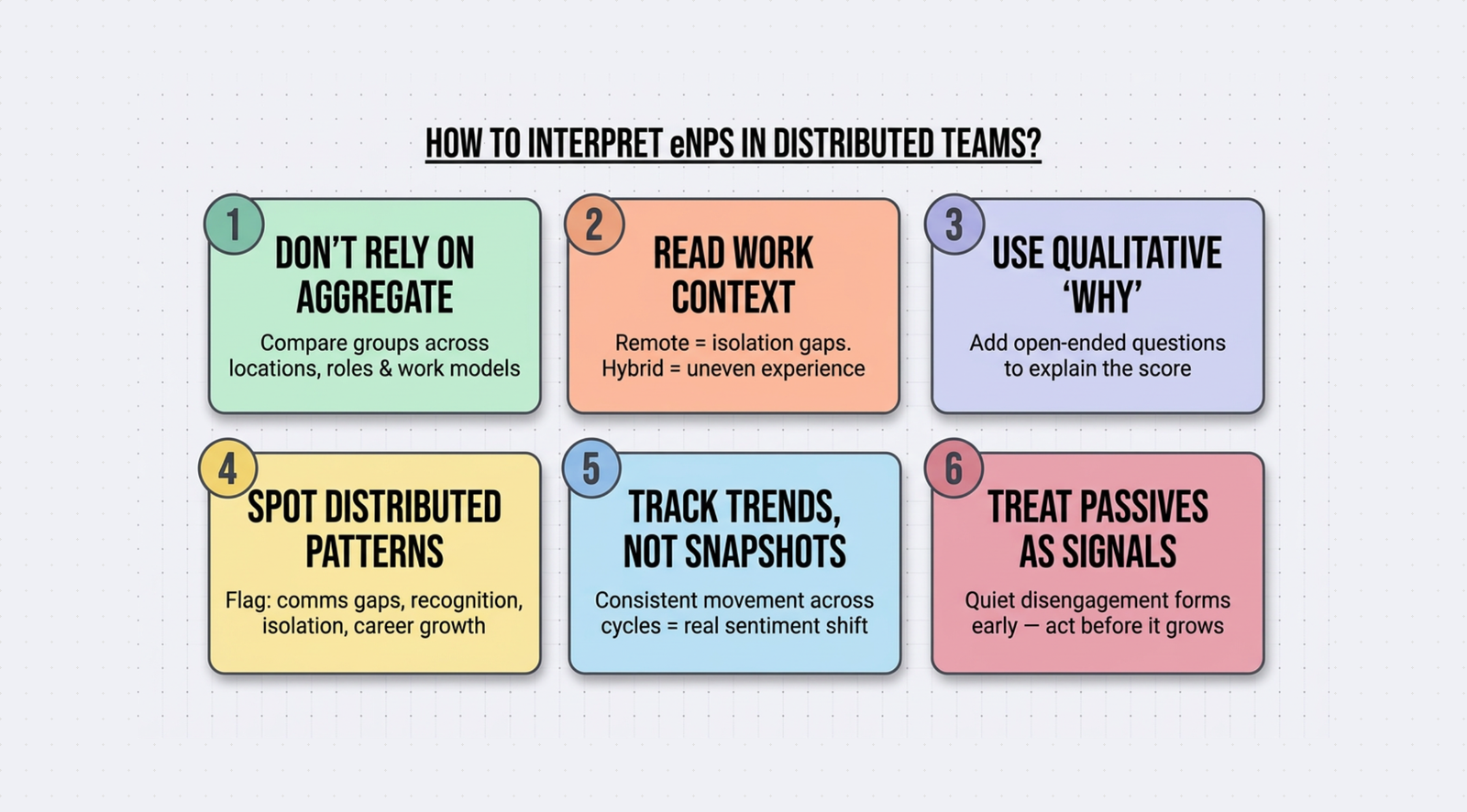
eNPS in distributed teams should be interpreted by comparing groups, analyzing patterns, and using context from feedback, because remote conditions change what the same score actually represents. Modern eNPS software streamlines the entire lifecycle from question design through insight generation for HR teams.
- Do not rely on the aggregate score: A single number hides variation across locations, roles, and work models. Always read differences across groups before drawing conclusions. Conduct short surveys (1-2 questions) quarterly to track trends in employee engagement.
- Interpret scores based on work context: In remote teams, lower scores often reflect isolation or communication gaps. In hybrid teams, variation often reflects uneven experience between employee groups.
- Use qualitative feedback to understand “why”: The score shows sentiment, not cause. In distributed teams, include open-ended questions in surveys to provide context for the quantitative scores and to identify what is driving the score.
- Look for patterns in distributed-specific themes: Focus on recurring issues like communication gaps, work-life boundaries, lack of improving employee recognition, career development and isolation.
- Track trends, not snapshots: One cycle reflects temporary conditions. Consistent movement across cycles shows real change in sentiment. Trend analysis matters more than a single survey cycle because distributed teams change quickly.
- Treat passive responses as early signals: In distributed teams, passives often indicate disengagement forming quietly, especially when feedback is limited. Communicate aggregated survey results and planned actions to prevent 'survey fatigue' and disengagement.
- Read score meaning, not just score level: The same score can indicate disconnection in remote teams or inconsistency in hybrid teams. Context defines what the score actually means. This is especially true when manager effectiveness shapes the day-to-day experience of remote staff.
In office teams, eNPS is interpreted using direct observation and consistent context. In distributed teams, interpretation depends on differences across locations, time zones, and work models, where experience is not uniform. The goal is not just collecting employee net promoter score data, but turning it into meaningful insights and actionable insights.
Common eNPS mistakes in remote and hybrid teams

Common eNPS mistakes in remote and hybrid teams include misinterpreting scores, comparing groups without context, and ignoring cultural differences, which leads to inaccurate conclusions about employee sentiment.
- Comparing remote and in-office scores directly: Different work conditions make direct comparison misleading.
- Ignoring cultural and time zone differences: Distributed teams respond differently based on location and work patterns.
- Relying on the aggregate score: A single number hides variation across teams and work models.
- Missing proximity bias in hybrid teams: Higher in-office scores can mask remote dissatisfaction.
- Treating eNPS as a complete measure: The score shows sentiment, not the underlying cause.
- Ignoring communication gaps: Feedback may reflect misalignment, not actual dissatisfaction.
- Overlooking passive responses: Passives often signal early disengagement in distributed teams.
- Applying office-based interpretation logic: Remote scores require different reading due to the lack of visibility.
One common mistake is reading remote work feedback without accounting for company culture differences across groups. High employee net promoter scores are often associated with lower employee turnover, improved team morale, and better customer and job satisfaction scores.
Conclusion
eNPS for remote and hybrid teams requires context-driven interpretation because visibility, communication, and employee experience differ across distributed environments. The same score can indicate isolation, misalignment, or uneven experiences depending on the work model. Treating eNPS like an office-based metric leads to misinterpretation and poor decisions.
CultureMonkey helps solve misreading sentiment by enabling contextual eNPS analysis through segmentation, anonymous feedback, and continuous listening, ensuring accurate interpretation in distributed teams.
Book a demo with CultureMonkey.
FAQs
1. Does eNPS work for remote teams?
Yes, eNPS works for remote teams because it provides a structured way to measure employee sentiment when direct observation is not possible. It captures engagement levels in distributed environments where managers cannot rely on in-person signals or informal cues.
2. How is eNPS different in hybrid workplaces?
eNPS is different in hybrid workplaces because employee experiences in such a workplace culture vary between remote and in-office settings. This creates uneven sentiment across groups, making it necessary to compare responses separately instead of relying on a single overall score.
3. What challenges affect eNPS in remote teams?
eNPS in remote teams is affected by isolation, communication gaps, and low visibility into engagement. These challenges make it harder to interpret whether scores reflect true dissatisfaction or temporary conditions.
4. How do you improve eNPS in remote environments?
Improving eNPS in remote environments depends on clear communication, proper timing, and consistent follow-ups because remote teams lack visibility and context. These factors ensure feedback is accurate, trusted, and reflects real employee sentiment.
5. Should remote teams use eNPS more frequently?
Remote teams should use eNPS more frequently because engagement signals are not visible in daily interactions. Regular surveys help track shifts in sentiment over time, allowing organizations to identify emerging issues early and respond before disengagement becomes difficult to detect or address.
6. Can remote eNPS scores be compared with office teams?
Remote eNPS scores should not be directly compared with office teams because work environments differ significantly. The same score can reflect different experiences, such as isolation in remote teams or imbalance in hybrid setups, making context essential for accurate and meaningful interpretation.
7. How do you ensure participation in remote eNPS surveys?
Participation in remote eNPS surveys improves when communication is clear, surveys are short, and employees trust anonymity. Proper timing and visible follow-up actions also increase engagement and improve professional development, ensuring employees feel their feedback is valued and worth contributing regularly.
8. What insights does eNPS reveal in distributed teams?
eNPS reveals insights into employee sentiment across teams, locations, and work models because it captures patterns not visible through observation. It helps identify gaps in communication, engagement differences, and inconsistencies in employee experience across distributed environments.