



Measuring morale after peak season workload in logistics teams to detect early burnout signals in 2026

Measuring morale after peak season workload in logistics teams involves systematically checking how frontline employees feel, cope, and recover after intense operational pressure.
Peak season stretches frontline teams through overtime, tight deadlines, and sustained performance demands. Fatigue can quietly affect productivity, safety, and retention across warehouses and delivery routes.
Once the rush slows, hidden burnout and disengagement may surface. Leaders who measure morale of operations teams can quickly stabilize operations and reduce post-peak increased turnover. Smart management teams check how to boost morale in the workplace early to prevent burnout, safety issues, and post-peak attrition.
The following sections outline what to measure, when to measure it, and why timing matters.


- Measuring morale after peak season workload in logistics teams means assessing recovery, fatigue, employee engagement, and retention risk after demand drops.
- Peak pressure leaves lasting strain that can affect productivity, safety, and workforce stability.
- Timely surveys and cross-site comparisons help detect burnout signals before attrition rises.
- Tracking recovery trends enables leaders to prioritize interventions and stabilize operations.
- CultureMonkey strengthens measuring morale after peak season workload in logistics teams through real-time dashboards, heatmaps, automated triggers, and AI sentiment analysis.
Why measuring morale after peak season workload matters in logistics operations
Measuring morale after peak season workload in logistics teams means checking recovery, energy, and employee engagement after demand drops, so burnout, errors, and attrition do not spike. This matters most when frontline output still has to hold steady at work.
Peak pressure leaves residue that metrics miss. A logistics workforce burnout assessment helps leaders spot strain early.
- Extended overtime and shift extensions often lead to peak season burnout in warehouses.
- Physical and mental fatigue can drag down post peak season employee morale logistics across sites.
- Operational errors rise when exhausted supply chain teams lose focus during handoffs and cutoffs.
- Burnout can trigger post-peak resignations, especially in supervisor-dependent frontline roles.
- Frontline morale monitoring logistics helps catch silence, low participation, and low energy fast.
Offering completion bonuses and fostering a positive workplace culture can improve retention of seasonal workers in logistics during peak seasons.
How peak season workload impacts logistics workforce stability

Peak season does not just stretch capacity, it tests workforce limits. When supply chain demand spikes, logistics teams absorb the pressure through longer shifts, tighter dispatch windows, and constant performance tracking.
The real impact appears after volume stabilizes. Understanding these operational consequences helps leaders connect workload impact with retention risk before instability spreads across sites and negatively affects company culture.
- Physical strain in warehouse operations: Continuous lifting, repetitive tasks, extended standing hours, and compressed break times in a busy workplace create lasting physical fatigue that slows recovery after peak cycles.
- Delivery staff fatigue due to tight schedules: Back-to-back routes and strict timelines increase mental load, raising the likelihood of costly mistakes like driving chronic workplace stress and performance decline.
- Increased absenteeism after peak cycles: Once peak ends, accumulated exhaustion often results in higher sick leave and unplanned, frequent absences across shifts.
- Reduced motivation once demand pressure drops: Teams that operated in survival mode may disengage when urgency disappears, affecting participation and workplace morale.
- Higher employee turnover risk immediately after peak season: When recovery support is weak, burnout converts into exits, directly linking workload impact with retention risk.
Staffing agencies can provide flexible and scalable workforce solutions to help logistics companies manage increased workloads during peak seasons.
How to identify morale drop signals in warehouses and delivery teams?
After peak demand slows, supply chain morale rarely drops overnight. The shift is gradual, and warning signs often hide inside routine workforce patterns.
Explaining warning indicators helps leadership detect operational signals HR teams often miss, especially when conducting supply chain employee sentiment tracking or logistics employee wellbeing measurement.
- Increased sick leave after peak season often reflects signs of burnout in logistics teams and delayed physical recovery.
- Low participation in optional overtime signals post peak engagement survey logistics gaps and falling discretionary effort.
- Reduced productivity despite lower workload points to logistics workforce burnout assessment findings that fatigue has not reset.
- Increased complaints or grievances indicate frontline stress measurement tools may reveal deeper workload strain.
- Supervisor reports of disengagement highlight frontline engagement measurement gaps across shifts and delivery routes.
Efficient supply chain coordination is critical during peak season to maintain smooth operations in logistics. Implementing real-time inventory tracking can help logistics companies avoid costly stockouts or surplus during peak seasons.
How to design post-peak morale assessments for logistics teams?
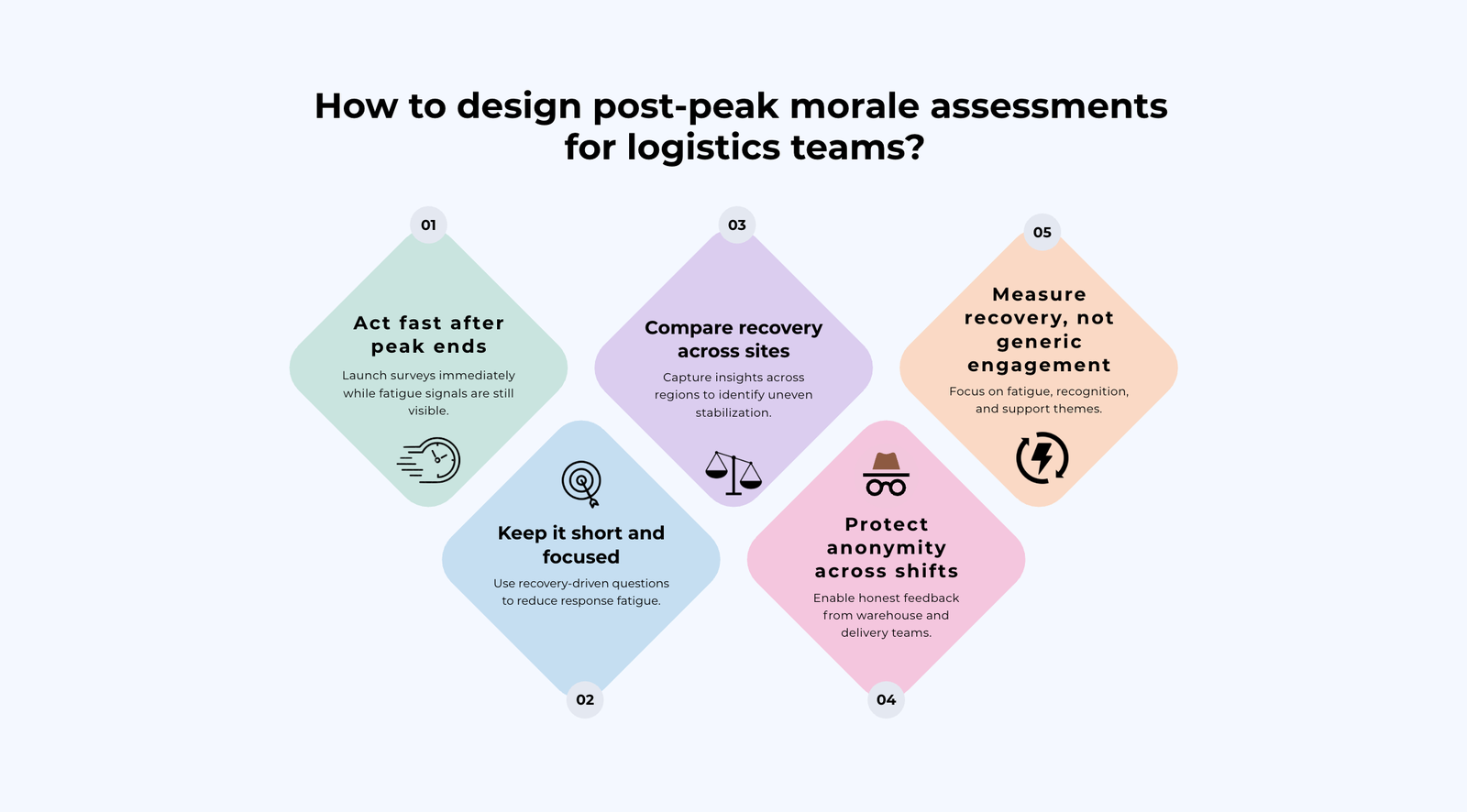
Designing post-peak morale assessments for logistics teams require a listening program built around recovery, not generic engagement themes. The goal is to understand how peak season warehouse and delivery teams are stabilizing after sustained operational pressure.
Well-timed, focused surveys for supply chain teams produce clearer signals than broad annual check-ins. Post peak engagement survey logistics efforts should directly support recovery decisions at work.
Core listening program design principles
- Launch surveys immediately after peak season while fatigue signals are still visible to act fast after peak ends.
- Use short and sharp recovery-focused questions to reduce response fatigue.
- Focus on fatigue, recognition, and support instead of generic engagement.
- Enable anonymous participation across shifts to protect anonymity and improve honest feedback.
- Encourage open dialogue and capture insights across warehouses and regions while comparing results across sites to spot uneven recovery.
Companies often rely on temporary or seasonal workers to address spikes in labor demand during peak seasons. Effective workforce management strategies are essential for maintaining high productivity and service quality during peak seasons in logistics.
Workforce recovery integration
Results should feed directly into logistics employee wellbeing measurement and planning decisions. Measuring morale after peak season workload in logistics teams must inform staffing balance and retention risk management.
- Link insights to action: Align findings with logistics workforce burnout assessment with real time visibility for targeted recovery steps.
- Track patterns over time: Use supply chain employee sentiment tracking to monitor stabilization trends and for early intervention.
- Strengthen follow-through: Embed insights into frontline engagement measurement beyond peak cycles.
A recovery-first listening design protects workforce stability and long-term performance. Effective communication and feedback mechanisms are essential for maintaining high employee morale in logistics teams.
Calibrating survey timing and frequency
Surveys should be timed around recovery stages to collect feedback, not routine schedules. The effects of peak season surface gradually, so listening must follow that pattern.
| Timing Stage | What to Do | Why It Matters |
|---|---|---|
| Within 2 weeks after peak | Launch first pulse survey | Capture early fatigue signals before they normalize |
| 4–6 weeks post-peak | Run follow-up survey | Measure whether recovery is improving or slipping |
| Avoid weekly pulses | Limit survey frequency | Prevent response fatigue across warehouse and delivery teams |
| Align with shift cycles | Schedule around shift rotations | Ensure balanced participation across roles and regions |
| Ongoing tracking | Continue structured pulses | Track recovery trends, not momentary sentiment |
What morale themes should you measure after peak season in logistics teams?
Instead of repeating earlier survey structures, focus on themes that reflect recovery and operational strain. For leaders confused on how to raise morale in the workplace, these themes keep the content fresh and context-specific while supporting measuring morale after peak season workload in logistics teams.
Fatigue and recovery readiness
- Reveals whether teams have physically and mentally reset after intense demand.
- Helps logistics workforce burnout assessment detect delayed exhaustion patterns.
- Supports measuring morale after peak season workload in logistics teams through recovery-based signals.
Workload fairness during peak
- Identifies perception gaps in shift distribution and overtime allocation.
- Highlights pressure points that affect post peak season employee morale logistics.
- Connects workload equity concerns to future retention risk.
Recognition and support
- Assesses whether frontline employees felt valued during peak operations.
- Surfaces gaps in frontline engagement measurement after high-pressure cycles.
- Strengthens post peak engagement survey logistics insights beyond employee satisfaction scores.
Intent to stay after peak season
- Detects early resignation signals before exit spikes occur and impact negatively on organization's success.
- Links morale shifts directly to retention risk assessment.
- Helps supply chain employee sentiment tracking forecast workforce stability.
Manager support during high pressure
- Evaluates leadership presence during demand spikes.
- Identifies whether supervisor behavior influenced signs of burnout in logistics teams.
- Provides context for logistics employee wellbeing measurement across sites.
Engaged frontline employees are more productive and make fewer errors, which is crucial in the logistics industry. Implementing technology solutions can help reduce burdensome tasks and improve communication, which are key to preventing burnout.
How should you compare morale recovery across warehouses and regions after peak season?
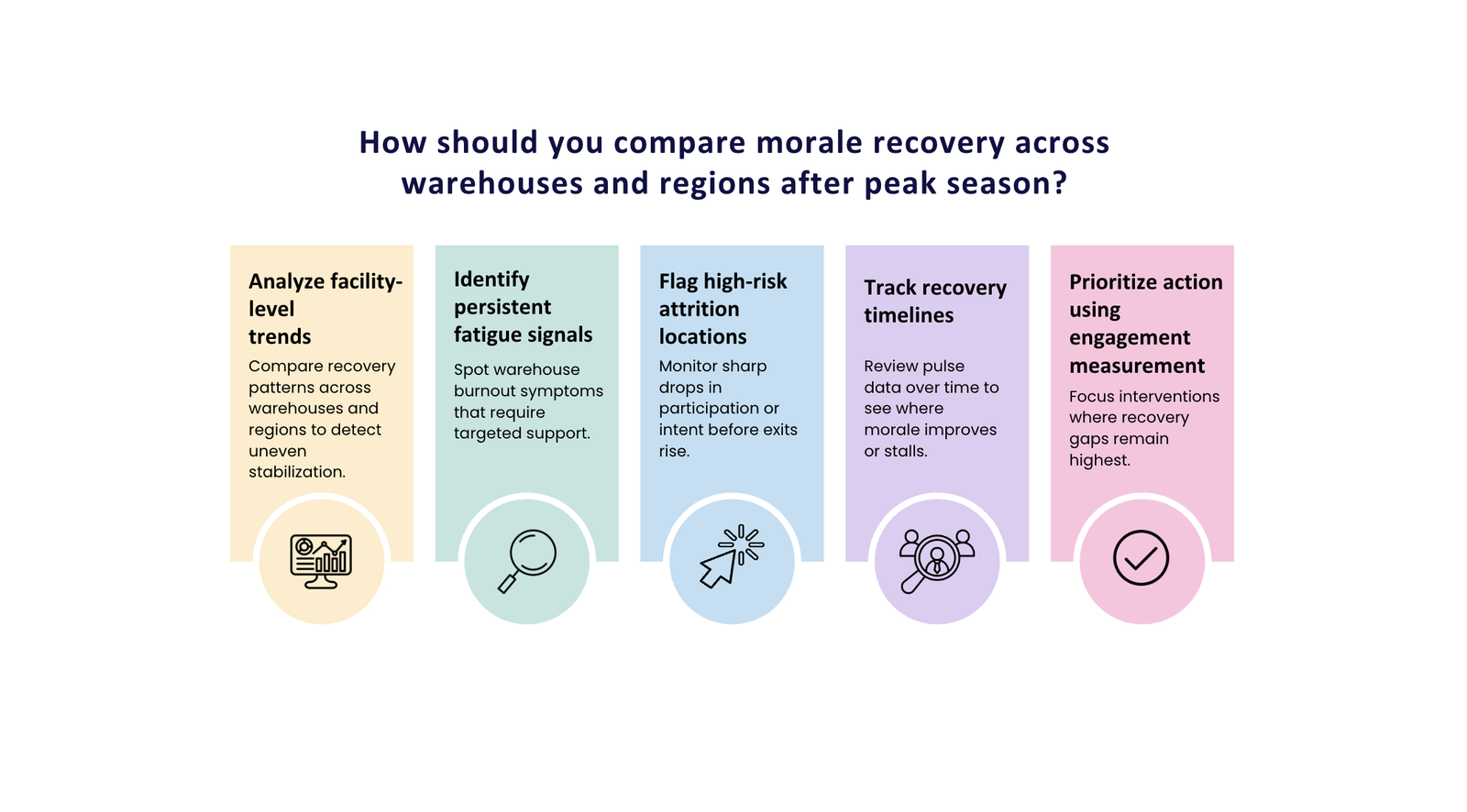
Recovery does not move at the same speed everywhere. Some facilities stabilize quickly, while others carry strain longer than expected.
Operational analysis helps leaders see where pressure still exists. Comparing recovery patterns supports smarter decisions and helps prioritize interventions before problems escalate.
- Compare trends between facilities to identify uneven recovery across warehouses and regions.
- Persistent fatigue signals in specific sites often reflect warehouse burnout symptoms that require targeted support.
- Sharp drops in intent or participation can indicate high-risk attrition locations needing immediate attention.
- See how morale improves or stalls post peak season by reviewing pulse data over time.
- Prioritize interventions based on real recovery gaps by using frontline engagement measurement across regions.
Performance metrics such as picking errors and productivity levels often reflect team morale and burnout. Effective burnout prevention strategies in logistics include optimizing shift schedules, enhancing communication, and providing mental health resources.
What actions can logistics companies take to restore workforce morale after peak season?

Restoring morale of logistics workers after peak season requires practical execution, not broad motivation campaigns. Recovery strategies must reduce fatigue, rebuild trust, and stabilize performance in the workplace.
The focus should stay on measurable recovery steps for logistics workers. Each action below supports structured reset for leaders confused on how to improve morale at work.
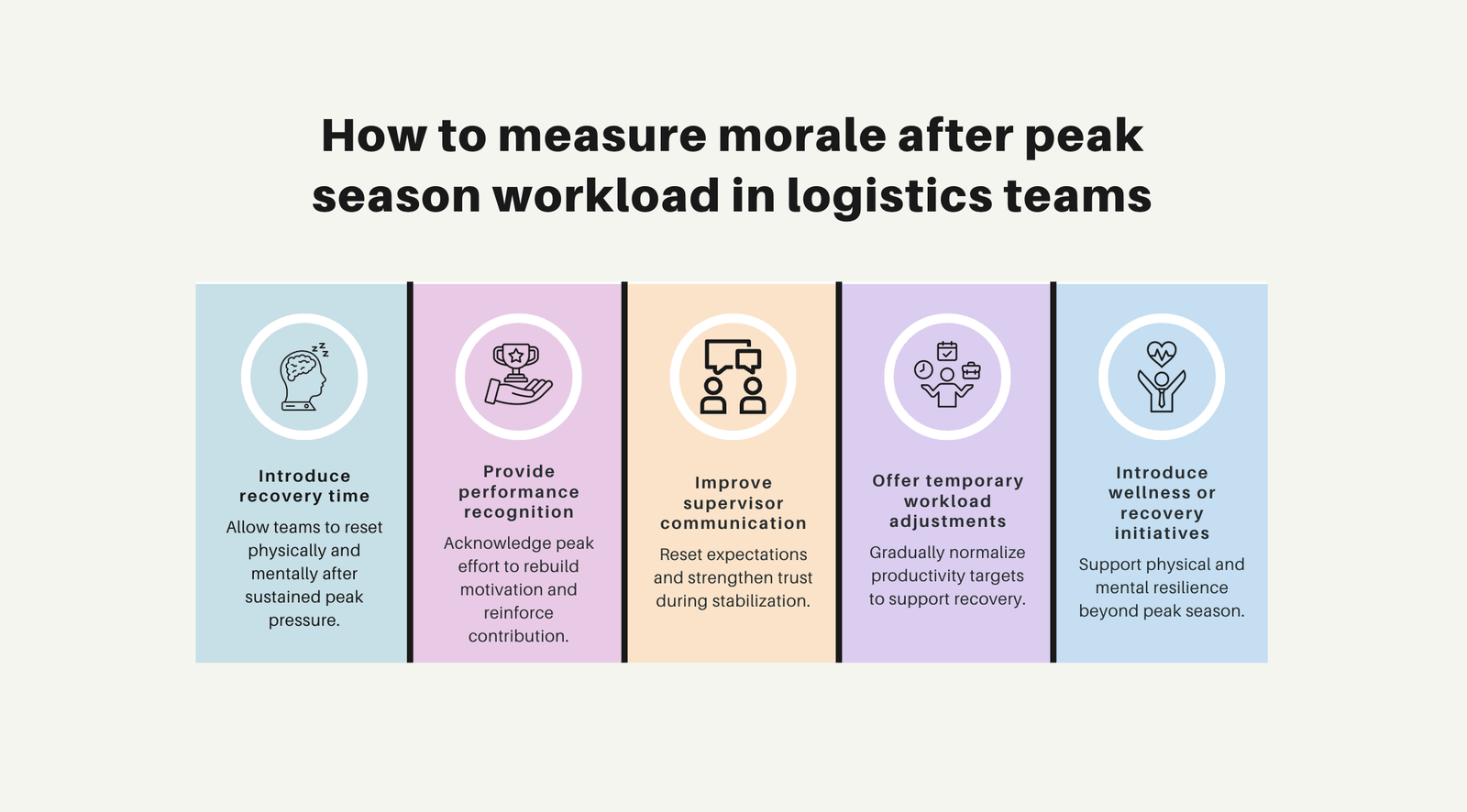
Introduce recovery time or flexible scheduling
Peak season compresses shifts and personal time of logistics workers. Recovery strategies must first address physical and mental reset before expecting performance gains.
Flexible scheduling helps reduce accumulated fatigue and signals operational fairness after intense demand cycles.
Action plan
- Offer staggered shifts to allow gradual recovery without supply chain disruptions.
- Rotate high-intensity roles to reduce repeated physical strain across teams.
- Provide optional recovery days to support reset without penalizing attendance metrics.
Provide performance recognition bonuses or rewards
Recognition after peak season reinforces effort and stabilizes morale. Logistics workers need visible acknowledgment once the pressure subsides.
Recovery strategies should connect recognition to contribution, not just output numbers.
Action plan
- Issue targeted bonuses to reward peak season effort transparently.
- Highlight team achievements to reinforce shared accomplishment across facilities.
- Provide small recovery incentives to maintain motivation after demand drops.
Improve supervisor communication post peak
Communication gaps widen after high-pressure periods. Managers must reset expectations and clarify workload transitions.
Clear communication reduces uncertainty and prevents disengagement during stabilization.
Leaders should
- Conduct structured check-ins to address concerns early across shifts.
- Share recovery plans to build trust in leadership direction.
- Train supervisors to recognize warehouse burnout symptoms quickly.
Offer temporary workload adjustments
Teams often need gradual workload normalization. Sudden productivity expectations can prolong fatigue.
If you’re wondering how do you boost morale in the workplace, recovery strategies should balance operational targets with workforce capacity.
Leaders should
- Adjust productivity benchmarks to match realistic post-peak recovery levels.
- Reallocate high-pressure tasks to distribute workload more evenly.
- Use the best way to assess logistics teams fatigue to guide staffing resets responsibly.
Introduce wellness or recovery initiatives
Structured recovery programs reinforce long-term stability. Wellness initiatives should support both physical and mental reset.
Operational efficiency and recovery depends on sustained workforce resilience to contribute to business outcomes.
What action to take
- Provide access to short-term wellness programs and mental health resources to support physical recovery.
- Offer immediate feedback sessions using employee morale survey questions logistics to understand recovery needs directly.
- Decide when you should survey frontline employees after peak season and monitor recovery progress systematically.
Recognition programs, such as bonuses or extra time off, are critical for restoring motivation among logistics teams.
How does CultureMonkey support monitoring workforce recovery after peak operation?
Monitoring recovery at scale requires more than manual check-ins. Enterprise logistics environments need structured listening, cross-site visibility, and automated risk detection built for operational complexity.
CultureMonkey enables continuous monitoring after peak season without adding administrative burden. The platform is designed to support measuring morale after peak season workload in logistics teams with enterprise-grade visibility and control.
- Real-time analytics dashboard enables real-time morale tracking after peak season across warehouses and delivery networks.
- Heatmap-based facility-level recovery comparisons give leadership instant visibility into uneven recovery trends across warehouses and regions.
- Automated feedback collection triggers send surveys at the right recovery milestones, shift cycles, or post-peak checkpoints without manual coordination.
- AI sentiment analysis of employee feedback analyzes open-text responses to surface emerging attrition risk before it reflects in employee turnover data.
.webp)
Improve the Morale of Your Logistics Team with Pulse Surveys
- Multi lingual Surveys
- White Glove Onboarding
- People Science Backed Reports
- Enterprise Grade Security
Conclusion
Measuring morale after peak demand periods helps logistics companies prevent burnout-driven attrition before it poses operational challenges. Post-peak listening enables faster recovery and stabilizes workforce performance when teams are still recalibrating after intense demand cycles. Organizations that act quickly on recovery feedback retain frontline talent and protect operational continuity across warehouses and delivery networks.
CultureMonkey strengthens measuring morale after peak season workload in logistics teams through its real-time analytics dashboard, heatmap-based facility comparisons, automated feedback collection triggers, and real time sentiment tracking with AI. Together, these features help logistics leaders track recovery accurately and convert the workforces' valuable insights into timely, targeted action.
Book a demo with CultureMonkey.
FAQs
1. Why should logistics companies measure morale after peak season?
Logistics companies should measure morale after peak season to detect fatigue, disengagement, and retention risk before they affect productivity metrics or pose safety risks. Peak demand often leaves lingering strain across warehouse and delivery teams. Early measurement helps leaders stabilize workforce performance and prevent burnout-driven attrition.
2. When should morale assessments be conducted after peak workload?
Morale assessments should be conducted within two weeks after peak workload, followed by a structured follow-up four to six weeks later. This timing captures early fatigue signals, worker well being and tracks whether recovery is improving or slipping across facilities and shifts.
3. How does peak season impact warehouse engagement?
Peak season impacts logistics operations engagement by increasing overtime, compressing shifts, and raising physical strain. Once demand drops, teams may experience reduced motivation, slower recovery, and lower participation, which can affect overall in raising employee morale and operational consistency.
4. Can morale measurement reduce post-peak attrition?
Yes, morale measurement can reduce post-peak attrition by identifying burnout signals and disengagement early. When leaders act quickly on feedback, they address recovery needs before employees decide to leave, improving retention stability.
5. What are early signs of burnout after peak season?
Early signs of burnout after peak season include increased sick leave, reduced discretionary effort, withdrawal during team interactions, and persistent fatigue. These signals often appear gradually and require structured listening to detect accurately.
6. How do companies compare morale across logistics facilities?
Companies compare morale across logistics facilities by analyzing employee engagement trends, recovery speed, and participation rates across regions. Effective tools for tracking employee sentiment in logistics include platforms like CultureMonkey, Officevibe, and TINYpulse, which offer mobile access and anonymous feedback.
7. Can post-peak feedback improve retention planning?
Post-peak feedback improves retention planning by highlighting high-risk teams and locations before exit rates increase. Structured insights allow leadership to adjust work life balance, recognition, and support strategies proactively.
8. How soon does morale typically recover after peak season?
Morale recovery timelines vary by workload intensity and support systems. Some teams stabilize within weeks, while others require structured recovery initiatives over several months to restore full employee engagement and energy.
9. What role do managers play in morale recovery?
Managers play a critical role in morale recovery by communicating clearly, recognizing effort, and adjusting expectations during stabilization. Consistent check-ins and visible support significantly influence post-peak employee engagement outcomes.
10. What technology helps track workforce recovery after peak operations?
Technology such as real-time analytics dashboards, automated survey triggers, heatmap comparisons, and AI sentiment analysis helps track workforce recovery after peak operations. These tools provide continuous visibility into morale trends and emerging retention risks.