



Reducing attrition among construction site workers: A guide

Reducing attrition among construction site workers refers to addressing the predictable conditions that cause workers to leave during projects.
Attrition rates can reach 89.3% in labour-hire-heavy segments, according to The Resource. The five triggers driving these exits, dangerous-job fatigue, labour-hire insecurity, project exit spikes, poor supervision, and no visible future, follow predictable patterns that most retention systems are not designed to catch.
This guide outlines tested frameworks built for construction environments to help teams act earlier, stabilise workforce continuity, and reduce repeated hiring pressure across projects.


- Reducing attrition among construction site workers means addressing predictable project, labour-hire, and fatigue-driven exit conditions.
- Construction attrition is driven by project cycles, labour-hire structures, and on-site conditions, not random dissatisfaction.
- Five drivers cause exits: fatigue, labour-hire gaps, project exits, supervision issues, and no visible future.
- Retention interventions at mobilisation are 3x more effective than exit interview programs at reducing site worker churn.
- CultureMonkey surveys support employee retention by capturing site feedback and identifying early exit signals across crews.
What is construction site worker attrition?

Construction site worker attrition is the rate at which site-based workers leave during or between projects due to predictable on-site conditions. It reflects why construction workers quit when work cycles change, risk exposure builds, or job continuity feels uncertain.
This is a growing employee retention issue across the construction industry, especially where construction employers depend on skilled workers to meet demand.
What are the 5 triggers that drive site worker exits?
The 5 triggers that drive site worker exits are dangerous-job fatigue, labour-hire insecurity, project exit spikes, poor supervision, and lack of a visible future. For construction companies and construction firms, reducing employee turnover is now critical to retain employees, protect productivity, and fill positions in a tight labor shortage.
These factors raise employee turnover because construction workers often face physical strain, weak career pathways, and limited support on active projects.
The 5 root causes of site worker exits:
- Dangerous-job fatigue: Continuous exposure to physically demanding and high-risk tasks reduces willingness to stay.
- Labour-hire insecurity: Temporary contracts and weak attachment to the contractor increase early exits.
- Project exit spike: Workers leave when a project ends and the next assignment is unclear.
- Poor supervision: Inconsistent or ineffective supervision drives dissatisfaction at the crew level.
- No visible future: Lack of clear progression or continuity reduces long-term commitment.
Retention improves when employers focus on building career pathways, improving site safety, and creating a site culture across active crews, recognition, and open communication. Enterprise bargaining agreement (EBA) clarity and consistent rostering that include creative benefits can enhance workforce stability in construction.
(Source: Dodge Construction Network)
Labour hire attrition in construction and where retention breaks
Labour hire attrition in construction is highest among agency-based workers because retention systems are built for direct employees, not temporary crews. For construction employers, this is not just a retention issue. Labour hire turnover construction patterns affect workforce continuity, project delivery, and the ability to retain experienced workers over time.
Where retention breaks for labour-hire workers:
- No direct employer connection: Workers identify with the agency, not the site contractor, reducing commitment. This is one reason construction firms struggle to retain skilled workers, especially when labor shortage conditions give workers more options across projects.
- Short-term visibility of work: Lack of clarity on next assignments increases early exits.
- Limited inclusion on-site: Labour-hire workers are often excluded from communication and feedback loops.
- Inconsistent supervision experience: Frequent crew changes lead to unstable manager relationships.
- No tracked feedback signals: Without structured input, early dissatisfaction goes unnoticed until exit.
(Source: Rippl)
Why does attrition spike during seasonal and project-exits?
Attrition spikes during seasonal shutdowns and project exits because work continuity breaks and workers are not reassigned in time. This predictable pattern, known as the project exit attrition spike, occurs when transition planning is missing and directly affects construction workforce stability.
No confirmed next assignment
- Workers do not see a clear path to the next project before current work ends.
- Even short uncertainty windows push them to secure alternative sites.
Competitive labor market dynamics allow skilled workers to easily move for even minor annual salary increases, such as $1 more per hour. A high construction attrition rate increases hiring costs, weakens team stability, and reduces access to institutional knowledge on the job site.
Project completion without transition planning
- Contracts close without structured movement into the next role.
- Workers are released instead of retained across projects.
High turnover leads to missed deadlines, increased safety incidents, and reduced project quality in construction.
Seasonal shutdown income gaps
- Work pauses create immediate financial uncertainty.
- Workers shift to more stable opportunities during downtime.
High turnover in construction often results in lost knowledge, reduced team productivity, increased recruitment costs, and project delays.
Late or unclear communication
- Updates about future work come too late or remain vague.
- Workers assume there is no continuity and exit early.
Exit intent builds before project end
- Decisions to leave are made in the final phase, not after completion.
- Lack of tracking means early warning signs are missed.
4-stage retention framework for site workers

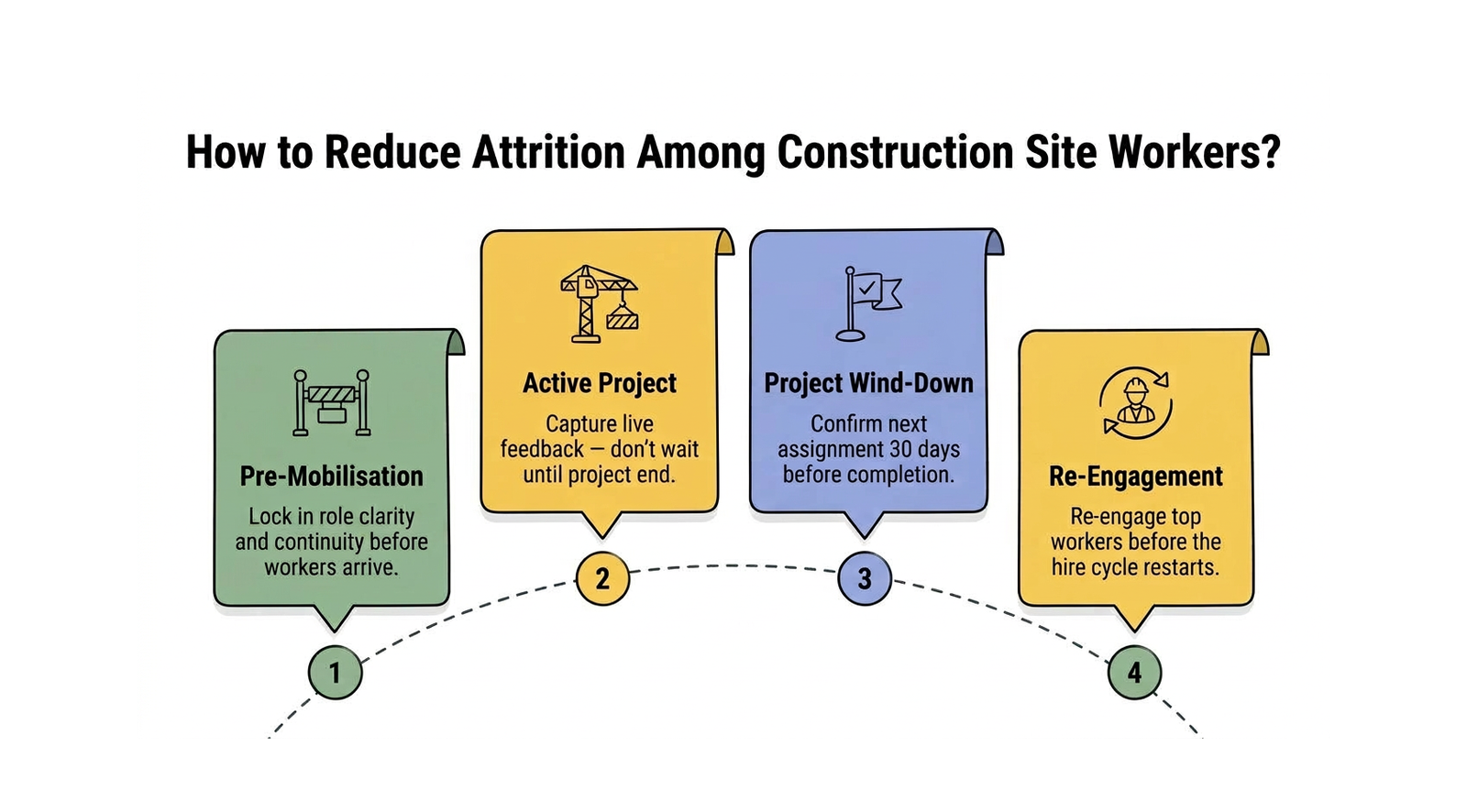
The 4-stage retention framework for site workers is a project-aligned approach that reduces exits by acting at four critical phases: pre-mobilisation, active project, project wind-down, and offboarding or re-engagement.
For employers, these construction site worker retention strategies work best when they support both skilled workers and experienced workers across the full project cycle.
Step 1: Pre-mobilisation (before workers arrive on-site)
What happens on-site
Crew allocation, contract setup, and supervisor assignment are finalised.
What to track
- Drop-offs between offer and site joining.
- Early uncertainty around job duration or role clarity.
What to do
- Confirm next-project visibility at entry, not later.
- Set clear expectations on role, duration, and continuity.
Step 2: Active project (during execution phase)
What happens on-site
Work stabilises, but fatigue and supervision quality begin to influence retention.
What to track
- Crew-level sentiment shifts.
- Supervisor-level attrition variance.
- Early signs of disengagement.
What to do
- Capture regular on-site feedback, not just end-of-project inputs.
- Identify crews or supervisors driving higher exits.
Step 3: Project wind-down (final phase before completion)
What happens on-site
Exit decisions are formed as workers assess what comes next.
What to track
- Time-to-exit signals (0–30 days before completion).
- Drop in engagement or intent to stay.
What to do
- Communicate next assignment before project closure.
- Intervene early with workers showing exit intent.
Step 4: Offboarding and re-engagement (post-project transition)
What happens on-site
Workers either exit or move to the next project.
What to track
- Labour-hire vs direct hire retention differences.
- Rejoin rates across projects.
What to do
- Re-engage high-value workers before they leave the system.
- Maintain continuity across projects instead of restarting hiring cycles.
Re-engaging high-value workers before they exit the project system is faster and cheaper than restarting a hire cycle. Identify workers with strong site tenure and confirm next assignment before final week.

In today’s transparent job market, employment brand and employee engagement have become synonymous.
Josh Bersin



Founder at The Josh Bersin Company
How to measure attrition by site and trade?
Attrition should be measured by breaking data into site, trade, and supervisor segments instead of relying on company-level averages. Construction attrition rate benchmarks only become useful when they show where churn is concentrated and what is driving it.
Site-level view
What it shows:
Attrition differences across active sites.
What to look for:
- Sites with consistently higher exits.
- Patterns linked to project type or location.
Why it matters:
Site conditions drive retention. Aggregated data hides problem locations. Site-level measurement helps construction companies identify job site risks that affect safety, productivity, and retention.
Trade-level view
What it shows:
Attrition variation across trades such as electricians, plumbers, and general labour.
What to look for:
- Trades with higher exit rates.
- Skill-specific churn patterns.
Why it matters:
Each trade experiences different risk, demand, and fatigue levels. This gives employers a clearer view of turnover drivers across the workforce and helps construction firms act on other factors beyond pay alone.
Supervisor-level view
What it shows:
Attrition differences across supervisors and crews.
What to look for:
- Supervisors with consistently higher churn.
- Crew-level retention gaps.
Why it matters:
Strong supervision can create trust, improve culture, and help workers contribute more consistently across crews. This is especially important for skilled workers whose skills are harder to replace in a labor shortage.
Companies that prioritize retention will come out ahead in reduced costs and stronger crews.
Workforce type split
What it shows:
Attrition differences between labour-hire workers and direct employees.
What to look for
- Faster exits in labour-hire segments.
- Differences in exit timing.
Why it matters:
This reveals structural retention gaps across employment models. This also shows whether contractors and labour-hire employees are experiencing the same level of support and communication.
Communicate project updates on a set cadence because workers who know what is coming next do not look for exits.
Time-to-exit patterns
What it shows:
When workers leave during the project lifecycle.
What to look for:
- Early exits (0–30 days).
- Mid-phase exits (30–90 days).
- End-of-project spikes.
Why it matters:
Timing shows whether attrition is onboarding-related, supervision-driven, or transition-based. Timing analysis helps employers lead earlier interventions instead of reacting after employee turnover affects projects and costs.
Reducing turnover in a construction company within 90 days

You can reduce turnover in construction company environments within 90 days by acting on known exit points during active projects and transition phases. The fastest gains come from fixing continuity gaps, improving supervision visibility, and capturing early exit signals before workers disengage.
Fix continuity before project end
- Start reassignment planning 2–3 weeks before completion, not after.
- Confirm next-site allocation early to prevent last-phase exits.
For construction companies, the goal is to reduce turnover, protect productivity, and retain experienced workers without adding unnecessary hiring costs.
Stabilise supervisor-driven churn
- Identify crews with higher exits and map them to supervisors.
- Intervene where patterns repeat instead of treating attrition as random.
Clear transition planning helps construction employers meet demand without constantly trying to fill positions at short notice.
Capture feedback during the project, not after
- Run short, frequent check-ins at the crew level.
- Detect dissatisfaction early instead of relying on exit interviews.
Better site leadership can reduce high turnover, improve safety, and strengthen commitment across crew members.
Reduce labour-hire drop-offs
- Include agency workers in communication and planning loops.
- Close visibility gaps around contract continuity and next assignments.
Short check-ins help employers surface concerns early and build open communication across the team. This improves retention by helping temporary workers feel supported rather than excluded from the company culture.
Act on early exit signals
- Track intent indicators in the final project phase.
- Intervene within days, not weeks, when disengagement appears.
Conclusion
Construction attrition peaks at project handover, not randomly. Labour-hire workers show lower retention because loyalty sits with the agency. Dangerous-job fatigue is measurable and distinct from burnout. Intervening at mobilisation is more effective than exit interviews. Segmenting attrition by site and trade reveals supervisor-driven churn patterns.
CultureMonkey helps reduce turnover in construction company settings by running anonymous multi-channel surveys, capturing site-level feedback, and surfacing early exit signals across crews, supervisors, and employees.

Book a demo with CultureMonkey.
FAQs
1. What is the average attrition rate in construction?
Construction attrition typically ranges from 40–60% annually, higher than most industries, according to The Resource. Labour-hire-heavy segments may exceed it due to contract-based work and limited continuity across sites, making workforce stability difficult to maintain over time across most projects today.
2. How do construction companies reduce worker turnover?
The most effective approaches are early re-engagement at mobilisation, structured communication before project wind-down, visible career pathways, supervision quality tracking, and stabilising labour-hire contract clarity. These reduce exits by addressing continuity gaps before workers disengage.
3. What causes high turnover among site workers?
High turnover is driven by project-exit spikes, dangerous-job fatigue, labour-hire insecurity, poor site supervision, and lack of visible career progression. These factors combine physical risk, job instability, and limited growth visibility.
4. How does labour hire affect construction attrition?
Labour-hire workers often exit 2–3× faster than direct hires because their employment relationship is with the agency, not the principal contractor. This creates a structural loyalty gap unless actively managed through communication and continuity planning.
5. What is the cost of high attrition in a construction company?
Replacing a site worker costs 30–50% of their annual salary when factoring recruitment, onboarding, and lost productivity. High churn also delays project timelines, increases rework risk, weakens crew cohesion and costs that compound across every successive project cycle.
6. How do you reduce site attrition among labour-hire workers specifically?
To reduce site attrition among labour-hire workers specifically, include agency workers in project communication loops, confirm next-assignment visibility before project close, and create direct touchpoints with the principal contractor. These three actions address the gap that causes labour-hire workers to exit.
7. When is the best time to run engagement surveys on a construction site?
The best time to run engagement surveys on a construction site are short check-ins at three points: pre-mobilisation (first two weeks on-site), mid-project (the fatigue window), and wind-down (final 30 days). End-of-project surveys alone miss the exit window entirely, when workers decide to leave during the project.