



Reducing attrition in hotel staff: A practical guide

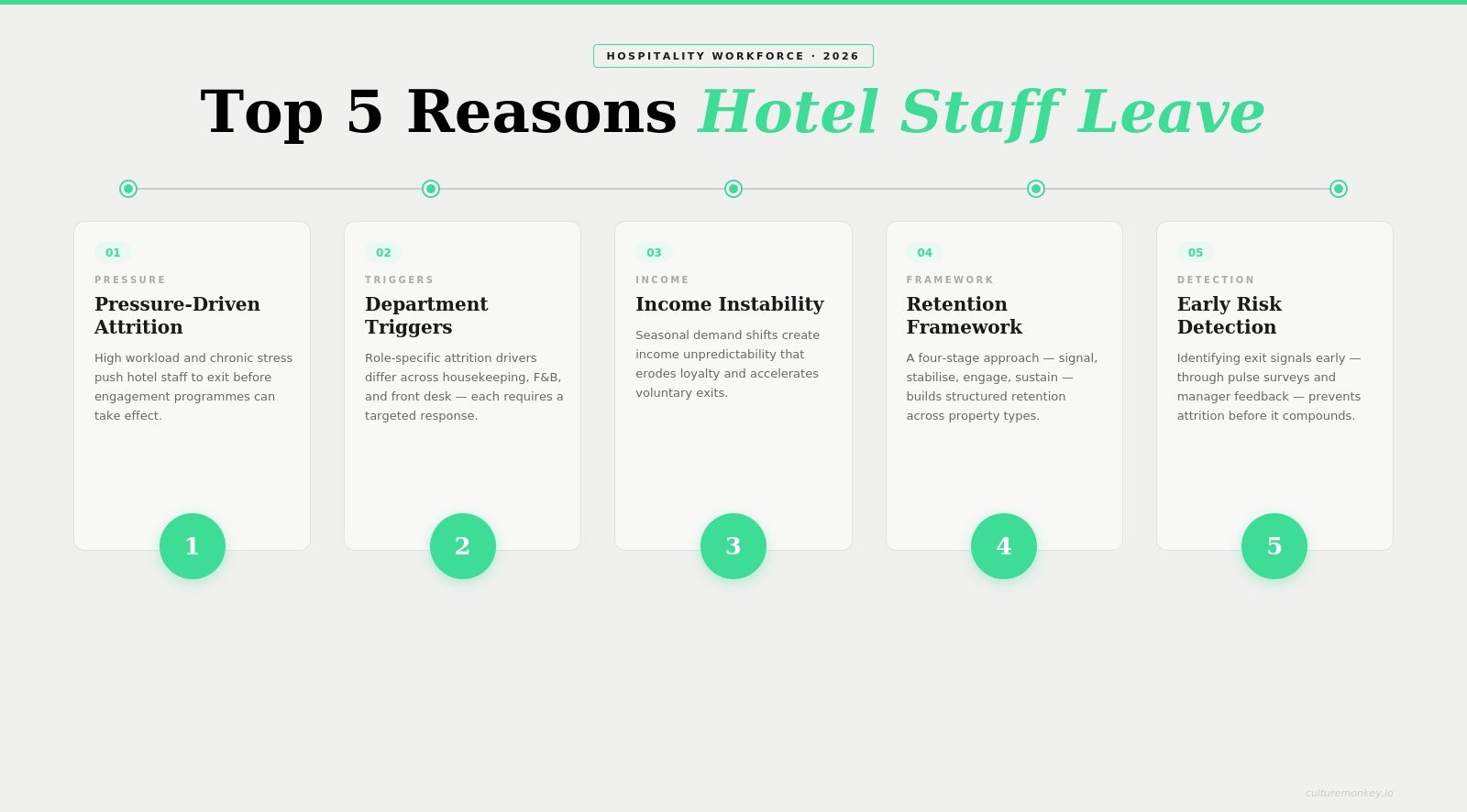
Reducing attrition in hotel staff requires identifying where and why exits begin, not just tracking overall turnover rates. Attrition in hotels typically starts within high-pressure departments like the front desk or housekeeping, then spreads as workload imbalance and service strain increase. A generic retention strategy fails because each department faces different operational triggers.
This guide breaks down the department-level causes of attrition across front desk, housekeeping, F&B, and events teams, and introduces a structured framework to reduce turnover through targeted, role-specific interventions that stabilize workforce continuity and guest experience outcomes.


- Hotel staff attrition is usually caused by department-level pressure, not one hotel-wide issue.
- Front desk, housekeeping, F&B, and events teams leave for different reasons, so retention plans must be role-specific.
- Tipping instability, rigid scheduling, physical strain, and seasonal hiring are major hotel attrition drivers.
- A four-stage approach works best: detect pressure, diagnose the trigger, intervene by department, and stabilize the system.
- CultureMonkey helps hotels reduce attrition with real-time feedback, manager-level segmentation, always-on surveys, and early warning insights that show where turnover risk is building first.
The hotel attrition reality in numbers

Hotel staff attrition in the hospitality industry is structurally high because operational pressure, staffing shortages, and inconsistent work conditions drive sustained employee turnover across roles. Reducing attrition in hotel staff requires understanding how employee turnover rate impacts service quality, labor costs, and long-term business performance.
What hotel attrition rates actually look like
- High annual turnover rates: This is one of the highest turnover benchmarks across all industries. It reflects continuous workforce churn rather than stable employment cycles and directly increases hiring, onboarding, and training costs for hospitality businesses.
- Frontline-driven turnover: Employee turnover in hospitality is among the highest globally, driven by frontline workforce churn. Guest-facing roles experience the highest exit rates due to emotional and operational stress, accelerating voluntary turnover.
- Guest-facing role concentration: High employee turnover is concentrated in guest-facing roles like front desk, housekeeping, and F&B. Constant service pressure and high guest interaction increase burnout risk and reduce job satisfaction.
- Frequent role refilling cycles: The average number of exits per role is significantly higher compared to other industries over a given period. Roles are often refilled multiple times annually, weakening team cohesion and workplace culture.
- Seasonal turnover spikes: Turnover in the hospitality sector increases during peak seasons. Demand spikes increase hiring temporarily, but post-season exits create workforce instability and reinforce short-term employment cycles.
Why hotel attrition is structurally higher than other industries
- Workload pressure from shortages: Staffing shortages force remaining employees to take on additional responsibilities. This creates workload imbalance, reduces work-life balance, and accelerates burnout among hospitality employees.
- High expectations with low support: Service standards remain high even when teams are understaffed. Employees face constant pressure without adequate resources, leading to reduced employee satisfaction and disengagement.
- Operational inefficiency from inexperience: Frequent onboarding creates skill gaps and inconsistent execution. Errors increase due to a lack of training, directly impacting service quality and guest experience.
- Limited career growth pathways: A lack of career development opportunities discourages long-term commitment. Employees leave for better advancement options, reducing overall staff retention in the hospitality sector.
- Weak workplace culture and recognition: Employees often do not feel valued due to poor recognition programs and a lack of support. This lowers morale, reduces motivation, and increases voluntary turnover.
What does “high attrition” mean in hotel operations
| Attrition Level | Impact on Hotel Operations |
|---|---|
| Low | Stable workforce, consistent service quality, strong guest satisfaction, improved repeat business |
| Moderate | Rising labor costs, increased training cycles, early signs of inconsistent service, and operational gaps |
| High | Lost productivity, high operational costs, poor service quality, decreased morale, unstable workforce |
The hotel attrition cascade model
The hotel attrition cascade occurs when employee turnover in one department increases workload in others, spreading exits across teams, creating a cascade that amplifies staff turnover and reduces operational efficiency across the entire property.
How attrition spreads across hotel departments
- Front desk exits increase: High emotional labor and constant guest pressure lead to burnout. Irregular shifts further disrupt work-life balance, making exits more likely in frontline roles.
- Workload shifts to remaining staff: Remaining employees absorb additional responsibilities, leading to stress accumulation. Over time, performance drops as teams struggle to maintain service standards.
- Housekeeping pressure intensifies: Higher room turnover increases physical strain on housekeeping teams. Fatigue builds quickly, and time pressure leads to more errors and reduced service consistency.

You can’t deliver a great guest experience without first fixing the employee experience behind it.


- Service quality begins to drop: Delays in service delivery become more frequent. As standards slip, inconsistent service starts affecting the overall guest experience.
- Guest complaints increase: Negative reviews begin to impact business performance. Declining guest satisfaction reduces repeat business and puts further pressure on staff.
- Pressure spreads to other departments: F&B and events teams take on additional load due to operational gaps. Cross-departmental strain increases workload and leaves employees feeling overwhelmed.
- System-wide attrition accelerates: Multiple departments experience exits simultaneously. Workforce stability declines rapidly, creating a cycle of high turnover across the hotel.
Why traditional HR metrics miss this cascade
- Turnover tracked at the org level: Aggregated employee turnover rate hides department-level stress. This prevents hotel managers from identifying where attrition actually starts.
- Infrequent employee surveys: Surveys conducted periodically miss real-time operational pressure. Delayed insights reduce the ability to act before problems escalate.
- Post-exit analysis focus: Voluntary turnover is analyzed only after employees leave. This reactive approach limits prevention and ignores early warning signals.
- Disconnected employee feedback: Employee feedback is not linked to operational data. As a result, insights remain disconnected from actual workplace conditions and decision-making suffers.
- No visibility into workload imbalance: Metrics fail to capture workload distribution across departments. Operational pressure remains unquantified, leading to incomplete analysis.
What changes when you manage attrition as a system
- Workforce stability improves through early detection of pressure points
- Institutional knowledge is retained, reducing dependency on new employees
- Operational efficiency increases due to balanced workloads
- Employee engagement improves through better support systems
- Guest experience stabilizes with consistent service delivery
Department-specific attrition triggers
Employee turnover in hospitality is driven by department-specific triggers, not a uniform problem across the hotel industry, making targeted employee retention strategies essential.
Attrition triggers by department
| Department | Trigger | Why does it cause exits | Early signal |
|---|---|---|---|
| Front Desk | Guest confrontation fatigue, rigid scheduling | Emotional burnout, low job satisfaction | Absenteeism, disengagement |
| Housekeeping | Physical strain, lack of recognition | Employees feel undervalued, decreased morale | Productivity drop, errors |
| F&B | Tipping income instability, split shifts | Poor work-life balance, income inconsistency | Overtime refusal, low motivation |
| Events | Seasonal roles, lack of permanence | No career growth, low employee loyalty | High post-season exits |
Why one-size retention strategies fail in hotels
One-size employee retention strategies fail in hotels because they ignore role-specific stress drivers across departments. Competitive compensation alone does not address deeper workplace culture issues or ensure employees feel valued.
A lack of career advancement opportunities reduces long-term job satisfaction and weakens employee loyalty, while ineffective employee recognition programs fail to motivate employees consistently. Additionally, poor alignment between management teams and frontline staff creates a disconnect, limiting open communication and reducing the impact of retention efforts.
The tipping-income instability driver
Tipping income instability increases employee turnover in hospitality by creating unpredictable earnings that reduce financial security, employee satisfaction, and long-term retention.
How tipping variability affects employee retention
Income fluctuation creates ongoing financial uncertainty for hospitality employees. This uncertainty leads to stress, which directly reduces job satisfaction and weakens employee engagement.
As satisfaction declines, employee loyalty drops, increasing the likelihood of voluntary turnover. Over time, this cycle contributes to high employee turnover in hospitality by increasing financial stress and reducing retention, higher labor costs, and persistent staffing shortages across hotel operations.
Roles most impacted by tipping instability
Tipping variability affects roles where income depends on guest interaction and service volume. This includes F&B service staff, banquet and event teams, and other guest-facing hospitality employees.
Seasonal service roles are especially vulnerable, as demand fluctuations further amplify income instability and reduce workforce stability.
Why fixed-salary roles behave differently
Fixed-salary roles show higher employee retention because income stability improves overall job satisfaction. Benefits such as health insurance, retirement plans, and paid time provide financial security that supports long-term commitment.
Predictable pay also enables a healthier work-life balance, making career growth and professional development more achievable. As a result, employees in stable compensation structures are more likely to stay longer and contribute to workforce stability.
Seasonal exit spikes: the predictable crisis
Seasonal hiring patterns in the hospitality sector create predictable spikes in staff turnover, especially after peak demand periods, leading to recurring workforce instability.
- When hotel attrition spikes happen: Post-holiday workforce exits, end-of-tourism season drops, and off-season workforce reductions are the most common attrition points. Contract-based role completion further accelerates exits, creating predictable cycles of staff turnover across hospitality businesses.
- Why seasonal hiring resets retention: New employees are often hired for short-term operational needs without long-term alignment. Limited career development opportunities reduce retention motivation, while weak onboarding impacts employee engagement. Without structured retention planning, workforce stability declines after each cycle, increasing reliance on continuous hiring.
- How hotels can plan for predictable attrition cycles: Offering flexible scheduling helps retain seasonal workers beyond peak periods. Building retention pathways across seasons improves employee loyalty and long-term staff retention. Using scheduling software enables better workforce planning, while continuous employee feedback and a stronger workplace culture improve engagement and reduce turnover.
A 4-Stage Hotel Staff Retention Framework

Reducing attrition in hotel staff requires breaking the cycle where pressure builds silently, spreads across departments, and eventually results in employee turnover. A hotel staff retention framework works by intercepting attrition before exits happen, using a system that tracks pressure, diagnoses causes, applies targeted fixes, and stabilizes workforce continuity across the hotel.
In simple terms: In hotels, attrition is not reduced by reacting to exits but by managing the conditions that create them, but by managing the conditions that create them.
Stage 1: Detect where attrition is forming, not where it has happened
Hotel staff attrition begins as pressure, not exits. The earliest signals appear as declining employee engagement, rising absenteeism, and visible workload imbalance across departments.
Front desk teams may show signs through guest-handling fatigue, while housekeeping teams show it through productivity drops. Tracking these signals in real time, through employee feedback and operational data, allows hotel managers to identify risk zones before employee turnover becomes visible.
Stage 2: Diagnose the exact trigger behind the pressure
Once pressure is detected, the next step is identifying why it exists. Employee turnover in hotels is never generic. It is tied to role-specific triggers such as income instability in F&B, physical strain in housekeeping, or emotional stress in guest-facing roles.
Analyzing employee turnover rate by department, combined with employee surveys and feedback, reveals whether the issue is compensation, career development, workplace culture, or workload design. This stage prevents misdiagnosis, which is the biggest reason retention strategies fail.
Stage 3: Intervene with targeted, role-specific retention actions
Employee retention in hotels only works when the solution matches the role-specific attrition trigger. Offering competitive compensation helps where income instability exists, but it does not fix burnout or lack of recognition.
Hotels must combine compensation with employee recognition programs, mental health resources, wellness programs, and structured career development opportunities. Encouraging open communication between management teams and frontline staff ensures employees feel valued, which directly improves employee satisfaction and reduces voluntary turnover.
Stage 4: Stabilize the system to prevent repeat attrition cycles
Employee retention in hotels is not a one-time intervention. Without stabilization, the same triggers reappear. This stage focuses on maintaining workforce stability by continuously tracking employee satisfaction, strengthening employee loyalty through feedback loops, and building a supportive work environment.
A strong workplace culture ensures that employees stay longer, develop professionally, and contribute to consistent service quality and guest experience.
What makes this framework different from traditional retention approaches
- It focuses on causes, not outcomes: Traditional approaches track employee turnover after exits. This framework tracks the conditions that lead to turnover.
- It operates at the department level, not the average level: Instead of relying on the overall employee turnover rate, it identifies where attrition actually starts inside the hotel.
(Source: Gallup)
- It replaces generic solutions with targeted interventions: Each department receives retention strategies aligned with its specific challenges.
- It improves both employee outcomes and business performance: Lower turnover costs, higher operational efficiency, and improved service quality directly enhance guest satisfaction and repeat business.
How to Measure Attrition Risk Before Exits Happen
Hotel staff attrition risk can be predicted before resignations using leading indicators such as absenteeism, disengagement, and workload imbalance.
Typical thresholds include:
- Absenteeism above 8% weekly signals early risk
- An engagement drop of 10–15% indicates burnout risk
- Overtime refusal across two consecutive weeks signals overload
Leading indicators of hotel staff attrition
| Signal | Threshold | What it means | Action |
|---|---|---|---|
| Absenteeism | >8% weekly | Burnout forming | Reduce workload immediately |
| Engagement drop | >10% decline | Disengagement risk | Run pulse survey within 48 hours |
| Overtime refusal | 2+ weeks trend | Workload imbalance | Adjust shift allocation |
| Survey silence | <50% response | Trust issue | Enable anonymous feedback |
Lagging indicators, you should stop relying on them
- Employee turnover rate alone
- Exit interviews after resignation
- Annual surveys without real-time tracking
- Aggregate HR reports without segmentation
How to build an attrition risk dashboard
- Step 1: Collect real-time employee feedback using employee surveys
- Step 2: Segment data by department and role
- Step 3: Track hotel staff attrition indicators weekly by department using a dashboard
- Step 4: Align insights with operational data
- Step 5: Enable hotel managers to act quickly
Conclusion
CultureMonkey helps hotels reduce attrition by enabling continuous employee feedback, real-time engagement tracking, and actionable insights at the department level. By capturing frontline signals across teams, CultureMonkey helps managers identify early risks and improve employee turnover outcomes before exits occur.
With features like shift-aware surveys, multi-channel feedback collection, and manager-level dashboards, CultureMonkey empowers hotel teams to strengthen workplace culture, boost morale among hard-working employees, and build long-term workforce stability.
“Reviewed April 2026.”
FAQs
1. What causes high attrition in hotel staff?
High attrition in hotel staff is driven by workload imbalance, irregular shifts, low average pay, and limited professional growth. Guest-facing stress, weak recognition, and poor workplace culture reduce morale among hard-working employees, increasing voluntary turnover.
2. What is the average turnover rate for hotel employees?
The average turnover rate for hotel employees varies by market, but the hospitality industry consistently reports high employee turnover. Hotels should track attrition by department, season, and role because front desk, housekeeping, F&B, and events teams face different exit risks.
3. How do you retain housekeeping staff in hotels?
Hotels retain housekeeping staff by reducing physical strain, improving schedule fairness, and offering competitive average pay. Formal recognition programs, safe equipment, and clear professional growth paths help hard-working employees feel valued and improve long-term staff retention.
4. How does the Hotel Attrition Cascade work?
The hotel attrition cascade occurs when employee turnover in one department increases workload in others. This leads to stress, declining service quality, rising guest complaints, and further exits, spreading turnover across teams and reducing overall workforce stability.
5. How can hotels boost morale to reduce attrition?
Hotels boost morale by recognizing hard-working employees, improving communication, and building a positive work culture. Formal recognition programs, fair pay, and supportive management create a positive work environment that improves employee engagement and reduces turnover.
6. Why is professional growth important for hotel staff retention?
Professional growth is essential in hospitality jobs because it gives employees a clear path for career advancement. Without growth opportunities, employees leave for better roles, while structured development improves employee loyalty, engagement, and long-term workforce stability.
7. Do formal recognition programs reduce employee turnover in hotels?
Formal recognition programs reduce employee turnover by making employees feel valued and appreciated. Recognizing hard-working employees consistently improves morale, strengthens workplace culture, and increases employee satisfaction, leading to better retention outcomes.
8. How can hotels measure attrition risk before exits happen?
Hotels measure attrition risk before exits by tracking leading indicators like absenteeism, engagement decline, overtime refusal, and survey participation. These signals help identify early turnover risk by department, enabling proactive action before resignations occur.
9. Why does seasonal hiring increase hotel staff turnover?
Seasonal hiring increases hotel staff turnover because employees are hired for short-term demand without long-term stability. Lack of career growth, inconsistent scheduling, and weak onboarding reduce engagement, causing exits after peak seasons and repeating turnover cycles.
10. Which hotel departments face the highest attrition risk?
Front desk, housekeeping, and F&B departments face the highest attrition risk due to guest pressure, physical strain, and income instability. These roles experience high stress and workload imbalance, leading to lower job satisfaction and higher employee turnover.