


Building a feedback culture in construction organizations

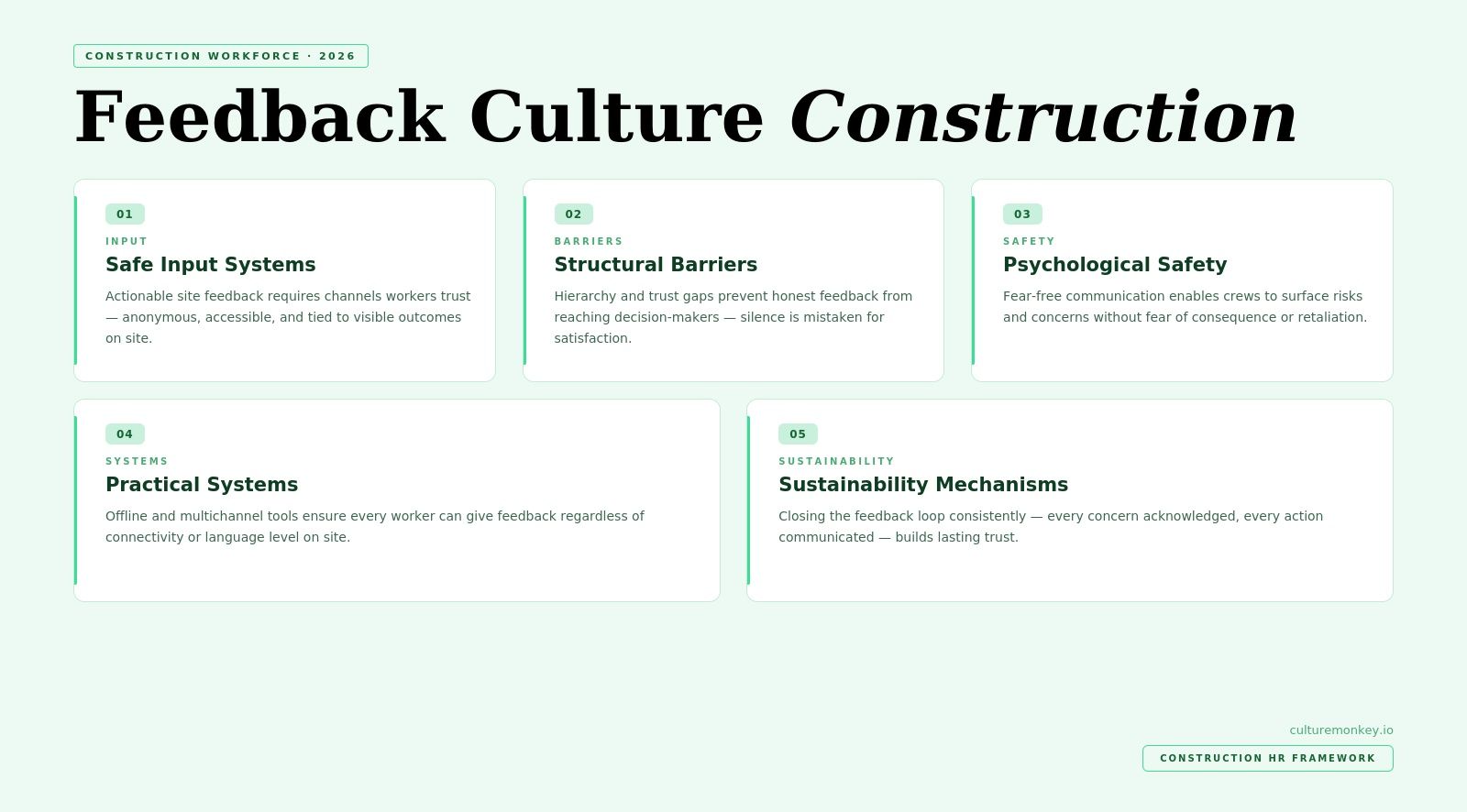
Building a feedback culture in construction organizations means enabling workers to share honest input safely and ensuring leaders act on it consistently across sites. Unlike office environments, construction teams operate in high-noise, shift-based, and multi-contractor conditions where traditional survey models fail to capture real-time issues.
In practice, feedback culture on a construction site looks like a worker at a crib shed raising a process concern without fear and seeing visible action taken. This guide explains how to build that system from the ground up using site-level behaviors, feedback channels, and leadership accountability, supported by the right employee survey tools to enable safe and consistent worker input.


- A feedback culture in construction organizations is a system where workers can share honest input safely, and leaders respond to it consistently across all job sites.
- Construction sites struggle with feedback due to hierarchy, fragmentation, low trust, and inconsistent leadership accountability structures.
- Psychological safety allows workers to share concerns without fear, forming the foundation of an effective feedback culture.
- Practical feedback systems must work offline, use multiple channels, and fit shift-based construction site environments.
- Sustaining feedback culture requires closing the loop, developing foremen, and following a structured roadmap consistently.
- CultureMonkey enables anonymous, continuous feedback across frontline teams with structured listening programs and real-time action dashboards.
Why construction has a feedback culture problem
Construction organizations struggle to build a feedback culture because site hierarchies suppress worker voice, fragmented contractor teams break communication continuity, and shift-based schedules eliminate time for structured feedback sessions. These structural barriers mean feedback rarely reaches decision-makers, and workers quickly learn that giving input changes nothing.
Unlike office environments, the construction industry relies on distributed teams, multiple contractors, and shift-based work where regular communication is inconsistent. This makes it difficult for team members to deliver feedback, receive feedback, and align on project goals.
Core reasons feedback culture breaks in construction
- Hierarchy suppression prevents employees from giving feedback to project managers, which reduces open communication and limits employee contributions.
- Contractor fragmentation creates disconnected teams, which weakens company culture and prevents teams from staying on the same page.
- Shift isolation reduces opportunities for regular check-ins and feedback sessions, limiting continuous feedback across job sites.
- Fear of retaliation discourages employees from raising safety concerns, increasing the risk of costly mistakes and poor safety protocols.
- Perceived futility leads employees to believe their feedback will not drive change, reducing employee and job satisfaction.
- Constant pressure on project timelines limits time for feedback sessions, which weakens employee engagement and continuous improvement.
In practice: A feedback culture in the construction industry fails when employees believe giving feedback will not improve outcomes, reducing trust, engagement, and long-term success.
How feedback culture in construction differs from office environments
Feedback culture in construction differs from office environments because work happens on dynamic, high-risk sites with fragmented teams and limited digital access. Unlike offices, where feedback is structured and scheduled, construction requires real-time, practical systems that account for hierarchy, literacy levels, and on-site constraints.
Psychological safety in construction: The foundation of feedback
Psychological safety in construction is the condition where employees feel safe to give constructive feedback, raise concerns, and share ideas without fear of negative consequences. It is the foundation of an effective feedback culture in construction organizations.
In construction environments where teams work under constant pressure, psychological safety determines whether employees feel valued and confident enough to speak up about safety concerns, work processes, and project outcomes.
The levels of psychological safety that construction teams must build
Psychological safety in construction develops in progressive levels, where each stage enables deeper feedback and stronger employee engagement.
1. Physical safety: Workers feel protected by strong safety protocols and trust that safety concerns will be addressed immediately, reducing risk and enabling confident participation in daily operations.
2. Interpersonal safety: Team members communicate openly without fear of blame, enabling collaboration, reducing conflict, and supporting a consistent flow of constructive feedback across job sites and teams.
3. Voice safety: Employees deliver feedback and raise issues without fear of retaliation, increasing employee engagement, surfacing hidden problems early, and improving overall project outcomes across teams consistently.
4. Organizational trust: Leadership responds to feedback consistently and transparently, reinforcing company culture, building mutual respect, and ensuring employees believe their input leads to meaningful change across projects.
5. Growth safety: Continuous learning and employee development support professional growth, encouraging employees to share ideas, improve skills, and contribute to long-term success across the entire organization.
Key takeaway: Psychological safety construction environments must prioritize trust, open communication, and consistent leadership response to enable effective feedback and higher engagement.
How to collect feedback without digital infrastructure
Collecting employee feedback on construction sites requires practical systems that work without relying entirely on digital tools. A strong feedback culture construction industry approach uses multiple channels to ensure continuous feedback across job sites.
Many construction companies must balance limited access to technology with the need to collect valuable data from frontline workers, making multi-channel systems essential for an effective feedback culture.
Feedback channels for construction sites
| Channel | How it works | Best use case |
|---|---|---|
| Toolbox talks | Supervisors gather feedback during daily briefings | Real-time safety concerns and quick insights |
| QR codes | Workers scan codes placed on-site to submit feedback | Anonymous feedback construction workforce |
| Supervisor check-ins | Foremen conduct regular check-ins with team members | Ongoing employee engagement and alignment |
| Paper forms | Simple forms collected during shifts | Low-tech environments without digital access |
What makes feedback collection effective
- Accessibility ensures employees can give feedback easily, regardless of job site conditions or technology access.
- Frequency enables continuous feedback instead of relying on annual reviews or performance reviews.
- Anonymity encourages honest feedback, especially in frontline feedback program construction environments.
In practice: Learning how to collect feedback from construction workers requires combining low-tech methods with structured systems that ensure consistent, actionable input.
Making feedback anonymous in a small site crew
Anonymous feedback construction workforce systems are critical in small crews where employees can easily be identified. Without structural safeguards, employees may avoid giving feedback due to fear of exposure.
Construction companies must design systems that protect identity while still capturing valuable feedback that supports employee engagement and continuous improvement.
Anonymity controls for construction sites
| Control | How it works | When to apply |
|---|---|---|
| Aggregation | Combine feedback across teams or time periods | Small job sites with limited staff |
| Minimum thresholds | Release feedback only after enough responses | Prevent the identification of individuals |
| Delayed reporting | Share results in batches instead of real time | Reduce timing-based identification |
| External facilitation | Use third-party tools or systems | High-sensitivity feedback environments |
Rules for maintaining anonymity
- Never release identifiable feedback that could expose employees, even unintentionally.
- Avoid real-time reporting that allows patterns to reveal individual contributors.
- Protect minority voices by ensuring that all feedback is effectively grouped and anonymized.

Psychological safety is the foundation of performance in high-risk environments. When workers feel safe to speak up, organizations prevent failures before they happen.


Key takeaway: Anonymous feedback construction workforce systems require structural controls, not just promises, to ensure employees feel safe sharing feedback.
Closing the feedback loop: The make-or-break step
Closing the feedback loop means responding to employee feedback visibly and consistently so employees know their input leads to action. It is the most critical factor in building a strong feedback culture in construction organizations.
Without visible action, employees stop giving feedback, reducing employee engagement and weakening the overall feedback culture across job sites.
Steps to close the feedback loop effectively
- Acknowledge feedback quickly so employees know their input has been received.
- Evaluate feasibility based on safety protocols, project goals, and operational constraints.
- Communicate actions clearly to ensure teams communicate and stay aligned.
- Explain constraints honestly when feedback cannot be implemented immediately.
- Show visible change so employees see the impact of their feedback on project outcomes.
In practice, feedback culture breaks down when organizations collect feedback but fail to communicate actions, reducing trust and employee satisfaction.
Building a foreman-level feedback capability
Foremen determine whether feedback culture succeeds or fails in construction organizations. Because they sit between project managers and frontline workers, every feedback interaction passes through them. Organizations that train and equip foremen to model open feedback behavior see stronger participation rates, earlier issue detection, and higher site-level trust.
In the construction industry, foremen operate between project managers and frontline workers, making them the most influential layer in any construction worker voice program or frontline feedback program construction system. If foremen fail to model effective feedback, even the best systems will not work.
Core behaviors that build foreman-level feedback capability
- Ask for input during regular check-ins and toolbox talks so employees can share specific feedback in real time.
- Respond without defensiveness when receiving feedback, using body language and tone to reinforce mutual respect.
- Act immediately on safety concerns and escalate critical issues to project managers to prevent costly mistakes.
- Communicate decisions clearly so team members understand project goals, expectations, and next steps.
- Reinforce positive feedback publicly to boost morale, increase employee satisfaction, and encourage engaged employees.
- Follow up on feedback sessions consistently so employees see visible action and trust the feedback culture.
(Source: HSE)
What changes when foremen lead feedback effectively
- Teams communicate more openly, creating a collaborative environment across job sites.
- Employees feel valued and take more responsibility for safety protocols and project outcomes.
- Continuous feedback improves employee development, professional growth, and overall job satisfaction.
- Higher engagement and employee retention increase, supporting long-term success and business growth.
Key takeaway: Foreman-level capability determines whether a feedback culture in construction organizations succeeds, because daily site behavior drives trust, engagement, and continuous improvement.
A 12-month feedback culture roadmap for construction organizations
Building a feedback culture in construction organizations requires a phased approach that aligns systems, behaviors, and leadership practices over time. It cannot be achieved through one-time initiatives or annual performance reviews.
A structured roadmap helps construction companies build a strong feedback culture that supports employee engagement, continuous improvement, and long-term success.
12-month roadmap for implementation
| Phase | Focus | Outcome |
|---|---|---|
| Months 1–3 | Build trust and baseline feedback systems | Employees begin giving feedback safely |
| Months 4–6 | Introduce feedback channels and programs | Increased participation and valuable data collection |
| Months 7–9 | Strengthen leadership behavior and accountability | Teams communicate effectively and align on goals |
| Months 10–12 | Scale systems across the entire organization | Strong company culture and higher engagement |
What success looks like
- Employees feel valued and actively participate in feedback sessions across job sites.
- Teams communicate effectively, improving project outcomes and reducing costly mistakes.
- Employee retention improves as engaged employees stay longer with the construction company.
What to measure
Measuring feedback culture requires tracking participation, response consistency, and safety-related signals across job sites.
| Metric | Baseline target | Strong target |
|---|---|---|
| Feedback participation rate | 40% of site workers | 70%+ |
| Loop closure rate | 60% of issues acknowledged | 90%+ |
| Safety concern report frequency | At least 1 per week per site | 3+ per week per site |
| Engagement score trend | Stable quarter over quarter | Improving quarter over quarter |
Common risks
- Lack of leadership accountability reduces trust and weakens feedback culture.
- Over-reliance on tools without behavioral change limits effectiveness.
- Inconsistent communication prevents teams from staying on the same page.
In practice: Building a feedback culture in construction organizations requires phased execution, leadership commitment, and consistent systems that drive growth, employee engagement, and business growth.
Conclusion
Building a feedback culture in construction organizations is essential for improving employee engagement, safety protocols, and project outcomes across job sites. When employees feel safe giving and receiving feedback, teams communicate better, reduce costly mistakes, and drive continuous improvement. A strong feedback culture also strengthens company culture, boosts morale, and supports long-term success in the construction industry.
To implement this effectively, organisations need the Best employee survey tools for construction companies that enable anonymous feedback, frontline participation, and real-time action across sites.
CultureMonkey helps organizations build this system by enabling continuous feedback, anonymous input, and real-time insights across frontline teams.With structured listening programs and actionable dashboards, CultureMonkey ensures feedback leads to visible action, helping organizations create a more engaged, productive, and high-performing workforce.
“Last reviewed April 2026.”
FAQs
1. How do you build a feedback culture in construction?
Building a feedback culture in construction requires enabling psychological safety, deploying multi-channel collection systems, training foremen to model open feedback, and closing the loop visibly after every input cycle. These four steps align site-level behavior with organizational trust and engagement goals.
2. How do you collect anonymous feedback from site workers?
Collect anonymous feedback from construction workers using QR code stations, paper drop boxes, and toolbox talk surveys. Protect identity by setting minimum response thresholds before releasing data, using delayed batch reporting, and applying external facilitation on high-sensitivity crews.
3. What is psychological safety in a construction context?
Psychological safety in construction means workers feel safe raising concerns, reporting hazards, and giving feedback without fear of retaliation or blame. It develops in five stages from physical safety to organizational trust, and it determines whether any feedback system on a site will work.
4. How do you run a feedback program for low-literacy workers?
Run a feedback program for low-literacy construction workers using verbal sessions during toolbox talks, visual prompt cards, and supervisor-led check-ins. Simplify input to yes/no or emoji-scale formats and ensure foremen record responses on behalf of workers who cannot write.
5. Why do feedback cultures fail in construction?
Feedback cultures fail in construction when employees do not see action after giving feedback, or when performance review systems are infrequent. Lack of trust, poor communication, and weak leadership reduce engagement, limit individual growth, and weaken the company's long-term retention.
Feedback cultures fail in construction when workers see no visible action after sharing concerns. The core causes are hierarchy suppression, inconsistent leadership accountability, fragmented contractor teams, shift isolation, and perceived futility. Workers stop giving input when they believe nothing will change.
6. How do you train foremen to deliver effective feedback?
Train foremen to deliver feedback through role-specific coaching on asking questions without judgment, responding without defensiveness, escalating safety issues immediately, and following up after every feedback session. Foremen who model this behavior consistently drive higher participation and trust on site.
7. How does feedback improve employee retention in construction?
Feedback improves retention in construction by making workers feel heard and valued, which increases job satisfaction and reduces voluntary turnover. When foremen close the feedback loop consistently, and leadership acts on site concerns, employees are more likely to stay across project cycles.
8. What tools help scale feedback across construction sites?
Scale feedback across construction sites using mobile pulse surveys, QR code stations, offline paper collection with digital aggregation, and centralized dashboards. The right platform handles multi-site data, supports anonymous input from frontline workers, and surfaces actionable trends for site managers in real time.