


How to choose an employee engagement survey vendor: A practical 10-step framework

Choosing an employee engagement survey vendor usually begins with feature comparisons, demo calls, and pricing discussions. As evaluations progress, most platforms appear similar in capability, design, and analytics. Without clear evaluation criteria, decisions often default to surface-level impressions instead of long-term fit.
Vendor selection should be anchored in defined business outcomes such as reducing attrition, improving manager effectiveness, strengthening accountability, or protecting trust through anonymity.
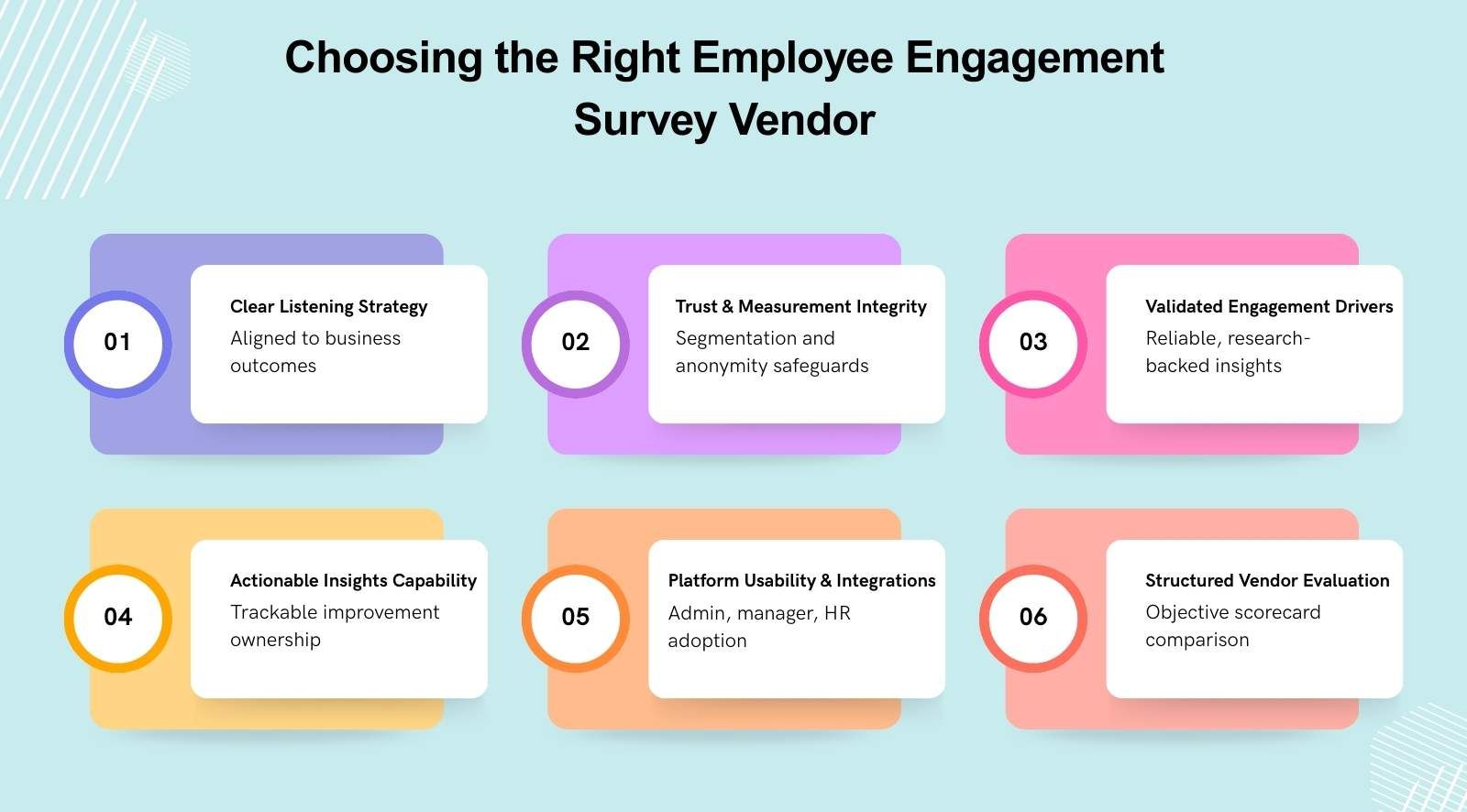
The right decision framework focuses on listening strategy, segmentation depth, validated drivers, actionability, usability, integrations, and data ownership.


- Start with a defined listening strategy aligned to business outcomes before evaluating vendors.
- Clarify segmentation by function, location, and manager to ensure actionable, accountable insights.
- Set anonymity thresholds that match your risk profile and protect trust in reporting.
- Prioritize validated engagement drivers over excessive customization to preserve benchmarking and trend accuracy.
- Evaluate actionability, admin and manager usability, integrations, and use a structured vendor scorecard to compare options and identify red flags objectively.
Start with your listening strategy before you compare vendors

Vendor selection should begin with a clearly defined listening strategy. Before reviewing features or pricing, determine what business outcomes the engagement survey must influence. Whether the focus is retention, manager effectiveness, culture, or accountability, your objectives should guide evaluation criteria.
- Listening strategy definition: A listening strategy is your plan for what you will ask, who you will listen to, and what you will change after the engagement survey. Without it, employee engagement tools become reporting machines, not decision tools.
- Outcomes first: Decide if you are fixing employee retention, rebuilding workplace culture, or improving manager follow-through, then pick the vendor capabilities that support that outcome. Otherwise, high employee satisfaction scores can hide the real blockers you need to remove.
- Cadence match: Choose between annual, pulse, and lifecycle listening based on how fast issues surface. Shortlisting employee engagement survey software top options is easier when the cadence is clear, because employee engagement software must handle repeat launches, reminders, and trend accuracy.
- Measure vs change: Sentiment tracking tells you how people feel; change tracking proves what improved after action. Ask vendors to show how employee feedback becomes actionable insights, with owners, deadlines, and follow-up pulses, not just charts and heatmaps.
- Leadership alignment: Tie survey themes to the decisions leaders already make, like staffing, training, and workload allocation. The best employee engagement survey vendors and employee engagement survey providers will map drivers to actions leaders own, not HR-only tasks.
- Avoid feature-first shortlists: Feature grids reward what demos show, not what your org needs. If you want employee engagement survey vendor help, start with strategy, then test features against it. This prevents buying tools that you never roll out.
Define who you’re listening to: segmentation by function, location, and manager

Effective engagement surveys depend on accurate segmentation. Define which populations need visibility, how reporting lines should roll up, and where localized insights matter. Without clear segmentation rules, engagement data becomes too broad to act on.
- Why segmentation drives insight quality: Groups turn employee insights into decisions leaders can own. Without them, employee engagement insights blur into one score, and you cannot enhance engagement where it breaks. Ask vendors how they define segments before showing dashboards.
- Structural segmentation: Segment by department, business unit, and reporting line so you can analyze employee feedback where accountability lives. This links employee experience to manager actions, not vague themes. A strong Employee engagement survey vendor template should capture these fields.
- Operational segmentation: Segment by plant, shift, and region to spot friction that averages erase. This helps you track employee feedback in frontline-heavy setups and compare sites fairly. Your employee engagement platform should handle rotating rosters without manual cleanup.
- Manager visibility vs enterprise rollups: Give managers only what they can act on, while leaders see system patterns. This keeps company culture conversations grounded in local fixes and enterprise themes. Engagement data controls prevent overexposure, confusion, and underaction.
- Demographic filters without identity risk: Use tenure, role family, or location bands only when thresholds protect people well. The goal is meaningful insights for action, not guesswork. Vendor rules should block slicing that can reveal identities in small teams.
- Minimum response thresholds and small-team risks: Set minimum counts for scores and comments, then test edge cases. This is where Free employee engagement survey vendor options often fail, because protections are thin. Make sure you can measure employee engagement safely.
Choose anonymity thresholds that match your organization’s risk profile
Anonymity standards directly affect participation quality and employee trust. Define minimum reporting thresholds, comment protections, and data visibility rules before evaluating vendors. The right balance protects confidentiality while still enabling actionable insights.
- What anonymity thresholds mean: Anonymity thresholds define the minimum number of survey responses required before results appear in employee engagement survey platforms. Clear rules help employees trust pulse surveys and share honest employee sentiment, which improves continuous feedback quality and helps leaders gain insights safely.
- Typical reporting minimums: Most employee engagement survey platforms set minimums between five and ten responses per segment. Free employee survey tools often use lower thresholds, which may increase risk. Strong vendors explain these key features clearly and adjust settings for different business contexts.
- Anonymous vs confidential surveys: Anonymous surveys remove identifiable data, while confidential surveys restrict visibility but retain backend linkage. If you plan continuous improvement through pulse surveys, clarify this difference early. The model you choose shapes trust, survey fatigue levels, and how freely employees share feedback.
- Comment-level protection: Open-text comments carry a higher exposure risk than scores. Advanced analytics can flag names or sensitive terms automatically, but survey templates must support redaction rules. Without this, employee engagement survey platforms may gain insights yet unintentionally reduce psychological safety.
- IP tracking and metadata: Some engagement tools log IP addresses or device data to prevent duplicates. Clarify what is stored and who can access it. Transparency here directly affects employee sentiment and determines whether employees view pulse surveys as safe or monitored.
- Granularity vs trust tradeoff: More granular reporting helps managers act faster, but small-group breakdowns increase identification risk. To boost engagement long-term, protect trust first. Continuous feedback only works when employees believe anonymity rules support continuous improvement, not exposure. engagement survey provider selection
Prioritize validated engagement drivers over unlimited custom questions
Survey effectiveness depends on question design. Prioritize validated engagement drivers that support benchmarking and trend consistency. Excessive customization weakens comparability across cycles and reduces predictive value. Vendors should offer research-backed frameworks while allowing limited contextual flexibility aligned with business priorities.
- What validated engagement drivers are: Validated drivers are research-tested themes that predict outcomes and keep engagement metrics consistent. They help you trust survey results across teams and time. In engagement survey provider selection, ask which drivers are standard and why they matter.
- Why research-backed questions benchmark better: Standard drivers enable apples-to-apples comparisons across business units and industry data sets. A good survey tool supports consistent scales, so survey data stays comparable. That improves data analysis and produces valuable insights that leaders can act on.
- Risks of fully custom survey design: Unlimited customization feels flexible, but it breaks trend lines and creates noisy survey data. When every cycle changes, survey results become hard to read. It also weakens engagement metrics because you cannot separate real change from question changes.
- Trend consistency across cycles: Keep a stable core set of drivers for at least three cycles to see real movement. This steadies the survey process and reduces confusion during data analysis. You can still rotate a small set of questions without losing your baseline.
- Balance standard drivers with context: Use validated drivers as the base, then add a few targeted questions for current priorities. This approach improves engagement survey provider selection because you test flexibility without losing comparability. It also helps turn employee feedback into focused actions.
- How vendors handle benchmarking data: Ask what benchmarks are used, how they are built, and how often they are updated. Strong vendors explain sampling, segmentation, and how survey data is normalized. Weak ones use vague benchmarks that look like customer satisfaction scores.
Evaluate actionability: what happens after the dashboard?
Reporting alone does not create change. Assess how vendors convert survey insights into structured action plans, ownership workflows, and follow-up measurement. True actionability includes manager guidance, accountability tracking, and impact validation. Without embedded follow-through mechanisms, engagement efforts stall after results are shared.
- What actionability really means: Actionability is the system that converts survey feedback into clear next steps, not static charts. During employee engagement software comparison, ask how HR survey software solutions guide managers toward informed decisions using deeper insights and practical prompts.
- Built-in action planning workflows: Strong employee feedback software vendors embed structured workflows inside the survey platform, so leaders move from team insights to action plans quickly. This keeps customized surveys tied to measurable change across the employee lifecycle, not just one-time reporting.
- Manager-level recommendation engines: The best engagement platform tools analyze trends and suggest targeted steps for specific teams. Instead of generic advice, managers receive contextual nudges that help identify trends and protect the organization’s culture through practical improvements.
- Accountability and ownership tracking: Action tracking assigns owners, deadlines, and progress markers inside the survey platform. This transparency builds trust with existing customers internally, because employees see movement, not silence, after sharing feedback. Clear ownership strengthens customer loyalty inside the workforce.
- Follow-up pulses to measure impact: Ongoing pulse surveys check whether actions worked or stalled. This approach supports comprehensive feedback loops across the employee lifecycle and helps leaders identify trends early, instead of waiting for the next annual cycle.
- Closing the loop with employees: Communicating what changed after feedback is essential for business success. Recognition tools, updates, and brief check-ins reinforce that survey feedback drives real change. Without closure, even strong HR survey software solutions lose credibility quickly.
Assess the admin and manager experience: the hidden adoption lever

Adoption determines impact. Evaluate how easily HR teams can launch surveys and how quickly managers can interpret results. Complex systems reduce follow-through. Vendors should provide intuitive dashboards, role-based access controls, and minimal training requirements to ensure consistent usage across leadership levels.
- Ease of survey creation and deployment: Admin teams should launch cycles in days, not weeks, using clear workflows and guardrails. Enterprise engagement survey tools must balance extensive features with simplicity, so employee needs are addressed without creating bottlenecks or slowing down momentum.
- Template libraries vs build-from-scratch models: A strong anonymous employee survey platform offers proven templates alongside customization. Templates protect reliable data and trend continuity, while limited flexibility addresses specific employee needs. Build-from-scratch models often delay launch and weaken overall satisfaction tracking.
- Dashboard usability for managers: Managers need clear views that turn actionable analytics into meaningful action within minutes. Sentiment analysis should surface key themes automatically, not require data skills. If managers struggle to read reports, anonymous feedback rarely drives change.
- Role-based access control: Access settings must protect anonymous feedback while giving managers enough detail for meaningful action. An anonymous employee survey platform should define who sees what clearly. This builds trust, so employees feel safe sharing honest input.
- Training and onboarding requirements: The best tools require minimal onboarding because workflows guide behavior naturally. When platforms demand heavy training, actionable feedback slows. Simple design helps managers focus on professional growth conversations instead of navigating software complexity.
- Time-to-launch across vendors: Compare how quickly vendors move from contract to first survey. Enterprise engagement survey tools that take months delay actionable analytics and meaningful action. Faster deployment helps you track trends and respond to employee needs sooner.
Verify integrations: HRIS, SSO, collaboration tools, and BI systems
Integration capability affects data accuracy and operational efficiency. Confirm real-time HRIS sync, secure SSO access, collaboration tool integrations, and BI export functionality. Manual uploads and disconnected systems increase risk and delay action. Seamless integration supports timely insights and sustained engagement tracking.
- Why integration reduces admin burden: Seamless integration removes duplicate data entry and manual reconciliation work. Hr teams spend less time cleaning files and more time addressing performance gaps. A user-friendly platform should connect systems quietly, without forcing technical workarounds.
- HRIS sync for employee data accuracy: Real-time HRIS sync keeps reporting lines, locations, and role data current inside employee pulse survey software. This protects industry benchmarks comparisons and ensures workforce engagement measurement tools reflect reality, not outdated rosters.
- SSO and access control compliance: Single sign-on protects sensitive insights while simplifying login for managers. A user-friendly platform should align with company access policies and prevent unauthorized views. Strong access controls protect actionable data without slowing daily workflows.
- Slack or Teams nudges for participation: Integration with collaboration tools improves response rates through timely reminders. This helps boost retention by keeping surveys visible in daily communication channels. Workforce engagement measurement tools perform better when participation feels natural, not forced.
- API access and BI exports: Open APIs allow organizations to combine survey data with financial, performance, or operational metrics. Actionable data becomes more valuable when linked to performance gaps and business outcomes.
- Real-time sync vs manual CSV uploads: Manual CSV uploads increase errors and delay insights. Seamless integration with automated sync keeps employee pulse survey software current. Faster updates help hr teams react quickly instead of waiting for quarterly data consolidation.
Use a vendor evaluation scorecard and watch for red flags

Vendor comparisons should follow a structured evaluation framework. Use weighted criteria across strategy fit, segmentation, anonymity, actionability, integrations, support, and data ownership. A formal scorecard prevents bias and highlights risks early. Watch for vague answers, unclear pricing, and weak implementation support during demos.
- What the scorecard includes: Capture strategy fit, segmentation, anonymity, actionability, integrations, support, and security in one employee survey vendor checklist. Use simple scoring so teams can compare engagement analytics software options without getting pulled into feature noise.
- Weighted criteria that reflect priorities: Weight the categories based on your risk profile and goals. If anonymity is critical, score it higher than nice-to-have UI. This keeps engagement analytics software selection aligned to outcomes, not vendor storytelling.
- Commercial transparency: Ask for a clear pricing structure, add-ons, and renewal terms in writing. A scorecard prevents surprises when the demo price differs from the real contract. Strong vendors answer quickly and consistently, without vague “it depends” language.
- Customer success and implementation support: Score onboarding, training, success cadence, and who owns outcomes post-launch. Engagement analytics software only delivers value when managers adopt it. If support is vague, adoption risk is high, even with great features.
- Data ownership and portability: Confirm you own survey data, can export it easily, and keep historical data after the contract ends. Your employee survey vendor checklist should include export formats, APIs, and retention rules. This protects long-term trend analysis and vendor flexibility.
- Common red flags during demos: Watch for overly complex dashboards, fuzzy anonymity answers, heavy reliance on consultants, missing action planning tools, and weak benchmarking transparency. When vendors dodge specifics, the risk usually shows up after launch, not before.
Conclusion
Knowing how to choose an employee engagement survey vendor is no longer a procurement exercise; it is a strategic workplace decision. The right vendor influences trust, data quality, manager action, and ultimately retention and culture outcomes. A poor choice leads to low adoption, weak follow-through, and feedback fatigue. A strong choice turns insight into measurable progress.
CultureMonkey supports organizations with structured listening, robust anonymity controls, actionable workflows, intuitive manager dashboards, and seamless integrations. Instead of stopping at reporting, it enables real ownership and continuous improvement. When vendor selection is aligned with strategy, engagement efforts translate into sustained business impact.
FAQs
1. What should you define before choosing an employee engagement survey vendor?
Before evaluating the best employee engagement survey tools, define your listening strategy and business outcomes. Clarify whether the goal is reducing attrition, improving manager effectiveness, strengthening accountability, or protecting anonymity. Vendor comparison should reflect these priorities. Without outcome clarity, feature evaluations become superficial and misaligned with long-term organizational impact and sustained engagement improvement.
2. How do anonymity thresholds impact employee trust and participation rates?
Anonymity thresholds determine when results are visible and directly influence employee trust. If thresholds are too low, employees may hesitate to provide honest feedback. If protections are clear and consistent, participation improves. Strong employee feedback software vendors explain reporting minimums, comment safeguards, and data visibility rules before implementation to ensure credibility and reliable engagement data.
3. Should we use validated engagement drivers or fully customized survey questions?
Validated engagement drivers provide consistency, benchmarking value, and predictive strength across survey cycles. Fully customized surveys offer flexibility but weaken comparability and long-term trend analysis. The best employee engagement survey tools balance research-backed core drivers with limited customization, ensuring results remain stable, interpretable, and aligned with measurable organizational priorities over time.
4. What makes an engagement survey platform truly actionable after results are released?
An actionable platform goes beyond reporting and embeds structured follow-through. Effective employee feedback software vendors provide manager-level recommendations, ownership tracking, action planning workflows, and follow-up pulse capability. Results should connect directly to decisions and measurable improvements. Without structured action mechanisms, survey data rarely translates into meaningful organizational change.
5. How important are integrations when selecting employee engagement survey software?
Integrations ensure data accuracy, reduce administrative workload, and support real-time analysis. Seamless HRIS sync, secure SSO access, collaboration tool integration, and BI exports strengthen decision-making. The best employee engagement survey tools prevent manual data handling and disconnected systems, allowing organizations to act quickly on reliable insights instead of outdated reports.
6. What red flags should we watch for during vendor demos and evaluations?
Watch for vague anonymity explanations, unclear pricing structures, overly complex dashboards, and weak action planning capabilities. If employee feedback software vendors avoid specifics about data ownership, benchmarking methodology, or implementation support, risk increases. Transparent responses and documented processes signal maturity; hesitation often predicts post-launch friction and adoption challenges.
7. How do we objectively compare employee engagement survey vendors without bias?
Use a structured evaluation scorecard with weighted criteria aligned to your strategy. Compare best employee engagement survey tools across segmentation, anonymity, actionability, integrations, usability, support, and data portability. A formal framework reduces demo bias, prevents feature-driven decisions, and ensures vendor selection reflects business outcomes rather than presentation quality.