


How to design an effective employee engagement survey: A practical guide for HR and business leaders (2026)

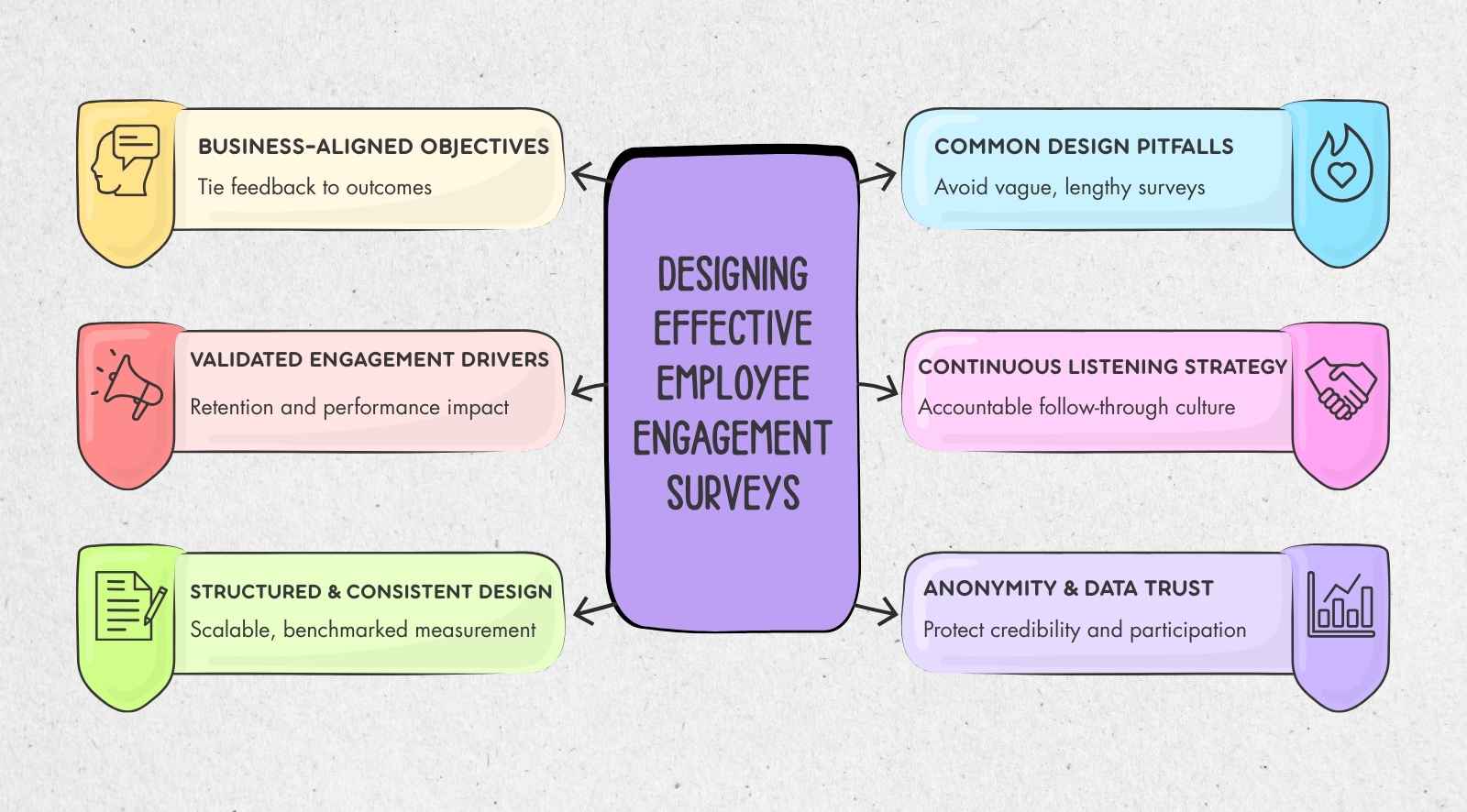
Designing an effective employee engagement survey starts with clarity and ends with action. You define precise engagement survey objectives, select measurable drivers tied to business priorities, craft concise and behavior-focused questions, use consistent scales, and build a reporting structure that links insights to engagement improvement planning.
Most organizations struggle not because employees refuse to respond, but because survey purpose alignment is weak. Without clear engagement measurement goals and defined engagement success metrics, data remains descriptive instead of directional.
An effective survey is built around a structured workforce listening strategy. It connects feedback to retention, performance, and broader business outcomes from engagement surveys. When done correctly, it becomes a decision tool for leadership, not a one-time data exercise.


- Design engagement surveys with clear objectives tied to business outcomes.
- Select validated drivers influencing retention, performance, culture, and well-being.
- Use structured scales, concise length, and benchmark consistently across cycles.
- Avoid vague wording, excessive length, anonymity gaps, and inaction.
- Embed surveys within continuous listening strategy with accountable follow-through.
How to select employee engagement drivers that align with business goals
Selecting the right employee engagement drivers starts with clarity on your engagement measurement goals. Before launching engagement surveys, define what outcomes matter most. When drivers align with business priorities, your survey moves beyond data collection and delivers focused, actionable insight.
1. Employee communication effectiveness
This driver measures clarity, transparency, and consistency of information flow across the organization. Surveys should evaluate whether employees understand company priorities, role expectations, and decision updates.
Strong communication improves engagement success metrics such as productivity and alignment, while supporting linking surveys to retention and performance goals by reducing confusion-driven disengagement. Effective communication also facilitates gathering feedback from employees, ensuring their insights are continuously collected and acted upon.
2. Leadership trust and transparency
This driver assesses confidence in leadership integrity, fairness, and openness. Engagement measurement goals should include evaluating whether leaders communicate honestly and act consistently with stated values.
Trust levels significantly influence business outcomes from engagement surveys, especially during organizational change, restructuring, or growth phases. Transparent leadership encourages honest feedback, making employees feel safe to share candid responses that lead to more meaningful insights and effective organizational improvements.
3. Employee recognition perception
Recognition perception evaluates whether employees feel valued and fairly acknowledged. Engagement survey objectives in this area should measure the frequency, equity, and relevance of recognition practices.
Recognition data informs engagement improvement planning and directly impacts engagement success metrics such as discretionary effort and performance consistency. Effective recognition practices also play a key role in boosting overall employee satisfaction, which contributes to workplace stability and retention.
4. Career growth and development opportunities
This driver focuses on perceived access to learning, advancement, and skill-building pathways, including career development opportunities. Surveys should assess clarity of progression, internal mobility, and training support.
Growth-related questions are critical for linking surveys to retention and performance goals, as lack of development opportunities remains a leading cause of voluntary turnover.
5. Manager support and effectiveness
Manager influence is central to engagement measurement goals. Surveys should evaluate coaching quality, feedback frequency, fairness, and workload guidance.
Manager-level insights enable targeted engagement improvement planning and strengthen engagement success metrics at the team level. Managers can use detailed feedback gathered from open-ended survey questions to better understand employee concerns and tailor their support more effectively.
6. Collaboration and workplace culture drivers
This driver measures teamwork quality, inclusion, and psychological safety. A well-designed workforce listening strategy captures how effectively teams share information and resolve conflict, and thoughtfully designed team collaboration survey questions can reveal how employees experience day-to-day cooperation.
Strong collaboration scores contribute to measurable business outcomes from engagement surveys, including innovation capacity and execution speed.
In addition to surveys, focus groups can be used to further explore issues related to collaboration and workplace culture, providing deeper insights through interactive discussions.
7. Workload sustainability and well-being indicators
Sustainable workload and well-being indicators measure burnout risk, stress levels, and flexibility support, as well as the effectiveness of work-life balance policies, which are core elements of a positive work environment. These factors must be integrated into engagement survey objectives to ensure performance remains sustainable.
Monitoring well-being strengthens survey purpose alignment and supports linking surveys to retention and performance goals by identifying risk areas early.
8. Alignment with company purpose and goals
This driver evaluates how clearly employees understand organizational direction and how their roles contribute to it, which are central components of the broader organizational environment and culture. Engagement measurement goals should include assessing strategic clarity and personal connection to company priorities.
Purpose alignment improves engagement success metrics and ensures business outcomes from engagement surveys translate into long-term retention and performance stability. Additionally, understanding employee alignment with company purpose provides valuable insights that help shape the company's future.
How to choose the right question formats for engagement surveys

Choosing the right question formats directly impacts the quality of employee morale insights and the value of collecting data.
Poor formats reduce participation rates and limit thoughtful responses. Strong formats surface addressing concerns early and turn data collected into strategic tools that support organizational growth, organizational performance, and clarity across the broader organization.
- Quantitative vs qualitative engagement questions: Quantitative items generate measurable data collected for benchmarking and tracking organizational performance. Qualitative prompts uncover thoughtful responses about employee morale and employees' needs. Combining both strengthens collecting data, supports addressing concerns early, and equips senior leadership with clearer signals for organizational growth and customer loyalty impact.
- Rating-scale engagement questions: Rating scales help keep surveys concise while driving higher participation rates. Clear scales improve data collection consistency across the broader organization. They enable senior leadership to monitor employee morale trends and link results directly to organizational performance and professional development priorities.
- Open-text feedback collection: Open-text prompts capture thoughtful responses that numbers miss. They surface employee morale shifts, addressing concerns, and employees' needs in context. When analyzed properly, this data collected adds depth to collecting data efforts and guides professional development and organizational growth strategies.
- Driver-based question formats: Driver-based formats organize collecting data around organizational values, leadership behaviors, and workplace systems. This structure keeps surveys concise while clarifying what influences employee morale. It helps senior leadership connect data collected to organizational performance and broader organization outcomes.
- Experience-based measurement questions: Experience-based questions focus on real scenarios rather than abstract opinions. They improve participation rates by asking what employees need in their daily work. The resulting data collected support addressing concerns, strengthening professional development, and improving organizational growth outcomes.
- Sentiment tracking question formats: Sentiment tracking captures shifts in employee morale over time. Consistent formats enhance data reliability and allow senior leadership to compare data collected across cycles. These insights support strategic tools that influence organizational performance and customer loyalty.
- Avoiding ambiguous question wording: Clear wording increases thoughtful responses and reduces confusion that lowers participation rates. Precision in collecting data ensures employees' needs are accurately reflected in the data collected. This strengthens addressing concerns and aligns findings with organizational values and organizational growth goals.
How to design effective engagement survey scales and response options
Scales must align with engagement survey objectives, support engagement measurement goals, generate clear engagement success metrics, and enable engagement improvement planning while linking surveys to retention and performance goals when designing an effective employee survey.
1. Likert scale best practices
- Choose scale length with intent: 5-point for simplicity and cross-team comparability, 7-point for finer sensitivity when you need nuance.
- Label all endpoints and key midpoints (e.g., strongly disagree → strongly agree); don’t rely on numbers alone.
- Keep direction consistent (higher = more positive) and document coding rules for analytics.
- Use clear anchors tied to observable behavior (e.g., “agree” vs “agree strongly” vs “never/always”).
2. Balanced response options
- Offer symmetric positive and negative choices so averages reflect true central tendency.
- Avoid excessive extremes; extreme-heavy scales inflate volatility and complicate trend analysis.
- Make the number of positive and negative points equal to prevent systematic bias.
3. Neutral response placement strategy
- Decide whether to include a neutral midpoint based on engagement survey objectives. Include when measuring opinion distribution; omit when you must force a directional choice for decision-making.
- If included, label the neutral option clearly (e.g., “neither agree nor disagree”) and treat neutrals in analysis as a distinct category.
- Monitor neutral-use rates; high use can signal unclear wording or low engagement.
4. Avoiding biased or leading response scales
- Avoid emotionally charged anchors (e.g., “awful” vs “excellent”) that steer answers; use descriptive, behavior-focused labels similar to those used in structured culture index survey questions.
- Never combine two concepts in one item (double-barreled) or use double negatives.
- Pilot test phrasing and scales to catch unintended leaning before full deployment.
5. Consistency across survey questions
- Use the same scale type for related drivers (e.g., all leadership items share the same agreement scale) to enable aggregation and clear engagement measurement goals.
- Keep response direction consistent across sections to reduce respondent cognitive load and measurement error.
- Standardize numeric coding (e.g., 1 = strongly disagree) and document it in the survey spec.
6. Improving data comparability across survey cycles
- Maintain the scale length, labels, and direction consistency across waves to preserve trend validity.
- If changes are unavoidable, include bridging items and report methods for scale conversion (e.g., rescaling or z-scores).
- Store raw item-level data and metadata (question text, scale definitions) to enable historical re-analysis and benchmarking.
How long should an employee engagement survey be?

Optimizing engagement survey length and completion time is critical to participation rates and data quality. When deciding how to design an effective employee engagement survey, survey length must align with engagement survey objectives and engagement measurement goals, while avoiding survey fatigue through concise, closed-ended questions within your workforce listening strategy.
1. Ideal survey completion time
Research across enterprise engagement studies shows optimal completion time falls between 8–12 minutes for full engagement surveys and 3–5 minutes for pulse surveys. Surveys exceeding 15 minutes experience measurable participation decline and increased straight-line answering.
Completion time should align with the survey's purpose. If the goal is strategic benchmarking, a slightly longer instrument may be justified. If the goal is rapid engagement improvement planning, shorter, focused surveys yield higher-quality responses and stronger engagement success metrics.
2. Balancing depth vs participation
Depth increases diagnostic value but reduces participation when poorly managed. Each additional question introduces cognitive load, particularly in large enterprises.
To balance effectively, link every section to defined engagement measurement goals. If a driver does not directly influence business outcomes from engagement surveys, it should be removed or moved to a follow-up pulse or scheduled into a broader employee engagement calendar.
3. Reducing survey fatigue
Survey fatigue occurs when employees perceive repetition, irrelevance, or excessive frequency. This weakens linking surveys to retention and performance goals because disengaged employees provide unreliable data, so it helps to balance surveys with engaging initiatives, such as creative employee engagement activities.
Reduce fatigue by:
- Rotating non-core drivers across cycles
- Limiting open-text prompts
- Communicating clear engagement survey objectives before launch
- Sharing action updates to reinforce survey purpose alignment
Fatigue management is a measurable component of engagement success metrics.
4. Prioritizing engagement drivers
Not all drivers require equal measurement frequency. Core drivers such as leadership trust, manager effectiveness, workload sustainability, and recognition should remain stable across cycles.
Secondary or emerging drivers can be rotated depending on the workforce listening strategy priorities. Prioritization ensures engagement improvement planning focuses on high-impact areas connected to retention and performance, while targeted employee engagement initiatives address the most critical gaps.
5. Mobile-friendly survey design considerations
In many organizations, over 50% of engagement responses are submitted via mobile devices. Long matrix questions, complex grids, and excessive scrolling reduce completion rates.
Mobile-first design principles include:
- Single-question-per-screen layout
- Minimal matrix scaling
- Clear tap-friendly response options
- Progress indicators
Optimizing for mobile protects engagement measurement goals and strengthens overall business outcomes from engagement surveys.
6. Short vs long engagement survey trade-offs
Short surveys increase participation and speed of analysis but may limit diagnostic depth. They are ideal for pulse cycles within an ongoing workforce listening strategy.
Longer surveys provide broader insight but risk fatigue if not tightly aligned with engagement survey objectives. The decision should depend on whether the organization prioritizes rapid engagement improvement planning or comprehensive benchmarking.
7. For Decision Makers
When learning how to design an effective employee engagement survey, length should always be treated as a strategic decision tied to engagement success metrics, not as an afterthought.
How to use benchmarking to improve engagement measurement
Using benchmarking to improve engagement measurement ensures your survey data has context and direction. When designing an effective employee engagement survey, benchmarking must support engagement measurement goals, define engagement success metrics, and strengthen the linking of surveys to retention and performance goals within a structured workforce listening strategy.
1. Internal engagement benchmarking across teams
Internal benchmarking compares engagement scores across departments, managers, or business units. It is most effective when scales, question wording, and response options remain consistent across cycles, and when you supplement them with focused manager feedback survey questions to understand leadership impact.
To maintain engagement measurement goals, integrity:
- Standardize survey instruments across teams
- Control for team size and response rates
- Compare driver-level scores, not just overall engagement
Internal benchmarking strengthens engagement success metrics by identifying high-performing teams whose practices can inform engagement improvement planning across the organization.
2. Industry engagement benchmarks
External benchmarks provide context beyond organizational boundaries. These can be sourced from third-party providers, consortium datasets, or sector research.
Use industry benchmarks carefully:
- Ensure comparable scale formats and sample profiles
- Verify geographic and industry alignment
- Avoid comparing overall engagement indices without reviewing driver composition
Industry benchmarking supports survey purpose alignment by helping leaders understand whether low or high scores reflect internal issues or broader market conditions.
3. Tracking engagement trends over time
Trend analysis is more valuable than a one-time comparison. Engagement measurement goals should include tracking directional change rather than focusing only on absolute scores.
Best practices include:
- Maintaining identical scale structures across cycles
- Preserving core engagement drivers
- Flagging statistically significant movement
Trend benchmarking strengthens linking surveys to retention and performance goals by detecting early engagement declines before turnover increases.
4. Comparing engagement scores across locations
Multi-location organizations must account for contextual variables such as regional labor markets, leadership styles, and cultural norms.
For reliable comparison:
- Standardize core survey content globally
- Translate questions carefully while preserving meaning
- Adjust interpretation based on demographic distribution
Location benchmarking supports business outcomes from engagement surveys by identifying structural differences that require targeted engagement improvement planning.
5. Benchmarking engagement drivers for action prioritization
Overall engagement scores rarely provide enough clarity for action. Benchmarking should focus on specific drivers such as leadership trust, manager effectiveness, or workload sustainability.
Prioritization framework:
- Identify drivers below the internal and external benchmarks
- Cross-reference with retention and performance data
- Evaluate statistical impact on overall engagement
Driver-level benchmarking strengthens engagement survey objectives by ensuring that improvement efforts are evidence-based rather than assumption-driven.
What does a well-structured employee engagement survey template look like?

When planning a sample employee engagement survey template structure, clarity and alignment matter more than volume. When deciding how to design an effective employee engagement survey, each section must support engagement survey objectives and engagement measurement goals, follow best practices for conducting surveys, and fit within broader workplace feedback mechanisms to ensure reliable, actionable results.
1. Engagement driver-based question grouping
What it is: Instead of asking random questions, you group 3–5 related questions under one theme, such as communication or recognition.
How it works: Each group produces one average “driver score.” That score tells you how that specific area is performing.
Example:
(Driver: Communication effectiveness):
- I receive the information I need to do my job well. (1 = Strongly disagree, 5 = Strongly agree)
- Company priorities are communicated clearly. (1 = Strongly disagree, 5 = Strongly agree)
- Leaders share updates in a timely way. (1 = Strongly disagree, 5 = Strongly agree
Why this matters: Grouping questions strengthens engagement measurement goals because it isolates problem areas. It also makes engagement improvement planning practical and measurable.
2. Leadership and communication measurement sections
What it is: This section measures trust in leadership, transparency, and clarity of direction.
How it works: Use rating-scale questions (typically a 5-point agreement scale). These generate benchmarkable engagement success metrics.
Example:
- I trust senior leaders to make sound decisions. (1 = Strongly disagree, 5 = Strongly agree)
- Leaders explain the reasons behind major changes. (1 = Strongly disagree, 5 = Strongly agree)
- I understand how my role supports company goals. (1 = Strongly disagree, 5 = Strongly agree)
Why this matters: Leadership scores strongly influence business outcomes from engagement surveys and are critical when linking surveys to retention and performance goals.
3. Growth and development assessment sections
What it is: This section measures whether employees see career progression and learning opportunities, and whether structured employee growth plans are visible and accessible.
How it works: Questions focus on advancement clarity, training access, and skill-building support.
Example:
- I have opportunities to learn and grow here. (1 = Strongly disagree, 5 = Strongly agree)
- I understand what I need to do to advance. (1 = Strongly disagree, 5 = Strongly agree)
- Training resources are accessible to me. (1 = Strongly disagree, 5 = Strongly agree)
Why this matters: Professional growth-related drivers are directly tied to employee retention risk. Strong survey purpose alignment here helps organizations predict and reduce voluntary turnover.
4. Recognition and culture evaluation areas
What it is: Measures whether employees feel valued and treated fairly within the organization through targeted workplace culture survey questions.
How it works: Use perception-based rating questions and one targeted open-text question if needed.
Example:
- My contributions are recognized in meaningful ways. (1 = Strongly disagree, 5 = Strongly agree)
- Recognition is fair across the team. (1 = Strongly disagree, 5 = Strongly agree)
- People treat each other with respect. (1 = Strongly disagree, 5 = Strongly agree)
Why this matters: Recognition impacts discretionary effort and morale, both key engagement success metrics within a workforce listening strategy.
5. Workload and well-being assessment themes
What it is: Measures the sustainability of performance and burnout risk.
How it works: Questions focus on workload balance, flexibility, and support systems.
Example:
- My workload is manageable. (1 = Strongly disagree, 5 = Strongly agree)
- I can maintain a healthy work-life balance. (1 = Strongly disagree, 5 = Strongly agree)
- I receive support when I feel overwhelmed. (1 = Strongly disagree, 5 = Strongly agree)
Why this matters: Well-being data connects directly to business outcomes from engagement surveys because burnout affects productivity, absenteeism, and retention.
6. Engagement outcome measurement structure
This section is different from drivers. Drivers explain why engagement changes. Outcome questions measure the overall engagement level.
How it works: Include 2–3 high-level summary questions that act as bridge metrics across cycles.
Example:
- I would recommend this organization as a good place to work. (1 = Strongly disagree, 5 = Strongly agree)
- I feel motivated to go beyond what is required in my role. (1 = Strongly disagree, 5 = Strongly agree)
- I feel enthusiastic about my work. (1 = Strongly disagree, 5 = Strongly agree)
Why this matters: Outcome questions help in linking surveys to retention and performance goals and allow benchmarking over time. They serve as top-level engagement success metrics within your workforce listening strategy.
These questions also provide valuable insight into overall job satisfaction, helping you understand employee fulfillment, motivation, and areas for improvement.
7. How does the full template fit together?
A structured survey typically includes:
- Leadership and communication (3–4 questions)
- Manager effectiveness (3–4 questions)
- Growth and development (3 questions)
- Recognition and culture (3 questions)
- Workload and well-being (3 questions)
- Engagement outcomes (2–3 summary questions)
- One final open-text question for additional feedback
Total: 25–35 rating questions
Completion time: 8–12 minutes
This structure ensures clear survey purpose alignment, produces measurable engagement success metrics, and supports actionable engagement improvement planning. When executed properly, it turns how to design an effective employee engagement survey into a disciplined measurement system rather than a collection of disconnected questions. A well-structured survey also helps organizations identify highly engaged employees, understand their characteristics, and support their continued commitment, enthusiasm, and productivity.
What are the most common employee engagement survey design mistakes?

When learning how to design an effective employee engagement survey, avoiding common design mistakes is essential. Poor structure, unclear questions, and misaligned metrics can weaken engagement measurement goals and limit engagement improvement planning.
Acting on feedback strengthens trust and ensures survey insights translate into meaningful organizational change.
1. Surveys without clear objectives
What it is: Launching a survey before defining engagement survey objectives (what you will measure and why).
Consequence: Results are unfocused; stakeholders request endless new questions; analysis yields no clear actions.
How to fix it:
- Define 3–5 primary objectives (e.g., retention risk, manager effectiveness, workload).
- Map every question to one objective in the survey spec.
- Stop adding items that don’t map to those objectives.
Example:
- Bad - “Add a question about office snacks.”
- Fixed - remove or move to a short pulse with an explicit purpose.
2. Overly long surveys reduce participation
What it is: Including too many items or long matrices that push completion time past what respondents will tolerate.
Consequence: Lower response rates, higher straight-lining, more drop-offs, and biased samples.
How to fix it:
- Set a target completion time (8–12 min full survey; 3–5 min pulse).
- Limit rating items per driver to 3–5 and one open-text per section.
- Rotate non-core topics across cycles and pilot for mean completion time.
Example:
- Bad - 60-item one-off survey.
- Fixed - core 30-item instrument + rotating modules.
3. Unclear or leading questions
What it is: Questions that are vague, double-barreled, or worded to nudge a response.
Consequence: Measurement error and unreliable engagement success metrics; misdirected actions.
How to fix it:
- Use single-concept, behavior-focused wording (experience-based questions).
- Avoid double negatives and emotionally loaded anchors.
- Pilot test wording and check for high neutral or don’t-know response rates.
Example:
- Bad - “Leadership communicates clearly and fairly.”
- Fixed - split into two items: “Leadership communicates information clearly,” and “Leadership treats employees fairly.”
4. Lack of anonymous communication
What it is: Failing to clearly explain whether responses are anonymous, confidential, or identifiable.
Consequence: Lower truthfulness on sensitive drivers (trust, leadership, well-being); biased downward reporting.
How to fix it:
- State the privacy model up front, explain how data will be aggregated, and show who sees raw responses, especially when using tools like Google Forms for anonymous feedback.
- For small teams, apply minimum cell-size masking or combine categories to avoid deanonymization, or explore other ways to collect anonymous feedback online that strengthen confidentiality.
- Offer both anonymous and identifiable response paths only when there is a clear follow-up plan.
Example:
- Bad - “Survey is anonymous,” but manager-level reports include raw comments instead of using carefully designed anonymous survey questions for employees.
- Fixed - clarify aggregation rules & apply masking.
5. Failure to act on survey results
What it is: Collecting feedback and not publishing results or specific follow-up actions.
Consequence: Survey disbelief, lower future participation, and degraded engagement measurement goals.
How to fix it:
- Publish a concise results summary and a 30–60 day action plan.
- Assign owner(s) and timelines for the top 3 priority drivers.
- Track and report progress in the next pulse; use engagement success metrics to show impact.
Example:
- Bad - results shared once with no actions.
- Fixed - results + named owners + quarterly status updates.
6. Inconsistent survey structure across cycles
What it is: Changing scales, question wording, or driver sets between waves without bridging items.
Consequence: Breaks trend analysis and weakens the ability to link surveys to retention and performance goals.
How to fix it:
- Preserve core driver items and scale labels across cycles.
- If changes are required, keep 3–5 legacy bridge items to enable rescaling.
- Document all changes in a versioned survey spec and metadata store.
Example:
- Bad - switching from 5-point to 7-point scales mid-stream.
- Fixed - keep 5-point for core drivers and pilot 7-point in a portable module.
For decision makers (quick operational checklist)
- Lock 3–5 strategic engagement survey objectives before drafting questions.
- Cap completion time; pilot with a representative sample.
- Use behavior-based, single-concept wording and standardized scales.
- Communicate anonymity and reporting rules clearly before launch.
- Publish results plus an action plan with owners and timelines.
- Preserve core items for longitudinal comparability; use bridging items for any change.
Avoiding these mistakes ensures your surveys produce reliable engagement success metrics, feed evidence-based engagement improvement planning, and strengthen your workforce listening strategy, turning survey outputs into measurable business outcomes from engagement surveys.
Conclusion
Designing how to design an effective employee engagement survey is not a compliance exercise. It is a leadership decision that shapes how clearly you understand workforce sentiment, priorities, and risk signals.
When surveys align with business goals, engagement measurement goals, and defined success metrics, they become decision tools rather than annual rituals. The real value lies in structured design, focused drivers, and disciplined follow-through.
CultureMonkey helps organizations operationalize this process. From People Science-backed survey templates and driver-based frameworks to advanced analytics and action planning, the platform turns feedback into measurable outcomes. Instead of collecting opinions, you build a continuous workforce listening strategy that drives accountability, retention, and performance.
FAQS
1. How do you design an effective employee engagement survey?
An effective employee engagement survey starts by defining the survey's purpose and aligning it with the organization's goals. Clarify engagement survey objectives, involve senior management, and design concise employee engagement survey questions that generate comparable data and meaningful feedback. A successful survey connects employee input to organizational success and supports continuous improvement.
2. What questions should an engagement survey include?
Employee engagement survey questions should measure alignment with the company's values, leadership effectiveness, recognition, growth, and workload. Combine quantitative data, such as strongly disagree scales, with qualitative feedback for deeper qualitative insights. Well-designed questions ensure meaningful employee feedback that helps improve employee engagement and informs future surveys.
3. How long should an engagement survey be?
An engagement survey should be concise enough to avoid survey fatigue while still capturing meaningful feedback. Most successful survey designs limit questions to essential drivers that support effective employee engagement. Keeping the survey process focused increases participation, improves survey results quality, and encourages employees to provide honest employee input.
4. How often should companies conduct engagement surveys?
Surveying employees should follow a structured cadence aligned with the organization's goals and company culture priorities. Many leadership teams combine annual engagement surveys with shorter pulse surveys for continuous improvement. Regular measurement helps track progress, maintain comparable data, and ensure feedback leads to timely action.
5. What is the best engagement survey scale to use?
The best engagement survey scale balances simplicity and analytical depth. Five-point Likert scales ranging from strongly disagree to strongly agree generate reliable quantitative data and comparable data across teams. Clear scales strengthen the survey process, support effective employee engagement, and allow consulting firms or internal analysts to interpret survey findings accurately.
6. Should engagement surveys be anonymous?
Anonymous engagement surveys encourage employees to share meaningful feedback without fear of consequences. When employee feedback feels safe, qualitative feedback becomes more honest and valuable. Protecting confidentiality strengthens company culture, improves survey results accuracy, and supports organizational success by ensuring feedback leads to informed decisions by senior management.
7. Can engagement surveys predict attrition and performance trends?
Engagement survey findings can signal risks related to retention and performance when analyzed correctly. Patterns in quantitative data and qualitative insights help leadership teams identify early warning signs. When employee feedback is linked to the organization's goals, it becomes possible to improve employee engagement and protect the company's success.
8. How can companies use survey results to drive improvement?
Survey results should translate into clear action plans owned by the leadership team. Communicate findings transparently, align initiatives with the organization's goals, and demonstrate how employee input shapes change. When feedback leads to visible action, it strengthens effective employee engagement, supports continuous improvement, and builds long-term organizational success.
)