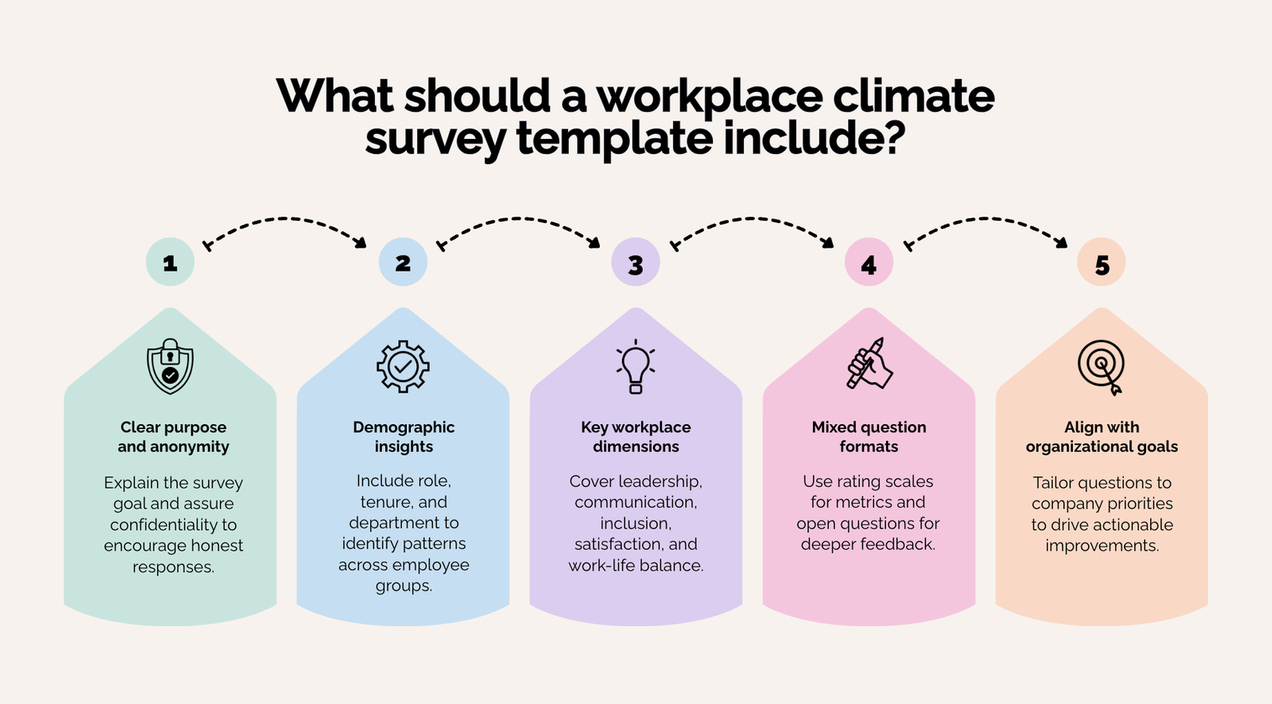



Anonymous employee survey in financial services: A practical guide for banks and financial institutions in 2026

An anonymous employee survey in finance services is a structured feedback system that allows employees in banks and financial institutions to share honest input without revealing their personally identifiable information.
In regulated environments, fear of retaliation and strict compliance structures often suppress open criticism. Generic employee surveys for banks fail because they overlook small team exposure, data privacy controls, and reporting hierarchies.
A compliance-safe employee survey protects identity through response thresholds, restricted dashboards, and controlled data access. When implemented correctly, it improves survey participation in financial services and surfaces early signals of conduct risk, burnout, and cultural strain before they escalate.
The sections ahead outline how to design and implement anonymous employee surveys without compromising trust or compliance while fostering better engagement.


- An anonymous employee survey in finance services is a structured system that lets bank employees share honest feedback without revealing identity.
- In banking environments, anonymity reduces fear of retaliation and surfaces hidden ethical, and compliance concerns.
- Well-designed surveys detect conduct risk, burnout, and morale issues before audits, errors, or attrition spikes.
- Strong security, response thresholds, role-based access, and structured analysis convert feedback into operational insight.
- CultureMonkey enables secure anonymous listening with enterprise controls, audit-ready reporting, and HRIS integrations that turn feedback into measurable action.
Why anonymous feedback matters in financial services organizations
In financial institutions, silence in employee feedback is rarely neutral. It often reflects pressure, caution, or fear. In high-control workplaces, employees weigh every word against compliance rules and career impact.
An anonymous employee survey in finance services allows staff to share honest feedback without revealing identity, helping banks uncover engagement, workload, ethical, and compliance concerns that may otherwise stay hidden. This clarity strengthens decision-making inside real workplace conditions.
- Compliance pressure: Strict audit and regulatory scrutiny make employees cautious about raising concerns openly.
- Career risk perception: High-performance cultures create fear that honest feedback may affect ratings, bonuses, or promotion paths.
- Target versus ethics tension: Sales and revenue goals can conflict with compliance standards, discouraging transparent reporting.
- Hierarchical reporting lines: Layered structures limit upward communication, especially in large banks and financial institutions.
- Small team exposure: In small finance branch employees, employees worry their responses can be traced without a safe employee feedback system.
Why employees in banking and financial services hesitate to share honest feedback

In banking and financial services, every action is recorded, reviewed, and evaluated. When employee engagement survey feedback feels traceable, caution replaces candor in the workplace.
These realities explain the challenges of employee surveys in banking and why employee surveys for banks and financial institutions often struggle to generate increasing honest feedback in finance services across daily operations.
- Fear of retaliation: Employees worry honest responses may affect ratings, bonuses, or promotion decisions in high-pressure finance roles.
- Distrust in confidentiality: Past survey efforts create doubt about data privacy compliant employee feedback in future surveys and whether anonymity is truly protected.
- Manager visibility concerns: Staff question whether supervisors can trace answers, especially in small teams.
- No visible action: When previous feedback led to little change, confidence in running anonymous employee surveys in banks declines.
- Performance-driven company culture: Aggressive targets discourage openness and weaken employee engagement in financial services.
Anonymous surveys can be distributed through various methods, including web links, QR codes, or private emails.
Where anonymous surveys drive the biggest impact in financial institutions
Operational blind spots in financial institutions rarely appear first in dashboards. They surface in behavior, sentiment, and small warning signs across teams.
Implementing anonymous employee surveys in financial institutions strengthens risk visibility. When supported by compliance safe employee surveys for banks and designing anonymous surveys for finance teams, leadership gains structured insight that improves control and decision quality.
- Surface ethical pressure and misconduct signals early, reducing regulatory penalties and reputational damage.
- Identify burnout and workload imbalance before errors, client complaints, or productivity decline increase.
- Detect branch-level morale issues that directly affect service quality and revenue consistency.
- Track restructuring or merger sentiment shifts using anonymous pulse surveys in banking to stabilize performance.
- Address recurring manager behavior concerns while protecting employee identity in small finance teams to prevent attrition spikes.
How to design anonymous employee surveys for financial services organizations
Design determines whether an anonymous employee survey in finance services builds trust or creates suspicion. In regulated environments, poorly structured employee engagement surveys reduce credibility and participation.
Employee surveys for banks and financial institutions must reflect compliance realities, performance pressure, and small team exposure. Generic templates weaken increasing honest feedback in finance services.
Designing anonymous surveys for finance teams requires clarity, restraint, and operational alignment. The goal is simple, safe feedback that supports employee engagement in financial services without creating risk.
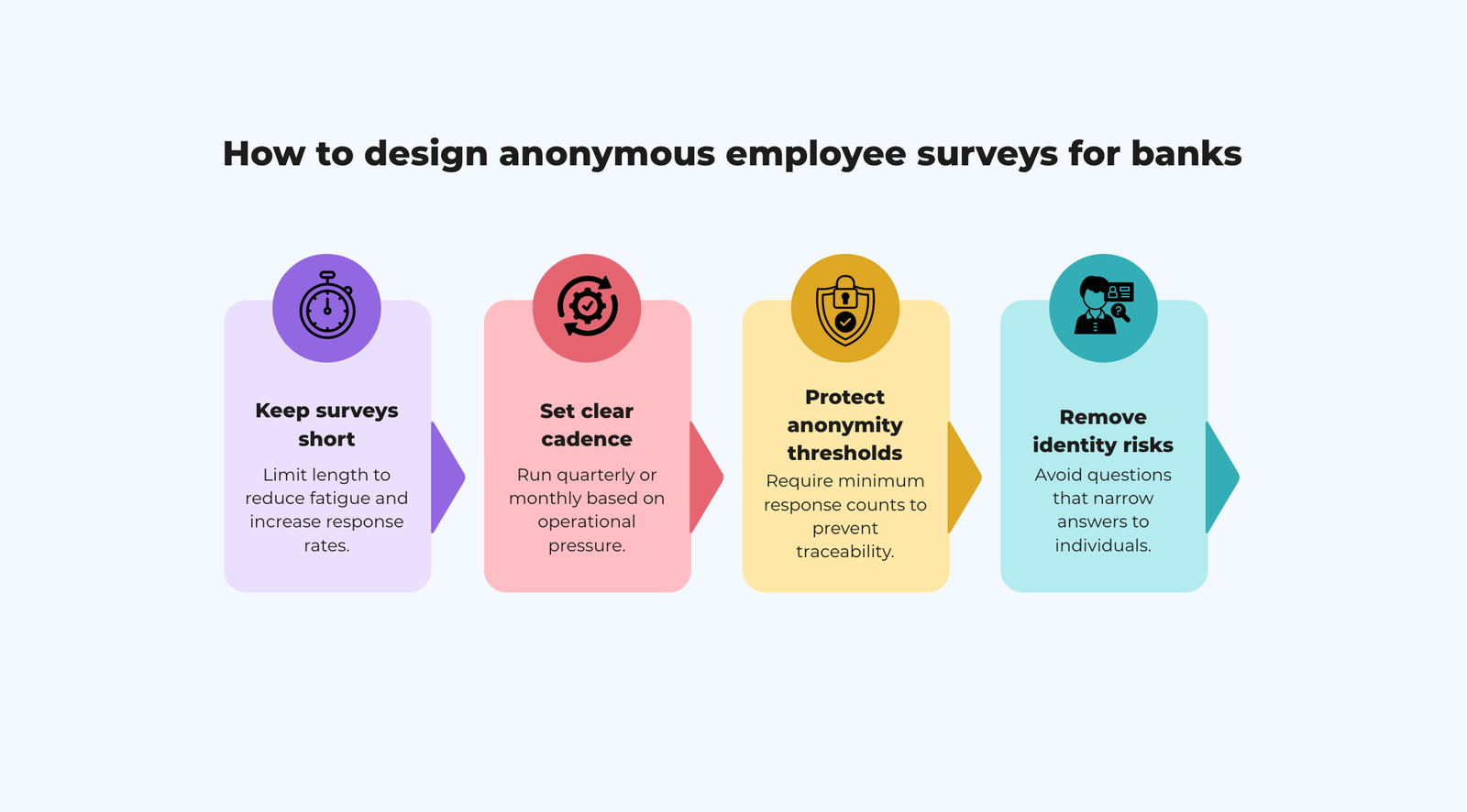
Core survey design principles
- Use short and focused surveys to prevent survey fatigue and improve survey participation in financial services.
- Maintain a quarterly or monthly cadence depending on operational pressure levels.
- Enforce department-level anonymity thresholds to protect employee identity in small finance teams.
- Avoid identity-exposing questions that narrow responses to specific roles or individuals.
Security and compliance considerations for BFSI surveys
Security credibility determines employee response honesty. Without visible safeguards, employees doubt data privacy compliant employee feedback systems.
Running anonymous employee surveys in banks requires enterprise safeguards aligned with regulatory scrutiny. Security architecture directly influences participation and trust.
- Ensure GDPR and regional compliance alignment across jurisdictions where financial institutions operate.
- Maintain SOC 2 and enterprise-grade security standards for survey platforms.
- Implement end-to-end encryption of survey responses during transmission and storage.
- Restrict insights through role-based reporting access controls to prevent misuse.
- Provide secure data hosting options aligned with regulatory requirements.
Survey length should be kept under 15 minutes to maximize participation rates.
Best anonymous employee survey topics for financial services employees
Topic selection determines whether an anonymous employee survey in finance services produces real risk insight or generic engagement data. Financial institutions require focused themes tied to regulation, performance pressure, and trust.
Clear thematic categories support improving survey participation in financial services and clarify how anonymous surveys improve employee honesty by reducing fear and confusion in feedback processes.
Ethical and compliance climate
Comfort in raising concerns reflects whether compliance culture functions effectively under daily pressure in financial institutions and revenue-driven environments.
Why this reduces compliance risk in banking
- Identifies gaps between written policies and daily practices across regulated teams.
- Surfaces hesitation in reporting conduct concerns before escalation.
- Strengthens alignment between engagement data and compliance oversight.
Anonymity helps to eliminate social desirability bias, leading to more candid responses.
Workload and burnout signals
Sustained workload pressure in banking roles affects judgment quality, client handling standards, and long-term operational resilience.
Why this protects service quality
- Detects prolonged stress in revenue-driving or frontline roles.
- Connects workload strain to rising operational errors.
- Supports leadership intervention before attrition increases.
Survey questions should be clear, actionable, and free of bias to gather meaningful feedback.
Leadership transparency and trust
Clarity to make informed decisions and fairness in communication directly influence employee confidence across regulated and performance-monitored environments.
Why this builds leadership credibility
- Reveals perception gaps between leadership intent and employee experience.
- Highlights areas where open communication reduces uncertainty.
- Reinforces ethical tone at the top across financial institutions.
Demographic questions should be designed carefully to avoid identifying individuals in small teams.
Customer and sales pressure
Revenue targets and client expectations often create operational tension between performance goals and strict compliance obligations.
Why this prevents target-related misconduct
- Flags incentive structures creating ethical tension.
- Identifies pressure patterns influencing decision quality.
- Supports early mitigation of conduct and reputation risk.
Survey length and structure can impact participation rates, with shorter surveys generally yielding better results.
Recommended survey cadence for financial institutions
| Banking situation | Recommended cadence | Primary objective |
|---|---|---|
| High-pressure revenue and frontline teams | Monthly pulse survey | Detect burnout, ethical pressure, and conduct risk before compliance exposure increases |
| Stable operations and support functions | Quarterly survey | Monitor engagement stability and prevent gradual morale decline |
| Post-policy, audit, or incentive changes | 30–45 days after change | Assess impact on trust, workload strain, and compliance confidence |
| During restructuring or mergers | Monthly during transition | Track morale shifts and reduce attrition risk |
| Branches with rising errors or attrition | Targeted pulse within 30 days | Link engagement signals to performance and retention patterns |
How to analyze anonymous survey results across banking operations
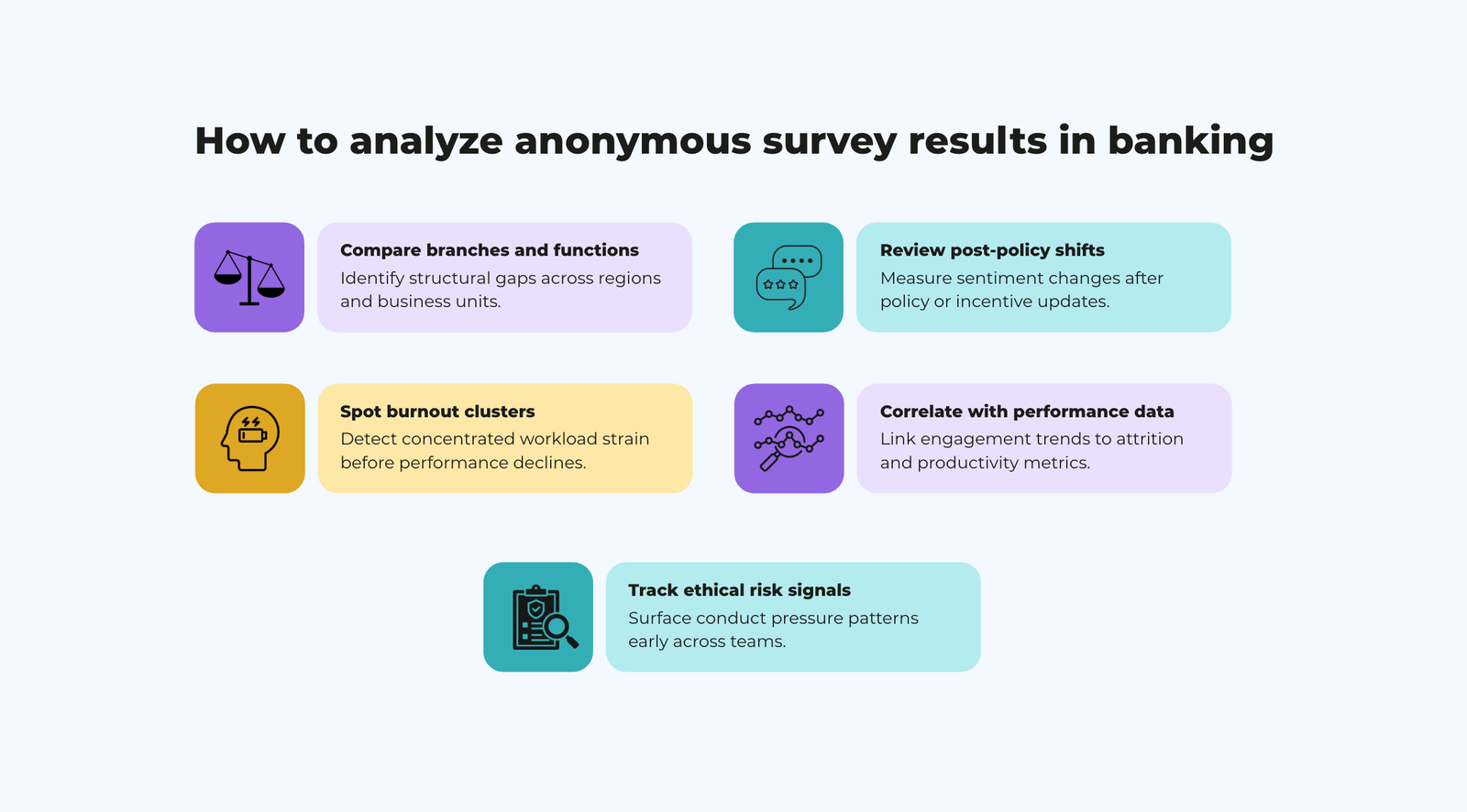
Analyzing anonymous engagement survey results across banking operations means translating employee sentiment into measurable operational intelligence that informs risk management, branch performance, compliance oversight, and workforce planning.
In regulated banking environments, analysis must connect actionable feedback trends with audit exposure, service quality, incentive pressure, and retention patterns. Without structured review, survey data collected remains descriptive instead of decision-ready.
Cross-branch and functional comparison
Engagement data must be reviewed across branches, regions, and central functions to reveal structural inconsistencies that affect service standards and internal controls.
Why this improves decision accuracy
- Identifies performance gaps linked to local management effectiveness and practices.
- Highlights structural strain between frontline and support functions.
- Prevents misinterpretation of issues as isolated events.
Anonymity in employee surveys encourages employees to share sensitive feedback they might hesitate to express in public forums.
Burnout risk concentration analysis
Sustained workload stress often clusters in specific units or roles before operational decline becomes visible.
Why this protects service reliability
- Detects concentration of fatigue in revenue-critical teams.
- Links stress levels to rising error frequency.
- Supports early staffing or workload redistribution decisions.
Anonymous surveys create psychological safety, allowing employees to express their thoughts without fear of judgment or retribution.
Ethical culture signal tracking
Recurring sentiment patterns can indicate pressure points in conduct, escalation comfort, and policy adherence.
Why this strengthens risk oversight
- Surfaces emerging compliance vulnerabilities across reporting lines.
- Connects behavioral sentiment with audit observations.
- Enables earlier intervention before regulatory scrutiny increases.
Organizations that address issues identified in anonymous surveys typically see improved employee retention rates within six months.
Post-policy impact monitoring
Major policy updates, restructuring decisions, and incentive revisions directly influence employee sentiment across regulated banking teams.
Why this validates leadership decisions
- Measures whether policy intent aligns with employee experience.
- Detects unintended stress or confusion after implementation.
- Supports corrective adjustments based on evidence.
Anonymous feedback often reveals systemic issues rather than personal grievances, providing organizations with more constructive criticism about management practices.
Performance and attrition correlation review
Survey findings gain depth when examined alongside retention rates, absenteeism trends, and measurable output indicators.
Why this strengthens workforce planning
- Identifies engagement decline preceding voluntary exits.
- Connects morale shifts to productivity fluctuations.
- Improves forecasting of operational risk trends.
The collective nature of anonymous feedback reveals patterns that individual conversations might miss, enabling leaders to make decisions better aligned with workforce sentiment.
Turning anonymous feedback into visible organizational improvements

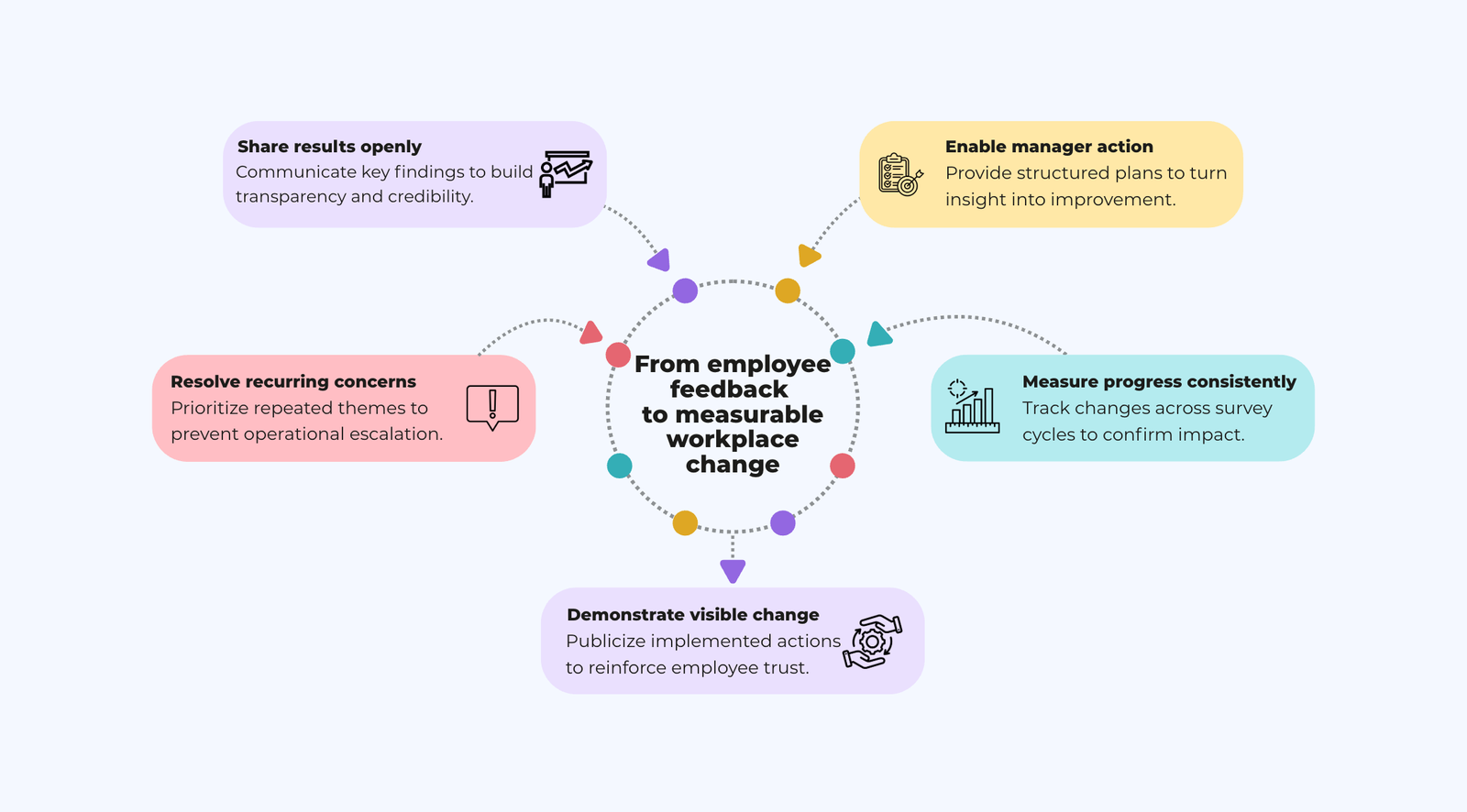
Survey distribution and collecting feedback signals company initiative intent. Acting on it signals leadership maturity. In banking environments, credibility depends on what changes after employee survey results are reviewed.
Organizations that move beyond survey collection treat feedback as operational input, not reputation management. Visible follow-through builds confidence across regulated, performance-driven workplaces.
- Communicate results transparently: Share high-level findings across branches and functions to demonstrate accountability and reduce speculation about hidden outcomes.
- Equip managers with action plans: Provide structured response plans so managers translate feedback into measurable team-level improvements and improve workplace dynamics.
- Address recurring workforce concerns: Prioritize repeated themes in previous surveys to prevent small issues from escalating into operational or compliance risks.
- Track improvements across survey cycles: Track progress over time to confirm corrective actions produce measurable cultural and performance shifts to show continuous improvement.
- Reinforce trust through visible action: Publicize implemented changes and act on practical strategies clearly so banking employees see feedback influencing real workplace decisions.
Choosing anonymous survey software for financial services organizations
Selecting survey software in banking is a risk decision. In regulated financial institutions, tools must withstand compliance scrutiny, data sensitivity, and enterprise oversight.
Evaluation at this stage should focus on operational safeguards. The right platform reduces exposure, protects employee identity, and supports defensible reporting in audit-driven environments.
- Enterprise-grade security and compliance readiness with encryption, regulatory alignment, and controlled authentication suited for highly regulated financial institutions.
- Anonymous response protection mechanisms that enforce response thresholds and prevent traceability in small banking teams when employees share negative feedback.
- Branch and department reporting capabilities enabling leadership to compare performance patterns without exposing individual responses.
- Role-based access controls allow HR, compliance, and executive teams to view relevant insights while safeguarding anonymity so that the employees don't face negative consequences for being honest in surveys.
- HRIS integrations connecting survey data with workforce metrics to support operational and retention planning.
- Audit-ready reporting and historical tracking maintaining documented visibility into engagement and conducting trends across survey cycles.
.webp)
Run Compliance-ready Employee Surveys for Banks
- Multi-lingual Surveys
- White Glove Onboarding
- People Science Backed Reports
- Enterprise Grade Security
Conclusion
Anonymous listening enables employees to share concerns safely in regulated environments where visibility and compliance pressure discourage open dialogue. It creates a structured channel for surfacing ethical risks, workload strain, and cultural gaps before they escalate.
Continuous feedback strengthens engagement, workplace culture, and workforce stability by giving leadership early, reliable signals instead of reactive audit surprises. Financial institutions that act consistently on feedback build stronger employee trust, credibility, and long-term retention.
Modern engagement platforms like CultureMonkey support banking-specific needs through enterprise-grade security, strict anonymity thresholds, role-based access controls, branch-level reporting, audit-ready analytics, and HRIS integrations that translate anonymous feedback into measurable, defensible action.
Book a demo with CultureMonkey.
FAQs
1. What is an anonymous employee survey in financial services?
An anonymous employee survey in financial services is a structured feedback mechanism that allows employees to share honest input without revealing their identity. It helps banks uncover engagement gaps, ethical concerns, workload pressure, and compliance risks that may remain hidden in formal reporting systems.
2. How do banks ensure employee survey anonymity?
Banks ensure anonymity by setting response thresholds, removing identifiable metadata, restricting dashboard access, and using encrypted platforms. Clear communication about data handling practices also reassures employees that individual responses cannot be traced back to them.
3. Are anonymous employee surveys compliant with financial regulations?
Yes, anonymous employee surveys can align with financial regulations when supported by strong data protection controls, audit-ready reporting, encryption, and access governance. Compliance depends on secure data storage, privacy safeguards, and alignment with regional regulatory standards.
4. How often should banks run anonymous employee surveys?
Most banks run surveys quarterly or monthly depending on operational pressure levels. High-stress functions benefit from more frequent pulse surveys, while stable divisions may require structured quarterly reviews to track cultural and compliance trends effectively.
5. Can anonymous surveys help detect compliance risks?
Yes, anonymous surveys can reveal early warning signs such as ethical pressure, reluctance to report concerns, or target-related stress. These signals often appear before formal complaints or audit findings, allowing earlier corrective action.
6. Do anonymous surveys improve employee participation in banks?
Participation improves when employees trust anonymity safeguards and see visible action taken on feedback. Clear communication, secure platforms, and consistent follow-through increase confidence and response rates across banking teams.
7. How can financial institutions build trust in surveys?
Trust is built by enforcing employee feedback to remain anonymous, limiting managerial visibility into raw responses, communicating results transparently, and demonstrating action based on feedback. Consistency between listening and response strengthens credibility over time.
8. Can anonymous surveys reduce banking attrition?
Anonymous surveys can reduce attrition by identifying burnout, leadership concerns, and cultural strain early. When institutions address these issues promptly without overwhelming employees, they are more likely to remain engaged and committed.
9. Who should access anonymous survey results?
Access should be role-based and not to be viewed by all corporate teams. Human resources, compliance, and senior leadership should review aggregated and valuable insights relevant to their responsibilities, while individual-level data remains restricted to protect anonymity and prevent misuse.
10. What software capabilities support anonymous surveys in BFSI organizations?
Effective platforms provide enterprise security, encryption, response threshold controls, role-based access, audit-ready reporting, branch-level analytics, and HRIS integration to ensure compliance, confidentiality, and operational insight.