


Anonymous eNPS surveys: How they work

An anonymous eNPS survey is a method of collecting employee net promoter score feedback through a survey without linking responses to individual identities.
Honest eNPS results depend on whether employees trust that their responses are truly anonymous. When anonymity is credible, response bias drops and feedback becomes more accurate.
This guide explains how anonymous eNPS surveys work, why anonymity directly impacts trust and data quality, and how to design them so feedback remains both protected and reliable.


- An anonymous eNPS survey collects employee feedback without linking responses to identities, ensuring honest and unbiased input.
- Anonymity builds psychological safety, increasing participation and improving honest, candid feedback quality.
- Aggregation, thresholds, and data masking prevent responses from being traced to individuals.
- Poor setup, over-segmentation, or small teams can break anonymity and reduce trust in survey data.
- CultureMonkey enables secure anonymous eNPS surveys with aggregation, thresholds, and data controls for reliable insights.
What is an anonymous eNPS survey?
An anonymous eNPS survey is an employee net promoter score survey where responses are not linked to individual identities. It removes identifiable data and reports results in aggregated groups, ensuring employees cannot be traced. This allows organizations to collect honest employee sentiment while protecting anonymity and reducing response bias.
Promoters are categorized as those who rate 9-10, Passives as 7-8, and Detractors as 0-6. eNPS results range from -100 to +100 with a score above 0 considered acceptable, 10–30 good, and 50+ excellent. It also ensures personally identifiable information is not linked to survey responses.
Why anonymity matters in eNPS surveys
Anonymity matters in eNPS surveys because honest feedback depends on whether employees feel safe to share it. Without anonymity, responses in employee surveys are often filtered, cautious, or incomplete.
- Enables honest feedback: Employees share real concerns instead of safe or socially acceptable answers.
- Creates psychological safety: Reduces fear of retaliation from HR team, managers or colleagues.
- Improves response quality: Feedback becomes more specific, candid, and actionable.
- Increases participation: Employees are more likely to respond when identity is protected.
- Builds trust: Signals that anonymous employee feedback eNPS is meant for improvement, not surveillance.
- Uncovers honest feedback: Employees reveal real concerns instead of safe or socially acceptable answers.
This is especially important for sensitive topics, where employees may otherwise avoid sharing negative comments. Anonymous surveys help employees feel secure and speak freely, leading to honest responses and stronger employee engagement.
How anonymous eNPS surveys actually work

How anonymous eNPS works is by separating employee identities from responses and reporting employee survey feedback only in aggregated groups so individuals cannot be traced.
Response aggregation
- Responses are grouped by team or department, not shown individually.
- Results reflect collective sentiment, not individual feedback.
The eNPS is calculated using the formula: eNPS = % Promoters - % Detractors. Anonymous surveys help organizations identify issues sooner and understand trends across teams.
Minimum response thresholds
- Reports are only generated when a minimum response count (typically 5+) is met.
- Prevents managers from identifying responses in small groups.
eNPS surveys improve employee loyalty and retention when organizations use feedback to make tangible changes.
Employee data masking
- Identifiers like names, emails, and IP addresses are removed to protect anonymity and ensure anonymity in data collection.
- Feedback is stored without traceable personal data collected.
High participation rates in eNPS surveys lead to uncovering hidden systemic issues and improving workplace culture.
Controlled result access
- Managers see summarized results, not raw responses.
- Access is restricted to prevent misuse of accurate data.
These controls ensure individual responses cannot be traced back to a single employee. Anonymous employee surveys can help reduce turnover by making employees feel valued and heard.
Best practices for running anonymous eNPS surveys
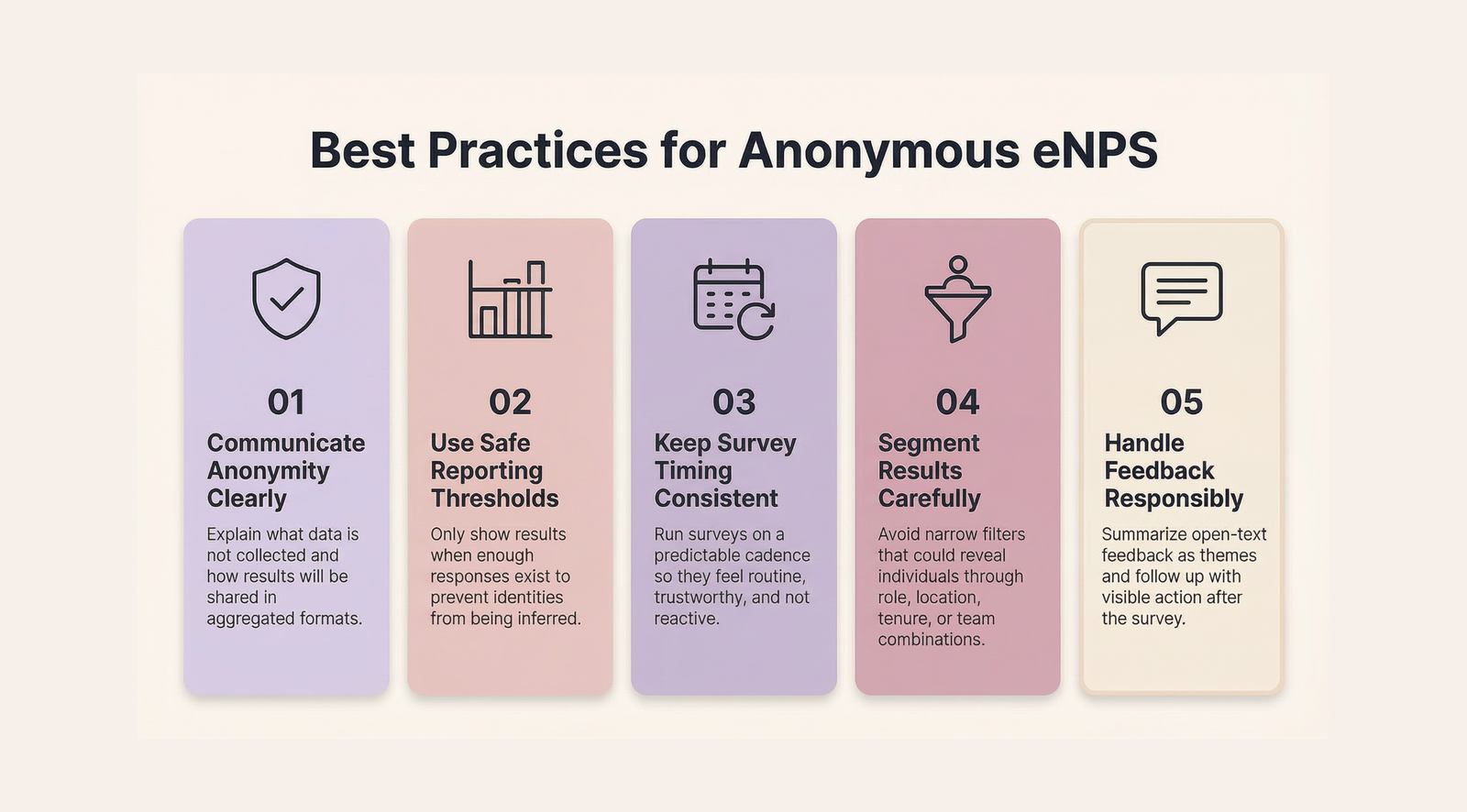
Anonymous eNPS best practices focus on protecting trust before, during, and after survey collection. The goal is to make anonymity in employee surveys believable, keep responses untraceable, and ensure feedback stays usable without exposing individuals.
Clear communication about anonymity
- Explain what data is not collected, such as names, emails, or identifiable metadata.
- Set expectations on how results will be shared in aggregated formats.
Regular pulse surveys help track changes in engagement after policy shifts or leadership changes.
Safe reporting thresholds
- Use minimum response thresholds before displaying results for any segment.
- Avoid reporting on small groups where identities can be inferred.
eNPS surveys uncover areas of dissatisfaction requiring immediate action, such as toxic culture or poor management.
Consistent and thoughtful survey frequency
- Maintain a predictable cadence so surveys feel routine, not reactive.
- Avoid over-surveying, which can reduce trust and response quality.
Use secure survey platforms with access controls to prevent unauthorized access to responses.
Careful use of segmentation
- Limit combining multiple filters like role, tenure, and location.
- Keep reporting broad enough to prevent indirect identification.
A concise, welcoming survey introduction can reassure employees that their feedback remains anonymous.
Responsible handling of open-text feedback
- Watch for comments that include self-identifying details.
- Share insights as themes instead of exposing individual phrasing.
Using a third party to conduct anonymous surveys can increase trust among employees.
Reinforcing trust after the survey
- Share findings at a grouped level without exposing small-team data.
- Follow up with visible actions to show feedback is used responsibly.
Transparency in how data is collected and stored helps build trust in confidential surveys and anonymous employee surveys. This approach improves data quality by ensuring survey data reflects real employee experience instead of filtered answers.
Common concerns about anonymity in eNPS

Common concerns about anonymity in eNPS come from whether employees can truly trust that their feedback and data cannot be traced back to respondents or linked across systems. When that trust is unclear in anonymous employee surveys, participation drops and responses become cautious, incomplete, or biased.
“Can managers identify my responses?”
Employees often fear that negative feedback could be traced back to them, especially in small teams or closely managed environments. Even indirect clues like role or writing style can create hesitation.
“Is eNPS data really anonymous?”
Many employees doubt whether surveys are fully anonymous, particularly if trust in leadership is already low. This concern is stronger in organizations with low trust or past data privacy issues. Past experiences with data exposure or lack of transparency can reinforce this skepticism.
“Can small teams stay anonymous?”
In smaller groups, anonymity becomes harder to maintain. Combining team size with filters like role or tenure can unintentionally reveal who gave certain feedback.
“Can anonymity be misused?”
Anonymous formats can sometimes lead to unfiltered or unconstructive responses. Without accountability, a small portion of feedback may be emotional or less actionable.
(Source: Gallup)
“Does anonymity limit follow-up?”
When feedback is fully anonymous, leaders cannot ask follow-up questions or clarify responses. This can make some insights harder to act on without additional context.
This helps gather feedback that is honest, actionable, and useful for measuring engagement over time. Anonymous surveys can uncover operational insights that help organizations improve processes and workflows.
Mistakes that break anonymity in eNPS surveys
Mistakes that break anonymity in eNPS surveys occur when survey design, setup, or internal behavior makes it possible to trace responses. When anonymity is compromised, participation drops, and feedback becomes cautious or biased.
- Over-segmentation of data: Breaking results into very small groups or combining filters like role, tenure, and team makes individuals identifiable.
- Small team reporting: Showing results for groups below minimum thresholds allows managers to infer who gave specific feedback.
- Excessive demographic questions: Collecting too many personal attributes increases the chance of linking responses to individuals.
- Open-text responses revealing identity: Employees may unintentionally include details that expose who they are through context or writing style.
- Tracking through links or metadata: Unique survey web links, IP tracking, or login-based systems can directly connect responses to employees.
- Incorrect survey settings: Failing to enable anonymity settings allows platforms to collect identifiable data without clear visibility.
- Internal handling of survey data: Running surveys internally or giving access to raw responses reduces trust, even if identities are technically hidden.
- Manager “detective” behavior: Attempting to guess who submitted feedback breaks perceived anonymity and discourages honesty in employee engagement surveys.
- Offline or identifiable collection methods: Paper surveys or in-person collection can expose identity through handwriting or submission context.
These issues reduce data accuracy and can impact employee satisfaction and trust in company surveys. Anonymous employee surveys help organizations identify trends and issues that may not be visible through traditional feedback methods.
Anonymous vs identifiable eNPS surveys
Anonymous vs identifiable eNPS surveys differ in how feedback is collected and used: anonymous eNPS prioritizes honest, safe responses, while identifiable eNPS enables follow-up and deeper analysis but depends on employee trust.
| Aspect | Anonymous eNPS surveys | Identifiable eNPS surveys |
|---|---|---|
| Identity visibility | No identifying data is linked to responses | Responses can be linked to individuals or roles |
| Honesty of feedback | Higher, as employees feel safe sharing critical views | May be lower if employees fear consequences |
| Participation rates | Typically higher due to trust in anonymity | Can be lower without strong trust culture |
| Follow-up ability | Not possible at an individual level | Enables direct follow-up on specific responses |
| Data depth | Limited to aggregated insights | Allows deeper segmentation and trend analysis |
| Risk of bias | Lower response bias | Higher chance of safe or neutral responses |
| Best fit | Low-trust environments or early-stage listening | High-trust organizations focused on actionability |
Key considerations
- Anonymity vs confidentiality: Many surveys are confidential, not fully anonymous, meaning data exists, but access is restricted. Confidential surveys allow for robust analytics and deeper statistical modeling due to linked responses.
- Transparency: Clearly explain how data is collected, stored, and shared to build trust. Confidential surveys are ideal for tracking trends over time and connecting feedback to the employee lifecycle.
- Actionability: Anonymous eNPS relies on acting on group-level insights rather than individual follow-up. Confidential surveys protect individual identities while allowing responses to be linked to personal information for analysis.
Anonymity in employee surveys helps surface sensitive issues that employees may hesitate to raise in public forums. The right choice depends on your work environment, leadership trust, and how your organization handles feedback and follow up.
Conclusion
Anonymous eNPS surveys work best when anonymity is trusted and consistently protected. Many organizations also use anonymous eNPS as part of a pulse survey strategy to track engagement trends over time. Building a credible anonymity framework ensures feedback reflects reality, not perception.
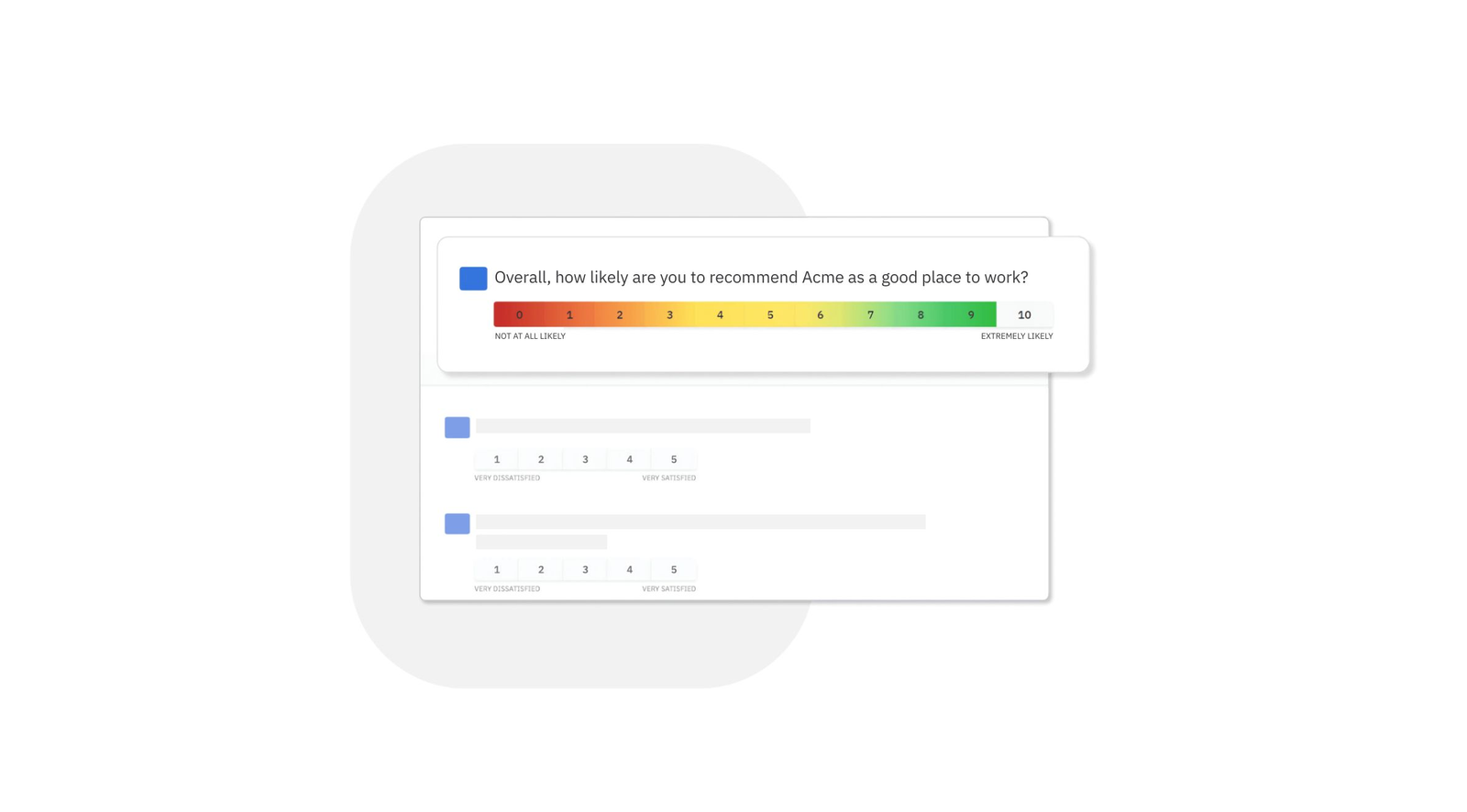
CultureMonkey supports anonymous eNPS surveys with features such as response aggregation, threshold controls, and secure data handling, helping organizations collect honest and candid feedback about employee engagement while ensuring confidentiality and secure data handling while maintaining trust and data reliability.
Book a demo with CultureMonkey.
FAQs
1. Are eNPS surveys really anonymous?
eNPS surveys are anonymous when identifying data is not collected, responses are grouped, and minimum thresholds prevent tracing individuals. Anonymity depends on proper setup, data controls, and clear communication so employees trust that their feedback cannot be linked back to them.
2. Can managers identify responses in eNPS?
No, managers cannot directly identify responses when thresholds and aggregation are applied. However, in small teams or with excessive segmentation, responses may be inferred. Poor setup, access to raw data, or tracking methods can increase the risk of identifying individuals in eNPS surveys.
3. What makes an eNPS survey anonymous?
An eNPS survey is anonymous when responses are not linked to identities, data is aggregated into groups, and minimum thresholds prevent tracing individuals. Identifiers like names, emails, and IP data are removed or masked, ensuring feedback cannot be connected back to specific employees.
4. Should eNPS surveys always be anonymous?
Yes, eNPS surveys should be anonymous when trust is low or feedback is sensitive, as it improves honesty and participation. The choice depends on balancing honest input with the need for deeper action. Anonymity encourages honest feedback on sensitive topics like workload, psychological safety, and fairness.
5. How do tools ensure anonymity in eNPS?
Tools ensure anonymity in eNPS by masking identifiers, aggregating responses, enforcing minimum thresholds, and restricting access to raw data. They prevent tracking through links or metadata and display only grouped insights so individual feedback cannot be traced back to specific employees.
6. What happens if anonymity is broken?
If anonymity is broken, employee trust declines, participation drops, and responses become cautious or biased. Employees may avoid sharing honest feedback, leading to incomplete or misleading data. This reduces the reliability of eNPS insights and weakens decision making across teams.
7. Can small teams run anonymous eNPS surveys?
Yes, small teams can run anonymous eNPS surveys, but anonymity is harder to maintain due to limited group size. To reduce risk, organizations must use higher response thresholds and avoid detailed segmentation so individuals cannot be identified from context or combined attributes.
8. Does anonymity improve response rates?
Yes, anonymity improves response rates by reducing fear of retaliation and increasing trust in the process. When employees believe their feedback cannot be traced, they are more likely to participate and share honest opinions, leading to higher quality and more reliable eNPS data.