



30 Employee climate survey questions to understand workplace culture

An employee climate survey questionnaire is a structured set of questions designed to measure how employees experience their workplace culture, leadership practices, communication, and day-to-day work conditions.
HR leaders often look for an employee climate survey when retention concerns grow.
This guide explains what should be included in an employee climate survey questionnaire, using tested frameworks that help organizations capture meaningful climate survey signals and understand their workplace more accurately.


- Employee climate surveys capture employee sentiment and uncover workplace challenges.
- They focus on areas like leadership, communication, trust, inclusion, and well-being.
- Surveys should be anonymous, concise, actionable, and aligned with goals.
- Use a mix of scaled and open-ended questions for balanced insights.
- CultureMonkey helps run structured employee climate surveys with templates, anonymous feedback, AI insights, and dashboards that turn climate signals into action.

The Complete Playbook for
Employee Climate Surveys
Download now
What is an employee climate at work?

Employee climate at work refers to how employees collectively perceive their workplace environment, including leadership behavior, communication, fairness, trust, and everyday work conditions. It reflects how organizational policies and management practices influence employee experience.
A positive employee climate indicates supportive leadership, clear communication, and psychological safety, while a negative climate may signal issues such as poor management practices, low trust, or unclear expectations that affect morale, collaboration, and overall workplace performance.
Why would an organization want an employee climate survey done?
An employee climate survey is a practical way for organizations to understand how employees really feel about their workplace. It gives honest, actionable insights to improve culture, engagement, and overall business success.
- Identifying organizational blind spots: Employee climate surveys reveal underlying issues or gaps in the work environment that leadership may not be aware of. These hidden challenges, such as ineffective processes or misaligned policies, can be addressed proactively to prevent larger disruptions.
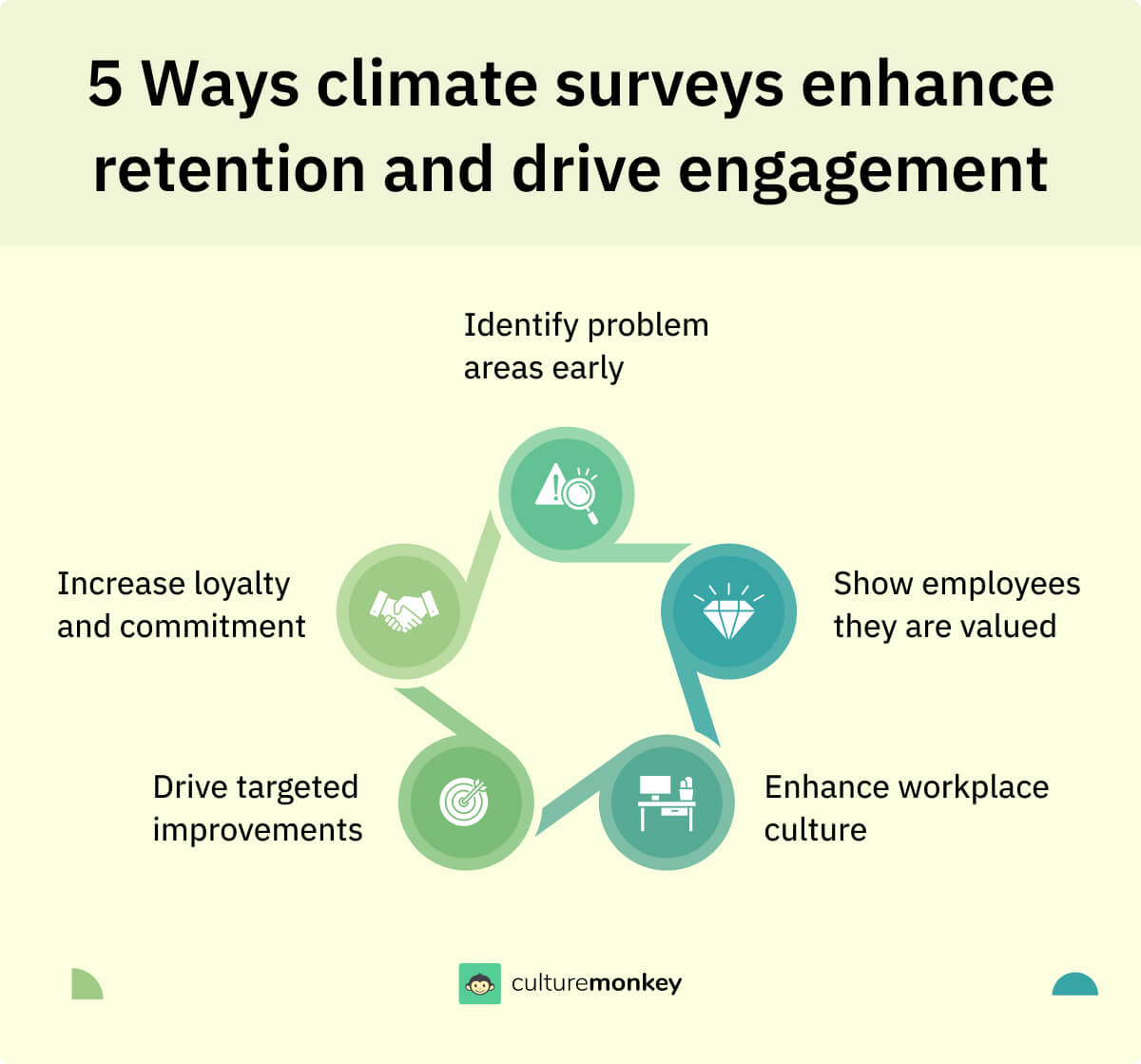
- Enhancing employee engagement and retention: By understanding what motivates employees and what challenges they face, organizations can implement targeted strategies to boost engagement. An engaged workforce is more productive, committed, and less likely to leave the organization.
- Promoting transparency and trust: Conducting a climate survey signals to employees that their opinions are valued. When organizations act on feedback, it builds trust and fosters an environment of open communication.
- Improving leadership effectiveness: Surveys provide direct insights into how leadership is perceived by employees. This allows organizations to identify gaps in leadership effectiveness and implement training or changes to improve managerial support.
- Guiding organizational growth: Climate surveys serve as a diagnostic tool for assessing whether workplace practices align with organizational goals. This ensures the culture and employee experience evolve to meet future business needs.
30 Employee climate survey questions in 6 categories (2026)

Creating an effective employee climate survey is crucial for understanding the pulse of your organization and fostering a positive workplace environment.
Before reviewing the questions, it helps to understand how climate surveys differ from other employee surveys.
| Survey type | What it measures | When to use | Insight produced |
|---|---|---|---|
| Employee climate survey | Employee perceptions of leadership, communication, and workplace environment | To understand overall workplace climate | Reveals morale patterns and workplace climate signals |
| Organizational climate survey | Company policies, management practices, and work conditions | To evaluate structural workplace factors | Identifies systemic issues affecting the work environment |
| Employee engagement survey | Motivation, commitment, and discretionary effort | To measure engagement and retention risk | Highlights drivers of engagement and productivity |
| Employee satisfaction survey | Satisfaction with role, compensation, and benefits | To evaluate job satisfaction levels | Identifies dissatisfaction and turnover risk |
| Pulse survey | Short, frequent feedback on specific topics | To track sentiment between larger surveys | Detects emerging workplace concerns early |
Here's a well-crafted, complete employee climate survey questionnaire with 30 questions to ask your employees in 2026:
1. Job satisfaction and role clarity
Measures whether employees understand their responsibilities and feel complete and aligned with their work.
- How satisfied are you with your current role and responsibilities?
- Do you feel your workload is manageable and reasonable?
- How clear are your job expectations and responsibilities?
- Do you feel your role makes good use of your skills and abilities?
- Are you provided with the tools and resources needed to perform your job effectively?
2. Workplace environment and well-being
Evaluates how employees experience the day-to-day work environment.
- On a scale of 1–10, how would you rate the overall work environment?
- Do you feel safe and comfortable in your work environment or remote setup?
- How satisfied are you with your work-life balance?
- Do you feel the organization supports employee well-being and mental health?
- How well does the company support employees during periods of high workload?
3. Leadership and management effectiveness
Assesses how leadership behavior influences the workplace climate.
- How well does your immediate manager support your professional growth?
- How satisfied are you with the leadership and direction provided by senior management?
- How effectively does leadership communicate company goals and priorities?
- How approachable and accessible do you find senior leadership?
- How well does leadership handle employee concerns or workplace issues?
4. Communication and transparency
Examines whether information flows clearly across the organization.
- How effective are communication channels within the organization?
- How transparent is communication about company changes or decisions?
- Are company-wide updates from leadership clear and helpful?
- How effective are internal tools used for collaboration and communication?
- Do you feel informed about important organizational developments?
5. Recognition, feedback, and growth
Measures whether employees feel valued and supported in their development.
- Do you feel your contributions are recognized and appreciated?
- How effective is the feedback and performance review process?
- Do you receive helpful feedback that supports your development?
- Are there sufficient opportunities for professional growth or learning?
- Are there clear opportunities for career advancement within the organization?
6. Culture, trust, and inclusion
Captures deeper signals about company culture and employee trust.
- Do you feel your opinions are valued in decision-making processes?
- Do you believe the organization fosters a culture of trust and transparency?
- How inclusive is the workplace in respecting diverse perspectives?
- How well does the organization respond to employee feedback or suggestions?
- Overall, how likely are you to recommend this organization as a great place to work?
Research-Backed Employee Climate Survey Questions to Ask Your Employees
Download nowHow do you assess workplace climate?

Assessing workplace climate means taking a closer look at how employees actually feel about their day-to-day work environment and culture. It’s about understanding their experiences, spotting what’s working, and uncovering areas that need improvement to create a more positive, supportive, and productive atmosphere for everyone.
- Employee surveys and feedback systems: Conduct regular surveys and establish anonymous feedback channels to measure satisfaction, engagement, and well-being while fostering open communication.
- Leadership assessment: Evaluate leadership styles and accessibility to ensure leaders are supportive, empathetic, and approachable.
- Team dynamics and communication: Observe team interactions and evaluate communication channels to promote collaboration, inclusivity, and transparency.
- Workplace policies and practices: Review policies on diversity, inclusion, flexible work, and employee well-being to ensure they are up-to-date and effective.
- Performance management: Analyze the fairness and transparency of performance evaluation processes to boost morale and recognition.
- Physical work environment and safety: Examine the physical workspace and safety protocols to provide a comfortable and secure environment.
- Retention and turnover analysis: Evaluate retention rates and conduct exit interviews to identify workplace climate issues and areas for improvement.
- External reputation: Monitor employer branding and social media presence to assess external perceptions and the organization’s reputation as a workplace.
What are the benefits of measuring workplace climate?

Checking in on your workplace climate isn’t just a nice-to-have — it’s a smart way to understand what employees really need to thrive. By gauging the environment, you can create a happier, more engaged, and more resilient team that drives lasting success.
- Employee engagement: Understanding workplace climate helps identify factors affecting employee engagement. A positive climate, with open communication and supportive leadership, enhances engagement, leading to increased productivity and job satisfaction.
- Retention and recruitment: Positive workplace climates contribute to employee retention. Organizations prioritizing a healthy environment attract and retain top talent. A positive reputation for a good workplace climate can be a powerful recruitment tool.
- Increased productivity: A favorable climate encourages collaboration, creativity, and a sense of purpose among employees. A motivated workforce is likely to be more productive, contributing to the overall success of the organization.
- Identifying issues: Regular climate assessments unveil potential issues early on, allowing management to address concerns before they escalate. Whether it's communication breakdowns, conflict resolution, or workload management, understanding the climate aids in proactive problem-solving.
- Enhanced communication: Gauging workplace climate involves gathering feedback from employees. This process fosters open communication channels, giving employees a platform to express their opinions, concerns, and ideas. Improved communication builds trust between employees and management.
- Wellness and mental health: A positive workplace climate prioritizes employee well-being. Monitoring the climate enables organizations to identify stressors and implement wellness programs. Addressing mental health concerns contributes to a healthier and more satisfied workforce.
- Innovation and creativity: A supportive climate encourages employees to share ideas and take risks without fear of reprisal. This fosters a culture of innovation and creativity, as employees feel valued and empowered to contribute to the organization's growth.
- Adaptability to change: Organizations with a clear understanding of their workplace climate are better equipped to navigate change. Organizations can implement strategies to ease transitions and maintain morale by knowing how employees perceive changes.
Mistakes in designing employee climate survey questions
Crafting a good climate survey requires strategy, yet many teams make avoidable mistakes that undermine their efforts. Here’s what to watch out for when creating your employee climate survey questions, so your organizational climate assessment delivers meaningful, actionable results employees can trust.
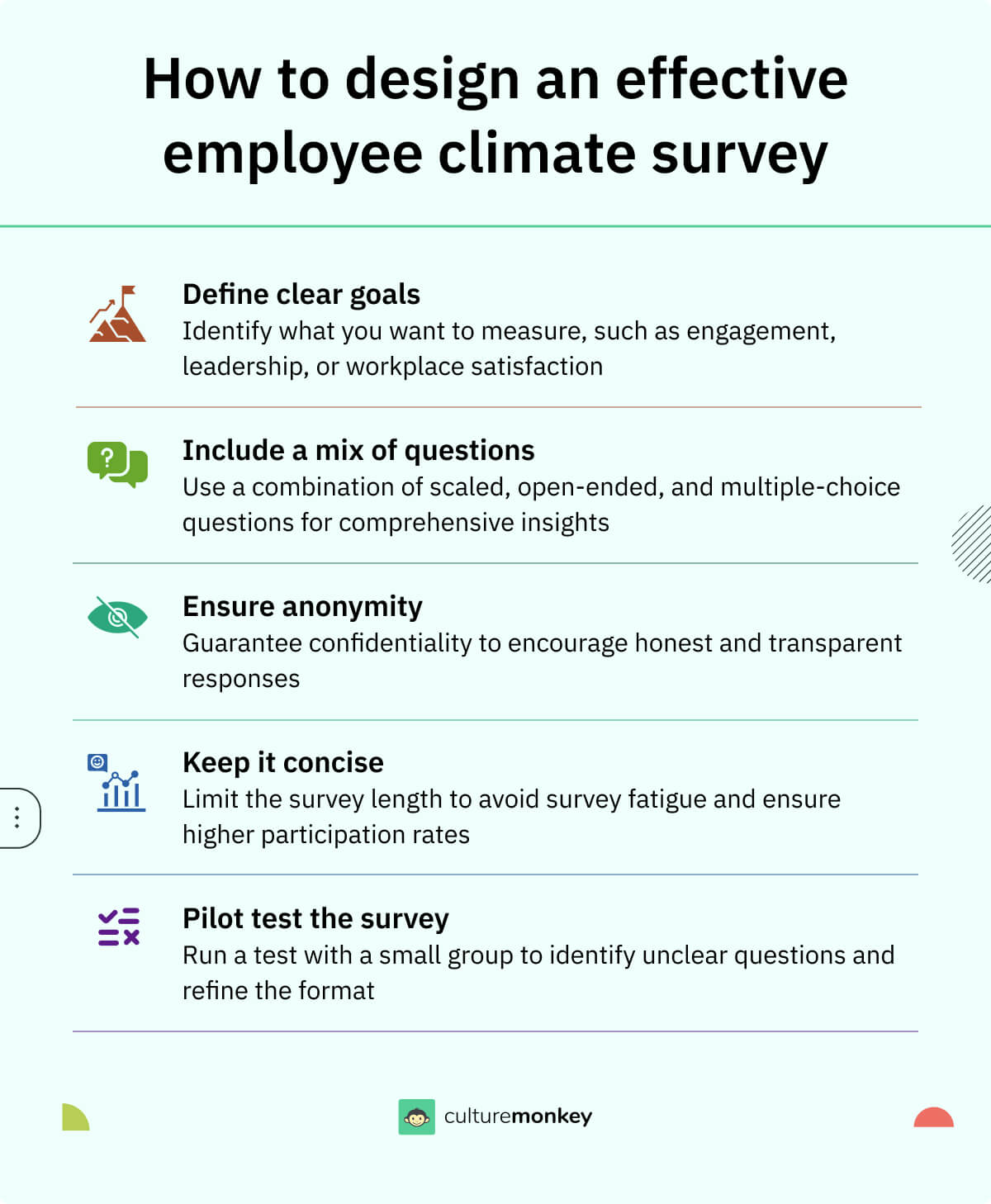
- Overloading with too many questions: While it’s tempting to cover everything, an excessively long survey overwhelms respondents and reduces completion rates. Keep your employee climate survey template focused, with only the most relevant and impactful questions.
- Vague or ambiguous wording: Poorly worded organizational climate survey questions confuse employees and lead to inconsistent answers. Be specific and clear in what you’re asking to ensure feedback accurately reflects the workplace environment you’re assessing.
- Ignoring anonymity and psychological safety: Employees won’t answer honestly if they fear retaliation. If you’re wondering what a climate survey is, remember it’s about candid feedback, so stress confidentiality and make sure the process feels safe.
- Skipping pilot testing: Launching without testing is risky. Before rolling out to the full team, pilot your employee climate survey template with a small group to catch unclear language or technical glitches.
- Failing to align with organizational goals: Your organizational climate assessment should tie back to company culture and strategy. Generic or disconnected employee climate survey questions fail to surface the insights leaders need to make informed improvements.
- Neglecting open-ended feedback: Surveys that only use rigid multiple-choice options miss rich qualitative insights. Include space for comments alongside structured organizational climate survey questions to capture employee voices more fully.

What is a climate survey?

A climate survey, also known as an organizational or HR climate survey, is a tool used to assess employee attitudes, perceptions, and experiences within the workplace. These surveys focus on critical areas like leadership, communication, organizational culture, employee satisfaction, and overall morale.
Typically conducted anonymously to encourage honest feedback, climate surveys use a mix of closed-ended questions (e.g., Likert scales) and open-ended questions to gather both measurable data and deeper insights. This allows organizations to identify strengths, uncover challenges, and understand the reasons behind employees’ perspectives.
The feedback gathered helps organizations make informed, data-driven decisions to improve workplace culture, guide change efforts, and address specific concerns. By conducting climate surveys regularly, companies demonstrate their commitment to employee engagement and creating a positive, supportive environment.
This ongoing evaluation ultimately drives employee well-being, productivity, and a healthier workplace culture, ensuring continuous improvement and organizational success.
Employee climate survey: Uses
Employee climate surveys are invaluable tools for organizations aiming to assess and improve workplace dynamics and employee satisfaction. Here are the key uses and benefits of conducting employee climate surveys:
- Measuring employee satisfaction: Climate surveys provide a structured approach to gauge overall employee satisfaction with various aspects of their roles, work environment, and organizational culture. This quantitative data helps identify areas of strength and areas needing improvement.
- Identifying issues and concerns: Climate surveys uncover underlying issues such as communication breakdowns, workload concerns, or dissatisfaction with management practices. By pinpointing these issues early, organizations can take proactive steps to address them before they escalate.
- Promoting open communication: Implementing regular surveys fosters a culture of open communication where employees feel valued and heard. This transparency encourages employees to voice their opinions, concerns, and ideas without fear of reprisal.
- Supporting decision-making: Data from climate surveys provides actionable insights that inform strategic decision-making. Whether it's refining policies, improving benefits, or reallocating resources, organizations can align their actions with employee feedback to drive positive change.
- Monitoring organizational culture: Climate surveys assess the alignment between stated organizational values and actual workplace practices. This helps maintain a positive organizational culture that promotes inclusivity, fairness, and respect among employees.
- Driving continuous improvement: Climate surveys facilitate a cycle of continuous improvement by measuring changes in employee perceptions over time. Trends identified through longitudinal survey data enable organizations to track progress and adjust strategies accordingly.
- Benchmarking and comparison: Climate surveys allow organizations to benchmark their performance against industry standards or competitors. Comparative analysis helps identify areas where the organization excels and areas needing improvement.
- Enhancing employer brand: A positive survey outcome can enhance the organization's employer brand, making it more attractive to prospective employees. Demonstrating a commitment to employee feedback and satisfaction can differentiate the organization in the competitive job market.
- Compliance and risk management: Climate surveys help ensure compliance with legal and regulatory requirements related to employee satisfaction, workplace safety, and fair employment practices. This proactive approach mitigates legal risks and promotes a harmonious work environment.
Models for the preparation of organizational climate survey questions

Several models guide the preparation of organizational climate survey questions, helping organizations measure culture, leadership, and equitable workplace conditions effectively. Below are key models and concepts for preparing climate survey questions:
Kirkpatrick’s Four-Level Model
Originally created for training evaluation, this model assesses four levels: employee reactions (e.g., satisfaction), learning (e.g., skill acquisition), behavior changes (e.g., teamwork), and results (e.g., workplace performance). It provides a structured way to connect employee feedback to measurable outcomes. By using this model, organizations can evaluate how employees perceive initiatives and how these impact behavior.
The Job Demands-Resources (JD-R) Model
This model focuses on balancing job demands (e.g., workload, deadlines) and resources (e.g., leadership support, training). Questions based on this model uncover stressors that can lead to burnout or disengagement. It also identifies areas where resources can be optimized to boost productivity. By addressing these imbalances, organizations can create a healthier, more supportive work environment.
Organizational Justice Model
The organizational justice model evaluates perceptions of fairness in workplace rewards, processes, and interpersonal interactions. It includes distributive justice (fair rewards), procedural justice (fair processes), and interactional justice (respect and dignity). Questions based on this model highlight inequities that may harm morale and engagement.
Competing Values Framework
This model categorizes organizational culture into four areas: clan (collaboration), adhocracy (innovation), market (results-driven), and hierarchy (structured processes). It assesses how employees perceive the company’s dominant culture and its alignment with organizational goals. By analyzing these perceptions, organizations can pinpoint cultural strengths and weaknesses.
Maslow’s Hierarchy of Needs Framework
This model evaluates whether an organization meets employee needs, such as safety, belonging, and self-actualization. Questions explore areas like job security, workplace relationships, and growth opportunities. By addressing unmet needs, organizations can improve morale and motivation. This model ensures that the workplace supports both professional and personal fulfillment.
.webp)
Improve Workplace Culture With Honest Employee Climate Feedback
- Multi-lingual Surveys
- Mobile & QR Distribution
- Omni-Channel Reminders
- Unified Employee Dashboard
Core dimensions in employee climate: Leadership, communication, well‑being, inclusion & trust
An effective organizational climate survey uncovers how employees truly feel across key areas that define a healthy workplace. Here are six core dimensions every climate survey should explore to build a more engaged, resilient, and inclusive culture.
- Leadership that inspires and guides: Leadership shapes the tone of the workplace. Good climate survey questions should assess how employees perceive their leaders’ vision, fairness, and ability to motivate, helping pinpoint gaps in alignment and trust.
- Open and transparent communication: Miscommunication breeds confusion and disengagement. Your climate survey should explore how well information flows across levels, whether employees feel heard, and if communication channels support honest dialogue.
- Employee well‑being and balance: Burnout is a real threat to morale. Include climate survey questions that assess workloads, stress management, and support for physical and mental health to ensure your team feels cared for and valued.
- Inclusion and belonging: A workplace thrives when everyone feels included. Your organizational climate survey must examine whether diversity is respected, contributions are recognized fairly, and all voices feel welcome in decision‑making.
(Source: PwC)
How do you measure workplace climate?

Measuring workplace climate is essential for organizations seeking to understand the overall health and dynamics of their work environment. A positive workplace climate fosters employee engagement, satisfaction, and productivity, while a negative climate can lead to increased turnover and decreased morale.
Here's why anonymous surveys are considered the best way to measure workplace climate:
- Encourages honest feedback: Anonymity allows employees to express their opinions and concerns candidly without fear of reprisal or judgment. This fosters open and honest communication, providing organizations with valuable insights into the prevailing sentiments within their workforce.
- Minimizes bias: By removing identifying information from survey responses, anonymous surveys help minimize bias and ensure that feedback is based solely on the individual's experiences and perceptions. This allows organizations to obtain a more accurate and representative picture of the workplace climate.
- Increases participation rates: Employees may be more inclined to participate in surveys when they can do so anonymously, as they feel reassured that their responses will remain confidential. Higher participation rates lead to a more comprehensive dataset, enhancing the reliability and validity of the survey results.
- Promotes psychological safety: Anonymity creates a sense of psychological safety, where employees feel comfortable sharing their honest opinions and experiences without fear of repercussions. This fosters trust between employees and management, facilitating more meaningful dialogue and collaboration.
- Facilitates actionable insights: Anonymous survey data allows organizations to identify areas of strength and opportunities for improvement within the workplace climate. Armed with actionable insights, organizations can implement targeted interventions and initiatives to address identified issues and enhance the overall employee experience.
- Pulse surveys: Implement regular pulse surveys to measure real-time fluctuations in the workplace climate. Short, frequent surveys provide quick snapshots of employee sentiments and allow organizations to promptly address emerging issues or trends.
- Qualitative interviews: Conduct qualitative interviews or focus groups with employees to delve deeper into specific aspects of the workplace climate. These interviews allow for richer, nuanced insights that may not be captured through quantitative surveys alone.
- Continuous feedback loops: Implement mechanisms for ongoing feedback collection beyond surveys and interviews. Tools such as suggestion boxes, virtual suggestion platforms, or feedback apps allow employees to provide real-time feedback on various aspects of the workplace climate, fostering a culture of continuous improvement.
- Benchmarking: Compare survey results and qualitative data with industry benchmarks or previous organizational data. Benchmarking helps organizations understand their relative performance and identify areas where they excel or lag, guiding targeted improvement efforts.

Clients do not come first. Employees come first. If you take care of your employees, they will take care of the clients.
Richard Branson



Founder at Virgin Group
How do you conduct an employee climate survey at work: 7 Best practices to follow

Employee climate surveys are vital tools for gauging the overall workplace atmosphere, identifying areas for improvement, and making decisions about ensuring employee satisfaction. Here are seven best practices to conduct a successful and insightful employee climate survey:
- Define clear objectives: Clearly outline the survey's purpose. Whether it's to measure job satisfaction, identify communication gaps, or assess leadership effectiveness, a well-defined objective ensures focused and actionable results.
- Ensure anonymity and confidentiality: Establish trust by assuring employees that their responses are anonymous. This encourages open and honest feedback, providing a more accurate reflection of the workplace climate.
- Craft well-designed questions: Formulate clear, specific, and unbiased questions to elicit meaningful responses. Mix quantitative and qualitative questions to gather both statistical data and in-depth insights into employee knowledge and sentiments.
- Use a mix of survey methods: Employ a combination of survey methods, such as online surveys, interviews, or focus groups, to accommodate different preferences and ensure respondents have a comprehensive understanding of the climate.
- Communicate transparently: Communicate the purpose, benefits, and expected outcomes of the survey to employees. Transparency fosters participation and helps employees understand how their input contributes to positive changes in the workplace.
- Regularly conduct surveys: Employee sentiments can change over time. Regularly conduct climate surveys to track trends, assess the impact of implemented changes, and adapt strategies accordingly. This ongoing feedback loop supports continuous improvement.
- Act on survey results: The most critical step is acting on the survey findings. Share the results transparently, acknowledge areas for improvement, and develop action plans collaboratively with employees. This demonstrates a commitment to their well-being and enhances trust in the organization.
What kind of questions do you ask in a workplace climate survey?

A workplace climate survey is your chance to really hear what employees think about their experience. The right questions can uncover how they feel about their roles, leaders, culture, and growth opportunities and where improvements are needed. It’s all about giving employees a voice and using their feedback to create a better workplace for everyone.
- Employee satisfaction and engagement: Focus on understanding how satisfied and motivated employees feel in their roles and with the workplace experience. These questions aim to uncover whether employees feel valued, appreciated, and aligned with the organization's goals.
- Communication effectiveness: Evaluate the clarity, transparency, and efficiency of communication within teams and across departments. Effective communication is crucial for collaboration, productivity, and ensuring employees feel informed about organizational updates.
- Leadership assessment: Assess employees’ perceptions of leadership in terms of support, accessibility, and decision-making. Strong leadership is often a key driver of trust, motivation, and alignment within the organization.
- Professional growth and development: Gauge opportunities for learning, skill-building, and career advancement. These questions assess how well the organization invests in employee development and provides constructive feedback.
- Work-life balance: Analyze whether employees feel supported in managing professional responsibilities alongside personal well-being. This includes examining flexibility in work arrangements and overall organizational support for mental and physical health.
- Diversity, inclusion, and fairness: Examine the organization's approach to promoting a diverse and inclusive environment. These questions also address fairness in policies, practices, and decision-making, ensuring equity for all employees.
- Health and well-being: Assess whether employees feel supported in managing stress and maintaining overall health. This includes access to wellness programs, mental health resources, and workplace safety measures.
- Organizational culture and morale: Understand the workplace atmosphere, team dynamics, and the culture's impact on collaboration, innovation, and belonging. A positive culture directly influences employee retention and satisfaction.
- Feedback opportunities: Identify whether employees feel empowered to share their opinions and whether there are sufficient channels for open dialogue. Constructive feedback processes help build trust and improve organizational practices.
- Overall improvement suggestions: Provide a platform for employees to highlight areas for change and suggest improvements. This fosters engagement by showing employees their input is valued in shaping the workplace environment.
Workplace climate survey template
A workplace climate survey works best when it’s thoughtfully designed to build trust and gather meaningful insights. A good template sets the tone, explains why the feedback matters, and reassures employees about confidentiality.
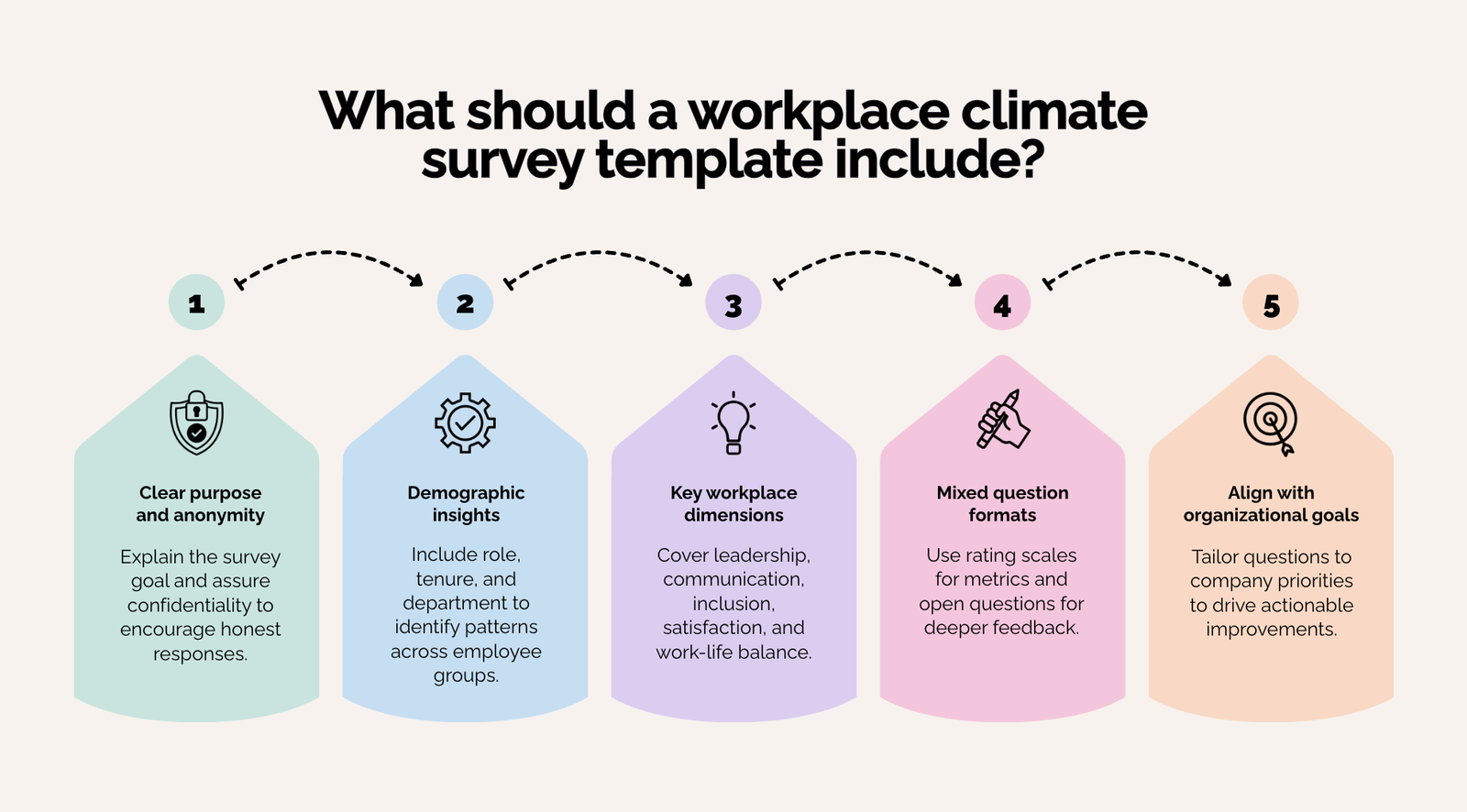
- Introductory section for purpose and confidentiality: Begin with a brief explanation of the survey’s purpose and assure employees of anonymity to encourage honest feedback. This fosters trust and increases participation.
- Demographic questions for segmented insights: Include questions about department, tenure, job role, and location to identify patterns or trends across different groups without compromising confidentiality.
- Key workplace dimensions: Address areas such as leadership effectiveness, communication clarity, diversity and inclusion, job satisfaction, and work-life balance. Ensure the questions are focused on specific aspects of the employee experience.
- Mix of quantitative and qualitative questions: Use Likert-scale questions to measure satisfaction and agreement levels while incorporating open-ended questions to gain deeper insights and actionable suggestions.
- Customization for organizational goals: Tailor the survey template to align with your company’s strategic objectives, ensuring relevance and a direct connection to actionable outcomes.
- Follow-up commitment: Add a closing note thanking employees for their input and highlighting the organization’s commitment to acting on the feedback received.
How can employees contribute to a positive organizational climate?

Creating a positive organizational climate is a collaborative effort that involves contributions from both management and employees. While leaders play a significant role in shaping the culture of an organization, employees also have a crucial part to play in fostering a supportive and thriving work environment.
Here are several ways in which employees can contribute to a positive organizational climate:
- Embrace open communication: Encouraging open and transparent communication among colleagues fosters trust, enhances collaboration, and reduces misunderstandings. Employees can contribute by actively participating in discussions, sharing their ideas and concerns, and providing constructive feedback to their peers and supervisors.
- Demonstrate respect and empathy: Treating colleagues with respect and empathy creates a welcoming and inclusive atmosphere where everyone feels valued and appreciated. Simple acts of kindness, such as active listening, offering assistance, and acknowledging the contributions of others, contribute to a positive organizational climate.
- Promote teamwork and collaboration: Actively participating in team projects, sharing knowledge and expertise, and offering support to colleagues fosters a sense of camaraderie and teamwork. By working together towards common goals, employees contribute to a positive and cohesive work environment.
- Maintain a positive attitude: Cultivating a positive attitude can have a contagious effect on the workplace, inspiring optimism and motivation among colleagues. Employees can contribute by approaching challenges with a solutions-oriented mindset, staying resilient in the face of adversity, and celebrating successes, both big and small.
- Embrace diversity and inclusion: Valuing and respecting the diverse backgrounds, perspectives, and experiences of colleagues contributes to a more inclusive organizational climate. Employees can contribute by actively promoting diversity and inclusion initiatives, challenging stereotypes, and fostering a culture of acceptance and belonging.
- Take ownership and accountability: Taking ownership of one's responsibilities and holding oneself accountable for their actions fosters a culture of accountability and trust. Employees can contribute by meeting deadlines, delivering high-quality work, and taking initiative to address issues proactively.
- Support organizational values: Aligning individual behaviors and actions with the values and mission of the organization reinforces its cultural identity and strengthens its reputation. Employees can contribute by upholding ethical standards, demonstrating integrity in their interactions, and embodying the core values of the organization in their daily work.
Steps to be taken post a staff climate survey to address the findings

The true measure of the survey's effectiveness lies in the actions taken in response to its findings. Here are a series of proactive steps that organizations should undertake after conducting a staff climate survey to address the identified issues and foster a positive workplace environment.
- Review and analyze results: Begin by thoroughly reviewing and analyzing the survey results. Identify trends, patterns, and areas of concern that emerge from the data. Pay attention to both quantitative metrics and qualitative feedback to gain a comprehensive understanding of the workplace climate.
- Identify priority areas: Prioritize the findings based on their impact and importance to the organization. Identify critical areas requiring immediate attention, such as low employee morale, communication breakdowns, or issues with diversity and inclusion.
- Engage stakeholders: Engage key stakeholders, including senior leadership, managers, and employees, in the process. Share the survey findings transparently and encourage open dialogue to solicit input and perspectives on potential solutions.
- Develop action plans: Collaboratively develop action plans to address the identified issues and improve the workplace climate. Set clear, measurable objectives and outline specific steps, timelines, and responsibilities for implementation.
- Implement interventions: Implement targeted interventions and initiatives to address the identified issues effectively. This may involve implementing training programs, revising policies and procedures, enhancing communication channels, or fostering a more inclusive work environment.
- Communicate progress: Communicate progress and updates on the implementation of action plans to all stakeholders. Maintain transparency throughout the process and solicit ongoing feedback to ensure alignment and effectiveness of interventions.
- Monitor and evaluate: Continuously monitor and evaluate the impact of interventions on the workplace climate. Track key performance indicators, solicit employee feedback, and conduct follow-up surveys to assess progress and identify areas for further improvement.
- Celebrate successes: Celebrate successes and milestones achieved in improving the workplace climate. Recognize and reward individuals and teams for their contributions to fostering a positive work environment.
- Address resistance and challenges: Address any resistance or challenges encountered during the implementation process promptly. Identify root causes, adapt strategies as needed, and provide support and resources to overcome obstacles.
- Commit to continuous improvement: Commit to a culture of continuous improvement by integrating feedback mechanisms and regularly revisiting the staff climate survey process. Encourage ongoing dialogue and engagement to sustain positive changes and drive long-term organizational growth and success.
AI & predictive analytics: Turning employee climate survey signals into action
Collecting feedback is only the first step—what truly matters is turning insights into meaningful change. Here’s how AI and predictive analytics help organizations transform staff climate survey results into actionable strategies for a better workplace.
- Identifying hidden patterns in feedback: AI uncovers trends that might not be obvious in a traditional climate survey for employees, such as subtle signs of disengagement or emerging concerns across teams, helping leaders act before problems escalate.
- Prioritizing issues with data‑driven clarity: Not every issue carries equal weight. AI analyzes workplace climate survey results to show which areas—like communication, inclusion, or well‑being—have the greatest impact on morale, enabling targeted interventions.
- Predicting future outcomes: Using past and present staff climate survey data, predictive analytics forecasts risks like turnover or burnout, giving leaders time to implement preventive measures that protect both employees and performance.
- Segmenting insights by teams or demographics: AI can break down climate survey for employees results by department, role, or tenure, highlighting specific pain points for different groups while preserving anonymity and ensuring tailored responses.
- Tracking the impact of actions over time: After acting on workplace climate survey findings, AI monitors ongoing feedback to measure improvements, showing whether initiatives truly enhance employee experience and where further tweaks are needed.
- Empowering leadership with real‑time dashboards: AI‑driven dashboards give managers clear, actionable insights from staff climate survey results at a glance, empowering them to lead with empathy, data, and confidence every day.
Role of an employee survey app in conducting climate surveys at work?

An employee survey app plays a pivotal role in conducting climate surveys at work, serving as a dynamic and efficient tool for gauging the overall workplace environment. Here's a breakdown of its crucial role:
- Accessibility and convenience: The app provides a user-friendly platform accessible to employees anytime, anywhere. This accessibility ensures a higher participation rate, leading to more comprehensive and representative data.
- Real-time feedback: An employee survey app enables the administration of climate surveys in real time. This immediacy allows organizations to promptly address emerging concerns, fostering a proactive approach to enhancing workplace satisfaction and addressing issues promptly.
- Anonymous responses: Many employee survey apps offer anonymity features, encouraging honest and open feedback. This anonymity promotes candid responses, crucial for obtaining accurate insights into the actual climate of the workplace.
- Customization and flexibility: These apps often allow organizations to customize surveys based on specific needs. This flexibility ensures that the survey aligns with organizational goals, addressing particular aspects of the work environment, such as leadership effectiveness, team dynamics, or work-life balance.
- Data analysis and reporting: Employee survey apps come equipped with advanced analytics tools. This functionality assists HR professionals and leaders in interpreting survey results effectively. Identifying patterns and trends supports informed decision-making for implementing targeted improvements.
- Engagement and gamification: Some apps incorporate gamification elements to boost employee engagement. Interactive features and gamified surveys can make the process more enjoyable, increasing participation rates and yielding more meaningful data.
- Cost-effectiveness: Conducting climate surveys through an app is often more cost-effective than traditional methods. It eliminates the need for paper, printing, and manual data entry, streamlining the entire survey process.
- Integration with HR systems: Integration capabilities with existing HR systems enhance the overall employee experience. Seamless connectivity ensures that survey data is aligned with broader HR analytics, facilitating a holistic understanding of the workplace climate.
Conclusion
An employee climate survey questionnaire helps organizations understand how employees actually experience the workplace. Well-structured questions reveal signals in leadership, communication, workload, and collaboration.
When these signals are measured consistently, HR leaders gain the evidence to address cultural gaps, improve policies, and strengthen the overall workplace climate.
CultureMonkey helps organizations run structured employee climate surveys with ready-to-use question templates, anonymous feedback collection, AI-driven insights, and manager dashboards that turn survey responses into clear climate signals and actionable improvement plans.

Book a demo with CultureMonkey.
FAQs
1. What is a staff climate survey, and why is it important for organizations?
A staff climate survey collects structured feedback about how employees experience leadership, communication, policies, and daily work conditions. It helps organizations understand workplace climate patterns, identify cultural risks, and detect issues affecting trust, morale, and productivity before they escalate.
2. How often should organizations conduct staff climate surveys?
Most organizations run a staff climate survey once a year to evaluate overall workplace climate trends. Some also use shorter pulse surveys quarterly to monitor changes in employee sentiment, track improvement initiatives, and identify emerging concerns during organizational changes or growth.
3. Can staff climate surveys help identify potential sources of workplace stress or burnout?
Yes. Staff climate surveys can reveal early signs of stress or burnout by measuring workload pressure, role clarity, support from managers, and work-life balance. These signals help organizations detect risk areas across teams and take targeted actions to prevent long-term fatigue, disengagement, or turnover.
4. How do staff climate surveys help promote employee well-being and mental health in the workplace?
Staff climate surveys promote employee well-being by capturing feedback on workload, support systems, psychological safety, and workplace culture. The insights help leaders identify gaps affecting employee mental health and implement policies, resources, and management practices that improve resilience at work.
5. Are staff climate surveys valuable for remote or hybrid work environments?
Yes. Staff climate surveys are especially valuable in remote or hybrid workplaces where informal feedback is limited. They help organizations understand communication gaps, workload pressure, collaboration challenges, and employee inclusion across distributed teams, ensuring leadership stays connected.
6. Who should be involved in creating the survey?
Creating a staff climate survey should involve HR leaders, senior leadership, and employee representatives. HR designs the methodology and questions, leadership aligns the survey with organizational priorities, and employee input ensures the questionnaire reflects real workplace experiences and concerns across teams.
7. How can HR encourage high participation rates in the survey?
HR can increase participation by explaining the purpose of the survey and how employee feedback will influence decisions. Ensuring anonymity, keeping the survey concise, offering mobile or multi-channel access, and sharing follow-up actions based on results helps build trust and encourages employees to participate.
8. How is a climate survey different from an engagement survey?
A climate survey measures how employees perceive leadership practices, policies, communication, and fairness. An engagement survey focuses on motivation, commitment, and connection to the organization. Climate surveys evaluate the workplace, while engagement surveys measure how employees respond to work conditions.
9. How many questions should we include in a climate survey?
Most climate surveys include about 25 - 40 focused questions. This range provides enough depth to measure leadership, communication, fairness, and workplace support while keeping the survey manageable. Shorter surveys improve completion rates while still generating clear insights into workplace climate patterns.
10. How do you analyze and act on climate survey data?
Organizations analyze climate survey data by reviewing patterns across teams, roles, or locations. Identifying recurring issues helps highlight gaps in leadership, communication, or workplace conditions. Sharing results transparently and implementing actions shows employees that their feedback leads to improvements.
11. What role does anonymity play in climate survey effectiveness?
Anonymity allows employees to share honest feedback without fear of retaliation. When employees trust that their identity is protected, responses tend to be more candid. This improves participation rates and helps organizations uncover deeper issues related to workplace culture, leadership, and employee experience.
12. What mistakes should HR avoid in running climate surveys?
Common mistakes include vague questions, overly long surveys, weak anonymity safeguards, and failing to share results. The biggest risk is collecting feedback but not acting on it. When employees see no visible change after surveys, trust declines and participation in future surveys often drops significantly.