


Employee engagement strategy for consulting organizations in 2026

Employee engagement strategy for consulting organizations is a structured approach to improving consultant retention, utilization stability, and client delivery outcomes. It aligns engagement with billable work cycles, role hierarchy, and performance incentives unique to consulting firms.
This guide presents a consulting firm employee engagement strategy built on tested frameworks used in consulting firm engagement strategy design. It explains employee engagement strategy for consulting firms using role-based segmentation, outcome-linked metrics, and execution models that go beyond generic engagement programs.


- Employee engagement strategy for consulting organizations aligns engagement with billable work, client outcomes, and role-based incentives to drive retention and revenue.
- Engagement functions as an execution layer tied to project cycles, not a standalone culture initiative.
- The Consulting Workforce Archetype Model segments engagement across client-delivery, internal specialists, and partners for role-specific design.
- Engagement drives client satisfaction, NPS, and repeat mandates when measured at project-level and triggered by events, not fixed surveys.
- CultureMonkey enables this through role-based segmentation, project analytics, and event-driven surveys aligned to consulting workflows.
Last reviewed: April 28, 2026. Sources checked: CultureMonkey industry benchmarks and linked editorial references.
What is an employee engagement strategy for consulting organizations?

An employee engagement strategy for consulting organizations is a structured system that aligns engagement with billable work, client outcomes, and role-based incentives. It uses role segmentation, project-based measurement, and event-driven feedback to improve consultant retention, utilization stability, and delivery quality.
In consulting firms, engagement must fit within project timelines and utilization constraints. It must also be segmented across client-delivery professionals, internal specialists, and partners, as each group operates under different incentives and visibility.
Most importantly, engagement is measured through delivery outcomes such as client satisfaction, NPS, and repeat mandates. This shifts engagement from a survey-driven activity to an operational system embedded in project cycles.
Why is employee engagement different in consulting firms?
Employee engagement is different in consulting firms because work is billable, delivery quality is client-visible, and retention depends on promotion velocity. That means engagement programs must follow project cycles, role structures, and utilization pressure rather than a generic annual HR calendar.
1. Billable workforce accountability defines engagement design
Measuring engagement through employee feedback must fit within billable time constraints. Employee engagement surveys and feedback must be short, role-specific, and aligned to project phases to avoid utilization loss and to stress on the fact that employees feel valued about their time.
2. Client-outcome accountability defines engagement measurement
Measuring engagement in employee feedback is reflected in delivery quality, timelines, job satisfaction and client satisfaction. A consultant engagement strategy must connect engagement data to project outcomes, not just internal sentiment.
3. Promotion-driven retention defines engagement focus
Retention depends on career progression across roles and projects. Engagement must reinforce visibility, skill growth, and readiness for the next level.
These factors define tool requirements
Role-based segmentation
Project-level analysis
Delivery context
Without these, tools will fail in consulting environments.
Why do generic engagement strategies fail in consulting environments?
Generic engagement strategies fail in consulting because they assume employees have spare desk time, similar incentives, and sentiment metrics that can stand alone. Consulting teams need short, role-specific, event-triggered feedback tied to staffing, delivery, and client outcomes.
- Office-designed surveys fail during peak utilization: Generic engagement programs rely on long, periodic surveys that assume desk time. In consulting firms, peak utilization limits participation, leading to low response quality and incomplete data.
- Single-strategy models fail across workforce archetypes: Consulting teams include client-delivery professionals, internal specialists, and partners with different incentives. A single approach makes insights difficult to act on at project or role level.
- Engagement measurement fails when disconnected from client outcomes: Generic strategies PS measure sentiment in isolation. In consulting firms, engagement of highly engaged employees must connect to delivery quality, timelines, job satisfaction and client satisfaction to be actionable.
Where generic engagement programs break in consulting firms
Engagement gaps in consulting firms are context-specific and driven by role, firm size, and delivery structure. This table shows where generic engagement programs fail and what consulting environments actually require.
What is the Consulting Workforce Archetype Model?

The Consulting Workforce Archetype Model is a 3-track framework for designing engagement by role. It separates client-delivery professionals, internal specialists, and partners so firms can tailor recognition, growth signals, and measurement to each group’s real engagement drivers.
Track 1: Client-delivery professionals are driven by intellectual challenge and project variety
Engagement must focus on exposure to higher-complexity work and varied projects that build capability across engagements.
Track 2: Internal-facing specialists are driven by role dignity and contribution visibility
Engagement must ensure their work is visibly linked to client delivery, with clear employee recognition of how internal expertise drives outcomes by tracking engagement metrics.
Track 3: Partner tier is driven by peer community and institutional trust
Engagement must reinforce alignment with firm direction, peer credibility, and confidence in leadership decisions to create a highly engaged workforce.
Consulting engagement operating model
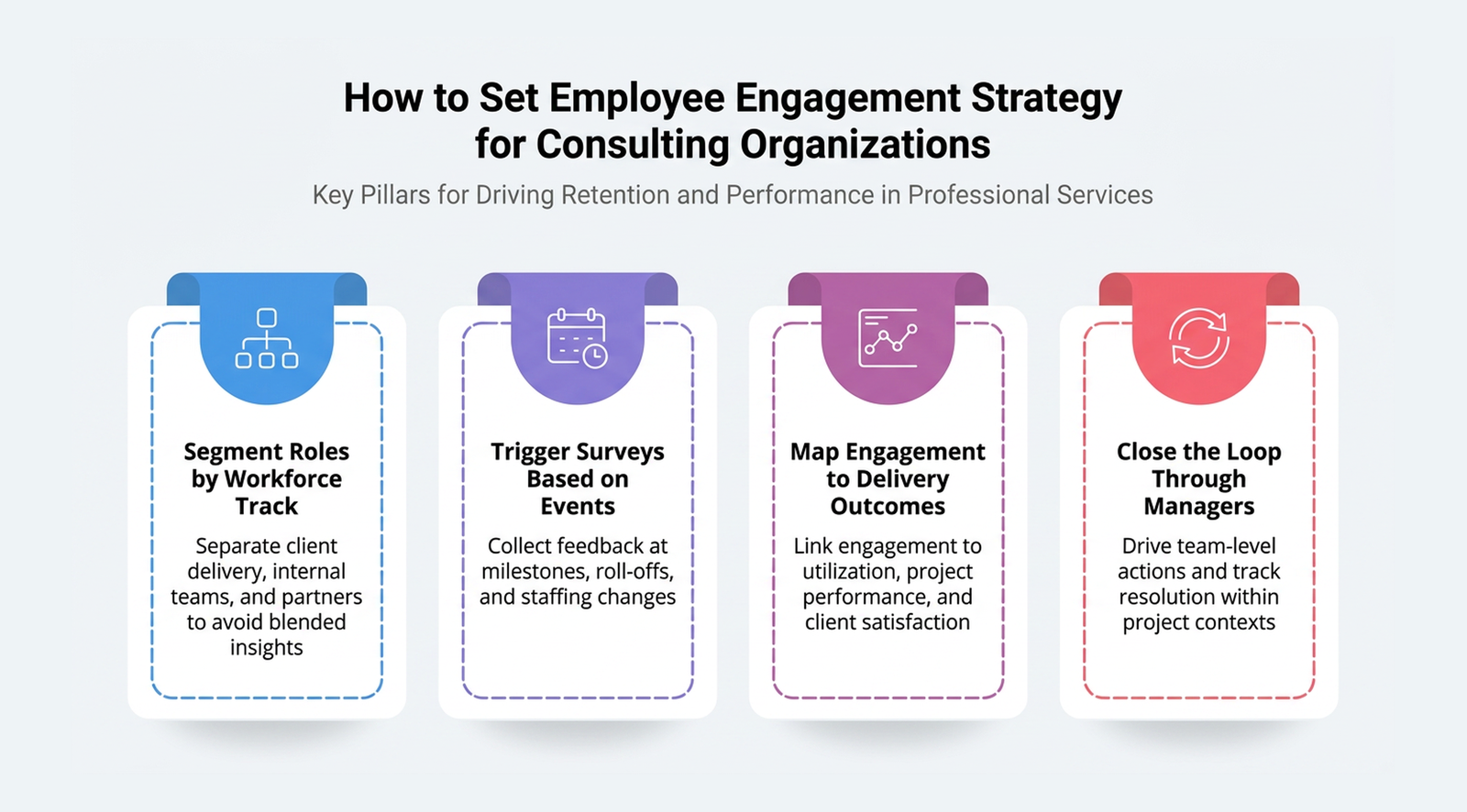
The Consulting Workforce Archetype Model becomes actionable through a four-layer operating model that connects segmentation, measurement, and action.
Segment roles by workforce track
Separate engagement measurement across client-delivery professionals, internal specialists, and partners to avoid blended, unusable insights.
Trigger surveys based on events, not schedules
Collect feedback at project milestones, roll-offs, and staffing changes instead of fixed survey cycles.
Map engagement metrics to delivery outcomes
Link engagement data to utilization, project performance, client satisfaction, and retention to make it decision-relevant.
Close the loop through manager-led actions
Convert insights into actions at team level and track whether issues are resolved within delivery contexts.
Engagement tools must support all four layers. Without segmentation, event triggers, outcome linkage, and action tracking, the model cannot be executed effectively.
How to engage client-delivery professionals?
Client-delivery professionals in consulting stay engaged when they get varied project exposure, visible career progression, and access to stretch work. Engagement for this group should be measured around staffing changes, milestone completion, and promotion readiness, not through generic recognition programs alone.
- Project variety and client challenge quality drive intellectual engagement: Consultants engage more when assigned to diverse projects with complex problem-solving, not repeated exposure to similar project types to encourage continuous improvement.
- Career acceleration visibility drives retention and performance: Engagement depends on clear signals of progression, including stretch roles, increased responsibility, supporting employees' professional development through training programs and visibility into promotion readiness.
- Cross-practice exposure expands capability and engagement: Exposure across domains builds broader expertise, knowledge sharing and prevents concentration in narrow delivery tracks and helps to build a supportive environment.
- Contribution to thought leadership reinforces professional identity: Opportunities to contribute to firm insights and intellectual capital by asking for employees' consistent feedback and valuable insights improve retention and continued performance.
This is central to consultant retention strategy as high performers leave when project exposure and growth signals decline.
(Source: CultureMonkey Benchmarks)
How to engage internal-facing specialists?
Internal-facing specialists in consulting firms stay engaged when their work is visibly connected to client delivery outcomes. Recognition, planning access, and outcome attribution matter more for these teams than billable metrics because their value is often indirect but operationally critical.
- The contribution-visibility gap reduces engagement for internal teams: Functions like finance, HR, IT, and marketing are less visible compared to billable consultants whose work is directly tied to revenue.
- Engagement depends on linking internal work to client delivery: Internal contributions must be mapped to project outcomes, showing how support functions influence delivery quality and timelines.
- Role dignity depends on recognition beyond billable metrics: Engagement must include recognition systems that value operational impact, not just revenue contribution.
- Visibility into decision-making increases engagement: Internal specialists engage more when included in planning, resourcing, and execution discussions tied to delivery.
Engagement systems must attribute internal contributions to specific projects or outcomes. Tools that cannot connect internal roles to delivery impact produce data that cannot guide decisions.
Employee Engagement by Patrick Lencioni
How to engage the partner tier?
Partner engagement in consulting firms depends on peer trust, institutional confidence, and autonomy over practice direction, and not participation metrics. Senior leaders disengage when strategy feels unclear or governance decisions bypass their input, and that misalignment cascades across teams quickly.
- Peer community drives partner-level engagement: Partners engage when peer groups enable shared decision-making and influence across practices.
- Institutional trust determines senior leader engagement: Engagement depends on confidence in firm direction, governance decisions, and long-term strategy.
- Autonomy over practice direction sustains engagement: Partners engage when they control how they build, position, and grow their practice areas.
- The senior engagement gap shapes firm culture from the top: Misalignment at the partner level cascades into inconsistent decisions, weak coordination, and fragmented culture across teams.
Engagement systems must capture alignment, trust, and decision influence at the partner level.
How to link employee engagement to client outcomes?

Linking engagement to client outcomes means connecting staff engagement data directly to client satisfaction, NPS, and repeat mandate rate. In consulting firms, engagement is a leading indicator of delivery quality and revenue continuity.
- Engagement scores predict client satisfaction: Teams with higher engagement with transparent communication deliver more consistent output quality, fewer errors, and stronger client interactions.
- Engagement levels influence client NPS: Engaged consultants communicate better, manage expectations clearly, and build stronger client relationships with high performance, improving NPS.
- Engagement drives repeat mandate rate: Clients are more likely to extend or renew work when delivery teams show employees work on consistency, ownership, and responsiveness.
- Low engagement creates delivery risk: Disengaged teams show delays, rework, and weaker coordination, directly affecting client outcomes.
This linkage defines the business case for engagement investment. Engagement systems must connect employee data with client metrics at project level.

Engagement occurs when workers trust leaders and feel an emotional connection to the organization – the same way they did their first day on the job.
Jill Christensen


Best-Selling Author & Keynote Speaker
Which engagement metrics matter in consulting firms?
Engagement metrics that matter in consulting firms are those that connect employee sentiment to utilization, delivery quality, client satisfaction, and retention outcomes. Unlike generic HR metrics, consulting engagement metrics must reflect how work is staffed, billed, and delivered and they must be captured at project level to be actionable.
Billable utilization rate
This shows whether engagement translates into productive, revenue-generating work. Sustained drops indicate disengagement, burnout, or poor staffing alignment before attrition appears.
Client satisfaction and NPS
This reflects how engagement shows up externally. Engaged consultants manage expectations better, communicate clearly, and build stronger client relationships, improving repeat business.
Project margin and delivery performance
This shows whether engagement is improving execution. Disengaged teams create delays, rework, and cost overruns, reducing profitability at the project level.
Staffing alignment and allocation efficiency
This shows whether the right consultants are placed on the right work. Poor alignment leads to disengagement, underperformance, and uneven utilization across teams.
Retention and internal promotion rates
This reflects whether engagement is sustaining the talent pipeline. Strong promotion velocity signals aligned engagement, while weak progression leads to exits.
These metrics must be connected at project level. Systems that do not link engagement data with utilization, staffing, and client outcomes cannot guide decisions.
How to measure consulting engagement metrics across project cycles?
These metrics must be measured at the right time to reflect real consulting workflows.
How to design a billing-cycle-aware engagement calendar?
A billing-cycle-aware engagement calendar aligns survey timing and engagement actions to project milestones, proposal seasons, staffing transitions, and fiscal year-end pressure. In consulting firms, timing is everything and feedback captured mid-project or at roll-off is far more accurate than input collected on a fixed quarterly schedule.
- Survey timing must avoid peak billing periods: Run pulses after delivery milestones or during bench periods to maintain response quality and coverage.
- Engagement timing must align with proposal seasons: During high proposal activity, reduce survey load and use short check-ins that do not disrupt delivery work to create an engaged workforce.
- Engagement actions must follow staffing transitions: Trigger feedback when consultants join or exit projects to capture accurate, experience-based input.
- Year-end pressure requires targeted engagement checks: Fiscal cycles affect workload, promotion expectations, and retention risk, requiring focused measurement.
Engagement timing should be event-based, not fixed. Project milestones, roll-offs, and proposal cycles should trigger measurement instead of quarterly schedules. Engagement systems must support these triggers, or critical signals will be missed.
How does consulting engagement compare with generic professional services engagement?
Consulting engagement is fundamentally different from broader professional services engagement in its focus, timing, and measurement. Consulting work is project-bounded, and outcome-linked, which means engagement must be designed around intellectual challenge, career visibility, and client delivery rather than operational efficiency or task completion.
What features should an engagement platform support for consulting firms?
An engagement platform for consulting firms must go beyond standard survey tools. It needs role-based segmentation, event-driven triggers, and outcome linkage to support the unique pressures of billable work, project delivery, and promotion-driven retention. The features below reflect what consulting environments actually require.
Role-based segmentation for consulting workforce engagement
The platform must segment data across client-delivery professionals, internal specialists, and partners. Without this, engagement signals cannot be acted on at role level.
Team-level analytics aligned to consulting delivery structures
Engagement must be measured across teams, practices, and business units that reflect how consulting work is delivered. This enables linkage between engagement, staffing, and delivery performance.
Event-driven survey triggers across consulting project cycles
Surveys must be triggered by milestones such as onboarding, roll-offs, and key delivery phases. Fixed schedules miss engagement shifts during active project cycles.
Multi-channel surveys for distributed consulting teams
Consultants and internal teams operate across locations and devices. Surveys must reach them through email, mobile, QR, and collaboration tools during active work cycles.
Anonymous feedback with adaptive thresholds in consulting teams
Consulting hierarchies require safe feedback mechanisms. Anonymity settings must adjust based on team size to maintain trust and response quality.
Manager dashboards with action workflows for delivery teams
Managers must receive role-specific insights tied to their teams, along with structured actions to address engagement issues within delivery contexts.
Action tracking and feedback closure for engagement programs
Engagement must move beyond data collection. The platform should track actions taken and show employees how feedback leads to changes.
Integrations with HRIS and collaboration tools in consulting firms
Engagement must integrate into systems such as HRIS, Slack, and Microsoft Teams to fit into daily consulting workflows.
Real-time engagement analytics and benchmarking for consulting firms
Leaders need access to current engagement data with comparisons across teams and time periods to identify risks early.
These features ensure engagement is embedded into consulting operations. Platforms that lack segmentation, event triggers, and action tracking cannot support consulting firm requirements.

Conclusion
An employee engagement strategy for consulting organizations must align with how consulting firms operate. Effective employee engagement strategies should include clear communication of goals and expectations. A consulting firm employee engagement strategy must be segmented, measurable, and tied to delivery and retention outcomes.
CultureMonkey enables this by supporting role-based segmentation, project-level insights, and event-driven surveys aligned to consulting workflows. Its dashboards connect engagement data to delivery signals, helping firms design and execute a high-impact employee engagement strategy for consulting organizations.

Book a demo with CultureMonkey.
FAQs
1. What is an employee engagement strategy for consulting organizations?
An employee engagement strategy for consulting organizations is a role-based system that aligns feedback, recognition, career growth, and measurement with billable work, project delivery, and promotion cycles. It helps firms improve retention, utilization stability, delivery quality, and client outcomes.
2. Why do generic engagement programs fail in consulting firms?
Generic engagement programs fail in consulting firms because they ignore utilization pressure, treat all roles the same, and measure sentiment without linking it to delivery outcomes. Consulting teams need short, timed, role-specific interventions tied to projects, staffing transitions, and client impact.
3. How should consulting firms measure employee engagement?
Consulting firms should measure employee engagement through short pulse surveys, project-based trigger checks, role-specific segmentation, and outcome links to client satisfaction, repeat mandates, attrition risk, and promotion readiness. Measurement should follow delivery events, not a fixed HR calendar.
4. What should be included in a consulting engagement calendar?
A consulting engagement calendar should include pulses after project milestones, check-ins during staffing changes, lighter touchpoints during proposal seasons, and focused reviews near fiscal year-end. It should avoid peak billing periods and use event-based triggers to capture feedback when context is fresh
5. How can internal specialists stay engaged in consulting firms?
Internal specialists stay engaged when firms make their contribution to client delivery visible, recognize operational impact beyond billable revenue, include them in planning decisions, and connect their work to outcomes. Engagement improves when support roles are seen as essential to delivery success.
6. What drives partner engagement in consulting firms?
Partner engagement in consulting firms depends on peer trust, influence over direction, and confidence in governance decisions. Senior leaders disengage when autonomy drops or strategy feels unclear. Measuring partner alignment helps firms catch cultural and operational risk before it spreads across teams.