



Employee engagement survey vendor comparison: The only scorecard you need

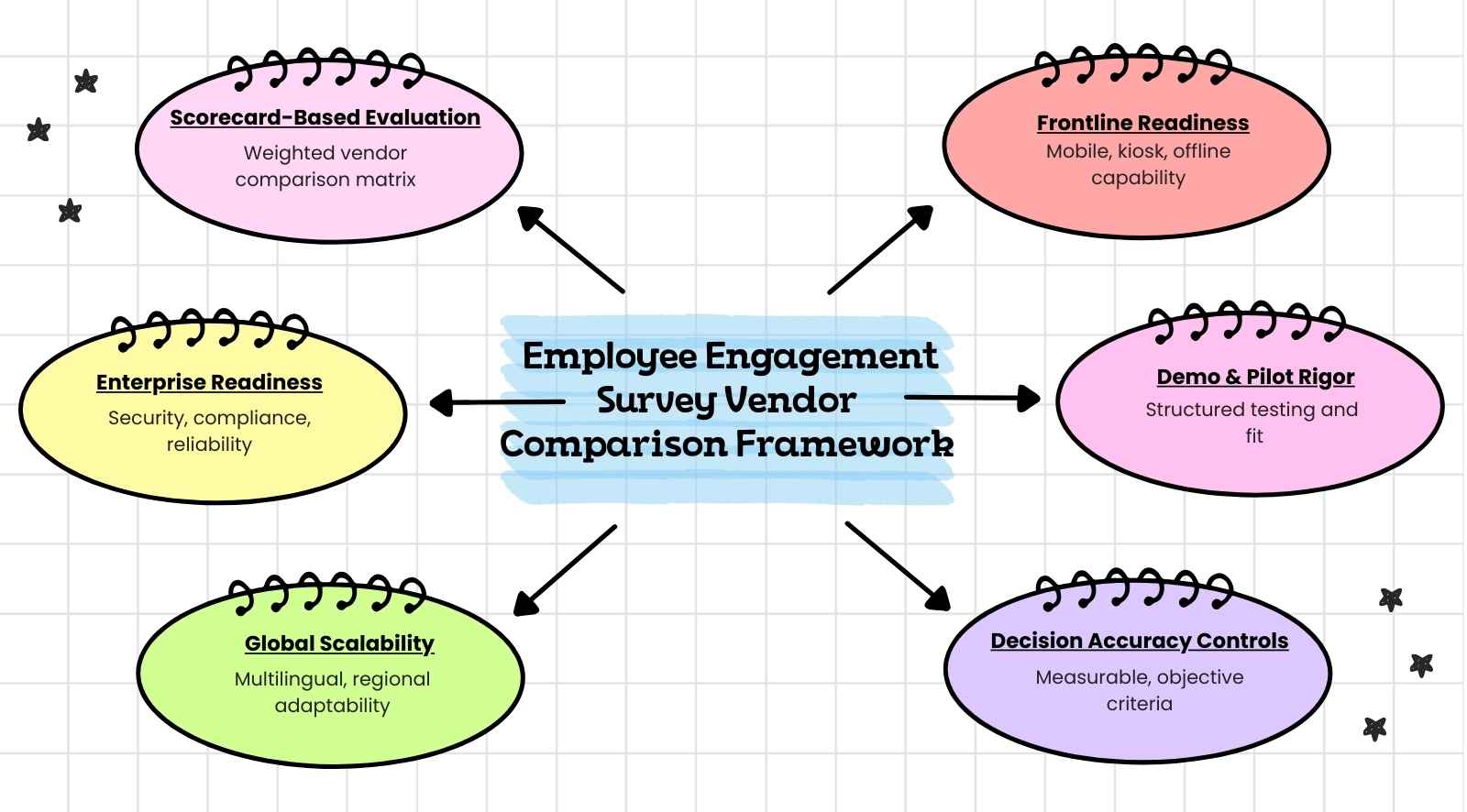
Choosing the right platform requires a structured comparison of employee engagement survey vendors that goes beyond feature lists and brand familiarity. Most vendors appear similar at first glance, yet differences in analytics depth, anonymity safeguards, action-planning workflows, and integration capabilities determine whether survey data translates into measurable outcomes.
Without a clear scorecard, decisions often rely on polished demos instead of operational fit. A disciplined comparison framework helps leadership teams evaluate enterprise readiness, global scalability, frontline accessibility, and security standards in a consistent way. The goal is not to pick the most popular vendor, but the one aligned to your listening strategy and long-term impact.


- What to compare in employee engagement survey vendors, how to score them, and how a weighted comparison matrix improves decision accuracy
- How to evaluate enterprise readiness, including security, compliance, access controls, and service reliability
- What defines global scalability, from multilingual delivery to regional compliance and localized analytics
- How to assess frontline readiness, including mobile access, offline capability, kiosk modes, and privacy-safe segmentation
- What to ask in demos and how to shortlist vendors using structured scorecards, pilots, and measurable fit criteria
What should you compare in an employee engagement survey vendor, and what can you safely ignore?

You should compare capabilities that directly influence data quality, insight depth, and execution support. Focus on survey design flexibility, analytics sophistication, anonymity controls, and integration strength. Deprioritize cosmetic dashboards and oversized question banks. The goal is measurable impact, not visual appeal.
- Survey design capability: Compare how employee engagement survey tools support scale types, branching logic, and driver models. Strong employee engagement survey companies offer validated frameworks, flexible customization, and structured pulse surveys that generate reliable employee feedback without survey fatigue.
- Analytics and insight depth: Evaluate how employee engagement survey providers transform survey data into actionable insights. Leading employee engagement tools provide heatmaps, trend comparisons, driver impact analysis, and segmentation filters that go beyond surface-level employee satisfaction scores.
- Action and accountability workflows: Assess whether employee engagement survey companies enable managers to convert engagement survey results into trackable action plans. The best employee engagement survey tools embed ownership, timelines, and follow-ups directly within the employee engagement survey platform.
- Anonymity and data governance: Validate anonymity thresholds, aggregation logic, and access controls across employee engagement survey vendors. Top employee survey companies clearly define visibility rules, ensuring employee feedback remains confidential while preserving analytical depth.
- Integration ecosystem: Review how employee engagement survey providers integrate with HRIS, SSO, Slack, and Teams. Strong employee engagement survey companies synchronize employee data seamlessly, reducing manual errors and ensuring survey data accuracy across systems.
- What to deprioritize: Cosmetic dashboards, oversized question banks, and inflated feature lists often distract from core impact. Employee engagement survey tools should be judged on insight quality and execution support, not visual polish alone.
What criteria should you use to score employee engagement survey vendors?

Use a structured framework that evaluates survey engine strength, analytics capability, action enablement, anonymity safeguards, and ecosystem integration. Each scoring category must connect to business outcomes such as participation rates, insight clarity, and follow-through. Clear criteria eliminate subjective decision-making.
- Survey engine strength: Evaluate how employee survey tools handle branching logic, multilingual delivery, and customizable survey templates. Strong employee engagement platform design supports diverse employee engagement survey questions and structured employee surveys without relying on rigid survey templates or limited free employee survey tools.
- Analytics and data analysis capability: Assess how employee engagement survey vendors convert survey responses into valuable insights. Leading engagement survey software comparison frameworks prioritize real-time dashboards, trend tracking, and driver-based data analysis that help measure employee engagement and strengthen workplace culture.
- Action enablement and follow-through: Review how the employee engagement platform supports managers in acting on employee sentiment. Strong employee survey tools embed goal tracking, accountability workflows, and structured feedback loops that connect employee experience data to measurable outcomes and more engaged employees.
- Anonymity and response integrity: Confirm how employee engagement survey vendors protect confidentiality while preserving reporting depth. Effective systems balance anonymity thresholds with meaningful segmentation, ensuring survey responses remain trustworthy and actionable across different layers of workplace culture.
- Integration and ecosystem alignment: Examine whether the employee engagement platform integrates with HR systems, collaboration tools, and reporting environments. Reliable integrations reduce manual effort, protect data consistency, and ensure employee surveys align seamlessly with broader employee experience programs.
How does a vendor comparison matrix help you choose the right platform?
A vendor comparison matrix standardizes evaluation across vendors. It assigns weighted importance to critical features, exposes capability gaps, and reduces demo-driven bias. This structure ensures decisions are based on measurable alignment rather than presentation quality or brand familiarity.
- Define critical criteria first: Start your employee engagement platform comparison by listing must-have capabilities across engagement survey vendors. Focus on how the best employee engagement survey tools support customized surveys, schedule surveys effectively, and align survey results with performance management and the employee lifecycle.
- Assign weighted importance: Not all features influence job satisfaction or company culture equally. In employee survey vendor evaluation, assign weights based on how strongly each capability helps gather employee feedback and boost employee engagement across different stages of the employee lifecycle.
- Score consistently across vendors: When you compare employee feedback platforms, apply identical scoring rules to each option. This ensures the best employee survey tools are judged on engagement data quality, survey results clarity, and the ability to support performance management consistently.
- Multiply score by weight: Structured calculations convert subjective opinions into measurable comparisons. This step strengthens employee engagement platform comparison by highlighting which employee engagement software delivers meaningful impact rather than surface-level features.
- Identify structural gaps early: A matrix exposes missing capabilities in engagement survey vendors before emotional bias forms. It clarifies whether employee engagement software can truly boost employee engagement or simply collect survey results without deeper insight.
- Use totals to reduce demo bias: Final weighted totals shift focus from polished presentations to data-backed evaluation. Strong employee survey vendor evaluation frameworks prioritize long-term company culture impact over short-term impressions.
How do you evaluate enterprise readiness in engagement survey software?
Enterprise readiness is determined by compliance certifications, access governance, audit trails, service reliability, and data retention controls. Vendors must demonstrate security maturity, scalable architecture, and documented operational safeguards before enterprise-wide deployment.
- Security and compliance foundation: Confirm employee engagement survey providers meet SOC 2, ISO 27001, and GDPR standards. In any employee survey software features comparison, strong data protection ensures employee data remains secure across global organizations and supports safe, continuous feedback cycles.
- Access control and identity management: Review SSO, SAML, and OAuth capabilities alongside role-based permissions. An effective engagement survey vendor checklist verifies that survey tools restrict sensitive data access while still enabling HR teams to boost engagement responsibly.
- Auditability and reporting governance: Examine audit trails that track report access and data exports. Enterprise-ready survey tools must document how engagement features are used, especially when survey results inform performance reviews and professional growth discussions.
- Service reliability and SLA clarity: Evaluate uptime guarantees, response times, and escalation policies. A strong employee engagement tool comparison guide prioritizes dependable infrastructure that supports continuous feedback without disruption during high-response survey cycles.
- Data retention and lifecycle control: Validate configurable retention settings that align with employee data policies. Enterprise systems should support long-term storage controls while enabling continuous improvement across different phases of the employee lifecycle.
What makes an engagement survey vendor globally scalable?

Global scalability requires multilingual delivery, localized analytics, time-zone-aware scheduling, regional data hosting, and compliance across jurisdictions. A scalable platform maintains consistent standards while adapting to regional legal and operational requirements.
- Multilingual survey delivery: In pulse survey vendor comparison, verify native language support across survey creation, dashboards, and reports. A scalable engagement platform must handle customizable survey logic while preserving key engagement drivers and anonymous feedback across diverse employee populations.
- Localized analytics and key driver analysis: Employee listening platform comparison should examine whether key driver analysis adapts by geography. Strong key features include region-specific benchmarks, culturally tuned question phrasing, and employee insights that reflect how employees feel within different market contexts.
- Time-zone aware scheduling: Global systems must automate survey creation and exit surveys based on regional calendars. Reliable engagement platform design ensures employees feel respected when pulse surveys launch during appropriate working hours, supporting better employee performance outcomes.
- Regional data hosting and industry standards compliance: Assess data residency controls and adherence to industry standards in each jurisdiction. Scalable platforms protect anonymous feedback while aligning with legal expectations that influence HR management practices worldwide.
- Cultural adaptability in survey design: Compare how tools approach cultural nuance versus rigid frameworks. A strong engagement platform supports customizable survey structures that reflect local norms while maintaining consistent employee insights across global teams.
How do you assess frontline readiness in engagement survey platforms?
Frontline readiness depends on accessibility, connectivity tolerance, flexible distribution methods, and privacy protection at the shift level. Platforms must support mobile-first design, offline capability, kiosk modes, SMS access, and secure segmentation to drive participation in operational environments.
- Mobile-first accessibility: A user-friendly platform must allow teams to create surveys and respond easily on personal devices. Strong engagement tools enhance engagement by reducing friction, supporting employee well-being, and improving engagement metrics tied to employee retention.
- Offline and low-bandwidth support: Frontline environments often lack stable internet. Enterprise-ready platforms should support secure offline or low-bandwidth data capture with reliable sync protocols. This ensures turning employee feedback into reliable benchmarking data without disrupting daily operations.
- Kiosk and shared device mode: A practical employee feedback tool comparison checks whether shared terminals protect anonymity. Secure kiosk access helps streamline HR processes while preserving accurate engagement metrics and meaningful advanced analytics for leadership.
- SMS and QR distribution: Effective engagement tools must support quick participation through text links and QR codes. These channels enhance engagement by meeting employees where they are and improving employee retention through consistent feedback loops.
- Shift-level segmentation with privacy: Advanced analytics should segment engagement metrics by shift without identity exposure. This strengthens benchmarking data, supports employee well-being initiatives, and helps enterprise engagement survey vendors convert feedback into targeted action.
What questions should you ask in a demo to reveal real product capability

Ask questions that test operational reality rather than surface features. Focus on anonymity enforcement, action planning workflows, data sync resilience, driver validation methodology, segmentation flexibility, and implementation timelines. Require live demonstrations instead of slide explanations.
1. How is anonymity protected in small teams?
Ask vendors to show threshold logic inside reporting tools, not slides. Strong systems protect work-life balance and trust, proving the employee experience platform supports a productive workforce without compromising sensitive data.
2. Can managers build action plans live?
Request a real walkthrough inside the dashboards. This reveals whether the employee experience platform connects survey insights to HR processes and other key metrics that influence performance and long-term engagement.
3. What happens if data sync fails mid-cycle?
Test how reporting tools handle disruptions. Vendors with a proven track record demonstrate recovery workflows that protect enterprise survey programs from operational breakdowns.
4. How are engagement drivers validated?
Ask for methodology details and sample outputs. A serious employee experience platform links driver models to other key metrics that shape a productive workforce and measurable outcomes.
5. Can you show live segmentation filters?
Insist on real-time filtering within reporting tools. This demonstrates whether the employee engagement survey vendor comparison checklist for HR leaders captures depth beyond surface metrics.
6. What is the realistic launch timeline?
Request a step-by-step breakdown of implementation. Vendors with a proven track record align rollout plans with HR processes and minimize disruption to work-life balance.
How do you shortlist employee engagement survey vendors using a structured scorecard?
Shortlisting requires eliminating non-compliant vendors, applying weighted scoring, validating capabilities through controlled pilots, and comparing measurable outcomes. Final selection should reflect operational fit, governance strength, and long-term execution capability, not brand recognition.
- Set hard fail gates: Remove vendors that cannot meet your security, anonymity thresholds, or required reporting access. This step protects trust and prevents unusable results later. Document the minimums so legal, IT, and HR sign off once, not repeatedly.
- Weight what matters: Assign importance scores to criteria like survey engine depth, analytics, action workflows, and integrations. Weighting stops “nice-to-have” features from dominating. It also reflects your reality, whether you run quarterly census surveys or frequent pulses across sites.
- Score consistently: Use the same definitions for every vendor, and insist on live proof during demos. Consistent scoring reduces bias and makes vendor notes comparable. If a feature is “coming soon,” score it as missing unless it exists today.
- Pilot with real segments: Run a controlled pilot that mirrors your org’s complexity, including locations, roles, and manager layers. Measure completion rates, comment quality, and time-to-insight. A pilot exposes friction in distribution, reporting, and action planning fast, too.
- Compare outcomes, not slides: Judge vendors on what the pilot produced: clarity of drivers, usefulness of insights, and ease of follow-through. This contrast reveals which tools help managers act, versus tools that generate charts. Keep screenshots and exports as evidence.
- Decide with measurable fit: Use weighted totals to rank finalists, then sanity-check against curated vendor lists and references. Select the vendor that matches your use cases and operating model. Brand familiarity is not a success metric; adoption and action are.
Conclusion
An effective employee engagement survey vendor comparison is critical because the platform you choose shapes how your organization listens, decides, and acts. The right evaluation framework ensures survey data turns into clear insights, accountable action plans, and measurable cultural improvement. Without structured comparison, organizations risk investing in tools that generate reports but fail to drive change.
CultureMonkey supports this decision process by delivering strong analytics depth, anonymity safeguards, action workflows, and scalable deployment across enterprise, global, and frontline environments.
CultureMonkey's structured listening approach helps organizations move beyond collecting feedback to building consistent, data-driven engagement strategies that sustain long-term impact.
FAQs
1. What is an employee engagement survey vendor comparison?
An employee engagement survey vendor comparison is a structured method to evaluate and score platforms based on analytics depth, anonymity safeguards, action workflows, integrations, and scalability, ensuring survey data translates into measurable business outcomes rather than surface-level reporting.
2. Why do you need a structured scorecard to compare engagement survey vendors?
A structured scorecard standardizes decision-making by applying weighted criteria to every vendor. It reduces demo bias, eliminates subjective judgment, and ensures platforms are evaluated on operational fit, security maturity, and action enablement instead of brand recognition or presentation polish.
3. Which features matter most when evaluating employee engagement survey software?
The most important features include flexible survey design, strong anonymity controls, seamless integrations, and built-in action planning workflows. These capabilities determine insight clarity and whether employee feedback can translate into measurable improvements across teams and organizational levels.
4. How do you assess enterprise readiness in engagement survey platforms?
Enterprise readiness requires reviewing compliance certifications, SSO capability, role-based access controls, audit trails, SLA commitments, and data retention policies. These safeguards ensure secure, scalable deployment and protect employee data across complex organizational structures and regulatory environments.
5. What makes an engagement survey vendor globally scalable?
Global scalability depends on multilingual delivery, localized analytics, time-zone-aware scheduling, regional data hosting, and jurisdictional compliance. A scalable platform maintains consistent data standards while adapting to regional legal requirements and operational realities across international teams.
6. How can you test a vendor’s real capability during a product demo?
Test capability by requesting live demonstrations of anonymity thresholds, segmentation filters, action planning workflows, data synchronization handling, and implementation timelines. Avoid slide explanations and validate features directly within the product to ensure operational reliability.
7. What is the most reliable way to shortlist employee engagement survey vendors?
The most reliable method is to eliminate vendors that fail non-negotiables, apply weighted scoring criteria, run controlled pilots with real employee segments, compare measurable outcomes, and select the platform that demonstrates the strongest operational alignment.